Your Trusted Vitamin C Serum Manufacturer
We help skincare brands develop market-ready products with reliable formulations, professional packaging, and scalable manufacturing support—so you can launch confidently and grow your product line with a stable supply chain.


Private Label Vitamin C Serum
At Metro Private Label, we see Vitamin C Serum as more than a standard brightening product. For brands, the real challenge is choosing a formula direction that customers can understand quickly and use consistently. That may mean a high-potency Vitamin C + E + Ferulic Acid serum, a brightening formula for dark spots and uneven tone, a gentler hydrating serum for sensitive skin, or an anti-aging formula focused on firmness and fine lines. In this category, the Vitamin C form, concentration, supporting ingredients, packaging, and stability all need to work together.
From what we see across Google Shopping, Amazon, Shopify, clinics, and professional beauty channels, demand is concentrated in four clear product directions: Brightening and Dark Spot Care Vitamin C Serum, High-Potency Vitamin C + E + Ferulic Acid Serum, Gentle and Hydrating Vitamin C Serum for Sensitive Skin, and Anti-Aging and Firming Vitamin C Serum. These types reflect how consumers search for Vitamin C products and how experienced brands create a clear selling point instead of launching another generic serum.
We help brands turn these market directions into production-ready products. This includes selecting the appropriate Vitamin C system, adjusting texture and skin feel, evaluating oxidation and packaging risks, and coordinating bottles, labels, cartons, and e-commerce packaging. We also prepare supporting documents such as the INCI list, COA, SDS, and product specifications. Our goal is practical: to help you develop a Vitamin C Serum that is clearly positioned, stable in production, suitable for your target market, and ready for real sales channels.

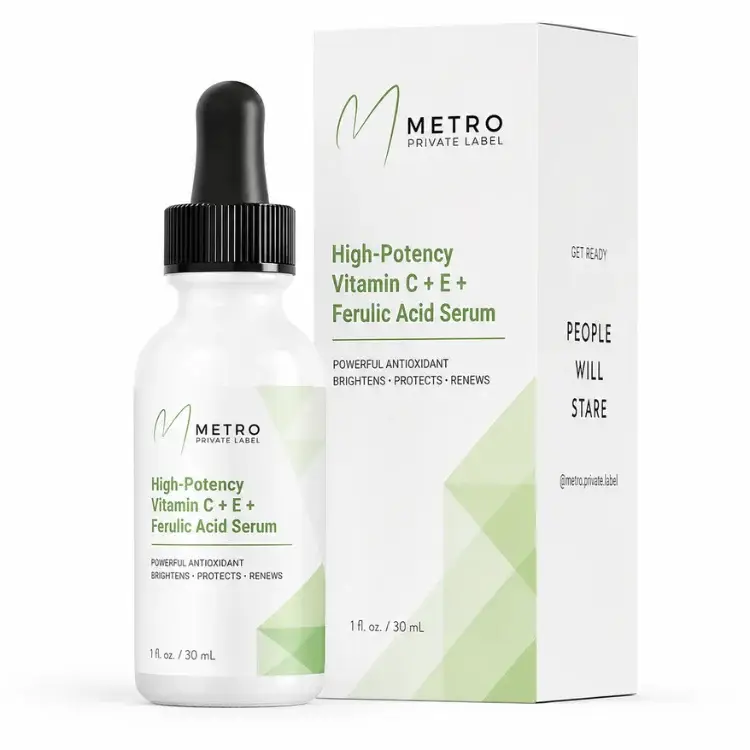
High-Potency Vitamin C + E + Ferulic Acid Serum
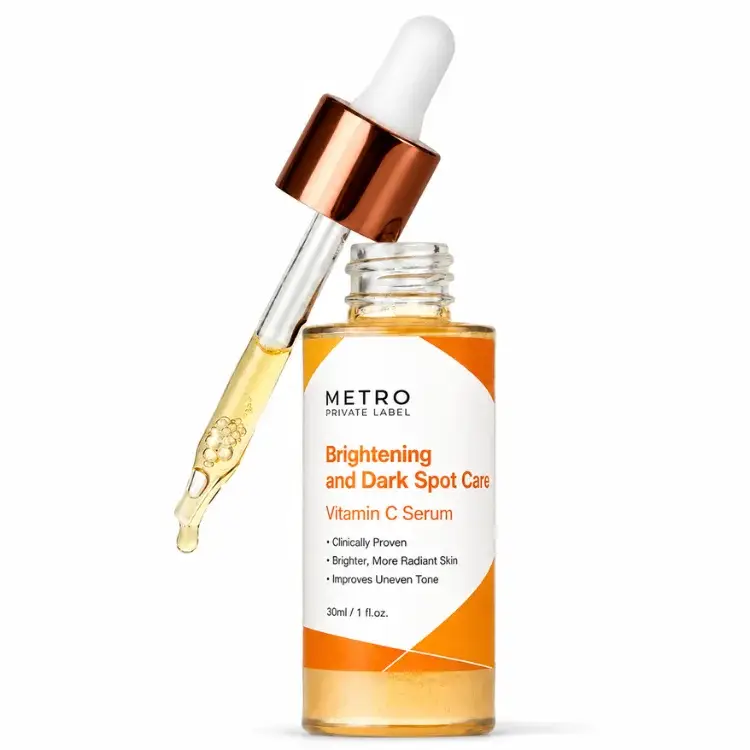
Brightening and Dark Spot Care Vitamin C Serum
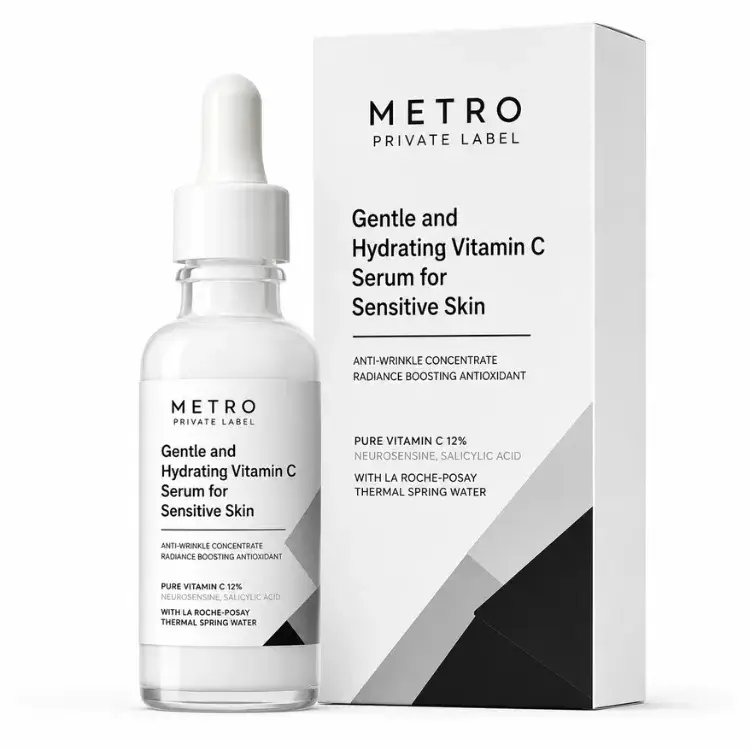
Gentle and Hydrating Vitamin C Serum for Sensitive Skin
Bakuchiol Clarifying Serum for Acne-Prone Skin
Build a Private Label Vitamin C Serum Line That Fits Today’s Market
If you’re looking for a private label Vitamin C Serum manufacturer, you’re probably already beyond the stage of simply researching popular ingredients. In most cases, you already have a sales channel, an existing skincare range, or a clear plan to add a brightening, antioxidant, or anti-aging serum. That may be for Amazon, Shopify, TikTok Shop, a distribution network, or a professional clinic channel.
In this category, success is not about placing “Vitamin C” on the front label and choosing the highest possible percentage. The real challenge is building a formula with a clear reason to buy, while making sure the Vitamin C system, supporting ingredients, texture, packaging, cost, and stability all fit together.
From what we see across Google Shopping, Amazon, e-commerce brands, and professional skincare channels, customers usually choose Vitamin C Serum for four main reasons: stronger antioxidant care, visible brightening and dark spot positioning, gentler daily use for sensitive skin, or a more complete anti-aging and firming routine. The products that perform best are not built around concentration claims alone. They are built around a clear consumer, a clear skin concern, and a formula story that can be understood quickly.
That is also how we approach product development. We do not begin by asking only which ingredients you want to add. We first look at your sales channel, target consumer, intended retail price, product claims, packaging preference, and competitor references. From there, we help define the Vitamin C form, concentration range, supporting active system, texture, packaging format, and documentation requirements.
The goal is not only to make a formula that can be produced. It is to create a product that is practical to position, market, deliver, and reorder.
Our 4 Core Private Label Vitamin C Serum Concepts
Brightening and Dark Spot Care Vitamin C Serum
This direction is developed for brands targeting dullness, uneven-looking skin tone, post-acne marks, and visible dark spots. Depending on the intended market and formula positioning, the concept may combine a stable Vitamin C derivative with ingredients such as niacinamide, alpha-arbutin, licorice extract, glutathione, or hydrating support.
This is one of the broadest commercial directions because the consumer benefit is easy to understand. It works particularly well for Amazon, Shopify, TikTok Shop, mass-premium skincare brands, and distributors looking for a recognisable hero serum.
High-Potency Vitamin C + E + Ferulic Acid Serum
This concept is designed for brands seeking a stronger antioxidant and premium active-skincare position. It is commonly associated with L-Ascorbic Acid, Vitamin E, and Ferulic Acid systems, often supported by hydration or soothing ingredients.
The important part is not simply increasing the Vitamin C percentage. High-potency formulas require closer attention to pH, oxidation, colour changes, packaging, storage, and consumer tolerance. This direction is better suited to experienced skincare brands, professional channels, and buyers who understand the development requirements of a high-strength formula.
Gentle and Hydrating Vitamin C Serum for Sensitive Skin
This direction is created for consumers who want the benefits of Vitamin C but are concerned about stinging, dryness, redness, or aggressive low-pH formulas. It normally uses a stable Vitamin C derivative together with ingredients such as hyaluronic acid, panthenol, ectoin, centella, beta-glucan, or ceramide-support systems.
The positioning focuses on comfortable daily use rather than maximum strength. It is particularly suitable for sensitive-skin brands, clinics, fragrance-free product lines, first-time Vitamin C users, and brands building around barrier-care concepts.
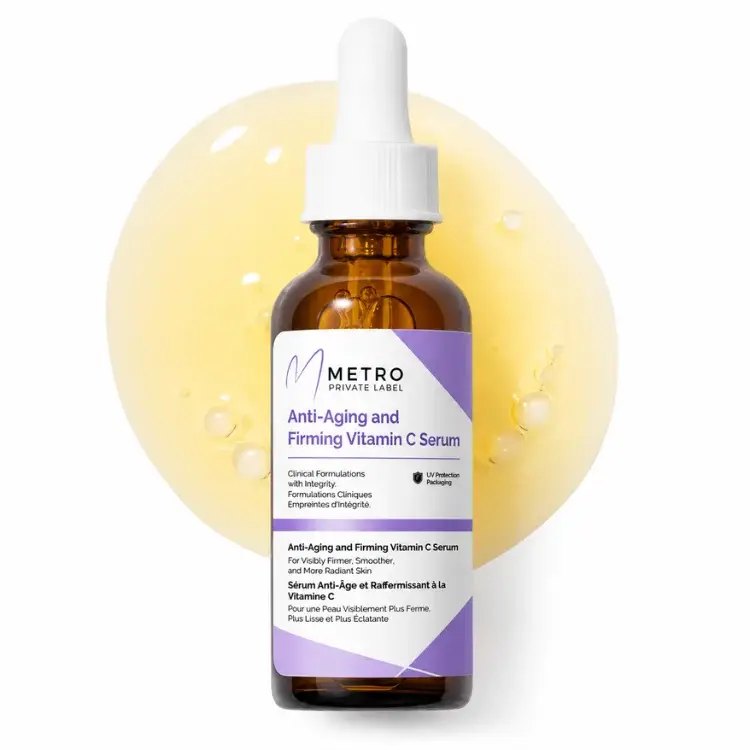
Anti-Aging and Firming Vitamin C Serum
This concept combines Vitamin C with ingredients selected for firmness, fine-line, hydration, and mature-skin positioning. Depending on the product strategy, this may include peptides, Vitamin E, hyaluronic acid, ectoin, ceramides, coenzyme Q10, or other compatible anti-aging ingredients.
It is suitable for premium skincare brands, aesthetic clinics, mature-skin ranges, and businesses looking to build a more complete anti-aging routine rather than launch a basic brightening serum.
Manufacturing That Supports Real Brand Growth
We understand that choosing a manufacturer is not only about finding a factory that can fill serum into bottles. You need a partner who understands how formula stability, packaging, compliance documents, target cost, and production timing affect the final commercial result.
Vitamin C products require more attention than many standard hydration serums. The selected Vitamin C form may influence the formula pH, colour, odour, skin feel, packaging choice, and shelf-life expectations. A product may look good during the first sample review but still require proper stability and packaging evaluation before it is ready for commercial production.
For standard dropper bottles, pump bottles, and serum packaging, our production MOQ normally starts from approximately 1,000 units per SKU. This is suitable for brands testing a new product direction, expanding an existing range, or preparing an initial commercial launch.
For customised bottle moulds, special colours, printing, electroplating, gradient spraying, or premium surface finishes, the final MOQ depends on the packaging supplier and the selected manufacturing process.
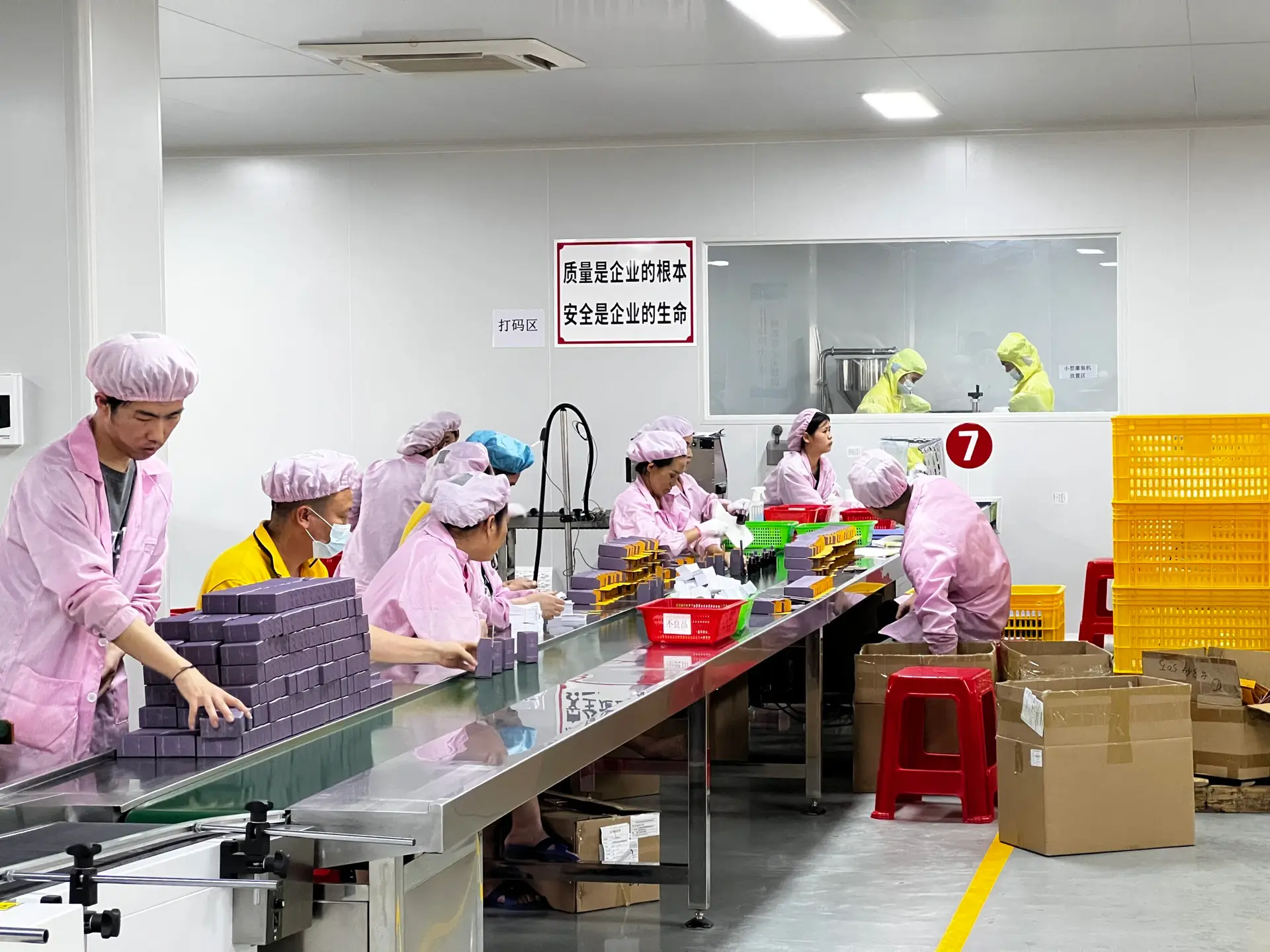
Before mass production, we help organise the complete development process, including formula direction, sample adjustments, skin feel, packaging compatibility, artwork information, and supporting documents such as the INCI list, COA, SDS, and product specifications. We can also provide practical label-review support based on the intended market, while clearly identifying which registrations, claims, and compliance responsibilities remain with the brand or its local responsible party.
Our goal is straightforward: to help you launch a Vitamin C Serum with a clear market position, realistic cost structure, stable production quality, and enough differentiation to compete in real e-commerce, clinic, distribution, and retail channels.

More Than Just a Private Label Vitamin C Serum Manufacturer
At Metro Private Label, we help you turn a Vitamin C Serum idea into a product that is easier to launch, easier to sell, and easier to scale.

Launch Faster with a Clear Product Direction
We help you choose a Vitamin C Serum concept that fits your sales channel, target customer, and retail price, so you can move into sampling and quotation without wasting time on unclear formula ideas.
Reduce Product and Packaging Risks
We match the Vitamin C system with suitable packaging, texture, and production requirements to reduce common problems such as oxidation, colour changes, leakage, pilling, and poor skin feel.
Create a Product Customers Want to Reorder
We focus on absorption, comfort, consistency, and daily usability—not only the ingredient list. This helps you build a serum that supports better reviews, repeat purchases, and long-term brand value.
Scale with One Manufacturing Partner
We coordinate formula development, bottles, labels, cartons, production, and supporting documents through one process. You spend less time managing different suppliers and can reorder more efficiently as sales grow.
Build a Private Label Vitamin C Serum Line That Fits How Customers Shop Today
At Metro Private Label, we do not believe a successful Vitamin C Serum starts by adding a popular ingredient to a standard formula. It starts by understanding why your customers are buying Vitamin C and what makes them choose one serum over another.
Some consumers want a high-potency antioxidant serum. Others are focused on dark spots and uneven-looking skin tone, need a gentler formula for sensitive skin, or want an anti-aging serum for fine lines and firmness. Each direction requires a different Vitamin C system, supporting ingredients, texture, packaging format, and retail position.
That is why our work goes beyond following a basic product brief. We help you turn your initial idea into a product that is easier for customers to understand, easier for your team to market, and more practical to manufacture and reorder.
Developed Around Real Market Demand
We develop Vitamin C Serum concepts around the way consumers already search, compare, and purchase products across Google, Amazon, Shopify, TikTok Shop, clinics, and retail channels.
The four directions with the clearest commercial logic are Brightening and Dark Spot Care Vitamin C Serum, High-Potency Vitamin C + E + Ferulic Acid Serum, Gentle and Hydrating Vitamin C Serum for Sensitive Skin, and Anti-Aging and Firming Vitamin C Serum.
These concepts are already familiar to consumers, which makes them easier to communicate through product pages, advertising, packaging, and sales materials. We then adapt the selected direction around your target customer, sales channel, intended retail price, ingredient preferences, and competitor references.
Instead of giving you another generic Vitamin C Serum, we help you build a product with a clearer reason to buy.
Packaging and MOQ That Match Your Launch Strategy
We plan packaging around how you intend to sell the product, not only around what is convenient for production.
For Amazon and other e-commerce channels, bottle sealing, leakage prevention, shipping durability, and carton size can directly affect returns, fulfilment costs, and customer reviews. For premium DTC brands and clinics, an airless pump, heavier bottle, protective coating, or more refined finish may support a stronger professional image and higher retail price.
Vitamin C formulas may also require greater protection from light, oxygen, and repeated exposure during use. We therefore consider the selected Vitamin C form, formula stability, dispensing system, and packaging compatibility together rather than treating the bottle as a separate decision.
For many standard serum bottles, droppers, and pump formats, production normally starts from approximately 1,000 units per SKU. Custom colours, printing, spraying, electroplating, moulds, and special decorative finishes may require higher packaging quantities.
Before you commit to production, we help compare the available options and explain how each decision may affect cost, lead time, appearance, formula protection, and future replenishment. This helps you avoid overspending on an initial launch or selecting packaging that becomes difficult to reorder when sales grow.
A Manufacturing Process You Can Plan Around
We understand that launching a skincare product involves much more than approving a sample. Formula development, packaging sourcing, artwork preparation, supporting documents, production scheduling, and shipment planning all depend on one another.
We keep the project structured by moving through product positioning, formula selection, sampling, adjustments, packaging confirmation, artwork review, production preparation, quality checks, and shipping coordination.
Throughout the process, we clarify what stage the project has reached, what information is still required, and which decisions may affect the final price or launch date. This reduces repeated communication and helps prevent last-minute problems with packaging, labels, or production planning.
Depending on the project, we can also prepare supporting information such as the INCI list, COA, SDS, and product specifications. We can review practical label information for the intended market, while clearly identifying any testing, registration, claim substantiation, or local compliance work that still needs to be completed by the brand or its responsible party.
Many clients initially approach us expecting only a formula and quotation. What they often gain is a clearer development path, better visibility into the supply chain, and practical guidance that helps them avoid expensive mistakes before mass production begins.
Supporting Long-Term Brand Growth
We do not view a Vitamin C Serum as an isolated production order. For many brands, it can become a hero product that supports a broader brightening, antioxidant, sensitive-skin, or anti-aging range.
Once the first serum has been validated in the market, we can help you plan complementary products such as gentle cleansers, barrier-support moisturisers, eye serums, daily sunscreens, peptide creams, and nighttime treatments.
This allows you to expand around one recognised customer need instead of launching unrelated products without a clear range strategy. It can also simplify future formulation, packaging, marketing, and supplier management.
Our goal is not only to help you complete the first order. We want to help you develop a Vitamin C Serum that can earn repeat purchases, support future SKUs, and move into more stable production as your sales grow.
When your product performs well, your order volume grows and our partnership grows with it. That is why we approach every project with one practical question: how can we make this product easier for you to launch, easier for customers to understand, and easier to scale?
FAQs Vitamin C Serum
For your convenience, we’ve gathered the most commonly asked questions about our Vitamin C Serum . However, should you have any further queries, please don’t hesitate to reach out to us.
1. What types of private label Vitamin C Serum can you manufacture?
We manufacture four main commercial directions: Brightening and Dark Spot Care Vitamin C Serum, High-Potency Vitamin C + E + Ferulic Acid Serum, Gentle and Hydrating Vitamin C Serum for Sensitive Skin, and Anti-Aging and Firming Vitamin C Serum.
We can also adjust the concept around your sales channel, target consumer, competitor reference, intended retail price, and ingredient preferences.
2. Can you customise the Vitamin C formula for our brand?
Yes. We can adjust the Vitamin C form, concentration, supporting ingredients, texture, absorption, fragrance level, colour, and overall skin feel.
We normally begin by understanding what you want the product to achieve commercially. A serum developed for Amazon, for example, may need a different cost structure and packaging strategy from a premium clinic product.
3. Which form of Vitamin C should we use?
That depends on the positioning you want.
L-Ascorbic Acid is widely recognised and suitable for high-potency concepts, but it requires more attention to pH, oxidation, packaging, and consumer tolerance. Stable derivatives such as 3-O-Ethyl Ascorbic Acid, Ascorbyl Glucoside, or Sodium Ascorbyl Phosphate may be more suitable for gentle daily-use or sensitive-skin products.
We help you compare the options based on stability, cost, claims, target skin type, and packaging requirements.
4. What is your MOQ for private label Vitamin C Serum?
Our standard production MOQ normally starts from around 1,000 units per SKU when using commonly available serum bottles, droppers, pumps, or airless packaging.
Custom bottle colours, special printing, spraying, electroplating, moulds, or premium decorative finishes may require a higher MOQ. We confirm the final quantity after reviewing the formula and packaging specifications.
5. Do you offer ready formulas and fully customised formulas?
Yes, we support both development routes.
A ready-developed formula is usually faster and more cost-effective for distributors, first commercial launches, or brands testing a new SKU. A customised formula is more suitable when you have a specific competitor reference, ingredient system, skin feel, claim direction, or price position.
We help you choose the route that matches your budget and launch plan rather than pushing unnecessary custom development.
6. How long does sampling and production usually take?
Initial formula samples generally require around 7–10 working days after the product direction and sample requirements are confirmed.
Mass production normally takes approximately 25–35 working days after the formula, packaging, artwork, deposit, and production details have been approved. Custom packaging or additional testing may extend the schedule, so we review the timeline before production begins.
7. Can you help us select suitable packaging?
Yes. We can source and coordinate dropper bottles, pump bottles, airless packaging, labels, cartons, inserts, and shipping cases.
For Vitamin C Serum, we consider more than appearance. We also look at light protection, oxygen exposure, dispensing control, leakage risk, e-commerce transport, unit cost, and the ability to reorder the same packaging later.
8. What documents can you provide?
Depending on the project and confirmed product specifications, we can prepare documents such as:
- Full INCI ingredient list
- Certificate of Analysis
- Safety Data Sheet
- Product specification
- Manufacturing and quality documents
- Available factory certification information
The exact document package depends on the destination market, formula, order details, and any additional testing arranged for the product.
9. Can you support label claims and compliance preparation?
We can help review ingredient information, product directions, warnings, and practical label content based on the intended market. We can also provide ingredient highlights and realistic cosmetic benefit language for your marketing materials.
However, registrations, local responsible-person requirements, final legal review, and claim substantiation may still need to be completed by your brand or local compliance partner. We explain these responsibilities early so there is no misunderstanding later.
10. Can you support international shipping and repeat orders?
Yes. We work with international brands and can prepare the product and export documents required for shipment. Depending on your arrangement, we can also coordinate with your freight forwarder or introduce logistics providers familiar with cosmetic shipments.
For repeat orders, we keep the confirmed formula, packaging, artwork, and production specifications on record. This makes replenishment more efficient and helps maintain consistency as your sales volume grows.
We spoke with several manufacturers before choosing Metro Private Label, but they were the first team that asked about our customers and sales channel before discussing the formula. Their advice on product positioning, packaging, and launch planning helped us avoid expensive mistakes. The entire process felt practical, organised, and much easier than we expected.
Emily Carter, Founderfrom United Kingdom
As an Amazon seller, I needed a supplier that understood speed, documentation, and repeat production. Metro Private Label responded quickly, helped us refine the Vitamin C Serum concept, and provided the supporting documents we needed. Communication was straightforward, and the production timeline stayed on track.
Lucas Andersen, E-commerce Directorfrom Denmark
What stood out to us was that Metro Private Label never pushed the most expensive solution. They compared different packaging options, explained how each one affected cost and MOQ, and helped us choose what made the most commercial sense for our launch. That honesty gave us confidence to move forward.
Sophie Lambert, Purchasing Managerfrom France
We came to Metro Private Label with a rough product idea, but their team helped us turn it into something much more marketable. They explained the different Vitamin C systems, recommended packaging that suited our retail price, and guided us through sampling without making the process feel overwhelming.
Nathan Mitchell, Brand Managerfrom Australia
Our goal was to develop a professional Vitamin C Serum for our clinic rather than another generic skincare product. Metro Private Label understood that immediately. They helped us create a formula and packaging direction that matched our treatment philosophy, and the final product looked and felt consistent with the premium image we wanted to build.
Isabella Conti, Clinic Ownerfrom Italy






Metro Private Label in Numbers
Happy Clients
0 +
Million-dollar Buyers
0 +
Formulation
0 +
Professional Staffs
0 +
Your Ultimate Guide to Vitamin C Serum
If you’re planning to add a Vitamin C Serum to your product line—whether it’s your first brightening SKU, a new hero product for e-commerce, or an upgrade to an existing anti-aging range—you’re not simply following another ingredient trend. You’re entering one of the most recognised and commercially established categories in skincare. Consumers already understand Vitamin C in connection with radiance, antioxidant care, dark spots, and visible signs of ageing, which makes the category easier to market than many newer actives. When the formula is clearly positioned and comfortable to use, a Vitamin C Serum can become a daily routine product that supports repeat purchases rather than a one-time trend-driven sale.
Over the years, we’ve seen Vitamin C Serum develop into several distinct market directions across Amazon, Shopify, clinics, retail stores, and distributor channels. Some brands succeed with high-potency Vitamin C + E + Ferulic Acid concepts, while others perform better with dark spot care, sensitive-skin, hydrating, or anti-aging positioning. At Metro Private Label, we’ve seen that the products most likely to scale are not always those with the highest Vitamin C percentage or the longest ingredient list. They are the products where the Vitamin C form, texture, packaging, price structure, claims, and target customer have been planned together from the beginning.
This guide is based on what we’ve learned while helping brands move from an initial Vitamin C Serum idea to sampling, packaging selection, quotation, production, and repeat supply. Rather than focusing only on ingredient theory, we explain what actually happens behind a commercial Vitamin C Serum project. Choosing between pure Vitamin C and stable derivatives, controlling colour and odour changes, selecting packaging that protects the formula, defining a realistic concentration, managing MOQ and cost, and preparing the right documentation can all influence whether the product becomes a reliable seller or an expensive development problem.
Table of Contents
Why Are Brands Still Launching Vitamin C Serums in a Crowded Market?
Vitamin C Serum is one of the most competitive categories in modern skincare, yet I continue to see new brands, established retailers, clinic owners, and e-commerce operators invest in it. The reason is not simply that Vitamin C remains popular. The real attraction is that consumers already understand the category, while brands still have room to build more specific positions around skin concerns, usage experience, price level, and sales channel. In my experience, the opportunity is not in launching another general brightening serum. It is in identifying a clear commercial gap and developing the entire product around that gap.
The Search Is Really About Commercial Opportunity
When someone searches for a private label Vitamin C Serum manufacturer, I rarely assume they are still trying to understand whether Vitamin C is popular. Most serious buyers already know the market is crowded. They have reviewed products on Amazon, Google Shopping, independent brand websites, clinic platforms, and retail shelves. They are usually searching because they want to know whether there is still a commercially defendable position for their own brand.
This distinction matters because the search is not really about the ingredient. It is about market entry. A buyer may be preparing to launch a hero product, replace an underperforming supplier, extend an existing skincare range, or respond to customer demand for a familiar active. What they need from a manufacturer is not only a formula. They need help understanding whether the proposed product can be clearly positioned, realistically priced, consistently produced, and differentiated enough to justify its place in the market.
From what I have seen, brands continue to enter the Vitamin C category because it offers strong consumer recognition. However, that recognition only creates value when the brand can turn it into a focused reason to buy.
Consumer Familiarity Creates a Commercial Advantage
One of the strongest advantages of Vitamin C is that consumers already associate it with brighter-looking skin, antioxidant care, dullness, dark spots, and visible signs of ageing. I do not need to explain the basic ingredient story from the beginning in the same way I might with a newer or more technical active.
This familiarity can reduce the education burden across several channels. An e-commerce operator can communicate the main benefit more quickly through a product title, image, and advertisement. A distributor can present the category to retail buyers without introducing an unfamiliar concept. A clinic owner can recommend the serum as part of a morning routine or ongoing home-care programme without spending too much time explaining why Vitamin C belongs in skincare.
However, the same familiarity also creates pressure. Consumers have seen the same brightening and antioxidant claims many times. A product labelled simply as a “Vitamin C Brightening Serum” may be easy to understand, but it may not provide a convincing reason to choose one brand over another.
In my view, familiarity helps a product enter the conversation, but differentiation determines whether it earns attention, conversion, and repeat purchases.
A Generic Formula Is Easy to Produce but Difficult to Defend
I often receive product briefs that ask for Vitamin C, hyaluronic acid, niacinamide, and several botanical extracts in one serum. From a manufacturing perspective, this type of product may be possible. From a commercial perspective, however, it may be difficult to distinguish from dozens of similar products already available.
The underlying problem is usually not the ingredient list. It is the absence of a clearly defined customer, usage occasion, or market position. When a serum is developed for everyone, it often becomes especially meaningful to no one.
I also see brands trying to create differentiation by adding more trending actives. This can make the formula sound more impressive, but it can also weaken the product message. Consumers may see a long ingredient list without understanding what the product is primarily designed to achieve. The formula may also become more difficult to stabilise, more expensive to produce, and harder to position at a realistic retail price.
For this reason, I usually find that narrowing the product idea creates more commercial value than expanding it.
The Strongest Opportunities Come from Narrower Positioning
A Vitamin C Serum becomes easier to understand and defend when it is built around a specific customer need. I may work with one brand on a gentle daily-use serum for sensitive skin and another on a high-potency antioxidant formula built around Vitamin C, Vitamin E, and Ferulic Acid. These products belong to the same broad category, but they are not competing through exactly the same promise.
A dark spot-focused serum may require a different supporting ingredient system from a mature-skin firming serum. A lightweight formula designed to layer under sunscreen may need a different texture strategy from a richer clinic-positioned product. A mass-premium retail serum may need a more accessible cost structure, while a professional brand may be willing to invest more in packaging, active selection, and sensory experience.
In each case, the product direction influences the Vitamin C form, concentration, pH, supporting ingredients, packaging, claims, retail price, and development timeline. This is why I do not believe there is one universally correct Vitamin C Serum formula.
The most commercially useful formula is the one that supports a clearly defined position and remains realistic for the intended sales channel.
Sales Channel Changes What the Product Needs to Become
I always consider the sales channel before finalising a product direction because the same formula may perform very differently across Amazon, Shopify, clinics, and retail distribution.
An Amazon operator often needs a product with an immediately understandable benefit. The title, main image, review profile, price, and advertising cost all influence conversion. Packaging also needs to tolerate fulfilment handling and transport without leakage or breakage.
A Shopify brand may have more space to explain the formula story, but it may also need stronger differentiation in texture, ingredient system, packaging, and visual identity to support a higher retail price. The product experience becomes part of the brand story rather than only a functional purchase.
A clinic or aesthetic business may care more about professional presentation, skin tolerance, treatment compatibility, and how the serum fits into a wider home-care routine. A distributor may place more value on broad consumer recognition, stable production, repeat-order consistency, wholesale margin, and packaging availability.
When I understand how the product will be sold, I can make more practical decisions about formulation, packaging, MOQ, claims, and cost. Without this context, even a technically strong serum may be commercially mismatched.
The Product Must Solve a Specific Buying Problem
Before I discuss Vitamin C concentration, derivatives, peptides, botanical extracts, or decorative packaging, I ask one central question: why should a customer choose this serum instead of the hundreds of alternatives already available?
The answer cannot simply be that the product contains Vitamin C. That only identifies the category. A stronger answer might be that the serum provides high-potency antioxidant care in a lightweight texture, that it is designed for sensitive skin, that it supports a professional clinic routine, or that it offers dark spot positioning at a more accessible retail price.
Once this reason is clear, the rest of the development process becomes more disciplined. It becomes easier to decide which ingredients are essential, which ingredients are unnecessary, which packaging format is appropriate, which claims are realistic, and which costs are justified.
Without a clear buying reason, the project can easily become a collection of ingredients. With a clear buying reason, the formula, packaging, price, and marketing language begin to support the same commercial story.
Market Crowding Does Not Mean the Category Is Closed
I do not believe a crowded category automatically means there is no room for new products. It means the standard for entry is higher.
Vitamin C consumers are not one uniform group. Some want visible brightening. Some are concerned about sensitivity. Some want a stronger active product. Some prioritise texture, packaging, price, or professional recommendation. These differences create room for brands that understand their customer more precisely.
The market is crowded at the generic level, but it is less crowded when the product is built around a specific skin concern, customer profile, price point, or sales environment. A well-positioned clinic serum does not compete in exactly the same way as a low-cost marketplace product, even though both may contain Vitamin C.
From my perspective, the category remains commercially relevant because it combines strong consumer understanding with multiple possible product directions. The opportunity comes from choosing one of those directions deliberately.
Why Brands Continue to Invest in Vitamin C Serum
Brands continue to launch Vitamin C Serums because the category can support customer acquisition, repeat purchasing, bundling, and range expansion. A well-developed serum can become a hero product that introduces customers to the wider brand.
An e-commerce operator may use it to create bundles with a cleanser, moisturiser, or sunscreen. A clinic may include it in a morning routine or post-treatment support programme where appropriate. A distributor may use the serum as an accessible entry product before expanding into a broader brightening or anti-ageing collection.
I see the strongest long-term potential when the first Vitamin C Serum is not treated as an isolated SKU. Its customer group, retail price, packaging style, and benefit direction should leave room for future products that feel commercially connected.
The goal is not to enter the category simply because Vitamin C sells. The goal is to create a product with a clear role inside the brand and a reason for customers to return.
In my experience, brands are still launching Vitamin C Serums because the category remains familiar, commercially flexible, and capable of supporting several distinct market positions. The challenge is no longer proving that consumers want Vitamin C. The challenge is giving them a convincing reason to choose one product over another.
I therefore begin with the customer, sales channel, retail position, and buying motivation before discussing the final ingredient list. When those elements are aligned, the formula becomes more focused, the packaging decisions become more practical, and the marketing message becomes easier to communicate.
A crowded market does not remove the opportunity. It rewards brands that enter with greater clarity, stronger discipline, and a product built around a real customer need.
Which Vitamin C Serum Concept Fits Your Sales Channel?
The same Vitamin C Serum will not automatically perform equally well on Amazon, Shopify, TikTok Shop, in a professional clinic, or through a regional distributor. In my experience, one of the biggest mistakes brands make is choosing the formula first and thinking about the sales channel later. I prefer to reverse that process. I first look at where the product will be sold, how customers will discover it, what they will compare it against, what retail price the channel can support, and how quickly inventory may need to be replenished. Once these commercial conditions are clear, I can make much better decisions about the Vitamin C system, supporting ingredients, packaging, MOQ, target cost, claims, and development schedule.
Why I Start with the Sales Channel Before the Formula
When clients first contact me about developing a private label Vitamin C Serum, they often begin with an ingredient request such as “15% Vitamin C,” “Vitamin C + E + Ferulic Acid,” or a competitor product they want to reference. These are useful starting points, but they do not tell me enough to determine whether the final product will make commercial sense. I need to understand where the serum will actually compete. A formula designed for a price-sensitive Amazon category may need a very different cost structure from a premium serum sold through a clinic, while a Shopify brand may be able to invest more in texture, packaging, and differentiation because it has greater control over how the product story is communicated.
This is why I do not treat the sales channel as a marketing question that comes after formulation. I see it as part of product development itself. The channel influences how quickly the product benefit must be understood, how much differentiation is necessary, how much packaging customisation is commercially justified, what margin structure the brand needs, and how important rapid replenishment will become. When these factors are considered before sampling begins, the development process becomes much more focused and the risk of creating a technically good but commercially mismatched product is significantly reduced.
Amazon Needs a Product Customers Can Understand Immediately
For an Amazon-focused Vitamin C Serum, I usually prioritise clarity, recognisable demand, practical packaging, and a disciplined cost structure. Amazon shoppers can compare multiple products within minutes, so the product needs a benefit that is immediately understandable through the title, main image, concentration, price, reviews, and key claims. Concepts such as High-Potency Vitamin C + E + Ferulic Acid Serum or Brightening and Dark Spot Care Vitamin C Serum are easier to communicate than a complicated formula containing many ingredients with no obvious hero benefit. The formula still needs differentiation, but that differentiation must be simple enough for customers to understand quickly.
I also pay close attention to the economics behind the product because the manufacturing cost is only one part of an Amazon seller’s real cost. Fulfilment fees, advertising, storage, promotions, returns, and marketplace competition all affect profitability. Packaging must also survive fulfilment and transport without leaking, breaking, or generating unnecessary negative reviews. For this reason, I may recommend a reliable standard pump or well-sealed bottle over an expensive custom component if it gives the brand better margins, faster replenishment, and lower shipping risk. For Amazon, the strongest product is often not the most complicated one; it is the one that combines a clear selling point with reliable execution and enough margin to keep selling profitably.
Shopify Gives More Room for Product Differentiation
When I work with a Shopify or DTC brand, I usually have more room to develop a distinctive Vitamin C Serum because the brand controls more of the customer journey. Unlike a marketplace listing where products are compared side by side, a DTC website can explain why a particular Vitamin C form was selected, how supporting ingredients work within the concept, what the texture feels like, who the product is designed for, and how it fits into a wider skincare routine. This creates opportunities for more specific concepts such as a sensitive-skin Vitamin C Serum, a premium antioxidant system, or a targeted dark spot formula with a stronger ingredient story.
However, greater freedom also means the complete product experience needs to justify the positioning. I look more closely at texture, absorption, packaging, dispensing experience, visual identity, and how the serum connects with future SKUs. A premium bottle may help support a higher retail price, but I still consider its MOQ, lead time, shipping safety, and future availability before recommending it. I have seen brands invest heavily in beautiful packaging for the first production run only to discover that the same component requires a much larger quantity or a long replenishment cycle later. For Shopify brands, I therefore try to balance differentiation with scalability so the product can remain commercially practical as sales increase.
TikTok Shop Needs a Product That Is Easy to Demonstrate and Explain
For TikTok Shop, I think about how quickly the product can communicate its value through short-form content. Consumers may discover the serum through a creator rather than actively searching for a specific formula, which means the concept needs a simple and memorable reason to attract attention. Brightening, glow, dark spot care, lightweight hydration, or a visually appealing serum texture can often be communicated more naturally than a highly technical ingredient story. If a creator needs several minutes to explain why eight different actives are included, the product may be too complicated for the channel.
I also consider what happens if the product suddenly gains traction. TikTok demand can accelerate quickly, so a formula that depends on highly customised packaging with long production lead times may create a supply problem just when the brand begins to grow. I therefore look for a balance between visual appeal, content potential, production flexibility, and replenishment speed. The bottle should dispense cleanly on camera, the texture should look appealing when demonstrated, and the product story should be simple enough for different creators to communicate consistently without making unrealistic claims.
Clinics Need Professional Credibility and Comfortable Daily Use
When I develop a Vitamin C Serum for a clinic or aesthetic business, I approach the project differently because the product is often recommended within an existing professional relationship. The clinic may sell it as part of a home-care routine, alongside aesthetic services, or as part of a broader brightening, anti-ageing, or maintenance programme. In this environment, I usually place greater emphasis on tolerability, texture, fragrance level, layering, controlled dispensing, and professional presentation rather than simply pursuing the highest Vitamin C percentage available.
I also think about how easily clinic staff can explain and recommend the product. They need to understand who it is designed for, where it fits into the skincare routine, and why one customer may need a gentler formula while another may prefer a stronger antioxidant concept. A Gentle and Hydrating Vitamin C Serum may therefore create more commercial value for some clinics than an aggressive high-potency formula, particularly when the customer base includes people with different levels of skin sensitivity. In my experience, clinic products perform best when professional credibility, comfortable use, and clear routine integration work together rather than when the product relies on a single dramatic concentration claim.
Distributors Need Products That Are Easy to Sell and Easy to Reorder
A distributor or retail buyer usually evaluates a Vitamin C Serum from two perspectives at the same time: whether consumers will understand and buy the product, and whether the supply chain can support it consistently. They may be less interested in spending months developing a highly customised formula if an established product direction can reach the market faster with a competitive wholesale price. In many distributor projects, familiar concepts, standardised packaging, clear quantity-based pricing, reliable documentation, and predictable replenishment create more value than excessive customisation.
This is why I often recommend that distributors start with commercially established directions such as a Brightening and Dark Spot Care Vitamin C Serum or a recognisable antioxidant formula, then differentiate through selected ingredients, packaging presentation, or market positioning without making the supply chain unnecessarily complicated. I also pay close attention to whether bottles, pumps, cartons, and raw materials can be sourced consistently for repeat orders. A distributor may successfully place a product into multiple stores, but if the packaging disappears or the next production run requires a completely different MOQ, that success quickly becomes a supply problem. For this channel, repeatability is not simply an operational issue; it is part of the commercial value of the product.
Retail Buyers Need Clear Shelf Positioning and a Logical Price Point
For retail channels, I think about what happens when the Vitamin C Serum sits beside several competing products on a physical or digital shelf. Customers may only spend a few seconds comparing the product name, packaging, primary benefit, size, and price. This means the formula needs a clear commercial identity that can be communicated without requiring a long explanation. A product positioned around dark spots, sensitive skin, high-potency antioxidant care, or anti-ageing and firmness is generally easier to place within a retail assortment than a serum trying to communicate many unrelated benefits at once.
I also make sure that the formula, packaging, and price tell the same story. If the brand wants premium positioning, the sensory experience and packaging need to support that expectation. If the target is accessible mass-premium retail, an unnecessarily expensive active system or highly customised bottle may make the wholesale and retail margins difficult to maintain. Retail success depends on more than whether the formula is good; the buyer needs to understand where the product belongs, why consumers will choose it, and whether the price structure works throughout the distribution chain.
How I Match the Vitamin C Concept to the Commercial Model
I do not believe there is one Vitamin C Serum concept that is automatically best for every channel. A High-Potency Vitamin C + E + Ferulic Acid Serum may work well for an established active-skincare audience, while a Brightening and Dark Spot Care Serum may offer broader commercial appeal across e-commerce and retail. A Gentle and Hydrating Vitamin C Serum may be more appropriate for sensitive-skin brands and clinics, while an Anti-Aging and Firming Vitamin C Serum can support premium mature-skin positioning. The important point is that I do not choose between these concepts based only on which formula sounds most impressive.
I match the concept to the customer, channel, price structure, packaging expectations, and supply model. Once those factors are aligned, decisions about Vitamin C form, concentration, supporting ingredients, bottle type, MOQ, and claims become much easier to make. This also prevents brands from overinvesting in features that their channel does not reward while overlooking practical factors that directly affect profitability and repeat orders.
Final Perspective: Build for the Channel Where the Product Must Win
When I evaluate a private label Vitamin C Serum project, I always ask where the product must actually win. Amazon rewards immediate clarity, competitive economics, reliable packaging, and strong replenishment. Shopify gives brands more freedom to differentiate through formulation, storytelling, sensory experience, and packaging. TikTok Shop requires a concept that can be communicated visually and scaled when demand moves quickly. Clinics need professional credibility, comfortable use, and clear integration into skincare routines, while distributors and retailers place greater emphasis on familiar demand, margins, supply consistency, and repeatability.
Once I understand the sales channel, I can make much more informed decisions about the formula, packaging, MOQ, unit cost, claims, and development schedule. In my experience, this is far more effective than developing a Vitamin C Serum first and trying to find a market for it afterwards. The goal is not to manufacture one formula and sell it everywhere. The goal is to develop a product whose formula, price, packaging, and commercial logic naturally fit the channel where customers will actually discover, compare, buy, and reorder it.
How Should You Choose Between Pure Vitamin C and Stable Derivatives?
Choosing the right form of Vitamin C is one of the most important decisions I make when developing a private label Vitamin C Serum because “Vitamin C” is not one single formulation system. L-Ascorbic Acid and derivatives such as 3-O-Ethyl Ascorbic Acid, Ascorbyl Glucoside, Sodium Ascorbyl Phosphate, and Magnesium Ascorbyl Phosphate behave differently in a formula and can lead to very different decisions around pH, concentration, texture, packaging, stability, cost, and market positioning. I therefore never judge a Vitamin C Serum simply by the percentage printed on the label. I first look at what form of Vitamin C is being used, what type of product the brand is trying to build, and whether the complete formulation system supports that commercial objective.
Why a Higher Vitamin C Percentage Does Not Tell the Whole Story
One of the most common requests I receive is for a “15% Vitamin C Serum” or “20% Vitamin C Serum.” I understand why buyers start with these numbers. Percentage claims are highly visible in the market, easy for consumers to compare, and often associated with stronger performance. The problem is that a percentage has limited meaning until I know exactly which Vitamin C ingredient is being discussed. A serum containing 15% L-Ascorbic Acid is fundamentally different from a formula containing a Vitamin C derivative at another concentration, and those percentages should not be treated as directly interchangeable measures of product strength.
This distinction becomes particularly important when brands compare quotations from different manufacturers. Two suppliers may both quote a “10% Vitamin C Serum,” but one may be referring to L-Ascorbic Acid while another is referring to a derivative, a raw-material blend, or even the dosage of a premixed ingredient rather than the actual active content. The products may have completely different stability profiles, formulation costs, pH requirements, and marketing positions despite appearing similar on a quotation sheet. Whenever I evaluate a Vitamin C project, I therefore look beyond the headline percentage and clarify the exact INCI, raw-material composition, recommended use level, and role of the ingredient within the finished formula.
When L-Ascorbic Acid Makes Commercial Sense
L-Ascorbic Acid is the form many consumers recognise as pure Vitamin C, which gives it strong marketing value for brands targeting active-skincare users. It is commonly associated with high-potency antioxidant and brightening concepts, particularly formulas positioned around combinations such as Vitamin C, Vitamin E, and Ferulic Acid. If a brand already has an educated customer base that actively compares concentrations and ingredient systems, L-Ascorbic Acid can provide a clear and familiar product story.
However, I never recommend choosing L-Ascorbic Acid simply because “pure Vitamin C” sounds more powerful on the front of the packaging. Its formulation requirements need to match the brand’s commercial expectations. Water-based L-Ascorbic Acid systems typically require careful pH control and greater attention to oxidation, temperature, oxygen exposure, light, manufacturing conditions, and packaging. Consumer tolerance also needs consideration because the acidic environment used in certain formulations may not suit every skin type. For an experienced active-skincare brand, these trade-offs may be completely acceptable. For a brand seeking a very gentle daily serum, long distribution cycles, or highly flexible packaging, another Vitamin C system may make more practical sense.
Why Oxidation Changes the Development Strategy
Oxidation is one of the most important practical differences I discuss when a client is considering a pure Vitamin C formula. A product may look excellent when the first laboratory sample is prepared, but commercial success depends on what happens months later during production, international shipping, warehousing, retail storage, and repeated consumer use. Changes in colour or odour can quickly affect customer confidence, particularly in e-commerce where consumers compare their bottle with product images and may interpret visible darkening as evidence that the serum is old or defective.
For this reason, I evaluate the formula and packaging as one system rather than two separate purchasing decisions. The antioxidant system, chelating strategy, pH, raw-material quality, manufacturing controls, filling process, bottle protection, dispensing method, headspace, and expected storage conditions can all influence the final stability profile. A brand that chooses a high-potency L-Ascorbic Acid concept should therefore budget and plan for the additional formulation and packaging attention that this direction may require rather than treating stability as something that can be solved after the formula has already been approved.
When Stable Vitamin C Derivatives Become the Better Choice
Stable Vitamin C derivatives can offer greater formulation flexibility when the brand’s priority is not simply maximum concentration positioning. Ingredients such as 3-O-Ethyl Ascorbic Acid, Ascorbyl Glucoside, Sodium Ascorbyl Phosphate, and Magnesium Ascorbyl Phosphate each have different characteristics, but they can allow me to explore product concepts that may be more difficult to achieve with a traditional low-pH L-Ascorbic Acid system. This can be particularly useful for daily brightening, hydration-focused, sensitive-skin, mass-premium, or multifunctional serum concepts.
For example, if I am developing a Vitamin C Serum for a clinic with a broad customer base, I may place greater value on comfortable daily use and formula stability than on advertising the highest possible concentration. If I am working with an e-commerce brand targeting first-time Vitamin C users, a stable derivative may allow us to build a more approachable product story around radiance, hydration, and routine compatibility. The important point is that I do not treat all derivatives as one interchangeable category. Their solubility, pH preferences, recommended use levels, raw-material costs, formulation behaviour, and supporting evidence differ, so the specific derivative should be selected according to the complete product strategy.
Different Derivatives Serve Different Product Strategies
I often see “stable Vitamin C” used as if it describes one standard type of formula, but this can be misleading. 3-O-Ethyl Ascorbic Acid, Ascorbyl Glucoside, Sodium Ascorbyl Phosphate, and Magnesium Ascorbyl Phosphate are different ingredients, and I would not automatically substitute one for another simply because they are all Vitamin C derivatives. The choice can influence the formula architecture, pH range, texture, ingredient compatibility, cost, and the type of marketing story the brand can reasonably build.
This is why I prefer to work backwards from the intended product rather than forwards from an ingredient trend. If the goal is a lightweight daily brightening serum, I evaluate which derivative and supporting system best fit that experience. If the goal is a sensitive-skin product, I consider the complete tolerability profile rather than assuming that the word “derivative” automatically means non-irritating. If the product needs to reach a specific mass-premium retail price, I also consider whether the selected ingredient concentration leaves enough room in the cost structure for packaging, distribution margins, advertising, and repeat production. Ingredient selection is therefore both a formulation decision and a business decision.
Why Supplier Quotations Can Be Difficult to Compare
One of the biggest industry problems I see is that Vitamin C quotations can appear much more comparable than they really are. A buyer may receive three quotations labelled “Vitamin C Brightening Serum” with significantly different prices and assume that one factory is simply cheaper. In reality, the quotations may be based on completely different Vitamin C forms, active concentrations, raw-material grades, supporting ingredients, packaging assumptions, testing requirements, and formula systems.
I advise buyers to ask what specific Vitamin C ingredient is being used and how the stated percentage is calculated before comparing prices. It is also important to understand whether the quotation is based on a ready-developed formula or a customised system, whether the packaging provides appropriate protection, and whether additional stability or compatibility work is required. A low quotation can become expensive later if the formula needs to be reformulated, the packaging needs to change, or the product cannot support the positioning the brand originally planned. In my experience, a meaningful quotation is one based on a clearly defined product specification, not simply the lowest number attached to the words “Vitamin C Serum.”
Packaging Should Follow the Vitamin C System, Not Just the Brand Mood Board
Packaging is another area where the choice between pure Vitamin C and stable derivatives becomes commercially important. Many brands begin with a visual reference and request a transparent glass dropper because it matches their desired aesthetic. I understand the appeal, but I do not approve packaging based on appearance alone when the formula may be sensitive to light, oxygen, or repeated exposure during use.
For an oxidation-sensitive system, I may evaluate opaque or coated bottles, controlled-dose pumps, airless formats, or other protective options depending on the final formula. A more stable derivative system may provide greater packaging flexibility, but compatibility still needs to be considered because stability is determined by the complete finished product rather than the Vitamin C ingredient alone. I also consider practical issues such as leakage, pump performance, e-commerce shipping, MOQ, decoration cost, and future availability. The right packaging needs to protect the product and support the brand position without creating unnecessary supply-chain problems.
The Target Customer Should Influence the Vitamin C Choice
I do not select the Vitamin C system in isolation from the person who will actually use the serum. A customer actively searching for a 15% or 20% pure Vitamin C treatment may accept a different sensory experience from someone buying their first daily brightening serum. A sensitive-skin consumer may prioritise comfort and hydration, while a mature-skincare customer may be more interested in a broader antioxidant and firming system. These differences affect not only the Vitamin C form but also the supporting ingredients, texture, directions for use, claims, and packaging.
The same principle applies to professional channels. A clinic may prefer a product that can be recommended consistently to a wider group of clients, while a specialised active-skincare brand may intentionally develop a stronger product for experienced users. I therefore ask who the product is for before deciding what “strong” or “premium” should mean. In some projects, premium means a high concentration of pure L-Ascorbic Acid. In others, premium means greater stability, a more elegant texture, better packaging, and a formula customers can use consistently.
Cost Should Be Evaluated Across the Whole Product
When comparing pure Vitamin C with stable derivatives, I do not look only at the price per kilogram of the active ingredient. The real commercial cost includes the entire formula, manufacturing complexity, packaging requirements, testing, filling, expected wastage, MOQ, storage, and the risk of future stability problems. A cheaper active ingredient does not automatically produce a cheaper commercial product if it requires more demanding packaging or creates greater development risk.
I also work backwards from the intended retail price and sales model. An Amazon seller needs enough margin for fulfilment and advertising. A distributor needs room for wholesale and retail margins. A premium Shopify brand may accept a higher manufacturing cost if the formula and packaging genuinely support a higher selling price. By looking at the whole cost structure, I can help clients avoid choosing an ingredient system that looks attractive technically but becomes difficult to sustain commercially.
Choose the Vitamin C System That Supports the Product You Actually Want to Sell
When I help a client choose between pure L-Ascorbic Acid and stable Vitamin C derivatives, I do not begin by asking which ingredient is universally better because there is no single answer that fits every project. L-Ascorbic Acid can be an excellent choice for a high-potency, recognisable active-skincare concept when the brand is prepared to manage its formulation, packaging, stability, and tolerance requirements. Stable derivatives can offer greater flexibility for daily brightening, sensitive-skin, hydration-focused, and mass-premium concepts, but they also need to be selected carefully rather than treated as identical substitutes.
The decision should come from the complete commercial picture: what claims the brand wants to communicate, who the target customer is, where the product will be sold, what packaging is appropriate, how much stability is expected, what retail price needs to be achieved, and how easily the product must scale into repeat production. In my experience, the strongest Vitamin C Serum is not necessarily the one with the highest percentage or the most expensive active. It is the one where the Vitamin C system, formula, packaging, customer expectation, and business model all make sense together.
Does a Higher Vitamin C Percentage Create a Better Product?
A higher Vitamin C percentage can make a serum look more powerful, but I do not consider concentration alone a reliable measure of product quality. In my experience, the percentage only becomes meaningful when I understand the exact Vitamin C form, the pH of the formula, the delivery system, the supporting ingredients, the packaging, the stability expectations, and the type of customer who will use the product. A well-balanced 10% serum may create a better daily experience and stronger repeat-purchase potential than a poorly designed 20% formula. For this reason, I treat concentration as part of the product strategy rather than the entire product story.
Why High Percentages Attract So Much Attention
High percentages are commercially attractive because they are simple to communicate. A number such as 15% or 20% can be placed prominently on the carton, bottle, product title, marketplace listing, or advertisement, and consumers often interpret the larger number as stronger performance. For e-commerce brands in particular, this can create an immediate point of comparison when shoppers are reviewing several Vitamin C Serums at the same time.
I understand why brands are drawn to this approach. A percentage claim feels concrete, easy to explain, and easier to market than a more technical formulation story. However, it can also create unrealistic expectations. Once the product is positioned around a high number, customers may expect faster, stronger, and more visible results, even when the actual performance depends on many other variables. The percentage may attract the first purchase, but it does not guarantee that the customer will enjoy using the serum or purchase it again.
The Percentage Means Little Without the Vitamin C Form
Whenever a client asks me for a high-percentage Vitamin C Serum, I first clarify which Vitamin C ingredient they mean. A 20% L-Ascorbic Acid serum is not directly comparable with a 20% raw-material blend or a serum containing a stable Vitamin C derivative. The same percentage can represent very different active content, formulation behaviour, pH requirements, stability, skin feel, and marketing value.
This is why I do not compare Vitamin C Serums by concentration alone. I look at the exact INCI, the composition of the raw material, the recommended use level, and how the ingredient behaves in the finished formula. Without this information, a high percentage can be more of a marketing number than a useful indication of product strength. It may also make supplier quotations appear comparable when they are actually based on very different ingredient systems.
Formula pH Can Be More Important Than the Number on the Label
The pH of a Vitamin C formula can strongly influence both performance and user experience, especially when L-Ascorbic Acid is involved. A high concentration may require a more acidic environment, which can create a sharper sensory profile and a higher risk of stinging, dryness, or discomfort for some consumers. This does not mean acidic formulas are automatically unsuitable, but it does mean the target customer needs to be considered carefully.
If I am developing a product for experienced active-skincare users, a stronger low-pH formula may fit the positioning. If the target customer has sensitive skin, is new to Vitamin C, or wants a serum for daily use under sunscreen, the same direction may create unnecessary friction. In that case, a moderate concentration, a different Vitamin C form, or a more supportive hydration system may produce a better commercial product. The goal is not to avoid strength. It is to make sure the strength matches the customer.
User Experience Determines Whether Customers Reorder
A high-percentage serum may generate interest, but the daily experience determines whether the product becomes part of the customer’s routine. I pay close attention to how the serum spreads, absorbs, layers with moisturiser and sunscreen, and feels after several minutes on the skin. These details often influence repeat purchases more than the headline concentration.
A formula that feels sticky, pills under other products, leaves an uncomfortable film, or causes frequent stinging may create poor reviews even if the ingredient story looks impressive. The same is true if the serum changes colour quickly or develops an unpleasant odour during use. Customers may not understand the formulation chemistry, but they notice inconsistency immediately.
This is why I often prefer a well-balanced formula over the highest possible percentage. A moderate-strength product that customers can use comfortably every morning may create more long-term value than a stronger serum they apply irregularly or stop using after a few days.
Stability Can Limit the Value of a High-Concentration Claim
Stability is another reason I do not treat higher concentration as automatically better. Increasing the level of certain Vitamin C ingredients can make the formula more difficult to stabilise, particularly when combined with demanding pH conditions, multiple active ingredients, transparent packaging, or repeated oxygen exposure.
A high-strength sample may look excellent during the first review, but the more important question is how it behaves after production, shipping, storage, and repeated consumer use. If the colour darkens quickly, the odour changes, the texture shifts, or the packaging does not protect the formula effectively, the concentration claim loses much of its commercial value.
I therefore evaluate the antioxidant system, chelating strategy, manufacturing controls, filling conditions, packaging protection, and expected shelf life together. A strong concentration only makes sense when the finished product can remain acceptable throughout its intended commercial life.
Supporting Ingredients Must Strengthen the Formula Rather Than Complicate It
Brands often try to compensate for a high Vitamin C concentration by adding many soothing, hydrating, brightening, or anti-ageing ingredients. This can be useful when the supporting ingredients have a clear role, but it can also make the formula more difficult to develop.
Every additional active may affect pH, colour, viscosity, compatibility, cost, and claims. A formula containing high Vitamin C, niacinamide, peptides, alpha-arbutin, glutathione, hyaluronic acid, and several botanical extracts may sound highly competitive, but the system can become unnecessarily crowded. The product story also becomes less focused because customers may not understand which benefit is supposed to be primary.
When I build a high-potency concept, I prefer to use supporting ingredients strategically. They should improve stability, comfort, hydration, antioxidant support, or the chosen claim direction. They should not be added simply because they are popular.
High Potency Works Best When the Brand Can Support the Positioning
For some brands, a high Vitamin C percentage is commercially appropriate. An established active-skincare brand may already have customers who understand low-pH formulas, compare ingredient concentrations, and accept a stronger sensory experience. A Vitamin C + E + Ferulic Acid serum with a clear potency story may fit naturally into that type of range.
However, the brand also needs to support the positioning through packaging, education, usage instructions, customer service, and realistic claims. A strong formula may require careful guidance about frequency of use, layering, storage, and customer suitability. If the brand cannot communicate these details clearly, the high concentration may create more complaints than loyalty.
I therefore look at the entire brand model before recommending a high-potency direction. The product needs the right customer, channel, price point, packaging, and educational support. Potency should feel credible within the brand rather than added only to compete with a larger number on another product’s label.
Moderate Strength Can Create a Stronger Daily-Use Product
For many brands, the best commercial opportunity is not the strongest serum but the one customers can use consistently. A moderate concentration can allow more flexibility in texture, hydration, skin comfort, packaging, and supporting ingredients. It may also appeal to a broader consumer group, particularly first-time Vitamin C users or people concerned about sensitivity.
This type of product can work especially well for clinics, mass-premium brands, and daily skincare routines. The formula can focus on brightening, antioxidant support, hydration, and comfortable layering rather than relying on an aggressive concentration claim. The marketing message may be less dramatic, but the product experience can be more dependable.
In my experience, long-term brand value often comes from products customers finish and reorder. A serum that fits easily into a daily routine can create more stable sales than one that attracts attention but is difficult to use consistently.
Higher Concentration Can Increase Cost Without Increasing Commercial Value
A stronger formula may require more expensive raw materials, additional stabilisation work, more protective packaging, longer development, or more careful production controls. These changes can increase the unit cost, but they do not always allow the brand to charge a proportionally higher retail price.
This is especially important for Amazon sellers, distributors, and retail buyers who need enough margin for fulfilment, advertising, wholesale discounts, promotions, and returns. A high percentage may look attractive in the product brief but become commercially difficult once the full cost structure is calculated.
I prefer to work backwards from the target retail price and sales channel. If the higher concentration supports a meaningful price premium and clear customer demand, it may be justified. If it only increases development difficulty and cost without strengthening the product position, I usually recommend a more balanced direction.
I Make the Percentage Support the Product Concept
My approach is to decide what the product needs to achieve before deciding which concentration should appear on the label. If the goal is a high-potency antioxidant serum for experienced users, then a stronger percentage may be central to the concept. If the goal is a gentle daily brightening serum, sensitive-skin product, or clinic-friendly formula, comfort and stability may be more important than reaching the highest number.
This approach keeps the formula, customer expectation, claims, packaging, and price aligned. It also prevents the development team from forcing every other decision around a concentration chosen only for marketing reasons.
The percentage should strengthen the product story. It should not dictate the entire project without regard for how the serum will actually perform and sell.
Better Means More Than Stronger
I do not believe a higher Vitamin C percentage automatically creates a better product. It may create a stronger first impression, but the real quality of the serum depends on the Vitamin C form, pH, stability, packaging, supporting ingredients, texture, consumer tolerance, and overall consistency.
For some brands, high potency is the right commercial position and can become a strong reason to buy. For others, a moderate-strength formula with better comfort, stable appearance, elegant texture, and broader daily usability can create more repeat purchases and fewer customer complaints.
When I evaluate concentration, I ask whether the number improves the product or simply makes the label more competitive. In my experience, the best Vitamin C Serum is not the one with the largest percentage. It is the one that delivers the clearest value to the intended customer while remaining comfortable to use, stable to supply, realistic to price, and commercially sustainable for the brand.
How Can a Brand Differentiate a Vitamin C Serum Without Overcomplicating It?
Differentiation is essential in a crowded Vitamin C Serum market, but I do not believe complexity automatically creates value. In my experience, many brands try to make a product look unique by adding more active ingredients, more claims, and more technical language. The result may appear impressive in a product brief, yet become difficult to formulate, difficult to explain, difficult to price, and difficult for customers to remember. I usually recommend a more disciplined approach: choose one clear commercial direction, build the formula around that direction, and make every supporting ingredient strengthen the same product story.
Why More Ingredients Do Not Automatically Create More Value
One of the most common briefs I receive includes Vitamin C, niacinamide, peptides, glutathione, alpha-arbutin, tranexamic acid, hyaluronic acid, ceramides, and several botanical extracts in one serum. I understand the intention behind this type of request. The brand wants the product to look advanced, multifunctional, and more competitive than standard Vitamin C Serums already on the market. However, a longer ingredient list does not automatically make the product easier to sell. It often creates more questions than answers because the customer cannot immediately understand which concern the serum is primarily designed to address.
From a development perspective, every added active can influence pH, colour, viscosity, solubility, stability, cost, and packaging compatibility. Some ingredients may work well together, while others may require different formulation conditions or create unnecessary complexity. Even when the system can be manufactured successfully, the final serum may feel sticky, become difficult to stabilise, or reach a cost level that does not match the intended retail price. This is why I do not judge a formula by how many recognisable ingredients it contains. I judge it by how clearly those ingredients support the product’s purpose.
The Customer Needs One Main Reason to Buy
A crowded formula often creates a crowded message. If a product claims to brighten, firm, hydrate, repair the barrier, reduce the appearance of dark spots, support acne-prone skin, smooth fine lines, and provide antioxidant protection, the customer may struggle to understand which benefit matters most. In e-commerce, this problem becomes especially serious because customers make quick comparisons. They may only see the product title, main image, key benefit, concentration, and price before deciding whether to continue reading.
I therefore try to define one primary buying reason before finalising the formula. That reason should be clear enough to explain in one sentence and strong enough to guide the product name, packaging, claims, texture, and supporting ingredients. A focused product does not need to be simplistic. It can still contain several effective ingredients, but they should all contribute to the same central direction rather than competing for attention.
A High-Potency Antioxidant Serum Needs a Focused Formula Story
A high-potency Vitamin C + E + Ferulic Acid Serum is one of the clearest examples of focused differentiation. The commercial story is familiar, easy to recognise, and relevant to customers who actively compare antioxidant products. In this type of project, I would usually keep the formula centred on potency, antioxidant support, and product stability rather than adding many unrelated brightening or barrier ingredients simply to make the INCI list look longer.
The texture, packaging, pH, and user instructions should also support the same position. A high-potency product may need more protective packaging, a more controlled development process, and clearer guidance for experienced active-skincare users. The supporting ingredients should improve stability, comfort, and the antioxidant system. They should not dilute the product message or make the formula difficult to explain.
A Dark Spot Serum Should Be Built Around Visible Unevenness
A Brightening and Dark Spot Care Vitamin C Serum requires a different development logic. The primary customer concern is not simply antioxidant care. It is the appearance of uneven tone, dullness, post-acne marks, or visible dark spots. This gives me a clearer basis for selecting supporting ingredients and shaping the claims.
In this concept, I may evaluate ingredients such as niacinamide, licorice extract, alpha-arbutin, N-Acetyl Glucosamine, or other suitable brightening components depending on the target market and complete formula. I would not automatically include all of them. I would choose the ones that create a coherent system, remain compatible with the selected Vitamin C form, and fit the intended retail price. The result should feel like one carefully designed dark spot serum rather than several unrelated products combined into one bottle.
Sensitive-Skin Differentiation Comes from Restraint
A Gentle and Hydrating Vitamin C Serum for sensitive skin can stand out precisely because it does not chase the highest concentration or the longest active list. In this type of formula, I focus on daily comfort, stable appearance, hydration, texture, and the ability to layer with other skincare products. A suitable Vitamin C derivative, panthenol, beta-glucan, ectoin, hyaluronic acid, or barrier-support ingredients may contribute more commercial value than adding several aggressive actives.
The product story should also remain disciplined. Sensitive-skin consumers often look for reassurance, consistency, and ease of use rather than dramatic claims. If the serum includes too many strong actives, acids, fragrances, or complicated instructions, the formula begins to contradict its own positioning. I therefore see restraint as a form of differentiation. A product that feels calm, credible, and easy to use can be more distinctive than one that tries to promise everything.
Anti-Ageing Positioning Requires More Than Adding Peptides
An Anti-Ageing and Firming Vitamin C Serum may include peptides, Vitamin E, Coenzyme Q10, hydrating ingredients, or other supportive components, but I do not assume that adding a peptide automatically creates a convincing anti-ageing product. The complete formula needs to support the intended customer experience. Mature-skin users may value hydration, comfort, smooth application, and a more nourishing finish alongside antioxidant and firming claims.
This means I consider texture and skin feel as seriously as the ingredient list. A thin, tacky formula may not match the expectations of a premium mature-skin audience, even if the active system looks strong on paper. The packaging and retail position should also reinforce the same message. In my experience, anti-ageing differentiation works best when formulation, texture, packaging, and claims all communicate a more complete sense of care rather than relying on one trending ingredient.
Texture Can Differentiate a Product More Than Another Active
Brands often focus heavily on hero ingredients and underestimate the commercial importance of texture. However, customers interact with texture every time they use the serum. They notice whether it spreads easily, absorbs quickly, feels sticky, pills under sunscreen, leaves a film, or works comfortably in a morning routine. These details can influence reviews and repeat purchases more directly than an additional botanical extract that appears near the end of the ingredient list.
I therefore treat sensory experience as a meaningful source of differentiation. A lightweight serum designed for humid climates, a cushiony hydrating texture for dry skin, or a fast-absorbing formula for layering can all create a specific reason to choose the product. Texture also helps the brand support its claims in a practical way. A gentle hydrating serum should feel gentle and hydrating, while a premium anti-ageing serum should provide an experience that supports its higher price.
Packaging Should Reinforce the Concept Rather Than Distract from It
Packaging can strengthen differentiation when it supports the formula and sales channel. A protective pump may reinforce the quality of a high-potency antioxidant serum. A clean airless bottle may fit a clinic or sensitive-skin concept. A heavier component and refined finish may support a premium anti-ageing position. The packaging should make the product easier to understand and use, not simply look different from competitors.
I am cautious when brands attempt to create uniqueness through highly customised packaging before the product concept is fully defined. Custom colours, coatings, moulds, and decorative processes can increase MOQ, unit cost, lead time, and replenishment risk. If the packaging does not strengthen the main buying reason, that extra complexity may provide little commercial return. I prefer to use packaging as an extension of the product strategy rather than as a separate design exercise.
Claims Should Be Clear Enough to Remember
A product may contain many beneficial ingredients, but the customer should not need to study the full INCI list to understand why it matters. I usually encourage brands to build their communication around one primary benefit and a small number of closely connected supporting benefits. This creates a more consistent message across the product name, carton, website, advertising, and retailer presentation.
Clear claims also make it easier for distributors, clinic staff, content creators, and customer service teams to explain the product correctly. When the formula tries to support too many claims, marketing language often becomes inconsistent and exaggerated. A focused claim structure is not only easier to sell; it is also easier to manage from a compliance and customer-expectation perspective.
Cost Control Is Part of Differentiation Strategy
Overcomplicated formulas often create cost without creating an equal increase in perceived value. Premium actives, multiple extracts, specialised raw materials, protective packaging, and additional testing can all increase the final unit cost. If customers cannot understand why the serum deserves a higher price, the brand may lose margin without gaining a stronger position.
I therefore consider differentiation together with the intended retail price and channel economics. An Amazon operator may need a focused concept that leaves enough margin for advertising and fulfilment. A distributor may need clear wholesale pricing and dependable repeat supply. A premium Shopify brand may accept a higher cost, but the difference must be visible through the product story, sensory experience, and packaging. The goal is not to make the formula as expensive or complex as possible. The goal is to invest in the elements customers can actually recognise and value.
Clarity Is a Stronger Form of Differentiation
I believe the strongest Vitamin C Serums are not always the ones with the most ingredients. They are the ones where the customer, concern, formula, texture, packaging, claims, and price all point in the same direction. A high-potency antioxidant serum, a dark spot care serum, a gentle hydrating serum, and an anti-ageing firming serum can each succeed because they offer a clear and different reason to buy.
My role is to help brands decide what that reason should be and then remove anything that weakens it. Supporting ingredients should strengthen the central concept, improve the user experience, or solve a real formulation need. They should not compete with one another for space on the label.
In my experience, clarity creates stronger product pages, more consistent marketing, easier staff training, better customer understanding, and more realistic formulation decisions. Differentiation does not come from trying to say everything. It comes from choosing one valuable idea and executing it more convincingly than a generic product.
Why Do Some Vitamin C Serums Change Colour or Develop an Unpleasant Odour?
Colour and odour changes are among the most common concerns I encounter during Vitamin C Serum development. A formula may look clear, bright, and completely acceptable when the first laboratory sample is prepared, yet begin to darken, smell different, or lose its original appearance after transport, storage, or repeated consumer use. In my experience, these changes are rarely caused by one single factor. They usually result from the interaction between the Vitamin C form, formula pH, oxygen exposure, light, heat, trace metals, packaging headspace, manufacturing conditions, and the way the product is opened and used. This is why I evaluate stability as a complete system rather than treating colour change as a simple ingredient problem.
Why Vitamin C Colour Change Is Such a Common Development Concern
Vitamin C products receive more attention for colour change than many ordinary hydration serums because consumers already associate Vitamin C with oxidation. Even a small visible shift from clear or pale yellow to a darker yellow, orange, or brown tone can immediately raise questions about freshness, quality, and effectiveness. A product may still appear physically uniform, with no obvious separation or sediment, but customers often interpret darkening as evidence that the serum has failed.
This creates a commercial issue as much as a formulation issue. On Amazon, Shopify, TikTok Shop, or clinic retail channels, customers compare the serum in their bottle with product images, previous purchases, and online reviews. If the colour changes faster than expected, they may request a refund, leave a negative review, or lose confidence in the brand. I therefore do not look at colour only from a laboratory perspective. I also consider how the change will be perceived by the customer and whether the brand has enough stability, packaging protection, and communication in place to manage that expectation.
The Vitamin C Form Strongly Influences Stability Behaviour
The first factor I examine is the exact form of Vitamin C used in the serum. L-Ascorbic Acid is widely recognised and valuable for high-potency positioning, but it is also more sensitive to oxidation in many water-based systems. Stable derivatives such as 3-O-Ethyl Ascorbic Acid, Ascorbyl Glucoside, Sodium Ascorbyl Phosphate, and Magnesium Ascorbyl Phosphate may provide greater formulation flexibility, although they still need to be evaluated within the complete finished product.
I do not assume that choosing a derivative automatically eliminates every stability risk. The surrounding formula still matters. Solvents, botanical extracts, fragrance materials, colourants, metal contamination, pH, packaging, and processing conditions can all affect the appearance and odour of the product. The Vitamin C ingredient establishes the general stability challenge, but the rest of the formulation determines how that challenge behaves in practice.
Oxygen Exposure Can Continue After Production
Oxygen is one of the most important contributors to Vitamin C oxidation, but exposure does not begin and end at the manufacturing stage. Air can enter through the formula preparation process, filling conditions, packaging headspace, the dispensing system, and repeated opening during consumer use. A dropper bottle, for example, may expose the serum to fresh air each time the pipette is removed and returned, while a more controlled pump system may reduce repeated exposure depending on the packaging design.
I also pay attention to the amount of empty space inside the final container. A bottle with excessive headspace may contain more oxygen than necessary, even if the formula was filled correctly. The package may look attractive, but the relationship between fill volume, bottle size, closure system, and expected usage period can influence stability. This is why I prefer to evaluate the final fill conditions and intended packaging rather than relying only on how the formula behaves in a small laboratory container.
Light and Heat Can Accelerate Visible Changes
Light exposure can contribute to colour and odour changes, particularly when the formula is stored in transparent packaging or displayed under strong retail lighting. Heat can accelerate chemical reactions and create additional stress during international shipping, warehouse storage, and last-mile delivery. A serum that remains stable in a controlled laboratory environment may behave differently after spending time in a hot container, delivery truck, bathroom cabinet, or sunny window.
This is especially important for brands selling internationally. The product may pass through several climates before reaching the customer, and those conditions may be more demanding than the brand expects. I therefore consider the destination market, likely transport conditions, storage instructions, and packaging protection when evaluating the product. Stability should reflect the real supply chain, not only the ideal conditions under which the first sample was reviewed.
Trace Metal Ions Can Create Problems Even at Very Low Levels
Metal ions are another factor that can accelerate oxidation reactions. They may come from raw materials, water quality, production equipment, pigments, botanical extracts, or packaging components. The levels involved may be extremely small, but even trace amounts can influence a sensitive formula over time.
This is where the chelating system becomes important. A suitable chelating ingredient can help bind certain metal ions and reduce their ability to participate in unwanted reactions. However, I do not treat a chelator as a complete solution on its own. Raw-material quality, equipment cleanliness, water specification, manufacturing controls, and formula design still need to work together. Stability improves when potential sources of metal contamination are managed throughout the process rather than addressed only after a problem appears.
Odour Change May Develop Alongside Oxidation
When Vitamin C oxidation progresses, the product may not only darken. It can also develop a stronger, sourer, metallic, or otherwise unfamiliar odour. Even when the odour remains within technically acceptable limits, customers may interpret any noticeable change as spoilage.
The difficulty is that odour can also be affected by other parts of the formula. Botanical extracts, fragrance-free raw materials, solvents, antioxidants, and packaging materials may contribute their own natural scent. Heat and storage can make those notes more noticeable over time. I therefore compare the odour profile across different stages rather than assuming every change comes from the Vitamin C ingredient alone.
For fragrance-free products, this issue can become more visible because there is no added fragrance masking the natural odour of the raw materials. The brand then needs to decide whether a more natural formula scent is acceptable for its target customer or whether the formula needs further adjustment to create a more stable and consistent sensory experience.
Preservation and Oxidation Are Not the Same Problem
One of the most common misunderstandings I see is the assumption that adding more preservative will stop a Vitamin C Serum from changing colour. Preservation and oxidation are different issues. Preservatives are primarily used to control microbial contamination, while oxidation involves chemical reactions that affect the Vitamin C system, colour, odour, and potentially other ingredients in the formula.
A formula can be microbiologically well-preserved and still oxidise. It can also appear visually stable while having an inadequate preservation system. These two areas need separate evaluation and control. Increasing preservative levels without understanding the actual cause of the colour change may not solve the problem and could create new concerns around skin tolerance, regulatory limits, or formula compatibility.
I therefore look at preservation, antioxidant protection, chelation, packaging, and manufacturing controls as connected but distinct parts of the development process.
Manufacturing and Filling Conditions Matter More Than Many Brands Expect
A formula that performs well in a small laboratory batch may behave differently when produced at commercial scale. Mixing time, temperature, order of addition, exposure to air, transfer between tanks, holding time before filling, and filling speed can all influence the final product. If the formula is sensitive, unnecessary heat or prolonged exposure before packaging may reduce the stability margin before the product even leaves the factory.
I pay close attention to whether the production process matches the needs of the Vitamin C system. Raw materials may need to be added at a controlled stage, temperatures may need to be limited, and the filling process may need to reduce unnecessary air contact. The final product should also be inspected for colour, odour, pH, texture, and filling consistency before release.
Manufacturing controls are not separate from formulation quality. A stable formula still needs to be produced and filled under conditions that preserve the intended performance.
Packaging Must Be Evaluated with the Final Formula
Packaging selection is often one of the most important stability decisions. An attractive transparent dropper bottle may fit a brand’s visual direction, but it may not offer the same protection as an opaque, coated, pump, or airless format. The right choice depends on the formula, the expected shelf life, the sales channel, the user experience, and the cost structure.
I do not assume that one packaging format is automatically best for every Vitamin C Serum. Airless packaging may reduce repeated exposure in some systems, but it also needs to be compatible with the formula viscosity and filling process. A pump may provide controlled dosing, while a dropper may fit a premium visual identity but create more user exposure. Coated glass may improve light protection but increase cost and MOQ.
For this reason, packaging compatibility should be assessed using the final formula, not only a similar base or temporary laboratory sample. The formula and packaging must function as one commercial system.
Stability Testing Should Reflect Real Commercial Conditions
A serum that looks acceptable after a few days is not necessarily ready for production. I prefer to evaluate stability over time and under different conditions, including elevated temperature, lower temperature, light exposure where relevant, and packaging compatibility. The exact programme depends on the formula, destination market, packaging, claims, and project requirements.
The purpose of stability testing is not to prove that the product will never change at all. Many cosmetic products may show small acceptable changes over their lifetime. The goal is to understand whether the product remains within acceptable limits for colour, odour, texture, pH, appearance, and overall usability throughout the intended shelf life.
I also look at what happens after the package is repeatedly opened or dispensed because consumer use conditions may differ from sealed storage. A formula may remain stable in an unopened bottle yet change more quickly once the product enters normal daily use.
Storage Instructions Can Reduce Avoidable Problems
Even a well-designed Vitamin C Serum can be affected by poor storage. Customers may leave the bottle in direct sunlight, near a bathroom window, inside a hot car, or with the closure improperly sealed. The brand cannot control every behaviour, but clear storage and usage instructions can reduce avoidable problems.
I usually recommend that the product information reflect the actual needs of the formula. This may include keeping the container tightly closed, avoiding direct sunlight, storing it in a cool and dry place, and using the product within the recommended period after opening. The wording should remain practical and easy to follow rather than creating anxiety around the product.
Good instructions do not replace stability work, but they help preserve the product under real consumer conditions and set more realistic expectations.
Final Perspective: Colour and Odour Stability Must Be Designed into the Product
When a Vitamin C Serum changes colour or develops an unpleasant odour, the cause is rarely solved by one simple adjustment. I look at the Vitamin C form, pH, antioxidant support, chelating system, oxygen exposure, light, temperature, trace metals, manufacturing controls, filling conditions, packaging, storage instructions, and expected shelf life as one connected system.
The most important lesson is that stability must be evaluated using the final formula in the intended packaging. A laboratory sample in a temporary container can help with early development, but it does not fully represent what will happen during commercial production, international transport, warehousing, retail storage, and repeated consumer use.
In my experience, the best way to manage colour and odour change is to design stability into the product from the beginning. This reduces the risk of customer complaints, protects the brand’s reputation, supports more consistent repeat orders, and gives the final Vitamin C Serum a stronger chance of performing reliably throughout its commercial life.
What Packaging Actually Works for a Vitamin C Serum?
When I help a brand select packaging for a Vitamin C Serum, I never look at the bottle as a purely visual decision. Packaging is part of the product system. It can influence exposure to light and oxygen, dispensing performance, filling efficiency, leakage risk, shipping damage, customer experience, MOQ, unit cost, production lead time, and even whether the same component will still be available when the brand needs to reorder. A beautiful bottle can strengthen a product, but if it does not protect the formula, survive the sales channel, or support reliable replenishment, it can quickly become an expensive problem. This is why I evaluate Vitamin C Serum packaging by balancing four things from the beginning: formula protection, customer experience, commercial cost, and long-term supply.
Why I Do Not Choose Packaging Based on Appearance Alone
Many packaging discussions begin with a reference image. A client may send me a frosted glass bottle, a transparent dropper, a metallic pump, or a custom-coloured airless bottle and ask whether we can create something similar. I understand why packaging starts this way because visual identity matters, especially when the product needs to compete on Amazon, Shopify, retail shelves, or inside a professional clinic. However, before I confirm any packaging direction, I need to understand the formula that will go inside it and the commercial environment in which it will be sold.
The same bottle can perform very differently depending on the Vitamin C system, viscosity, fill volume, dispensing mechanism, transport conditions, and expected shelf life. I also consider whether the packaging supplier can maintain consistent quality across repeat orders, whether the decoration process changes the MOQ, and whether the bottle can be filled efficiently at commercial scale. In my experience, packaging problems often happen when the bottle is selected too early and the formula is later forced to fit it. I prefer to develop the formula and packaging together so neither decision creates unnecessary limitations for the other.
Clear Glass Droppers Look Familiar but Need Careful Evaluation
Clear glass dropper bottles are widely associated with facial serums and can create a familiar premium or clinical appearance. They also allow customers to see the formula, which some brands value as part of the visual experience. However, for certain oxidation-sensitive Vitamin C systems, transparency and repeated opening may create disadvantages that need to be considered before the bottle is approved.
Each time a dropper is removed and returned, the product may be exposed to additional air, and a transparent bottle may provide less protection from light than an opaque or appropriately coated package. This does not mean I automatically reject droppers for every Vitamin C Serum. The correct decision depends on the exact Vitamin C form, antioxidant system, expected usage period, storage conditions, and stability results. If a brand strongly prefers the dropper aesthetic, I may evaluate amber glass, coated glass, UV-protective finishes, or other options that preserve more of the desired appearance while better supporting the formula.
Pump Bottles Can Improve Control and Daily Usability
Pump packaging can be a practical option when I want more controlled dispensing and less direct interaction between the consumer and the bulk formula. A well-designed pump can provide a consistent dose, reduce mess around the bottle opening, and create a more convenient daily experience. This can be particularly valuable for customers who use Vitamin C Serum every morning and want to apply a predictable amount before moisturiser and sunscreen.
However, I do not assume that adding a pump automatically solves every packaging problem. Pump performance depends on the formula viscosity, internal mechanism, dip tube or dispensing structure, closure quality, and compatibility between the product and component materials. A pump that works well with a lightweight water serum may behave differently with a more viscous or emulsion-like formula. I therefore evaluate dispensing performance during development rather than discovering after mass production that the pump delivers inconsistently, drips after use, or leaves too much inaccessible product inside the bottle.
Airless Packaging Can Offer Advantages but Is Not Automatically the Best Choice
Airless packaging is often requested for active skincare because it can reduce repeated exposure of the bulk formula to outside air during normal dispensing, depending on the packaging design. It can also create a clean, controlled, and professional user experience, which may suit premium DTC brands, sensitive-skin concepts, and clinic-oriented skincare lines.
At the same time, airless systems can increase packaging cost and may have different MOQ, filling, compatibility, and decoration requirements from standard bottles. The internal mechanism must work correctly with the formula viscosity, and the filling process needs to match the packaging structure. I therefore recommend airless packaging when its functional and commercial benefits justify the additional complexity. I do not use it simply because “airless” sounds more premium in marketing. The packaging still needs to make sense for the formula, target retail price, first-order budget, and future production volume.
Light Protection Should Match the Stability Needs of the Formula
For a Vitamin C Serum, I pay particular attention to how much protection the packaging provides from light. Certain formula systems may benefit from opaque bottles, amber glass, coated components, or other protective packaging, especially when the product is expected to spend significant time in warehouses, retail environments, bathrooms, or other locations where light exposure cannot be fully controlled.
The important point is that I do not make this decision based only on the words “Vitamin C.” Different Vitamin C forms and complete formulation systems have different stability profiles. A more stable derivative-based serum may provide greater packaging flexibility than a more oxidation-sensitive system, but the final decision should still be supported by stability and compatibility evaluation. Packaging protection should match the actual formula rather than relying on assumptions about the hero ingredient.
E-Commerce Packaging Must Survive More Than the Bathroom Shelf
When I develop packaging for an Amazon, Shopify, or TikTok Shop product, I think about what happens before the serum ever reaches the customer’s bathroom. The product may move through factory packing, international freight, warehouses, fulfilment centres, conveyor systems, last-mile delivery vehicles, and individual parcel handling. A bottle that looks perfect on a display shelf may not perform equally well inside an e-commerce supply chain.
I therefore consider cap security, pump locks, dropper fit, leakage resistance, glass breakage, carton strength, internal protection, bottle-to-carton fit, and the dimensions of the final packaged product. These details can affect shipping costs, fulfilment efficiency, returns, and customer reviews. A leaking serum can damage the carton and other items in the parcel, while broken glass creates a much more serious customer experience problem. For e-commerce brands, packaging durability is not a secondary technical issue. It directly affects profitability and brand reputation.
Packaging Dimensions Can Affect Costs in Ways Buyers Do Not Expect
A small difference in bottle or carton dimensions can influence more than appearance. It can affect how many units fit into a master carton, how efficiently cartons fit onto a pallet, volumetric shipping weight, warehouse storage, fulfilment fees, and the overall logistics cost per unit. This becomes increasingly important as production volume grows.
I therefore encourage clients to evaluate packaging as part of the total landed-cost structure rather than comparing only the bottle price. A bottle that costs slightly less may require a larger carton, increase shipping volume, or need additional protective material. Another option may have a higher component price but reduce damage and pack more efficiently. The correct decision becomes clearer when I look at the complete supply chain rather than a single packaging quotation.
Premium Packaging Must Justify Its Commercial Cost
For clinic brands and premium DTC skincare, packaging plays an important role in perceived value. A heavier glass bottle, refined pump, custom coating, metallic decoration, silk-screen printing, or specialised finish can help communicate a more premium position and support a higher retail price. In these projects, I understand that the customer is buying an experience as well as a formula.
However, premium packaging creates value only when it supports the business model. Custom colours and decorative processes may increase MOQ, lead time, component rejection rates, and reorder complexity. A specialised bottle may also depend on one packaging supplier, creating additional supply risk. I therefore ask whether the premium feature will be visible and meaningful enough to the customer to justify the additional investment. Sometimes a well-selected standard bottle with excellent artwork and one controlled decorative process creates a more commercially efficient premium result than a fully customised package.
MOQ Should Be Considered Before the Packaging Is Finalised
Packaging MOQ is one of the most common reasons a product concept changes during development. A brand may plan to manufacture 1,000 units of Vitamin C Serum but select a custom-coloured bottle that requires 5,000 or 10,000 components. The formula MOQ and packaging MOQ are not always the same, which can create unexpected inventory and cash-flow pressure.
I explain this distinction early because it affects the entire launch strategy. Standard bottles, labels, and cartons often provide more flexibility for lower-volume launches, while custom moulds, colours, coatings, electroplating, or specialised printing may require larger commitments. For a brand testing a new SKU, I may recommend starting with a more standard component and investing in greater customisation once sales have been validated. This allows the brand to preserve capital while still creating a professional product.
Repeat-Order Availability Is as Important as the First Production Run
One packaging question I believe brands should ask more often is whether the same bottle will still be practical to source six or twelve months later. A packaging supplier may discontinue a component, change the pump, increase the MOQ, modify the colour, or extend the lead time. If the entire brand identity depends on a difficult-to-source bottle, the next production run can become much more complicated than the first.
For this reason, I consider supplier stability, component standardisation, lead time, and future availability when helping clients choose packaging. For products expected to become hero SKUs, I prefer solutions that can support repeat production rather than packaging selected only because it looks distinctive in the first sample. A successful product needs to be replenished, and packaging continuity is part of maintaining customer recognition and operational consistency.
Formula and Packaging Compatibility Must Be Confirmed Together
I never treat formula compatibility as something that can be assumed simply because the bottle is described as “cosmetic packaging.” The serum may interact with the pump, gasket, dip tube, coating, decoration, or other contact materials over time. The formula viscosity may also affect dispensing, while certain components may show swelling, discolouration, leakage, or functional changes under storage conditions.
This is why I prefer to evaluate the final or representative formula with the intended packaging before commercial production. The objective is to confirm not only that the serum remains stable, but also that the package continues to dispense correctly, seal properly, maintain its appearance, and protect the product throughout the expected use period. Formula stability and packaging compatibility are connected parts of the same product-validation process.
The Best Packaging Balances Protection, Experience, Cost, and Supply
When I choose packaging for a private label Vitamin C Serum, I do not ask which bottle looks the most expensive or which format is currently the most fashionable. I ask whether the packaging protects the formula appropriately, works reliably during filling and consumer use, survives the intended sales channel, fits the target cost, supports the brand position, and can be sourced again when the product needs to be reordered.
A clear glass dropper may be appropriate for one formula and brand, while a coated pump or airless system may make more sense for another. There is no single packaging format that is automatically best for every Vitamin C Serum. The correct choice depends on the relationship between the formula, stability requirements, customer experience, sales channel, MOQ, logistics, retail price, and long-term production plan.
In my experience, the most successful packaging decisions are made before mass production with the complete commercial picture in mind. A good package should not only make the Vitamin C Serum look attractive on launch day. It should protect the product, reduce avoidable operational problems, support positive customer experiences, and remain practical when the brand needs to produce the second, fifth, and tenth order.
From Enquiry to First Production: A Representative Vitamin C Serum Project
The following case is an anonymised representative example based on recurring issues I see across Vitamin C Serum development projects. It is not presented as a named client testimonial. Instead, I use it to show how a project can move from an ambitious initial idea to a commercially workable first production when formulation, packaging, cost, claims, and timing are reviewed together rather than treated as separate decisions. In my experience, this type of case is more useful than a simplified success story because it reflects the compromises, revisions, and practical judgement that usually happen before a product is ready for market.
The Initial Enquiry Looked Clear but Was Not Yet Production-Ready
A growing e-commerce skincare brand approached me because it wanted to add a Vitamin C Serum to an existing cleanser and moisturiser range. The brand already had customers, an established visual identity, and a clear reason for expanding the line. It wanted the serum to become a stronger active product within the range and help increase average order value through bundles.
The initial brief requested a 20% Vitamin C Serum in a clear glass dropper bottle, supported by niacinamide, peptides, glutathione, ferulic acid, and hyaluronic acid. The client also provided a fixed target unit cost and wanted the finished product ready within a short promotional window. On paper, the request looked detailed. In reality, several of the most important decisions had not yet been connected.
The brief defined many desired features, but it did not yet define which benefit should lead the product, which Vitamin C system would support that benefit, whether the packaging was suitable for the formula, or whether the cost target matched the requested ingredient and packaging level.
The First Problem Was the Formula Architecture
The first issue I identified was that the requested ingredients did not automatically belong in one simple formula system. A 20% L-Ascorbic Acid direction typically requires careful control of pH, oxidation, processing, packaging, and consumer tolerance. Some of the requested supporting ingredients had different preferred formulation conditions or introduced additional questions around stability, texture, colour, and claims.
This did not mean the ingredients could never appear together under any circumstances. The real problem was that the brief treated each active as an independent marketing benefit without defining how the complete system should behave. The formula was expected to be high-potency, brightening, hydrating, firming, antioxidant, and premium at the same time, while also remaining within a fixed cost and short development schedule.
In my experience, this is a common starting point. Brands often build the first brief by combining successful claims from several competitor products. The result can look strong commercially, but it may lack a clear formulation hierarchy. Before sampling, I needed to establish which benefit was primary and which ingredients were genuinely necessary to support it.
The Packaging Did Not Match the Proposed Potency Direction
The second issue was the clear glass dropper bottle. It matched the brand’s current visual identity and was familiar to customers, but it was not the most practical starting point for the proposed high-potency, oxidation-sensitive system. Transparency, repeated opening, packaging headspace, and air exposure all required closer consideration.
I did not tell the client that a dropper was impossible. Instead, I explained the trade-off. If the brand wanted to retain the visual style, we could explore more protective variations such as coated or amber glass. If formula protection and controlled dispensing were more important, a pump or airless format could provide a stronger functional direction depending on the final formula and compatibility results.
This discussion helped shift the packaging decision away from appearance alone. The client began to see the bottle as part of the stability and user-experience system rather than simply a branding component.
The Target Cost Did Not Match the Full Product Brief
The third issue was commercial. The requested combination of high active loading, multiple premium ingredients, customised packaging, and short lead time did not align with the target unit cost. The client had compared its desired retail price with several products already on the market, but the initial calculation did not fully account for formulation complexity, packaging decoration, carton cost, testing, fulfilment, advertising, and possible development revisions.
I could have issued a low preliminary quotation based on incomplete assumptions, but that number would almost certainly have changed later. In my experience, this creates more frustration than value because the client may begin planning its margins, advertising, and launch budget around a price that was never technically confirmed.
Instead, I explained which parts of the brief were driving cost and which could be adjusted without weakening the product concept. This allowed the client to make a commercial decision before investing further in samples and artwork.
I Reorganised the Project Around One Primary Product Direction
Rather than quoting the original brief immediately, I reorganised the project into two possible development routes. The first was a high-potency L-Ascorbic Acid concept built around recognisable antioxidant positioning. The second was a more stable brightening derivative system designed for comfortable daily use, easier packaging flexibility, and more predictable appearance over time.
This comparison gave the client a clearer decision than simply choosing between ingredient percentages. The high-potency route offered a stronger active-skincare story but required greater attention to pH, packaging, stability, and user tolerance. The derivative route offered a gentler and more flexible daily brightening concept, with greater room to optimise texture and support e-commerce repeat use.
After reviewing the target customer, current product range, intended retail price, and launch channel, the client decided that the serum should primarily support daily brightening and antioxidant care rather than compete only through the highest possible concentration.
Reducing Competing Hero Ingredients Strengthened the Product
Once the main direction was clear, I simplified the active system. Instead of trying to make Vitamin C, niacinamide, peptides, glutathione, and ferulic acid compete equally for attention, I focused the product around one central brightening and antioxidant story.
Some supporting ingredients remained because they contributed to hydration, texture, stability, or the selected claim direction. Others were removed or reduced because they added cost and formulation complexity without creating enough additional value for the target customer.
This was not about making the product basic. It was about making the formula more coherent. The final concept became easier for the formulation team to develop, easier for the brand to explain, and easier for customers to understand. It also gave the packaging and claim strategy a more consistent direction.
The First Sample Proved That Potency Alone Was Not Enough
The first sample was intentionally built closer to the client’s original potency expectations. It created a strong active-product impression, but the user experience was not ideal. The serum felt too tacky after application and did not layer comfortably under sunscreen.
This mattered because the brand intended to position the serum for morning use. A formula can contain attractive actives and still fail commercially if it disrupts the customer’s routine. For e-commerce products, this type of issue often appears in reviews as “sticky,” “pills under makeup,” or “does not absorb,” even when the underlying formula is technically stable.
The first sample therefore gave us useful information. It showed that the project needed to balance potency with daily usability rather than optimise only for the concentration claim.
The Second Sample Improved Absorption and Layering
For the second sample, I adjusted the texture system and supporting hydration structure. The goal was to improve spreadability, reduce tack, and help the serum sit more comfortably beneath moisturiser and sunscreen.
The client compared the second version with the first in a realistic morning routine rather than judging it only on the back of the hand. This produced more commercially useful feedback. The brand confirmed that the second sample felt easier to use and better matched the experience expected by its existing customers.
At this stage, the formula direction was becoming much clearer. The product still maintained a recognisable Vitamin C story, but it no longer depended on an aggressive sensory profile to communicate strength.
The Third Adjustment Finalised the Product Experience
The third adjustment focused on smaller details rather than changing the entire concept again. I refined the hydration balance, absorption profile, and final after-feel so the serum remained comfortable without becoming too thin or losing its premium character.
This stage is often where a product moves from acceptable to commercially convincing. The main ingredient direction may already be correct, but the texture still needs to feel consistent with the retail price and channel. The final version needed to work as part of the brand’s existing routine, feel suitable for repeated morning use, and support the planned product-page message.
Once the client approved the third version, the formula was no longer just a list of desired ingredients. It had become a defined product with a clear use case and a consistent sensory identity.
Packaging Development Continued at the Same Time
While the formula was being adjusted, I did not wait until the final sample to begin packaging work. The bottle, pump, label area, carton dimensions, decoration options, and compatibility requirements were reviewed in parallel.
The client moved away from the original clear dropper and selected a more protective pump format that still matched the brand’s visual direction. I confirmed the fill volume, dispensing suitability, label dimensions, bottle-to-carton fit, and available decoration processes before the artwork was finalised.
This parallel approach saved time because the packaging decision did not become a new project after the formula was approved. It also allowed the stability and compatibility work to reflect the intended commercial package rather than a temporary sample bottle.
Artwork and Label Information Needed Practical Review
The brand already had a designer, but the first artwork draft was based largely on visual layout. It needed additional review for practical production and product-information requirements. I checked whether the label dimensions matched the printable area, whether important text remained readable, and whether the product name, directions, warnings, net content, ingredient information, and batch-related areas had been considered.
I also helped the client distinguish between cosmetic marketing language and claims that could require stronger support or local legal review. This was important because the original brief used several ambitious benefit statements based on the requested active list. Once the formula was simplified, the claims also needed to become more focused and accurate.
The result was packaging copy that better matched the confirmed product instead of marketing language written for an earlier version of the concept.
The Production Schedule Became More Realistic Once Dependencies Were Visible
The client initially wanted to meet a short promotional window, but the first timeline had not included enough space for formula adjustments, packaging confirmation, artwork approval, compatibility review, production preparation, and shipping.
I reorganised the schedule around the actual dependencies. Formula approval had to happen before the final INCI and product information could be confirmed. Packaging dimensions had to be fixed before the artwork could be completed. Components and printed materials had to be available before filling and packing could begin.
Once these dependencies were visible, the client could make an informed decision about the launch date. The final schedule was slightly longer than the original expectation, but it was far more reliable and reduced the risk of last-minute label, bottle, or production problems.
The Final Quotation Came After the Product Was Properly Defined
Only after the formula, bottle, pump, label, carton, decoration, quantity, and document requirements were aligned could I prepare a meaningful final quotation. At that point, the cost was connected to a real product specification rather than a collection of assumptions.
The final unit price was higher than the client’s earliest target, but the brand understood exactly why. It also had options for controlling cost through decoration, carton structure, and order quantity without weakening the formula direction.
This made the quotation more useful for financial planning. The client could calculate margins, advertising budgets, fulfilment costs, and retail pricing using a figure that was much less likely to change unexpectedly before production.
First Production Required Control, Not Just Approval
After the formula and packaging were approved, the project moved into production preparation. I confirmed the final specifications, artwork versions, component quantities, filling requirements, production schedule, and quality checkpoints.
During first production, consistency was especially important because the commercial batch needed to match the approved sample in appearance, odour, texture, pH, filling volume, and packaging performance. The first order also established the reference standard for future repeat production.
I view first production as part of product development rather than a separate mechanical step. A successful laboratory sample has limited value if the commercial batch is not controlled against the same approved standard.
The Real Lesson Was About Connecting Decisions
The main lesson from this project was not that the client’s original idea was wrong. The brand had identified a commercially relevant category and wanted a product with strong selling points. The problem was that formula, packaging, cost, claims, and launch timing had initially been planned as separate decisions.
Once I connected those decisions, the project became much easier to manage. The formula had one clear commercial direction. The packaging better supported the selected system. The claims matched the final product. The cost was based on confirmed specifications, and the launch schedule reflected the actual development process.
This is the part of private label development that many buyers do not see when they first request a formula and quotation. The value does not come only from producing the serum. It comes from identifying where the original brief conflicts with commercial reality and resolving those conflicts before mass production.
Final Perspective: A Better Process Creates a Better First Product
From enquiry to first production, this representative project shows why I do not treat Vitamin C Serum development as a sequence of isolated tasks. The formula affects the packaging, the packaging affects stability and logistics, the active system affects claims and cost, and every approval affects the launch timeline.
The client did not end up manufacturing the exact product described in the first email. It developed a more focused product that was easier to use, easier to position, more practical to package, and more realistic to produce within its business model.
In my experience, that is what a successful first project should achieve. The goal is not to preserve every detail of the original brief at any cost. The goal is to understand what the brand is trying to accomplish and turn that ambition into a product that can be manufactured consistently, launched with confidence, and reordered when the market responds.
What Should Be Confirmed Before Requesting an Accurate Quotation?
When buyers search for a “Vitamin C Serum manufacturer price,” they often expect a single unit cost that can be compared immediately across suppliers. I understand why. Price is usually one of the first filters in a sourcing decision, especially for e-commerce brands, distributors, clinics, and founders working within a fixed launch budget. However, I do not consider a quotation reliable until the main product specifications are defined. A price provided too early may look attractive, but it often changes once the formula, packaging, quantity, testing, and destination market are confirmed. In my experience, an accurate quotation is not simply a number. It is the financial result of a clearly defined product.
Why a “30 ml Vitamin C Serum” Is Not One Standard Product
Two products can both be described as a 30 ml Vitamin C Serum and still have completely different cost structures. One may use a standard derivative-based brightening formula in a stock dropper bottle, while another may use a high-potency L-Ascorbic Acid system with Vitamin E, Ferulic Acid, a coated pump bottle, custom decoration, and additional stability work. The fill volume is the same, but almost every cost-driving decision is different.
This is why I do not price a product based only on the product name and size. The words “30 ml Vitamin C Serum” describe the category, not the specification. To prepare a meaningful quotation, I need to understand what the product actually contains, how it needs to perform, how it will be packaged, where it will be sold, and what level of customisation the brand expects. Without that information, the quotation is only an estimate based on assumptions.
The Vitamin C Form Has a Direct Effect on Cost
The first technical factor I confirm is the Vitamin C system. L-Ascorbic Acid, 3-O-Ethyl Ascorbic Acid, Ascorbyl Glucoside, Sodium Ascorbyl Phosphate, and Magnesium Ascorbyl Phosphate do not have the same raw-material cost, recommended use level, formulation behaviour, or stability requirements. A high-potency pure Vitamin C concept may also require more protective packaging, tighter processing controls, and a different antioxidant support system.
I also clarify whether the percentage refers to the actual active ingredient, a raw-material blend, or the dosage of a premixed solution. This matters because two quotations may both state “10% Vitamin C” while representing very different levels of active content and very different commercial products. I prefer to define the exact INCI and ingredient system before comparing prices so the client is not making a decision between numbers that only appear similar.
Active Concentration and Supporting Ingredients Shape the Formula Cost
The concentration of the Vitamin C ingredient affects cost, but it is only one part of the formula. Supporting ingredients such as Vitamin E, Ferulic Acid, niacinamide, glutathione, alpha-arbutin, peptides, hyaluronic acid, ceramides, ectoin, or botanical extracts can also change the price significantly depending on the grade, dosage, and supplier.
A long active list may make the product sound premium, but it can also increase formulation complexity, stability risk, and development time. I therefore ask which ingredients are essential to the product concept and which are simply desirable. This helps avoid paying for ingredients that do not create a clear commercial advantage. It also allows me to build a quotation around a focused formula rather than an expensive collection of claims that may later need to be simplified.
Formula Complexity Affects More Than Raw-Material Cost
Buyers sometimes assume that formula cost is simply the total price of the ingredients. In practice, a complex formula can affect processing, development, testing, filling, and quality control. A system that requires tight pH control, controlled temperature, special mixing steps, longer processing, or additional protection against oxidation may cost more to produce than a simpler serum, even when the raw-material difference appears modest.
Texture also matters. A lightweight water serum, a viscous gel serum, and a milky emulsion serum may require different thickening systems, filling equipment, and packaging compatibility checks. I therefore look at how the product needs to behave, not only what ingredients it contains. The manufacturing process is part of the quotation because it determines whether the formula can be produced consistently at commercial scale.
Packaging Can Change the Unit Cost More Than the Formula
In many Vitamin C Serum projects, packaging creates a larger cost difference than the formula itself. A standard stock bottle with a label may be relatively economical, while a custom-coloured glass bottle, premium airless pump, metallic collar, coating, silk-screen printing, or electroplating can increase both unit cost and MOQ.
The dispensing system also matters. A dropper, pump, and airless mechanism have different component prices, filling requirements, leakage risks, and compatibility considerations. I need to know whether the client wants a standard package for a fast launch or a highly customised package designed to support a premium retail price.
I also confirm whether the quotation should include only the primary bottle or the complete packaging set, including the label, carton, insert, shrink wrap, seal, master carton, and any decorative process. A low quotation may exclude several of these elements, which is why buyers should always check what is actually included.
Decoration and Artwork Choices Influence MOQ and Lead Time
Packaging decoration is another area where early assumptions can create unrealistic pricing. A simple pressure-sensitive label is usually more flexible for lower quantities, while screen printing, spraying, hot stamping, electroplating, custom colour matching, and mould development may require higher minimums and longer lead times.
I ask how important each decorative element is to the brand’s retail position. If the product is a first launch, a standard bottle with a well-designed label and carton may create a professional result without tying up too much capital. If the brand already has proven demand and needs stronger shelf differentiation, more customised decoration may be commercially justified.
The quotation should reflect the actual decoration plan, not a generic bottle image. Otherwise, the price can change substantially after the artwork and finish are confirmed.
Order Quantity Changes Both Formula and Packaging Economics
The expected order quantity affects raw-material purchasing, production efficiency, packaging procurement, decoration cost, and carton pricing. A 1,000-unit order and a 10,000-unit order may use the same formula, but they will not have the same cost structure.
I also distinguish between the finished-product MOQ and the packaging MOQ. A factory may be able to produce 1,000 units of serum, while a custom bottle supplier requires 5,000 components. This can leave the client with excess packaging inventory or require a higher initial commitment than expected.
Before quoting, I therefore ask not only how many finished units the client wants to order, but also whether they are comfortable purchasing excess custom packaging for future production. This prevents confusion between the production quantity and the total packaging investment.
Testing and Documentation Requirements Need to Be Defined Early
Testing requirements can vary by formula, market, claim direction, and brand policy. Stability testing, packaging compatibility, microbiological testing, preservative efficacy testing, heavy metal testing, or specific market-related reports may need to be included or arranged separately.
The document package also matters. A client may require an INCI list, COA, SDS, product specification, factory certificates, test reports, or additional regulatory support. These requirements should be discussed before the quotation is finalised because some documents are standard production outputs while others involve external testing, additional fees, or longer timelines.
I prefer to clarify these needs early so the client understands what is included, what is optional, and what may still need to be completed by a local responsible person, regulatory consultant, or third-party laboratory.
The Destination Market Can Affect the Final Specification
The destination market influences more than shipping. It can affect ingredient restrictions, labelling language, required responsible-party information, claims, documentation, packaging symbols, and testing expectations. A product intended for the United States may follow a different compliance preparation process from one intended for the European Union, United Kingdom, Middle East, or Southeast Asia.
I therefore ask where the product will be sold, not only where it will be shipped. A client may manufacture in China, ship to a warehouse in one country, and sell across several markets. That wider commercial plan needs to be understood before the formula and label are finalised.
A quotation that ignores the destination market may look complete but later require formula, artwork, or documentation changes. Those changes can affect both cost and launch timing.
The Sales Channel Helps Define the Right Cost Structure
I also ask whether the Vitamin C Serum will be sold through Amazon, Shopify, TikTok Shop, clinics, distributors, retail stores, or a combination of channels. The sales channel affects how much margin the product needs and which investments are commercially sensible.
An Amazon operator may need enough margin for fulfilment fees, advertising, returns, and promotions. A distributor needs space for wholesale and retail mark-ups. A clinic may accept a higher unit cost if the product supports professional positioning and a stronger retail price. A premium DTC brand may invest more in packaging and sensory experience because those elements support its brand story.
Without knowing the sales channel, I cannot judge whether the proposed formula and packaging are financially realistic. A technically possible product may still fail commercially if the final cost leaves too little margin for the way it will be sold.
Intended Retail Price Helps Me Work Backwards
One of the most useful questions I ask is the intended retail price. Some clients hesitate to share it because they expect the factory to quote first, but the retail target helps me understand what level of formula, packaging, decoration, and testing the product can reasonably support.
If the planned retail price is low, an expensive active system and custom bottle may create an unsustainable margin. If the product is positioned at a premium price, a basic stock package and generic formula may not provide enough perceived value.
I use the retail price as a planning reference rather than a reason to maximise the manufacturing cost. It helps me build a product that fits the brand’s commercial model and avoids overengineering elements that the customer may not recognise or value.
A Competitor Reference Is Useful, but It Is Not a Complete Specification
Clients often send a competitor product and ask for a similar quotation. I find competitor references very useful because they reveal the intended texture, packaging, price level, claims, and target customer. However, a public ingredient list does not show the exact formula percentages, raw-material grades, manufacturing process, testing programme, or packaging supply terms.
I therefore use competitor products as directional references rather than exact costing templates. I still need to know which features the client wants to match, which features they want to improve, and which elements are not necessary for their own brand.
This prevents the project from becoming an expensive attempt to copy every visible detail of another product without understanding whether those details support the client’s actual channel and budget.
Ready-Developed and Customised Formulas Need Different Quotations
A ready-developed formula and a fully customised formula involve different levels of development time, sample adjustment, testing, and technical work. A ready formula may be the better choice for brands that want a faster launch, lower development risk, or a more controlled budget. A customised formula may be appropriate when the client has a specific active system, competitor target, texture, claim direction, or brand requirement.
I ask which route the client prefers before preparing the quotation because the development cost and timeline can differ significantly. Some projects begin with a ready-developed base and make controlled adjustments, which can offer a practical middle ground between white label and full custom development.
The most suitable route depends on the brand’s level of differentiation, budget, launch schedule, and willingness to go through multiple sample rounds.
Why I Avoid Giving an Artificially Low Initial Price
It is easy to provide a low starting price by assuming a basic formula, standard bottle, simple label, large quantity, and minimal testing. The problem is that the client may interpret that number as the expected cost of their actual project. Once custom ingredients, premium packaging, small order quantities, decoration, documents, and market requirements are added, the quotation can rise substantially.
I do not believe this approach creates trust. I would rather explain which information is still missing and provide a realistic range or clearly defined basis for the preliminary quotation. This gives the client a better foundation for comparing suppliers and planning the launch.
The purpose of asking detailed questions is not to delay the price. It is to prevent the client from building a business plan around a number that was never based on the real product.
An Accurate Quotation Starts with an Accurate Product Definition
Before I prepare a practical quotation for a private label Vitamin C Serum, I need to understand the Vitamin C form, active concentration, supporting ingredients, formula complexity, packaging format, dispensing system, decoration, label, carton, order quantity, testing requirements, destination market, sales channel, retail price, competitor reference, and level of customisation.
This may appear more detailed than asking for a simple bottle price, but every one of these decisions can affect the final cost. Two products with the same name and fill volume may require completely different investments.
In my experience, the best quotation is not the first or lowest number a buyer receives. It is the quotation that accurately reflects the product the brand intends to manufacture and is unlikely to change unexpectedly once development begins. When the specification is clear, the price becomes more reliable, supplier comparisons become more meaningful, and the brand can plan its margins, launch budget, and production schedule with greater confidence.
How Can One Vitamin C Serum Support Long-Term Brand Growth?
For many brands, a Vitamin C Serum should not be treated as an isolated SKU. I often see it become the first product that defines a broader brightening, antioxidant, sensitive-skin, or anti-ageing range. Because consumers already understand the category, a well-positioned Vitamin C Serum can attract new customers, support repeat purchases, and create a natural starting point for future products. In my experience, the greatest long-term value comes when the first serum is developed with expansion in mind rather than launched as a one-time product with no connection to the rest of the brand.
Why a Vitamin C Serum Can Become a Hero Product
Vitamin C Serum has the potential to become a hero product because it combines strong consumer recognition with several clear benefit directions. Customers already associate Vitamin C with radiance, antioxidant support, dark spot care, and visible signs of ageing, which makes the category easier to understand than many newer ingredients. For a growing brand, this can reduce the amount of education needed at the beginning and make the product more suitable for advertising, product-page content, clinic recommendations, or distributor presentations.
I do not assume that every Vitamin C Serum will automatically become a hero SKU. The product still needs a clear reason to buy, a comfortable user experience, appropriate packaging, reliable supply, and a price that fits the intended channel. However, when these elements are aligned, the serum can become the product customers first associate with the brand. It can then support customer acquisition, routine building, bundling, and the introduction of related products over time.
The First Product Should Open a Clear Product Territory
When I help a client plan a Vitamin C Serum, I also think about what broader product territory the serum can establish. A dark spot-focused serum may become the foundation of a brightening range. A gentle derivative-based formula may support a sensitive-skin or daily radiance collection. A high-potency Vitamin C + E + Ferulic Acid serum may lead into a more advanced antioxidant line, while an anti-ageing and firming serum may provide the starting point for a mature-skin range.
This does not mean the first product needs to do everything. In fact, I prefer the opposite. The serum should have one clear position, but that position should be broad enough to support logical future development. A product that is too generic may not establish a strong identity, while a concept that is too narrow may leave little room for expansion. The goal is to create a focused first SKU that gives the brand a recognisable direction and makes the next product easier to explain.
E-Commerce Brands Can Build Bundles Around One Recognised Need
For an e-commerce operator, a successful Vitamin C Serum can become the centre of a daily routine and a practical tool for increasing average order value. Once customers understand and trust the serum, the brand can introduce related products such as a gentle cleanser, barrier-support moisturiser, eye serum, sunscreen, or nighttime treatment. These additions feel more natural when they solve connected needs rather than appearing as unrelated products launched only to increase the catalogue size.
I usually recommend building bundles around routine logic. A brightening morning set may combine a cleanser, Vitamin C Serum, moisturiser, and sunscreen. A sensitive-skin range may pair the serum with a gentle cleanser and barrier cream. An anti-ageing concept may connect the serum with peptides, eye care, or a richer nighttime moisturiser. This makes the range easier for customers to understand and gives the brand more opportunities for cross-selling, subscriptions, and repeat orders.
Clinics Can Use the Serum as Part of a Home-Care Routine
For clinics and aesthetic businesses, a Vitamin C Serum can create value beyond a single retail transaction. It may become part of a recommended morning routine, a maintenance programme, or a broader professional skincare plan. When the product is easy for staff to explain and comfortable for clients to use, it can help extend the clinic relationship beyond the treatment room.
I pay close attention to how the serum fits with the clinic’s existing services and customer base. A clinic that serves many sensitive-skin clients may need a gentler daily-use concept, while another may prefer a more active antioxidant product for experienced users. Once the serum is established, the clinic can expand into complementary home-care products that support hydration, barrier care, cleansing, or sun protection. This creates a more complete retail system and gives staff a clearer structure for product recommendations.
Distributors Can Use the Serum to Introduce a Broader Range
For distributors and retail buyers, a Vitamin C Serum can serve as an accessible entry product because the category already has broad consumer recognition. A distributor may introduce the serum first, assess market response, and then expand into related products once retailers and customers show consistent demand.
I find that this approach is often more practical than launching a large range at the beginning. The first serum creates a reference point for packaging, price, positioning, and customer response. If the product performs well, the distributor can add a cleanser, moisturiser, eye product, or sunscreen with greater confidence. This also makes inventory planning more manageable because expansion is based on real demand rather than assumptions.
For this model to work, the first product needs reliable packaging, clear wholesale pricing, consistent documentation, and stable repeat production. A distributor cannot build a range around a hero SKU that becomes difficult to reorder.
Packaging Should Create a Visual System for Future Products
Packaging decisions made for the first Vitamin C Serum can influence the appearance and efficiency of the entire future range. I therefore look at whether the bottle shape, label structure, colour system, carton format, and decoration method can be adapted across different products without requiring a completely new packaging strategy each time.
A consistent packaging family can make a small range look more established and easier to recognise. It can also reduce development work because the brand already has approved dimensions, artwork logic, colours, and supplier relationships. However, the packaging should not be so specialised that every future SKU requires high MOQs or long lead times.
I prefer a system that creates visual consistency while allowing different product sizes and functions to remain practical. The first serum should look distinctive, but it should also provide a foundation for the rest of the line.
Ingredient Strategy Can Support Future Product Development
The active system of the first Vitamin C Serum can also influence future expansion. If the serum is positioned around sensitive-skin brightening, future products may continue using soothing, hydrating, and barrier-support ingredients. If the concept is high-potency antioxidant care, the wider range may include Vitamin E, Coenzyme Q10, ferulic acid, peptides, or complementary nighttime actives.
I do not recommend repeating the same ingredients in every SKU simply for consistency. Each product should have its own function. However, a shared formulation philosophy can make the range feel coherent. Customers should be able to understand why the cleanser, serum, moisturiser, and eye product belong together.
Planning this direction early also helps avoid ingredient and claim conflicts later. The brand can decide which active should remain the hero of the serum and which benefits should be reserved for future products instead of forcing everything into the first formula.
Retail Price Should Leave Space for a Logical Product Ladder
The first Vitamin C Serum also establishes expectations about price. If the serum is positioned too low, it may become difficult to introduce premium complementary products later. If it is priced too high without enough differentiation, the brand may limit its customer base before the range has been established.
I look at how the serum fits into a future product ladder. A cleanser may sit at a lower entry price, the serum may become the hero mid-to-premium product, and a specialised eye or treatment product may sit higher. This structure helps customers move through the range and gives the brand more flexibility in bundling and promotions.
The manufacturing cost, packaging, and retail price of the first serum should therefore support both current margins and future range architecture. I prefer to make this decision early rather than discovering later that the first product has created an inconsistent pricing structure.
Repeat Purchases Matter More Than a Large First Launch
Long-term brand growth depends less on how many units are launched initially and more on whether customers finish the product and reorder it. A Vitamin C Serum may attract attention through its ingredient story, concentration, packaging, or advertising, but repeat purchases depend on the actual daily experience.
I focus on absorption, layering, comfort, dispensing, colour stability, odour consistency, and batch-to-batch reliability because these details affect whether the product becomes part of the customer’s routine. A serum that is used consistently is more likely to create reviews, referrals, subscriptions, and demand for related products.
This is why I do not view product development only through the first-order quantity. I look at whether the formula and supply chain can support the second, fifth, and tenth production runs. Stable repeat business is created through a product customers want to reorder and a manufacturing system the brand can depend on.
Customer Feedback Should Guide the Next SKU
Once the first Vitamin C Serum reaches the market, the brand gains information that is more valuable than early assumptions. Customer reviews, return reasons, frequently asked questions, bundle behaviour, clinic feedback, and distributor requests can all reveal what the next product should be.
If customers consistently ask for a moisturiser to use with the serum, that may be a stronger expansion opportunity than launching an unrelated toner. If sensitive-skin customers like the formula but want a gentler cleanser, that feedback can help define the next SKU. If a distributor sees stronger demand for dark spot care than general anti-ageing, the brand can expand around that evidence.
I encourage clients to use the first serum as a market-learning tool. The product should have a clear original strategy, but the future range should also respond to what customers actually buy and request.
A Shared Manufacturing System Makes Expansion More Efficient
When the first serum is properly documented and produced consistently, future product development can become more efficient. The brand already has an established manufacturing relationship, packaging direction, artwork process, quality expectations, document requirements, and production workflow.
This does not remove the need to develop and validate each new product, but it reduces repeated setup work and helps the team make faster decisions. The brand and manufacturer also understand one another’s communication style, approval process, and commercial priorities.
I see this as one of the biggest long-term advantages of treating the first Vitamin C Serum as the beginning of a product platform rather than a one-off transaction. Each successful production run creates a stronger foundation for the next SKU.
One Strong SKU Can Become the Foundation of a Brand
I do not see a private label Vitamin C Serum as only one bottle to manufacture. I see it as a possible entry point into a broader customer relationship and a more coherent skincare range. It can become a hero product for e-commerce, a home-care recommendation for clinics, or a practical entry SKU for distributors and retailers.
The first product should remain focused, but its formula philosophy, packaging style, retail price, customer group, and supply structure should leave room for logical expansion. When these decisions are made carefully, future products become easier to position and the brand develops greater consistency across its range.
In my experience, long-term growth does not come from launching as many SKUs as possible. It comes from building one credible product, earning repeat purchases, learning from the market, and expanding around a customer need the brand already understands. My goal is not simply to help a client complete one Vitamin C Serum order. It is to help create a product that can support future SKUs, stable repeat production, and a stronger business as sales grow.
Ready to Launch Your Skincare Line?
*Metro Private Label takes your privacy very seriously. All information is only used for technical and commercial communication and will not be disclosed to third parties.