Your Trusted Transdermal Patches Manufacturer
We help skincare brands develop market-ready products with reliable formulations, professional packaging, and scalable manufacturing support—so you can launch confidently and grow your product line with a stable supply chain.


Private Label Transdermal Patches
At Metro Private Label, we see private label transdermal patches as more than simply putting popular ingredients into an adhesive patch. For us, the first question is what kind of product your customers are actually expected to buy and use. A Sleep Patch, Energy & B12 Patch, Focus Patch, Immunity Patch, Beauty & Collagen Patch, or Metabolism Patch may all use the same wearable format, but their target customers, ingredient strategy, price point, packaging, and sales story can be very different. Before discussing a formula, we normally look at your target market, sales channel, intended positioning, usage scenario, and expected retail price so we can decide whether an existing formula or a more customized development route makes commercial sense.
From our development experience, a good patch concept needs to balance ingredient feasibility, patch structure, skin contact, stability, comfort, and market positioning. Not every ingredient that works well in a capsule, gummy, or serum automatically works well in a wearable patch, and simply increasing the active loading does not necessarily create a better product. We also need to consider ingredient solubility, compatibility with the patch matrix and adhesive system, patch size, wear time, skin feel, packaging protection, and the claims you plan to make in your target market. For established e-commerce, wellness, beauty, and supplement brands, this technical evaluation is important because the product still needs to be easy to explain, practical to use, commercially priced, and consistent enough for repeat orders.
At Metro Private Label, we help brands turn patch ideas into practical private label products rather than asking them to manage the formula, patch, packaging, and production separately. You can start with a mature formula for categories such as Sleep, Energy & B12, Calm & Stress, Focus, Immunity, Multivitamin, Beauty & Collagen, or Metabolism & Berberine, or work with us on a more customized concept based on your ingredient direction and market positioning. We support formula assessment, sample development, patch size and format selection, packaging coordination, stability evaluation, bulk production, and available technical documents such as ingredient lists, COA, SDS, and product specifications. Our goal is to help you build a patch product with a clear reason to buy, a realistic formulation foundation, and a supply structure that can support both the first launch and future reorders.

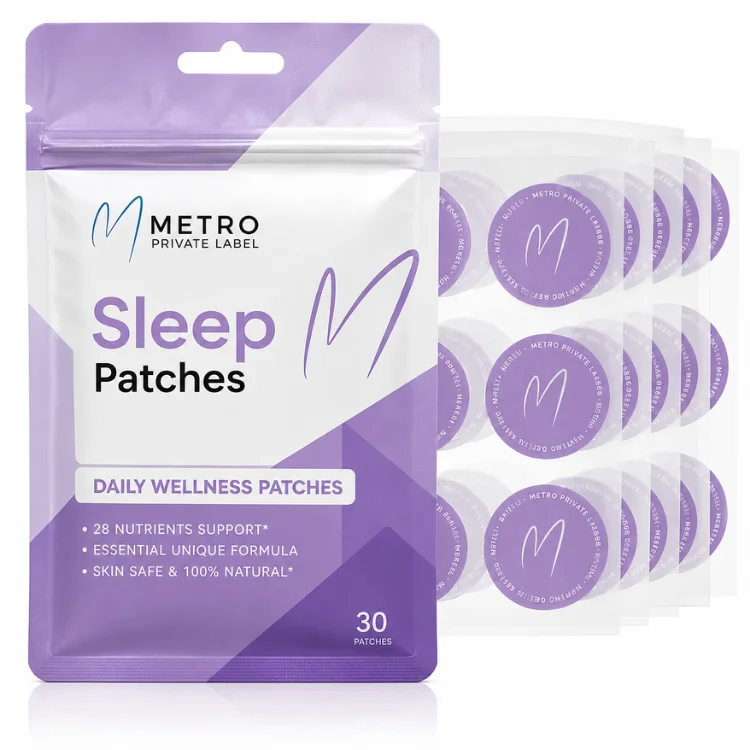
Sleep Patches
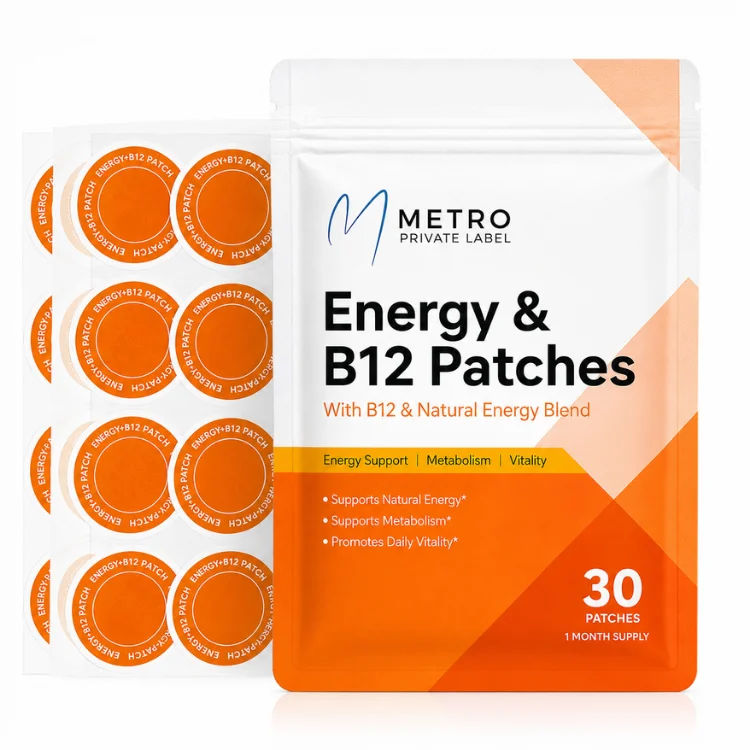
Energy & B12 Patches
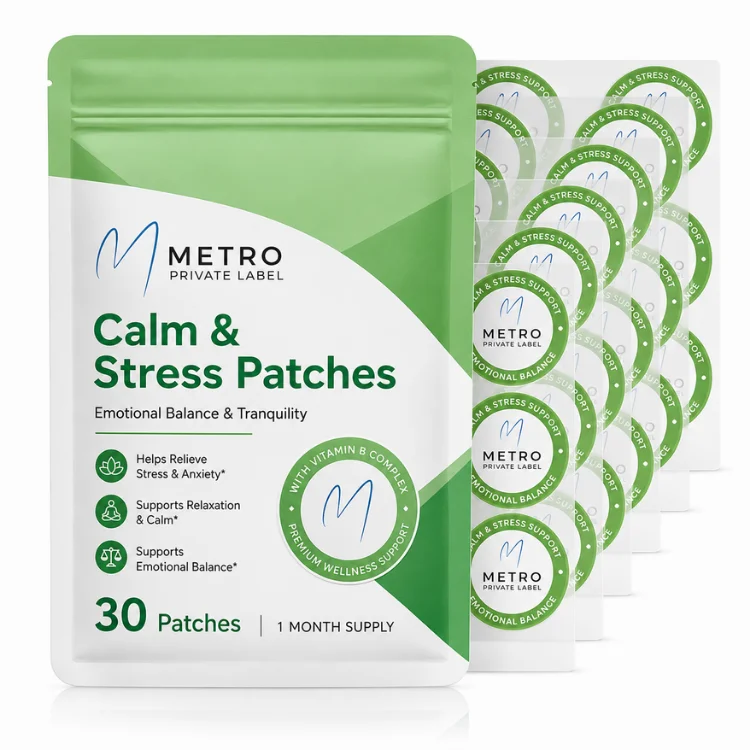
Calm & Stress Patches
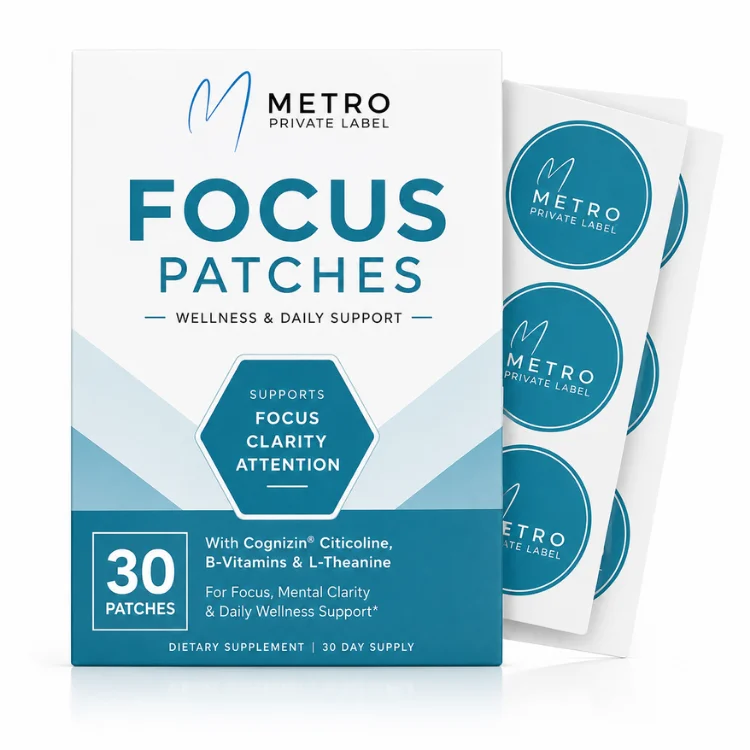
Focus Patches
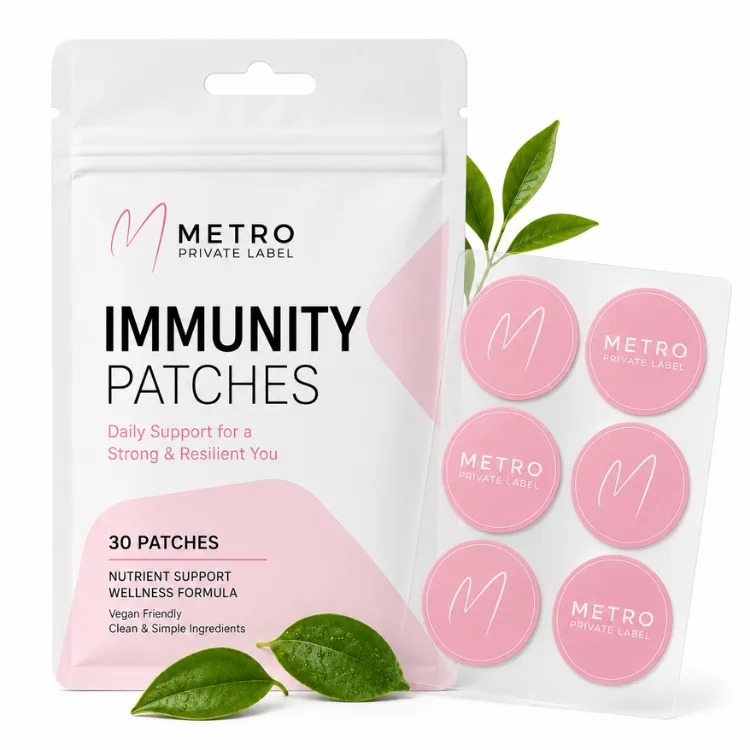
Immunity Patches
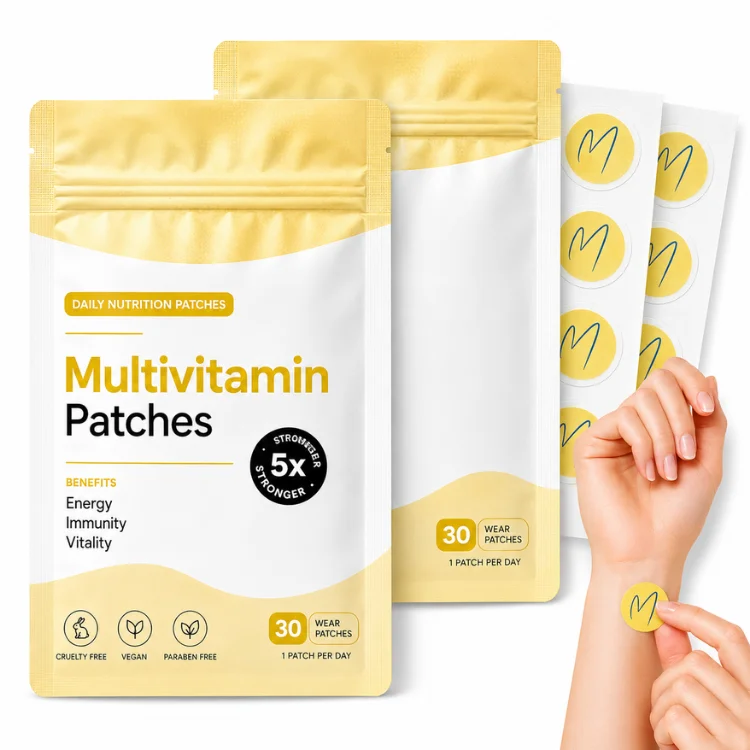
Multivitamin Patches
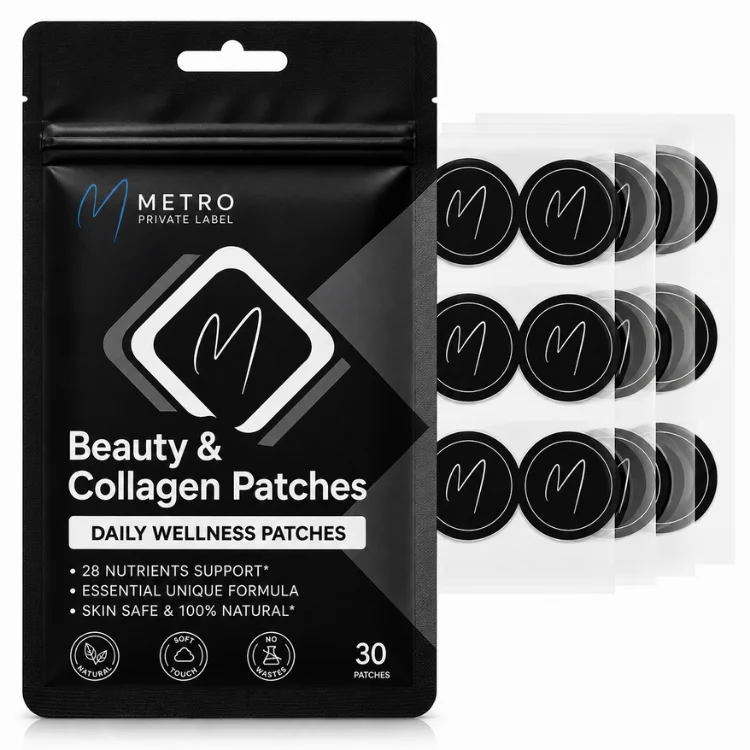
Beauty & Collagen Patches
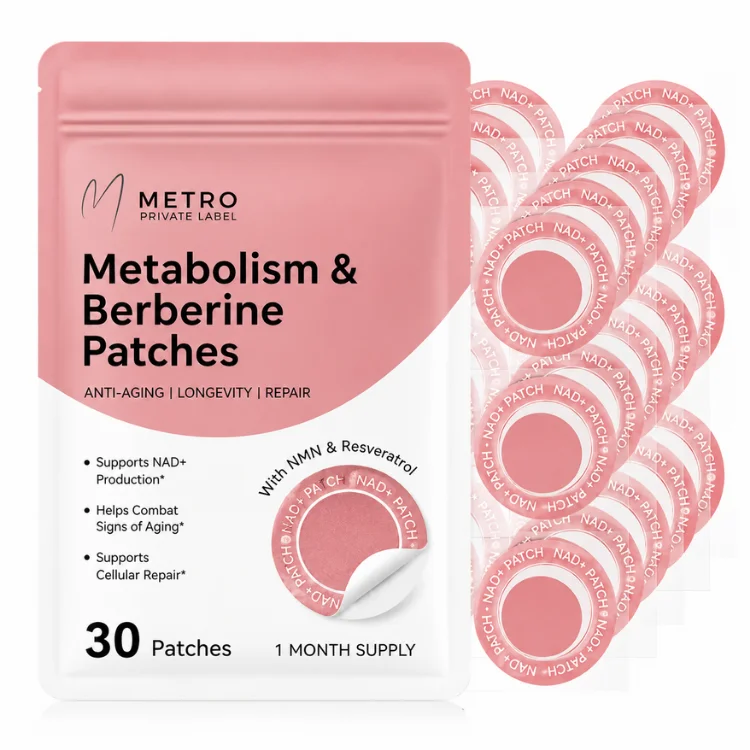
Metabolism & Berberine Patches
Build a Private Label Transdermal Patch Line That Fits Your Market
If you are looking for a private label transdermal patch manufacturer, you probably need more than a supplier that can simply put ingredients into a patch and print your logo on the pouch. You may already run an Amazon, Shopify or TikTok brand, operate a beauty or wellness business, or distribute products through an established retail channel. What you really need is a patch concept that fits your customers, price point, market positioning and launch plan.
You have come to the right place. At Metro Private Label, we look at the commercial side of the project before recommending a formula. A Sleep Patch sold as a recurring nighttime product, an Energy & B12 Patch for an e-commerce wellness brand, and a Beauty & Collagen Patch added to an existing skincare range all require different ingredient strategies, packaging, usage instructions and price structures. We first look at who will buy the product, where you plan to sell it and what position the patch needs to hold in your product line.
From what we see in the market, successful patch ranges are usually built around a clear consumer need rather than an overly complicated ingredient list. Sleep, energy, stress support, focus, immunity, daily vitamins, beauty wellness and metabolic support are easier for customers to understand and easier for brands to build into a repeat-purchase range. We help you choose between a mature formula for a faster launch and a more customized development route when your brand needs stronger differentiation.
Our Core Private Label Transdermal Patch Products
Sleep Patches: Nighttime wellness concepts developed around ingredients such as magnesium, valerian and other suitable botanical or nutritional ingredients, depending on the target market and positioning.
Energy & B12 Patches: Wearable wellness products built around energy-oriented ingredients such as Vitamin B12, B-complex and complementary nutritional ingredients for active lifestyle and e-commerce brands.
Calm & Stress Patches: Daily wellness concepts designed around relaxation and stress-support positioning, with ingredient directions such as magnesium, ashwagandha and selected botanical combinations where appropriate.
Focus Patches: Products developed around concentration, productivity and daytime wellness positioning, suitable for brands targeting work, study and active lifestyle routines.
Immunity Patches: Vitamin and wellness patch concepts built around immune-support positioning, with formulation directions that may include Vitamin C, Vitamin D, zinc and complementary ingredients depending on market requirements.
Multivitamin Patches: Daily wellness products designed around broader vitamin and micronutrient concepts, suitable for supplement brands, distributors and e-commerce operators looking for an alternative wearable format.
Beauty & Collagen Patches: Beauty-wellness concepts developed around ingredients such as collagen-positioned actives, glutathione, antioxidants and other beauty-support ingredients, making them especially suitable for skincare and beauty brands expanding into wellness.
Metabolism & Berberine Patches: Wellness products developed around metabolic-support positioning, including Berberine and complementary botanical or nutritional concepts where formulation feasibility and local regulations allow.
Manufacturing Support for Transdermal Patch Brands
We know that developing a patch product is not only about choosing ingredients. The formula still needs to work with the patch matrix and adhesive system, remain stable during storage, feel comfortable on the skin and stay within a commercially realistic cost. Patch size, wear time, ingredient loading, pouch protection, carton design and market claims also need to be considered before production.
At Metro Private Label, we support formula evaluation, sample development, patch size and format selection, packaging coordination, stability evaluation and bulk production. We can also provide available technical documents such as ingredient lists, COA, SDS and product specifications, while helping you understand which parts of the project may need additional testing or market-specific compliance review.
Our goal is simple: to help you turn a patch idea into a product that is practical to manufacture, easy for customers to understand and commercially realistic to reorder. Whether you are starting with one hero SKU or planning a wider Sleep, Energy, Beauty or Daily Wellness range, we want the supply structure to work not only for your first order, but also for the next stage of your brand.

More Than Just a Private Label Transdermal Patch Manufacturer
At Metro Private Label, we understand that your goal is not simply to put vitamins or botanical ingredients into a patch and launch another wellness product. You need a product that fits your market, supports the right retail price, gives customers a clear reason to use it, and can develop into repeat orders. That is why we look at both the commercial concept and the technical feasibility before moving a project into sampling and production.

Develop Patch Products Around Real Market Demand
We first look at who will buy the patch, where it will be sold, and what role it should play in your product range. A Sleep Patch for an Amazon wellness brand, an Energy & B12 Patch for TikTok Shop, and a Beauty & Collagen Patch for an established skincare brand may all use a wearable format, but they require different ingredient directions, usage concepts, packaging and price structures. We use this context to recommend a product direction that makes sense for your actual sales channel.
Reduce Development Risks Before Mass Production
A strong ingredient story does not automatically mean it will work well in a patch. Ingredient compatibility, loading level, patch matrix, adhesive performance, skin contact, wear time, stability, pouch protection and target cost all need to work together. We review these factors early so we can identify unrealistic concepts before they create repeated sample changes, packaging problems, unexpected costs or production delays.
Create Patches Customers Will Actually Keep Using
Customers may first notice a patch because of a trending ingredient such as B12, Magnesium, Berberine or Glutathione, but repeat purchases depend on the complete user experience. The patch needs to be easy to apply, comfortable to wear, stay in place properly, remove cleanly and fit naturally into a daily routine. We therefore look beyond the ingredient list and help balance formulation, patch structure, packaging and positioning so the finished product feels commercially complete.
Grow Your Patch Range With One Manufacturing Partner
From formula evaluation and sample development to patch size selection, packaging coordination, technical documentation, bulk production and repeat orders, we support the complete private label process. As your sales grow, we can also help you expand from one hero SKU into a broader range covering Sleep, Energy, Focus, Immunity, Beauty or Daily Wellness. This allows you to spend more time on marketing, customer acquisition and channel growth while we manage the manufacturing details behind your patch products.
Build a Private Label Transdermal Patch Line Around Your Business Goals
At Metro Private Label, we understand that developing a transdermal patch product is not simply about choosing a formula, selecting a patch size, and printing your logo on a pouch. If you already sell through Amazon, Shopify, TikTok Shop, retail stores, distribution networks, beauty channels, or wellness businesses, your real goal is to create a product that fits your customers, supports your target selling price, works within your sales model, and has the potential to generate repeat orders.
Many clients first come to us with a general idea such as a Sleep Patch, Energy & B12 Patch, Focus Patch, Immunity Patch, Beauty & Collagen Patch, or Berberine Patch. But turning that idea into a commercially practical product requires several decisions before production begins. Is the ingredient direction suitable for the patch format? Will the patch stay comfortable during the intended wear time? Does the packaging fit your retail price and sales channel? Can the cost structure support the margin you need? This is where we believe a manufacturing partner should provide more value than simply producing what is requested.
Develop Patch Products Based on Your Market, Not Only the Ingredients
When we work on a transdermal patch project, we do not begin by putting as many vitamins, botanicals, or trending ingredients as possible into one formula. We first look at who will buy the product, where it will be sold, what problem the customer expects it to fit into their routine, and what retail price the brand needs to support. An Amazon Sleep Patch may need a simple nighttime-wellness story, recognizable ingredients, competitive pricing, and easy-to-understand packaging. A beauty brand may want a more premium Beauty & Collagen concept, while a distributor may prefer mature formulas and several coordinated SKUs that can reach the market quickly. We connect these commercial needs with realistic patch-development options before recommending the final direction.
Make Smarter Decisions Before Production
A strong ingredient story does not automatically mean the same formula will work well in a patch. Ingredient compatibility, loading level, patch matrix, adhesive performance, skin contact, wear time, stability, pouch protection, packaging materials, target cost, and market positioning can all affect the finished product. We review these factors during development instead of waiting until mass production to discover problems. This can reduce repeated sampling, unstable concepts, poor adhesion, unsuitable packaging, unexpected cost increases, and unnecessary delays. We will also tell you when a concept needs to be simplified or adjusted, because agreeing with every ingredient request is not always the best way to protect your product or your budget.
Build Patch Products Customers Will Continue Using
Consumers may first notice a patch because of B12, Magnesium, Berberine, Glutathione, or another trending ingredient, but they do not repurchase simply because the ingredient appears on the front of the pouch. They continue using the product when the patch is easy to apply, comfortable to wear, stays in place properly, removes cleanly, and fits naturally into their daily routine. That is why we pay attention to patch size, flexibility, adhesive feel, wear time, packaging convenience, usage instructions, and overall product experience. A patch still needs to work well in real life, not only sound attractive in a marketing presentation.
Plan Beyond Your First Patch Product
Your first product may only be a Sleep Patch or Energy Patch, but it can later become the foundation of a wider wellness range. A successful hero SKU may expand into Focus, Calm & Stress, Immunity, Multivitamin, Beauty & Collagen, or Metabolism & Berberine products. We therefore look beyond the first purchase order and consider how the ingredient direction, packaging system, price positioning, and product story can support future SKUs without forcing you to rebuild the entire supply chain each time.
From formula assessment and sample evaluation to patch size selection, packaging coordination, technical documentation, bulk production, and repeat-order planning, we work to support the complete development process. Our goal is to provide more value than you may expect from a private label factory and help you create patch products that are practical to manufacture, clear to market, comfortable to use, and structured to support long-term business growth.
FAQs Transdermal Patches
For your convenience, we’ve gathered the most commonly asked questions about our Transdermal Patches . However, should you have any further queries, please don’t hesitate to reach out to us.
1. What types of private label transdermal patches can you manufacture?
We focus mainly on consumer wellness and beauty patch concepts rather than pharmaceutical patches. Our main development directions include Sleep Patches, Energy & B12 Patches, Calm & Stress Patches, Focus Patches, Immunity Patches, Multivitamin Patches, Beauty & Collagen Patches, and Metabolism & Berberine Patches.
If you already sell supplements, wellness products, skincare, or other lifestyle products, we can also evaluate whether your existing ingredient concept is suitable for development into a patch format.
2. How do transdermal patches work?
The active blend is incorporated into the patch matrix during production so that the ingredients are distributed throughout the functional layer of the patch. When the patch is applied to the skin, the ingredients are released from the matrix and interact with the skin surface during the intended wear period.
However, we do not assume that every vitamin, botanical extract, or trending ingredient will automatically pass through the skin at a meaningful level. Skin is a strong natural barrier, so ingredient properties, concentration, patch structure, wear time, and formulation all need to be considered during development.
For this reason, we evaluate the formula first instead of simply adding any requested ingredient and calling it “transdermal.”
3. Can you customize the formula for our brand?
Yes. We can start from one of our existing mature patch concepts or evaluate a more customized formula based on your brand positioning.
For example, you may want a Sleep Patch built around Magnesium and selected botanicals, an Energy Patch with B12 and complementary nutrients, or a Beauty Patch built around antioxidant and beauty-wellness positioning.
We will discuss the ingredients you want, target market, product story, target cost, intended wear time, and packaging before confirming the development direction. If an ingredient or loading level is not technically practical, we will tell you early rather than create repeated sampling problems later.
4. What is your minimum order quantity for private label patches?
Our standard MOQ is based on the production sheet rather than only the number of retail boxes.
A common packaging structure is:
6 patches per sheet × 5 sheets per box or pouch.
Our standard starting MOQ is 10,000 sheets, which equals approximately:
2,000 retail boxes or pouches per SKU when packed 5 sheets per unit.
This structure works particularly well for established e-commerce brands, wellness companies, distributors, and other businesses that already have a sales channel and want a commercially realistic first production run.
Different packaging structures may affect the final MOQ, so we normally confirm the formula and packaging direction before issuing the final quotation.
5. Can we change the patch size, shape, color, or packaging?
Yes. The patch itself and the retail presentation can both be customized depending on the project.
We can discuss patch dimensions, shape, backing appearance, individual sheet format, pouch design, carton design, instructions, labels, and shipping cartons.
But we do not recommend selecting the largest or most unusual patch simply for marketing purposes. Patch size affects material consumption, ingredient loading, comfort, adhesion, packaging size, and ultimately your unit cost. We prefer to choose a format that supports both the product concept and your target retail price.
6. Do you offer both white label and custom development?
Yes.
If speed and initial investment are your priority, we normally recommend starting with a mature existing formula and customizing the branding and packaging. This reduces development complexity and usually provides a faster route to market.
If your brand already has a clear positioning or ingredient concept, we can evaluate a custom development route.
For experienced e-commerce or wellness brands, we often recommend deciding first whether the new patch is intended to be a fast-launch SKU or a highly differentiated hero product. The answer determines how much customization is commercially worthwhile.
7. How do you evaluate whether our ingredient concept is suitable for a patch?
We look beyond the marketing popularity of the ingredient.
During development, we consider factors such as ingredient compatibility, solubility, loading level, stability, interaction with the patch matrix, adhesive performance, skin contact, intended wear time, and target cost.
This is especially important when a brand comes to us with a long ingredient list from a capsule, gummy, powder, or oral supplement and wants to transfer the same concept directly into a patch.
A formula that works in one dosage format does not automatically work in another. Sometimes simplifying the formula creates a more realistic product than trying to fit every marketing ingredient into one patch.
8. What testing and quality checks do you perform?
We evaluate both the formula and the finished patch rather than checking only the ingredient mixture.
Depending on the product and project requirements, this may include checks related to appearance, weight or loading consistency, adhesion, patch integrity, formula stability, packaging compatibility, and finished-product specifications.
For customized projects or specific target markets, additional testing may also be required before certain performance or marketing claims can be used.
We prefer to identify these requirements during development, because finding out after packaging has already been printed is much more expensive.
9. What documents can you provide for our private label patch products?
Available documentation can include product specifications, ingredient information, COA, SDS and other manufacturing or technical documents relevant to the finished product.
The exact documentation required depends heavily on what ingredients are used, what claims you make, and where the product will be sold.
This is especially important for wellness patches because the regulatory classification of a product can change based on its ingredients and claims. We therefore recommend confirming your target market before finalizing the packaging copy.
We can support the manufacturing documentation we have available, but market registration, advertising claims, and regulatory approval should always be assessed according to the requirements of the country where you plan to sell.
10. Can you support packaging, production, shipping, and repeat orders?
Yes. We can support the project from formula selection and sampling through patch production, pouch or box coordination, technical documentation, bulk manufacturing, carton preparation, and shipping coordination.
For brands already selling through Amazon, Shopify, TikTok Shop, retail stores, or distribution networks, we also think beyond the first order.
If one Sleep Patch performs well, for example, the next step may be Energy, Focus, Calm, or Multivitamin products using a coordinated packaging system. Planning this early can make future SKU expansion easier and reduce the need to rebuild the supply chain for every new product.
Our goal is not simply to complete your first 10,000-sheet production run. We want to build a patch manufacturing structure that remains practical when you come back for your second, third, and larger repeat orders.
What stood out to us was that Metro Private Label looked beyond simply producing the patch. Their team discussed our target retail price, packaging structure, ingredient direction, and how the product would fit into our existing online range. They also helped us simplify the first formula so we could move into sampling faster without making the product feel too generic.
Maya Whitmore, E-commerce Product Managerfrom United States
We came to Metro Private Label with a fairly ambitious Sleep Patch concept and several ingredients we wanted to include. Instead of agreeing to everything immediately, their team explained which parts needed further evaluation and which ingredients could make the formula unnecessarily complicated. That practical feedback helped us create a much clearer product direction and gave us more confidence before committing to production.
Callum Harrington, Wellness Brand Founderfrom United Kingdom
Our priority was to find a manufacturer that could offer several mature wellness patch concepts and make the purchasing process straightforward. Metro Private Label gave us clear information on MOQ, patch formats, packaging options, documentation, and production planning. This made it much easier for us to evaluate Sleep, Energy, and Multivitamin patches as a coordinated range rather than sourcing each product separately.
Élodie Marchand, Distribution Purchasing Managerfrom France
We wanted to introduce a small wellness patch range that felt professional enough to sit alongside our existing beauty services. Metro Private Label helped us think through the product positioning, packaging, and how customers would actually use the patches in their daily routines. Their team was particularly helpful in keeping the concepts simple and understandable instead of overloading every patch with too many marketing ingredients.
Annika Vogel, Aesthetic & Wellness Clinic Directorfrom Germany
The communication throughout the project was clear and commercially realistic. Metro Private Label explained how patch size, ingredient loading, adhesive performance, pouch packaging, and order quantity could all affect the final cost. They also told us early when certain ideas were likely to create unnecessary development risk. That transparency made the move from sample evaluation to production much easier for our team.
Matteo Rinaldi, Product Sourcing Managerfrom Italy






Metro Private Label in Numbers
Happy Clients
0 +
Million-dollar Buyers
0 +
Formulation
0 +
Professional Staffs
0 +
Your Ultimate Guide to Transdermal Patches
If you’re planning to add transdermal or wearable wellness patches to your product line—whether it’s your first patch SKU or an extension of an existing supplement, beauty, or wellness range—you’re not simply choosing another product format. You’re entering a category where consumer interest is increasingly built around convenience, daily routines, and clear need-based positioning such as Sleep, Energy, Focus, Calm, Multivitamin, Beauty, and Metabolic Wellness. For brands that already have an audience or sales channel, patches can create a new way to extend an existing product story. But the commercial opportunity depends on more than choosing a trending ingredient. The product still needs a clear reason to buy, a realistic retail price, comfortable everyday use, and enough repeat-purchase potential to justify the inventory and marketing investment behind the launch.
Over the past few years, we’ve seen patch products move beyond novelty positioning and become a more visible format across e-commerce, wellness brands, supplement ranges, beauty businesses, and retail channels. At Metro Private Label, what we’ve learned is that the projects that move forward most smoothly are usually the ones where product positioning, ingredient feasibility, patch size, active loading, adhesion, packaging, MOQ, claims, and target-market requirements are considered together from the beginning. A patch may look simple from the outside, but small decisions can quickly affect the entire project. Adding more ingredients can change the matrix, reducing patch size can limit loading capacity, stronger adhesion can affect comfort, and premium packaging can change both MOQ and landed cost. These are often the issues that determine whether a concept remains commercially practical once development begins.
This guide is built around the questions we see behind real B2B sourcing decisions rather than only explaining what a patch is. We want to show how to compare white label and custom development, understand why oral supplement formulas cannot always be transferred directly into patches, evaluate active loading and wear time, calculate the real meaning of MOQ, plan total launch cost, review testing and quality risks, and think about claims before packaging is printed. We also look at what can change during a project from the original idea to the first production run, because the most useful industry knowledge often comes from the adjustments made along the way. Our goal is to help you understand not only how patch products are manufactured, but how the technical, regulatory, and commercial decisions behind them can determine whether a new SKU becomes a scalable part of your business or an expensive product that is difficult to reorder.
Table of Contents
What Is a Transdermal Patch — and How Is It Different From a Topical or Wellness Patch?
When buyers first research patch products, the terms “transdermal patch,” “topical patch,” “vitamin patch,” “wellness patch,” and “wearable patch” often appear to describe almost the same thing. In practice, they are not scientifically or commercially interchangeable. This distinction matters because the terminology used at the beginning of a project can later affect formulation decisions, testing expectations, packaging language, marketing claims, marketplace listings, and regulatory positioning. Before discussing ingredients or concentrations, the more important question is what the patch is actually designed to do and what level of evidence will be required to support that positioning.
What “Transdermal” Actually Means
In the strict technical sense, a transdermal system is intended to move an active ingredient across the skin and toward systemic circulation. That is very different from simply placing an ingredient-containing patch on the skin. A patch containing Vitamin B12, Magnesium, Berberine, Glutathione, botanical extracts, or other popular wellness ingredients does not automatically become a true transdermal system simply because those ingredients are present in the matrix.
For a genuine transdermal concept, the development questions are much more demanding. The active must be able to remain stable in the formulation, release from the patch matrix, cross the skin barrier at a meaningful level, and perform consistently enough to support the intended claims. This is why the word “transdermal” should not be treated as a marketing upgrade for any wearable patch. From a B2B perspective, the distinction becomes especially important once the brand starts preparing packaging, distributor materials, marketplace content, or regulatory documentation.
The Skin Is a Barrier, Not an Open Door
One of the most common misunderstandings in patch development is the assumption that ingredients can easily enter the body once they are placed against the skin. The reality is almost the opposite. The outermost layer of the skin, especially the stratum corneum, is designed to protect the body from the external environment and acts as a highly effective barrier. Whether an ingredient can pass through that barrier depends on factors such as molecular size, solubility, lipophilicity, concentration, formulation environment, contact time, and the condition of the skin itself.
This is why a technically realistic patch project should not begin with the question, “Can we add this ingredient?” The more useful questions are whether the ingredient is compatible with the patch system, whether it can remain stable during storage, whether it can be released from the matrix, whether the intended loading is practical, and whether the final claim is realistic for that delivery format. This becomes particularly important when an existing supplement brand wants to transfer a capsule or gummy formula directly into a patch, because a formula designed for oral consumption and one designed for skin-contact delivery operate under very different physical and formulation constraints.
How the Patch Matrix Affects the Finished Product
A patch is better understood as an integrated delivery system rather than simply an adhesive material containing ingredients. The active formula is incorporated into a matrix or adhesive structure that stays in contact with the skin during use, while the finished product may also include a backing layer, release liner, stabilizing materials, and protective pouch packaging. These components interact with one another, which means the final performance of the patch depends on much more than the headline ingredients listed on the front of the package.
For example, increasing active loading may sound attractive commercially, but it can change matrix consistency, adhesion, stability, thickness, or comfort. Increasing patch size may provide more formulation area, but it can also affect material cost, packaging size, and wearability. A stronger adhesive may improve attachment during the intended wear period, but it can also make removal less comfortable. In real development work, ingredient loading, adhesive performance, patch size, wear time, backing material, and packaging all need to be considered together rather than treated as independent specifications.
How a Topical Patch Is Different
A topical patch is generally designed to provide an effect primarily on or near the area where the product is applied rather than relying on meaningful systemic delivery. This difference is commercially important because a topical product can still be highly valuable without claiming that ingredients enter the bloodstream. Beauty patches, under-eye patches, treatment patches, and other local skincare formats can be built around hydration, soothing, barrier support, or other local cosmetic benefits while remaining clearly positioned as topical products.
Problems often arise when brands use the term “transdermal” simply because it sounds more advanced. If the product is primarily intended to act locally on the skin, the positioning should reflect that function. More accurate terminology usually makes it easier to build credible claims, communicate with distributors, and avoid creating a gap between what the product actually does and what the packaging appears to promise.
What a “Wellness Patch” Really Means
“Wellness patch” is different again because it is primarily a commercial product category rather than a precise scientific definition of delivery. The current market includes Sleep Patches, Energy Patches, Focus Patches, Calm Patches, Immunity Patches, Vitamin Patches, Beauty Patches, and many other products positioned around everyday lifestyle needs. These products may contain vitamins, minerals, botanical extracts, caffeine, essential oils, or other ingredients, but the phrase “wellness patch” by itself does not demonstrate that those ingredients achieve systemic transdermal delivery.
This distinction gives brands more flexibility than they often realize. A wellness patch can still have a clear consumer proposition based on convenient wearable use, ingredient positioning, daily routines, or lifestyle occasions without making aggressive claims about bloodstream absorption. In many commercial projects, this creates a more realistic balance between product differentiation and claim risk, especially when the available technical evidence supports the presence and use of the ingredients but does not establish a defined systemic delivery profile.
Ingredient Inclusion Is Not the Same as Demonstrated Delivery
This is one of the most important distinctions for B2B buyers to understand. If Vitamin B12 is present in a patch, that confirms that B12 has been included in the formulation. It does not automatically tell us how much leaves the matrix, how much reaches the skin surface, how much crosses the skin barrier, or whether a meaningful quantity reaches systemic circulation. The same logic applies to Magnesium, Berberine, Glutathione, botanical extracts, and other ingredients commonly used in wellness patch concepts.
This is where the gap between marketing and product development often becomes visible. A front label may focus heavily on a trending ingredient, while the technical question is whether the finished product can support the claims being made about that ingredient. For long-term brand development, it is much safer to address this issue before packaging and advertising content are finalized. Revising the positioning during development is relatively easy; revising it after thousands of printed retail packages have already been produced is much more expensive.
Why Wrist or Upper-Arm Placement Does Not Automatically Mean Better Absorption
Another explanation commonly seen in the market is that a patch should be placed on the wrist or upper arm because these areas are close to arteries or blood vessels, supposedly allowing the ingredients to enter circulation more easily. This explanation is too simplistic. The first major barrier is still the skin itself, and placing a patch above an artery does not remove the stratum corneum or guarantee that an ingredient will cross the skin at a meaningful level.
Application site can certainly matter because skin thickness, hair, movement, temperature, adhesion, and local skin condition can vary between different areas of the body. However, those factors are very different from saying that a patch works because it sits directly over an artery. For experienced buyers, oversimplified explanations like this can actually reduce confidence because they turn a complex delivery issue into a marketing shortcut that may not withstand technical or regulatory review.
Why the Word “Transdermal” Matters for Product Claims
Terminology is not merely a branding decision. The wording used on the packaging, website, marketplace listing, advertising materials, and usage instructions can influence how customers, platforms, distributors, and regulators understand the intended function of the product. “Transdermal” carries a stronger implication than “wearable” or “topical” because it suggests delivery across the skin rather than simple skin contact.
The difference becomes obvious when comparing two concepts. “Wearable B12 Wellness Patch for Daily Routine Support” describes a consumer format and use case, while “Transdermal B12 Patch Delivers B12 Directly Into the Bloodstream” makes a specific statement about systemic delivery. The second claim creates a much higher technical and evidentiary burden. This is why claims should not be written only after product development is finished. The intended positioning should be considered early enough to influence formulation, testing, documentation, and packaging decisions.
How I Separate Topical, Wellness, and Transdermal Concepts in Practice
In practical product development, the clearest approach is to separate these concepts by intended function. A topical patch is primarily designed to act on or near the skin where it is applied. A wellness patch is a consumer product format built around ingredients, convenience, and lifestyle positioning without automatically implying proven systemic delivery. A true transdermal system, in the stricter technical sense, is intended to move an active across the skin toward systemic circulation and therefore creates much higher expectations around formulation performance and supporting evidence.
These distinctions make sourcing and development much easier to evaluate. Two patches may look almost identical from the outside, but one may be a conventional ingredient-containing wellness patch while another may be a system where release, permeation, adhesion, and delivery performance are central to the project. If a buyer compares only the ingredient list, MOQ, and unit price, those differences can easily be missed.
Why This Distinction Matters Before Choosing a Manufacturer
Before comparing suppliers, the product itself should first be defined correctly. The most important question is not whether a factory can put a particular ingredient into a patch, but whether the supplier understands what kind of product is actually being developed. A conventional wellness patch, a topical beauty patch, and a system intended to demonstrate systemic transdermal delivery may all use a similar physical format, but their formulation logic, testing requirements, documentation, claims, and regulatory expectations can be very different.
For this reason, I would always clarify the product category before discussing detailed concentrations, patch dimensions, or final unit pricing. Once the intended delivery concept is clear, it becomes much easier to evaluate ingredient feasibility, development cost, testing needs, packaging language, and commercial positioning. The most important principle is that the technology, evidence, claims, packaging language, and market positioning should all describe the same product. When those elements are aligned from the beginning, the entire project becomes easier to develop, easier to explain, and much easier to manage commercially.
Which Transdermal Patch Categories Make the Most Commercial Sense for Your Market?
When someone searches for “best wellness patches to sell,” “private label sleep patches,” “vitamin patch business,” or “best-selling patch products,” the real question is usually not which patch categories exist. The buyer is trying to decide which SKU deserves inventory, packaging, marketing budget, and shelf space. That is a much more difficult decision. A patch can be technically manufacturable and still be commercially weak if customers do not immediately understand why they need it, if the usage occasion is too narrow, or if the brand has to spend too much money educating the market. When I evaluate a new patch category, I therefore look beyond the ingredient formula and consider consumer recognition, frequency of use, repeat-purchase potential, retail price tolerance, marketing complexity, and how naturally the product fits the existing sales channel.
The current wellness-patch market already gives us useful signals. Established brands repeatedly build ranges around Sleep, Energy, Stress or Calm, Focus, Multivitamin, Immunity, Collagen, and Metabolism-related concepts. The Good Patch currently gives prominent positions to B12 Awake, Dream, Be Calm, Relax, Think, and other need-based products, while The Patch Remedy carries Sleep, Energy, Focus, Immunity, Multi V, Collagen, and multiple metabolic products. I would not interpret this as proof that every category will work for every brand. What it tells me is that consumers already have recognizable commercial language around these needs, which can reduce the amount of education required when a new brand enters the market.
I Start With the Consumer Need, Not the Ingredient Trend
One mistake I frequently see in private label development is starting with a trending ingredient and then trying to invent a reason for customers to buy it. From a commercial perspective, I prefer to reverse that process. The first question should be what the customer is trying to achieve in daily life: sleep better, maintain energy, stay focused, manage stressful routines, support daily nutrition, or add a beauty-oriented wellness product to an existing skincare routine. The ingredient strategy can then be built around that recognizable need.
This matters because ingredient recognition and product recognition are not the same thing. A consumer may not understand the technical difference between several forms of Magnesium, B vitamins, botanical extracts, or antioxidant ingredients, but they immediately understand the concept of a “Sleep Patch” or “Energy Patch.” For an e-commerce brand paying for every click, that difference can significantly affect how easily the product can be explained in a thumbnail, headline, short video, Amazon title, or retail shelf display. A more complicated concept is not necessarily a more valuable concept if the brand must spend heavily just to explain what the product is for.
Sleep Patches: One of the Clearest Hero-SKU Opportunities
Sleep is one of the easiest patch categories for consumers to understand because the usage occasion is obvious. The customer has a nighttime routine, the product has a defined time of use, and repeat consumption can naturally become daily or several times per week. Current retail portfolios reflect this maturity. The Good Patch sells several sleep-focused products, including Dream and Slumber, while The Patch Remedy also maintains Sleep as a core category.
From a B2B perspective, I see Sleep Patches as particularly suitable for Amazon sellers, Shopify wellness brands, existing supplement companies, and retailers looking for an easily understood entry product. The commercial advantage is not simply that “sleep is popular.” It is that the product can be explained quickly and fits a recurring routine, which gives it stronger repeat-purchase logic than an occasional-use novelty product. The challenge is differentiation. Because Sleep is already competitive, a new brand needs to decide whether its advantage comes from ingredient direction, melatonin-free positioning, packaging, target audience, price point, or integration into a broader nighttime-wellness range. A generic Sleep Patch may be easy to launch but difficult to defend if there is no reason for customers to choose it over established alternatives.
Energy & B12 Patches: Strong Recognition and Broad Channel Fit
Energy products also have an immediate consumer proposition. The usage occasion can include work, travel, exercise, studying, long days, or replacing another energy-oriented routine. B12 is particularly useful commercially because consumers already associate it with energy products. The Good Patch’s B12 Awake is currently positioned specifically as an Energy Support Patch and has substantially more customer reviews than many of the brand’s narrower patch concepts, which is at least a useful retail signal of category familiarity and consumer engagement.
I generally see Energy & B12 Patches as a strong fit for e-commerce operators and supplement or wellness brands because the product does not require a major change in consumer behavior. A supplement brand already selling B-complex, B12, energy gummies, powders, or capsules can introduce a patch as an alternative format within an existing product story. The commercial risk is that “energy” can easily become overpromised. A brand still needs to distinguish between a recognizable wellness positioning and claims that imply specific physiological outcomes beyond what the product can substantiate. From a pricing perspective, the category also needs enough differentiation to justify the premium of a wearable patch compared with inexpensive oral vitamin products.
Calm & Stress Patches: Strong Lifestyle Relevance but Positioning Matters
Stress and relaxation form another broad need-state category because consumers can immediately connect the product with workdays, travel, busy routines, or evening relaxation. Current patch ranges commonly use terms such as Calm, Relax, Stress Relief, and similar lifestyle language. The Good Patch, for example, carries several separate products around this territory, including Be Calm and Relax, while describing Relax around everyday stressful moments and ingredients such as ashwagandha, passionflower, and rhodiola.
Commercially, this category can work well for DTC wellness brands because it supports strong lifestyle storytelling. At the same time, the positioning needs discipline. “Calm,” “relaxation,” “stress support,” and medical claims about anxiety are not interchangeable. A product that begins as a lifestyle wellness SKU can create a very different regulatory discussion if the packaging begins promising treatment of psychological or medical conditions. I therefore see this category as commercially attractive when the brand understands both the emotional marketing opportunity and the limits of responsible claims.
Focus Patches: More Specific Than Energy, but Useful for the Right Audience
Focus is often grouped together with Energy, but I would keep them commercially separate. A customer searching for an Energy Patch is generally thinking about tiredness or physical and mental energy, while a Focus Patch is associated more closely with concentration, productivity, study, cognitive routines, and sustained attention. The Good Patch currently separates Think from its B12 Awake energy product, and The Patch Remedy similarly offers Focus and Energy as distinct SKUs.
That distinction makes Focus particularly interesting for digital-first brands targeting students, professionals, creators, gamers, or productivity-oriented consumers. It can also pair naturally with Energy as part of a two-product daytime range. However, Focus normally requires slightly more product education than Sleep or Energy because the customer needs to understand what makes the formula different from coffee, an energy patch, or an ordinary vitamin product. I would therefore consider the category more attractive for brands that are already good at content marketing than for a distributor simply looking for the easiest possible product to put on a shelf.
Immunity Patches: High Consumer Recognition but Greater Claim Sensitivity
Immunity has one major commercial advantage: consumers already understand the wellness concept from vitamins, gummies, powders, and supplements. That familiarity means a brand introducing an Immunity Patch does not need to invent an entirely new category. Current patch portfolios continue to include immunity-oriented products alongside daily vitamins, energy, sleep, and other mainstream wellness needs. The Patch Remedy, for example, currently lists Immunity as part of its core US patch range.
From a channel perspective, I see Immunity Patches fitting most naturally with supplement companies, health and wellness retailers, and e-commerce brands that already sell nutritional products. The limitation is that the commercial language can quickly become too aggressive. “Immune support” and claims about preventing or treating infections are very different propositions. Seasonality can also influence demand, with consumer interest potentially becoming stronger during colder months or periods when immunity products receive more attention. For a distributor, this may still be attractive because the category is familiar; for a brand looking for one evergreen hero SKU, I would compare its repeat-use logic carefully with Sleep, Multivitamin, or Energy before deciding where to invest first.
Multivitamin Patches: Broad Appeal and Strong Repeat-Purchase Logic
Multivitamin patches solve a different commercial problem. Instead of focusing on one moment such as sleep or focus, they can be positioned as part of a daily wellness routine. This makes the category particularly relevant to existing supplement brands because consumers already understand what a multivitamin is. The product innovation is mainly the wearable format rather than the nutritional concept itself. The Patch Remedy currently positions its Multi V as a daily multivitamin and even describes it as a base product that can be combined with other patch categories such as Sleep, Focus, Immunity, and Metabolism.
For B2B buyers, the commercial attraction is recurring consumption. If the product is genuinely integrated into a daily routine, the business model is easier to understand than an occasional-use SKU. At the same time, Multivitamin Patches raise more formulation questions because a long nutritional ingredient list may look attractive on the package but be technically harder to justify within a patch system. This is where commercial ambition and formulation reality need to meet. A brand may gain more from a focused, credible micronutrient concept than from trying to reproduce a twenty-ingredient oral multivitamin inside an adhesive patch.
Beauty & Collagen Patches: The Strongest Bridge Between Skincare and Wellness
Beauty & Collagen Patches make particular commercial sense for skincare, beauty, aesthetic, and beauty-wellness businesses because the audience already understands concepts such as collagen support, skin appearance, antioxidants, glow, and healthy-aging routines. The Patch Remedy currently carries Collagen as a dedicated patch product, while the broader patch market also shows increasing overlap between beauty formats and wearable wellness.
I see the biggest opportunity here when the patch is not treated as an isolated supplement product but as part of an existing beauty ecosystem. A skincare brand selling serums, creams, masks, or beauty supplements already owns the customer relationship and can introduce a Beauty Patch as another routine format. Clinics and professional beauty operators may also find this easier to merchandise than generic wellness products because the concept remains connected to their core business. The challenge is scientific wording. Terms such as “Collagen Patch” can be commercially attractive, but brands need to distinguish between ingredient positioning and claims that a particular ingredient is demonstrably delivered systemically or produces a specific physiological result. The more premium the beauty story becomes, the more important that credibility becomes.
Metabolism & Berberine Patches: High Trend Potential but Higher Education and Claims Risk
Metabolism and Berberine currently represent a more trend-driven opportunity. Commercial interest around metabolic wellness has created new patch products positioned around metabolism, vitality, and related ingredient stories. The Patch Remedy, for example, currently carries both Metabolise and Thermo GL concepts within its range. This shows that metabolic positioning has become visible enough to support dedicated products rather than remaining a niche ingredient idea.
From a B2B standpoint, I would treat this category differently from Sleep or Multivitamin. The upside can be high because trending ingredients give e-commerce operators strong advertising hooks, particularly on TikTok, Shopify, and other discovery-driven channels. The downside is greater dependence on education, trend cycles, and claims management. Berberine may be recognizable to supplement buyers but much less familiar to mainstream beauty consumers. Metabolic concepts can also drift very quickly into weight-loss, blood-glucose, GLP-1, or disease-related claims. For an experienced wellness brand that understands compliance and performance marketing, this may be a compelling category. For a first-time distributor looking for a low-education retail product, I would usually consider Sleep, Energy, or Multivitamin easier to commercialize.
The Best Category Changes With the Sales Channel
One of the most important lessons I have learned from B2B product development is that there is no universal “best-selling patch” that makes sense for every buyer. Amazon rewards products that customers already search for and can understand quickly, which makes categories such as Sleep, Energy, B12, and established vitamin concepts relatively intuitive. Shopify and TikTok brands have more freedom to create demand through storytelling, video, influencers, and ingredient education, making Focus, Beauty, Berberine, or other differentiated concepts more commercially viable if the brand already has strong content capabilities.
Distributors and retail buyers normally need a different approach. They often prefer products that are easy for store staff and consumers to understand without a long explanation, so Sleep, Energy, Multivitamin, and possibly Immunity can be easier to merchandise. An existing supplement company already owns consumer trust around nutritional ingredients, so Multivitamin, B12, Immunity, or metabolic concepts can extend naturally from its current range. A skincare or professional beauty business, meanwhile, may gain more strategic value from Beauty & Collagen because the new format still speaks to the same customer rather than forcing the company into an unrelated wellness category.
A Hero SKU and a Product Range Require Different Decisions
Another distinction I make is whether the buyer needs one product to acquire customers or several products to build a broader patch category. If the objective is to launch one hero SKU, I normally prefer a product with a very clear need state and sufficient repeat-use potential. Sleep and Energy are strong examples because the customer can understand the reason for buying them in seconds. If the objective is to establish a complete wearable-wellness range, the commercial logic changes. The brand can use different products for different moments of the day, such as Energy or Focus during the daytime, Calm in the evening, and Sleep at night.
A coordinated range can also improve average order value because customers have reasons to purchase more than one SKU. Current brands already demonstrate this approach by offering complementary patch categories and encouraging combinations; The Patch Remedy, for example, explicitly mentions combinations such as Sleep with Magnesium and Energy with Focus. However, launching eight products at once is not automatically better. Every additional SKU creates inventory, artwork, packaging, testing, forecasting, and cash-flow requirements. For a new category, I generally find it more commercially rational to prove demand with one or two strong products before expanding into a broader portfolio.
How I Would Evaluate the Commercial Opportunity Before Investing
When deciding which patch category deserves investment, I would not rely on a single signal such as Google search volume, a trending ingredient, or the number of products appearing on Amazon. I would look at whether consumers already understand the need, how frequently they are likely to use the product, whether the price can support the manufacturing and acquisition costs, how difficult the claims are to substantiate, and whether the product fits the customers the business already knows how to reach.
A category with slightly lower search volume can still be the better commercial decision if it matches an existing audience. A skincare brand with thousands of repeat customers may have a much easier time selling a Beauty & Collagen Patch than competing for generic Sleep Patch keywords. A supplement company already known for B12 may have a natural advantage with an Energy & B12 Patch. A distributor with pharmacy and wellness-store relationships may prefer Multivitamin or Immunity because the products require less explanation at the point of sale.
For me, this is the real meaning of “commercial sense.” The best patch category is not simply the one that appears most frequently in the market. It is the one where consumer demand, product understanding, repeat-use behavior, price structure, claims, and the brand’s existing sales channel align closely enough to support a profitable repeat-order business. That alignment should be established before formula development and packaging investment begin, because choosing the right category at the start usually has a much bigger commercial impact than adding one more trending ingredient later.
White Label vs. Custom Formula Patches: Which Development Route Should a Brand Choose?
When buyers search for “white label patches,” “custom transdermal patch manufacturer,” or “private label patch OEM,” they have usually moved beyond the question of whether they want to sell patches. The real decision is how much product development they actually need before going to market. I often see brands assume that a fully customized formula must be the better option because it sounds more differentiated, while white label is treated as the basic or lower-value route. In practice, that is not how I would evaluate the decision. The better route depends on the sales channel, launch timing, available budget, level of technical experience, competitive positioning, and how much evidence the brand already has that customers want the product.
For a distributor testing wellness patches for the first time, a mature formula may reduce unnecessary development risk and allow the business to validate demand faster. For an established supplement company, beauty brand, or e-commerce operator with an existing audience, a more customized formula may make sense because the product needs to fit an established ingredient philosophy or provide a clearer reason to switch from competitors. The important point is that customization should solve a commercial problem. If it only increases the number of ingredients, sampling rounds, cost, and development time without creating meaningful differentiation, it may actually make the launch weaker rather than stronger.
What White Label Really Means in Patch Manufacturing
In patch manufacturing, white label generally means starting from a mature formula or product structure that has already been developed and can be adapted with the buyer’s branding and packaging. Depending on the manufacturer and project, some limited adjustments may still be possible, such as packaging design, patch appearance, pouch artwork, retail box format, or certain ingredient variations, but the core formula and production process remain largely established.
I do not view this route as simply “buying a generic product.” For many B2B buyers, its real value is that several of the most uncertain development decisions have already been made. The manufacturer already understands how the matrix behaves, how the adhesive works with the formula, how the patch can be produced consistently, and what packaging structure is practical. That can significantly reduce the number of variables that need to be solved before production. When the business objective is to test whether customers will actually purchase a Sleep, Energy, Focus, or Multivitamin Patch, reducing technical uncertainty can be more commercially useful than creating a highly customized ingredient list from the first order.
Why Mature Formulas Can Be the Smarter First Launch
When entering a new category, the largest business risk is often not whether the formula contains enough differentiation. It is whether there is enough real demand to justify repeat production. A brand can spend months customizing ingredients, testing multiple samples, developing premium packaging, and refining claims, only to discover after launch that the product does not fit its existing customers or that customer acquisition costs are too high.
This is why I often see mature formulas as a useful market-validation tool. A distributor with an established retail network may want to test three or four recognizable concepts such as Sleep, Energy, Multivitamin, and Beauty rather than spend a large development budget on one highly customized SKU. An Amazon operator may want to validate search demand and conversion first. A clinic may want to see whether clients are interested in wearable wellness products before building a larger range. In these situations, speed, predictable cost, and lower development complexity can create more value than maximum formulation originality.
What Custom Formula Development Actually Involves
A custom patch project begins with a different question. Instead of asking which mature formula best fits the brand, the project starts from a specific ingredient concept, target positioning, or performance requirement that needs to be translated into a manufacturable patch system. This may involve changing active ingredients, concentrations, supporting ingredients, matrix composition, patch size, wear time, or other technical parameters.
The important industry reality is that patch customization is not the same as customizing a conventional skincare serum. In a serum, adding or changing an ingredient can certainly affect stability, texture, pH, or compatibility, but in a patch the formula also has to work within a physical matrix and adhesive system. Increasing one ingredient may affect tackiness, flexibility, drying behavior, adhesion, or release from the matrix. A requested concentration may not fit within the available patch area. An ingredient may work commercially in a capsule or gummy but create solubility or stability problems in a patch. For this reason, custom development often requires more technical compromise than buyers initially expect.
Development Time Is Usually the First Major Difference
White label projects normally move faster because the core formulation and manufacturing structure already exist. The main work is often concentrated around product selection, packaging, artwork, labeling, documentation, and confirmation of the final retail format. Sampling may still be required, but the purpose is usually to confirm that the buyer accepts the existing product rather than to redesign the system through several development rounds.
Custom development adds feasibility assessment before the formula can be treated as production-ready. The requested ingredients need to be reviewed, initial samples may expose issues that were not obvious on paper, and changes in active loading can influence other parts of the patch. Packaging may also need to be reconsidered once the final patch size or stability requirements become clear. I therefore see development time not as a fixed number of weeks but as a function of how many variables the buyer is asking the manufacturer to change. The more technical assumptions that need to be proven, the less realistic it becomes to expect the same timeline as an existing formula.
Sampling Complexity Can Increase Faster Than Expected
Sampling is another area where buyers often underestimate the difference between the two routes. With a mature formula, one or two evaluations may be enough to confirm patch feel, adhesion, packaging, or general acceptance. With a custom formula, each sample can answer one question while creating another. A higher active level may require an adjustment to the matrix. That adjustment may then influence adhesion. A change in patch size may affect packaging. A new botanical extract may change color, odor, or stability.
This does not mean custom development is inherently problematic. It means that sampling should be treated as technical decision-making rather than simply choosing which version looks best. I become cautious when a project begins with a long list of ingredients and the assumption that everything can be approved in one sample round. In patch development, reducing variables early is often the fastest way to reach a differentiated final product.
MOQ Is Not Always Lower With a White Label Formula
There is also a common assumption that white label automatically means a much lower MOQ. Sometimes it does, especially when the manufacturer keeps mature materials or packaging options available. But patch MOQ is often determined by production-sheet quantities, printed packaging, pouch materials, or minimum material runs rather than only by whether the formula is existing or custom.
For example, if a production structure uses 6 patches per sheet and 5 sheets per retail box, a 10,000-sheet minimum represents approximately 2,000 finished retail units. A custom formula may use the same production line and therefore have a similar base manufacturing MOQ, while custom printed pouches or special materials may introduce additional minimums. This is why I would never compare white label and custom projects using only the number printed next to “MOQ.” The useful comparison is how much total inventory and cash the buyer must commit after formula, packaging, printing, testing, and production requirements are combined.
Cost Differences Go Beyond the Unit Price
White label usually gives the buyer more predictable economics because the development risk has already been absorbed into an existing product system. Formula cost is easier to estimate, fewer sample rounds are required, and there is less chance that a late technical change will force the packaging or production plan to be revised. This can make the route particularly useful for businesses whose competitive advantage comes from distribution, content, advertising, or customer relationships rather than proprietary formulation.
Custom development can justify a higher investment when it creates something commercially valuable. That may be an ingredient story the brand already owns, a formula designed to complement an existing supplement range, or a product positioned for a specific customer segment that generic patches do not address well. However, the cost should include more than the finished patch price. Development samples, formulation adjustments, testing, special raw materials, packaging changes, and additional project time all become part of the true cost of differentiation. I would therefore ask whether the customization gives the brand enough extra pricing power, conversion potential, or customer loyalty to justify that investment.
Customization Does Not Automatically Create Differentiation
This is one of the most important lessons in private label development. A longer ingredient list does not automatically make a product easier to sell. In some cases, it does the opposite. If consumers do not understand why fifteen ingredients are present, the brand may have created more technical complexity without improving the buying decision.
The strongest differentiation usually comes from a clear product concept rather than maximum formulation complexity. A Sleep Patch built around a recognizable, well-explained nighttime routine can be more commercially compelling than a patch containing twelve unrelated ingredients. A Beauty Patch connected to an existing skincare range can have stronger brand relevance than a completely custom formula with no obvious relationship to the business. When I evaluate customization, I therefore look for a clear answer to the question: what will the customer understand or value differently because of this change?
Distributors Often Benefit More From Speed and Product Breadth
For distributors and retail buyers, the commercial model often favors mature formulas. Their strength lies in having stores, wholesale customers, pharmacy relationships, or regional distribution networks. They need products they can put through those channels efficiently, and they may prefer several coordinated SKUs over one technically ambitious hero product.
In that situation, a white label route can allow the buyer to build a range around Sleep, Energy, Multivitamin, Immunity, or other recognizable needs without carrying months of R&D cost for each SKU. If sales data later shows that one category performs particularly well, the distributor can then consider a more differentiated second-generation formula. This sequence uses the market itself to determine where customization is worth paying for.
Established Brands Have a Stronger Reason to Customize
The calculation changes when the buyer already owns a recognizable brand position. A supplement company known for B12 or metabolic wellness may not want a generic Energy Patch because the new product needs to reflect ingredients and positioning its customers already associate with the brand. A beauty company may want a Beauty & Collagen Patch that connects with the same antioxidant or healthy-aging story used across its skincare range. An experienced DTC operator may also know from customer data which ingredients generate the strongest conversion.
For these buyers, customization is not simply a desire to make something different. It protects consistency across the product portfolio. The new patch needs to feel like a natural extension of the existing business rather than an unrelated white label SKU with the company logo added afterward. That is the type of project where additional development complexity can create genuine commercial value.
A Hybrid Development Route Is Often Overlooked
In practice, I find that the decision does not always need to be completely white label or completely custom. There is often a useful middle route: begin with a mature patch system and make targeted modifications that actually matter to the brand. This may involve adjusting one or two hero ingredients, refining the product positioning, changing the patch size, or building a more distinctive packaging system while keeping the underlying manufacturing structure relatively stable.
This approach can reduce technical risk while still creating enough differentiation for an established brand. It is particularly useful when the buyer knows what needs to be different but does not need every component redesigned from zero. From a commercial perspective, targeted customization often provides a better return than rebuilding a formula simply so the finished product can be called “fully custom.”
How I Would Choose Between the Two Routes
If the business is entering patches for the first time, has limited category data, wants to test several SKUs, or competes primarily through distribution and marketing, I would usually evaluate mature formulas first. The faster the product reaches real customers, the sooner the business learns which category actually deserves additional investment. In these cases, reducing development complexity can be a strategic advantage rather than a compromise.
If the business already has a strong customer base, proven ingredient positioning, clear product-development experience, or a reason why an existing patch formula cannot support the desired proposition, custom development becomes much easier to justify. The buyer is no longer paying for customization simply to feel unique; the investment is connected to an existing commercial advantage.
For me, the most useful question is therefore not, “Should we choose white label or custom?” It is, “What exactly does this product need to be different in order to sell successfully?” Once that answer is clear, the development route normally becomes much easier to choose. White label can provide speed, lower complexity, and faster market validation. Custom development can create stronger differentiation and portfolio consistency. The better option is the one that solves the brand’s actual commercial problem without adding technical complexity that customers will never notice.
Can a Capsule, Gummy, or Supplement Formula Be Turned Directly Into a Patch?
When an established supplement brand decides to develop patches, one of the most natural questions is whether an existing capsule, gummy, powder, or liquid formula can simply be transferred into a wearable patch. On paper, this sounds efficient: the brand already knows the ingredients, customers already understand the product story, and the formula may already be selling successfully. In practice, however, I would treat the existing supplement formula as a starting concept rather than a manufacturing specification. An oral product is designed to dissolve, disperse, and be processed through the gastrointestinal system, while a passive patch has to hold its ingredients inside a thin matrix, remain stable during storage, maintain skin contact, and release ingredients toward a skin barrier that is specifically designed to resist penetration.
This difference changes almost every development decision. Ingredient molecular characteristics, solubility, concentration, physical form, compatibility with the patch matrix, available loading space, adhesive performance, stability, and intended wear time all become relevant. That is why a formula that makes perfect commercial sense as a five-ingredient gummy or a ten-ingredient capsule may need to be simplified substantially before it becomes a realistic patch concept.
An Oral Formula and a Patch Formula Are Designed for Different Environments
A capsule or gummy begins its useful life after it is swallowed. The dosage form breaks down in the gastrointestinal tract, ingredients dissolve or disperse in digestive fluids, and absorption can take place through the gastrointestinal system. Formulators therefore design oral products around factors such as dissolution, taste, digestive stability, dose size, capsule volume, and interactions between ingredients inside an ingestible dosage form.
A passive patch faces a completely different environment. The ingredients need to remain distributed within a relatively thin matrix or adhesive system, stay physically and chemically stable during storage, release from that system during use, and then encounter the stratum corneum—the outer skin layer that forms the main barrier to permeation. Transdermal-delivery literature consistently identifies the stratum corneum as the principal limitation on passive delivery and notes that only a relatively narrow range of molecules have physicochemical properties naturally suited to crossing it. This is why copying an oral ingredient list into a patch without redesigning the formulation can create a product that looks convincing on the label but is technically difficult to justify.
Molecular Size Is One of the First Filters, but It Is Not the Only One
One useful starting point in transdermal formulation is molecular size. A frequently cited rule of thumb in passive transdermal delivery is that suitable molecules are generally below approximately 500 Daltons, with moderate lipophilicity and adequate solubility in both lipid and aqueous environments. This is not an absolute law, and modern delivery technologies can expand what is technically possible, but it illustrates how restrictive passive skin delivery can be compared with oral supplementation.
This becomes especially relevant when brands choose ingredients because they are popular in capsules or gummies. Vitamin B12 is a good example. Cyanocobalamin has a molecular weight of approximately 1,355.4 g/mol, considerably above the classic size range associated with straightforward passive transdermal diffusion. That does not mean that every B12 patch concept should automatically be dismissed, but it does mean I would be cautious about assuming that putting B12 into a conventional adhesive wellness patch proves meaningful systemic delivery. If systemic delivery is central to the commercial claim, the formulation strategy and supporting evidence need to be considered much more seriously.
Small Molecular Size Still Does Not Guarantee Good Skin Permeation
The opposite assumption can also create problems. A molecule being relatively small does not automatically mean it will cross the skin efficiently. Skin permeation also depends on lipophilicity, water solubility, ionization, melting characteristics, concentration, vehicle composition, and the way the molecule partitions between the formulation and the skin. Transdermal-delivery literature often describes suitable passive candidates as requiring a balance between lipid and water solubility because the molecule must first move through the lipid-rich stratum corneum and then into more aqueous underlying tissues.
Berberine illustrates why ingredient evaluation needs more than a molecular-weight check. Berberine chloride has a molecular weight of approximately 371.8 g/mol, which falls below the commonly discussed 500-Dalton guideline, but that number alone does not tell us whether a particular formulation will achieve meaningful delivery. Its chemical form, solubility, charge, concentration, matrix compatibility, and intended claim still matter. For B2B development, I therefore see molecular weight as an early screening parameter rather than proof that an ingredient is “transdermal.”
Dose Becomes a Completely Different Problem in a Patch
Another major difference is the amount of material that can realistically be incorporated into the dosage format. Capsules, tablets, gummies, and powders can accommodate relatively large quantities of ingredients. Consumers are already familiar with supplements containing hundreds of milligrams or even grams of material per serving. A thin adhesive patch has far less physical space available, and the amount of active that can be loaded cannot be increased indefinitely without affecting the structure of the product.
This is where I often see oral formulas become unrealistic when translated directly into patches. A supplement may contain several ingredients at relatively high oral doses, but reproducing all of those quantities inside a small patch could require substantially more matrix material, a larger surface area, or a different delivery technology. Even regulated transdermal systems typically contain more active in the patch than is actually delivered during use, because only part of the loaded amount leaves the system and crosses the skin. EMA guidance explicitly distinguishes between the amount contained in a transdermal patch and the amount ultimately delivered, which is an important reminder that “milligrams loaded” and “milligrams delivered” are not the same metric.
Patch Size and Loading Capacity Have to Be Considered Together
When a requested formula contains too much material for the available matrix, increasing patch size may appear to be the obvious solution. Sometimes it can help, because a larger surface area provides more space for the formulation. But it also changes the product commercially. A larger patch costs more material, requires a larger pouch, occupies more retail-packaging space, and may become less comfortable or less discreet during wear.
This creates an important development trade-off. The target should not simply be the smallest possible patch or the highest possible active loading. The patch needs enough formulation capacity to support the product concept while remaining wearable, adhesive, stable, manufacturable, and commercially priced. For this reason, I would evaluate ingredient loading and finished patch area together, rather than allowing the marketing team to finalize a patch size before the formulation work begins.
Adding More Ingredients Can Change the Matrix Itself
A supplement formula is often marketed through ingredient stacking. A Sleep gummy may contain Magnesium, L-Theanine, botanical extracts, vitamins, and several secondary ingredients, while a metabolic supplement may combine Berberine with multiple plant extracts and micronutrients. In an oral product, the main question may be whether those ingredients can coexist inside the tablet, capsule, or gummy and remain stable until ingestion. In a patch, every additional ingredient also becomes part of the physical matrix.
That matters because powders, salts, oils, extracts, solvents, humectants, and other formulation components can change viscosity, drying behavior, tack, flexibility, moisture content, crystallization tendency, and adhesive performance. A formula that looks attractive as an ingredient table can become difficult to coat uniformly or may behave differently after several weeks of storage. This is one of the reasons I would rather develop a focused patch with a clear hero-ingredient story than force a long oral supplement formula into a matrix simply to preserve every ingredient appearing on the original label.
Solubility Becomes a Practical Manufacturing Constraint
Solubility is another issue that tends to become much more visible in patch development. Ideally, the active ingredients should remain appropriately distributed within the formulation rather than separating, precipitating, or forming crystals during manufacturing and storage. If the loading exceeds what the matrix or solvent system can maintain, the product may initially appear acceptable but change over time.
This is not just an appearance problem. In true transdermal systems, the degree to which an active is dissolved, dispersed, or crystallized can influence release from the patch and therefore affect performance. EMA guidance specifically treats formulation design, drug release, dissolution, and skin-permeation behavior as connected development considerations. For wellness patches, the regulatory pathway may be different, but the physical-development lesson remains relevant: simply increasing concentration does not guarantee a better-performing product if the ingredient can no longer remain in a stable and usable formulation state.
Oral Excipients Should Not Automatically Follow the Active Ingredients
The reformulation issue goes beyond the headline actives. Gummies, capsules, powders, and liquids also contain excipients chosen for oral manufacturing: sweeteners, flavors, colors, binders, fillers, flow agents, capsule materials, acids, oils, or other processing aids. Those components were selected because they perform a job in an ingestible product, not because they are suitable for prolonged contact with the skin or compatible with a pressure-sensitive adhesive system.
When transferring an existing product concept into a patch, I therefore separate the commercially important active-ingredient story from the original dosage-form construction. The brand may want to preserve the identity of “B12 + supporting vitamins” or “Berberine + botanical support,” but the formulation architecture needs to be rebuilt around the patch. Trying to reproduce every ingredient—including oral processing ingredients that provide no value in the new format—usually creates complexity without creating meaningful differentiation.
Stability Needs to Be Reconsidered From the Beginning
A formulation that is stable inside an opaque capsule bottle does not automatically remain stable inside a patch. The active ingredients may now be distributed through an adhesive or polymeric matrix, potentially exposed to different levels of residual moisture, oxygen, light, temperature, and contact with backing materials or pouch layers. The packaging therefore becomes part of the stability strategy rather than simply a branding decision.
For this reason, pouch barrier performance, storage conditions, material compatibility, and the possibility of formula changes over time need to be considered during patch development. A sample that looks good immediately after production is only one data point. What matters commercially is whether the patch remains physically consistent, adhesive, and suitable for use after weeks or months of storage and throughout its intended shelf life. This is also why I would avoid finalizing printed packaging too early in a custom project; a formula or patch-structure adjustment discovered during development can change the final dimensions or packaging requirements.
The Same Ingredient Can Behave Differently Depending on Its Form
Ingredient names on consumer packaging often hide an important formulation detail: the exact chemical form matters. “Vitamin B12,” “Magnesium,” or “Berberine” may sound like single ingredients to the consumer, but formulators may be working with different salts, derivatives, molecular forms, particle characteristics, or raw-material specifications. These differences can influence solubility, stability, color, odor, compatibility, and potentially skin interaction.
This means an existing supplement formula cannot always be transferred even by matching ingredient names one-for-one. The raw material selected for an oral capsule may not be the most appropriate form for a patch matrix. During reformulation, the useful question is not simply whether the label still says “Magnesium” or “B12,” but which specific raw-material form gives the most realistic balance between formulation feasibility, stability, positioning, and target-market requirements.
Why Simplifying the Formula Can Actually Strengthen the Product
Brands sometimes worry that removing ingredients from an existing supplement formula will make the patch look weaker. Commercially, I often see the opposite. A focused formula can give the brand a clearer story, make technical development easier, reduce raw-material interactions, improve cost control, and make it easier for customers to understand why the product exists.
Imagine an existing daily supplement with twelve ingredients. The brand may initially want all twelve ingredients in the patch because they already appear on the capsule label. But if only three or four ingredients are central to the customer’s understanding of the product, preserving the entire list may create technical complexity that the consumer never notices. A more focused patch can instead be built around one recognizable need state—Sleep, Energy, Focus, Beauty, or Daily Wellness—with a smaller number of ingredients that make sense for that format and positioning. The development question becomes not “How do we copy the formula?” but “Which parts of this formula are essential to preserving the product concept?”
Reformulation Does Not Mean Losing the Existing Brand Story
For established supplement companies, redesigning the formula does not require abandoning the commercial success of the original product. The existing SKU can still provide valuable information about customer needs, ingredient recognition, pricing tolerance, repeat-purchase behavior, and the language that already converts. Those insights can become the foundation of the patch concept even when the technical formula changes.
For example, a brand known for a B12 energy supplement may retain the Energy + B12 positioning while redesigning the supporting formulation around what is practical in a wearable format. A beauty supplement brand may translate its “skin glow” or antioxidant positioning into a Beauty Patch without copying every capsule ingredient. In this way, the brand preserves the consumer logic while adapting the formulation logic to a completely different delivery format.
Passive Patches and Advanced Delivery Technologies Should Not Be Confused
Another issue I pay attention to is whether the proposed product is a conventional passive adhesive patch or uses a more advanced delivery technology. Passive transdermal delivery is strongly restricted by the skin barrier, which is why researchers have developed approaches such as chemical penetration enhancement, iontophoresis, sonophoresis, electroporation, microneedles, and other technologies to expand the range of molecules that can be delivered across the skin.
This distinction matters when interpreting marketing claims or competitor products. Evidence that an ingredient can be delivered using microneedles, for example, does not automatically demonstrate that the same ingredient will behave similarly in a conventional adhesive patch. The mechanism is different. When reviewing technical literature, I therefore pay close attention to how the ingredient was delivered, not simply whether the paper contains the words “transdermal delivery.”
What an Existing Supplement Formula Is Still Very Useful For
Although I would rarely recommend copying an oral formula directly, the original product remains extremely valuable during development. It tells us which ingredients define the brand, which consumer problem the product addresses, what retail price the market accepts, which claims are important to the positioning, and whether the customer already buys the product repeatedly.
That information can dramatically improve the quality of a patch-development brief. Instead of approaching a manufacturer with a request to “put these ten ingredients into a patch,” the buyer can explain that the existing product is an Energy supplement, that B12 is the hero ingredient, that customers buy it primarily for daytime use, that the target retail price is $24.99, and that the patch is intended to extend the range rather than replace the capsule. That context gives formulation development a much clearer commercial objective.
When I Would Redesign Rather Than Copy the Formula
If the original oral product contains many high-dose ingredients, large molecules, poorly compatible raw materials, several botanical powders, or components selected specifically for gastrointestinal delivery, I would expect significant reformulation. The same applies when the proposed patch is small but the requested active load is large, or when the desired marketing claims depend on systemic delivery that has not been demonstrated.
By contrast, if the brand has a focused ingredient concept, realistic loading expectations, a clear wellness positioning, and flexibility around supporting ingredients, translating the concept into a patch can be much more straightforward. The objective is not necessarily to reproduce the oral formula mathematically. It is to preserve the commercial identity of the product while rebuilding the formulation around the physical realities of the new format.
The Better Question Is Not “Can We Copy It?”
When a supplement brand approaches patch development, I would replace the question “Can our capsule formula be turned into a patch?” with a more useful one: “How much of our existing product concept can be translated into a technically realistic patch?”
That change in wording reflects what actually happens in development. The oral formula can provide the hero ingredients, target consumer, benefit direction, retail positioning, and existing market evidence. The patch-development process then determines which ingredients are physically suitable, how much can realistically be loaded, what matrix and patch area are required, how stability and adhesion behave, and what claims can be responsibly supported.
For B2B buyers, understanding this distinction early can save significant time and sampling cost. A patch should not be treated as a thinner version of a capsule or gummy. It is a different product format with its own formulation constraints, manufacturing behavior, user experience, and evidence requirements. In many cases, the strongest commercial result comes not from reproducing the original ingredient list, but from simplifying it, preserving the core product story, and redesigning the formula around what the patch format can realistically support.
Active Loading, Patch Size, Adhesive and Wear Time: Why More Is Not Always Better
When buyers begin developing a patch, the first questions are often very specific: “How many milligrams can we put into one patch?”, “Can we make the patch smaller?”, “Can we use stronger adhesive?”, or “Can customers wear it for 12 or 24 hours?” I understand why these questions come first because each specification appears to be an independent way to make the product more competitive. In actual patch development, however, these variables are closely connected. Increasing active loading can change the matrix, increasing patch size can affect comfort and packaging, stronger adhesion can make removal less pleasant, and extending wear time can create new requirements for both adhesive performance and skin compatibility. The useful way to evaluate a patch is therefore not to maximize any single specification, but to find a workable balance between active loading, matrix structure, surface area, adhesion, wear time, stability, user comfort, and commercial cost.
This system-level view is not unique to consumer wellness patches. In regulated transdermal delivery systems, authorities also treat adhesion, release, permeation, formulation design, and finished-product performance as interconnected development considerations. FDA’s final July 2026 guidance specifically addresses adhesion performance for transdermal and topical delivery systems, while EMA guidance discusses drug release, adhesion, skin permeation, packaging, and stability as important parts of transdermal-patch development. Although non-medical wellness patches may follow very different regulatory pathways, the engineering lesson is still useful: a patch has to perform as one complete system.
Active Loading Is Limited by More Than the Amount of Space Available
When a brand asks how many milligrams can be loaded into a patch, I would not answer the question based only on the physical dimensions of the patch. The real limit depends on how much of the selected ingredient system can be incorporated while the matrix still behaves properly. A formulation may contain powders, salts, botanical extracts, vitamins, solvents, humectants, penetration-enhancing components, or other materials, and each of these can affect viscosity, coating behavior, drying, flexibility, crystallization, tack, and long-term stability.
This means that increasing an ingredient from 10 mg to 30 mg is not always a simple threefold increase. At some point, the additional material may begin changing the physical properties of the matrix itself. The patch may become thicker, less flexible, less adhesive, uneven after drying, or more prone to ingredient crystallization. If additional solvent is needed to maintain the formula, that change can create another set of manufacturing and stability considerations. For this reason, I prefer to treat active loading as a formulation variable rather than a marketing number that should always be pushed upward.
“Loaded in the Patch” and “Delivered Through the Skin” Are Different Numbers
Another distinction that matters commercially is the difference between the amount of active contained in the patch and the amount that is actually released and delivered during use. A brand may want to promote a high milligram number because it looks stronger on packaging, but the total amount incorporated into the product does not automatically represent the amount that leaves the matrix, crosses the skin, or becomes systemically available.
EMA’s guidance for pharmaceutical transdermal systems explicitly distinguishes the amount contained in a patch from the delivery performance of the system and evaluates factors such as release and skin permeation separately. I think this is a valuable principle even when evaluating non-pharmaceutical patch concepts. If two patches each contain 50 mg of an ingredient, that number alone does not tell us whether they behave in the same way. Their matrices, adhesive systems, surface areas, ingredient forms, wear times, and skin interactions may be completely different.
For B2B buyers, this is why I would be cautious about comparing suppliers only through “mg per patch.” A higher loading figure may help a product look competitive on a spreadsheet, but it does not necessarily mean the formulation is technically better or that the product has stronger delivery evidence.
Patch Size and Active Loading Need to Be Designed Together
When loading becomes difficult, increasing patch size is one of the most obvious solutions because a larger surface area can provide more space for the formulation. From an engineering perspective, that may be reasonable. From a product perspective, however, a larger patch changes much more than formulation capacity.
A larger patch uses more backing, adhesive, release liner, and formula material. It normally requires a larger protective pouch and may increase carton dimensions, shipping volume, and unit cost. It can also become more visible on the body and more difficult to place comfortably on curved or mobile areas. If the patch is intended for daily use, these small differences in comfort can become commercially significant because the customer experiences them every time the product is applied.
I therefore do not see “small patch” and “high active loading” as two independent goals that can always be maximized simultaneously. If the formula requires more material, there may need to be a trade-off between concentration, patch area, thickness, ingredient count, and wearability. The best specification is the one that preserves the intended product concept without creating a patch that customers dislike using.
A Larger Patch Does Not Automatically Mean Better Performance
It is also easy to assume that a larger patch must perform better because it covers more skin. Surface area can certainly be an important design parameter, especially when delivery depends on contact area, but larger size creates its own practical limitations. More surface area means more opportunity for edges to lift during movement, more interaction with sweat and clothing, and potentially more discomfort during removal.
The ideal dimensions depend heavily on where the patch is intended to be worn and for how long. A patch placed on a relatively flat, low-movement area can behave differently from one placed near a joint or in an area subject to repeated stretching. Body location therefore becomes part of product design rather than simply a line in the usage instructions.
This is why I would normally decide patch dimensions only after understanding the formula requirement, target loading, intended application area, packaging format, and consumer routine. Designing the smallest possible patch before those questions are answered can force unnecessary formulation compromises later.
Adhesion Is a Performance Requirement, Not Just “Stickiness”
Adhesive is another area where more is not automatically better. A buyer may reasonably say, “We want the patch to stay on all day, so please make the adhesive stronger.” But good adhesion is not simply maximum adhesive force. A successful patch needs to remain attached during the intended wear period without excessive edge lifting, while still being comfortable enough to remove and suitable for repeated skin contact.
FDA’s July 2026 final guidance on assessing adhesion reflects how seriously patch-to-skin performance is treated in regulated transdermal and topical systems. The guidance focuses specifically on evaluating whether a delivery system remains adequately adhered during use rather than treating attachment as a secondary packaging characteristic. For a consumer wellness patch, the regulatory framework may be different, but the practical issue is exactly the same: if a patch curls, lifts, falls off, or becomes uncomfortable, the user experience immediately deteriorates.
A stronger adhesive can improve hold, but it can also increase pulling during removal, leave residue, or create more discomfort on sensitive skin. The better target is appropriate adhesion for the intended use, not the strongest possible adhesive formulation.
Formula Changes Can Also Change Adhesion
One of the reasons patch development becomes more complicated than many buyers expect is that the adhesive system does not operate independently from the active formula. Changes to oils, solvents, powders, plant extracts, humectants, or other ingredients can alter how the matrix and adhesive behave.
A formula may perform well when the active loading is moderate, but after additional ingredients are introduced the surface may become less tacky or the matrix may soften. Another formula may initially adhere well but change after storage because ingredients migrate, moisture levels shift, or crystallization occurs. This is why adhesion should not be evaluated only on the first day a sample is produced.
In real product development, I want to understand whether the patch remains consistent after storage and whether the formula, matrix, backing, liner, and pouch continue to behave as intended together. The sample that sticks perfectly today is not necessarily the same patch the customer will receive after months inside a retail package.
Wear Time Changes the Entire Product Requirement
Wear time is often treated as another marketing specification. If competitors claim eight hours, a brand may want twelve hours; if twelve hours is common, twenty-four hours may sound even more premium. I would not increase wear time simply because a larger number looks stronger on packaging.
Every additional hour extends the period in which the patch must remain adhered, flexible, comfortable, physically intact, and stable against the skin. Longer contact can also increase exposure to sweat, body movement, friction from clothing, heat, showering, or environmental humidity. At the same time, prolonged skin contact can change the importance of irritation and sensitization considerations. FDA issued updated draft guidance in July 2026 specifically addressing irritation and sensitization assessment for transdermal and topical delivery systems, illustrating how skin-contact duration and tolerability are integral to regulated patch development.
For wellness products, I therefore prefer wear time to follow the product concept and available evidence rather than marketing ambition. A Sleep Patch may naturally fit an overnight routine, while an Energy or Focus product may fit a daytime period. The correct question is not “What is the longest wear time we can print?” but “What wear period makes sense for the formula, adhesive system, customer routine, and intended positioning?”
User Comfort Can Decide Whether the Product Is Repurchased
From a commercial perspective, comfort is one of the most underestimated specifications in patch development. Consumers may buy the product for B12, Magnesium, Berberine, Collagen, or another headline ingredient, but they physically interact with the adhesive, backing material, patch dimensions, and edges every time they use it.
If the patch pulls the skin, feels stiff, catches on clothing, leaves residue, becomes uncomfortable after several hours, or hurts during removal, those problems can outweigh the ingredient story. This is particularly important for products intended for daily or repeated use because a small irritation in one application can become a major retention problem over thirty applications.
When I evaluate the commercial potential of a patch, I therefore think about the entire routine. How easily does the release liner peel away? Does the patch fold onto itself during application? Can it follow body movement without lifting? Is it obvious which side should touch the skin? Does the customer need to spend time cleaning adhesive residue afterward? These details may not appear in a marketing brief, but they can influence reviews, refunds, repeat purchases, and ultimately reorder volume.
Stronger Adhesion Can Create a Hidden Trade-Off at Removal
Removal is the other half of adhesion that brands often forget. A patch that stays attached extremely well may appear successful during wear, but the experience is incomplete until the customer removes it.
Very aggressive adhesion can pull body hair, stretch the skin, create discomfort, or leave adhesive residue. If the product is intended to be worn daily, that negative experience becomes repetitive. For clinics, beauty businesses, or premium wellness brands, this can be especially damaging because the finished product is expected to feel professionally designed, not simply functional.
This is why I see adhesion as a range rather than a maximum. Too weak and the patch fails during wear; too strong and the product can become unpleasant to remove. The development target sits between those two extremes and depends on wear time, application site, patch area, backing flexibility, and the expected consumer.
The Backing Material Also Influences Wear Performance
The backing layer is sometimes treated as a cosmetic choice because brands focus on color, transparency, printing, or overall appearance. In practice, backing characteristics also influence flexibility, moisture behavior, comfort, and how well the patch conforms to the body.
A very stiff material can make a small patch feel noticeable and can encourage lifting when the skin bends. A more flexible backing may follow body movement better but may behave differently during converting, application, or removal. Moisture transmission can also matter depending on the design of the product and expected wear conditions.
This is why I would not select the backing purely from an appearance sample. A premium-looking material that performs poorly during eight hours of real wear is not actually a premium solution. The final decision needs to connect visual positioning with functional performance.
Packaging Becomes More Important as Loading and Wear Requirements Increase
Patch design does not stop when the patch leaves the production line. The formula still needs to remain stable inside the pouch until the customer opens it. Ingredients may be sensitive to moisture, oxygen, light, or temperature, while adhesive properties can also change during storage if the package does not provide adequate protection.
EMA’s transdermal-patch guideline includes packaging and stability within the overall quality framework rather than treating packaging as a purely decorative component. That principle is useful for commercial wellness patches as well. A high-loading formula with several sensitive ingredients may require a stronger barrier package than a simple aromatherapy-style patch. Larger patches also require larger pouches, which can change carton design, shipping volume, and material cost.
This creates another trade-off that is easy to miss during early costing. Increasing active loading or patch area can eventually increase not only formula cost but also pouch size, printing cost, carton size, master-carton efficiency, and freight cost. The retail package and the patch therefore need to be developed together.
Why “Maximum Specification” Can Produce a Worse Commercial Product
I sometimes see project briefs that effectively ask for everything at once: the highest ingredient loading, the smallest patch, the strongest adhesion, the longest wear time, premium packaging, and the lowest possible unit cost. Individually, each request sounds reasonable. Together, they often conflict.
Higher loading can require more matrix volume. More matrix may require a larger patch. A larger patch can reduce comfort and require a larger pouch. Longer wear may require stronger or differently balanced adhesion. Stronger adhesion can increase removal discomfort. More sophisticated materials raise cost. Trying to force all of these variables into a predetermined low target price can then lead to compromises somewhere else in the system.
This is why I prefer to identify which specifications actually create consumer value. If the customer primarily buys the product for overnight use, comfortable eight-hour wear may be more valuable than claiming twenty-four hours. If the brand’s audience values discretion, a smaller patch with a focused formula may make more sense than maximizing milligrams. If the product competes on Amazon, packaging efficiency and landed cost may matter more than an unusual backing material. Engineering decisions should support the business model, not compete with it.
Specifications Should Be Evaluated in the Context of the Sales Channel
The right balance can also change depending on where the product is sold. An Amazon operator has to consider unit economics, fulfillment dimensions, consumer reviews, and the visual clarity of the listing. A premium DTC wellness brand may accept higher material cost if the patch experience supports stronger pricing. A distributor may prioritize consistent manufacturing, simple packaging, and reliable shelf life because it needs to move volume across multiple retail locations.
Clinics and professional beauty operators may place more emphasis on comfort, skin feel, and premium presentation because the product reflects directly on their professional reputation. Supplement companies may focus more heavily on ingredient identity and how the new patch relates to an existing oral range. The same technically feasible patch can therefore be a good product for one channel and commercially inefficient for another.
This is why I would not finalize specifications before understanding the buyer’s commercial model. Technical optimization without channel context can easily create a patch that performs well in the factory but performs poorly in the market.
How I Think About the Final Design Balance
When I assess a patch concept, I mentally connect the variables in a chain. The active ingredients determine part of the required loading. Loading affects the matrix and potentially the required surface area. Surface area affects adhesion, comfort, material consumption, and pouch dimensions. Adhesive performance has to match the intended wear time. Wear time influences both attachment requirements and skin-contact experience. All of these decisions eventually affect manufacturing cost, packaging cost, retail positioning, and repeat-purchase potential.
The aim is therefore not to achieve the highest possible value for every specification. The aim is to create a system in which none of the specifications undermine the others.
A commercially strong patch may contain fewer ingredients than originally planned, use a slightly larger surface area, and have a shorter stated wear period than the marketing team first imagined. Yet if it remains stable, applies easily, stays attached during normal use, feels comfortable, fits the required package, and supports a profitable retail price, it may be a much stronger product than one that wins every specification comparison on paper.
For me, this is the most important principle behind active loading and patch engineering: more milligrams, more surface area, stronger adhesion, and longer wear are not automatically signs of a better patch. A better patch is one where loading, matrix, size, adhesion, wear time, comfort, stability, packaging, and cost have been designed to work together for the customer who will actually use it.
How Does Private Label Patch MOQ Really Work?
When buyers search for “private label patches low MOQ” or “transdermal patch manufacturer MOQ,” the number they usually want is simple: how many units do I need to order? In practice, patch MOQ is one of the easiest specifications to misunderstand because suppliers may quote production quantities in completely different units. One factory may quote individual patches, another may quote sheets, another may quote pouches, and another may quote finished retail boxes. All four numbers can be technically correct while representing very different amounts of inventory and very different levels of cash commitment. Before I compare quotations, I therefore convert every offer into the same final retail unit and calculate how many products can actually be sold to customers.
This is particularly important for e-commerce brands, distributors, and wellness companies because the number that matters commercially is not how many patches leave the production line. What matters is how many finished saleable units the brand will own after the patches are converted, packed, printed, boxed, and prepared for the sales channel. A quoted MOQ of “10,000” can sound much larger or much smaller depending on whether the supplier is talking about patches, sheets, or boxes.
Start by Understanding What the Supplier Calls a “Unit”
The first thing I clarify in any patch quotation is the unit behind the MOQ. A single patch is one adhesive piece applied to the skin. A sheet may contain several individual patches. Multiple sheets may then be packed into one pouch or retail carton. The finished box purchased by the consumer is therefore several production steps removed from the individual patch.
Consider a common packaging structure of 6 patches per sheet and 5 sheets per retail box. If the manufacturing MOQ is 10,000 sheets, the project contains 60,000 individual patches. However, those 10,000 sheets become only 2,000 finished retail boxes because each box uses five sheets.
From a factory perspective, “10,000 sheets MOQ” is accurate. From the brand owner’s perspective, however, the commercially useful number is 2,000 saleable units. If the intended retail price is $24.99, the inventory planning, cash-flow calculation, warehouse requirement, and marketing budget should all be built around those 2,000 boxes rather than the 60,000 individual patches inside them.
Why Two “10,000 MOQ” Quotations May Not Be Comparable
This is where sourcing comparisons often become misleading. Imagine one supplier quoting an MOQ of 10,000 individual patches while another quotes 10,000 sheets containing six patches each. On a spreadsheet, both suppliers appear to have the same MOQ. In reality, the second project contains six times as many individual patches before retail packaging is even considered.
The same problem appears with finished units. One supplier may say its MOQ is 2,000 boxes, while another says 10,000 sheets. If each finished box contains five sheets, those quotations may actually describe almost exactly the same commercial quantity. Without converting them into a common unit, a buyer can easily reject one supplier as “high MOQ” even though the actual finished inventory requirement is similar.
For this reason, I always normalize quotations into three numbers: how many individual patches are being produced, how many sheets or primary packs that represents, and how many finished retail units the brand will finally receive. Once these quantities are aligned, price comparisons become much more meaningful.
The Retail Pack Structure Can Change the MOQ Without Changing Production Volume
MOQ is also influenced by how the brand chooses to sell the product. The same 10,000-sheet production run can create very different numbers of retail units depending on how many sheets are placed into each box or pouch.
If five sheets are packed together, 10,000 sheets create approximately 2,000 retail units. If ten sheets are packed together, the same production volume produces only 1,000 finished units. If the brand chooses a smaller trial pack containing two sheets, it could theoretically create 5,000 retail units from the same number of sheets.
This is why packaging architecture is not simply a design decision. It affects how the MOQ appears commercially, how much the consumer pays, how frequently the product is repurchased, and how much packaging material is required. A “30-day supply” concept may support a higher retail price but use more sheets per box, while a trial pack lowers the consumer’s initial commitment but requires more pouches or cartons for the same production quantity.
When evaluating MOQ, I therefore look at production volume and retail pack size together. Changing the pack count does not necessarily reduce how much the factory needs to manufacture, but it can completely change how much finished inventory the brand has to sell.
Why the Patch Itself Is Often Not the Only MOQ
Another common misunderstanding is assuming that once the patch manufacturer’s MOQ is confirmed, the entire project’s minimum quantity is fixed. In private label manufacturing, several components can have their own independent minimum production quantities.
The patch may have a 10,000-sheet manufacturing minimum, while the printed foil pouch supplier may require a different print run. The folding-carton supplier may have another MOQ based on printing setup and finishing. Instruction leaflets, labels, display cartons, custom release liners, printed backing materials, or specialty substrates may each introduce another production threshold.
This means the final project MOQ is often controlled by the component with the least flexible manufacturing economics.
For example, a patch factory may technically be able to produce 10,000 sheets, but if a highly customized printed pouch requires enough material for 15,000 sheets, the packaging supplier has effectively increased the commercially practical starting quantity. Alternatively, the brand may still manufacture 10,000 sheets but be required to purchase excess printed packaging for future use. The patch MOQ has not changed, but the cash commitment has.
Packaging Can Become the Real MOQ Driver
This is especially common when buyers want highly customized packaging at relatively low initial volumes. Printing presses, laminating equipment, die-cutting, hot stamping, special coatings, custom structures, and material production all have setup costs. Packaging suppliers therefore need enough quantity to spread those costs across a reasonable number of pieces.
A mature stock pouch with an applied label may allow a project to begin at a smaller volume, while a fully printed custom foil pouch can create a higher material MOQ. A standard folding carton may be relatively flexible, but a rigid premium box with inserts, specialty paper, embossing, foil stamping, or custom construction can quickly become the component that determines the true starting quantity.
This is why I would not choose packaging only by asking which option looks most premium. The more useful question is whether the packaging structure makes sense at the planned first-order volume. A $30 retail product may justify more packaging investment than a $12 mass-market wellness patch, but the economics still need to match the sales channel.
Formula Customization Can Also Affect the Minimum Quantity
The formula itself can introduce another MOQ layer. A mature white label formula may use ingredients and matrix materials already purchased regularly by the manufacturer, allowing production to fit more easily into existing sourcing and processing structures. A custom formula may require a specialty active ingredient, botanical extract, adhesive component, or functional material that the supplier must purchase specifically for the project.
Raw-material suppliers often have minimum purchase quantities of their own. If the required ingredient is expensive and only a small amount is used per patch, the buyer may indirectly be paying for more raw material than is consumed in the first production run. In some cases, the unused balance can be held for repeat production; in others, shelf life or storage requirements make that less practical.
This is one reason a highly customized formula can have a higher commercial starting point even if the factory’s physical patch-production minimum remains unchanged. MOQ is not only a machine limitation. It is also a supply-chain economics problem.
Custom Patch Shapes and Materials Can Create Hidden Minimums
Patch customization can extend beyond formula and packaging. Brands may request a specific shape, unusual dimensions, printed backing, custom color, special film, or a different adhesive structure. Each customization can introduce tooling, die-cutting, material, or setup requirements.
A standard rectangular or rounded patch may use existing converting equipment and tooling. A completely custom shape can require a new die. A standard backing material may be available from stock, while a custom printed or specially colored material may require a larger production run from the upstream supplier.
These costs do not always appear clearly when a buyer first asks, “What is your patch MOQ?” They often become visible later when the concept moves from quotation to technical confirmation. This is why I prefer to define the formula, patch dimensions, material structure, and packaging direction before treating any MOQ figure as final.
Low MOQ and Low Financial Risk Are Not Always the Same Thing
I think this is one of the most important distinctions for new brands. A supplier may advertise a very low MOQ, but the finished project can still require a significant investment if the unit cost, packaging cost, testing, artwork, freight, and launch expenses are high.
Suppose one supplier offers 500 finished units at a much higher unit price, while another requires 2,000 units but has more efficient packaging and production economics. The first option clearly requires less inventory, but it is not automatically the better business decision. The buyer needs to consider gross margin, expected sell-through rate, customer acquisition cost, repeat-order timing, and how quickly the initial setup costs can be recovered.
Conversely, lower unit price should not be used to justify purchasing 10,000 retail units when the brand has never sold a patch before. Inventory that remains unsold for two years is not cheap simply because the factory price was low.
The practical objective is to find the production quantity where inventory risk and manufacturing efficiency are reasonably balanced.
Why Distributors and DTC Brands May Interpret the Same MOQ Differently
A 2,000-unit first order can mean very different things depending on the buyer’s sales channel. For an established Shopify brand with strong monthly traffic, 2,000 units may represent only a few months of stock. For an Amazon operator with proven search demand, the same quantity may be manageable if the launch plan and advertising budget are already defined. For a regional distributor with dozens of stores or wholesale accounts, 2,000 units may actually be a relatively small market test.
For a completely new brand without an audience, however, 2,000 units can represent substantial inventory risk. The physical MOQ has not changed, but the commercial risk has.
This is why I do not think MOQ should be judged as “high” or “low” in isolation. The better question is how many months of realistic sales the order represents. If a brand expects to sell 300 units per month, a 2,000-unit order represents roughly six to seven months of stock before safety inventory and launch uncertainty are considered. If projected sales are only 50 units per month, the same order creates a very different situation.
MOQ Should Be Connected to Repeat-Order Planning
The first production order should also be evaluated together with the likely reorder cycle. Some buyers focus so heavily on reducing the first MOQ that they overlook what happens if the product sells faster than expected.
A smaller first run reduces inventory risk, but if the repeat production lead time is long, the brand may run out of stock before the second order arrives. This can be particularly damaging for Amazon and DTC businesses where stockouts interrupt advertising, rankings, subscriptions, and repeat purchasing.
On the other hand, ordering excessive safety stock creates unnecessary cash-flow pressure and increases exposure to packaging changes, product updates, or slower-than-expected demand. The better approach is to understand the full timeline from purchase order to raw-material preparation, packaging production, manufacturing, inspection, international shipping, and warehouse receipt, then place repeat orders before existing stock reaches the critical level.
This is another reason MOQ is not merely a purchasing number. It is part of inventory planning.
How to Normalize a Patch Quotation Before Comparing Suppliers
When I compare patch manufacturing offers, I convert the quotation into a simple commercial picture. Using the example of 6 patches per sheet, 5 sheets per retail box, and a 10,000-sheet MOQ, I know that the production represents 60,000 individual patches and approximately 2,000 finished boxes. I then calculate the complete cost required to create those 2,000 saleable units, including patches, primary packaging, cartons, printing, required testing, and any one-time tooling or development charges.
Only after that calculation would I compare another supplier.
If another factory quotes 30,000 individual patches, I convert that into sheets and retail units using its proposed packaging structure. If it quotes 3,000 boxes, I calculate how many sheets and individual patches are included. This removes much of the confusion created by different quotation formats and makes it easier to compare actual inventory exposure.
The same method should be used for unit pricing. A supplier quoting $0.30 per patch cannot be compared directly with another quoting $2.50 per retail box until the number of patches per box, sheet structure, packaging, and included components are understood.
Why the Cheapest MOQ Structure Can Create a More Expensive Product
There is also a trade-off between MOQ flexibility and manufacturing efficiency. Small production runs typically carry higher setup cost per unit because coating, converting, printing, packing, quality control, and equipment preparation are spread across fewer finished products.
A brand may successfully negotiate a smaller run but later discover that the finished retail unit is too expensive to support its target price. At that point, the low MOQ has solved the inventory problem but created a margin problem.
The opposite can happen with a larger production run. Unit economics improve, but too much cash becomes locked in inventory. This is why I prefer to work backward from target retail price and realistic sales volume rather than choosing an MOQ first and trying to make the economics fit afterward.
A Practical Example of What “10,000 Sheets MOQ” Really Means
Using a common configuration makes the sourcing logic easier to understand. If each sheet contains six patches and five sheets are packed into each finished box, a 10,000-sheet production run creates 60,000 individual patches and 2,000 saleable boxes.
If the finished box sells for $24.99, the theoretical retail value of the inventory is close to $50,000. That does not mean the brand will generate $50,000 in profit. Marketplace fees, discounts, advertising, fulfillment, shipping, returns, distributor margins, and cost of goods all reduce the realized value. However, looking at MOQ this way helps the buyer understand the scale of the commercial commitment.
For an existing wellness brand, 2,000 boxes may be a manageable launch. For a distributor, it may be divided across multiple accounts. For a new entrepreneur without established traffic, the same quantity may be challenging. The factory MOQ is identical in every case; the business meaning is completely different.
Why I Never Judge MOQ by One Number
When I evaluate a private label patch project, I do not treat MOQ as a single manufacturing specification. I see several connected minimums: the patch-production quantity, the retail packaging structure, the printed-material requirements, any specialty raw materials, custom tooling, and the amount of finished inventory the business can realistically sell.
This is why a supplier advertising “low MOQ patches” does not necessarily offer the lowest-risk project, and a factory quoting 10,000 sheets does not necessarily require 10,000 finished retail products. The numbers need to be translated into the same commercial language before they mean anything.
For B2B buyers, the most useful question is therefore not simply, “What is your MOQ?” A better question is, “At your minimum production run, how many finished retail units will I receive, what packaging and materials are included, and what additional minimum quantities apply to the complete project?”
Once those questions are answered, MOQ becomes much easier to compare. More importantly, the buyer can evaluate the project based on the number that actually matters: how much finished inventory must be funded, launched, sold, and eventually reordered.
What Does It Really Cost to Launch a Private Label Patch Product?
When buyers search for “private label patch cost,” “how much does it cost to manufacture vitamin patches,” or “transdermal patch OEM price,” they are rarely trying to find one factory number. What they really want to know is whether the product can support a workable business model after every cost layer is included. A patch quoted at $1.50 per finished unit may look highly profitable against a $24.99 retail price, but that apparent margin can shrink quickly after packaging, printing, sampling, testing, freight, import charges, fulfillment, marketplace fees, promotions, returns, distributor margins, and customer-acquisition costs are added. For that reason, the more useful way to plan a patch product is to work backward from the realistic selling price and required gross margin, then determine how much room remains for the formula, patch structure, packaging, logistics, and channel costs. If the economics only work before Amazon fees, advertising, wholesale discounts, or freight are considered, the product has not really been costed yet.
The Factory Price Is Only the First Layer of Cost
A factory quotation may include the patch formula, matrix, adhesive, backing material, release liner, converting, and basic packing, but it may exclude printed pouches, folding cartons, labels, instructions, testing, shipping cartons, or one-time development charges. This is why two quotations that appear to describe the same patch can differ significantly. A $1.20 quotation that excludes retail packaging and development may eventually cost more than a $1.60 quotation that includes a more complete retail-ready structure. Before comparing factories, the important question is not simply “What is your unit price?” but “What exactly is included in that price, and what will one finished saleable unit cost once every required component is added?” Only after the quotation is converted into a complete retail-unit cost does the comparison become commercially meaningful.
Formula Cost Depends on Much More Than Ingredient Count
Formula cost is influenced by the type of ingredients, their loading level, raw-material specification, supplier MOQ, stability requirements, and how well they work within the patch matrix. A mature Sleep Patch using commonly purchased ingredients may have a relatively predictable cost structure, while a customized Beauty, B12, Berberine, or botanical formula may require specialty actives, higher-cost raw materials, or additional formulation work. One expensive active used at a meaningful concentration can influence cost more than several inexpensive supporting ingredients, and the exact chemical form, purity, origin, and minimum purchase quantity can all change the economics. This is also why a longer ingredient list is not automatically a stronger commercial product. If five extra ingredients increase raw-material cost, complicate stability, require more testing, and do not help the brand charge a higher price or improve conversion, they have added cost without adding enough value.
Patch Size and Active Loading Affect More Than the Formula Cost
Patch dimensions and active loading are closely connected to overall cost because a larger patch usually requires more matrix, adhesive, backing, liner, and primary packaging material. If active loading increases at the same time, both formulation cost and material consumption rise together. The impact often continues into packaging. A larger patch may require a larger foil pouch, which may then require a larger folding carton, which can reduce the number of retail units that fit into each master carton and increase freight volume. What appears to be a small technical adjustment during development can therefore affect formula cost, packaging cost, carton efficiency, shipping cost, and final landed cost at the same time. This is why patch size, loading, pouch dimensions, and retail packaging should be evaluated as one commercial system rather than separate design decisions.
Packaging Can Become a Major Part of the Finished Cost
Packaging is one of the most underestimated expenses in private label patch projects. The brand still needs to decide how each sheet will be protected, how many sheets will be sold together, whether the product uses a pouch, folding carton, instruction leaflet, or other retail components, and how the finished product should appear on Amazon, Shopify, a retail shelf, or inside a clinic. A basic stock pouch with a label may keep the first launch relatively lean, while a custom printed barrier pouch, premium carton, specialty paper, foil stamping, embossing, insert, or unusual box structure can significantly increase both unit cost and packaging MOQ. Packaging suppliers may also require more printed material than the patch factory needs for the first production run, which means part of the launch budget may be tied up in unused pouches or cartons for future orders. The most commercially sensible packaging is therefore not always the most visually complex one; it is the one that supports the target retail price, brand positioning, sales channel, and expected first-order volume without consuming too much margin.
Sampling and Development Costs Matter Most on the First Order
Sampling costs are easy to ignore because they are often invoiced separately from the finished product, but they still form part of the real launch cost. A mature white label formula may require only basic sample confirmation and packaging evaluation, while a custom project may go through several rounds of ingredient adjustment, patch-size changes, adhesion testing, packaging prototypes, and technical review. Courier charges, formulation fees, artwork changes, additional raw materials, and the time lost between sampling rounds also carry real economic value. If a brand spends $1,000 on development and then produces only 2,000 finished units, that development burden effectively adds $0.50 to the economics of each unit in the first order, even if the factory quotation does not show it that way. These costs become less important over repeat orders, but for a first launch they should be included when assessing how much capital the project actually requires.
Testing Can Change the Economics of the Entire Project
Testing requirements depend on the formula, intended claims, product positioning, target market, and how the patch is classified. Depending on the project, the buyer may need stability evaluation, packaging compatibility work, adhesion assessment, skin-related testing, chemical or microbiological checks, or evidence to support specific claims. The biggest commercial mistake is treating testing as something that can be decided after the formula and packaging are already finished. If a brand builds its entire product around an aggressive claim and only later discovers that the claim requires expensive substantiation, the project cost can rise quickly and printed packaging may need to be revised. From a business perspective, it is often smarter to define the intended claims early and decide whether the additional testing they require will actually create enough commercial value to justify the expense.
Outer Cartons and Shipping Preparation Also Affect Unit Economics
After the consumer-facing packaging is finished, the product still needs to survive international transportation, warehouse handling, fulfillment, and final delivery. Master cartons, inner dividers, protective materials, carton labels, palletization where required, and other shipping preparations all add cost. Individually, these expenses may look small, but they repeat with every production run. Retail-packaging dimensions also influence logistics efficiency. If the retail carton is unnecessarily large, fewer units fit inside each master carton and less inventory fits into a given freight volume. A box that looks premium on a design screen can therefore create a permanent logistics penalty on every reorder. For e-commerce and international distribution, packaging efficiency should be evaluated almost as carefully as visual presentation because the same oversized structure may increase factory packaging cost, freight cost, warehouse space, and fulfillment cost at the same time.
Freight and Import Costs Turn Factory Price Into Landed Cost
The factory price becomes commercially meaningful only when the goods reach the destination warehouse and are ready for sale. Freight method, chargeable weight or volume, fuel surcharges, customs brokerage, duties or taxes where applicable, terminal charges, local delivery, and warehouse receiving all influence landed cost. A first order may be shipped by air or courier because launch speed matters, while larger repeat orders may move by sea or another more economical method. This means the same factory price can produce very different landed costs depending on order size and logistics strategy. A healthy product should therefore not depend on one perfectly optimized freight scenario. If the margin disappears as soon as freight becomes slightly more expensive, the commercial structure is too fragile.
Marketplace Fees Can Be Larger Than the Manufacturing Cost
For Amazon, TikTok Shop, and other marketplace sellers, platform economics can quickly become more important than the factory price. Referral fees, fulfillment fees, storage, inbound placement, returns, coupons, promotions, and advertising can consume a large share of the retail price. A patch that lands in the warehouse at $4.00 may still require several more dollars in fulfillment and platform costs before a customer receives it. Advertising then has to be paid before the sale is generated, and coupons or launch promotions may reduce the actual selling price below MSRP. This is why experienced e-commerce operators usually focus on landed cost rather than EXW price. Saving $0.10 in manufacturing can help, but reducing packaging size, improving conversion, increasing repeat purchases, or avoiding unnecessary premium materials can sometimes create much more value than negotiating a few cents off the patch itself.
Customer Acquisition Cost Can Decide Whether a DTC Product Works
For Shopify and other direct-to-consumer businesses, customer acquisition can be the largest variable in the entire model. A patch may retail at $24.99 and have a landed product cost of only $4.00, but payment processing, fulfillment, shipping subsidies, discounts, customer service, and advertising can quickly consume most of the remaining margin. If the brand needs $12 in paid advertising to acquire one customer, the economics of the first order may be very different from what the factory price initially suggested. This is why repeat-purchase potential matters so much in wellness categories. A Sleep Patch, Multivitamin Patch, or another daily-use concept may support better lifetime economics if customers reorder regularly, because the brand does not necessarily need to pay the same acquisition cost again for every subsequent purchase. Occasional-use products can still work, but they generally need stronger margins, bundles, subscriptions, or higher average order values to compensate.
Distributor and Retail Margins Change the Cost Structure Completely
A product that works for DTC may not work for wholesale distribution because several businesses need margin between the manufacturer and the end consumer. The brand may sell to an importer or distributor, the distributor may sell to a retailer, and the retailer still needs enough margin to justify shelf space and inventory risk. If the final retail price is $24.99, the brand cannot assume it will receive anything close to that amount. A product with a $6 landed cost may still be profitable when sold directly online, but the same cost structure can become difficult when the product must pass through distributor and retailer margins. This is why the intended channel should influence the formula, packaging, and target cost from the beginning. Cost structure follows sales structure.
Promotions Should Be Built Into the Pricing Model From the Start
Many brands calculate margin using the full recommended retail price, even though they rarely sell every unit at that price. Amazon coupons, Shopify welcome offers, Black Friday sales, subscription discounts, retailer promotions, bundle pricing, and distributor deals all reduce the average realized selling price. A product with an MSRP of $29.99 may realistically sell at an average of $24 or $25 over time. If the economics only work at the full $29.99 price, the business becomes vulnerable as soon as discounting is needed to remain competitive. A more realistic model uses the expected average selling price rather than the highest possible retail price and then determines how much product cost the business can afford.
Returns, Damages, and Slow-Moving Inventory Are Real Costs
Not every unit manufactured will become a successful full-price sale. Products can be damaged in transit, returned by customers, marked down by retailers, charged long-term storage fees, or remain unsold longer than expected. These losses matter most during first launches because demand forecasting is less reliable. A 2,000-unit production run may appear manageable, but if only 1,500 units eventually sell at normal pricing, the effective cost per successful sale is higher than the original unit cost suggests. This is why buying more inventory simply to obtain a lower factory price can be dangerous. Saving $0.20 per unit is not valuable if the brand has to purchase thousands of additional units that sit in storage for two years.
A $1.50 Factory Price Can Become a Much More Expensive Commercial Product
A simplified example makes the cost stack easier to understand. Suppose the factory quotes $1.50 for the finished patch product. Custom retail packaging adds $0.60 per unit, while development and testing, spread across a first run of 2,000 units, add an effective $0.40. Freight, import handling, and warehouse receipt add another $0.70, bringing the landed cost to approximately $3.20 before fulfillment and sales-channel expenses. Once marketplace fees, fulfillment, discounts, returns, and customer-acquisition costs are included, the total commercial expenditure required to generate a new customer sale may be many times the original $1.50 factory price. The exact numbers vary by market and channel, but the lesson remains the same: the factory quotation is only the first layer of the economic model.
Working Backward From Retail Price Leads to Better Product Decisions
The more reliable way to plan a patch project is to begin with what customers are realistically willing to pay and what margin the business needs after channel costs. If a Sleep Patch is expected to retail at $24.99, the brand should estimate marketplace fees, fulfillment, promotions, freight, customer acquisition, and required profit first, then determine the maximum landed product cost the business can support. If the current specification exceeds that limit, meaningful product decisions can then be made. The formula may need to be simplified, the patch area reduced, pack count adjusted, premium packaging removed, or retail positioning reconsidered. This process is more commercially useful than developing the most technically elaborate product possible and only later discovering that it requires an unrealistic selling price.
Pack Count Changes Both Perceived Value and Margin
The number of patches or sheets in each retail package also has a major effect on cost structure. A five-sheet box and a ten-sheet box use different amounts of product but do not necessarily require twice the carton or artwork cost, which means larger packs can improve packaging efficiency per patch. At the same time, they raise the retail price and increase the consumer’s initial commitment. A smaller trial pack may convert more easily online but have a higher packaging cost per use, while a 30-day supply can improve perceived value and repeat-purchase logic but requires more working capital per finished unit. Pack count should therefore be treated as part of the commercial model because it influences cost per use, average order value, consumer entry price, packaging efficiency, and reorder frequency simultaneously.
First-Order Economics and Repeat-Order Economics Are Different
The first production run often carries costs that do not repeat at the same level. Formula development, samples, tooling, packaging setup, artwork adjustment, testing, and initial technical work can make the first order look less profitable on a per-unit basis. If the product succeeds, later orders may improve significantly because these setup costs have already been absorbed, production volumes may increase, packaging purchasing becomes more efficient, and freight can be optimized. This is why I find it useful to separate launch economics from steady-state economics. A first order can reasonably carry a lower margin if it is validating a new category and there is a clear path toward stronger economics on repeat production. A more serious warning sign is a product that remains commercially unattractive even after one-time development costs disappear.
The Cheapest Formula Is Not Always the Most Profitable Product
Reducing cost and reducing value are not the same thing. Removing an ingredient customers genuinely recognize, using an uncomfortable patch material, or choosing packaging that damages conversion may save a few cents while reducing willingness to pay by several dollars. The opposite is also true: adding expensive actives, premium finishes, or complicated packaging does not create value unless customers understand and reward the difference. The commercial objective is therefore not to manufacture the cheapest patch possible, but to spend money where it improves product understanding, positioning, conversion, user experience, or pricing power and remove cost where the customer receives little benefit.
How I Judge Whether a Patch Cost Structure Is Commercially Healthy
A healthy cost structure should survive more than one optimistic scenario. The product should still make sense after realistic freight, promotions, fulfillment, marketplace fees, distributor margins where applicable, and a reasonable customer-acquisition cost are included. There should also be enough room to absorb normal changes in freight, advertising, raw-material prices, and exchange rates without the entire margin disappearing. If a product is profitable only when every assumption is perfect, the economics are too fragile.
For me, this is the real answer to “What does it cost to launch a private label patch?” The true cost includes product development, formula and patch manufacturing, packaging, printing, testing, shipping cartons, freight, import, fulfillment, channel fees, discounts, customer acquisition, and the working capital tied up in inventory. The most useful calculation therefore begins at the other end of the equation: What will customers realistically pay, what margin does the sales channel require, and how much landed product cost can the business afford while still leaving enough room for marketing, repeat orders, and profit? Once those numbers are clear, the formula, packaging, MOQ, and manufacturing decisions become much easier to control.
What Testing and Quality Checks Matter for Patch Products?
When buyers search for “transdermal patch testing,” “patch adhesion test,” “patch stability testing,” or “private label patch quality control,” they are usually no longer just researching the category. They are often comparing manufacturers, reviewing samples, or preparing to move toward production. At that stage, the important question is no longer whether the patch contains the requested ingredients. It is whether the finished product can remain consistent from production to storage and then behave as expected when the customer actually wears it. In my experience, many real patch problems are not caused by the headline ingredient itself. They come from uneven matrix distribution, changes in adhesion after storage, edge lifting during wear, ingredient crystallization, pouch-barrier problems, or the patch behaving differently several months after production than it did when the first sample was approved.
This is why patch quality should be evaluated as a complete system rather than through one pass/fail test. Formula uniformity, loading consistency, matrix condition, adhesion, wear performance, patch appearance, packaging integrity, storage stability, and skin compatibility can all influence the final user experience. FDA takes a similarly system-based approach for regulated transdermal and topical delivery systems, discussing product design, manufacturing controls, finished-product controls, adhesion, and other performance-related issues as connected quality considerations. Its August 2026 final guidance also treats adhesion as a dedicated performance characteristic that should be evaluated over the intended wear period.
Formula Uniformity Matters Before the Patch Even Reaches the Skin
A patch formula may look simple because the finished product is thin, but achieving consistent distribution across production is an important manufacturing challenge. If vitamins, botanical extracts, salts, powders, solvents, or other functional ingredients are incorporated into a matrix, they need to remain sufficiently uniform during mixing, coating, drying, and converting. A laboratory sample prepared in a small batch may appear perfectly consistent, while larger production introduces longer mixing times, larger material volumes, coating speed, drying conditions, and other process variables that can influence how evenly the formula is distributed.
This is why I would not judge formula quality only by whether the correct ingredients appear on the specification sheet. The more useful question is whether the manufacturing process can reproduce the intended composition consistently across the production batch. Visible separation, sedimentation, crystallization, uneven color, changes in texture, or differences between the beginning and end of a coating run can indicate that the matrix is not behaving as uniformly as expected. For a private label brand, this matters because customers are not buying the formula once; they are expecting the same product experience across thousands of patches and then again on the next reorder.
Loading Consistency Is More Important Than a High Number on the Label
Active loading often receives a lot of attention during product development because brands want to communicate a clear milligram amount per patch. But once a target loading is established, consistency becomes just as important as the target itself. A nominal specification of 20 mg per patch has limited commercial value if individual patches vary significantly because coating thickness, matrix distribution, cutting area, or production conditions are inconsistent.
This is particularly important when several patches are cut from a larger coated sheet. The coating needs to be sufficiently uniform across the usable area so that one patch is not materially different from another simply because it was cut from a different position. In regulated transdermal systems, manufacturing process control and finished-product control are treated as central quality considerations because product performance depends on the delivery system being reproducible rather than only theoretically correct. For wellness patches, the specific regulatory requirements may differ, but the manufacturing principle remains relevant: the brand needs confidence that the formula approved in development is the formula customers consistently receive.
Patch Appearance Can Reveal Problems Before Laboratory Data Does
Appearance is sometimes dismissed as a cosmetic quality check, but I find it surprisingly useful because physical changes can reveal deeper formulation or process issues. A patch that develops spots, crystals, bubbles, uneven coating, discoloration, oily migration, dried edges, deformation, or irregular thickness may be showing signs of instability, poor dispersion, inappropriate drying conditions, or interaction between the formula and the matrix.
The important point is not that every visual variation proves a technical failure. Some botanical formulas naturally have color differences, and certain ingredients may create a less perfectly transparent matrix. What matters is whether the appearance remains within a defined and repeatable range over time. If a sample looks uniform immediately after production but changes noticeably after eight weeks at storage conditions, I would want to understand why before treating it as production-ready. Visual inspection is therefore most useful when it is connected to specifications and stability observations rather than treated as a final cosmetic check before packing.
Adhesion Should Be Evaluated During Wear, Not Only When the Patch Is First Applied
One of the easiest mistakes in patch evaluation is applying a sample to the skin for a few minutes, confirming that it sticks, and concluding that adhesion is acceptable. Real adhesion performance happens over time. The patch needs to remain attached during the intended wear period while exposed to body movement, changes in skin temperature, perspiration, clothing friction, and normal daily activity. A patch that initially feels very sticky can still begin lifting at the edges after several hours, while another that feels less aggressive at application may maintain more stable contact throughout use.
This is why regulated transdermal and topical delivery systems receive specific attention around adhesion. FDA’s August 2026 final guidance defines adhesion performance around whether the system remains adequately adhered at the application site during use and provides recommendations specifically for evaluating that behavior. I would not apply pharmaceutical testing requirements automatically to every consumer wellness product, but the underlying lesson is highly relevant: adhesion should be evaluated over the intended use period rather than judged only by initial tack.
Strong Adhesion Is Not Automatically Good Adhesion
Quality control also needs to avoid the opposite mistake—assuming that the strongest adhesive is the best one. A patch can remain firmly attached and still create a poor user experience if it pulls excessively during removal, leaves residue, catches body hair, feels uncomfortable after several hours, or creates unnecessary stress on the skin. A commercially successful patch needs enough adhesion to remain in place, but the product also has to be removable and suitable for the intended frequency of use.
This becomes especially important for products designed for daily application. A customer may tolerate a slightly uncomfortable removal once, but repeated irritation or residue can quickly become a reason to stop using the product. For this reason, I see adhesion quality as a balance between attachment and removability rather than a race toward maximum peel strength. Patch size, backing flexibility, adhesive chemistry, application site, wear time, and formula composition all influence where that balance should sit.
Wear Testing Should Reflect How Customers Will Actually Use the Product
A controlled factory check can confirm dimensions, appearance, and initial adhesion, but it cannot completely reproduce the way a customer uses the product. A Sleep Patch may be worn overnight while the user turns in bed and experiences changing temperature under clothing or bedding. An Energy or Focus Patch may be worn through commuting, office work, walking, exercise, and perspiration. A patch intended for the upper arm may experience more movement than one placed on a flatter area of the torso.
For that reason, I find wear-performance evaluation most useful when it reflects the real usage scenario. The goal is not simply to see whether the patch survives a fixed number of hours under ideal conditions, but to understand edge lifting, flexibility, residue, comfort, appearance after wear, and whether the patch remains practical in the routine being marketed. This information is valuable commercially because many negative reviews about wearable products are not about the ingredient formula at all. They are about patches falling off, feeling uncomfortable, being difficult to remove, or not fitting naturally into daily life.
Matrix Stability Can Change Even When the Ingredient List Does Not
A patch matrix is a physical formulation environment, and that environment can change over time. Ingredients may migrate, solvents can redistribute, moisture levels can change, crystals can form, and the relationship between the active formula and adhesive can evolve during storage. A product that feels flexible and adhesive one week after production may become harder, softer, more oily, less tacky, or visually different several months later even though the ingredient list has not changed.
This is one reason stability work matters so much in patch development. The objective is not only to determine whether a headline ingredient remains chemically present. The finished patch also needs to retain acceptable physical characteristics, adhesion, matrix integrity, appearance, and packaging compatibility throughout its intended shelf life. In regulated TDS development, FDA specifically links pharmaceutical development, manufacturing process controls, finished-product controls, and performance-related quality issues rather than evaluating the active ingredient in isolation. That same systems thinking is useful when assessing private label wellness patches, even when the exact test program is different.
Packaging Integrity Is Part of Product Stability
The pouch surrounding a patch is not simply a printed marketing surface. It can be one of the most important protective components in the entire product. Depending on the formula, the patch may need protection from moisture, oxygen, light, volatile loss, or environmental changes that could influence matrix consistency and adhesion. If the pouch material or seal does not provide sufficient protection, a formulation that performed well during development can gradually change while sitting in the warehouse.
This becomes particularly important when brands change packaging for visual or cost reasons after the formula has already been approved. A different laminate, sealing structure, pouch thickness, or printing process may look almost identical to the buyer but provide different barrier performance. I therefore see packaging compatibility as part of stability evaluation rather than something that should be confirmed separately at the end. The product that needs to remain stable is not an exposed patch sitting on a laboratory bench; it is the patch inside the exact pouch and retail configuration that will eventually reach the customer.
Seal Quality Can Be as Important as the Pouch Material
Even a high-barrier pouch can fail if the seal is inconsistent. Weak seals, wrinkles, contamination in the sealing area, incomplete bonding, or damage during packing can allow moisture or air to enter over time. These problems may not be obvious during a quick visual inspection because the pouch can appear closed while still having compromised integrity.
For a large production run, this is where process control becomes more important than checking a few attractive finished samples. The sealing temperature, pressure, dwell time, pouch material, cleanliness of the seal area, and packing process all need to remain controlled enough to produce consistent packages. A formula can be technically sound and the patch itself manufactured correctly, yet poor pouch sealing can still undermine shelf-life performance. This is one of the clearest examples of why private label patch quality cannot be reduced to an ingredient COA.
Storage Stability Should Look at the Finished Product, Not Just the Formula
When discussing stability, buyers sometimes focus entirely on whether the active ingredients remain within specification. That is important where relevant, but for a patch I also want to know whether the finished product continues to look, feel, adhere, and pack correctly over time. Matrix color, odor, tack, flexibility, patch dimensions, crystallization, separation, liner release, backing integrity, pouch condition, and other physical characteristics may all provide useful information about how the system is aging.
The exact stability program depends on the product, formula, target market, intended shelf life, and claims, so there is no single universal test schedule that fits every consumer patch. What matters is that stability is evaluated in the final packaging system and under conditions appropriate to the commercial product. A sample that performs beautifully immediately after manufacturing does not prove that the same experience will be delivered after twelve or twenty-four months in distribution.
Release Liner Performance Is Easy to Ignore Until Customers Start Complaining
The release liner looks like one of the simplest components in a patch, but it directly affects application. If the liner releases too easily, it may separate during packing or handling. If it bonds too strongly, customers may struggle to peel it away without stretching the patch, touching too much adhesive, or folding the product onto itself. Changes in the matrix or adhesive during storage can also influence how easily the liner separates later.
This is why I think liner-release behavior should be evaluated alongside adhesion rather than treated as a packaging detail. A consumer experiences the liner before they experience the formula. If opening and applying the patch feels awkward, the product can appear poorly engineered even when the formulation itself is perfectly acceptable. For e-commerce brands in particular, these small usability problems can quickly become repetitive review themes.
Skin Compatibility Becomes More Important as Wear Time and Frequency Increase
A patch can meet appearance, loading, and adhesion specifications and still fail commercially if repeated use is uncomfortable for the skin. Adhesive materials, active ingredients, solvents, botanical extracts, penetration-enhancing components, and the occlusive environment created under a patch can all influence skin response. The relevance increases as patch area becomes larger, wear time becomes longer, or the product is designed for daily use.
FDA’s August 2026 revised draft guidance for regulated transdermal and topical delivery systems specifically addresses irritation and sensitization assessment, illustrating how skin response is treated as a separate performance and safety consideration rather than being assumed from adhesion data alone. Consumer wellness patches may not require the same studies, but the development principle still matters: a patch that remains attached for eight hours is not automatically suitable for repeated skin contact. Where the formula, target market, or claims make additional skin-compatibility testing appropriate, those requirements are better identified before large-scale production.
Storage Conditions Can Expose Weaknesses That Normal Samples Do Not Show
Temperature and humidity can influence both the formula and the physical patch system. A product developed under controlled factory conditions may later spend weeks in international freight, sit inside a warm fulfillment warehouse, or be stored by consumers in bathrooms, bedrooms, or other uncontrolled environments. Adhesive properties, matrix moisture, ingredient stability, and pouch performance can respond differently when environmental conditions change.
This is why accelerated or stress-related stability observations can be useful during development, although they should not be confused with automatically proving a final shelf life. Their practical value is that they can expose weaknesses earlier. If a patch begins crystallizing, losing tack, discoloring, or changing texture under challenging storage conditions, that information gives the development team an opportunity to investigate the formula or packaging before the same problem appears in commercial inventory.
Production Quality Control Should Focus on Process Consistency, Not Only Final Inspection
Final inspection matters, but many important patch defects are easier to prevent during manufacturing than to detect after thousands of finished pouches have already been sealed. Mixing time, material temperature, coating thickness, drying conditions, roll handling, converting accuracy, cutting dimensions, liner alignment, pouch sealing, and packing conditions can all influence the finished product. If these variables are controlled consistently, final QC becomes verification of a stable process rather than an attempt to sort good products from bad ones at the end.
This is an important distinction when comparing manufacturers. A factory can show perfect samples and still have weak production consistency if the process is not well controlled. From a B2B perspective, I am more interested in whether the manufacturer understands which process variables affect the product and how those variables are monitored from batch to batch. Repeat orders depend on reproducibility, not on whether one pre-production sample looked good.
Finished-Product Specifications Should Reflect What Customers Actually Receive
A useful finished-product specification should connect technical quality with the physical experience of the product. Depending on the patch, relevant characteristics can include dimensions, weight or loading-related controls, appearance, matrix condition, adhesion-related performance, liner release, pouch integrity, labeling accuracy, and other product-specific requirements. The purpose is to define what “acceptable” means before mass production rather than arguing about quality after inventory has been produced.
I find this particularly important in customized projects because buyer expectations can otherwise remain subjective. Words such as “strong adhesion,” “premium patch,” or “comfortable wear” sound clear during a sales discussion but are difficult to manage as production standards. The more important characteristics should be translated into agreed specifications or evaluation methods wherever practical so that development approval and production QC are working toward the same finished product.
Why the First Sample Is Not Enough to Judge Patch Quality
One of the most valuable lessons in patch sourcing is that an attractive first sample proves much less than buyers often assume. A freshly produced sample has not yet demonstrated long-term adhesion stability, matrix behavior after storage, pouch protection, repeat-batch consistency, or how the product will feel after months in commercial distribution. It tells us what the concept looks like today, which is necessary, but it is only one stage of product evaluation.
The questions become more useful after sample approval: does the patch remain consistent after storage, does adhesion stay within an acceptable range, does the formula remain visually and physically stable, does the pouch continue protecting the product, can the production process reproduce the same result at scale, and does the user experience remain acceptable through the intended wear period? These are the issues that separate a visually convincing prototype from a commercially reliable SKU.
What I Look for Before Treating a Patch as Production-Ready
When I evaluate patch quality, I do not look for one laboratory result that proves the product is “good.” I want the evidence to make sense as a chain. The formula should remain sufficiently uniform, production should control loading and physical dimensions consistently, the matrix should remain stable, the patch should adhere appropriately through its intended use, removal should remain practical, the liner and backing should behave correctly, the pouch should protect the product, and storage should not create unacceptable changes in the finished experience. If skin-contact risks or specific claims require further evaluation, those questions should also be addressed before the product is treated as commercially complete.
For B2B buyers, this is the more useful way to think about “patch quality control.” Quality is not only checking whether the correct ingredients were mixed into the matrix or whether a finished carton looks clean. It is the ability to manufacture a patch repeatedly, protect it through storage and distribution, and deliver substantially the same product experience when the customer finally opens the pouch and applies it. In practice, many expensive quality problems begin in the spaces between formulation, adhesive, packaging, and storage rather than in the hero ingredient itself. Understanding those interactions early is what makes testing valuable rather than simply another document added to the project file.
Transdermal Patch Regulations and Claims: Why the Same Product Can Be Treated Differently in Different Markets
When buyers search for “FDA compliant transdermal patches,” “vitamin patch regulations USA,” “wellness patch regulations,” or “EU transdermal patch requirements,” they are often expecting a simple answer: which certificate does the factory need, which documents should be prepared, and what wording can be printed on the package? In practice, patch compliance rarely works that way. A product containing Vitamin B12, Magnesium, Berberine, botanical extracts, or beauty ingredients can fall into a very different regulatory conversation depending on what the product is intended to do, how the ingredients are delivered, what claims appear on the packaging, and which country receives the finished product. This is why I treat product classification as an early development decision rather than paperwork completed after manufacturing.
The biggest misunderstanding is assuming that a factory can make a patch “FDA compliant” or “EU compliant” in the abstract and that the same compliance status then follows the product everywhere. Manufacturing documents, ingredient specifications, safety information, market authorization, product classification, claims substantiation, and labeling review are separate issues. A COA or SDS may tell a buyer useful information about the product or ingredients, but those documents do not decide whether a Sleep Patch is legally a cosmetic, drug, food supplement, medical device, or another consumer product in the destination market. That determination depends much more heavily on the finished product and how it is presented.
Product Classification Starts With Intended Use, Not With the Factory Category
One of the first things I look at is the intended use of the finished patch. A factory may internally categorize products as Sleep Patches, Energy Patches, Beauty Patches, Vitamin Patches, or Wellness Patches, but regulatory authorities do not necessarily recognize those commercial categories in the same way. They look at the legal definitions that apply in their market and at the actual characteristics and claims of the product.
This is particularly important because two patches manufactured from a similar adhesive structure can be positioned very differently. A patch intended to provide a local cosmetic effect on the skin is not the same regulatory proposition as a patch claiming to deliver an active into systemic circulation. A wearable product positioned around a general lifestyle routine is also different from one presented as treating insomnia, anxiety, pain, vitamin deficiency, or another medical condition. In the European Union, for example, a medicinal product includes substances presented for treating or preventing disease as well as substances intended to restore, correct, or modify physiological functions through pharmacological, immunological, or metabolic action. The product concept therefore needs to be understood before anyone can give a meaningful answer about compliance.
“FDA Compliant Patch” Is Not a Universal Product Classification
I am particularly careful when I hear the phrase “FDA compliant,” because buyers sometimes use it as though FDA issues one general certificate approving a private label patch. The United States does not work that way. The applicable requirements depend on what the product legally is. FDA explains that cosmetics generally do not require premarket approval, apart from specific exceptions such as certain color additives, but cosmetic companies remain responsible for product safety and compliant labeling. FDA also makes clear that claims about treating or preventing disease, or affecting the structure or function of the body, can cause a product marketed as a cosmetic to be regulated as a drug.
For a B2B buyer, the important lesson is that “FDA compliant” should always lead to another question: compliant under which product category and based on which intended use? A topical beauty patch positioned around the appearance or condition of the skin may enter one regulatory discussion, while a patch claiming systemic delivery for sleep, metabolism, or another physiological function can enter a very different one. A supplier registration, quality certificate, ingredient COA, or general manufacturing document cannot replace that product-level analysis.
A Vitamin Patch Is Not Automatically a Dietary Supplement in the United States
This is one of the most commercially important issues for wellness brands. If a company already sells Vitamin B12 capsules, Magnesium gummies, or other supplements, it may naturally assume that a patch containing the same nutrients can be sold under the same dietary-supplement framework. FDA’s definition creates an important distinction: dietary supplements are products intended for ingestion, and FDA specifically explains that topical products are not dietary supplements.
That means I would not assume that familiar dietary-supplement labeling logic can simply be transferred from a capsule to a patch. The fact that Vitamin B12 or another recognized dietary ingredient appears in the formula does not itself determine the legal category. A non-ingested patch has to be evaluated according to its own route of administration, intended use, claims, and characteristics. This becomes especially important when marketing teams want to reuse supplement-style phrases such as “supports energy metabolism” or “supports immune function.” Those phrases may be familiar in the supplement market, but the regulatory framework that allows certain structure/function claims on dietary supplements should not automatically be assumed to apply to a wearable patch that is not ingested.
The Word “Transdermal” Can Change the Regulatory Conversation
The terminology used to describe the technology also matters. In a strict technical sense, “transdermal” implies delivery across the skin toward systemic circulation. That is a stronger proposition than simply saying that a patch is worn on the skin or contains a certain ingredient. If the brand describes the product as delivering Vitamin B12, Berberine, Magnesium, or another active through the skin into the bloodstream, the claim is no longer only about the presence of the ingredient; it is making a statement about delivery and physiological exposure.
This is why I do not treat “transdermal” as an SEO keyword that can be added to every patch without further thought. The development evidence, product classification, and regulatory position should be consistent with the terminology used. A brand may find that “wearable wellness patch,” “topical patch,” or another positioning more accurately describes the product if systemic delivery has not been demonstrated. The important principle is that the wording should follow what the product can substantiate, rather than choosing the strongest-sounding word first and trying to justify it afterward.
In the EU, a Patch Containing Vitamins Is Not Automatically a Food Supplement Either
A similar misunderstanding can arise in the European Union. EU legislation defines food supplements as foodstuffs intended to supplement the normal diet and marketed in dose forms such as capsules, tablets, powders, liquids, and similar measured quantities. A wearable skin patch is therefore not automatically brought within food-supplement rules simply because the formula contains vitamins, minerals, or ingredients commonly associated with supplements.
For a wellness brand entering Europe, this means the starting question should again be product classification rather than ingredient familiarity. If a patch is intended to exert a systemic physiological effect through an absorbed substance, that concept needs to be examined against medicinal-product, medical-device, cosmetic, and other applicable rules rather than assuming it can be registered in the same way as an oral supplement. EU authorities also recognize that borderline products can be difficult to classify and state that classification decisions may need to be made case by case. This is particularly relevant to new wellness formats because commercial innovation often moves faster than consumers’ understanding of traditional regulatory categories.
Cosmetic Positioning Has Its Own Boundaries in the European Union
For beauty-oriented patches, the EU Cosmetics Regulation provides another useful distinction. A cosmetic product is defined as a substance or mixture intended for contact with external parts of the human body, mainly for purposes such as cleaning, perfuming, changing appearance, protecting, keeping those parts in good condition, or correcting body odours. This definition can fit many conventional beauty and skincare products, but it should not be stretched to cover every patch simply because the product touches the skin.
If a Beauty Patch is primarily positioned around the appearance or condition of the skin, cosmetic classification may be relevant depending on the finished product. If the same patch is instead presented as delivering an ingredient systemically to modify physiological functions throughout the body, the regulatory analysis changes. This is why I see the distinction between a topical beauty patch and a systemic “beauty-from-within” transdermal claim as more than a marketing choice. It can determine which legal framework needs to be considered.
EU Medical Device Rules Create Another Possible Borderline
Some patch concepts can also raise questions about medical-device classification. Under the EU Medical Device Regulation, certain substance-based devices applied to the skin and absorbed or locally dispersed in the body are classified according to their intended action and degree of systemic absorption. Rule 21, for example, assigns Class III to certain substance-based devices that are systemically absorbed in order to achieve their intended purpose.
However, this does not mean that any systemically absorbed wellness patch can simply be called a medical device. A medical device cannot achieve its principal intended action by pharmacological, immunological, or metabolic means; where that is the primary mode of action, medicinal-product rules may instead become relevant. EU borderline guidance specifically recognizes these classification difficulties and evaluates them case by case. For B2B buyers, this is another reason not to select a regulatory category based on which route appears easiest. The intended purpose and principal mode of action need to support the classification.
Claims Can Change the Regulatory Risk Even When the Formula Does Not Change
One of the most useful things to understand is that regulatory risk can change without changing a single ingredient. The same formula can be presented with very different claims, and those claims can materially affect how the product is viewed.
A Sleep Patch described around a nighttime wellness routine creates a different regulatory proposition from a product claiming to “treat insomnia.” A Calm Patch positioned around relaxation is different from one claiming to “treat anxiety.” A Beauty Patch positioned around skin appearance is different from one claiming that its ingredients enter systemic circulation and increase collagen production throughout the body. An ingredient formula can therefore remain exactly the same while packaging language moves the finished product much closer to drug, medicinal, or another regulated territory.
In the United States, FDA explicitly states that claims to treat or prevent disease or affect the structure or function of the body can establish drug intended use. This is why I regard claim review as part of product development rather than merely a marketing department task.
Ingredient Claims and Finished-Product Claims Are Not the Same Thing
Another common problem is taking scientific information about an ingredient and transferring it directly to the finished patch. A supplier may provide research showing that an ingredient has a particular biological property, and the brand then assumes that the same property can automatically be claimed for the finished product. That logic is not always valid because the finished patch contains a specific concentration, matrix, delivery system, wear time, and formulation environment that may differ greatly from the conditions used in the research.
EU cosmetic-claims rules make this distinction particularly clear. Commission Regulation (EU) No 655/2013 requires cosmetic claims to be supported by adequate and verifiable evidence and specifically states that claims about the properties of an ingredient must not imply that the finished product has the same properties when it does not. I think this principle is valuable well beyond cosmetics. A study on oral Berberine, injected Vitamin B12, or another delivery method does not automatically demonstrate what happens when the same ingredient is included in a passive adhesive patch.
Manufacturing Documents Do Not Equal Market Authorization
When sourcing patches, buyers frequently ask the factory for COA, SDS, ingredient specifications, test reports, quality certificates, or manufacturing documentation. These documents can be important and may be necessary parts of the compliance file, but I would not confuse them with permission to sell the finished product in a particular market.
A COA generally confirms specified quality characteristics of a material or batch. An SDS provides safety-related information for substances or mixtures in relevant contexts. A product specification defines agreed technical characteristics. Manufacturing certifications can provide evidence about the quality system under which production takes place. None of these documents alone establishes that the final consumer product, its ingredients, its claims, and its labeling satisfy every requirement in the destination country.
Market compliance is therefore a combination of manufacturing evidence and market-specific regulatory work. The manufacturer can provide important technical information, while the brand, responsible person, importer, regulatory consultant, or other legally responsible party may still need to determine classification, prepare the required market file, substantiate claims, review labels, make notifications or registrations where required, and meet post-market obligations.
“We Have COA and SDS” Is Not a Complete Compliance Strategy
This distinction becomes especially important with B2B sourcing because COA and SDS are easy documents to request and compare. Buyers can therefore develop the impression that a supplier offering both has solved the compliance question. In reality, a market regulator is interested in the finished product, not only whether the raw materials have paperwork.
For example, a brand could have perfectly complete ingredient COAs and still use a prohibited or unsuitable marketing claim. It could have an SDS and still misclassify the product. It could have a stable manufacturing specification and still omit mandatory information from the label. It could also have compliant packaging text for one country but encounter different requirements in another. I therefore see technical documentation as the foundation for regulatory work, not the conclusion of it.
Label Review Needs to Include More Than the Ingredient List
When buyers think about compliance labeling, they often focus on whether the ingredient list is correct. That is necessary, but claims, product identity, usage instructions, warnings, responsible-party information, net contents, language requirements, batch information, and other mandatory particulars may also matter depending on the product category and market.
The marketing content around the package needs attention as well. A claim can appear in the product name, subtitle, icons, images, website description, marketplace listing, social advertising, or instructions—not only in a formal “claims” section. EU cosmetic-claims rules, for example, apply broadly to text, names, trademarks, pictures, and other signs that explicitly or implicitly communicate product characteristics or functions. From a development perspective, I therefore treat front-panel marketing language and compliance text as part of the same review rather than assuming the back label is the only regulated area.
Packaging Artwork Should Come After the Regulatory Position Is Clear
One of the most avoidable mistakes in private label manufacturing is finishing the artwork too early. The brand chooses the product name, writes all of the marketing claims, pays the designer, approves the pouch, and prints 2,000 retail boxes before anyone has properly confirmed how the product should be classified or whether the claims can be supported.
If the regulatory review later determines that a phrase such as “delivers B12 directly into your bloodstream,” “treats insomnia,” or “controls blood sugar” cannot be used under the intended market pathway, the artwork has to change. At that point, the issue is no longer a small wording correction. Printed foil pouches, folding cartons, inserts, Amazon images, and marketing materials may all need to be replaced. The financial loss can easily exceed the cost of doing the regulatory review earlier.
The sequence I consider more practical is to define the target market and intended use first, develop the formula and delivery concept around that positioning, determine the likely classification and evidence requirements, draft the claims, and only then finalize printed artwork. It may feel slower at the beginning, but it is usually much faster than correcting a completed project.
One Formula May Need Different Packaging Language for Different Markets
Global brands also need to understand that identical formulation does not always mean identical artwork. The underlying product may remain the same while permitted wording, required warnings, responsible-party details, language, or claims differ between markets. A brand planning to sell the same patch in the United States and European Union should therefore not automatically assume that one universal English package is enough.
This becomes particularly important for e-commerce operators that can enter new countries quickly through Amazon, Shopify, or cross-border fulfillment. The technical product can travel internationally much more easily than its compliance framework. Before expanding, I would recheck classification, claims, ingredients, and labeling for the new destination rather than assuming that successful sales in one country prove regulatory suitability everywhere.
Marketplaces Can Create an Additional Compliance Layer
Regulators are not the only parties reviewing patch products. Amazon, TikTok Shop, retailers, payment providers, distributors, and advertising platforms can impose their own documentation and content rules. A product may be legally arguable under one classification and still encounter marketplace restrictions because the platform interprets the claims, ingredients, or product category differently.
This is one reason experienced e-commerce operators often ask for documents before production begins. They are not only concerned with customs or regulators; they also need to consider whether the listing can remain active, whether advertising will be accepted, and whether customer complaints could trigger a documentation request. In practical B2B development, regulatory strategy and channel strategy therefore need to be aligned. A claim that looks powerful on the pouch has little commercial value if it repeatedly causes listing problems.
Why “Wellness” Does Not Automatically Remove Regulatory Risk
The word “wellness” is frequently used because it sounds softer than medical terminology, but simply calling a product a Wellness Patch does not override what the product actually claims or does. Regulators can look at the overall presentation, including the product name, website, testimonials, imagery, directions, and implied purpose. A package called “Wellness Patch” that then promises to treat a disease is not made lower-risk merely by the category name.
For this reason, I see wellness positioning as useful only when the entire product concept genuinely remains within an appropriate wellness or consumer framework. The formula, claims, evidence, and intended use need to tell the same story. Using softer terminology on one part of the package while making aggressive physiological promises elsewhere creates inconsistency rather than protection.
The Regulatory Question Should Be Asked Before the Formula Is Locked
Regulatory planning can also influence the formulation itself. A brand may choose an ingredient because it is trending in the United States but later discover that its status, permitted use, concentration, or classification creates complications in another target market. Changing the ingredient after final samples, stability work, and packaging design have been completed can force much of the development process to restart.
This is why the target market should be part of the formulation brief from the beginning. If the launch is intended for the United States, EU, or several markets at once, that information should influence ingredient screening, claim strategy, testing, and documentation before the final formula is frozen. Product development becomes much more efficient when compliance is one of the design constraints rather than an inspection performed at the end.
How I Approach Multi-Market Patch Compliance
When looking at a patch intended for several countries, I start with the product’s intended purpose and route of delivery, then examine the ingredients, proposed claims, and evidence behind those claims. Only after those elements are clear does it make sense to determine which product category may apply in each target market and what documentation, testing, notification, registration, responsible-party arrangements, or label requirements follow from that classification.
This approach is more realistic than asking whether one factory certificate makes the product “globally compliant.” The United States may analyze the product through its own drug, cosmetic, or other legal definitions, while the European Union may raise separate questions around cosmetics, medicinal products, devices, or other regulatory frameworks. Even within the EU, borderline questions can require case-by-case evaluation by competent authorities. The objective is not to find the easiest category name but to make sure the category is defensible based on what the finished product actually is.
Why Regulatory Planning Protects the Commercial Model, Not Just Compliance
I do not see regulatory planning as something that only protects a brand from legal problems. It also protects launch timing, packaging investment, advertising spend, distributor relationships, and future repeat orders. A product that needs to be renamed or repackaged after production can lose months of launch time. A distributor that discovers unsupported claims during due diligence may pause the purchase. An Amazon listing that repeatedly requests documentation can interrupt sales just when advertising begins to perform.
For B2B buyers, the most useful question is therefore not simply, “What documents can the manufacturer provide?” It is, “What is this product in my target market, what claims can I responsibly make, what evidence supports those claims, and what documentation and labeling requirements follow from that classification?”
Once those questions are answered, manufacturing documents such as COA, SDS, specifications, stability information, and other technical records can be organized around a clear regulatory strategy. More importantly, the packaging can be designed correctly before thousands of pouches and cartons are printed. In my experience, that is the point where compliance stops being a last-minute paperwork exercise and becomes what it should be: part of building a commercially sustainable patch product from the beginning.
From Idea to First Production Run: A Real Private Label Patch Project From 0 to 1
A private label patch project rarely moves in a straight line from “formula idea” to “mass production.” What usually happens is that the buyer arrives with a product concept that looks commercially clear, but once the project enters feasibility review, formula development, packaging, costing, and compliance, several assumptions need to change. This is where I think the most useful industry insight comes from. The final product may look simple—a patch inside a printed pouch and retail box—but reaching that final structure requires decisions about ingredient loading, patch area, adhesion, matrix behavior, pack count, MOQ, target retail price, packaging cost, and claims.
The project structure below reflects how I would reconstruct a real 0-to-1 private label wellness-patch development process using the manufacturing and packaging conditions commonly seen in this category. I am deliberately focusing on the problems, trade-offs, and corrections rather than presenting an unrealistic story in which every sample works immediately and the first quotation becomes the final order.
The Project Started With a Sales Channel, Not Just a Patch Idea
The buyer already had an established consumer sales channel and wanted to add a wearable wellness product rather than build an entirely new business around patches. That detail matters because the project did not begin with the question, “What patches can a factory make?” It began with a much more commercial question: what kind of patch could fit the existing audience, retail price, and product range without creating too much education cost?
The original concept was built around a recognizable wellness need and several ingredients the buyer already associated with that positioning. The brand also had a target selling price in mind, which immediately created a ceiling for manufacturing, packaging, freight, and channel costs. From my perspective, that target retail price was just as important as the ingredient list because a technically possible formula would still be a poor product if the final landed cost forced the retail price outside what the existing customer base would realistically pay.
The Original Formula Request Looked Better on Paper Than It Did as a Patch
Like many wellness projects, the first concept contained more active ingredients than the patch really needed. The buyer’s logic was understandable: several ingredients were already familiar in capsules, gummies, and supplement marketing, so combining them appeared to create a stronger product story. The problem was that an adhesive patch is not a supplement bottle with a different shape. Every additional active becomes part of the matrix and can influence solubility, viscosity, drying, crystallization, adhesion, stability, and the total amount of material that has to fit within the available patch area.
The feasibility review therefore focused on which ingredients actually carried the product concept and which ingredients were mainly being added because they looked attractive on the label. Instead of asking how to fit everything into the first version, the formula was simplified around the ingredients that customers were most likely to recognize and understand. This was one of the first important corrections in the project: reducing the ingredient list did not weaken the commercial concept. It made the patch easier to formulate, easier to explain, and easier to keep within the intended cost structure.
Active Loading Forced a Conversation About Patch Size
Once the formula direction became clearer, active loading and patch dimensions had to be considered together. The buyer originally wanted a relatively compact patch because smaller products look discreet and are easier to package. At the same time, the requested ingredient loading created a physical constraint. Increasing the concentration inside a small matrix can affect coating behavior, thickness, flexibility, and adhesion, while simply making the patch larger changes material consumption, pouch dimensions, and user comfort.
This is where the project stopped being a simple packaging exercise and became an engineering trade-off. The objective was not to achieve the smallest possible patch or the highest possible milligram number. It was to find a combination of formula concentration and surface area that could be manufactured consistently without creating an unnecessarily large or expensive product. I find this stage especially useful because it often reveals whether the original specification came from actual product logic or simply from comparing competitor labels.
The First Sample Was Useful Because It Exposed Problems
The first sample should not be expected to confirm that every decision was correct. Its real value is showing which assumptions need to change. In a patch project, the issues can be very different from those seen in an ordinary skincare formula. The matrix may feel softer or harder than expected, adhesion may change when more active material is introduced, edges may begin lifting during longer wear, or the patch may leave more residue than the buyer expected.
This is why I would never evaluate the first sample only by asking whether the patch sticks when it is applied. The more useful evaluation is what happens after several hours of normal wear. Does it remain flat? Does it follow body movement? Does the backing feel too stiff? Does the adhesive become uncomfortable during removal? Does the patch remain visually consistent after sitting in its pouch? These questions often reveal more about the commercial quality of the product than the headline ingredient concentration.
The sample stage therefore becomes a correction process rather than a simple approval process. If the formula is making the matrix unstable, the formula may need adjustment. If adhesion is too aggressive, the answer is not automatically to accept discomfort because the patch “sticks well.” The patch system needs to reach a balance where the product can remain attached during the intended wear period and still be practical for repeated use.
The Second Development Round Became More Focused
After the first evaluation, the project direction typically becomes much clearer because the buyer can finally see which specifications matter in real use. Instead of continuing to add more ingredients or increase loading, the second round focuses on correcting the issues that actually affect the finished product. That can mean simplifying the active system, adjusting the matrix, refining adhesion, changing dimensions slightly, or confirming a more realistic wear period.
This is one of the points where experienced brands usually make faster decisions than first-time buyers. Once they understand that every customization has a technical and commercial consequence, the discussion moves away from “Can we add one more ingredient?” and toward “Will this change create enough value for the customer to justify the additional complexity?” That shift normally improves both development speed and final product clarity.
Packaging Became Part of the Product Economics
Once the patch itself was becoming stable enough to evaluate commercially, packaging became the next major decision. A common private label structure is 6 individual patches per sheet and 5 sheets per retail box or pouch. That creates 30 individual patches in one finished consumer unit, which can support a monthly-use or repeat-routine positioning depending on how the product is instructed to be used.
At this stage, the buyer may initially focus on visual presentation, but packaging decisions quickly affect the economics. A fully printed barrier pouch is different from a stock pouch with a label. A folding carton adds another component, and premium finishes increase both unit cost and printing requirements. Larger sheets require larger pouches, while larger pouches may require larger cartons. The packaging therefore has to protect the patch, fit the intended product experience, and still support the target retail price.
This is where many projects discover that the cheapest-looking patch formula does not automatically produce the cheapest finished product. Packaging can become a significant share of the first-order cost, especially when custom printing quantities are relatively small.
The 10,000-Sheet MOQ Was Not the Same as 10,000 Retail Products
MOQ created another point that needed to be explained clearly. With a structure of 6 patches per sheet × 5 sheets per retail box, a production MOQ of 10,000 sheets represents 60,000 individual patches, but it does not represent 10,000 finished consumer units. Once five sheets are packed into each box or pouch, the same production run becomes approximately 2,000 finished retail units.
That conversion changes how the buyer should think about the order. From the production side, the MOQ is 10,000 sheets. From the commercial side, the business is funding approximately 2,000 saleable units. If the brand is evaluating whether the first production run is manageable, the second number is the more useful one because it determines inventory value, warehouse space, expected months of stock, and the amount of marketing required to sell through the order.
This is also why I do not think “low MOQ” can be understood from one number alone. Printed pouches, folding cartons, instructions, custom materials, and specialty raw ingredients may each have their own minimum quantities. In some cases, the patch MOQ is perfectly manageable but the packaging supplier requires more printed material than the first production run consumes. The business may then need to decide whether to buy excess packaging for the next reorder or simplify the packaging structure.
The Target Retail Price Forced Some Specifications to Stay Simple
Cost control became much easier once the project was viewed backward from the intended selling price. The question was no longer whether every technically possible feature could be added. The question was which features customers would actually notice and pay for.
A more expensive active, larger patch, premium printed pouch, specialty carton, additional testing requirement, and higher freight volume can all be justified individually, but when they are combined they can push the landed cost beyond what the channel can support. At that point, the formula may need to be simplified, packaging may need to lose an unnecessary finish, or the pack structure may need to change.
This is a very common point in real private label development. Buyers sometimes interpret specification reduction as compromising quality, but the better interpretation is commercial prioritization. The product needs enough differentiation to be worth buying and enough margin to be worth selling. A patch that is technically impressive but leaves no room for advertising, distributor margin, fulfillment, or repeat-order cash flow is not a commercially complete product.
Claims and Artwork Could Not Be Finalized Too Early
Patch projects also become risky when artwork is completed before the product’s regulatory position and claims have been reviewed. Marketing teams naturally want strong wording because phrases such as “transdermal delivery,” “absorbed into the bloodstream,” or aggressive physiological claims can make the product sound more advanced. The problem is that the strength of the claim needs to match both the evidence and the regulatory framework of the target market.
For that reason, the packaging language needs to be reviewed before printing begins. If the product is more accurately positioned as a wearable wellness patch rather than a demonstrated systemic transdermal-delivery system, the wording should reflect that distinction. Changing the artwork at the digital-file stage is inexpensive. Changing it after 2,000 cartons and thousands of printed pouches have already been produced is not.
This is one of the clearest examples of why regulatory planning should happen during development rather than after manufacturing. The formula, claims, packaging, and target market are not independent parts of the project; changing one can force changes in the others.
The Final Production Specification Was Simpler Than the Original Idea
By the time a patch project is genuinely ready for production, the final specification often looks simpler than the first concept. There may be fewer active ingredients, a more realistic loading target, a slightly different patch size, a defined wear period, a packaging structure that works with both stability and cost, and claims that are easier to support.
That does not mean the project has lost ambition. In many cases, the opposite is true. The finished product is stronger because every component has a clear reason to be there. The active system supports the positioning, the matrix remains manufacturable, the adhesive supports the usage period, the pack count creates a logical retail product, and the finished cost leaves enough margin for the sales channel.
This is the point where I would consider the product commercially more mature than the original brief. The first brief usually describes what the buyer wants to put into the product. The final production specification describes what can actually be manufactured, sold, used, reordered, and scaled.
Production Planning Also Had to Consider the Second Order
A first order should never be planned as though it exists in isolation. If approximately 2,000 retail units are produced from the initial 10,000-sheet run, the next question is how quickly those units are expected to sell and how long the second production cycle will take. For an established e-commerce business, running out of stock can interrupt advertising, marketplace ranking, subscriptions, and repeat purchasing. For a distributor, stockouts can weaken retailer confidence and make account planning more difficult.
At the same time, ordering the second run too early can lock unnecessary cash into inventory. This is why reorder planning needs to consider realistic monthly sales, safety stock, production lead time, packaging lead time, international freight, and warehouse receipt together. The first order proves whether consumers want the product; the second order tests whether the supply chain can support that demand reliably.
The First Successful SKU Also Changes How the Next Product Should Be Developed
Once one patch proves commercially viable, expanding the range becomes easier because several expensive decisions have already been solved. The brand already understands the preferred patch size, packaging architecture, pouch dimensions, design system, production MOQ, customer price tolerance, and how consumers respond to the wearable format.
A successful first SKU can therefore become the foundation for a broader range. A Sleep Patch may later lead to Calm or Focus. An Energy & B12 Patch can be followed by Multivitamin or Daily Wellness. A Beauty-oriented patch can expand into other wellness concepts that still fit the same customer base. The important point is that the second SKU should not be added simply because the factory has another formula available. It should answer a new consumer need while taking advantage of the supply structure already created by the first product.
What This 0-to-1 Process Actually Teaches
The most important lesson from a private label patch project is that the difficult part is rarely producing something that physically looks like a patch. The real work is getting formula feasibility, active loading, matrix behavior, patch area, adhesion, wear time, packaging, MOQ, cost, claims, and sales-channel economics to support the same commercial product.
The original concept normally changes during that process, and that is not a sign that development has failed. It is often evidence that the project is becoming more realistic. Ingredients that do not contribute enough value are removed. Loading targets are adjusted when the matrix cannot support them efficiently. Patch size changes when wearability conflicts with formulation capacity. Packaging is simplified when its MOQ or cost becomes disproportionate. Claims are revised when they go further than the available evidence supports.
For me, this is the industry reality behind “from idea to first production run.” A strong patch project is not the one where the factory agrees to every specification in the first email. It is the one where the important commercial idea survives the technical corrections required to make the product manufacturable, understandable, appropriately positioned, and financially realistic.
The first production run is therefore not the end of product development. It is the first real market test. The sales rate, repeat-purchase behavior, customer feedback, return reasons, adhesion complaints, packaging comments, and inventory turnover from those first approximately 2,000 retail units provide the information that should shape the second production order. That feedback is often more valuable than adding another ingredient during the initial sampling stage because it comes from the people who ultimately decide whether the patch becomes a repeat-order product or remains a one-time launch.
Ready to Launch Your Skincare Line?
*Metro Private Label takes your privacy very seriously. All information is only used for technical and commercial communication and will not be disclosed to third parties.