Your Trusted Toners & Mists Manufacturer
We help skincare brands develop market-ready products with reliable formulations, professional packaging, and scalable manufacturing support—so you can launch confidently and grow your product line with a stable supply chain.

Private Label Toners & Mists
At Metro Private Label, we know that the hardest part of developing a private label toner or face mist is usually not finding a formula—it is making sure the product has a clear reason to exist in your range and can actually sell through your channel. Many brands come to us with a broad idea such as “hydrating toner,” “milky toner,” or “soothing face mist,” but the real challenge is deciding how that product should be different from what is already on the market, what skin concern it should focus on, what texture customers will expect, and what price point the formula and packaging need to support. If you already sell through Amazon, Shopify, TikTok, a clinic, or a distribution network, this becomes even more important because a poorly positioned SKU can tie up inventory without adding meaningful sales. We help you turn that initial idea into a clearer product direction by looking at your target customer, existing product range, sales channel, target price, and launch goal before moving into formulation.
Once the direction is clear, we help solve the practical development problems that often slow projects down or create issues after launch. Toners and mists may look simple, but the customer experience depends heavily on details such as absorption speed, stickiness, pH, active compatibility, clarity, milky appearance, fragrance level, spray quality, and packaging performance. A milky toner that feels too heavy can lose repeat-purchase appeal, an exfoliating toner that is too aggressive can create complaints, and a face mist that sprays unevenly can make an otherwise good formula feel low quality. We therefore work with you on the formula and the delivery system together, whether the concept is focused on hydration, barrier support, pore care, brightening, soothing, or daily refreshment. At the same time, we help coordinate packaging, sample testing, production feasibility, label information, and supporting documents so you can reduce unnecessary back-and-forth between separate suppliers and move the project forward more efficiently.
For us, the goal is not simply to help you manufacture another toner or mist. We want the product to make sense commercially once it reaches the market. That may mean helping an e-commerce brand add a toner that increases routine completeness and average order value, helping a distributor launch several ready-to-label SKUs faster, or helping a clinic build a soothing and barrier-care range that supports retail repeat purchases. We support the project from formula selection and sample testing through packaging coordination, mass production, and technical documentation such as INCI lists, COA, SDS, and product specifications. By solving the development and supply-chain issues before production, we help you reduce launch risk, shorten decision time, create a more consistent customer experience, and build a product that is easier to reorder, scale, and expand into a larger skincare range as your business grows.

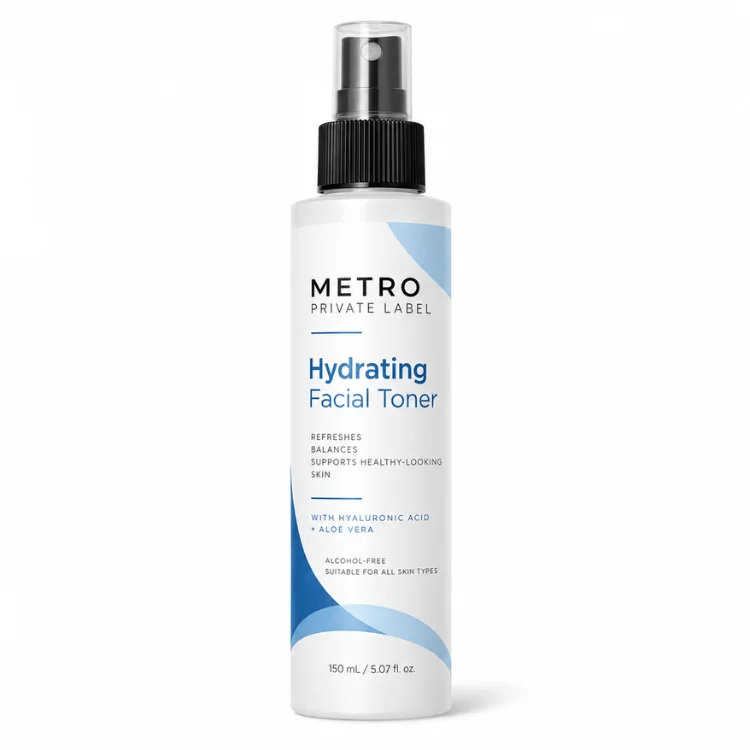
Hydrating Facial Toner
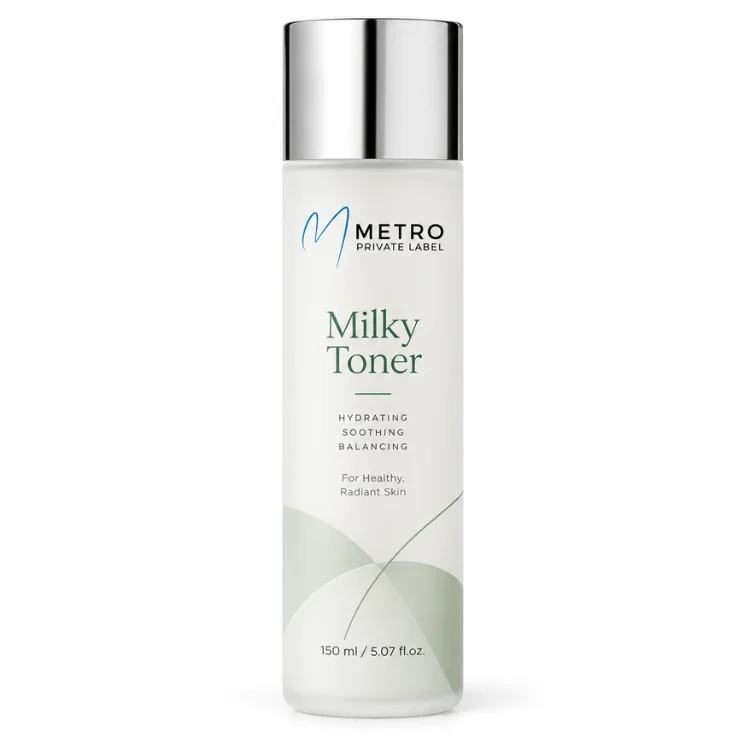
Milky Toner
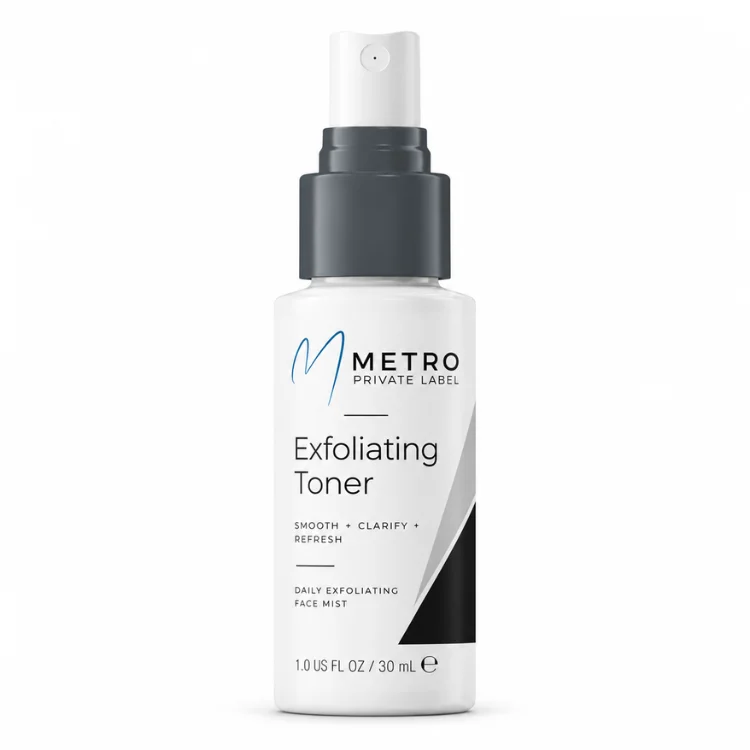
Exfoliating Toner
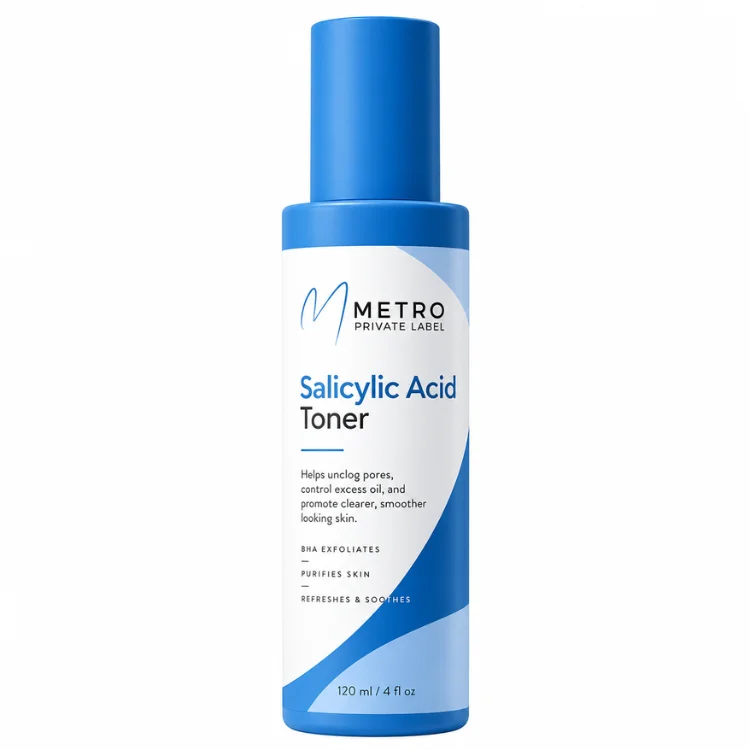
Salicylic Acid / Pore Toner
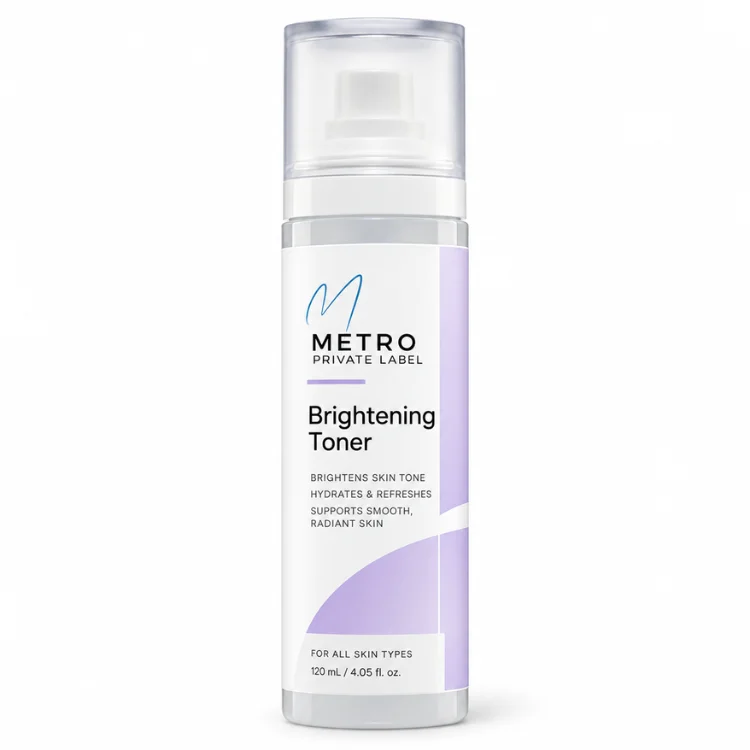
Brightening Toner
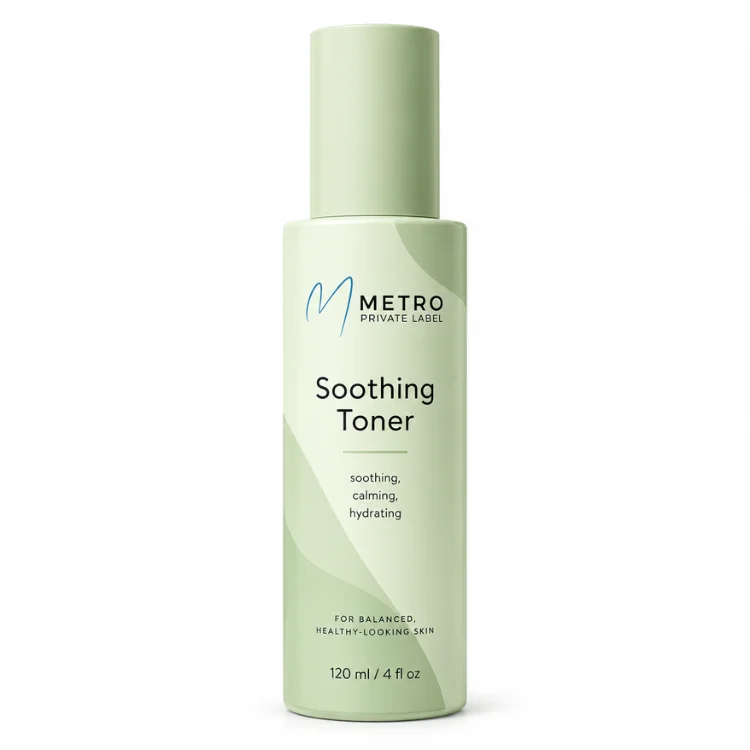
Soothing Toner
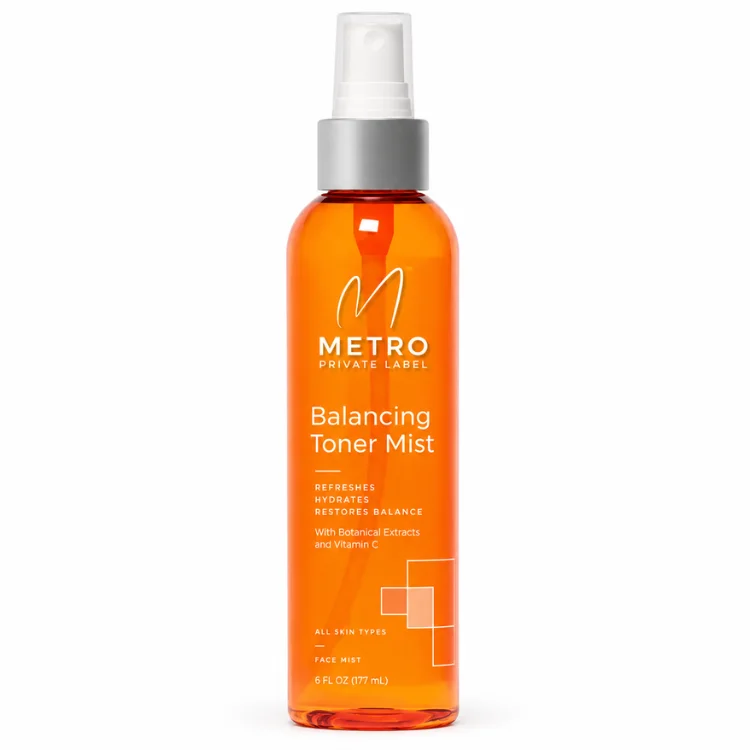
Balancing Toner Mist
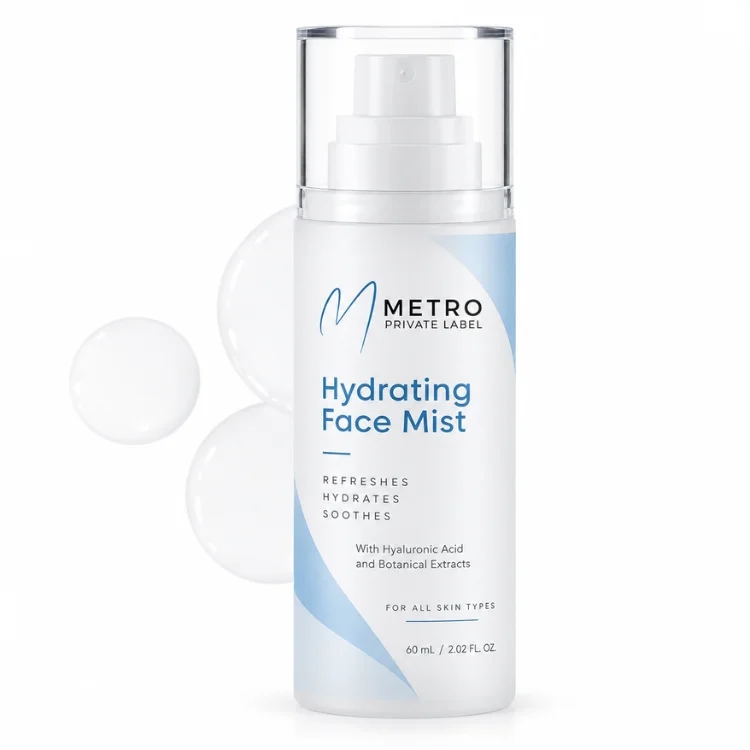
Hydrating Face Mist
Build a Private Label Toners & Mists Line That Fits Your Market
If you are looking for a private label Toners & Mists manufacturer, you are probably not simply searching for a factory that can put a basic water-based formula into a bottle. You may already have an Amazon or Shopify skincare brand, a clinic, a retail business, or an established distribution channel and now need a toner or face mist that fits your customers, price point, product positioning, and the way your existing skincare range is sold.
You have come to the right place. At Metro Private Label, we know that Toners & Mists can look like a simple category, but commercially they can play very different roles. A hydrating toner may be designed to complete a daily skincare routine, a milky toner can support a more premium barrier-care story, an exfoliating or salicylic acid toner may target pores and blemish-prone skin, while a facial mist can be positioned around hydration, soothing, refreshing, or professional skincare use. Before we recommend a formula, we first look at who you are selling to, how the product fits into your current range, your target retail price, preferred packaging, sales channel, and launch goal. This helps us avoid creating a product that sounds attractive during development but has no clear reason for customers to choose it once it reaches the market.
From what we see across skincare projects, Toners & Mists perform best when customers can immediately understand what role the product plays in their routine. This is why we usually develop concepts around clear directions such as hydration, barrier support, pore care, exfoliation, brightening, soothing, or daily skin refreshment. Depending on your positioning, we may use Hyaluronic Acid, Panthenol, and Betaine for hydration, Ceramides and Beta-Glucan for barrier-care concepts, AHA, PHA, or Salicylic Acid for exfoliating and pore-care products, Niacinamide and Vitamin C derivatives for brightening, or Centella, Heartleaf, and Allantoin for soothing formulas. Our role is not to add as many trending ingredients as possible. We help you choose the ingredients, texture, and product format that strengthen the product story while keeping the formula commercially realistic and easier for your customers to understand.
Our Core Private Label Toners & Mists Products
Hydrating Facial Toner: A practical choice for brands building a daily skincare routine around hydration and skin preparation. Formulas can be developed with Hyaluronic Acid, Panthenol, Betaine, Polyglutamic Acid, and other moisture-supporting ingredients.
Milky Toner: Suitable for K-beauty-inspired, barrier-care, and premium hydration positioning. We can develop soft, lightweight milky textures with Ceramides, Squalane, Beta-Glucan, Rice Extract, or Oat-based concepts while balancing richness with fast absorption.
Exfoliating & Pore-Care Toner: Designed for brands targeting uneven texture, excess oil, clogged pores, and blemish-prone skin. Development directions can include AHA, PHA, Glycolic Acid, Lactic Acid, Salicylic Acid, Niacinamide, and supporting soothing ingredients.
Soothing & Brightening Toner: Suitable for sensitive-skin, clinic, and everyday skincare positioning. Formulas can be built around Centella, Heartleaf, Panthenol, Niacinamide, Licorice Extract, and other ingredients that support a clearer, calmer, more balanced product story.
Hydrating & Balancing Face Mist: A flexible format for e-commerce, professional skincare, and retail brands looking for an easy-to-use hydration or refreshment product. We can develop fine-spray mist concepts around Hyaluronic Acid, Aloe, Panthenol, Botanical Waters, and skin-conditioning ingredients.
Manufacturing Support for Toners & Mists Brands
We understand that developing Toners & Mists is not only about choosing the right active ingredients. Many of the problems that affect customer reviews and repeat purchases happen in details that are easy to overlook during early development. A toner that feels too sticky may not fit a layering routine, a milky toner that is too heavy may feel more like a lotion, an acid toner that is too aggressive may create unnecessary complaints, and a facial mist with poor spray performance can make a good formula feel cheap. This is why we look at the formula and packaging together, including viscosity, absorption, pH, active compatibility, clarity, fragrance level, preservation, spray quality, bottle compatibility, and production consistency.
Many brands come to us with a product idea but still need to answer practical questions such as:
Should this toner focus on hydration, pores, brightening, barrier care, or sensitive skin?
Is a milky toner, clear toner, exfoliating toner, or facial mist more suitable for our target customer?
Which ingredients actually strengthen the product positioning instead of only increasing formula cost?
How can we create a premium skin feel while still staying within the target retail price and margin?
Which bottle, pump, or spray format gives the right customer experience and remains stable during shipping and repeat production?
At Metro Private Label, we support the process from formula selection and customization to sample testing, packaging coordination, production, and technical documentation such as INCI lists, COA, SDS, and product specifications. We also help you think beyond the first production run, because a product that sells well needs to be easy to reproduce, reorder, and integrate into a larger skincare range.
Our goal is simple: to help you turn a Toners & Mists idea into a market-ready product with a clear role in the skincare routine, a commercially realistic cost structure, a customer experience that supports repeat purchase, and a manufacturing setup that can grow with your business. Whether you are adding a toner to increase the completeness of an existing skincare line, launching a trend-driven milky toner, developing a clinic-oriented soothing mist, or expanding a distributor portfolio with ready-to-launch products, we want to help you create something that is easier to position, easier to sell, and easier to scale.

More Than Just a Private Label Toners & Mists Manufacturer
At Metro Private Label, we understand that your goal is not simply to launch another toner or face mist. You need a product that fits your customers, supports your target price, communicates a clear reason to buy, and has the potential to generate repeat sales through your existing channel.

Develop Toners & Mists Around Real Market Demand
We first look at your target customer, sales channel, retail price, and product positioning. A hydrating toner for Amazon, a milky toner for a premium skincare brand, a salicylic acid toner for pore care, and a soothing mist for clinics all require different formula strategies, textures, packaging, and cost structures.
Reduce Development Risks Before Mass Production
Toners and mists may look simple, but texture, pH, active compatibility, stability, spray performance, packaging compatibility, and target cost all need to work together. We review these factors early to reduce repeated sampling, unsuitable packaging, unexpected costs, and production delays.
Create Products Customers Understand and Repurchase
Customers are more likely to buy when they clearly understand what the product is designed to do. We develop formulas around hydration, barrier support, pore care, exfoliation, brightening, or soothing, using ingredients such as Hyaluronic Acid, Ceramides, AHA, PHA, Salicylic Acid, Niacinamide, Centella, or Panthenol where appropriate.
Build a Manufacturing Partnership That Supports Growth
From formula selection and sampling to packaging, technical documentation, production, and repeat orders, we support the complete private label process. As your business grows, we can also help expand a successful toner or mist into cleansers, serums, moisturizers, masks, or a broader skincare collection.
Build a Private Label Toners & Mists Line Around Your Business Goals
At Metro Private Label, we understand that creating a toner or face mist is not simply about choosing a few popular ingredients, selecting a bottle, and adding your logo. If you already sell through Amazon, Shopify, TikTok, retail stores, distribution channels, clinics, or professional beauty businesses, you need a product that fits your customers, supports your target retail price, strengthens your existing skincare range, and has the potential to become a repeat-purchase SKU rather than another slow-moving product in your inventory.
Many brands come to us with a clear direction: a hydrating toner, a milky toner, a salicylic acid pore toner, a brightening toner, a soothing formula, or a fine facial mist. But the difference between an attractive idea and a commercially successful product usually comes from the decisions made before production begins. The formula needs to match the customer concern, the texture needs to feel right in the routine, the packaging needs to work with the viscosity and dispensing system, and the final cost needs to leave enough room for your retail margin. This is where we believe a manufacturing partner should provide more than production capacity—we should help you make better product decisions before they become expensive problems.
Develop Toners & Mists Products Based on Your Business Strategy
When we develop a toner or mist, we do not begin by adding as many trending ingredients as possible. We first look at who you are selling to, where the product will be sold, your target retail price, and what role the product should play within your current range. An Amazon or Shopify brand may need a clear hero benefit such as hydration, pore care, brightening, or barrier support that customers can understand quickly. A premium skincare brand may care more about milky texture, layered hydration, skin feel, ingredient sophistication, and packaging experience. A clinic may need a gentle soothing mist that fits naturally into a professional home-care routine, while a distributor may prefer a proven formula that can be launched quickly and reordered consistently.
We connect these commercial requirements with realistic formulation and packaging options so the product is designed around how you actually plan to sell it. This helps prevent a common problem we see in the market—brands developing a formula first and only later trying to create a marketing story around it. By defining the product role, customer need, target cost, and positioning earlier, we can help you create a toner or mist that is easier to explain, easier to market, and easier to integrate into your existing skincare line.
Make Better Product Decisions Before Mass Production
Toners and face mists may look simple, but they involve more technical decisions than many brands initially expect. pH, viscosity, active compatibility, preservation, clarity, fragrance level, skin feel, spray performance, packaging compatibility, and formula stability all need to work together. A hydrating toner that feels too sticky may not layer well with serums, a milky toner that is too heavy may feel more like a lotion, an exfoliating toner that is too aggressive can increase irritation complaints, and a face mist that does not spray evenly can make a good formula feel low quality.
We also pay attention to how the formula interacts with the packaging selected for production. A formula may perform well in a laboratory sample but create problems later if the viscosity does not match the spray pump, if ingredients clog the nozzle, or if the packaging materials are not suitable for the formula. Our role is not simply to manufacture whatever appears on the initial brief. We help identify these practical issues early and recommend adjustments before they lead to repeated sampling, packaging changes, production delays, unnecessary reformulation, or unexpected costs.
Create Toners & Mists Customers Want to Use Again
Customers may first notice a toner because of Hyaluronic Acid, Niacinamide, Ceramides, Salicylic Acid, Centella, Heartleaf, or another trending ingredient, but they continue using it because the complete product experience works for them. The toner needs to absorb comfortably, layer well with other skincare, leave the right finish, and communicate a benefit that makes sense within the routine. A daily hydrating toner should feel different from an exfoliating acid toner, while a milky toner positioned at a premium price needs to provide a richer and more distinctive experience.
Face mists have similar expectations. The mist should feel fine and even, refresh the skin without leaving an unpleasant residue, and deliver a product experience that matches the positioning. We therefore look at ingredient story, texture, absorption, hydration, fragrance, spray quality, packaging usability, and overall product positioning together. Our goal is not to create the longest ingredient list. It is to help you develop a product that feels coherent, easy for customers to understand, and realistic for them to include in their daily routine and purchase again.
Build a Product Foundation for Future Growth
Your first toner or face mist may begin as one SKU, but we also look at what the product could become if it performs well in your market. A successful hydrating toner can later expand into a serum and moisturizer, a milky toner can become part of a complete barrier-care range, an exfoliating toner can support an acne or pore-care system, and a soothing facial mist can naturally connect with clinic-oriented serums, creams, and post-treatment products.
Thinking about this earlier can help maintain consistency across ingredients, packaging style, price architecture, product claims, and customer experience as your range grows. From formula selection and sample development to packaging coordination, technical documentation, bulk production, repeat orders, and future SKU expansion, we work with you throughout the development process.
Our goal is to help you create Toners & Mists products that are not only possible to manufacture, but also easier to position, easier to sell, more reliable to reproduce, and capable of supporting the next stage of your brand growth.
FAQs Toners & Mists
For your convenience, we’ve gathered the most commonly asked questions about our Toners & Mists. However, should you have any further queries, please don’t hesitate to reach out to us.
1. What types of private label toners and face mists can you manufacture?
We can develop a wide range of toner and mist products, including hydrating toners, milky toners, exfoliating toners, salicylic acid pore toners, brightening toners, soothing toners, balancing toner mists, and hydrating face mists. We can also adjust the product direction around your target customer, price level, sales channel, and existing skincare range rather than forcing you to choose from a fixed formula list.
2. Can you customize a toner or mist formula for our brand?
Yes. We can customize the formula around your preferred texture, skin feel, hero ingredients, fragrance level, target concerns, and product positioning. For example, we may build a hydrating concept around Hyaluronic Acid and Panthenol, a milky toner around Ceramides and Beta-Glucan, or a pore-care toner around Salicylic Acid and Niacinamide. We also look at whether those choices make sense for your target price and market positioning before moving into sampling.
3. What is your minimum order quantity for Toners & Mists?
Our standard MOQ is typically around 1,000 units per SKU, although the actual quantity can depend on the formula, bottle, spray pump, printing method, and packaging customization. If you want to launch with a smaller commercial risk, we may recommend using an existing formula and more standard packaging rather than creating a highly customized system from the beginning.
4. Do you offer both ready formulas and custom formulation?
Yes. We support both routes. If speed, budget, and market testing are your priority, an existing mature formula is usually the more efficient option. If your brand already has a clear positioning, reference product, ingredient concept, or sensory requirement, we can develop a more customized formula. We normally recommend the route based on your commercial goal rather than automatically pushing custom development.
5. How long does sampling and production normally take?
For most toner and mist projects, sampling normally takes around 7–14 days depending on the level of customization, while bulk production generally takes around 20–25 days after the formula, packaging, artwork, and order details are confirmed. Custom bottles, special printing, or repeated formula adjustments can extend the timeline, so we usually encourage brands with a fixed launch date to confirm packaging and formulation decisions as early as possible.
6. Can you help us choose suitable packaging for a toner or face mist?
Yes. Packaging is especially important for this category because the formula and dispensing system need to work together. We help you evaluate bottle type, closure, spray pump, dosage, material compatibility, and overall positioning. A fine facial mist requires a different spray experience from a standard toner bottle, while milky or slightly more viscous formulas may also need additional compatibility checks before mass production.
7. How do you handle exfoliating or salicylic acid toner development?
We pay particular attention to pH, active level, ingredient compatibility, skin feel, stability, and irritation risk when working with acid-based toners. More acid does not automatically mean a better product. We usually look at the complete formula and how frequently the final customer is expected to use it, then balance exfoliating performance with supporting hydration and soothing ingredients so the product remains commercially usable rather than simply looking strong on an ingredient list.
8. What quality and stability checks do you perform before production?
Before bulk production, we review formula stability, appearance, odor, viscosity, pH, packaging compatibility, and product performance based on the formula type. For facial mists, we also pay attention to spray performance and whether the formula works consistently with the selected pump. Additional third-party testing can also be arranged when your target market, retailer, or brand requirements call for it.
9. Can you provide technical documents for regulatory and marketplace requirements?
Yes. Depending on the project, we can provide supporting technical documents such as the INCI list, COA, SDS, product specifications, and relevant manufacturing information. We also work with clients who need documents for Amazon, distributors, retailers, or regulatory preparation. Because requirements vary by market, we recommend confirming the target country early so the product, label, claims, and supporting documentation can be planned correctly.
10. Can you support repeat orders and future Toners & Mists line expansion?
Yes. We do not look at a toner or face mist as a one-time production project. If the first SKU performs well, we can help you maintain production consistency, reorder the same formula and packaging, or expand the concept into related products such as cleansers, serums, moisturizers, masks, or other products within the same skincare routine. Our goal is to make the first project easier to scale rather than forcing you to rebuild the supply chain every time your brand adds another SKU.
What we valued most was how Metro Private Label helped us narrow down the product direction before sampling. We were considering several toner concepts, and their team helped us compare hydration, brightening, texture, packaging, and target cost together. That made the development process much more focused and helped us avoid unnecessary formula changes later.
Sophie Laurent, Skincare Product Managerfrom France
We needed a toner that could fit naturally into an existing online skincare range without creating a complicated development process. Metro Private Label gave us clear feedback on the formula, packaging, and price structure, and the communication stayed practical throughout sampling and production. It was helpful working with a supplier that understood both product development and the pace of e-commerce.
Marcus Bennett, E-commerce Brand Operatorfrom United States
Our main concern was consistency because the product was intended for repeat orders. Metro Private Label was clear about sampling, packaging compatibility, production timing, and the technical documents we would need. The process was well organized, and we appreciated that they raised potential production issues before we moved into the bulk order.
Helena Fischer, Private Label Buyerfrom Germany
We wanted a soothing toner and mist concept that felt professional enough for our clinic but simple enough for clients to use at home. Metro Private Label helped us balance skin feel, packaging, formula positioning, and cost instead of overcomplicating the ingredient list. The final direction felt much more aligned with how we actually sell skincare to our clients.
Amelia Thornton, Aesthetic Clinic Ownerfrom United Kingdom
We were looking for products that could be launched quickly through an existing retail network. Metro Private Label helped us evaluate mature formula options, packaging choices, and different price levels so we could make decisions faster. Their approach was practical and commercially focused, which made the sourcing process much easier for our team.
Lucas Moretti, Beauty Distribution Managerfrom Italy





Metro Private Label in Numbers
Happy Clients
0 +
Million-dollar Buyers
0 +
Formulation
0 +
Professional Staffs
0 +
Your Ultimate Guide to Toners & Mists
If you’re planning to add a toner or face mist to your skincare lineup—whether you’re completing an existing routine, testing a new category, or building a more focused barrier-care, pore-care, or professional skincare range—you’re not simply choosing another lightweight liquid product. Toners and mists can play very different commercial roles depending on how they are positioned. A hydrating toner may help complete a daily routine and increase cross-selling opportunities, a milky toner can support premium barrier-care positioning, an exfoliating or pore-care toner can give e-commerce brands a clearer problem-solution story, while a soothing face mist may fit naturally into clinic, sensitive-skin, or professional skincare programs. When the product direction matches the customer, channel, price point, and wider SKU strategy, a toner can become a repeat-use step rather than an optional product customers easily skip.
Over the years, we’ve seen the toner category move far beyond the traditional “cleansing and balancing” role. Brands now use toners and mists to create hydration layers, barrier-support routines, exfoliating treatments, pore-care systems, and convenient on-the-go skincare experiences. At Metro Private Label, we’ve also seen that the products which look simplest from the outside can still create some of the most frustrating development problems behind the scenes. Texture can become too sticky, a milky toner can feel too heavy, acid systems can become too aggressive, and a facial mist can lose perceived value simply because the spray pump does not match the formula. Packaging compatibility, pH, viscosity, preservation, testing, target cost, and repeat-order consistency all need to be considered early if the product is expected to scale rather than become a one-time launch.
This guide is built around what we’ve learned from developing and evaluating toner and mist projects from a manufacturing and commercial perspective. Instead of focusing only on ingredient trends, we want to explain the decisions brands actually face before placing a production order: which toner format fits a specific sales channel, when a ready-made formula makes more sense than custom development, what really drives project cost, how packaging choices create technical risks, why acid toners require more control, what testing and documentation may be needed, and why a laboratory sample still needs to prove itself in commercial production. Our goal is to help you understand what is happening behind the quotation and the sample so you can make better product decisions, reduce avoidable development risk, and build a Toners & Mists line that is easier to launch, reproduce, and grow over time.
Table of Contents
How to Choose the Right Toner or Face Mist for Your Brand and Sales Channel
When a brand asks which toner or face mist it should launch, the answer should rarely begin with a trending ingredient. The more important question is what commercial role the product needs to play. A hydrating toner, milky toner, exfoliating toner, pore-care toner, soothing toner, and facial mist may all sit within the same broad category, but they solve different customer needs, support different price points, and behave very differently across Amazon, Shopify, clinics, distributors, and retail channels. In real product-development discussions, the strongest projects normally start by defining the target customer, sales channel, intended retail price, current SKU structure, expected margin, and the reason this product needs to exist before the formula direction is finalized. Once those commercial conditions are clear, decisions around texture, hero ingredients, packaging, claims, and testing become much easier to make. This is why toner selection should be treated first as a product strategy decision and only then as a formulation decision.
Start With the Role the Product Needs to Play in the Range
Before choosing between a hydrating toner, milky toner, exfoliating toner, or mist, it is important to understand whether the product is supposed to become a hero SKU, complete an existing routine, increase average order value, support a clinic home-care program, or simply add another easy-to-sell item to a distributor portfolio. These roles require very different levels of differentiation. If a brand already sells cleanser, serum, and moisturizer, another highly active treatment may not add much value, while a hydrating or soothing toner can strengthen the routine and create more opportunities for bundling and repeat purchase. A newer brand entering a crowded category may need something more distinctive, such as a milky toner or pore-care toner, because the product needs a clearer reason to attract attention. Sales channel matters as well. An Amazon product has to communicate its benefit in seconds through a title, image, and a few claims, while a premium Shopify brand has more space to explain texture, ingredient story, ritual, and positioning. The best choice therefore depends less on which toner is currently popular and more on what job the SKU needs to perform inside the business.
Hydrating Toners Work Best When the Brand Needs Broad Appeal
Hydrating toners are often one of the most commercially flexible choices because the product is easy to understand, works across a broad range of skin types, and fits naturally between cleansing and serum. This makes them especially useful for brands that want to complete a routine without introducing too much complexity. The challenge is differentiation, because hydration is already a familiar promise and there are many similar products competing for attention. The real work therefore moves into texture, absorption speed, ingredient story, finish, and how the toner connects with the rest of the skincare line. A lightweight formula using ingredients such as Hyaluronic Acid, Panthenol, Betaine, or Polyglutamic Acid may suit a modern e-commerce brand, while a more botanical direction may be more appropriate for a natural-positioned range. What matters most is not building the longest ingredient list but creating a hydration concept that feels clear, comfortable, and easy to use every day. From a commercial perspective, that daily usability is what gives a toner repeat-purchase value rather than simply making it look attractive on the product page.
Milky Toners Make More Sense When Texture and Premium Positioning Matter
Milky toners are particularly useful when a brand wants to create a stronger sense of nourishment, barrier support, K-beauty influence, or premium hydration. Their commercial value comes partly from the fact that the texture itself becomes part of the product story. Customers expect a milky toner to feel noticeably different from a standard clear toner, but it still needs to remain light enough to sit comfortably between cleansing and serum. If the formula becomes too heavy, oily, or lotion-like, the product can lose the layered skincare experience that makes the category attractive in the first place. Ingredients such as Ceramides, Squalane, Beta-Glucan, Rice Extract, Oat, or Panthenol can support barrier-care positioning, but the final result still needs to absorb cleanly, layer well, and justify the intended price point. Packaging also matters more in this category because a premium milky toner sold at a higher retail price needs the bottle, closure, dispensing experience, and visual presentation to support that value. The strongest milky toner is therefore not simply a trendy opaque formula; it is a product where texture, ingredients, packaging, and brand positioning all reinforce the same commercial message.
Exfoliating Toners Need a Strong Problem-Solution Story
Exfoliating toners can be easier to sell because the customer immediately understands the problem they are intended to address, whether that is uneven texture, dullness, surface buildup, or smoother-looking skin. At the same time, this is one of the toner categories where the formulation strategy needs to be controlled carefully because marketing strength and customer tolerance do not always move in the same direction. AHA, PHA, Glycolic Acid, Lactic Acid, and Mandelic Acid can support different product stories, but a higher acid level does not automatically create a better commercial product. The formulation needs to consider pH, use frequency, target skin type, supporting hydration, the presence of other active products in the routine, and the amount of irritation the customer is realistically willing to tolerate. A formula can look impressive in marketing materials but still perform poorly commercially if customers find it uncomfortable and stop using it. For Amazon and TikTok brands, the clear benefit of an exfoliating toner can be a major advantage, while premium DTC brands may place more emphasis on a refined skin feel and a gentler treatment experience. The strongest product direction balances a recognizable result with enough comfort to support regular use and repeat purchase.
Pore-Care Toners Need to Match Oily and Blemish-Focused Customers
Pore-care toners deserve separate consideration because their customer intent is usually more specific than that of a general exfoliating toner. These products are often purchased by people concerned with excess oil, clogged pores, blackheads, or blemish-prone skin, which gives the brand a much clearer target audience and a stronger problem-solution message. Salicylic Acid is often central to this category, but the supporting formula is just as important. Niacinamide, Zinc PCA, lightweight humectants, and soothing ingredients can help create a more balanced experience and prevent the formula from feeling unnecessarily harsh. One of the common mistakes in this category is building the entire concept around stronger oil control while ignoring how the skin feels after repeated use. A toner that leaves the skin tight or stripped may create a strong first impression, but it can weaken long-term satisfaction and repurchase. For acne-focused Amazon brands, pore-care positioning can be particularly easy to communicate, while clinic or professional skincare channels may require a more controlled approach that fits within a wider treatment routine. The commercial opportunity is strong, but only when the product remains usable enough to become part of a customer’s regular skincare behavior.
Soothing Toners Work Best When Trust and Daily Use Matter More Than Aggressive Claims
Soothing toners often perform best in channels where trust, comfort, and repeat use are more important than dramatic short-term claims. This makes them especially relevant for sensitive-skin brands, clinics, barrier-care lines, and businesses that want a product customers can use consistently without feeling that every step of the routine needs to be highly active. Ingredients such as Centella, Heartleaf, Panthenol, Allantoin, and Beta-Glucan can support this positioning, but the overall formula still needs to consider fragrance level, finish, irritation potential, and compatibility with the serum and moisturizer that follow. In clinic and professional skincare settings, a soothing toner can also function as part of a broader home-care system rather than as a standalone hero product. Its value may come from supporting cleanser, repair serum, moisturizer, or post-treatment care rather than delivering one dramatic visible claim. This type of product is often commercially stronger than it first appears because it can become a dependable daily-use SKU with good repeat-purchase potential, especially when the brand already has an audience that values gentle, consistent skincare over aggressive treatment.
Face Mists Should Be Chosen Around the Usage Moment
A face mist should not be treated as simply a toner placed into a spray bottle because the usage occasion is different and the packaging becomes part of the product experience. A toner is normally used at a fixed point after cleansing, while a mist may be used before skincare, during the day, after treatment, while travelling, or whenever the customer wants quick hydration or refreshment. That difference changes the product strategy. A hydrating mist can work well for lifestyle and DTC brands, a soothing mist can fit naturally into clinic or sensitive-skin routines, and a balancing toner mist can sit between traditional toner use and on-the-go refreshment. Spray quality becomes critical because droplet size, pump consistency, coverage, residue, and nozzle performance all influence perceived value. A strong formula can still feel inexpensive if the mist lands unevenly or the pump produces a coarse spray. For this reason, the delivery system needs to be evaluated as part of the product itself rather than as a packaging decision made after formulation. The most successful mists normally have a clearly defined usage moment and a spray experience that reinforces that positioning every time the customer uses the product.
Amazon Brands Need Clear Benefits and Low Review Risk
For Amazon brands, toner selection is usually driven by clarity, review risk, and replenishment reliability. Customers make decisions quickly, so products positioned around hydration, pore care, exfoliation, soothing, or brightening are often easier to understand than broad concepts such as “skin balancing” or “multi-benefit treatment.” At the same time, operational problems can directly affect reviews. A sticky texture, leaking bottle, aggressive acid level, inconsistent pump, or poor packaging can become visible to customers immediately and create negative feedback that affects ranking and conversion. This is why the most commercially effective Amazon toner is not always the most technically complicated formula. In many cases, a clear product promise, comfortable skin feel, reliable packaging, and stable repeat production are more valuable than an ingredient list designed only to look impressive. The product needs to be easy to understand before purchase and predictable after purchase, because both factors influence whether an e-commerce SKU can scale successfully.
Premium Shopify Brands Can Use Texture and Experience as Differentiation
Premium Shopify and DTC brands have more space to build a story around texture, ingredients, ritual, packaging, and overall product experience, which gives them more freedom to explore milky toners, essence-like textures, barrier-support concepts, and premium facial mists. The challenge is that a higher retail price also raises customer expectations. A product positioned at a premium level needs to feel intentional from the first interaction, including the bottle, closure, viscosity, absorption, finish, and the way the formula layers with the rest of the routine. One fashionable ingredient is rarely enough to justify the positioning on its own. The product experience needs to support the price from beginning to end. This is where texture can become a real point of differentiation rather than just a technical detail. A well-developed milky toner can create a richer, more recognizable experience than a standard clear liquid, while a premium facial mist can use spray quality and sensory feel as part of the brand story. For DTC brands, the strongest product concepts are usually the ones where the sensory experience, packaging, ingredient narrative, and broader brand identity all feel consistent.
Clinics Should Focus on Compatibility With Professional Routines
Clinic and aesthetic businesses normally need to evaluate toner and mist products through a different commercial lens because the product often needs to support an existing treatment relationship rather than compete for attention as a standalone retail item. A soothing toner, hydrating mist, or barrier-support formula can make more sense than an aggressive exfoliating product when customers are expected to use it consistently at home. Comfort, perceived safety, packaging professionalism, and compatibility with cleanser, repair serum, moisturizer, or other recommended products become more important than trend appeal. The commercial value comes from extending the clinic experience into the customer’s daily routine and creating a product that feels appropriate to purchase alongside treatments. When the formulation and positioning are coherent with the clinic’s professional image, the toner or mist can become part of a repeat-purchase home-care system rather than simply another item on the retail shelf. This makes the category especially useful for clinics that already have strong customer relationships but do not want to build their entire retail strategy around highly aggressive active formulas.
Distributors and Retail Buyers Usually Need Proven and Easy-to-Explain Products
Distributors and retail buyers often approach toner development more pragmatically than brand founders because their first questions are usually about how quickly the product can be launched, whether the price structure works, whether retailers and consumers will understand the category, and whether supply can remain stable once the product begins selling. Mature concepts such as hydrating toner, soothing toner, pore-care toner, and simple facial mists can therefore be more commercially suitable than highly customized formulations that require long development cycles. If a distributor is testing several SKUs at once, reducing complexity can lower inventory risk and make it easier to identify which products deserve larger repeat orders. The strongest product is often not the one with the most unique formulation but the one that can be explained quickly, fits the target retail price, moves efficiently through the channel, and can be reordered without supply-chain disruption. For this customer type, product selection is closely connected to inventory efficiency and repeat supply rather than purely to brand differentiation.
The Best Product Choice Usually Comes From the Business Model, Not the Ingredient Trend
There is no universally best toner or face mist because the right product depends on the business model behind it. A milky toner may be the strongest choice for a premium barrier-care brand, while a salicylic acid toner may make more sense for an acne-focused Amazon business. A soothing mist can fit naturally into a clinic home-care routine, while a distributor may be better served by a mature hydrating toner that can launch quickly and support repeat orders. The decision becomes much clearer once the target customer, sales channel, retail price, margin structure, existing SKU range, and future product strategy are understood. From there, texture, hero ingredients, packaging, development route, and testing requirements can be selected with much more purpose. In practical product development, the strongest toner concepts are rarely created by chasing the newest ingredient trend first. They are created by understanding what the business actually needs the product to accomplish and then building the formula around that commercial reality.
Ready-Made Formula vs Custom Toner Formulation: Which Route Makes More Business Sense?
When a buyer searches for a custom toner manufacturer or asks whether they should use a ready-made formula, the real question is usually not about formulation alone. It is about how much development risk the business should take, how quickly the product needs to reach the market, how much differentiation is actually necessary, and whether the expected sales volume justifies a longer development process. In practice, I do not consider custom formulation automatically more professional or more valuable than using an existing mature formula. A distributor testing several SKUs, an Amazon seller moving quickly into a new category, and an established beauty brand developing a signature milky toner may all need completely different development routes. The right decision depends on the product strategy, target margin, launch deadline, customer expectations, packaging plan, and how much uncertainty the business can realistically absorb before the first production order.
A Ready-Made Formula Is Often the Better Choice When Speed Matters More Than Originality
A mature ready-made formula can be commercially stronger than a custom formula when the main objective is to enter the market quickly, control development cost, and reduce uncertainty. This is especially common with distributors, retail buyers, first-time brands, and e-commerce operators testing whether a toner category will perform with their existing customers. A formula that has already gone through previous production cycles usually gives the buyer a clearer understanding of texture, appearance, filling behavior, packaging compatibility, and expected manufacturing performance before significant money is committed. The main advantage is not simply lower development cost; it is the reduction in decisions that need to be made before launch. Instead of spending weeks discussing every ingredient or adjusting small sensory details, the brand can focus on product positioning, packaging, artwork, pricing, and sales preparation. When the market is still unproven, reducing development complexity can be a much more rational business decision than trying to create something highly customized from the first order.
Custom Formulation Makes More Sense When the Product Already Has a Clear Strategic Role
Custom development becomes more valuable when the brand already understands why the product needs to be different. If a beauty company has a clear reference product, defined target texture, specific hero ingredients, a known customer profile, and a price level that supports additional development, then customization can create meaningful differentiation rather than complexity for its own sake. I normally see the strongest custom projects coming from brands that can explain not only what ingredients they want but also what experience the final product should create. For example, a premium barrier-care brand may want a milky toner that feels richer than a standard hydrating toner but lighter than an emulsion, while an acne-focused DTC brand may want an exfoliating toner with a specific acid profile, low tack, and enough soothing support for frequent use. In these situations, formulation work directly supports product positioning, which gives the additional sampling and testing a clear commercial purpose.
The Biggest Difference Is Usually the Number of Decisions That Need to Be Made
One of the most underestimated differences between ready-made and custom formulation is how many variables remain open during development. With an existing formula, many technical decisions have already been resolved, so the buyer is usually choosing among proven options and adjusting selected elements such as fragrance, packaging, or positioning. With custom formulation, almost every decision can influence another one. Changing the viscosity may affect packaging choice, adding a new active may affect pH or stability, changing the texture may alter the sensory profile, and increasing the concentration of a hero ingredient may push the cost beyond the original target. This is why custom development often takes longer even when the requested changes appear simple on paper. The process is not only about making a different formula; it is about repeatedly narrowing technical and commercial variables until the product becomes stable, manufacturable, and aligned with the business brief.
Sampling Cycles Can Change the Entire Launch Timeline
Sampling is usually where the difference between the two routes becomes most visible. A mature formula can often move into evaluation relatively quickly because the base system, texture, preservation, and manufacturing behavior are already understood. Custom development normally involves more iteration because the first sample is often used to clarify the brief rather than finalize the product. A brand may discover that the requested milky texture is too heavy, the fragrance is stronger than expected, the acid toner feels too aggressive, or the skin finish does not match the reference product. Each adjustment can create another sampling cycle, and that time needs to be considered alongside packaging lead time, artwork confirmation, testing, and production scheduling. When a launch date is tied to a seasonal campaign, Amazon inventory window, retailer listing, or distributor commitment, an additional two or three rounds of sampling can become commercially significant. This is why I prefer to discuss the acceptable development timeline before deciding how customized the first version really needs to be.
Testing Requirements Increase as the Formula Moves Further From a Proven System
A custom formula usually creates more testing responsibility because the product has less production history behind it. Stability, microbiological quality, packaging compatibility, pH, appearance, odor, viscosity, and other characteristics may all need closer observation depending on the formulation and target market. This is particularly relevant when working with acid systems, milky emulsified toners, high levels of botanical extracts, unusual active combinations, or formulas intended for spray packaging. Even a small formulation change can alter the way the product behaves over time or interacts with a bottle, pump, or closure. A ready-made formula does not remove the need for appropriate quality control, but it can reduce some of the technical uncertainty because the underlying system has already been used before. From a business perspective, the testing question should therefore be considered together with launch timing and risk tolerance rather than treated as a technical issue that appears only after the formula has been approved.
Custom Formulation Usually Costs More Before the First Unit Is Sold
The cost difference between ready-made and custom development is often misunderstood because buyers focus only on the final unit price. In reality, much of the extra cost of customization appears before mass production begins. Additional sampling rounds, specialized raw materials, low-volume ingredient purchasing, packaging trials, stability work, third-party testing, and development time can all increase the amount invested before the brand has generated any revenue from the SKU. A custom toner may still have an attractive production cost once volume increases, but the first order needs to absorb more development expense and uncertainty. For a brand with an established channel and proven demand, this can be justified because differentiation may support a higher retail price or stronger customer retention. For a startup or distributor still testing the category, the same investment may simply increase the break-even point without creating enough additional sales value.
MOQ Is Influenced by More Than the Formula Itself
Buyers often associate low MOQ with ready-made formulas and high MOQ with custom formulas, but the reality is more complicated. Formula choice matters, but packaging, decoration, raw-material purchasing, filling requirements, and supplier minimums can affect the practical MOQ just as much. A ready-made toner paired with a standard bottle and label may be easier to produce at a relatively controlled quantity because most of the supply chain is flexible. A custom formula using specialized actives, custom-colored bottles, printed pumps, or unique cartons can create higher minimums even if the liquid itself could technically be produced in a smaller batch. This is why I prefer to look at MOQ as a full-project issue rather than a single manufacturing number. A brand trying to reduce inventory risk often gains more by simplifying packaging and customization than by negotiating only the filling quantity.
Differentiation Should Be Measured by Customer Value, Not by the Number of Custom Ingredients
One of the most common reasons brands choose custom formulation is fear of looking the same as competitors, but differentiation does not always require rebuilding the entire formula from zero. A product can be differentiated through texture, hero ingredient strategy, packaging, usage experience, positioning, target customer, or the way it fits into a larger routine. I have seen brands request multiple trending actives simply because they wanted the product to feel more unique, only to end up with higher costs and a message that became harder for customers to understand. In many cases, a mature base formula with one or two meaningful adjustments can create enough separation for the market while keeping development manageable. The important question is whether the customer can recognize the difference and whether that difference supports the intended retail price. If the customization cannot be explained clearly or felt during use, it may not create enough commercial value to justify the additional complexity.
Established Brands Can Use Custom Development to Protect Long-Term Product Architecture
Custom formulation becomes more strategic when a brand is building a long-term product system rather than a single isolated SKU. An established company may want the toner to share certain ingredients, textures, claims, or sensory characteristics with its serum, moisturizer, or future line extensions. In this case, the value of customization extends beyond the first toner because the formula becomes part of a broader product architecture. A barrier-care range, for example, may use a consistent combination of Ceramides, Panthenol, Beta-Glucan, and a recognizable skin feel across several products, while an acne-focused line may need controlled exfoliation and oil-management logic across toner, serum, and cleanser. When the brand already has repeat customers and plans to build multiple related SKUs, the additional development work can create consistency that strengthens the range over time. This is a very different reason for choosing custom formulation than simply wanting to say the product is “exclusive.”
Distributors and Retail Buyers Usually Gain More From Proven Formulas and Faster Market Testing
For distributors and retail buyers, I usually see more commercial value in reducing development time than in maximizing formulation uniqueness. Their advantage comes from an existing channel, so the key question is often how quickly a product can be placed into that channel and whether the economics work at retail. A proven hydrating toner, soothing toner, or pore-care toner can be easier to present to buyers, easier to price, and easier to reorder if the first test performs well. If several SKUs are being introduced at once, fully customizing every product can slow down the entire portfolio and increase inventory exposure before the distributor knows which products will actually move. A practical approach is often to begin with mature formulas, identify the categories that sell, and then invest in more customized versions once real demand is visible. This allows the channel itself to guide future product development instead of forcing the business to predict everything before launch.
E-Commerce Brands Need to Balance Speed With a Clear Reason to Buy
Amazon, Shopify, and TikTok brands face a different trade-off because speed matters, but so does product differentiation. A completely generic toner may be difficult to advertise, while a highly customized formula can delay the launch long enough to miss a market window. The best route is often somewhere between the two extremes. A mature formulation platform can sometimes be adjusted around a more distinctive texture, hero ingredient, fragrance-free positioning, or packaging experience without rebuilding the entire product. This gives the brand a clearer story while keeping the technical risk and development time under control. For performance-driven e-commerce, I place significant value on this balance because a product has to be different enough to generate interest but reliable enough to receive consistent reviews, replenish quickly, and maintain margin once advertising spend increases.
The Right Route Should Also Consider What Happens After the First Order
A development decision should not be made only around the first launch. If the product sells, the brand will need to reproduce the same formula, source the same packaging, maintain quality, and possibly increase volume quickly. Ready-made formulas can offer an advantage here because the manufacturing system is already established, while a well-developed custom formula can also scale effectively once all technical details have been finalized. Problems usually appear when the first order relies on ingredients, packaging components, or specifications that are difficult to source consistently. A product that looks highly differentiated at 1,000 units but becomes difficult or expensive to reproduce at 10,000 units may create a supply-chain problem exactly when the business starts growing. I therefore consider raw-material availability, packaging continuity, production repeatability, and future volume before deciding how complex a custom project should become.
The More Professional Choice Is the Route That Matches the Commercial Risk
The most important lesson is that ready-made and custom formulation should not be viewed as “basic” versus “professional.” Both can be professional decisions when they match the business objective. A first-time brand with an untested sales channel may make a very disciplined decision by using a mature formula, standard packaging, and a controlled initial order. An established brand with a strong customer base and clear product brief may be equally disciplined by investing in a custom toner that strengthens its long-term positioning. Problems begin when the development route is chosen for emotional reasons rather than commercial ones, such as believing that every premium product must be completely custom or that the lowest-cost ready formula is always the safest option. The better approach is to compare differentiation, cost, timing, testing, MOQ, margin, and scalability together. Once those factors are clear, the choice between ready-made and custom formulation usually becomes much easier to justify.
What Does It Really Cost to Launch a Private Label Toner or Face Mist?
When a buyer asks how much it costs to launch a private label toner or face mist, I rarely think the most useful answer is a single unit price. The real project cost is built from several connected decisions: the formula, active ingredients, filling volume, bottle, spray system, decoration, carton, sampling, testing, documentation, order quantity, and freight all influence the final investment. This is why two 100 ml toners can look almost identical from the outside but have very different cost structures once the full project is calculated. One may use a mature hydrating formula in a standard PET bottle with a pressure-sensitive label, while another uses a custom milky formula, imported actives, a frosted bottle, custom printing, a premium pump, a printed carton, additional compatibility testing, and third-party documentation. From a B2B perspective, the important question is therefore not simply “How much is the toner?” but “What combination of product, packaging, compliance, and quantity makes financial sense for the way I plan to sell it?”
The Formula Is Only One Part of the Total Project Cost
The bulk formula is often the first number buyers focus on, but in many toner and mist projects it is not the largest cost driver. A basic hydrating toner using familiar humectants and botanical extracts may be relatively economical to produce, while a milky toner, acid toner, or active-heavy treatment mist may require more expensive raw materials, additional emulsification work, tighter pH control, or more complex preservation. The formula cost also changes with filling volume, because a 150 ml toner naturally uses more bulk than a 100 ml product, but the relationship is not always proportional because packaging and processing costs remain separate. What matters commercially is how much of the final product value comes from the formula itself. If a brand is targeting mass retail, it may need to keep the formulation efficient so enough margin remains for packaging, freight, advertising, distributor markup, and retailer margin. If the product is positioned at a premium price, the formula may justify more expensive actives or a more distinctive texture, but only when those features can be communicated clearly to the customer.
Active Ingredients Can Change Cost Much More Than Buyers Expect
Active ingredients are one of the areas where project cost can move quickly because the price difference between raw materials is often much greater than the customer sees from the finished product. A toner built around Glycerin, Panthenol, and Niacinamide has a very different raw-material profile from one using high levels of peptides, specialty ferments, premium botanical extracts, PDRN, encapsulated actives, or imported branded ingredients. Concentration also matters. Increasing an active from a supporting level to a hero level can raise cost significantly, especially when several premium ingredients are combined in the same formula. I often see brands assume that adding more actives will automatically justify a higher retail price, but commercially that is not always true. If the customer cannot understand the added value, the formula cost rises without improving conversion. For this reason, I prefer to look at active ingredients through both a formulation and margin lens, asking whether each one contributes meaningfully to the product story, customer experience, or price positioning rather than treating a long INCI list as a sign of quality.
Filling Volume Changes More Than the Cost of the Liquid
A 50 ml mist, 100 ml toner, and 150 ml toner are not simply the same product in different sizes. Filling volume affects the amount of formula used, bottle dimensions, shipping weight, outer-carton configuration, warehouse space, and sometimes the perceived retail value of the product. Larger volumes can be attractive in categories such as toner because customers often expect generous daily-use sizes, but they also increase landed cost and freight exposure. A 150 ml glass bottle may look premium, yet its weight and breakage risk can change the economics significantly compared with a 100 ml PET bottle. On the other hand, reducing the volume too aggressively can make the product feel poor value if the retail price remains high. I therefore look at filling size as a commercial decision rather than a cosmetic detail. The right volume needs to support expected usage frequency, retail positioning, margin, channel economics, and freight efficiency at the same time.
Packaging Can Cost as Much as or More Than the Formula
Packaging is one of the biggest reasons two toner projects with the same fill volume can end up with very different quotations. A standard stock bottle with a simple cap or mist pump can be relatively cost-efficient, while custom-colored bottles, frosted finishes, thick-wall packaging, custom molds, decorated closures, premium pumps, or imported components can quickly raise the unit cost. This is especially important for face mists because the spray system is not merely decorative; it directly affects the user experience. A higher-quality fine-mist pump may cost more than a basic sprayer, but it can also create a noticeably better application experience. The same principle applies to toners using pumps, disc-top caps, reducers, or specialty closures. In many projects, I find that packaging decisions influence the budget more than small formula adjustments, which is why it is risky to discuss unit cost before the packaging direction has been defined.
Printing and Decoration Can Create Hidden Minimums
Decoration is another area where buyers often underestimate how quickly cost and MOQ can change. A simple label is usually the most flexible option because the print quantity can stay relatively low and artwork can be updated without changing the bottle itself. Direct screen printing, hot stamping, metallic effects, gradient coating, custom bottle colors, or multi-pass decoration can create a more premium appearance, but they often come with higher setup fees, minimum quantities, and longer lead times. A buyer may request 1,000 finished units but discover that the decorated bottle supplier requires 3,000 or 5,000 pieces per color or design. That does not necessarily make the project impossible, but it changes the cash flow and inventory structure because packaging may need to be purchased in larger quantities than the first filling run. This is one reason I prefer to evaluate packaging decoration early: what looks like a small aesthetic upgrade can change the project economics more than the toner formula itself.
Cartons and Secondary Packaging Should Be Included From the Beginning
Outer cartons are sometimes treated as an optional finishing detail, but for many retail, Amazon, and premium DTC projects they are part of the real landed product cost. A folding carton adds material, printing, finishing, assembly, and additional packaging labor, and more elaborate finishes such as foil stamping, embossing, special coatings, inserts, or textured papers raise the cost further. Carton dimensions also affect how many units fit into a master carton and how efficiently the products ship. A large decorative box may create strong shelf presence but increase freight cost and storage space without changing the amount of product inside. For e-commerce brands, I also consider whether the carton adds enough perceived value to justify the extra weight and shipping exposure. The strongest packaging decisions usually balance visual presentation with operational efficiency rather than assuming more packaging automatically means a more premium product.
Sampling Cost Is Small Compared With the Cost of a Wrong Production Decision
Sampling is often one of the smallest parts of the total project budget, yet it has one of the highest decision-making values. A buyer may compare a sample fee against the cost of a full bulk order and see it as an unnecessary expense, but from my perspective the sample stage is where many of the most expensive mistakes can still be corrected cheaply. Texture, fragrance, absorption, color, pH, spray feel, bottle compatibility, and overall product positioning can all be evaluated before thousands of finished units are produced. A custom formula may require several rounds of sampling, while a ready-made formula can usually move faster, but either route still benefits from proper evaluation. The cost of one additional sample round is normally insignificant compared with the cost of discovering after production that a milky toner feels too heavy, an acid toner is too aggressive, or a mist pump does not deliver the expected spray pattern.
Compatibility Testing Protects the Investment in Both Formula and Packaging
Formula and packaging compatibility can become a major hidden cost when it is ignored. A toner may remain stable in a laboratory container but behave differently once it is filled into the final bottle, exposed to a spray pump, stored for longer periods, or transported through changing temperatures. The product can discolor, develop odor changes, interact with packaging materials, leak through a closure, clog a nozzle, or change spray performance. A milky toner may also behave differently from a clear water-based toner because its viscosity and dispersed phase create additional packaging considerations. Compatibility checks require time and sometimes additional samples or testing, but I see this cost as risk control rather than an unnecessary technical expense. The more customized the formula and packaging become, the more important it is to confirm that both systems work together before mass production.
Technical Documentation and Third-Party Testing Depend on the Market
Documentation can range from basic manufacturing information to more extensive market-specific testing, and this is another reason the total project cost cannot be reduced to one unit price. Depending on the destination market and sales channel, a brand may need an INCI list, COA, SDS, product specifications, microbiological results, stability information, packaging compatibility data, safety assessments, or other third-party reports. Amazon sellers, retail buyers, clinics, and regulated markets may all ask for different supporting information. Some documents can be provided as part of the manufacturing project, while others require independent laboratories or regulatory specialists and create separate fees. I prefer to identify the target market early because discovering documentation requirements after the formula and packaging are finalized can add unexpected cost and delay the launch. Compliance planning is therefore part of the commercial budget, not something that should be added only after production.
Production Quantity Has a Major Effect on Unit Cost
The same toner can have a very different unit cost at 1,000, 3,000, 5,000, or 10,000 units because manufacturing and packaging include fixed costs that are spread across the production run. Raw-material purchasing, mixing, equipment setup, filling-line preparation, printing setup, packaging labor, carton production, and quality control all become more efficient as volume increases. This does not mean a brand should automatically place the largest possible order, because inventory risk also has a cost. For a new SKU, ordering too much can lock cash into products before demand is proven. For an established brand with reliable sales data, a larger production run may reduce unit cost enough to improve advertising margin or distributor pricing. The commercially correct quantity is therefore the point where manufacturing efficiency, cash flow, storage, sales velocity, and reorder lead time are in reasonable balance.
Low-Volume Customization Can Be More Expensive Than Buyers Expect
One of the most common misunderstandings in private label manufacturing is the assumption that a small first order should automatically produce a low total investment. In reality, low-volume customization can create the opposite effect because many suppliers in the packaging and raw-material chain still have fixed minimums. A brand may want only 1,000 finished units but request a unique formula, custom bottle color, direct printing, premium carton, and specialized active ingredients. The factory may be able to fill 1,000 units, but bottle suppliers, printers, or raw-material vendors may require much larger purchasing quantities. The unused materials either need to be stored for future production or absorbed into the first-order cost. This is why a simpler ready-made formula with standard packaging can sometimes be financially smarter for a market test than a heavily customized project with a lower filling quantity but much higher upstream commitments.
Freight Can Change the True Cost More Than the EXW Price Suggests
A product is not commercially useful until it reaches the warehouse, fulfillment center, distributor, clinic, or retail location, so I always consider freight when evaluating the true project cost. Toners and mists are relatively heavy products because they contain a high percentage of water, and larger bottle sizes can increase shipping weight quickly. Glass packaging, oversized cartons, and low carton efficiency can raise freight further. Air freight may make sense for urgent launches or smaller replenishment orders, while sea freight can reduce cost for larger volumes but requires more planning and longer lead times. Import duties, customs clearance, destination delivery, and local handling may also affect the landed cost depending on the country. A quotation that appears cheaper at the factory gate can therefore become more expensive once freight is included, which is why I prefer to compare projects on landed economics whenever enough logistics information is available.
Two 100 ml Toners Can Have Completely Different Cost Structures
A practical way to understand this is to compare two products with exactly the same 100 ml fill volume. The first could be a mature hydrating toner using standard ingredients, filled into a stock PET bottle with a standard cap, simple label, and no individual carton. The second could be a custom milky toner containing specialty barrier-support ingredients, filled into a frosted heavy-wall bottle with custom color, direct printing, a premium closure, printed carton, and additional compatibility and stability work. Both products contain 100 ml of toner, but almost every other commercial variable is different. The formula cost, packaging cost, decoration setup, sampling requirements, testing, MOQ, freight weight, and inventory commitment all change. This is why comparing quotations only by milliliters or finished-unit price can be misleading. What matters is understanding what is included in the price and whether those choices support the intended retail strategy.
The Lowest Unit Price Is Not Always the Lowest-Risk Project
A lower quotation can be attractive, but it should be evaluated carefully because the cheapest project can become expensive if it creates problems after launch. Poor spray pumps, unstable packaging, inconsistent formulas, weak carton protection, missing documentation, or unreliable lead times can create returns, bad reviews, marketplace problems, or emergency replenishment costs that outweigh the initial saving. At the same time, I do not believe brands should automatically choose the most expensive option. Premium packaging and complicated formulas only make sense when they support the sales channel and target price. The real objective is to spend where the customer can perceive value and where the supply chain needs reliability, while avoiding cost that adds complexity without improving the commercial outcome.
A Realistic Launch Budget Should Be Built Backward From the Business Model
The most reliable way to estimate a toner or face mist project is to work backward from how the product will be sold. If the target retail price is already known, the brand can estimate how much room must remain for marketplace fees, advertising, distributor margin, retailer margin, warehousing, freight, returns, and profit before deciding how much can be spent on manufacturing. A $20 toner sold directly through Shopify can support a different cost structure from the same product sold through a distributor and retailer, where several layers need margin. Amazon creates another model because fulfillment fees and advertising can take a significant share of revenue. This is why I prefer to discuss target retail price and sales channel early. The right formula and packaging budget becomes much easier to define when the commercial model is clear.
The Real Cost Is the Cost of Getting a Saleable Product to Market
When I evaluate the total investment required to launch a private label toner or face mist, I do not stop at the factory unit price. The real cost includes developing a formula customers can understand, selecting packaging that works with the product, confirming the user experience through samples, controlling compatibility and quality risks, preparing the required documentation, producing an economically sensible quantity, and moving the finished goods into the sales channel. Some projects should remain simple because the business is still testing demand, while others can justify higher formulation and packaging investment because the brand already has customers, margin, and repeat-order potential. The most useful cost comparison is therefore not “Which factory quoted the lowest price?” but “Which product structure gives the business the best balance of differentiation, margin, launch risk, and scalability?” Once that question is answered, the numbers behind the project become much easier to evaluate.
Milky Toner vs Hydrating Toner vs Exfoliating Toner: How Should a Brand Choose?
When a brand is deciding between a milky toner, hydrating toner, exfoliating toner, or pore-care toner, I do not treat the choice as a simple comparison of ingredients or textures. Each format has a different commercial role, different customer expectations, and a different level of formulation complexity. A hydrating toner usually offers the broadest daily-use appeal and can fit naturally into almost any skincare routine, while a milky toner gives the brand more room to build a premium barrier-care story through texture and sensory experience. An exfoliating toner creates a clearer problem-solution message around texture, dullness, or resurfacing, but it also requires more technical control because pH, acid level, skin tolerance, and use frequency all affect the customer experience. Pore-care toners go one step further by targeting oily, congested, or blemish-prone skin with a more specific customer profile. The right choice depends on the brand’s target audience, sales channel, expected retail price, existing product range, margin structure, and how much product education the customer is willing to absorb before purchase.
Hydrating Toners Offer the Broadest Commercial Entry Point
A hydrating toner is often the safest commercial choice when the goal is to reach a wide audience and add a low-friction step to an existing skincare routine. Customers already understand hydration, and the product can be positioned for dry, normal, combination, sensitive, or dehydrated skin without requiring complicated education. From a product-strategy perspective, this makes hydrating toner especially useful for Amazon brands, distributors, retail buyers, and established skincare lines that want to complete the sequence between cleansing and serum. The challenge is that broad appeal also means stronger competition, so the product still needs a clear reason to be chosen. That differentiation can come from texture, absorption speed, ingredient combination, sensitive-skin positioning, or how the toner connects with the rest of the range. Hyaluronic Acid, Panthenol, Betaine, Polyglutamic Acid, Aloe, and similar humectant or soothing ingredients can support the concept, but the formula works best commercially when the customer can immediately understand how it improves the routine rather than simply seeing another list of moisturizing ingredients.
Milky Toners Support Premium Hydration and Barrier-Care Positioning
Milky toners make more sense when the brand wants the product itself to feel more distinctive and emotionally premium. The opaque or softly emulsified appearance already creates a different expectation from a standard clear toner, and the texture allows the brand to communicate nourishment, barrier support, layered hydration, or K-beauty-inspired care more convincingly. I usually see this format working best for premium Shopify brands, clinic-inspired ranges, barrier-care collections, and brands targeting customers who are willing to pay more for texture and sensory experience. Ingredients such as Ceramides, Squalane, Beta-Glucan, Rice Extract, Oat, Panthenol, or lightweight emollients can support the product story, but the real challenge is keeping the formula light enough to remain a toner rather than turning it into a thin lotion. If the product feels too heavy, oily, or occlusive, it can lose the layering benefit that customers expect. The commercial opportunity is strong because a well-executed milky toner can support a higher retail price, but that higher price also raises expectations around packaging, skin feel, finish, and overall presentation.
Exfoliating Toners Create a Stronger Problem-Solution Story
Exfoliating toners are commercially attractive because the customer usually understands the intended result quickly. Uneven texture, dullness, roughness, congestion, or lack of radiance are clear concerns, which makes the product easier to explain through advertising, product pages, and marketplace listings. AHA, PHA, Glycolic Acid, Lactic Acid, Mandelic Acid, or combinations of these can support different levels of exfoliation, but the formulation needs to be controlled carefully because the strength of the marketing message can easily exceed the comfort of the final product. I pay particular attention to pH, use frequency, target skin type, supporting hydration, and the presence of other active products in the same routine. A brand may be tempted to increase the acid level because stronger sounds more competitive, but this can backfire if customers experience excessive dryness or irritation and stop using the product. From a business perspective, exfoliating toners work best when the brand wants a more active treatment position and is prepared to manage the technical and educational requirements that come with that promise.
Pore-Care Toners Fit Oily and Blemish-Focused Product Lines
Pore-care toners are closely related to exfoliating toners but have a more specific customer profile, which can actually make them easier to position. Customers searching for pore-care products are often concerned about excess oil, clogged pores, blackheads, breakouts, or blemish-prone skin, so the product can be built around a very direct need rather than a broad “skin renewal” message. Salicylic Acid is often the central active, supported by Niacinamide, Zinc PCA, lightweight humectants, and soothing ingredients to help balance efficacy with comfort. I see this category working particularly well for acne-focused e-commerce brands, younger customer segments, and ranges built around oil control or blemish management. The main commercial risk is over-positioning the product as aggressive or drying, because customers who use it regularly still expect the skin to feel comfortable. A strong pore-care toner should therefore feel targeted without creating the impression that the formula has to strip the skin to work.
Retail Price Expectations Change With the Product Format
Retail price is one of the most important factors when choosing between these toner categories because each format carries different customer expectations. A basic hydrating toner is usually easier to position in the mass or mid-market range, especially when the formula and packaging remain simple. A milky toner can support a higher price because the texture, ingredient story, and barrier-care positioning feel more premium, but the product experience must justify that difference. Exfoliating and pore-care toners can also command a higher retail price when the active system is clear and the brand can support the technical story, although customers may compare them more closely with treatment products such as serums. I always look at whether the planned retail price can absorb the formula, packaging, advertising, marketplace fees, distributor margin, and future promotion strategy. Choosing a product concept without considering the price architecture can create problems later, especially if the brand needs premium packaging for a low-priced SKU or an expensive custom formula for a channel that is highly price-sensitive.
Texture Is Part of the Commercial Positioning, Not Just a Sensory Detail
Texture often determines how customers classify a toner before they even think about the ingredients. A clear watery hydrating toner feels familiar and accessible, while a slightly viscous essence-like toner can feel more treatment-oriented. A milky toner immediately suggests nourishment and comfort, while an exfoliating toner usually benefits from a lightweight finish that reinforces a clean and active product image. These sensory cues influence perceived value, customer expectations, and how the product fits with the rest of the routine. I therefore do not treat texture as something to finalize after the ingredient list. It needs to support the positioning from the beginning. A premium barrier-care toner with an overly thin texture may feel underwhelming, while a pore-care toner that feels heavy or sticky can contradict the customer’s expectation of freshness and oil control. The strongest products use texture to reinforce the product story rather than allowing the formula to feel disconnected from the marketing.
Ingredient Story Should Support the Product Role Rather Than Compete With It
The ingredient story needs to be clear enough for customers to understand without turning the product into a collection of unrelated trends. A hydrating toner may work well with Hyaluronic Acid, Panthenol, Betaine, and Polyglutamic Acid because these ingredients reinforce one coherent message. A milky toner can use Ceramides, Squalane, Beta-Glucan, or Rice Extract to strengthen the barrier-care and nourishing story. An exfoliating toner needs a more disciplined acid system, while a pore-care toner may focus on Salicylic Acid, Niacinamide, and oil-balancing support. I often see brands trying to combine too many hero ingredients because they want the product to appear more advanced, but this can make the message harder to communicate and raise the formula cost without increasing customer understanding. From a commercial perspective, the best ingredient strategy is usually the one that makes the product’s role obvious and gives the sales team a simple explanation for why the formula belongs in the range.
Target Customer Should Decide the Toner Category Before the Trend Does
The target customer is often the clearest indicator of which toner category makes sense. A broad audience looking for daily hydration is naturally better suited to a hydrating toner, while customers interested in barrier repair, skin comfort, and premium routines may respond better to a milky toner. Younger oily-skin or acne-focused customers are more likely to understand pore-care and Salicylic Acid positioning, while customers already comfortable with active skincare may accept an exfoliating toner as part of a treatment routine. I also consider how much education the customer requires. A simple hydrating toner can be understood immediately, while a more technical acid toner may need usage instructions and clearer communication around frequency and compatibility with other actives. The stronger the match between the product category and the customer’s existing skincare knowledge, the easier the product becomes to market and the lower the risk of confusion after purchase.
Sales Channel Changes Which Product Direction Is Most Practical
The same toner can perform very differently depending on where it is sold. On Amazon, a clear benefit such as hydration, pore care, or exfoliation can be easier to communicate because the customer sees limited information before making a decision. Premium Shopify brands can take more time to explain the texture, ritual, ingredient story, and barrier-care positioning of a milky toner. Clinics may prefer soothing, hydrating, or barrier-focused products that fit into home-care recommendations, while distributors often favor mature categories that are easy to explain and reorder. Retail buyers may also look at shelf differentiation and price architecture, which can make a milky toner more attractive if the category already feels crowded with clear hydrating products. I do not see one product format as universally stronger; the commercial value comes from matching the formula and message to the buying behavior of the channel.
Formulation Complexity Should Match the Commercial Opportunity
Formulation complexity is often underestimated when comparing toner concepts. A simple clear hydrating toner is generally easier to stabilize and scale than a milky toner with an emulsion structure or an acid toner with strict pH requirements. Pore-care formulas also need careful balance because Salicylic Acid and supporting ingredients need to remain effective without creating unnecessary irritation or solubility problems. Milky toners may require closer attention to viscosity, emulsification, appearance, and packaging compatibility, while exfoliating toners need stronger control over pH, active concentration, and claims. I always look at whether the added complexity creates enough commercial value to justify the extra development time and testing. If the brand is still testing the category, a simpler concept may be more rational. If the brand already has strong demand and clear differentiation, the additional development work can be worthwhile because the product has a stronger chance of supporting a premium price or long-term customer loyalty.
Hydrating Toners Are Easier to Extend Into a Broad Routine
Hydrating toners are usually the easiest format to connect with a larger skincare range because hydration can support almost any product family. A cleanser, hydrating toner, serum, moisturizer, and sunscreen can form a straightforward routine without creating ingredient conflicts. This makes the format particularly useful for brands that want to build a wide portfolio over time. The toner can also act as a bridge between multiple future product categories, including barrier serums, peptide treatments, brightening products, or anti-aging creams. From a business perspective, this flexibility reduces the risk that the toner becomes isolated from the rest of the range and makes cross-selling easier.
Milky Toners Can Become the Center of a Barrier-Care Collection
A successful milky toner can create a stronger foundation for a barrier-focused product system because the texture and ingredient story naturally connect with serums, moisturizers, masks, and creams built around comfort and skin resilience. A brand can use the toner as the first visible expression of the range and later extend the same sensory direction, Ceramide story, or nourishing positioning into other SKUs. This is particularly useful for premium brands because consistency across texture, ingredients, packaging, and price architecture can make the entire range feel more intentional. The main challenge is maintaining enough differentiation between the products so the toner does not compete directly with a light moisturizer or essence. When that role is defined properly, a milky toner can become one of the most recognizable products in a barrier-care collection.
Exfoliating and Pore-Care Toners Need More Careful Line Extension
Exfoliating and pore-care toners can also support broader skincare systems, but the product architecture needs more control because active overlap can create usability issues. If the toner already contains a significant acid system, adding a strong exfoliating serum, retinoid, or acne treatment into the same routine may create unnecessary complexity or irritation. I therefore prefer to think about how the toner interacts with cleanser, serum, moisturizer, and spot-treatment products before building the rest of the range. A pore-care toner can work well with a gentle cleanser, lightweight Niacinamide serum, and non-comedogenic moisturizer, while an exfoliating toner may pair better with hydration and barrier-support products. The commercial opportunity is still strong because the customer can easily understand the system, but the range needs to be designed around complementary functions rather than stacking the same active story across every SKU.
The Best Choice Is the Product Concept That Gives the Brand the Clearest Commercial Role
When comparing milky, hydrating, exfoliating, and pore-care toners, I do not believe the answer should come from whichever format is receiving the most attention at the moment. A hydrating toner is often the strongest choice when the brand needs broad appeal and easy routine integration. A milky toner makes more sense when premium positioning, barrier care, and sensory differentiation are important. An exfoliating toner works well when the business needs a clear treatment story and is prepared to manage the formulation and customer-education requirements. A pore-care toner is particularly effective when the brand already understands its oily or blemish-focused audience. The strongest product decision is the one where customer need, retail price, texture, ingredient story, sales channel, formulation complexity, and future line extension all point in the same direction. When those elements are aligned, the toner becomes more than a category choice; it becomes a clear commercial role within the brand.
How to Choose Packaging for Toners and Face Mists Without Creating Problems Later
Packaging is one of the areas where I see brands make decisions too early. A bottle can look perfect in a rendering, match the brand colors, and support the intended retail price, but none of that matters if the formula leaks, the spray pattern feels cheap, the pump clogs, or the material does not remain compatible during storage and transport. Toners and face mists may appear simple because many formulas are water-based, yet the dispensing system still needs to match viscosity, formula composition, filling volume, usage frequency, and the way customers are expected to apply the product. A clear liquid toner, a milky toner, and a fine facial mist should not automatically use the same closure or pump. From a product-development perspective, I prefer to treat packaging as part of the formulation system rather than a decorative decision made after the formula is finished, because many of the most expensive problems appear when formula and packaging are developed separately.
Start With How the Customer Is Supposed to Use the Product
Before choosing a bottle, the first question should be how the customer is expected to apply the product. A standard toner may be poured onto a cotton pad or directly into the hands, which means the closure needs to control flow without making daily use frustrating. A face mist depends on even atomization, so the pump becomes part of the product experience rather than just a functional component. A milky toner may need a larger outlet or different dispensing system if the viscosity is higher than a standard clear toner. I normally look at the usage moment first because packaging should make that behavior feel intuitive. If customers need to shake, press repeatedly, or deal with inconsistent output, the product may feel less refined regardless of how good the formula is. The strongest packaging decisions usually begin with the expected customer behavior and then work backward into bottle shape, closure, pump, and material.
Bottle Material Should Be Selected for Both Formula Compatibility and Commercial Positioning
Glass, PET, PETG, PP, and other packaging materials can create very different visual and functional results, but I do not choose between them based on appearance alone. Glass can support a premium image and strong shelf presence, yet it adds weight, breakage risk, and freight cost. PET is lighter and often more practical for e-commerce and international shipping, while PETG can offer a clearer, more premium visual appearance but may have different cost and compatibility considerations. The formula itself also matters because some actives, solvents, fragrance systems, or acidic formulas can interact differently with packaging materials over time. For toner and mist projects, I therefore consider the expected shelf life, transportation conditions, target market, and whether the product needs to survive repeated handling in warehouses and fulfillment centers. A bottle that looks more luxurious is not automatically the better commercial choice if it creates higher breakage, freight cost, or compatibility risk.
Clear Toners and Milky Toners Should Not Be Packaged the Same Way by Default
One of the most common assumptions is that all toners can use the same bottle because they belong to the same product category. In practice, a clear low-viscosity toner and a milky toner can behave very differently. A clear toner usually flows easily and can work with simple caps, reducers, pumps, or mist systems depending on the intended use. A milky toner may contain emulsified or suspended components that increase viscosity and change how the product moves through a narrow opening or spray system. If the closure is too restrictive, the customer may need excessive pressure to dispense the product, while a spray nozzle may produce an uneven pattern or clog over time. I therefore treat texture and flow behavior as packaging inputs from the beginning. The goal is not simply to make the product come out of the bottle but to ensure it dispenses consistently throughout the customer’s entire use cycle.
Fine Facial Mists Depend Heavily on Pump and Nozzle Quality
For facial mists, I see the spray system as one of the most important parts of the product. Customers quickly notice whether the mist is fine, even, and comfortable or whether it lands in large droplets and feels more like a household spray. Pump output, nozzle design, spray angle, droplet size, and consistency between presses all affect perceived quality. A premium formula can lose value immediately if the spray pattern is coarse or inconsistent. The pump also needs to remain reliable after repeated use, because a nozzle that performs well during the first few tests can still clog or weaken after longer exposure to the formula. This is why I prefer to evaluate the actual filled product with the intended pump rather than approving the packaging based only on supplier specifications. In face mist development, the customer experience is created by both the formula and the mechanical performance of the dispenser.
Viscosity Has a Direct Effect on Dispensing Performance
Viscosity is one of the most practical technical factors in packaging selection, but it is often ignored until the first filled samples are tested. A very low-viscosity toner usually moves easily through small openings and mist pumps, while a thicker essence-like toner or milky formula may need a different closure or pump specification. If the formula is too viscous for the dispenser, the result can be weak output, delayed recovery between presses, inconsistent dosage, or complete blockage. At the same time, using a very large opening for a thin toner can create the opposite problem, with too much product pouring out and making the application feel uncontrolled. I normally look at viscosity together with dosage and usage frequency because the ideal dispensing system should deliver enough product comfortably without creating waste or frustration. This is one of the reasons why formula and packaging should be tested together before mass production.
Closure Systems Need to Balance Convenience, Control, and Leakage Protection
A toner bottle can use a screw cap, flip-top, disc-top, pump, reducer, or spray system, and each option changes the way the customer interacts with the product. Simple caps can be reliable and cost-effective, but they may provide less dosage control. Pumps offer a cleaner and more controlled experience but introduce more components that can fail or leak. Reducers can help manage flow, yet the opening size needs to match the formula. I usually evaluate closure systems by considering daily use, shipping, storage position, and the risk of repeated opening and closing. A closure that feels acceptable in a laboratory may behave differently after transportation or when the bottle is stored horizontally inside an e-commerce parcel. The most practical choice is not necessarily the most sophisticated mechanism but the one that remains easy to use and reliably sealed throughout the product’s life.
Leakage Problems Often Start With Small Details
Leakage is one of the most damaging packaging problems because it affects not only the product but also the customer’s perception of the brand. A leaking toner can soak the carton, damage labels, contaminate other products in the shipment, and create immediate negative reviews. The cause is not always obvious. It can come from poor thread matching, insufficient sealing, an unsuitable gasket, overfilling, pump looseness, closure deformation, or changes in pressure during transport. Temperature can also affect the formula volume and internal pressure. I therefore look at leakage risk as a system problem rather than blaming the bottle or cap individually. The container, closure, gasket, fill level, and formula all need to work together. For e-commerce brands in particular, leakage testing is not optional in my view because shipping exposes the package to orientations and handling conditions that a retail shelf does not.
Dosage Control Affects Both Customer Experience and Product Economics
The amount of product delivered with each pour, spray, or pump can influence how customers perceive value and how quickly they finish the bottle. A toner that dispenses too much may feel wasteful and shorten the usage cycle, while a mist that delivers too little may require repeated spraying and create frustration. I like to think about dosage not just as a packaging specification but as part of the product economics. If a 100 ml face mist is intended for several uses per day, the pump output should support a reasonable number of applications so the product does not disappear too quickly. The same applies to treatment-oriented toners where over-dispensing could increase irritation or make the product harder to control. A well-matched dispensing system creates a more predictable user experience and helps the brand maintain consistency between the intended routine and the actual way customers consume the product.
Packaging Compatibility Needs to Be Checked Over Time, Not Just on Day One
A formula can look completely stable when first filled and still create packaging problems weeks or months later. Certain ingredients can interact with seals, coatings, adhesives, or plastics, while fragrance and solvent systems can sometimes affect components gradually. A mist pump may initially perform well but begin to clog if solids, polymers, or botanical residues accumulate around the nozzle. Labels and printing can also be affected if the bottle surface is exposed to condensation, leakage, or repeated handling. I therefore prefer compatibility evaluation to include observation over time rather than relying only on an immediate fit test. The goal is to understand whether the package remains visually stable, mechanically functional, and properly sealed under realistic storage conditions. This is especially important when using new packaging suppliers, unusual materials, or a custom formula with limited production history.
Shipping Resistance Should Be Considered Before Finalizing the Packaging
Packaging that works perfectly on a bathroom shelf may still fail during international transportation or e-commerce fulfillment. Bottles are exposed to vibration, stacking pressure, temperature changes, repeated handling, and sometimes long periods in non-upright positions. Glass can crack or break, pumps can loosen, caps can shift, and cartons can collapse if the secondary packaging does not provide enough protection. I therefore look at the whole shipment structure, including the individual bottle, carton, inner packing, master carton, and pallet arrangement when necessary. For Amazon and DTC brands, this becomes particularly important because a damaged product often creates more cost through returns, refunds, reviews, and customer-service time than the original packaging savings were worth. Good packaging should therefore be judged not only by how it looks at launch but by whether it can survive the full journey to the customer.
Secondary Packaging Can Protect the Product but Also Add Cost and Complexity
A printed carton can improve presentation, protect the bottle, provide more space for regulatory information, and support premium positioning, but it also adds material, labor, freight volume, and another component that must be coordinated correctly. I usually consider whether the carton is solving a real commercial need or simply being added because it is common in the category. For a premium milky toner sold through retail, an outer box may help justify the price and protect the bottle. For a simple hydrating mist sold primarily online, the same packaging may add cost without creating enough value. The carton dimensions also affect how efficiently finished units fit into shipping cases, and oversized secondary packaging can quietly increase landed cost. The most effective packaging systems usually use secondary packaging intentionally rather than automatically.
Custom Decoration Can Create Supply-Chain Risks That Are Easy to Miss
Custom bottle colors, direct printing, hot stamping, metallic finishes, coatings, and special closures can make a toner or mist feel more distinctive, but they also add minimum order quantities, production steps, and supplier dependencies. I often see brands focus on the visual benefit without considering what happens when they need to reorder quickly. A stock bottle with a high-quality label may be easier to replenish than a fully customized bottle that requires a long decoration lead time or a much higher minimum purchase quantity. This does not mean custom packaging should be avoided; it means the decision should reflect expected sales volume and reorder strategy. A mature brand with predictable demand may justify the additional complexity, while a new SKU still testing the market may benefit from keeping the packaging structure more flexible. Packaging should support growth, not become the bottleneck once the product begins selling.
Formula Changes Can Force Packaging Changes Later
Packaging decisions should never be treated as permanently fixed while the formula is still being adjusted. A change in viscosity, fragrance level, suspended ingredients, pH, or active system can alter the way the product behaves inside the package. A mist that worked with the first sample may spray differently after the formula is made slightly richer, while a milky toner that becomes more viscous may no longer flow comfortably through the original reducer. I have seen projects lose time because the bottle was finalized too early and the formula was later forced to fit the packaging. In my experience, it is more efficient to allow the formula and package to develop together until both are stable enough for confirmation. This avoids the situation where one decision limits the quality of the other.
A Packaging Sample Should Be Tested With the Real Formula Whenever Possible
An empty bottle sample is useful for evaluating appearance, dimensions, printing area, and general quality, but it cannot tell you how the finished product will actually behave. Once the real formula is filled, problems with spray output, leakage, flow, clogging, residue, or dispensing pressure become much easier to identify. I therefore place more value on a filled compatibility sample than on an empty packaging sample when the project reaches the final evaluation stage. The customer should be able to experience the product in the same way the final consumer will, because packaging performance can influence whether the formula feels premium, convenient, or frustrating. This is especially important for facial mists and milky toners where the delivery system strongly affects the sensory experience.
E-Commerce Brands Need Packaging That Can Survive More Than a Retail Shelf
For Amazon, Shopify, and TikTok brands, packaging needs to survive individual parcel shipping, fulfillment-center handling, and customer delivery rather than simply looking attractive on a store shelf. This changes the priorities. A beautiful glass bottle may support premium positioning, but it also increases weight and breakage exposure. A decorative pump may look distinctive, but if it leaks under horizontal shipping conditions, the design choice becomes a commercial liability. I normally think about packaging in terms of review protection because customers often judge the product before they even try the formula. A damaged carton, loose pump, or leaking bottle creates a negative experience immediately. For e-commerce, reliability and transport resistance are therefore part of product quality, not just logistics.
Premium Brands Need Packaging to Support the Price Without Overcomplicating Reorders
Premium brands have more room to use heavier bottles, custom colors, refined pumps, frosted finishes, and more elaborate decoration because packaging contributes directly to perceived value. At the same time, I still look at whether those choices can be reproduced consistently and reordered within the brand’s expected sales cycle. A premium package that takes several months to reproduce can create supply problems if the SKU begins selling faster than expected. The strongest premium packaging systems balance visual distinction with operational continuity. In my view, the goal is not to maximize the number of decorative processes but to make the product feel intentionally premium while keeping the supply chain manageable enough to support repeat production.
The Best Packaging Is the One That Still Works After the Product Starts Selling
When choosing packaging for toners and face mists, the real question is not which bottle looks best in the first presentation. The more important question is whether the formula, closure, spray system, decoration, secondary packaging, and shipping structure can continue working together after thousands of units have been produced, transported, opened, and reordered. A clear toner, milky toner, and facial mist may all need different packaging solutions because their viscosity, dispensing behavior, customer expectations, and transport risks are different. I therefore treat packaging as a long-term product decision rather than a styling exercise. The strongest packaging system is one that protects the formula, delivers the right amount consistently, survives shipping, supports the intended retail price, and remains realistic to reproduce when the brand needs the next production run.
How to Develop an AHA, PHA, or Salicylic Acid Toner Without Making It Too Aggressive
When a brand asks for an acid toner, the first request is often expressed as a percentage: “Can we use 5% Glycolic Acid?” “Can we make a 2% Salicylic Acid toner?” or “Can we combine AHA and PHA for stronger exfoliation?” I understand why buyers think this way because concentration is easy to communicate in marketing, but in actual product development the percentage is only one part of the formula. The way an acid toner feels and performs depends on the acid type, pH, buffering system, solvent system, use frequency, supporting humectants, soothing ingredients, preservation, packaging, and how the product is expected to fit with the rest of the customer’s routine. A formula can look strong on the product page and still be commercially weak if customers find it uncomfortable, use it inconsistently, or stop repurchasing it. From a B2B perspective, the goal should not be to create the highest possible acid number. The goal is to build a product with a clear exfoliating story that customers can realistically use often enough to make the SKU valuable to the brand.
Start With the Skin Concern Before Choosing the Acid
I prefer to define the customer problem first because AHA, PHA, and Salicylic Acid do not create the same product experience or positioning. AHA-based toners are commonly associated with surface exfoliation, dullness, uneven-looking texture, and radiance, while PHA can support a gentler exfoliating story for brands that want a more comfortable daily-use direction. Salicylic Acid is usually more closely connected with oiliness, congested pores, blackheads, and blemish-prone skin, which gives the product a more specific target customer. A brand trying to create a broad “glow toner” may not need the same active system as a pore-focused Amazon SKU or a sensitive-skin line that still wants mild exfoliation. Choosing the acid based on the actual customer concern helps prevent a common development problem where several acids are combined simply because the ingredient list looks more impressive, even though the final positioning becomes less clear.
AHA, PHA, and BHA Create Different Commercial Stories
From a product-strategy perspective, each acid family gives the brand a different way to speak to customers. Glycolic Acid and Lactic Acid can support stronger resurfacing and brightness positioning, Mandelic Acid is often used when a brand wants a more measured exfoliation story, and PHA ingredients such as Gluconolactone can fit products positioned around gentler renewal and hydration. Salicylic Acid creates a much more targeted pore-care narrative and is often easier to communicate to oily or blemish-focused customers. I do not see one acid type as universally better. The important question is whether the ingredient story matches the customer, price point, channel, and expected use frequency. A premium Shopify brand may want a refined multi-acid system with a softer sensory profile, while a performance-driven Amazon brand may benefit from one highly recognizable hero ingredient that customers already search for. The strongest commercial formula is usually the one that gives the customer a clear reason to buy without making the product unnecessarily difficult to formulate or explain.
Percentage Alone Does Not Tell You How Strong the Toner Will Feel
One of the biggest misunderstandings in acid toner development is assuming that two formulas with the same acid percentage will behave the same way. They may not. The effective behavior of the acid system is influenced by pH, buffering, the specific acid used, solvent environment, supporting ingredients, and the condition of the skin during use. A toner with a lower nominal percentage can still feel aggressive if the system is poorly balanced, while another formula with a somewhat higher percentage may feel more controlled because the overall structure is different. This is why I avoid evaluating an acid toner only by the number printed in a concept brief. From a manufacturing and commercial standpoint, what matters is the complete system: whether the acid remains stable, whether the pH is appropriate for the formula, whether the product can be preserved properly, and whether customers can use it at the intended frequency without the formula feeling harsher than the marketing promise suggests.
pH Is Part of the Performance Story, Not Just a Laboratory Number
pH is one of the most important technical controls in an acid toner because it affects both product behavior and the way the formula interacts with other ingredients. I treat it as a design variable rather than a number to adjust at the end. If the pH is pushed too low in pursuit of a stronger acid story, the product may become less comfortable and more difficult to combine with certain ingredients or packaging systems. If it is too high, the brand may not achieve the exfoliation profile it expects from the chosen acid system. The correct pH range depends on the full formulation and intended product positioning, which is why it should be confirmed through development rather than copied from another product. Commercially, this matters because a well-balanced acid toner should deliver a credible treatment experience without creating unnecessary customer confusion around stinging, dryness, or overuse.
Use Frequency Should Be Designed Into the Formula From the Beginning
An acid toner intended for daily use should not be developed with the same logic as a stronger treatment used only several times per week. I like to clarify expected usage early because frequency affects acid level, supporting hydration, customer instructions, and the overall sensory profile. A daily toner needs enough comfort to fit into a regular routine, especially if the customer is also using Vitamin C, Retinoids, acne treatments, or other exfoliating products. A stronger toner can support more intensive positioning, but the brand then needs clearer communication around use frequency and routine compatibility. From a business standpoint, this distinction matters because a product customers can use consistently often has stronger repeat-purchase potential than a formula that sounds powerful but sits unused on the shelf because the customer is unsure how often to apply it.
Stronger Does Not Automatically Mean More Marketable
I often see buyers assume that a higher percentage will create a stronger marketing advantage, especially in e-commerce where numbers are easy to feature in product titles and images. In reality, there is a point where a higher active level can create more formulation complexity and customer risk than commercial value. If customers experience excessive tightness, discomfort, peeling, or difficulty combining the toner with the rest of their routine, negative reviews can quickly undermine the advantage of a strong headline percentage. A more balanced formula may actually perform better commercially because the customer understands the benefit and feels comfortable using it repeatedly. This is particularly important for Amazon and TikTok brands, where review quality and customer expectations can affect conversion much faster than a laboratory specification ever will.
Supporting Hydration Is Essential in an Exfoliating Toner
Acid toners often benefit from a formulation structure that does more than exfoliate. Humectants such as Glycerin, Betaine, Panthenol, Sodium PCA, or Hyaluronic Acid can help support a more comfortable after-feel, while other skin-conditioning ingredients can reduce the perception that the product is simply “stripping” the skin. I do not see these ingredients as decorative additions; they are part of the product architecture because they influence whether customers want to keep using the toner. A formula that combines a clear exfoliating purpose with enough hydration can fit more naturally into a routine and reduce the need for the brand to position the product as an occasional harsh treatment. From a commercial perspective, that makes the toner easier to sell to a broader audience and easier to extend into a larger skincare system.
Soothing Ingredients Can Improve Usability Without Weakening the Product Story
Soothing ingredients are especially valuable when the brand wants an active toner that still feels controlled and modern. Panthenol, Allantoin, Beta-Glucan, Centella-related ingredients, Bisabolol, or selected botanical extracts can support a calmer sensory profile and help balance the story around exfoliation. I prefer to use these ingredients with purpose rather than adding them simply to make the INCI look more complex. The product still needs a clear hero message, and the supporting ingredients should reinforce that message by making the toner easier to use. In practice, this can be commercially important because customers are increasingly aware that effective exfoliation does not need to feel unnecessarily harsh. A formula that communicates “active but balanced” can often appeal to a wider group than one that relies only on aggressive language.
Salicylic Acid Toners Need Particular Attention to Solubility and Formula Structure
Salicylic Acid requires a different development approach from many water-soluble toner ingredients because its solubility and solvent system need to be managed carefully. A concept may sound simple on paper—Salicylic Acid, Niacinamide, and a few soothing ingredients—but the formula still needs to remain clear or visually acceptable, stable over time, and compatible with the intended packaging. Changes in solvent balance, pH, or supporting ingredients can affect the final appearance and performance of the system. I therefore treat Salicylic Acid toners as structured formulation projects rather than simply adding a percentage to a standard toner base. This matters commercially because precipitation, haze, crystallization, or inconsistent appearance can create quality concerns even if the ingredient list itself looks attractive.
Combining Multiple Acids Increases Complexity Faster Than Many Brands Expect
Multi-acid formulas can create a strong treatment story, but every additional acid changes the formulation and communication challenge. Combining Glycolic, Lactic, Mandelic, PHA, and Salicylic Acid may sound more advanced, yet the brand then needs to justify why each one is present, maintain an appropriate pH environment, control overall irritation potential, and ensure that the product remains stable. I often question whether every acid is doing meaningful commercial work. If the customer cannot understand the benefit difference, the additional ingredients may raise cost and development time without making the product easier to sell. A focused two-acid system can sometimes create a clearer product than a formula containing every popular exfoliant. The decision should come from the intended customer experience and marketing position rather than from a desire to make the ingredient list appear technically complicated.
Niacinamide and Other Supporting Actives Need Compatibility Consideration
Acid toner development often becomes more complicated when brands want to combine the exfoliating system with brightening, oil-control, or anti-aging ingredients. Niacinamide, botanical extracts, antioxidants, peptides, and other actives may all have their own preferred formulation conditions, so the full ingredient combination needs to be evaluated rather than assuming everything can simply be mixed together. I pay attention to pH compatibility, color stability, odor, solubility, and whether adding another hero ingredient actually improves the product concept. In many cases, the strongest toner has one clear treatment story with supporting ingredients rather than several competing active narratives. This also makes the product easier to explain to customers and reduces the risk of reformulation later when one ingredient does not behave as expected in the final system.
Preservation Still Matters in Acidic Formulas
There is a common assumption that an acidic product is automatically easy to preserve, but I do not rely on low pH alone as a complete preservation strategy. The final system still needs to consider water activity, botanical content, packaging, manufacturing conditions, intended shelf life, and the effectiveness of the selected preservative system at the formula’s pH. A toner with multiple plant extracts, humectants, and water-soluble actives may behave differently from a simple acid-water system. From a manufacturing perspective, preservation needs to be evaluated as part of the complete formulation because microbiological quality is essential regardless of how “active” the product appears. This is also one reason why adding more extracts and trendy ingredients can create technical consequences that are not obvious from the marketing concept.
Skin Feel Can Decide Whether the Product Becomes a Repeat-Purchase SKU
An acid toner is still a daily-use cosmetic product, so the sensory experience matters more than many buyers initially expect. A formula can have the right acid level and stable pH but still fail commercially if it leaves the skin sticky, tight, heavily fragranced, or uncomfortable. I pay attention to evaporation, residue, tack, slip, after-feel, and how quickly the toner allows the customer to move to the next skincare step. This is especially important in layered routines where serum and moisturizer follow immediately. A technically effective toner that interferes with the rest of the routine can create frustration, while a balanced lightweight formula is easier to incorporate into everyday use. The commercial value of skin feel is simple: customers repurchase products they enjoy using, not just products with impressive active percentages.
Packaging Can Affect Acid Toner Stability and Customer Experience
Packaging should be evaluated together with the acid formula because pH, solvent system, fragrance, and other ingredients can influence compatibility with bottles, closures, liners, and decoration. A standard flip-top bottle may work well for one toner, while another formula may need a different closure or material depending on its composition and usage pattern. Leakage, label damage, closure interaction, or changes in appearance can become expensive problems once the product is produced at scale. I also think about dosage because an acid toner that pours too quickly can encourage overuse, while a controlled reducer or appropriate closure can create a more predictable application experience. Packaging therefore plays both a technical and behavioral role in the final product.
Claims Should Match What the Formula Can Realistically Support
The stronger the acid positioning, the more important it becomes to keep the product claims aligned with the actual cosmetic formula and intended market. I prefer claims that reflect the realistic role of the toner, such as improving the appearance of texture, supporting smoother-looking skin, helping refine the look of pores, or promoting a brighter-looking complexion, rather than creating medical or exaggerated promises that the formula cannot responsibly support. This is especially important when the product is sold across different markets because regulatory expectations and acceptable wording can vary. From a commercial standpoint, clear and credible claims are more sustainable than aggressive promises that create compliance or customer-expectation problems later.
Sample Evaluation Should Focus on More Than Whether the Product Stings
When brands evaluate an acid toner sample, they sometimes judge strength by how much tingling they feel. I do not consider that a reliable measure of product quality. The sample should be assessed for appearance, odor, clarity, pH, residue, absorption, layering, comfort, packaging performance, and whether the overall experience matches the intended positioning. A premium mild exfoliating toner should not be judged by the same sensory standard as a stronger treatment product. It is also important to test the formula within a realistic routine rather than in isolation because customer experience depends on what happens before and after the toner. A good sample evaluation asks whether the product is coherent, comfortable, understandable, and repeatable—not simply whether it feels “strong.”
The Best Acid Toner Balances Marketing Strength With Repeat Use
The most successful acid toner is rarely the formula with the highest percentage or the longest list of exfoliating ingredients. It is the one where acid type, concentration, pH, use frequency, hydration, soothing support, preservation, compatibility, packaging, and product claims all reinforce the same commercial position. A pore-care toner for oily skin needs a different balance from a gentle PHA toner aimed at daily radiance, and a premium multi-acid product needs a different sensory standard from a straightforward Amazon SKU. When those decisions are made together, the product becomes easier to explain, easier to use, and easier to reproduce consistently. In my experience, the real development skill is not making an acid toner as strong as possible; it is making it strong enough to support the product story while comfortable enough that customers actually want to keep using it.
What Testing and Technical Documents Are Needed Before Selling a Private Label Toner?
When a buyer asks what documents are needed before selling a private label toner, the most important thing I try to clarify first is where the product will actually be sold. There is no single universal document pack that works for every country, retailer, marketplace, clinic, or distributor. A toner intended for Amazon in the United States may follow a different compliance path from the same formula sold in the European Union or Great Britain, and a retailer or distributor may also ask for additional technical information beyond the minimum regulatory requirements. The formula itself matters as well. A simple hydrating toner, an acid-based exfoliating toner, and a facial mist with a more complex active system may require different levels of supporting data. In practice, many avoidable delays happen because brands finalize the formula, bottle, artwork, and claims first and only then ask what documentation will be required. By that stage, a safety assessor, marketplace, or regulatory partner may identify information that forces the brand to change the label, repeat testing, or provide additional data. I therefore see compliance planning as something that should begin during product development rather than as paperwork added at the end.
The Target Market Should Be Confirmed Before the Documentation List
Before deciding which tests or documents are needed, I first look at the destination country and sales model because these determine who carries the legal responsibility and what information must be available before the product reaches consumers. In the EU, cosmetic products are governed by Regulation (EC) No 1223/2009, which requires a Responsible Person, a safety assessment, a Cosmetic Product Safety Report, a Product Information File, and notification through the Cosmetic Products Notification Portal before the product is placed on the market. Great Britain operates a separate system requiring a UK Responsible Person, a Product Information File, safety assessment, and notification through the SCPN service. In the United States, MoCRA introduced requirements that include facility registration for manufacturers and processors, cosmetic product listing by the responsible person, and records supporting adequate safety substantiation, subject to applicable exemptions. These differences are why I do not recommend copying a compliance checklist from another brand and assuming it applies unchanged to a new toner project.
The INCI List Is the Starting Point for Almost Every Regulatory Discussion
The INCI list may look like a simple ingredient list, but it becomes one of the key reference documents throughout product development, labelling, safety assessment, marketplace review, and distributor communication. I expect the final INCI to reflect the actual production formula rather than an early marketing concept, because even relatively small formulation changes can affect the ingredient declaration. The order of ingredients, the correct INCI names, fragrance components, colorants where relevant, and ingredients subject to particular restrictions all need to be checked according to the target market. This becomes especially important with toners containing acids, botanical extracts, fragrance systems, brightening ingredients, or newer actives because the regulatory status or labelling requirements of individual ingredients can differ by jurisdiction. In the EU, for example, ingredient restrictions and fragrance-allergen labelling requirements are governed by the Cosmetics Regulation and its annexes, and those requirements continue to be updated. From a practical standpoint, I prefer to freeze the final INCI before artwork approval because changing the formula after labels or cartons have been printed can create unnecessary reprinting cost and launch delays.
A COA Helps Confirm What Was Actually Produced
A Certificate of Analysis, or COA, is often requested by distributors, retailers, Amazon operators, sourcing teams, or quality departments because it gives batch-specific information about the finished product or raw material against defined specifications. For a toner, the finished-product COA may include characteristics such as appearance, odor, pH, viscosity or relative density where appropriate, microbiological parameters, and other agreed quality criteria. I do not treat a COA as a substitute for regulatory approval or a safety assessment; its role is different. It helps show that a particular production batch was evaluated against the established specification and met the selected release criteria. This becomes especially valuable for repeat orders because the brand is not only buying “the same formula” conceptually but expects future batches to remain within an acceptable quality range. A well-defined COA therefore supports purchasing confidence, batch consistency, and quality communication across the supply chain.
SDS Documents Serve a Different Purpose From Consumer Cosmetic Safety Files
The Safety Data Sheet is another document buyers frequently request, but it is important to understand what it is actually for. An SDS is primarily designed to communicate information relevant to handling, storage, transport, occupational exposure, hazards, and emergency measures for substances or mixtures where applicable. It is not the same as a Cosmetic Product Safety Report, nor does it automatically prove that a toner is legally ready for consumer sale in a particular market. In B2B projects, an SDS can still be useful because freight forwarders, warehouses, distributors, or internal compliance teams may request it when reviewing how a product should be handled or transported. I often see inexperienced buyers collect SDS, COA, and INCI documents and assume that together they represent complete cosmetic compliance, but that is not how most regulatory systems work. Each document answers a different question, which is why understanding its purpose is more useful than simply building the largest possible folder of certificates.
The Product Specification Defines What “Consistent Quality” Means
A product specification is one of the most important technical documents for long-term manufacturing because it defines the characteristics the finished toner is expected to meet from batch to batch. Depending on the formula, this may include appearance, color, odor, pH range, viscosity range, fill weight or volume, microbiological limits, packaging configuration, storage conditions, and other relevant quality parameters. I see the specification as the bridge between product development and repeat production. During sampling, a brand may describe the product as “lightweight,” “milky,” or “fresh,” but those descriptions alone are too subjective to control future manufacturing. Once the formula is approved, the specification converts the product into measurable production requirements. This becomes particularly important for milky toners, acid toners, or facial mists where relatively small changes in viscosity, pH, clarity, or appearance can be noticeable to customers even when the ingredient list has not changed.
Batch Documentation Creates Traceability After Production Begins
Batch documentation is rarely exciting from a marketing perspective, but it becomes extremely important when a brand begins producing at commercial scale. Manufacturing records can help connect raw-material lots, production date, batch number, processing conditions, filling, quality checks, and finished goods to a specific production run. If a complaint later appears, traceability allows the manufacturer and brand to investigate whether the issue is isolated to one batch, packaging component, raw material, or wider process. This matters especially once a product is distributed across multiple warehouses, retailers, or countries. In regulated markets, traceability obligations are also part of the wider compliance framework; EU rules, for example, require supply-chain identification, while Great Britain similarly places responsibilities on Responsible Persons and distributors. From my perspective, batch numbers and production records are not simply factory paperwork—they are what makes a repeat-order business manageable when something unexpected happens.
Microbiological Testing Matters Because Toners Are Usually Water-Rich Products
Most facial toners and mists contain a high proportion of water, which makes microbiological control one of the fundamental parts of product quality. The finished formula needs an appropriate preservation system, controlled manufacturing conditions, and microbiological testing that demonstrates the product meets the applicable quality criteria. I pay particular attention when the formula contains botanical extracts, fermentation-derived ingredients, natural positioning, mild preservative systems, or packaging that exposes the product to repeated consumer contact, because these choices can change the preservation challenge. A product may look and smell completely normal while still having microbiological problems that are invisible to the customer. For this reason, I consider finished-product microbiological testing part of basic risk control rather than an optional marketing certificate. In markets where a formal safety assessment is required, microbiological quality and preservation information can also become part of the data used to support the safety evaluation. Great Britain’s official guidance, for example, specifically identifies microbial contamination and preservative effectiveness among the information that can be relevant to the cosmetic product safety assessment.
Preservative Effectiveness Testing May Be Needed for Some Formulas
A microbiological test tells me about the condition of the product at a particular point, but it does not automatically show how well the preservation system can respond if microorganisms are introduced during normal use. For some water-based products, especially formulas using alternative preservation systems, high levels of natural extracts, or unusual packaging, a preservative effectiveness or challenge test can become an important part of the safety evidence. Whether it is necessary depends on the formula, target market, safety assessor, packaging, and risk assessment rather than a universal rule that every toner project follows in exactly the same way. I prefer to discuss this during formulation because preservation changes made late in development can alter skin feel, odor, pH, claims, or the INCI list. A brand positioning itself around “clean,” “natural,” or preservative-sensitive claims should be especially careful not to remove a conventional preservative system simply for marketing reasons without understanding what that change means for microbiological stability.
Stability Testing Answers Whether the Formula Can Remain Acceptable Over Time
A toner that looks perfect immediately after filling still needs to remain acceptable through storage, shipping, and the intended shelf life. Stability testing helps observe changes in characteristics such as color, odor, pH, viscosity, clarity, separation, precipitation, and overall physical condition under defined storage environments. I consider this especially important for formulas containing acids, botanical extracts, vitamin derivatives, natural colors, fragrance systems, or milky emulsified structures because these products may show changes that are not visible during the first week of sampling. Stability testing does not only protect the technical formula; it also protects the brand experience. If an originally clear toner develops sediment, changes color significantly, or a milky toner begins separating after several months, customers are unlikely to distinguish between a cosmetic stability issue and “poor quality.” In EU and GB safety frameworks, product stability is explicitly part of the information relevant to safety assessment, which is another reason I prefer to plan it before launch rather than treating it as an afterthought.
Packaging Compatibility Testing Should Use the Final Formula and Final Pack
Formula stability and packaging compatibility are related but not identical questions. A toner can remain stable in a laboratory container and still create problems when filled into the final bottle. Acids may interact differently with certain components, fragrance or solvent systems may affect seals or coatings, a milky formula may not flow properly through the selected closure, and a facial mist can clog or produce inconsistent spray if the formula is not compatible with the pump. I therefore prefer to evaluate the actual formula with the actual bottle, closure, gasket, spray pump, and decoration whenever possible. The evaluation should consider leakage, discoloration, deformation, print or label durability, pump performance, clogging, dosage, and any visible changes during storage. This is one of the most common areas where brands create avoidable problems by approving packaging based only on appearance and discovering after production that the formula and delivery system do not work well together.
Acid Toners May Need More Technical Control Than a Basic Hydrating Toner
Not every toner creates the same testing burden. A basic hydrating formula using familiar humectants and a proven preservation system may be relatively straightforward, while an AHA, PHA, or Salicylic Acid toner introduces more variables around pH, active level, ingredient compatibility, stability, packaging, and consumer instructions. If the product is positioned around strong exfoliation or pore care, I also want the supporting technical information to be consistent with the intended claim and use frequency. For example, the pH recorded in the product specification and COA needs to remain within the range established during development, because changes can affect both the product experience and the acid system. This is why I do not recommend treating every private label toner as if the same testing package automatically applies. The more technically active the product becomes, the more important it is to define which performance and safety parameters actually need to be controlled.
The EU Requires More Than an INCI, COA, and SDS Folder
For brands entering the European Union, I think it is particularly important to correct the assumption that receiving several factory documents means the product is ready for sale. Under Regulation (EC) No 1223/2009, a cosmetic product must have an EU-based Responsible Person, undergo a safety assessment, have a Cosmetic Product Safety Report, maintain a Product Information File, comply with Good Manufacturing Practice requirements, and be notified through the CPNP before being placed on the EU market. The PIF includes the product description, CPSR, manufacturing method and GMP statement, supporting evidence for claimed effects where justified, and other required information. The manufacturer may provide much of the technical data used to prepare these files, but the legal responsibility and regulatory process extend beyond simply issuing a factory COA or SDS. This distinction is extremely important for private label brands because the manufacturer and the Responsible Person often perform different roles in getting the same product legally ready for sale.
Great Britain Has Its Own Responsible Person and Notification Process
Great Britain should also be planned separately rather than treated automatically as part of EU compliance. Products made available to consumers in England, Scotland, and Wales require a UK-established Responsible Person, an up-to-date Product Information File, an appropriate safety assessment, and notification to OPSS through the Submit Cosmetic Product Notifications service before the product is placed on the market. The PIF needs to include the product description, safety report, manufacturing and GMP information, and evidence supporting the product’s effects where relevant, and official guidance states that the file must be retained for ten years after the last batch is made available. The packaging also needs required consumer information, including the Responsible Person details, batch identification, ingredient information, and other applicable labelling elements. This is why a toner designed only around EU artwork may still require changes before launch in Great Britain.
U.S. Compliance Should Be Planned Around MoCRA Rather Than an “FDA Certificate”
For the United States, I often see buyers ask whether a toner is “FDA approved,” but that wording can create the wrong expectation for conventional cosmetics. FDA explicitly notes that cosmetic facility registration and product listing are not a cosmetic approval program and that the agency does not issue certificates for those registrations or listings. Under MoCRA, manufacturers and processors that are subject to the requirements must register facilities and renew registrations every two years, while responsible persons must list marketed cosmetic products and update listings annually; responsible persons must also maintain records supporting adequate safety substantiation. Imported cosmetics must comply with the same U.S. requirements as domestically produced products. From a B2B perspective, this means the useful question is not whether the factory can provide an “FDA certificate,” but whether the parties understand who is responsible for facility registration, product listing, safety records, labelling, and the other obligations applicable to the product.
Marketplace Requirements Are Not the Same as Government Regulations
Amazon, retailers, distributors, and professional channels can request documentation beyond what a government regulation explicitly requires, and these commercial requirements can vary over time. A marketplace may request ingredient information, images of the label, SDS documentation, manufacturing records, product testing, or evidence supporting certain claims, while a retail buyer may have its own vendor-quality questionnaire or restricted-substance policy. I therefore avoid assuming that regulatory compliance automatically means a product will pass every retailer or marketplace onboarding process without additional information. The reverse is also true: passing a marketplace document review does not replace the brand’s legal responsibilities in the destination market. For buyers already selling through Amazon or retail, I normally suggest confirming the channel-specific onboarding requirements before final artwork and mass production because those requirements can influence what documents need to be prepared and what information needs to appear on the pack.
Claims Can Create Additional Evidence Requirements
A simple hydrating toner and a product making strong performance claims do not create the same documentation burden. If the brand wants to say that a product delivers a specific measurable result, works within a defined period, has been clinically tested, or provides a particular performance benefit, the evidence supporting that claim needs to be considered before the claim is printed on packaging or used in advertising. EU and Great Britain frameworks both require cosmetic claims to be supportable and not attribute characteristics or functions that the product does not have, while the PIF can include proof of claimed effects where justified. This is why I prefer to discuss claims while the formula is still being developed. If the marketing team decides after production that it wants a stronger claim, the necessary testing may not have been performed and the formula itself may not have been designed to support that message.
Artwork Should Not Be Finalized Before the Regulatory Information Is Confirmed
One of the easiest ways to lose time and money is to print bottles or cartons before the final ingredient list, Responsible Person details, warnings, usage instructions, batch-marking method, net contents, country-of-origin information where required, and other market-specific labelling elements have been confirmed. I have seen product development become unnecessarily expensive because the packaging looked finished commercially but was not finished from a compliance perspective. A small formula adjustment can change the INCI list; a new destination market can change Responsible Person information; an acid toner may require different usage directions; and a new claim may require supporting evidence. When these decisions happen after printing, even a technically good formula can be delayed by something as simple as having to redesign a carton. For that reason, I prefer to treat artwork approval as one of the final development gates rather than one of the first.
The Technical File Should Continue to Evolve After Launch
Documentation should not be viewed as a folder that is created once and then forgotten. Formulas can change, suppliers can change, new safety information can become available, regulatory restrictions can be updated, claims can be revised, and packaging components may be replaced during future production runs. In both EU and Great Britain frameworks, the Product Information File is intended to remain current, and the safety documentation needs to reflect relevant new information. The same logic applies operationally even in markets using different systems. If a toner moves from 1,000 units to repeated 10,000-unit runs, maintaining controlled specifications, current COAs, traceable batches, updated artwork, and consistent technical records becomes increasingly important. What feels like “regulatory paperwork” during the first launch becomes part of normal supply-chain management once the brand starts scaling.
The Best Compliance Strategy Starts Before the Formula Is Locked
The most important lesson I have learned from private label projects is that testing and documentation work best when they are connected to product development from the beginning. The target market should be known before ingredient decisions are finalized, claims should be discussed before expensive testing is selected, packaging should be checked with the real formula, and regulatory information should be confirmed before artwork is printed. INCI lists, COAs, SDS documents, product specifications, batch records, microbiological results, stability data, packaging compatibility information, safety assessments, and market notifications all serve different purposes, so simply collecting more documents does not automatically make a product more compliant. The better approach is to understand what evidence the specific formula, country, channel, and product claims actually require. When that work happens early, the brand is far less likely to face late-stage reformulation, packaging redesign, repeated testing, or launch delays after most of the project budget has already been committed.
From Product Brief to First Production: A Real 0-to-1 Toner Development Case Study
The Client Came to Us With a Commercial Goal, Not Just a Formula Request
This opening should describe the real client anonymously: whether they were an Amazon seller, Shopify brand, distributor, clinic, or beauty-industry founder; which market they were selling into; what customers they were targeting; whether toner was a first SKU or an extension of an existing range; the initial quantity they were considering; the intended retail price; and the launch deadline. The purpose of this section is to show what the project looked like commercially before any formulation work began. A strong real case usually starts with a business constraint such as “the product had to fit an existing acne-care range,” “the distributor needed several SKUs quickly,” or “the brand wanted a premium milky toner at a retail price that limited the manufacturing cost.”
The Initial Brief Sounded Clear, but Several Questions Still Had to Be Resolved
This section should record the actual questions that emerged after the first brief. That may include whether the toner needed to be hydrating, exfoliating, soothing, or barrier-focused; which ingredient was genuinely essential to the positioning; how much viscosity the client expected; whether the formula had to be fragrance-free; what type of packaging they had in mind; and which claims they wanted to make. The useful industry insight is that a client can arrive with a very specific ingredient list and still not have a technically complete product brief. The article should explain what information was missing and why those gaps mattered before sampling began.
The First Formula Direction Revealed What Worked and What Did Not
Here we should describe the actual first sample, including its texture, appearance, hero ingredients, intended skin feel, and the commercial logic behind it. If the customer rejected it, the article should state the real reason rather than turning the rejection into a success story. Perhaps the formula was too sticky, the milky texture was too heavy, the fragrance did not fit the positioning, the acid toner felt stronger than expected, or the product did not resemble the benchmark closely enough. This is one of the most valuable parts of the case because it shows that product development is normally iterative and that sample rejection is not automatically a manufacturing failure—it often clarifies what the customer really wants.
The Formula Was Simplified or Adjusted for a Reason
If ingredients were removed, concentrations were changed, or the texture was revised, this section should explain the actual trade-off. A brand may initially request several hero ingredients because they want a stronger marketing story, but the final version may use fewer actives because the original concept created unnecessary cost, stability risk, pH conflicts, poor sensory performance, or an unclear message. Conversely, a relatively simple first sample may need an additional active or texture adjustment to justify the target retail price. The value of this section comes from explaining why the final formula was not identical to the original brief.
Packaging Changed the Product More Than the Client Initially Expected
This should document the real packaging options considered and why one was eventually selected. If the client originally chose a spray bottle, the article should record whether the actual formula produced the expected mist. If the nozzle was too coarse, clogged, or delivered inconsistent output, explain what was observed and what changed. If a milky toner flowed poorly through a reducer or a bottle looked premium but created a high MOQ, those are exactly the kinds of details worth including. The existing toner materials already reflect the genuine manufacturing principle that mist viscosity and spray dispersion need to match and that packaging is part of product performance, not just visual design.
The Target Price Forced Real Commercial Trade-Offs
A good case study should show where budget influenced the project. Perhaps the formula cost was acceptable but the custom-colored bottle pushed the finished cost too high. Perhaps direct printing created a packaging MOQ larger than the customer wanted. Perhaps the client had to choose between a more expensive hero ingredient and premium secondary packaging. The important point is not to show that every customer request was achieved; it is to show how the project reached a commercially workable compromise. This is where readers with real purchasing experience will recognize the case as authentic.
Testing Became Part of the Development Decision
This section should document what was actually tested before production and what changed as a result. Depending on the real project, that could include pH observation, microbiological testing, stability, preservative efficacy, formula-packaging compatibility, spray performance, leakage, or storage testing. Your existing toner materials already emphasize that a water-based toner must remain stable beyond day one and that compatibility, temperature exposure, preservation, and packaging can materially affect product quality. The case should go one step further by showing exactly which of those questions mattered in this particular project.
Documentation Had to Match the Actual Market, Not a Generic Checklist
The real client’s destination market should determine this section. If the project was for the EU, UK, United States, Amazon, a distributor, or a clinic, describe which technical documents were requested and at what stage. The useful detail is whether documentation affected the formula, artwork, claims, or timeline. A genuinely valuable case may show that the client initially focused on formula and packaging but later had to revise label wording or gather additional documents before production. That is much more useful than simply listing INCI, COA, and SDS.
Final Sample Approval Was a Commercial Decision as Much as a Sensory One
The final approved sample should be described in terms of why it was accepted. The client may have preferred the second sample because it absorbed faster, sprayed more evenly, better matched the benchmark, stayed within target cost, or gave the brand a clearer product story. This section should avoid vague statements such as “the customer loved it.” The real value comes from recording what measurable or observable differences made the final version acceptable and which compromises the client knowingly accepted.
Moving Into Production Introduced a Different Set of Questions
Once the sample was approved, the article should explain what still had to happen before bulk production: packaging arrival, artwork approval, final INCI confirmation, specification approval, production scheduling, filling, QC, carton configuration, or shipping preparation. This helps readers understand that “sample approved” does not mean “product ready to ship.” Your existing toner material already distinguishes development, packaging, testing, and international-launch requirements as separate parts of the process. A real case should show exactly how those stages connected.
What I Would Do Differently If the Same Project Started Again
This should be the most human part of the article. Instead of ending with “the project was successful,” explain what the project taught us. Perhaps packaging should have been shortlisted earlier, the initial brief should have included a clearer target texture, the client could have avoided one sampling round by providing a benchmark, or compliance requirements should have been confirmed before artwork started. Real retrospection gives the article much more authority than a polished success story because it shows that manufacturing knowledge comes from seeing where projects actually lose time and money.
The Biggest Lesson Was That the Formula Was Only One Part of the Product
The conclusion should connect the entire project back to the B2B decision. A toner moves from idea to production only when positioning, formula, texture, packaging, cost, testing, documentation, and repeatability work together. The most valuable lesson from a genuine 0-to-1 project is normally not which active ingredient ended up in the bottle, but which decisions prevented the product from becoming technically difficult, commercially overpriced, or operationally hard to reproduce.
I would keep Article 8 exactly as this real-case topic, rather than replacing it with a generic guide. But before publishing it as “A Real 0-to-1 Toner Development Case Study,” the case needs one actual Metro toner/mist project record. Otherwise the strongest E-E-A-T / AI Search article in the cluster would ironically be the least authentic one.
Why a Toner Sample Can Work in the Lab but Still Create Problems in Mass Production
One of the most misunderstood parts of private label skincare development is the assumption that once a toner sample looks good in the laboratory, the product is essentially finished. In practice, sample approval is only one stage of development. A 200 ml or 500 ml laboratory batch is made under very controlled conditions, usually with small equipment, short processing times, and close manual observation. A commercial production batch may involve tens or hundreds of kilograms of material, larger mixing tanks, different shear forces, longer processing times, larger temperature gradients, filtration, transfer lines, filling equipment, and a completely different packaging workflow. These changes can affect viscosity, clarity, color, fragrance, pH, suspension, preservation, spray performance, and even how the product feels on the skin. From a manufacturing perspective, scale-up is not simply making the same formula in a bigger tank. It is the stage where the formula has to prove that it can remain stable, consistent, and repeatable under real production conditions.
Laboratory Samples Are Made Under Conditions That Are Difficult to Replicate Exactly at Scale
A laboratory sample benefits from a very controlled environment. Small batches heat quickly, cool quickly, and are easier to mix evenly. The technician can observe every change in real time, adjust the mixing speed immediately, and make small corrections without creating much material loss. In a production tank, the situation is different. Heating and cooling happen more slowly, the center and outer areas of the batch may not reach the same temperature at the same time, and the mixing pattern changes because the tank geometry, impeller size, batch depth, and motor power are different. A formula that looks completely uniform in a beaker may take much longer to homogenize in a large vessel, and the same processing sequence can produce a slightly different texture if the scale-up parameters are not controlled carefully. This is why I consider the manufacturing process part of the formula itself. The ingredient list may remain unchanged, but the way the ingredients are processed can still change the final product.
Mixing Energy Can Change Texture, Clarity, and Ingredient Distribution
Mixing is one of the first areas where lab and production conditions diverge. In a small sample, a technician may use a high-shear homogenizer or overhead stirrer that creates strong and uniform dispersion within a few minutes. In a large production tank, the same energy is distributed across a much larger volume, so the formula may not receive the same shear rate per kilogram of product. This matters for milky toners, polymers, gums, emulsified systems, botanical powders, suspensions, and ingredients that need careful dispersion. If a thickener is not hydrated evenly, the production batch may show inconsistent viscosity. If an emulsion is not properly dispersed, a milky toner may look slightly uneven or become less stable over time. Even clear toners can develop haze if certain materials are not fully dissolved. When I review scale-up, I therefore look at mixing speed, order of addition, processing time, and whether the production equipment can realistically reproduce the same dispersion seen in the laboratory sample.
The Order of Ingredient Addition Becomes More Important in Larger Batches
In small-scale development, it can be tempting to think that the order of addition is flexible because the technician can correct the formula quickly if something does not dissolve properly. At commercial scale, the sequence becomes much more important. Adding an acid too early may change the pH environment before another ingredient has fully dissolved. Adding a polymer into the wrong phase can create clumps that are difficult to break once the batch becomes large. Botanical extracts or fragrance components may need to be introduced below a certain temperature, while preservatives may have specific conditions for effective incorporation. A mistake that is easy to correct in a 300 ml beaker can become expensive in a 300 kg batch because there is much more material involved and fewer opportunities to restart. This is one reason why a good formulation needs a defined manufacturing procedure rather than only a final ingredient list.
pH Control Can Shift During Scale-Up
pH is another parameter that can behave differently when a formula moves from laboratory scale to production. In a small sample, an acid or base adjustment disperses quickly, and the technician can take repeated measurements until the target range is reached. In a large batch, the correction needs more time to distribute evenly, and a pH reading taken too soon can be misleading. Temperature can also influence the measured value, and some formulas continue to settle after the initial adjustment as ingredients equilibrate. This is particularly important for AHA, PHA, Salicylic Acid, Niacinamide, botanical extracts, or preservative systems that perform best within specific pH ranges. I do not consider pH confirmation complete until the batch has mixed sufficiently and the measurement is taken under controlled conditions. A production batch that is technically within specification at one point in the tank but not evenly balanced throughout can create inconsistent product performance after filling.
Temperature Changes Can Affect Solubility, Fragrance, and Formula Stability
Temperature is one of the most practical differences between laboratory and commercial manufacturing. In a beaker, it is easy to bring the entire sample to a target temperature and cool it down quickly. In a large tank, heating and cooling are slower, which means ingredients may remain exposed to elevated temperatures for much longer. This can matter for heat-sensitive botanical extracts, fragrances, vitamins, peptides, certain preservatives, and other actives. Fragrance can also behave differently if it is added when the batch is still too warm, leading to evaporation or a slightly different scent profile after production. Some ingredients appear fully dissolved while hot but can precipitate as the formula cools. This is why I pay attention not only to the target temperature but also to how long the batch stays there and when sensitive ingredients are introduced. Scale-up often requires adjusting the manufacturing sequence even when the final formulation remains exactly the same.
Ingredient Dispersion Can Look Different Once the Batch Becomes Larger
A toner can contain ingredients that appear fully dispersed in a small laboratory sample but become more difficult to manage at scale. Botanical extracts, pigments, natural powders, polymers, encapsulated actives, and certain solubilized ingredients can behave differently when the batch volume increases. In a small container, sediment or micro-particles may remain suspended long enough that the sample looks uniform during evaluation, but a larger batch may reveal settling, haze, or uneven distribution more clearly. If the product is later filled through long transfer lines or held in a tank for several hours, the lower part of the batch can also behave differently from the upper part. I therefore look at whether the formula remains uniform not only after mixing but also during the actual production window. A product that depends on constant agitation to remain visually acceptable may create consistency problems if the filling process takes several hours.
Viscosity Can Change When Processing Conditions Change
Viscosity is one of the most common reasons a toner sample and production batch do not feel identical. Polymers, gums, emulsifiers, and humectant systems can respond to shear, temperature, pH, hydration time, and order of addition. A slightly viscous essence toner may feel perfect in the laboratory but become thinner in production if the polymer experiences too much shear, or thicker if the hydration process changes. Milky toners are particularly sensitive because the final sensory profile depends on balancing fluidity with enough body to feel nourishing. Even small viscosity changes can affect pouring, pump recovery, spray performance, and how the product spreads on the skin. This is why I consider viscosity a production-control parameter rather than simply a sensory preference. If the formula depends on a very narrow texture window, that needs to be understood before the first commercial batch.
Clarity Can Change Even When the Formula Has Not Changed
Clear toners create their own scale-up challenges because customers notice haze, floating particles, or precipitation immediately. A formula can look perfectly transparent in a small sample because all ingredients have dissolved under ideal conditions, but a production batch may show slight turbidity due to mixing, temperature, water quality, raw-material variation, or incomplete solubilization. Fragrance oils, botanical extracts, and certain actives can also push the system close to its solubility limit, which means a small change in concentration or processing can make the difference between clear and slightly cloudy. In some cases, the formula may look clear immediately after production but develop haze after cooling or storage. I therefore do not treat initial appearance as the only acceptance criterion. A clear toner needs to remain visually stable through the full production and storage process, not just look good when first removed from the tank.
Fragrance Can Shift During Commercial Production
Fragrance is another area where buyers are often surprised by scale-up differences. In a laboratory sample, fragrance is added in a small amount and mixed almost immediately into the entire batch. In production, the fragrance may be exposed to a warmer formula, longer mixing times, more air contact, or different shear conditions. This can slightly change the perceived top notes or intensity. Some raw materials also have their own natural odor, and the effect can become more noticeable at larger scale if there is batch-to-batch variation in extracts or active ingredients. I prefer to evaluate fragrance after the production batch has cooled and rested rather than judging it directly from the tank. The final scent should be assessed in the same packaging and usage conditions the customer will experience, because the goal is not simply to match the lab beaker but to maintain a consistent sensory profile across repeat production.
Color Variation Can Come From Raw Materials, Processing, and Storage
Toner color can shift for reasons that have nothing to do with an incorrect formula. Botanical extracts, natural ingredients, vitamins, and some actives can vary slightly from lot to lot, which means the same formula may not always produce exactly the same shade unless the specification allows for a controlled range. Heat exposure during production can also deepen color, while oxidation or light exposure may affect the appearance over time. In a clear or lightly tinted toner, even a small change can be noticeable because there is no opaque base to hide it. This is why I prefer to define an acceptable appearance range rather than expect every batch to look identical to a digital rendering or laboratory photo. The important question is whether the color variation remains within the product specification and whether it signals any real stability issue.
Filtration Can Change the Product More Than Buyers Expect
Many toner formulas are filtered before filling to remove insoluble particles, improve clarity, or protect pumps and spray nozzles, but filtration itself can influence the final product if it is not considered during development. A filter that is too fine may retain some suspended ingredients or create a different visual appearance, while a system that is too coarse may allow particles through that later affect the nozzle or customer experience. Botanical formulas can be particularly challenging because extracts may contain natural insoluble material even when the formula is technically stable. I treat filtration as part of the production design because the laboratory sample may not go through the same equipment. If the commercial product must be filtered, the development sample should ideally be evaluated with a comparable process so the brand is not approving a version that cannot be reproduced in actual manufacturing.
Preservation Performance Depends on the Final Manufacturing Environment
A preservative system may be well designed on paper, but commercial manufacturing introduces variables that do not exist in the same way during laboratory sampling. Larger equipment, transfer hoses, storage tanks, filling machines, and longer processing times create more contact points that need to be controlled hygienically. The water quality, raw-material handling, production environment, and filling conditions all affect microbiological risk. This is why good preservation is not only about adding the correct preservative percentage. The full manufacturing process needs appropriate sanitation and quality controls. I also pay attention to whether the production batch spends long periods at temperatures that could reduce preservative effectiveness or create contamination risk. The formula and the manufacturing environment need to work together, especially for water-rich toner and mist products.
Filling Equipment Can Reveal Problems the Laboratory Sample Never Showed
A laboratory sample is usually poured manually into a test bottle, but commercial production often uses automated or semi-automated filling equipment. This creates a different set of mechanical conditions. A very low-viscosity toner may foam during filling if the equipment introduces too much turbulence, while a slightly thicker milky toner may fill more slowly or create inconsistent volume if the machine is not adjusted correctly. Fragrance bubbles, entrapped air, dripping nozzles, and inconsistent fill levels can become visible only when hundreds or thousands of units are being processed. The bottle neck size and closure system also influence how efficiently the product can be filled. I therefore consider filling performance part of scale-up validation because a formula that looks perfect in the lab still needs to move through real production equipment efficiently and consistently.
Packaging Interaction Often Appears Only After the Formula Is Filled at Scale
Packaging compatibility is difficult to judge from an empty bottle or a short laboratory test. Once the real production batch is filled into the final packaging, the formula is exposed to closures, gaskets, pump components, coatings, labels, and adhesives for much longer periods. An acid toner may interact differently with certain seals, a fragrance system may affect plastic components, and a milky toner may leave more residue around a closure than expected. Face mists introduce additional risk because nozzle performance can change as the product sits inside the pump mechanism. I prefer to see filled-pack testing as a continuation of formulation development rather than a separate packaging step. The product is only truly stable when the formula and package remain compatible together under the expected storage and transport conditions.
Spray Performance Can Change When the Production Batch Is Slightly Different
Face mists are especially sensitive to scale-up because a small change in viscosity, surface tension, dissolved solids, or suspended material can change the spray pattern. A laboratory sample may produce a fine even mist, while the commercial batch may generate slightly larger droplets if the viscosity shifts or if the nozzle interacts differently with the final formula. A product can also spray well when first filled and then clog gradually if botanical residues or polymers accumulate in the nozzle. This is why I do not consider one successful spray test enough. I prefer to evaluate spray performance after repeated use and after the filled package has been stored for some time. For a facial mist, the dispensing system is part of the formula experience, so scale-up cannot be considered successful if the liquid is stable but the pump performance becomes inconsistent.
Holding Time Can Affect the Formula Before Filling Is Complete
Commercial batches are not always filled immediately after production. Depending on the factory schedule, batch size, packaging preparation, and filling speed, the product may remain in a holding tank for several hours before the entire run is completed. This can reveal problems that never appear in a small laboratory sample. Suspended particles may settle, foam may develop or collapse, viscosity can change as the batch cools, and fragrance intensity may shift. If the formula requires constant agitation to remain uniform, the holding stage becomes particularly important. I therefore look at the product not only at the moment mixing finishes but also at how it behaves during the realistic time between production and final filling. A formula that is stable only when freshly mixed is not ready for commercial manufacturing.
Batch Size Can Affect Heat Removal and Product Quality
Cooling is often slower in a large tank, and that can influence both product quality and production efficiency. A formula that cools from 70°C to 30°C in a laboratory within a short period may require much longer at commercial scale. During that time, heat-sensitive ingredients remain exposed to elevated temperatures, and the batch may continue changing in viscosity or appearance. If the product cannot be filled until it reaches a certain temperature, slow cooling can also extend production time and affect scheduling. This is particularly relevant for milky toners or toner-essence hybrids that use emulsification or heat-sensitive actives. When I think about scale-up, I therefore look at thermal history, not just the final temperature recorded at the end of the process.
Raw-Material Variability Becomes More Visible in Repeat Production
A laboratory sample is often made with one specific lot of each raw material, but commercial products need to be produced repeatedly over months or years. Natural extracts, fragrances, botanical waters, colors, and some specialty actives can vary slightly between supplier lots. If the formula is highly sensitive to these differences, future batches may show changes in color, odor, viscosity, or clarity even when the manufacturing process is unchanged. This is why raw-material specifications and supplier consistency matter as much as the first sample. I prefer to think about whether the formula is robust enough to tolerate normal raw-material variation without creating obvious differences for the customer. A product that can only be reproduced with one unusually perfect raw-material lot may create supply problems later.
The First Production Batch Is Often the Most Important Scale-Up Check
The first commercial batch should be treated as more than a routine production run because it is the first time the complete formula, manufacturing process, filling equipment, packaging, and quality system are working together at real scale. This is where I pay close attention to whether the batch matches the approved sample in appearance, pH, viscosity, odor, skin feel, and packaging performance. Small adjustments to mixing time, cooling, filling settings, or processing sequence may still be necessary as long as they remain within the approved manufacturing framework. The important point is that these observations are documented so future batches can be produced more consistently. A strong first production run creates a repeatable process; a weak one may technically fill the order but leave the same problems to reappear every time the brand reorders.
Batch-to-Batch Consistency Needs a Range, Not an Unrealistic Expectation of Absolute Identicalness
Customers naturally want every reorder to match the first production batch, and that expectation is reasonable, but cosmetic manufacturing still works within controlled specifications rather than mathematical identity. pH, viscosity, color, odor, and appearance are usually managed within defined acceptable ranges. Natural raw materials and production conditions can create small variations even when quality remains fully acceptable. I find it more useful to define what differences are technically acceptable and what differences would indicate a real quality issue. This becomes particularly important as the brand scales because larger or repeated production runs expose more raw-material lots and more operational variation. Consistency is achieved by controlling specifications, process parameters, testing, and batch records rather than assuming every batch can be visually identical at an microscopic level.
Sample Approval Should Include the Question of Whether the Formula Is Scalable
One of the most valuable questions during sample approval is not only “Do we like this formula?” but “Can this formula be produced reliably at commercial scale?” A highly delicate formula may feel impressive during development but require unusually narrow temperature control, difficult raw-material handling, complex mixing, or packaging that creates frequent production problems. If the brand is planning only a very small launch, that may still be manageable, but if the product needs to grow from 1,000 units to 10,000 or 50,000 units, manufacturing robustness becomes much more important. I therefore consider scalability part of product quality. A formula that looks slightly simpler but can be reproduced consistently may create more long-term commercial value than a technically fragile formula that performs beautifully only under laboratory conditions.
Stability Testing Should Continue After the Formula Moves Into the Final Package
A production batch can pass initial quality checks and still develop problems later, which is why stability evaluation remains important after scale-up. Changes in temperature, light exposure, packaging interaction, and storage time can reveal separation, precipitation, color change, odor shift, pH drift, or changes in viscosity that were not visible immediately after filling. For face mists, long-term observation should also include pump performance and clogging risk. I prefer to see stability as an ongoing confirmation that the product continues to behave as designed, not as a one-time test performed only during early development. The more customized the formula and packaging become, the more valuable this verification becomes before the brand commits to larger repeat orders.
A Good Production Process Protects the Customer Experience, Not Just the Formula Specification
Manufacturing quality is sometimes discussed only in technical terms, but the final purpose is to protect what the customer experiences. If viscosity changes, the toner may feel different on the skin. If spray performance changes, the mist may feel cheaper. If fragrance shifts, repeat customers may think the product has been reformulated. If color changes noticeably, customers may question freshness or stability. These are commercial problems even when the underlying chemistry remains within acceptable limits. This is why I look at scale-up through both a technical and brand perspective. The objective is not only to produce a batch that passes factory QC but to produce a batch that feels recognizably consistent to the customer who bought the previous one.
Sample Approval Is the Beginning of Manufacturing Validation, Not the End of Development
The most important lesson in toner scale-up is that a laboratory sample proves the concept, but commercial production proves the process. Mixing conditions, ingredient dispersion, pH adjustment, temperature control, filtration, preservation, filling equipment, packaging interaction, holding time, and raw-material variation all become more significant when the batch grows. This does not mean that every toner will encounter major scale-up problems, but it does mean that sample approval should never be treated as the final technical checkpoint. A strong manufacturing process takes the approved formula and verifies that it can be reproduced consistently under real production conditions. In my experience, that is what separates a formula that simply works once from a product that can support repeat orders, customer trust, and long-term brand growth.
How to Evaluate a Toner & Mist Manufacturer Before Placing a Purchase Order
When a buyer reaches the stage of comparing toner and face mist manufacturers, the decision is usually no longer about whether the product idea is possible. The real question is whether the supplier can turn that idea into a stable, repeatable, commercially workable product without creating problems later. I do not think the best manufacturer should be judged by the lowest quotation, the longest ingredient list, or the fastest promise alone. A professional evaluation should look at formulation ability, sample quality, packaging understanding, production controls, documentation, testing, lead-time transparency, repeat-order consistency, and the supplier’s ability to scale with the business. The strongest manufacturer is usually the one that can explain trade-offs clearly, identify risks before production, and show that the same product can still be produced consistently after the first order.
Start by Checking Whether the Supplier Understands the Product, Not Just the Keyword
One of the first things I look for is whether the manufacturer understands what the buyer is actually trying to develop. A supplier that only responds to “milky toner,” “salicylic acid toner,” or “hydrating mist” with a price list may be quoting a category rather than evaluating a product. A stronger manufacturer should ask who the target customer is, what sales channel the product will enter, what retail price it needs to support, whether the brand has a reference product, what texture is expected, and what role the toner or mist will play within the existing range. These questions are important because the same product name can describe very different commercial concepts. A milky toner for a premium DTC brand should not automatically be treated the same as a low-cost distributor SKU, and a soothing face mist for a clinic should not be developed with the same priorities as a TikTok product built around trend-driven marketing.
Formulation Capability Should Be Evaluated Through Reasoning, Not Formula Count
Manufacturers often advertise the number of formulas they have, but I do not consider a large formula library enough evidence of formulation capability. What matters more is whether the technical team can explain why a particular base, active system, pH, texture, or preservation approach makes sense for the project. A professional supplier should be able to discuss the difference between a ready-made formula and custom development, explain what happens when a buyer requests a higher acid level or more active ingredients, and identify when certain ingredient combinations may increase cost or stability risk without improving the product. If every request is answered with “yes, we can add it,” that can actually be a warning sign. Good formulation support sometimes means explaining why a requested change is unnecessary, impractical, or likely to create problems later.
Sample Quality Should Be Judged as a Product Experience, Not Just by the Ingredient List
When samples arrive, I do not evaluate them only by whether the requested hero ingredients are present. A toner or mist needs to be judged by texture, absorption, residue, fragrance, clarity, pH where relevant, spray quality, dispensing consistency, and how the product fits into the intended routine. A hydrating toner may contain good ingredients but still feel too sticky. A milky toner may look premium but feel too heavy to layer under serum. An exfoliating toner may have the expected acid percentage but feel unnecessarily aggressive, while a face mist can lose perceived value if the spray pattern is coarse or uneven. The sample stage is where a buyer should ask whether the product actually supports the intended positioning, not simply whether the formula matches the brief on paper.
A Good Supplier Should Be Able to Explain Why a Sample Needs Revision
The way a manufacturer handles sample feedback tells me a great deal about how future production problems may be managed. If a buyer says the toner feels too sticky, the supplier should be able to identify which parts of the formula may be contributing to the tack and explain what can be adjusted without damaging stability or performance. If a face mist does not spray properly, the response should not immediately blame the bottle without checking viscosity, pump specification, nozzle design, and formula composition together. A professional supplier should be able to translate subjective feedback such as “too heavy,” “not premium enough,” or “too strong” into technical and commercial adjustments. If the only response is to remake the sample without explaining what changed, the buyer has less visibility into whether the problem has actually been understood.
Packaging Support Should Go Beyond Sending a Bottle Catalog
Packaging is one of the areas where inexperienced suppliers can create expensive problems because the bottle, closure, pump, formula, and decoration need to work together. I would expect a toner or mist manufacturer to discuss bottle material, viscosity, spray output, closure type, leakage risk, filling compatibility, decoration method, MOQ, and transport conditions rather than simply asking the buyer to select a bottle from a catalog. A fine mist, clear toner, and milky toner may require different dispensing systems, and a bottle that looks attractive may have a packaging MOQ that does not match the intended production quantity. The buyer should also ask whether the supplier tests the final formula in the selected packaging and whether the packaging supplier has reliable repeat-order availability. Good packaging support protects both product quality and future replenishment.
The Manufacturer Should Be Transparent About MOQ and What Actually Creates It
MOQ is often presented as one fixed number, but in real projects it is usually influenced by several parts of the supply chain. Formula batch size, specialized raw materials, bottle purchasing, custom colors, printing, cartons, pumps, and decoration can all create different minimums. I would be cautious with a supplier that promises extremely low MOQ for highly customized packaging and formula work without explaining how the upstream quantities are being handled. Sometimes the factory can fill 1,000 units, but the bottle or printing supplier requires 3,000 pieces. A transparent manufacturer should explain which part of the project is creating the minimum and whether unused packaging or raw materials need to be stored for future orders. This information helps the buyer understand the real inventory commitment instead of judging the project only by the finished-unit MOQ.
Lead Time Should Be Broken Into Real Project Stages
A professional manufacturer should be able to explain lead time in more detail than simply saying “production takes four weeks.” The real timeline may include formulation review, sample preparation, sample revision, packaging sourcing, artwork confirmation, testing, raw-material purchasing, printing, filling, quality control, and final packing. Custom packaging or repeated sampling can extend the project significantly, while a ready-made formula with stock packaging may move much faster. I prefer suppliers that explain which stages can run in parallel and which cannot begin until the previous step is approved. This makes launch planning much more realistic. A manufacturer that promises an unusually short total timeline without asking about packaging, testing, or artwork may be giving a sales answer rather than a production schedule.
Certifications Should Be Verified in Context, Not Collected as Logos
Certifications are important, but I would not judge a manufacturer by the number of logos displayed on a website. The buyer should understand what each certification covers, which legal entity and facility it applies to, whether it is current, and whether it is relevant to the intended market or customer requirement. Good Manufacturing Practice systems, quality certifications, factory registrations, and audit reports can support supplier evaluation, but they do not replace product-specific testing, documentation, or regulatory responsibilities. I would ask to see current certificates and confirm that the manufacturing address and company information match the facility that will actually produce the toner. A certificate is useful evidence only when it is traceable and relevant to the project.
Technical Documentation Should Be Discussed Before the Purchase Order
A buyer preparing for Amazon, retail, distribution, or regulated markets should ask what technical documents can be provided before placing the bulk order. INCI lists, COA, SDS, product specifications, batch information, testing reports, and manufacturing documents all serve different purposes, and not every supplier provides them in the same way. I would also confirm when these documents become available because some can only be finalized after the formula or production batch is confirmed. A supplier that says “all documents are available” without asking the target market may not fully understand the compliance requirements. The better approach is to confirm where the product will be sold and then identify which documents come from the manufacturer and which may need to be prepared by a Responsible Person, safety assessor, regulatory consultant, or third-party laboratory.
Testing Capability Should Match the Formula Risk
Not every toner needs the same testing plan, but the manufacturer should be able to explain what checks are appropriate for the product. A simple hydrating toner, a milky emulsion toner, an acid toner, and a face mist with a fine pump system have different risk points. Stability, microbiological quality, pH, viscosity, appearance, preservative effectiveness, packaging compatibility, leakage, and spray performance may all need different levels of attention depending on the formula and market. I would be cautious with a supplier that says testing is unnecessary because “the formula has been made before,” especially if the packaging or active system has changed. A mature formula may reduce development risk, but every new commercial combination of formula, packaging, and market still needs appropriate verification.
Production Controls Matter More Than the Appearance of the Factory
Factory photos and videos are useful, but I would pay more attention to how production is controlled than to how impressive the facility looks. The buyer should understand how raw materials are received, identified, weighed, and released; how formulas are mixed; how pH, viscosity, appearance, and microbiological parameters are checked; how filling quantities are controlled; and how finished batches are released. Batch records, equipment cleaning, environmental control, traceability, and quality approval are more meaningful than a clean-looking production room in a promotional video. For repeat-order brands, these controls become especially important because the objective is not simply to make one acceptable batch but to reproduce the same product across multiple production runs.
Ask How the Supplier Handles Batch-to-Batch Consistency
Repeat-order consistency is one of the most important questions for established brands and distributors because customers notice when texture, fragrance, color, or spray performance changes from one order to the next. I would ask how the manufacturer defines product specifications, what parameters are checked during production, and how raw-material variation is controlled. Botanical extracts, fragrances, natural colors, and some specialty actives can vary slightly between lots, so the important issue is whether the formula has an acceptable specification range and whether the supplier can explain what variation is normal. A manufacturer that cannot describe how repeat production is controlled may still be able to make a good first sample, but that does not necessarily mean the product will remain consistent at scale.
Reorder Planning Should Be Discussed Before the First Order
A supplier relationship should not be evaluated only around the first production run. I would ask what happens if the product sells faster than expected, whether the same bottle and pump can be sourced again, whether any custom packaging needs to be ordered far in advance, and whether specialty raw materials have long procurement times. Some projects look simple at launch but become difficult to replenish because the packaging was highly customized or the formula depends on materials with unstable supply. If the brand sells through Amazon, retail, or distribution, stockouts can damage ranking, customer relationships, and channel confidence. A manufacturer that thinks about reorder continuity during the first project is more valuable than one that treats every purchase order as an isolated transaction.
Scalability Should Be Evaluated Before the Product Becomes Successful
A product that works at 1,000 units should also be evaluated for what happens at 5,000, 10,000, or more. I look at whether the formula can be manufactured in larger batches, whether the packaging supplier can support higher volume, whether the raw materials are commercially available, and whether lead times become shorter or longer as quantity increases. Some highly customized concepts are easy to make in a small pilot run but become difficult or expensive at larger scale because of complex processing, limited ingredients, or packaging constraints. Buyers with growth plans should ask whether the manufacturer has experience moving formulas from laboratory scale into larger production rather than assuming that increasing quantity is simply a matter of filling more bottles.
Communication Quality Often Predicts How Problems Will Be Handled Later
Communication is not just a customer-service issue; it is part of supplier risk. During development, I pay attention to whether questions are answered specifically, whether technical concerns are explained clearly, whether timelines are updated honestly, and whether the person handling the project understands enough to coordinate between sales, R&D, packaging, production, and quality teams. Fast replies are useful, but accurate replies are more important. If a supplier gives different answers to the same question, avoids technical detail, or changes important terms without explanation, those problems are likely to become more serious during bulk production. A professional supplier should make the project easier to understand as it becomes more complex, not more confusing.
Professional Buyers Should Ask What the Supplier Would Change About the Brief
One of the most useful questions I would ask before paying for samples is, “Based on this brief, what would you change before development starts?” A manufacturer that understands formulation and production should usually identify at least a few areas worth discussing, whether that is ingredient concentration, texture, packaging, target cost, pH, claims, or MOQ. If the supplier agrees with every part of the brief immediately, it may mean the project has not been reviewed deeply enough. Good manufacturing partners are not there to challenge the brand unnecessarily, but they should be willing to point out where the initial concept creates technical or commercial risk. This kind of feedback is often more valuable than receiving the lowest sample quotation.
Ask What Is Included in the Quotation and What Is Not
Comparing supplier quotations is difficult if the scope is unclear. One quotation may include formula, bottle, label, carton, filling, and basic documents, while another may exclude printing setup, samples, testing, freight, or custom packaging costs. I would always clarify what the unit price includes, whether there are one-time development or mold fees, whether packaging minimums create extra inventory, and whether testing or documentation is charged separately. A cheaper quotation may become more expensive once all missing items are added. Professional sourcing therefore means comparing equivalent scopes rather than only comparing the number shown beside the finished unit.
Warning Signs Often Appear Before the Sample Stage
Several warning signs can appear before money is committed. I become cautious when a supplier quotes a custom product immediately without asking for filling volume, packaging, target market, or formula details; promises that every ingredient concentration is possible without reviewing compatibility; claims that one certificate makes the product compliant worldwide; avoids discussing testing; or guarantees unrealistic lead times for custom packaging. Another warning sign is when the supplier can provide attractive product photos but cannot explain how the formula behaves, what the MOQ is based on, or what documents are available. These signals do not automatically prove the supplier is unreliable, but they suggest the buyer should ask more questions before moving forward.
A Very Low Price Can Be a Procurement Risk, Not Just an Advantage
Price matters, but an unusually low quotation should be understood before it is celebrated. The difference may come from a simpler formula, lighter packaging, different decoration, lower testing scope, fewer documents, larger hidden packaging minimums, or a different interpretation of the brief. There is nothing wrong with choosing the lower-cost route if the product strategy supports it, but the buyer should know what has been removed or simplified to achieve the price. I prefer quotations where the cost structure can be explained because that makes it easier to adjust the project intelligently. A supplier that can show how formula, packaging, quantity, and decoration affect cost gives the buyer more control than one that simply offers a lower number.
The Sample Should Be Evaluated With the Final Packaging Whenever Possible
Before approving the project for bulk production, I would try to evaluate the formula in the intended commercial packaging rather than judging the liquid separately from the bottle. This is particularly important for face mists, milky toners, and formulas with unusual viscosity. Spray quality, pump recovery, flow, leakage, residue, closure fit, and customer handling all become more visible once the real packaging is used. A sample that performs well in a generic laboratory bottle may behave differently in the final component. Testing the complete product experience before the purchase order reduces the chance that the first production run becomes the first time the brand discovers a packaging problem.
The Manufacturer Should Be Able to Explain What Happens After Sample Approval
Sample approval is not the same as production readiness, so I would ask what steps remain after the formula is confirmed. Packaging purchase, artwork approval, raw-material procurement, testing, documentation, production scheduling, filling, quality checks, carton packing, and shipment preparation may all still need to happen. The supplier should be able to explain the sequence and identify which decisions can still affect timing. This is especially important when a brand has a fixed launch date. If the buyer assumes that an approved sample means production can begin immediately, later packaging or documentation requirements can create unnecessary pressure.
Supplier Evaluation Should Consider the Cost of a Failed Reorder
Most buyers naturally focus on the first order because that is when the largest number of decisions need to be made, but I also think about the cost of the second and third orders going wrong. If the formula changes unexpectedly, the bottle becomes unavailable, the supplier cannot reproduce the same spray pump, or lead time increases without warning, the brand may face stockouts, customer complaints, and emergency freight. For an established e-commerce brand or distributor, these costs can be much larger than the difference between two initial quotations. This is why repeatability and supply continuity should carry real weight in procurement decisions.
A Factory Audit or Video Review Should Verify the Process, Not Just the Building
If a buyer decides to visit the factory, request an audit, or conduct a live video review, I would focus on the production and quality process rather than simply asking to see the warehouse and filling line. The useful questions are how materials are identified, how batches are documented, where in-process testing happens, how rejected materials are handled, how cleaning is recorded, and how finished goods are released. A visually impressive factory can still have weak process control, while a less glamorous facility may operate with strong discipline. The goal of the audit is to understand whether the manufacturing system can consistently protect the product, not to collect attractive photos for the sourcing report.
The Best Supplier Is Usually the One That Makes Risk Easier to See
When I evaluate a toner or mist manufacturer before placing a purchase order, I do not expect the supplier to say that every part of the project will be easy. In fact, I trust the process more when the manufacturer can explain where the real risks are, what needs testing, which packaging choices may increase MOQ, what can affect lead time, and what may need to change as the project scales. A good supplier does not remove all risk from product development; no manufacturer can do that. What matters is whether the risk becomes visible early enough for the buyer to make an informed decision. From a procurement perspective, that transparency is usually more valuable than aggressive promises because it gives the brand a much better chance of launching a product that can be reproduced, reordered, and scaled without rebuilding the supply chain from the beginning.
Ready to Launch Your Skincare Line?
*Metro Private Label takes your privacy very seriously. All information is only used for technical and commercial communication and will not be disclosed to third parties.