Your Trusted Tanning Oils & Lotions Manufacturer
We help skincare brands develop market-ready products with reliable formulations, professional packaging, and scalable manufacturing support—so you can launch confidently and grow your product line with a stable supply chain.


Private Label Tanning Oils & Lotions
At Metro Private Label, we understand that strong tanning products are not just about helping consumers get a deeper glow—they are about helping your brand launch faster, match real market demand, and turn seasonal interest into repeat sales. That is why we build our private label tanning oils and lotions around the product directions buyers are already looking for, from SPF tanning oils and fast-tanning oils to bronzing lotions, accelerator lotions, and self-tanning body formulas.
We pay close attention to what is actually happening in the market, not just what sounds good on paper. We study the tanning products shoppers are comparing across Google, Amazon, TikTok, and beauty retail channels, so the formulas we help you develop are aligned with real commercial demand. Whether your brand wants a lightweight dry tanning oil, a dark tanning lotion with bronzing appeal, or a gradual self-tanning lotion for everyday use, we focus on the kinds of products that are easier to position, easier to market, and more likely to fit what your target customers are already searching for.
As your manufacturing partner, we do much more than simply fill bottles. We help you shape a tanning SKU that makes sense for your sales channel, price point, and brand story. From formula direction and texture matching to packaging coordination and compliance document support, we work with you to create tanning oils and lotions that feel market-ready, brand-ready, and built to sell.

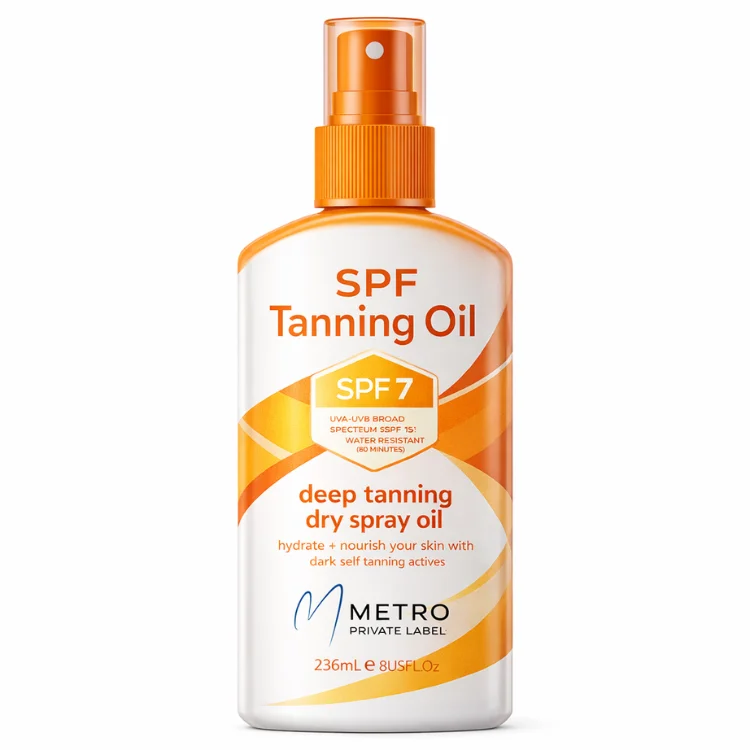
SPF Tanning Oils
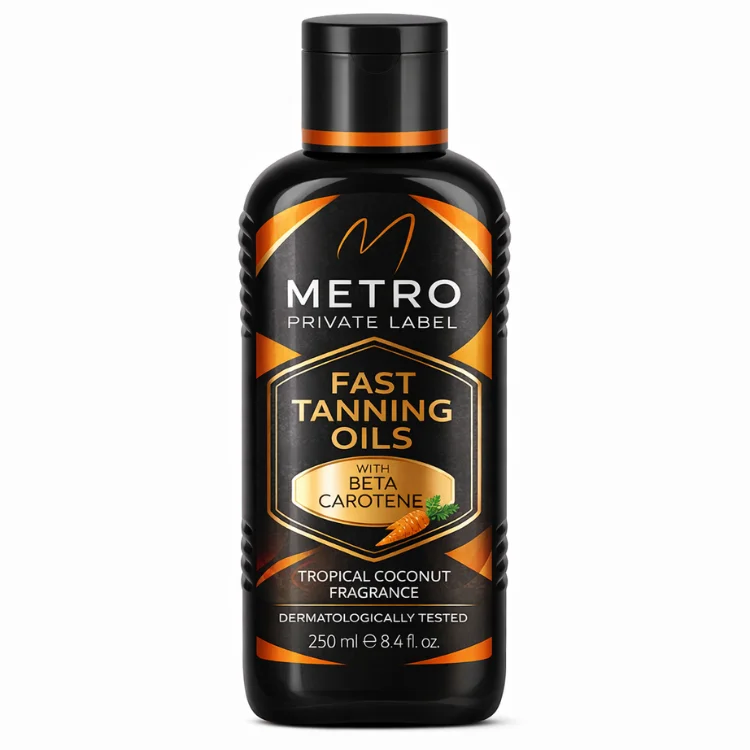
Fast Tanning Oils
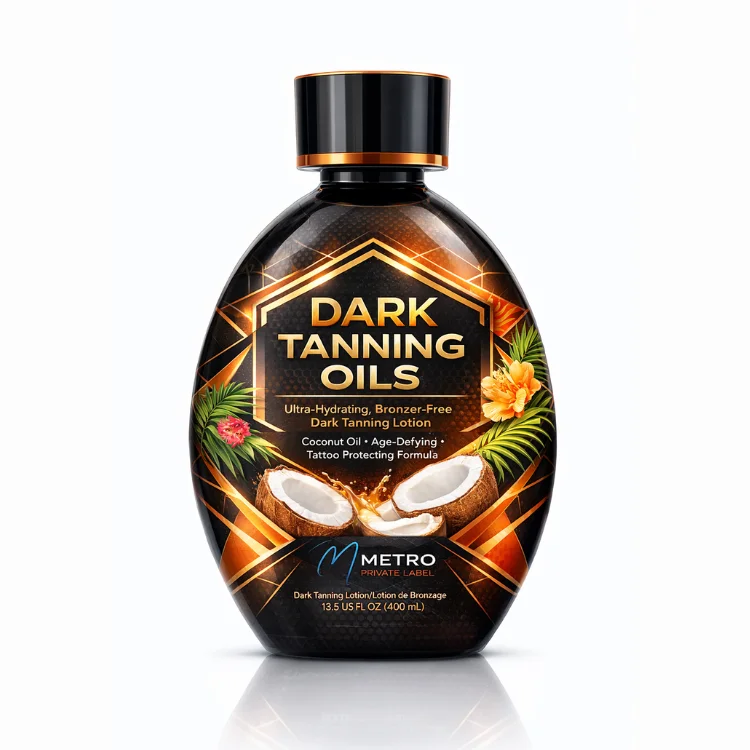
Dark Tanning Oils
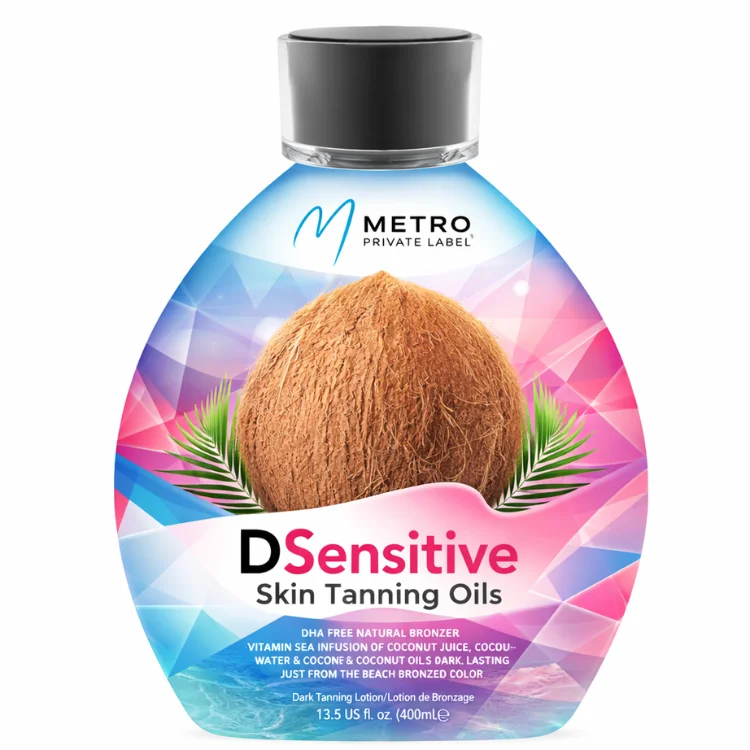
Natural / Sensitive Skin Tanning Oils
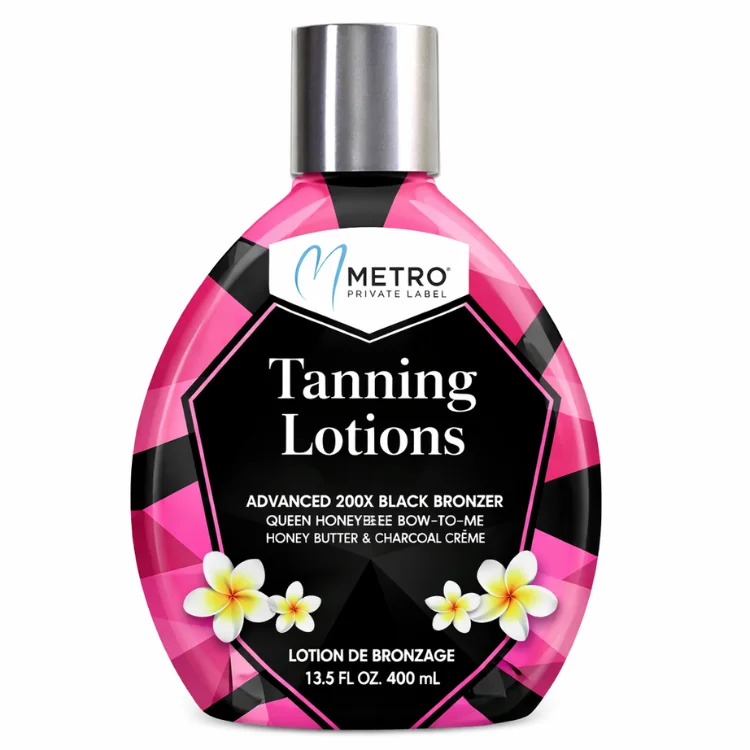
Tanning Lotions
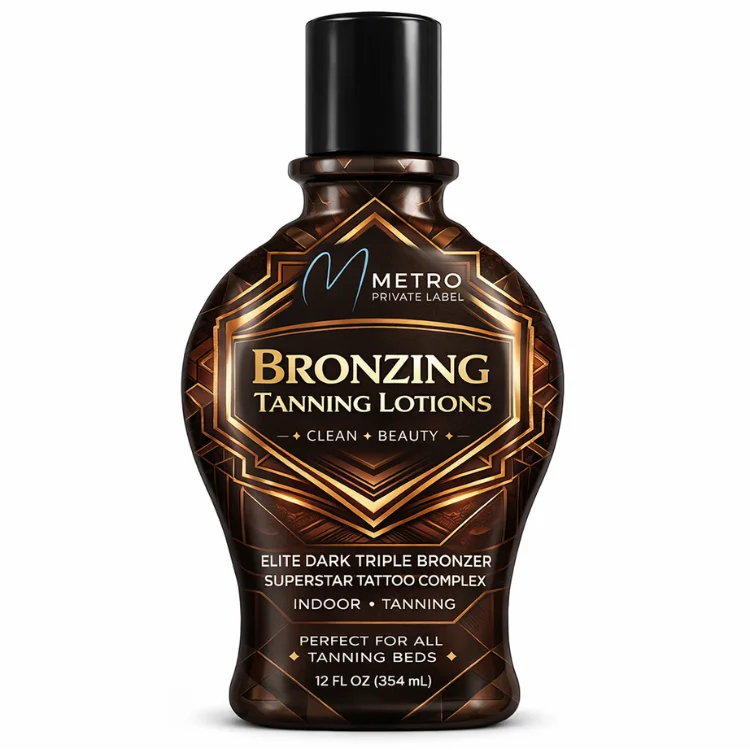
Bronzing Tanning Lotions
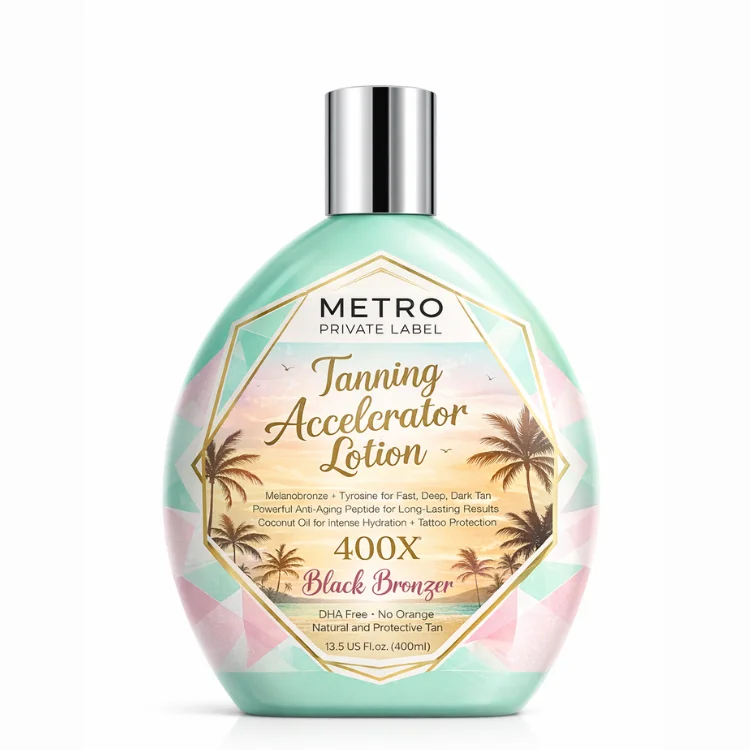
Tanning Accelerator Lotions
Build a Private Label Tanning Oils & Lotions Line That Actually Sells
At Metro Private Label, we understand that launching a tanning product is not just about helping customers get a glow—it’s about creating something they’ll keep coming back to. A tanning oil or lotion that delivers the right feel, the right result, and fits into a real lifestyle is what drives repeat purchase. And without repeat purchase, even a visually attractive product won’t scale. That’s why we don’t treat tanning oils and lotions as a generic category. We help you define a clear product direction based on real market demand—whether that’s SPF protection, fast tanning results, deeper bronzing, sensitive-skin positioning, or sunless tanning solutions.
We’ve seen many tanning products struggle not because the formula didn’t work, but because the positioning didn’t match the buyer. A tanning oil that feels too greasy for e-commerce users, a bronzing lotion that stains or looks unnatural, or a “natural” tanning product that still causes irritation will quickly lose customer trust. That’s why we guide you early—helping you align formula performance, texture experience, and packaging with how your product will actually be sold. The goal is simple: build something that not only works, but also fits your channel, your audience, and your price point.
As your manufacturing partner, we focus on helping you build tanning products that are designed for real selling environments. Whether you are launching a fast-moving SKU for Amazon, building a differentiated DTC brand, supplying a retail channel, or creating a seasonal tanning line, we help you structure the right product from the beginning. From formula direction and sampling to packaging coordination and compliance support, we help you move faster, reduce trial-and-error, and launch with more confidence.
💡 Our 8 Core Private Label Tanning Oils & Lotions Product Types
1️⃣ SPF Tanning Oils
This is one of the most commercially stable categories because it combines tanning with sun protection. It appeals to a wide audience looking for safer sun exposure while still achieving a glow. For brands, it offers strong positioning but also requires careful compliance planning, especially for US and EU markets.
2️⃣ Fast Tanning Oils
Designed for users who want quicker visible results, this category is highly popular in e-commerce channels. It is easy to market, easy to understand, and often performs well as a seasonal bestseller when positioned correctly.
3️⃣ Dark Tanning Oils
Focused on achieving a deeper, richer tan, this category attracts users who already have tanning experience. It is a strong SKU for brands looking to offer higher-impact results and build a more performance-driven product line.
4️⃣ Natural / Sensitive Skin Tanning Oils
This type is built around gentler formulations, often using plant-based oils or “clean beauty” positioning. It is especially suitable for DTC brands targeting ingredient-conscious consumers or those with sensitive skin concerns.
5️⃣ Tanning Lotions
A core category that balances hydration with tanning performance. Compared to oils, lotions are easier to position as daily-use products and are widely accepted across both mass and premium markets.
6️⃣ Bronzing Tanning Lotions
These products provide instant visible color along with gradual tanning benefits. They are highly effective for conversion-driven channels like Amazon and TikTok, where customers respond strongly to immediate results.
7️⃣ Tanning Accelerator Lotions
Formulated to enhance tanning performance, this category targets users who want to optimize their tanning process. It allows brands to position products with a stronger “performance” angle and higher perceived value.
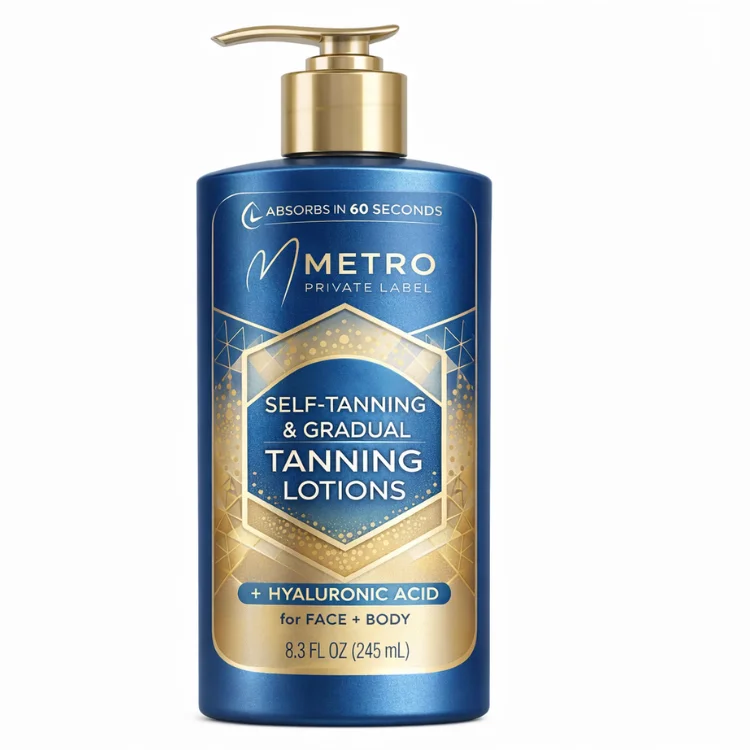
8️⃣ Self-Tanning & Gradual Tanning Lotions
This is one of the fastest-growing segments, offering sunless tanning solutions for year-round use. It is ideal for brands looking to reduce seasonality and build a more stable, repeat-purchase product line.
🎯 MOQ & Production Strategy (Built for Real Market Testing)
We understand that launching a tanning oils and lotions line always comes with one key question—how to test the market without overcommitting too early. That’s why our standard MOQ starts from 1,000 units per SKU, allowing us to maintain stable production, consistent filling, and reliable packaging quality, especially for brands selling through Amazon, Shopify, or retail channels.
If you are in an earlier stage or want to validate a new product direction, we also support lower MOQ options using in-stock packaging. In these cases, quantities can be adjusted to around 500–800 units, which is ideal for testing new ideas, entering the market quickly, or reducing upfront investment risk.
Our goal is not just to meet a minimum order requirement. We focus on helping you launch with the right product strategy, the right production setup, and a clear path to scale—so your tanning oils and lotions line is built for real sales, not just for production.

More Than Just a Private Label Tanning Oils & Lotions Manufacturer
At Metro Private Label, we don’t treat tanning oils and lotions as just another SKU you add to your catalog. For most of the brands we work with, these products quickly become key drivers of seasonal revenue and repeat purchase. They are highly experience-driven—customers immediately notice if a tanning oil feels too greasy, if a lotion applies unevenly, or if the result doesn’t match expectations. And once that trust is broken, it’s very hard to recover. That’s why we focus on helping you build tanning products that customers actually enjoy using and feel confident repurchasing, not just something that looks appealing on the shelf.
A successful tanning product is not about chasing trends or stacking ingredients without direction. It’s about creating the right balance between texture, absorption, visual result, and user comfort. Whether it’s a fast-tanning oil, a bronzing lotion with instant payoff, or a gradual self-tanning formula for daily use, what really drives growth is how well the product fits into your customer’s routine. That’s what leads to better reviews, stronger brand trust, and products that can scale beyond a single season.

✅ Formats That Already Work in the Market
We don’t build tanning products based on assumptions. We focus on what is already proven to sell. By analyzing high-performing SKUs across Google Shopping, Amazon, DTC brands, and retail channels, we concentrate on product types that customers are already searching for and willing to buy.
These typically include SPF tanning oils, fast-tanning oils, dark tanning oils, bronzing lotions, accelerator lotions, and self-tanning or gradual tanning products. When the format is familiar, customers understand it faster, trust it more easily, and convert more quickly. It also makes your brand positioning clearer and your marketing more efficient.
Our role is to help you start from that proven structure, so you’re not guessing what might work, but building a tanning oils and lotions line that is already aligned with real market demand.

✅ Production Models That Match How Brands Actually Launch
We understand that not every brand starts with large volumes, especially when testing a new tanning product or entering a seasonal category for the first time.
For most tanning oils and lotions, production typically starts from 1,000 units per SKU. This allows us to maintain stable filling, consistent texture, and reliable packaging compatibility—especially important for e-commerce brands where leakage, pump issues, or oil separation can quickly lead to negative reviews.
If you are testing a new idea or want to move faster, we also offer in-stock packaging options, where MOQ can be adjusted to around 500–800 units. This gives you the flexibility to enter the market with lower risk while still maintaining a professional and sellable product standard.
As your sales grow, we help you scale production smoothly without needing to rework your formula or packaging, so your product stays consistent as your business expands.
✅ Formulation Consistency That Supports Repeat Purchase
Tanning oils and lotions are highly sensitive to user experience. If an oil feels too heavy or sticky, customers won’t use it regularly. If a lotion applies unevenly or creates streaking, it leads to immediate dissatisfaction. Getting that balance right is what determines whether your product becomes a one-time purchase or a repeat-buy essential.
We focus on optimizing absorption, spreadability, finish on skin, and overall comfort, while ensuring consistent results from batch to batch. This includes stability testing, viscosity control, and making sure the formula works seamlessly with the selected packaging.
That level of consistency is what helps you generate better reviews, stronger retention, and more predictable long-term sales.
✅ Execution & Compliance Support That Keeps You Moving
We don’t just develop and manufacture your tanning oils and lotions—we help you bring them to market with fewer delays and fewer unknowns.
From INCI documentation and ingredient data to label guidance and packaging coordination, we simplify the process so you can stay focused on launching and selling. For brands targeting the US, EU, and other international markets, we help structure your products to align with compliance requirements while still maintaining strong commercial positioning.
Our goal is simple. We help you build tanning oils and lotions that are ready to sell, easy to scale, and designed to support real business growth—not just production.
✨ Build a Private Label Tanning Oils & Lotions Line That Performs Beyond Expectations
When you work with Metro Private Label, you’re not just choosing a tanning oils and lotions manufacturer—you’re working with a team that understands how these products actually perform in the real market. In this category, success is not defined by how attractive the formula sounds on paper, but by how it feels on the skin, how evenly it applies, and whether customers are willing to use it again and again. That’s what separates a one-time purchase from a product that keeps selling.
Tanning products are highly experience-driven. Customers immediately notice everything—from how fast an oil absorbs to whether a lotion streaks, how natural the color looks, and how their skin feels hours later. If it feels too greasy, they stop using it. If the color looks unnatural, they don’t trust it. What really drives repeat purchase is a product that delivers visible results while still feeling comfortable and easy to use. That’s exactly where we focus—helping you create tanning oils and lotions that customers enjoy using and feel confident buying again.
Whether you’re launching a fast-tanning oil for summer demand, a bronzing lotion for instant results, or a gradual self-tanning product for year-round sales, we structure every project around how your customers will actually use it. Details like absorption speed, finish on skin, color payoff, and packaging experience all directly impact how your product performs in the market. We help you get these right from the beginning—so your product is not just ready to launch, but ready to compete.
🧪 Formulation Built for Real Results
We don’t rely on generic base formulas or one-size-fits-all approaches. Every tanning oil and lotion we develop is built around real usage scenarios and customer expectations.
From selecting the right oil blend for lightweight absorption, to balancing bronzing agents for natural-looking color, to structuring self-tanning systems that minimize streaking and uneven tone, we focus on how the product actually performs on the skin. We also consider how the formula interacts with packaging, how it behaves over time, and how consistent it feels from batch to batch.
Our goal is simple—we help you build tanning products that don’t just look good in marketing, but actually perform where it matters most: in your customer’s daily use.
📦 Packaging & MOQ That Fit Real Launch Conditions
We understand that launching a tanning product always comes with uncertainty, especially when you are testing a new market or preparing for a seasonal push.
For most tanning oils and lotions, production typically starts from 1,000 units per SKU. This ensures stable filling, consistent texture, and proper compatibility between formula and packaging—especially important for oil-based products where leakage, pump issues, or separation can affect customer experience.
If you are in an earlier stage or want to move faster, we also support in-stock packaging options, allowing smaller runs around 500–800 units. This helps you test product-market fit while keeping your product at a professional, sellable level.
From bottles and pumps to labeling and outer cartons, we help align your packaging with how you actually sell—whether that’s Amazon, Shopify, or retail—so your product not only looks right, but also performs reliably in logistics and delivery.
⚙️ A Clear and Efficient Production Process
We keep the entire process simple, structured, and easy to follow. From initial idea and formula sampling to packaging confirmation and production scheduling, every step is clearly defined so you always know what comes next.
This is especially important for e-commerce brands and fast-moving teams that need to manage timelines around seasonal demand. Whether you are preparing for a summer launch, restocking a fast-selling SKU, or expanding your tanning line, we help you move forward without unnecessary delays or confusion.
🌿 Built for Brands Ready to Launch and Scale
We don’t measure success by production alone—we measure it by how your tanning oils and lotions perform after they reach the market.
That’s why we focus on building products that are stable, scalable, and aligned with real customer expectations. From the first sample to full production, everything is designed to support repeat purchase, positive reviews, and long-term growth.
With Metro Private Label, your tanning oils and lotions line is not just manufactured—it’s built to launch smoothly, perform consistently, and grow with your brand beyond the first order.

FAQs Tanning Oils & Lotions
For your convenience, we’ve gathered the most commonly asked questions about our Tanning Oils & Lotions . However, should you have any further queries, please don’t hesitate to reach out to us.
1. What types of private label tanning oils & lotions can you actually help us develop?
We usually guide our clients toward product types that already have proven demand in the market. This includes fast tanning oils, bronzing lotions, gradual tanning lotions, shimmer oils, after-sun repair lotions, and even hybrid skincare-tanning formats. Instead of pushing random ideas, we help you choose a direction that fits your target customers and sales channel, so you’re building something people are already searching for and willing to buy.
2. Can you adjust the tanning effect and skin feel to match our brand positioning?
Yes, and this is actually one of the most important parts of the whole project. We don’t just talk about “tanning strength”—we help you balance how fast the color develops, how natural the tone looks, and how the product feels on the skin. Some brands want a lightweight, dry-touch oil for beach use, while others prefer a richer lotion for daily gradual tanning. We’ll help you define that clearly and build the formula around it.
3. Can you adjust the tanning effect and skin feel to match our brand positioning?
We understand that most brands don’t want to overcommit in the beginning. That’s why our standard MOQ is around 1,000 units per SKU, which allows us to maintain stable quality. But if you’re still testing a new product direction, we can also work with in-stock packaging to bring that down to around 500–800 units. The goal is to help you launch realistically, not pressure you into unnecessary risk.
4. How long does it usually take to launch a tanning product with you?
From our experience, a realistic timeline is about 2–3 weeks for sampling, depending on how many adjustments are needed, and then around 4–6 weeks for production after everything is confirmed. What really affects the timeline is how quickly decisions are made on your side—especially formula direction and packaging. We’ll guide you step by step so you can move faster without missing key details.
5. Can you help us choose between white label and custom formulation?
Yes, and we’re very honest about this. If your priority is speed and cost control, we’ll recommend starting from a proven base formula and customizing slightly. If your goal is strong differentiation or premium positioning, then we’ll guide you through a more customized development process. We don’t push one option—we help you choose what actually fits your stage and business model.
6. How do you make sure the tanning result looks natural and not orange?
This is one of the most common concerns we hear, and it’s completely valid. We control this by adjusting the DHA level, combining it with the right undertone modifiers, and testing how the color develops over time on skin. It’s not just about the ingredient—it’s about how the whole system works together. Our goal is to help you create a result that your customers feel confident wearing, not something they’re worried about.
7. Can you support packaging that fits our sales channel (Amazon, DTC, retail)?
Yes, and we actually think about packaging based on how you sell, not just how it looks. For example, Amazon products need to minimize leakage and damage during shipping, while DTC brands may focus more on visual identity and unboxing experience. We help you choose bottles, pumps, and labeling solutions that match your real sales environment, so you don’t run into avoidable problems later.
8. What kind of quality control and testing do you do before production?
We focus heavily on consistency and stability because tanning products are very sensitive to formulation balance. Before production, we go through stability testing, compatibility checks between formula and packaging, and texture evaluation. During production, we also control filling, viscosity, and batch consistency to make sure what you launch is the same as what you approved.
9. Can you help us with compliance if we plan to sell internationally?
Yes, this is something we support regularly. We can provide INCI lists, MSDS, COA, and help guide your labeling to align with markets like the US, EU, or other regions. If you need additional support like EU Responsible Person or product registration, we can also connect you with the right partners. Our goal is to make sure your product is not only sellable, but also compliant where you plan to sell.
10. How do you support us beyond just manufacturing the product?
We see ourselves as more than just a factory. From the beginning, we help you think through product positioning, user experience, packaging, and launch strategy. We’ve seen many products fail not because the formula didn’t work, but because the direction wasn’t clear. So we focus on helping you build something that fits your market, launches smoothly, and has the potential to scale—not just something that gets produced.
What stood out to us was how well Metro Private Label understood the actual user experience of tanning products. They didn’t just talk about ingredients—they helped us refine the texture, absorption, and final skin feel. The result was a product our customers genuinely enjoy using, which made a huge difference in repeat sales.
Emily Carter, Founderfrom United Kingdom
We’ve worked with other manufacturers before, but the level of structure and clarity here was different. From sampling to production timelines, everything was clearly communicated. Metro Private Label helped us launch our tanning lotion on Amazon with fewer issues, and that made a big impact on our first batch performance.
Jason Miller, E-commerce Brand Ownerfrom United States
What I appreciated most was their ability to translate our brand idea into a workable formula. We had a vision for a lightweight tanning oil that didn’t feel greasy, and they guided us through the adjustments step by step. The final product felt exactly how we imagined, which is not always easy to achieve.
Sophie Laurent, Product Managerfrom France
Metro Private Label helped us make smarter decisions early in the process. Instead of overcomplicating the formula, they focused on what would actually sell and what customers would come back to. That kind of practical guidance saved us both time and cost, especially during our first launch.
Liam O’Connor, Directorfrom Ireland
The biggest value for us was consistency. The samples we approved were very close to the final production, and the packaging worked well for our online sales channel. There were no surprises, which gave us confidence to scale our tanning product line further with them.
Chloe Bennett, Brand Managerfrom Australia
Metro Private Label in Numbers
Happy Clients
0 +
Million-dollar Buyers
0 +
Formulation
0 +
Professional Staffs
0 +
Your Ultimate Guide to Tanning Oils & Lotions
If you’re planning to launch a Tanning Oils & Lotions line—whether it’s your first body care SKU or an extension of your existing skincare range—you’re not just adding another product category. You’re entering a highly experience-driven market where customer expectations are immediate, visible, and unforgiving. Unlike many skincare products that rely on long-term results, tanning products are judged instantly. The color development, skin feel, absorption speed, and overall usability all directly impact reviews and repeat purchase. Customers are not just buying a result—they are buying the entire experience of using the product, and that experience determines whether your product becomes a routine essential or a one-time trial.
Over the past few years, we’ve seen tanning oils and lotions evolve from simple sun-enhancing products into a more sophisticated category that blends skincare benefits with cosmetic results. Today’s customers expect more than just tanning—they expect hydration, skin comfort, even tone development, and a natural finish that fits seamlessly into their lifestyle. At the same time, the rise of e-commerce platforms like Amazon and TikTok has made product performance more visible than ever. A product that feels too greasy, develops unevenly, or fails to match its positioning will quickly be reflected in customer feedback. At Metro Private Label, we’ve seen how brands succeed when they treat tanning products not just as formulas, but as complete systems where formulation, packaging, positioning, and compliance are aligned from the beginning.
This guide is built on what we’ve learned working with brands across different markets and sales channels. Instead of focusing only on ingredient theory, we want to show how tanning oils and lotions actually perform in real commercial environments. Decisions such as choosing between fast-tanning and gradual-tanning formats, balancing visible results with daily usability, selecting packaging that prevents leakage in e-commerce logistics, planning MOQ to reduce inventory risk, and preparing compliance for US and EU markets all directly influence whether a product scales or stalls. Our goal is to help you not just develop a product, but build a tanning line that is structured to sell, repeat, and grow sustainably.
Table of Contents
How to Choose the Right Tanning Product Type for Your Sales Channel
When I start working with a brand on tanning oils and lotions, this is always the first decision I slow down and get right, because it quietly determines everything that comes after—your conversion rate, your pricing flexibility, your customer expectations, and even your long-term scalability. I’ve seen brands invest heavily in formula development and packaging, only to struggle in the market because the product type didn’t match how their customers actually buy. From my perspective, choosing the right product type is not a creative decision—it’s a commercial one, and it should always be driven by real purchasing behavior rather than internal assumptions.
Understanding How Your Sales Channel Shapes Customer Behavior
What I’ve learned over time is that every sales channel creates its own “logic of buying,” and if you don’t align with that logic, your product will feel out of place no matter how good it is. When I look at Amazon or fast-paced Shopify stores, I see customers who are outcome-driven and time-sensitive. They are not looking to explore—they are looking to solve something quickly. This is why I consistently recommend fast-result formats like bronzing lotions or express tanning oils for these channels. These products provide an immediate visual payoff, which matches the customer’s expectation at the exact moment they are making a purchase decision.
At the same time, I’ve worked with brands that operate in a completely different environment—brands that build their audience through storytelling, skincare positioning, or lifestyle branding. In those cases, the customer is not just buying a result, but buying into a routine. This is where gradual tanning lotions or skincare-infused tanning products become much more effective. These products don’t rely on instant transformation; instead, they create a consistent experience that integrates into daily use. And from what I’ve seen, once a product becomes part of someone’s routine, it becomes significantly harder to replace, which is exactly what you want for long-term brand growth.
Matching Product Type With Real Purchase Intent
One of the biggest gaps I often see between brands and the market is a misunderstanding of intent. Internally, a brand might be excited about a concept like “hydrating glow enhancement” or “skin-nourishing tanning experience,” but when I look at actual search behavior, customers are often using much more direct language. They are searching for things like “instant tan,” “quick bronze,” or “no streak self-tanner,” which tells me exactly what they expect to receive.
This is why I always encourage brands to step outside of their own perspective and look at how customers are actually making decisions. If someone is buying from a marketplace, they are usually comparing multiple options within seconds, and your product needs to answer their need immediately. If someone is buying from your brand directly, especially after engaging with your content, they are more open to understanding your product story and benefits over time. I use this difference to guide product direction, because when your product aligns with intent, your messaging becomes clearer and your conversion becomes more natural.
Building a Product Strategy Instead of Just Choosing a Product
What I rarely recommend is launching a single standalone product without thinking about how it fits into a broader structure. In my experience, the brands that scale successfully are the ones that understand the different roles each product can play. A fast-acting tanning oil or bronzing lotion is excellent for capturing attention and generating first-time purchases, especially in competitive environments where visibility is everything. But that alone is not enough to build a stable business.
This is where I usually introduce the idea of pairing that initial product with something designed for retention. A gradual tanning lotion or a skincare-focused tanning product gives customers a reason to come back. It transforms the relationship from a one-time transaction into an ongoing habit. When I help brands structure their product line this way, I’m not just thinking about what will sell today—I’m thinking about how to reduce reliance on constant new customer acquisition and build something that sustains itself over time.
Why This Decision Impacts Everything Downstream
What many brands don’t fully realize is how deeply this early decision affects everything else in the process. The product type you choose will influence how you position your product in the market, how you price it, how you design your packaging, and even how customers review it after use. If there is a mismatch between expectation and experience, it shows up immediately in feedback, and once that happens, it becomes much harder to recover.
From my perspective, getting this right early is one of the most effective ways to reduce risk. When your product type fits your sales channel and aligns with how customers actually behave, everything becomes smoother. Your messaging feels more natural, your product is easier to understand, and your customers are more likely to trust what you’re offering. That alignment is what turns a product from something that simply exists into something that actually sells, and more importantly, continues to sell as your brand grows.
Fast-Tanning vs Gradual-Tanning: Which One Builds Better Repeat Sales?
When I work with brands entering the tanning category, this is one of the most misunderstood but commercially important decisions we go through together. Many founders initially think they need to choose between fast-tanning and gradual-tanning, as if one is the “better” product. But from my experience, that mindset often leads to an incomplete product strategy. These two categories behave very differently in the market, and more importantly, they influence completely different parts of your business performance. What I always try to do is reframe the conversation—not around preference, but around how each product type contributes to acquisition, retention, and long-term scalability.
Why Fast-Tanning Products Naturally Win at First-Time Conversion
When I analyze fast-tanning products, what I see is a category designed around immediacy. These products are built to deliver visible results quickly, which aligns perfectly with how customers behave in high-speed buying environments. Whether it’s an express tanning oil or a bronzing lotion with instant color payoff, the value proposition is simple and easy to understand. The customer doesn’t need to imagine the result—they expect to see it almost immediately.
In channels like Amazon or performance-driven e-commerce stores, this becomes a major advantage. Customers are often comparing multiple options within seconds, and the products that clearly communicate “fast results” tend to stand out and convert better. From what I’ve observed across multiple launches, fast-tanning products reduce hesitation because they answer the most basic question customers have: “Will this work for me right now?”
However, I always caution brands not to confuse strong conversion with strong retention. These products often perform very well in driving initial sales, especially during peak seasons like summer or holiday periods, but their usage tends to be situational. Customers may use them for specific events, trips, or occasions, which means the purchase cycle is not always consistent. This creates a pattern where sales can spike quickly but may also fluctuate if not supported by a broader product strategy.
Why Gradual-Tanning Products Build Habit and Long-Term Value
When I shift my focus to gradual tanning products, I’m looking at a completely different behavioral pattern. These products are not built for immediate transformation, but for consistency. They are designed to be used repeatedly over time, often integrated into a daily or weekly skincare routine. This changes the relationship between the product and the customer.
From what I’ve seen, this is where repeat purchase becomes much more predictable. When a product fits naturally into someone’s routine, it reduces the decision-making effort required for each purchase. Instead of asking “Do I need this now?”, the customer begins to feel “This is something I always use.” That shift is incredibly powerful from a commercial standpoint.
I’ve worked with brands that initially focused heavily on fast-tanning products and later struggled to maintain steady sales outside of peak periods. When they introduced gradual tanning lotions or skincare-infused tanning products, the dynamic changed. Customers who discovered the brand through fast results began to stay because of the daily-use experience. This is where I see brands transition from short-term traction to long-term stability.
Understanding the Difference Between Occasion-Based and Routine-Based Products
One of the frameworks I often use internally is to distinguish between occasion-based products and routine-based products. Fast-tanning products typically fall into the first category. They are purchased with a specific moment in mind, which makes them highly effective for triggering immediate demand but less reliable for continuous consumption.
Gradual tanning products, on the other hand, belong to the second category. They are not tied to a single moment, but to an ongoing lifestyle. This is why they tend to generate more consistent reorder patterns. When I explain this to clients, it often helps them see that the question is not just about product performance, but about how the product fits into the customer’s life over time.
This distinction also affects how you position your brand. Occasion-based products often rely on urgency and transformation messaging, while routine-based products rely more on comfort, maintenance, and long-term skin feel. Understanding this difference allows you to build clearer communication and more targeted marketing strategies.
Structuring Your Product Line Around Acquisition and Retention
What I consistently recommend is to think beyond individual products and start thinking in terms of roles within your product line. Fast-tanning products are naturally positioned as acquisition tools. They bring new customers into your ecosystem because they are easy to understand, easy to market, and easy to convert.
Gradual tanning products, in contrast, act as retention drivers. They give customers a reason to continue engaging with your brand after the initial purchase. When these two elements are structured intentionally, your product line becomes much more efficient. Instead of relying entirely on continuous advertising and new customer acquisition, you begin to build a base of returning customers who generate stable revenue over time.
From a business perspective, this balance is critical. Customer acquisition is always more expensive than retention, and brands that fail to address this early often find themselves stuck in a cycle of constantly needing new traffic to maintain sales.
Why the Most Successful Brands Never Choose Just One Direction
If there is one pattern I’ve seen repeatedly, it’s that the most successful brands in this category never limit themselves to a single product type. Brands that focus only on fast-tanning often experience strong initial growth but struggle to maintain momentum. On the other hand, brands that focus only on gradual tanning may build a solid foundation but find it harder to stand out in competitive marketplaces.
This is why I always come back to a more balanced approach. Fast-tanning products give you speed, visibility, and initial traction. Gradual tanning products give you stability, repeat purchase, and long-term value. When both are aligned within the same product ecosystem, they reinforce each other.
From my perspective, the goal is not to decide which one is better, but to understand how each one contributes to the overall structure of your brand. When you get that structure right, you’re no longer relying on a single product to carry your business. Instead, you’re building a system where different products support different stages of the customer journey—and that’s what ultimately leads to sustainable growth.
What Makes a Tanning Oil or Lotion “Actually Sell”
When I look at why certain tanning oils and lotions perform consistently in the market while others struggle to gain traction, I rarely attribute the difference to formula strength alone. In today’s market, most products can technically deliver a tan. What truly separates a product that “exists” from one that actually sells is the total user experience. I’ve seen many products fail not because they didn’t work, but because something in the process felt uncomfortable, unpredictable, or inconvenient. And in a category where customers are directly applying the product to their skin and visually judging the results, even small imperfections in experience can immediately translate into lost trust.
Why “Feeling Right” Matters More Than “Working Right”
One of the most important shifts I guide brands to make is understanding that customers don’t evaluate tanning products the way formulators do. Internally, it’s easy to focus on whether the product develops color correctly or contains certain active ingredients. But from the customer’s perspective, the first judgment happens the moment the product touches their skin.
If a tanning oil feels too greasy, too heavy, or difficult to control, the experience already starts to break down—even before the tanning effect develops. The same applies to lotions. If the texture feels sticky, drags during application, or leaves uneven layers, the customer immediately feels uncertainty. In my experience, this emotional reaction is critical. Once a customer feels unsure during application, they start expecting a poor result, and that expectation often becomes the reality in their mind, regardless of the actual outcome.
This is why I always emphasize that a product must feel right before it can be perceived as working right. The sensory experience is not secondary—it is the foundation of trust.
The Hidden Impact of Application Control and User Confidence
When I refine a tanning product with a client, I spend a surprising amount of time on what I call “application control.” This is the level of confidence a user has while applying the product. Can they spread it evenly without thinking too much? Does it glide naturally across different areas of the body? Does it give them enough time to adjust before it sets?
These details might seem subtle, but they are often the difference between a product that gets positive reviews and one that generates complaints about streaking or uneven color. If a lotion develops unevenly or a product sets too quickly without proper spreadability, the customer feels like they made a mistake, even if the formulation is technically correct.
From what I’ve seen, the most successful products are the ones that guide the user through the process without friction. They make application feel intuitive rather than technical. When customers feel in control, they feel confident, and that confidence directly increases the likelihood of repeat purchase.
Why Even Development and Natural Tone Are Non-Negotiable
In many other product categories, small inconsistencies can be tolerated. In tanning, they cannot. The result is visible, immediate, and often judged under natural light. If a product develops unevenly, creates patches, or produces an unnatural tone, the customer doesn’t just feel disappointed—they feel exposed.
This is why I always treat color development as both a technical and psychological factor. It’s not just about achieving a tan, but about achieving a tone that looks believable and consistent across different skin areas. The customer should not feel the need to “fix” the result or adjust their routine to compensate for the product.
I’ve seen brands lose momentum very quickly when early users report streaking or unnatural color. On the other hand, when a product consistently delivers a natural-looking result, customers begin to trust it without hesitation. That trust reduces the mental barrier to repurchase, which is one of the most important drivers of long-term sales.
How Lifestyle Compatibility Drives Real Repeat Purchase
Another factor I always bring into the conversation is how well the product fits into the customer’s lifestyle. A tanning product may perform well in ideal conditions, but if it requires too much time, attention, or precision, it becomes difficult to use regularly.
From my experience, the products that truly scale are the ones that simplify the user’s routine rather than complicate it. A lotion that absorbs at the right speed, doesn’t transfer easily onto clothing, and doesn’t require constant monitoring becomes something the customer can use without planning their day around it. This is where convenience turns into habit.
When a product becomes effortless to use, it naturally integrates into daily life. And once that integration happens, repeat purchase is no longer something the brand has to push—it becomes a natural outcome of continued use.
The Difference Between a “Functional Product” and a “Commercial Product”
I often explain to clients that there is a clear difference between a product that functions and a product that performs commercially. A functional product meets basic expectations. It delivers a tan, it follows the formulation logic, and it technically does its job. But a commercial product goes further. It removes friction, builds confidence, and creates a positive experience that customers are willing to repeat.
In the tanning category, this distinction is especially important because the barrier to switching brands is relatively low. If a customer has even one uncomfortable experience, they will quickly look for alternatives. This means your product is not just competing on results, but on how consistently and comfortably it delivers those results.
Why Experience Is the Real Driver of Long-Term Sales
If there is one principle I always come back to, it is that experience drives behavior. Customers don’t come back because your product worked once—they come back because it felt reliable, easy, and enjoyable to use. That combination is what builds trust over time.
When I help brands develop tanning oils and lotions, I’m not just thinking about the first impression. I’m thinking about the second, third, and fourth use. I’m thinking about whether the customer will reach for the product again without hesitation. Because in the end, the products that actually sell are not the ones with the most complex formulas or the strongest claims, but the ones that fit seamlessly into the customer’s life and consistently deliver a result they feel good about.
Ingredient Strategy: What Customers Care About vs What Brands Think Matters
When I sit down with a brand to define the ingredient strategy for a tanning oil or lotion, I often find myself slowing the process down rather than speeding it up. Not because formulation is difficult, but because it’s very easy to go in the wrong direction for the wrong reasons. Many brands enter this category thinking that adding more trending ingredients will automatically increase product value. But from my experience, that approach usually leads to a formula that is harder to control, harder to position, and ultimately less effective in the real market. What I’ve learned over time is that customers are not buying your ingredient list—they are buying how your product makes them feel and how reliably it performs.
Why Customers Evaluate Experience, Not Ingredient Complexity
When I shift my perspective from the lab to the customer, everything becomes much clearer. Customers are not standing in front of a mirror thinking about DHA percentages or botanical extracts. They are thinking about whether the tan looks natural, whether their skin feels comfortable, and whether they can trust the product to deliver the same result every time. This is where I see a major disconnect between what brands think matters and what actually drives purchase decisions.
I’ve seen formulas packed with popular ingredients struggle because the experience felt inconsistent or overly complicated. At the same time, I’ve seen simpler, more focused formulas outperform them simply because they delivered a smooth, predictable result. This is why I always guide brands to prioritize experience first. If the product feels right, performs consistently, and avoids irritation, the customer is already satisfied—regardless of how many ingredients are listed on the label.
Understanding the Functional Role of Each Ingredient
When I build or refine a formula, I don’t think in terms of adding ingredients—I think in terms of assigning roles. Every component in the formula should have a clear purpose, and more importantly, those purposes should not conflict with each other. In tanning products, the most critical function is controlled color development, which is typically driven by DHA. But DHA on its own is not enough. Its performance depends heavily on the environment created by the rest of the formula.
For example, the emollient system determines how evenly the product spreads, which directly affects how evenly the tan develops. If the oil phase is too heavy, the product becomes difficult to control during application. If it’s too light, it may not provide enough glide, leading to patchy distribution. At the same time, humectants and soothing agents influence how the skin feels during and after use, which impacts whether the customer is willing to continue using the product regularly.
What I always focus on is how these elements interact. It’s not just about including DHA, moisturizing oils, or calming ingredients—it’s about creating a system where each one supports the others. When that system is balanced, the product feels intuitive and reliable. When it’s not, even high-quality ingredients can produce a disappointing result.
Why Overloading a Formula Often Reduces Performance
One of the most common mistakes I encounter is what I would call “ingredient stacking.” Brands want to include multiple trending actives—each with its own story—without fully considering how they affect the overall structure of the formula. On paper, this can look impressive. But in practice, it often introduces instability, texture issues, or unpredictable performance.
I’ve worked on projects where the initial formula included a wide range of botanical extracts, vitamins, and specialty ingredients. But when we tested the product, the texture felt inconsistent, the absorption was uneven, and the final tanning result was less controlled. After simplifying the formula and focusing on the core functional components, the product immediately improved—not because we added more, but because we removed unnecessary complexity.
From my perspective, every additional ingredient introduces a variable. And the more variables you introduce, the harder it becomes to maintain consistency across batches and ensure a predictable user experience. This is especially critical in tanning products, where even small inconsistencies can be highly visible.
The Commercial Advantage of a Clean, Structured Formula
Beyond formulation performance, there is also a commercial side to ingredient strategy that many brands overlook. A clean, well-structured formula is easier to explain, easier to position, and easier for customers to trust. When your product has a clear focus, your messaging becomes more direct, and your brand identity becomes stronger.
I’ve noticed that customers respond better to clarity than complexity. When they understand what your product is designed to do and feel confident in how it will perform, they are more likely to purchase and repurchase. On the other hand, when a product tries to communicate too many benefits at once, it can dilute its own value and create uncertainty.
This is why I often guide brands to simplify not just for formulation reasons, but for communication reasons as well. A product that is easy to understand is much easier to sell.
Bridging the Gap Between Marketing and Real Performance
One of the most important roles I see myself playing is helping brands bridge the gap between marketing ideas and real-world performance. It’s easy to build a strong concept around trending ingredients, but if the product doesn’t deliver a consistent and comfortable experience, that concept quickly loses credibility.
From my experience, the most successful tanning products are the ones where formulation and positioning are aligned. The ingredients support the experience, and the experience supports the brand story. There is no disconnect between what is promised and what is delivered.
Building an Ingredient Strategy That Supports Long-Term Success
In the end, what I aim to help brands achieve is not just a formula that works, but a formula that continues to perform over time. This means prioritizing balance over complexity, clarity over noise, and consistency over experimentation.
When a tanning oil or lotion is built with this mindset, it becomes much more than a functional product. It becomes something customers can rely on, something they feel comfortable using repeatedly, and something they are willing to recommend. And from a business perspective, that is what truly defines a successful product—not how many ingredients it contains, but how well it fits into the customer’s life and how consistently it delivers on its promise.
Texture & Skin Feel: The Hidden Factor Behind Customer Reviews
When I look back at projects that succeeded versus those that struggled, I’ve realized that texture is often the silent factor no one talks about early enough. Many first-time brands focus heavily on ingredients, claims, or even packaging design, assuming those are the primary drivers of success. But in reality, the moment a customer touches your product, everything changes. Texture is the first real interaction your customer has with your formula, and that interaction sets the tone for everything that follows. From my experience, the difference between a product that gets praised and one that gets criticized is often not the formula logic—it’s how the product feels on the skin.
Why the First Few Seconds Decide the Entire User Experience
What I’ve consistently observed is that customers form their opinion almost instantly. Before the tanning effect develops, before they see any visible results, they are already judging the product based on how it spreads, how it absorbs, and how it sits on their skin. This is something many brands underestimate because they focus on the end result, but the customer is reacting to the process.
If the product feels too oily, it creates a sense of lack of control. If it feels sticky, it creates discomfort. If it drags during application, it introduces hesitation. These reactions are not just physical—they are psychological. Once a customer feels uncomfortable in those first few seconds, they begin to expect something to go wrong. And in my experience, once that expectation is there, even a decent result cannot fully recover the perception.
This is why I always treat the initial skin feel as a critical checkpoint. If the first touch feels right, everything else becomes easier to accept.
The Subtle Difference Between “Lightweight” and “Uncontrolled”
When brands tell me they want a lightweight texture, I always go deeper into what that actually means. Lightweight is not just about making the product thinner or less viscous. It’s about creating a balance where the product feels easy to spread but still gives the user enough control during application.
I’ve seen formulations where the oil phase was reduced too much in pursuit of a “light” feel, but the result was a product that moved too quickly on the skin, making it difficult to apply evenly. On the other hand, I’ve seen lotions that were designed to feel rich and moisturizing but ended up feeling heavy and slow to absorb, which discouraged regular use.
From my perspective, the goal is not simply to make the product lighter or richer, but to make it feel intuitive. The user should not need to think about how to apply it. The product should guide the application naturally, allowing even distribution without effort. This balance is subtle, but it is one of the most important factors behind a product that performs well in real-world use.
How Texture Directly Affects Tanning Outcome
One of the biggest misconceptions I often correct is the idea that texture and performance are separate. In tanning products, they are directly connected. The way a product spreads across the skin determines how evenly the active ingredients are distributed, which directly affects how the color develops.
If the texture is uneven, the application becomes uneven. If the application is uneven, the result becomes uneven. It’s a simple chain reaction, but one that many brands overlook. I’ve worked on cases where the formula itself was technically correct, but because the texture made it difficult to apply smoothly, customers experienced streaking or patchiness.
Once we adjusted the texture—improving glide, adjusting absorption speed, and refining the overall feel—the performance improved immediately. This is why I always emphasize that texture is not just about comfort. It is a functional part of the formula that directly impacts the final result.
Aligning Texture With Real Usage Scenarios
Another layer I always consider is how the product fits into the customer’s actual lifestyle. A tanning product is not used in a vacuum—it is used in specific contexts, and the texture needs to match those contexts.
If a product is designed for quick application before going out, the texture needs to be fast-absorbing, non-transferable, and easy to control. If it’s designed for a more skincare-oriented routine, the texture can be slightly richer, offering a more nourishing feel that encourages regular use.
What I’ve found is that when texture aligns with usage, the product feels natural. When it doesn’t, the product feels inconvenient, even if the formula is technically strong. This is why I always ask brands to think beyond the product itself and consider how and when it will actually be used.
Why Texture Shows Up in Reviews More Than You Expect
If you read customer reviews carefully, you’ll notice that texture is one of the most frequently mentioned factors, even when customers don’t explicitly label it that way. Words like “greasy,” “sticky,” “heavy,” “smooth,” or “easy to apply” appear repeatedly, and these descriptions have a direct influence on how new customers perceive the product.
From my experience, negative reviews are often driven by discomfort rather than failure of function. A product might deliver a decent tanning result, but if it feels unpleasant during use, customers will still rate it poorly. On the other hand, a product that feels good during application can generate positive feedback even before the full result is visible.
This is why I always treat texture as a key driver of reputation. It shapes not only how customers experience the product, but also how they communicate that experience to others.
Why Texture Becomes a Long-Term Competitive Advantage
In a market where many products can achieve similar tanning results, texture becomes one of the most reliable ways to differentiate. It’s not something that can be easily copied without careful formulation work, and it’s something customers notice immediately.
From what I’ve seen, brands that invest time in refining texture often build stronger customer loyalty. Their products feel more comfortable, more predictable, and easier to use, which leads to better reviews and higher repeat purchase rates.
In the end, what I always come back to is this: customers may be attracted by claims, but they stay because of experience. And texture is at the center of that experience. When it’s done right, it removes friction, builds confidence, and turns a simple product into something customers genuinely enjoy using—and that is what ultimately drives long-term success.
Packaging Strategy: Built for E-commerce vs Retail Reality
When I work with brands developing tanning oils and lotions, packaging is one of the areas where I slow things down the most, because it directly impacts not just how your product looks, but how it survives, how it’s experienced, and ultimately how it is judged by your customer. Many brands initially approach packaging from a design perspective, focusing on color, finish, and visual identity. But from my experience, packaging is not a design decision first—it is a business decision. It needs to match how your product is sold, how it is shipped, and how it is used. If there is a mismatch in any of these areas, even a strong product can quickly lose credibility in the market.
Why E-commerce Packaging Is a Logistics Problem Before It Is a Branding Decision
When I look at products sold through e-commerce channels like Amazon or Shopify, I don’t evaluate packaging by how it looks—I evaluate it by how it behaves under pressure. Your product will go through multiple handling points, from factory packing to warehouse sorting to last-mile delivery. During this process, it may be exposed to shaking, stacking pressure, temperature changes, and unpredictable movement.
What I’ve seen repeatedly is that packaging that looks premium on screen can fail completely in this environment. A pump that slightly loosens during transit can lead to leakage. A cap that isn’t sealed properly can create a mess inside the shipping box. And once that happens, the customer doesn’t separate packaging from product—they see the entire experience as a failure.
This is why I always prioritize structural reliability first. I focus on sealing systems, cap tightness, pump locking mechanisms, and material strength. The goal is to ensure that when the customer opens the package, the product arrives exactly as expected. In e-commerce, that first unboxing moment is critical, and if it goes wrong, it directly translates into negative reviews.
The Direct Link Between Packaging Failure and Negative Reviews
From a commercial perspective, packaging issues are not small problems—they are amplified through customer feedback. I’ve seen brands lose momentum not because their formula was poor, but because customers repeatedly mentioned leakage, broken pumps, or damaged bottles in reviews.
What makes this more challenging is that these issues often appear early in the product lifecycle. Once negative feedback is visible, it starts influencing new buyers immediately. Even if the formula is excellent, the perception of risk reduces conversion. This creates a situation where the product is judged before it is even used.
That’s why I always treat packaging as part of your review strategy. A well-designed packaging system reduces the likelihood of negative feedback before the customer even applies the product. In many cases, preventing a problem is far more valuable than improving the formula itself.
Why Retail Packaging Is About Visual Psychology and Positioning
When I shift to retail or salon environments, the entire logic changes. In these settings, your product is not being judged through delivery—it is being judged visually, often within seconds, and often alongside competing products.
From my experience, this is where packaging becomes a communication tool. The weight of the bottle, the finish of the surface, and the overall presentation all contribute to how the customer perceives the product’s value. A matte finish can suggest a more modern or clean positioning, while a glossy or glass finish can create a more premium impression.
What I always consider here is how the packaging aligns with the brand’s price point and target audience. If there is a mismatch—if the packaging feels too basic for a premium product, or too complex for a mass-market item—it creates confusion. Customers may hesitate because the product does not clearly communicate what it is.
The Importance of Packaging Interaction, Not Just Appearance
One thing I always emphasize is that packaging is not just something customers see—it is something they interact with. The way a product dispenses, the control it gives during use, and how comfortable it feels in the hand all contribute to the overall experience.
In tanning products, this becomes even more important because application precision matters. If a bottle dispenses too much oil at once, it can lead to uneven application. If a pump is inconsistent, it disrupts the user’s flow. These small frustrations accumulate and affect how the customer feels about the product as a whole.
I’ve seen cases where improving the dispensing system alone significantly improved customer satisfaction, even without changing the formula. This is why I always evaluate packaging as part of the usage experience, not just the visual presentation.
Aligning Packaging With Real Usage and Customer Lifestyle
Another layer I always explore is how the product fits into the customer’s daily life. A tanning oil used at the beach requires different packaging compared to a gradual tanning lotion used at home. The environment, the frequency of use, and the level of control required all influence what type of packaging works best.
If the packaging doesn’t match the usage scenario, it creates friction. A product that is difficult to carry, hard to dispense, or inconvenient to use will naturally be used less often. And when usage decreases, repeat purchase also decreases.
This is why I always guide brands to think beyond the shelf or the screen. I ask how the product will actually be used, where it will be used, and what the customer expects in that moment. When packaging aligns with lifestyle, the product feels natural. When it doesn’t, it feels like an obstacle.
Bridging the Gap Between Design Intent and Real-World Performance
One of the most common challenges I see is that packaging decisions are made in isolation, often based on visual mockups rather than real-world testing. A design may look perfect digitally, but behave very differently once filled with product and exposed to real conditions.
From my perspective, this is where practical validation becomes critical. I always encourage testing packaging with the actual formula, observing how it behaves over time, and evaluating how it performs during simulated transport. This helps identify issues early, before they reach the customer.
The goal is to close the gap between what the packaging is supposed to do and what it actually does in real conditions. When that gap is minimized, the product experience becomes much more consistent.
Why the Right Packaging Strategy Supports Long-Term Brand Growth
In the end, packaging is not just about launching a product—it’s about sustaining it. A product that arrives safely, feels intuitive to use, and aligns with its sales channel builds trust over time. That trust leads to better reviews, stronger customer retention, and more predictable sales performance.
From my experience, the brands that succeed are the ones that treat packaging as an integral part of their product system. They don’t see it as a final step, but as a core component that supports both the product and the business.
What I always come back to is this: packaging should not only represent your brand visually, but also support it functionally. When it does both, it becomes more than just a container—it becomes part of the reason your product succeeds in the market.
MOQ & Launch Strategy: How to Test Without Overcommitting
When I work with brands preparing to launch a tanning oil or lotion, I often find that the biggest risk is not entering the market—it’s entering it with too much commitment and not enough clarity. Many founders feel pressure to “do it properly” from the beginning, which often translates into larger order quantities, multiple SKUs, and fully customized packaging. But from my experience, that approach increases complexity at the exact moment when flexibility is most important. What I always aim to do is help brands shift their mindset from launching perfectly to launching intelligently, where every decision is designed to learn, validate, and reduce uncertainty before scaling.
Why Controlled MOQ Is a Strategic Tool, Not a Limitation
One of the first things I clarify is that MOQ should not be seen as a restriction—it should be used as a strategic lever. Starting with a manageable quantity allows you to observe how your product performs in the real market without locking yourself into a large financial commitment. This is especially important in the tanning category, where small details like texture, fragrance, or even packaging usability can significantly influence customer feedback.
I’ve seen brands commit to high volumes based on internal confidence, only to discover that the product needed adjustments after launch. At that point, they are left with inventory that doesn’t fully align with market expectations. In contrast, when brands start with a controlled MOQ, they gain something much more valuable than cost efficiency—they gain flexibility. They can refine the product, adjust positioning, and move forward with real data instead of assumptions.
From my perspective, the first order is not about maximizing margin—it’s about minimizing risk while maximizing learning.
Why Launching Fewer SKUs Creates Stronger Market Focus
Another pattern I consistently see is the tendency to launch multiple products at once in an attempt to look more established. On the surface, this may feel like a stronger brand presence, but in reality, it often creates confusion both internally and externally. When you introduce too many SKUs without clear differentiation, your message becomes diluted, and customers are unsure where to focus.
This is why I always recommend starting with one or two well-defined products. These products should have a clear role, a clear benefit, and a clear target audience. When your offering is focused, your communication becomes sharper, your marketing becomes more effective, and your product becomes easier to position.
I’ve worked with brands that built strong traction from a single hero SKU because it was easy to understand and easy to trust. Once that foundation was established, expanding into additional products became a natural next step rather than a forced decision.
Testing the Direction, Not Just the Product
One of the most important shifts I encourage is to think of your launch as a test of direction, not just a test of the product itself. A product can be technically well-formulated, but still fail if the positioning, pricing, or target audience is not aligned.
When I evaluate a launch, I look at how customers respond to the entire experience. Are they understanding the product quickly? Are they confident in what it does? Are they satisfied enough to consider repurchasing? These are the signals that matter.
From my experience, brands that treat their first launch as a validation phase are much more likely to succeed in the long term. They gather feedback, identify patterns, and refine their approach. This allows them to make more informed decisions when they scale, rather than relying on initial assumptions that may not hold true.
Balancing Cost Efficiency With Flexibility
One of the most common tensions I help brands navigate is the balance between cost and flexibility. Larger production volumes often reduce unit cost, but they also reduce your ability to adapt. Smaller runs may have slightly higher costs, but they give you the freedom to make changes quickly based on market feedback.
I always approach this as a trade-off rather than a problem. If your priority is to validate a product concept, then flexibility is far more valuable than cost optimization. Once the product proves itself, you can then move into larger production runs with much greater confidence, knowing that the direction is already working.
This staged approach allows you to control risk while still building toward efficiency. It also prevents the situation where cost savings come at the expense of adaptability.
Why Early Overcommitment Creates Long-Term Constraints
One of the risks I see most often is that early overcommitment limits a brand’s ability to evolve. Once you have invested heavily in a specific formula, packaging, and volume, making changes becomes slower and more expensive. This can delay improvements and reduce your responsiveness to customer feedback.
In contrast, when you start with a more flexible approach, you retain the ability to adjust quickly. You can refine the texture, tweak the fragrance, or even reposition the product based on what you learn. This responsiveness is a major advantage, especially in competitive markets where customer expectations can shift quickly.
From my perspective, the ability to adapt is one of the most valuable assets a brand can have during its early stages.
Building a Launch Process That Supports Scalable Growth
Ultimately, what I aim to help brands build is not just a product launch, but a structured path toward growth. The first phase is about validation—understanding what works and what doesn’t. The second phase is about refinement—optimizing the product and positioning based on real feedback. The third phase is about scaling—expanding production and product range with confidence.
When this process is followed, growth becomes more predictable and sustainable. Instead of making large bets early on, you are building step by step, using each stage to inform the next.
What I’ve consistently seen is that the brands that succeed are not the ones that move the fastest or spend the most at the beginning, but the ones that make deliberate, informed decisions. By starting with the right MOQ, focusing on a clear product direction, and allowing room for adjustment, you create a foundation that supports long-term success rather than short-term pressure.
Compliance & Market Readiness: What You Actually Need to Prepare
When I work with brands entering the tanning oils and lotions category, I often notice that compliance is seen as a barrier rather than a structured process. Many founders delay their launch because they feel they are “not ready yet,” when in reality, they are simply unclear about what needs to be done. From my perspective, compliance is not about perfection—it is about alignment. Once your formula, documentation, and packaging are aligned with the expectations of your target market, you are already in a strong position to launch. What I always focus on is helping brands understand the minimum viable compliance required to enter the market confidently, and then build on that foundation as they scale.
What Compliance Really Means From a Practical Business Perspective
When I break down compliance for my clients, I don’t present it as a regulatory burden—I present it as a business system. At its core, compliance is about making sure that what you claim, what you sell, and what you deliver are consistent with each other. This includes your ingredient list, your product claims, your labeling, and your supporting documents.
I often see brands overcomplicating this by trying to anticipate every possible requirement at once. Instead, I guide them to focus on practical alignment. If your formula is stable and safe, your ingredient list is accurate, and your packaging communicates clearly, you are already covering the majority of what matters. Compliance is not about adding layers—it is about removing inconsistencies that could create risk later.
The Essential Documentation That Supports a Smooth Launch
From my experience, documentation is where most brands either feel overwhelmed or lose time unnecessarily. The reality is that the required documents are quite standardized, and once you understand them, they become predictable rather than intimidating.
What I always ensure is that brands have access to core documentation such as a complete and accurate INCI list, safety-related documents like MSDS, and batch-level verification such as COA. These are not just regulatory tools—they are also signals of professionalism when you work with distributors or retail buyers.
For markets like the EU, there is an additional layer of safety assessment and registration, which needs to be handled properly before selling. In the US, the focus shifts more toward labeling accuracy and ensuring that your product does not make claims that would classify it outside of cosmetic regulations.
What I consistently emphasize is that you should not be building these documents from scratch. A capable manufacturing partner should already have systems in place to provide most of what you need. This is one of the key advantages of working with an experienced supplier, because it transforms compliance from a complex task into a supported process.
Ingredient Strategy and Its Direct Impact on Regulatory Simplicity
One of the most underestimated factors in compliance is how your ingredient strategy affects the entire process. I often see brands chasing trends and adding multiple “active” or marketing-driven ingredients without fully considering the downstream impact.
Every additional ingredient introduces more complexity. It requires verification, documentation, and sometimes additional testing. It can also create challenges in labeling clarity and increase the risk of regulatory scrutiny if claims are not aligned.
This is why I always recommend a more structured approach to formulation. A balanced formula built around proven ingredients like DHA for tanning, combined with supportive moisturizing and soothing components, is not only easier to manage but also easier to communicate. When your formula is clear, your compliance becomes clearer as well.
From my perspective, the most successful products are not the most complex—they are the most coherent.
Packaging and Labeling as Both a Compliance Tool and a Trust Signal
Packaging is often approached from a purely visual perspective, but in reality, it plays a dual role. It is both your first impression to the customer and your primary compliance interface with regulators.
I always guide brands to think beyond design and consider how the label functions in real-world use. Your product name must accurately reflect the category, your ingredient list must follow proper format, and your usage instructions must be clear enough to prevent misuse. Depending on the market, you may also need to include responsible party information, batch coding, or specific warnings.
What I’ve learned is that many compliance issues do not come from the formula itself, but from incomplete or incorrect labeling. These are mistakes that can be avoided early with proper planning. When your packaging is done correctly from the beginning, it not only ensures compliance but also reinforces your brand’s credibility in the eyes of customers.
Navigating Market Differences Without Overcomplicating Your Strategy
Another area where I see brands hesitate is in understanding the differences between markets. It’s true that regions like the EU and the US have different regulatory frameworks, but this does not mean you need entirely separate strategies.
What I always recommend is building a flexible foundation. Start with a formula and documentation system that meets a high standard, and then adapt specific elements such as labeling or registration depending on the target market. This approach allows you to expand more efficiently without restarting the process each time.
From my experience, brands that plan for flexibility from the beginning are able to enter new markets faster and with fewer adjustments. They are not reacting to requirements—they are already prepared for them.
How I Help Brands Simplify Compliance and Stay Focused on Growth
Ultimately, my goal is to remove the friction that compliance can create during the launch process. I don’t believe brands should be slowed down by uncertainty when the path is actually quite structured. By focusing on the essentials, aligning each component of the product, and leveraging the support of experienced manufacturing partners, compliance becomes something that supports your launch rather than delays it.
I’ve seen many brands shift from feeling overwhelmed to feeling in control once they understand what truly matters. They stop chasing unnecessary details and start focusing on building a product that is both market-ready and scalable.
From my perspective, compliance is not just about meeting requirements—it is about building a solid foundation for your brand. When everything is aligned, you are not just ready to launch, you are ready to grow with confidence.
Building a Product Line: From One SKU to a Scalable Range
When I guide brands through building a tanning oils and lotions line, I always start by reframing how they think about “range building.” Most people imagine growth as adding more products, but from my experience, real growth comes from building structure. A scalable product line is not a collection of SKUs—it is a system where each product has a role, supports a specific customer need, and reinforces the brand’s positioning. The biggest mistake I see is brands trying to look complete too early, instead of becoming effective first. What I always focus on is helping brands create a path where one successful SKU becomes the anchor for everything that follows.
Why One Winning SKU Is More Valuable Than Five Average Ones
In the early stage, I always push brands to concentrate their energy on one product that can genuinely perform in the market. This means not just having a good formula, but having a product that customers understand immediately, trust quickly, and feel satisfied using repeatedly. When a single SKU achieves this, it becomes more than just a product—it becomes a reference point for your brand.
I’ve worked with brands that launched multiple SKUs at once, but none of them gained traction because the messaging was split and the positioning was unclear. At the same time, I’ve seen brands grow rapidly from one strong product because it created clarity. Customers knew exactly what the brand stood for, and that clarity made marketing, storytelling, and conversion significantly easier.
From my perspective, your first SKU is not a test of how many products you can launch—it is a test of how clearly you can win.
How I Think About Product Expansion as a System, Not a List
Once the first SKU proves itself, expansion should never be random. I always approach expansion by mapping how the customer interacts with the product over time. This means identifying what happens before use, during use, and after use, and then designing products that naturally fit into that journey.
For example, if your initial product is a fast-tanning oil that delivers immediate visual results, I would start thinking about what the customer needs next. Do they need something to maintain that tan? Do they need something to repair or soothe their skin after exposure? Do they need a more daily-use option that fits into their routine?
By thinking this way, the next product is not an isolated decision—it is a logical extension. This creates a product line that feels connected rather than fragmented, and it allows your brand to evolve in a way that customers can easily follow.
Turning Customer Behavior Into Product Opportunities
One of the most valuable insights I’ve gained is that product expansion should be driven by behavior, not ideas. Instead of asking what products are trending, I always look at how customers are actually using the product. Are they using it occasionally or daily? Are they combining it with other products? Are there moments where their experience feels incomplete?
These observations reveal natural opportunities for expansion. If customers are using your tanning oil for quick results but struggle to maintain the effect, that points toward a gradual tanning product. If they are concerned about dryness or irritation, that suggests a need for after-sun care. If they want a more convenient application method, that may lead to a different format or texture.
From my perspective, the best product ideas are not invented—they are discovered through how customers behave.
Why Timing Your Expansion Matters More Than Speed
Another critical factor I always emphasize is timing. Expanding too early often leads to operational strain, diluted focus, and unclear messaging. Expanding too late can mean missing momentum. The key is to expand when your first product has already created stability.
I usually look for signs such as consistent reorder patterns, positive customer feedback, and a clear understanding of what customers value most. When these signals are present, expansion becomes a strategic move rather than a risky guess.
What I’ve learned is that timing is not about reacting quickly—it is about responding accurately. When expansion is based on real performance, it becomes far more efficient and far less risky.
Maintaining Brand Consistency While Scaling Your Range
As the product line grows, one of the biggest challenges is maintaining consistency. I often see brands lose their identity as they expand, introducing products that feel disconnected from their original positioning. This creates confusion and weakens the brand over time.
What I always recommend is building around a core philosophy. This could be a focus on natural-looking tanning, skincare-infused formulations, or a specific sensory experience such as lightweight, non-greasy textures. Every new product should reinforce this philosophy rather than deviate from it.
From my experience, consistency does not limit creativity—it strengthens it. It ensures that every new SKU adds depth to the brand rather than noise.
Designing for Scalability From the Beginning
Even when starting with one SKU, I always think about scalability from day one. This does not mean overbuilding, but it does mean making decisions that will not restrict future growth. This includes choosing packaging formats that can be extended across multiple products, developing formulation frameworks that can be adapted, and creating a brand identity that can support expansion.
When these elements are considered early, scaling becomes smoother and more cost-efficient. You are not rebuilding your system with each new product—you are extending it.
From my perspective, scalability is not something you add later—it is something you design into your first step.
Building Momentum Through Structured Expansion
Ultimately, what I aim to help brands achieve is momentum. A well-structured product line allows each new SKU to build on the success of the previous one. Instead of starting from zero each time, you are leveraging existing trust, existing customers, and existing positioning.
This creates a compounding effect. Your first product attracts customers, your second product increases retention, and your third product increases average order value. Over time, your product line becomes not just a range, but a growth engine.
What I’ve consistently seen is that the brands that succeed are not the ones that launch the most products, but the ones that build with intention. By starting with one strong SKU, expanding based on real behavior, and maintaining a clear structure, you create a product line that is not only scalable, but sustainable.
Choosing the Right Manufacturing Partner (and Why It Matters More Than You Think)
When I look at tanning oil and lotion projects that succeed versus those that struggle, the difference is rarely just the product idea. In many cases, the deciding factor is the manufacturing partner behind the brand. I’ve seen strong concepts fail because execution was inconsistent, timelines slipped, or communication broke down. At the same time, I’ve seen relatively simple products perform extremely well because they were supported by a manufacturer who understood not just how to produce, but how to guide, optimize, and scale. This is why I always tell brands that choosing a manufacturer is not a procurement decision—it is a strategic decision that will influence almost every outcome of your business.
Why a Manufacturer Shapes Your Product Before It Even Exists
One of the most overlooked realities is that your manufacturer begins influencing your product long before production starts. From the moment you discuss formulation direction, texture preferences, or packaging ideas, they are already shaping what is feasible, what is scalable, and what is commercially viable.
I’ve worked with brands who came in with a very clear vision, but that vision needed to be translated into something that could actually perform in real-world conditions. A tanning oil that feels luxurious in a small lab sample may behave very differently when produced at scale. A lotion that looks perfect in a design mockup may face compatibility issues with certain packaging materials. If your manufacturer does not identify these gaps early, you will only discover them later—when changes are far more expensive.
From my perspective, the right partner doesn’t just execute your idea—they refine it so that it works in reality, not just in concept.
How the Right Partner Controls Your Timeline Without You Realizing It
Many brands assume that timelines are fixed or purely dependent on production capacity, but what I’ve learned is that timelines are largely shaped by coordination. Your manufacturer plays a central role in aligning formulation development, packaging sourcing, testing, and production scheduling.
I’ve seen projects delayed not because production itself was slow, but because small misalignments created chain reactions. For example, a delay in packaging confirmation can push back filling schedules. A last-minute formula adjustment can affect stability testing timelines. When these elements are not managed proactively, what should be a four-week process can easily become eight weeks or more.
This is why I always emphasize that a strong manufacturing partner acts as a coordinator, not just a producer. They anticipate dependencies, sequence tasks correctly, and keep the project moving forward without unnecessary friction. In my experience, this kind of structured management is what truly determines speed to market.
Understanding Cost Beyond the Surface-Level Price
One of the most common mistakes I see is evaluating manufacturers based purely on unit price. While price is important, it is only the visible layer of a much deeper cost structure. What matters more is how that price translates into long-term performance.
For example, a lower-cost manufacturer may reduce your upfront investment, but if the product consistency is unstable, if packaging issues lead to leakage, or if delays disrupt your launch schedule, the hidden costs quickly outweigh the initial savings. Negative reviews, returns, and lost customer trust are far more expensive than a slightly higher production cost.
When I work with brands, I always reframe the conversation around cost efficiency rather than cost minimization. A good manufacturing partner helps you avoid mistakes, maintain quality, and scale smoothly. These factors directly impact your profitability over time, even if they are not immediately visible in the quotation.
Why Consistency Is the Real Driver of Repeat Sales
In the tanning category, consistency is not optional—it is essential. Customers expect the same color development, the same texture, and the same skin feel every time they use the product. Even small variations can lead to dissatisfaction and loss of trust.
I’ve seen brands invest heavily in marketing to acquire customers, only to lose them because the product experience was not consistent across batches. This is where manufacturing quality systems become critical. It’s not just about having certifications or test reports—it’s about having a repeatable process that ensures every batch meets the same standard.
From my perspective, consistency is what turns a first purchase into a repeat purchase. Your manufacturer is directly responsible for delivering that consistency, which makes them a core part of your customer retention strategy.
The Role of Communication in Preventing Expensive Mistakes
If there is one factor that quietly determines whether a project runs smoothly or becomes stressful, it is communication. I’ve seen situations where delays, misunderstandings, and incorrect assumptions all stem from unclear or reactive communication.
A strong manufacturing partner communicates proactively. They explain trade-offs in a way that helps you make decisions faster. They flag potential risks before they become problems. They provide clarity when you are uncertain, rather than waiting for issues to surface.
From my experience, this kind of communication does more than save time—it reduces risk. It allows you to make informed decisions and maintain control over your project, even when complexities arise.
Evaluating Whether a Manufacturer Can Grow With Your Brand
Choosing a manufacturer is not just about your first order—it is about your future growth. I always encourage brands to think beyond the initial launch and consider whether their partner can support them as they scale.
This includes the ability to handle larger production volumes, develop new products, adapt to different market requirements, and maintain quality as complexity increases. A manufacturer who is suitable for small-scale production may not always be equipped to support long-term growth.
What I’ve learned is that switching manufacturers later can be costly and disruptive. It can affect product consistency, delay expansion, and require revalidation of formulas and packaging. This is why I always recommend choosing a partner who can grow with you, rather than one who only meets your current needs.
Why I See Manufacturing as a Long-Term Strategic Relationship
At the end of the day, I don’t see manufacturing as a transactional relationship. It is a long-term collaboration that directly influences how your brand operates and evolves. The right partner becomes an extension of your team, contributing not just to production, but to decision-making, problem-solving, and strategic planning.
When I work with brands, my goal is not just to deliver a finished product. I focus on helping them build something that performs in the market, adapts over time, and scales without unnecessary friction. This requires a level of alignment that goes beyond simple supply.
From my perspective, the brands that succeed are the ones that treat their manufacturing partner as part of their growth system. When that relationship is built on clarity, trust, and shared objectives, it becomes one of the strongest advantages a brand can have in a competitive market.
Why Partner with Metro Private Label for Your Tanning Oils & Lotions Line?
When I work with brands building a tanning oils and lotions line, I always begin by reframing what this partnership actually means. I am not here simply to manufacture a product based on a formula sheet—I am here to help you build something that performs in the real market. This category is far more demanding than it appears on the surface. Customers immediately notice texture, absorption speed, color development, and overall skin feel, and they respond quickly through reviews and repurchase behavior. Because of this, I never approach a project as a single SKU or a one-time production task. I approach it as a connected system where formulation, packaging, compliance, positioning, and scalability all work together. When these elements are aligned from the beginning, the result is not just a product launch—it is a product that can sustain performance and grow over time.
Why I Always Start From the Market, Not Just the Formula
One of the most important differences in how I work is where I begin the development process. I do not start by asking what ingredients you want to use—I start by understanding where and how your product will be sold. Over the years, I’ve seen technically strong formulas fail simply because they were not aligned with how customers actually discover, evaluate, and purchase products.
When I work with you, I look at your primary sales channel, whether it is Amazon, Shopify, TikTok, or professional distribution. Each channel has its own expectations. On Amazon, customers look for fast results and clear benefits. On TikTok, the product needs to demonstrate visible transformation and sensory appeal. In professional channels, trust and performance consistency matter more than immediate visual impact. By understanding this context, I can guide the product development toward something that fits not just your brand vision, but also the behavior of your target customer. This makes your product easier to position, easier to communicate, and significantly easier to convert once it reaches the market.
How I Translate Your Brand Vision Into a Product That Actually Performs
Many brands come to me with a clear idea of what they want to create, but the challenge is turning that idea into something that works both technically and commercially. This is where I see my role as critical. I do not simply execute instructions—I interpret, refine, and optimize them.
If your goal is to create a lightweight tanning oil that absorbs quickly without leaving a greasy residue, or a lotion that delivers a natural-looking tan while maintaining hydration and comfort, I work through the formulation details to make that experience consistent and repeatable. In this category, balance is everything. A product that develops color too quickly may feel unnatural. A product that feels heavy or sticky will not be used regularly. I focus deeply on how the product behaves during application, how it feels over time, and how it integrates into the customer’s daily routine. This is what ultimately determines whether a product is used once or becomes part of a habit.
Why I Structure Every Project for Clarity, Speed, and Scalability
One of the biggest risks in product development is not technical failure—it is lack of structure. When too many decisions are made without a clear sequence, projects slow down, communication becomes fragmented, and mistakes become more likely. This is why I always build a structured process from the beginning.
I define each stage clearly, from sampling and formula confirmation to packaging selection and production planning. I make sure that every step connects logically to the next, so that progress is continuous rather than interrupted. At the same time, I never think only about the first production run. I design the process in a way that supports reorders, maintains consistency, and allows for smooth scaling. This means that what you are building is not just a product, but a repeatable system that can grow without unnecessary friction.
How I Align Formula, Packaging, and Positioning Into One Cohesive Experience
One of the most common reasons I see products struggle in the market is misalignment. A formula might be well-developed, but the packaging does not communicate its value. Or the packaging may look premium, but the product experience does not match the expectation it creates. This disconnect is immediately noticed by customers.
What I always do is ensure that formulation, packaging, and positioning are developed together rather than separately. I look at how the texture interacts with the packaging format, how the packaging supports the pricing strategy, and how the entire experience feels from the customer’s perspective. This is not just about visual design—it is about creating a consistent and believable product story. When everything aligns, customers feel more confident in their purchase, and that confidence translates into stronger reviews and higher repeat purchase rates.
Why I Integrate Compliance From the Beginning, Not the End
Compliance is often treated as a final step, but from my experience, this is where many delays and complications begin. I approach compliance differently by integrating it into the development process from the start.
This means considering ingredient selection, documentation requirements, and labeling standards based on your target market early on. Whether you are planning to sell in the US, EU, or other regions, I make sure that your product is being developed with those requirements in mind. This approach prevents last-minute adjustments and ensures that once your product is ready for production, it is also ready for the market. It reduces uncertainty and allows you to move forward with confidence.
How I Help You Start Lean While Keeping the Door Open for Growth
I understand that many brands, especially in the early stages, want to test the market without committing to large volumes. I always support this approach because it allows you to validate your product direction before scaling.
I help you structure your initial production in a way that balances risk and opportunity. This includes selecting appropriate MOQs, choosing packaging that does not require excessive upfront investment, and focusing on one or two strong SKUs rather than a full range. At the same time, I make sure that these decisions do not limit your future growth. The goal is to create a starting point that is flexible enough for testing, but structured enough for scaling once the product proves itself.
Why I Focus on Long-Term Collaboration Instead of One-Time Production
For me, a successful partnership is not defined by a single order—it is defined by how the brand evolves over time. I see every project as the beginning of an ongoing process where we refine, expand, and optimize together.
As your brand grows, your needs will change. You may want to introduce new SKUs, adjust formulations based on customer feedback, or expand into new markets. I stay involved in that process, providing continuity and support so that each step builds on the previous one. This long-term approach allows you to move more efficiently and with greater confidence, because you are not starting from scratch each time.
How I Help You Build a System, Not Just a Product
At the end of the day, what I am helping you build is not just a tanning oil or lotion—it is a complete product system designed for real-world performance. Every decision, from formulation and packaging to compliance and production planning, is made with your long-term growth in mind.
I’ve seen how a well-structured approach can transform a single SKU into a scalable product line that customers recognize and trust. When everything is connected, your brand becomes easier to manage, easier to expand, and more resilient in a competitive market. That is why when you partner with Metro Private Label, you are not just creating a product—you are building a foundation that is designed to perform, adapt, and grow with you over time.
Related Resources




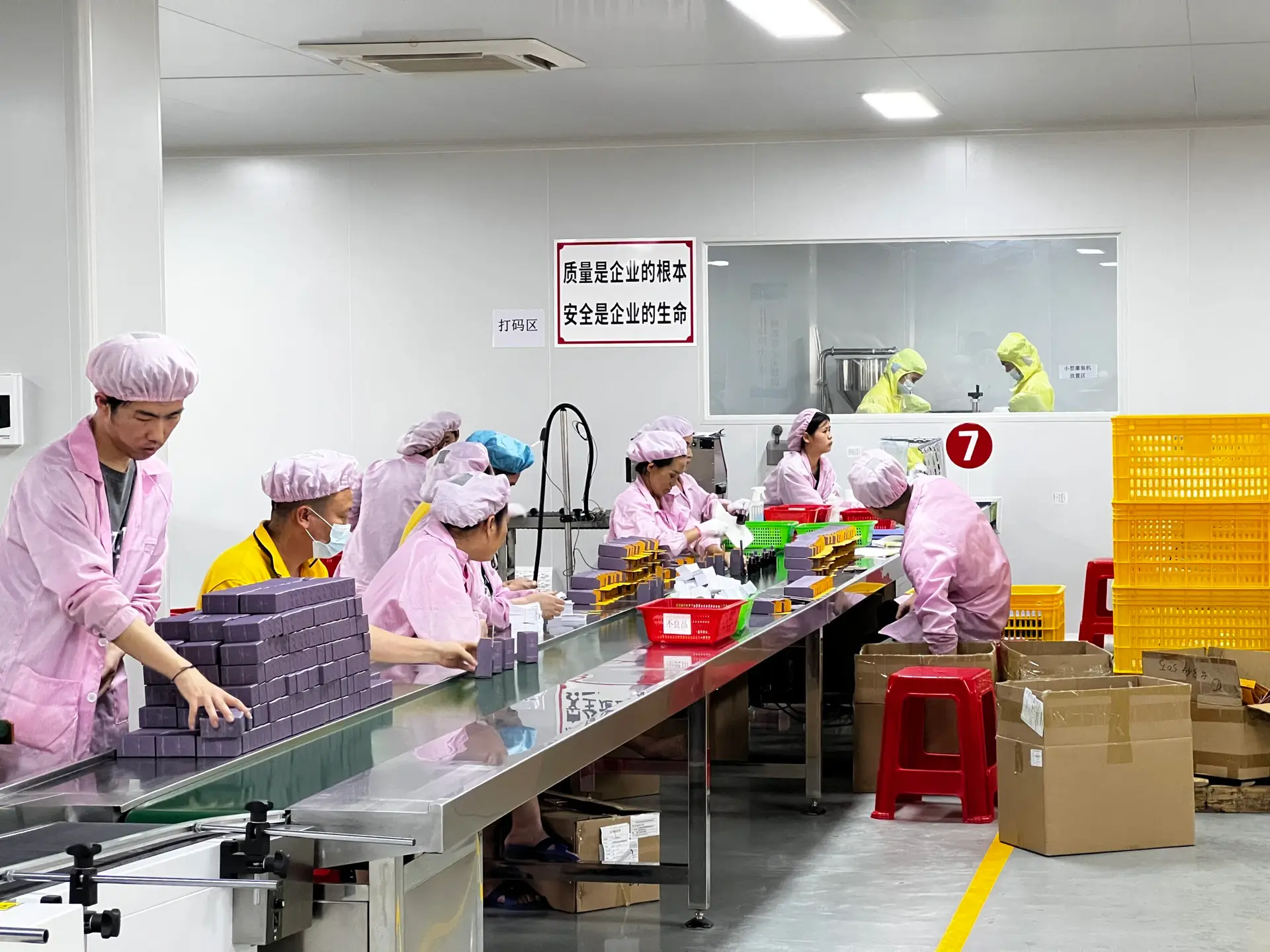




Ready to Launch Your Skincare Line?
*Metro Private Label takes your privacy very seriously. All information is only used for technical and commercial communication and will not be disclosed to third parties.