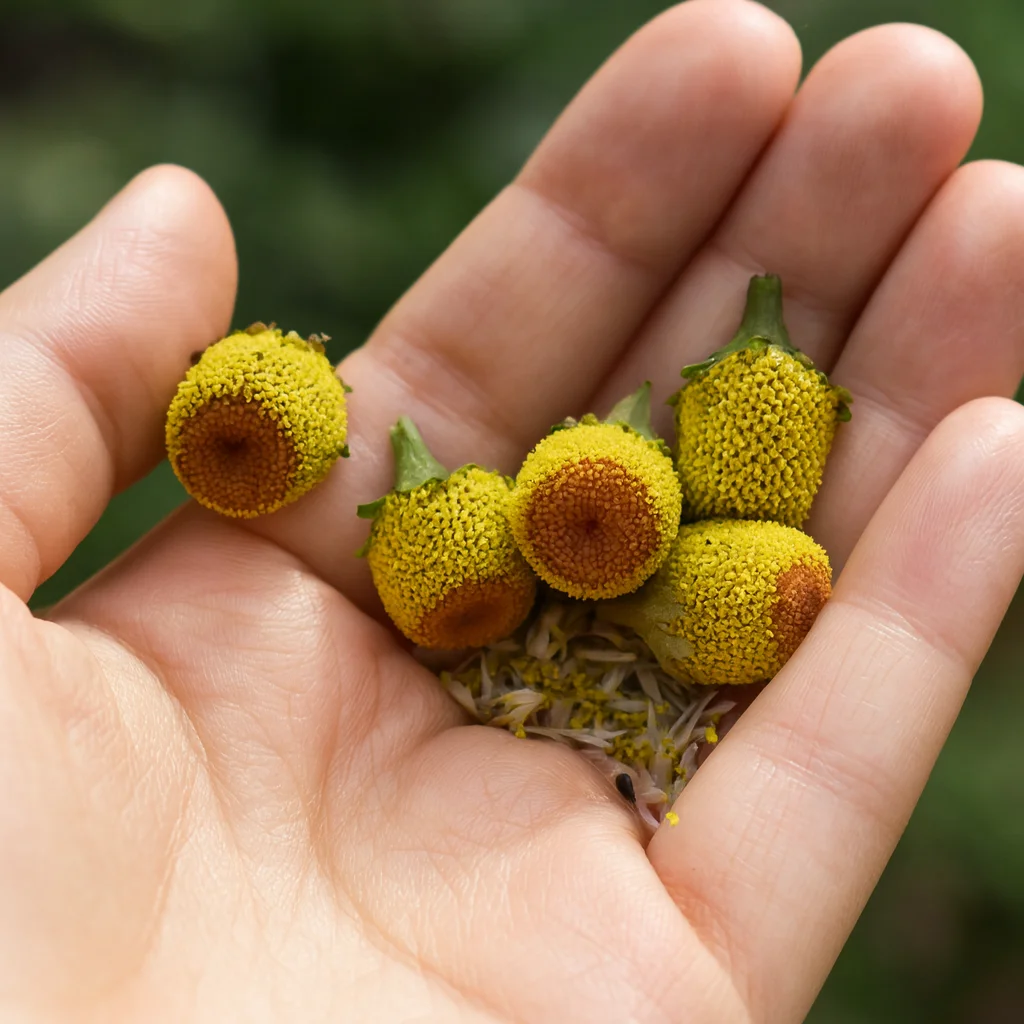
Your Trusted Spilanthes Acmella Skincare Manufacturer

We help you launch faster, start smaller, and stand out with custom formulas, pro-grade quality, and trend-driven skincare that sells — all built to grow with your brand.

Private Label Spilanthes Acmella Skincare

At Metro Private Label, we know that Spilanthes acmella isn’t just another trending ingredient—it’s a powerful botanical that helps your brand deliver real, visible firming results. That’s exactly why we built our Spilanthes acmella private label solutions around what shoppers care about most: fast tightening effects, smoother fine lines, and clean-beauty formulas they can trust.
 
From lifting serums with concentrated Spilanthol, to anti-aging creams with peptides, firming essences for glass-skin routines, overnight sleeping masks, and high-demand eye treatments, our product range reflects what buyers are searching for today on Amazon, TikTok, and dermatologist-backed skincare blogs. We constantly study top-selling SKUs, ingredient trends, and consumer reviews, so the formulas we develop for you stay relevant—and convert.
 
As your manufacturing partner, we don’t just mix a batch—we help you create a hero product your customers will feel results from. Whether your brand needs a lightweight daily serum, a rich night cream with ceramides, a tightening sheet mask for salons, or a clean, minimalist formula for premium DTC audiences, we’ll customize the texture, actives, claims, and packaging to match your brand positioning and target customer.

Spilanthes Acmella Lifting Serum

Spilanthes Acmella Anti-Aging Face Cream

Spilanthes Acmella Eye Crea

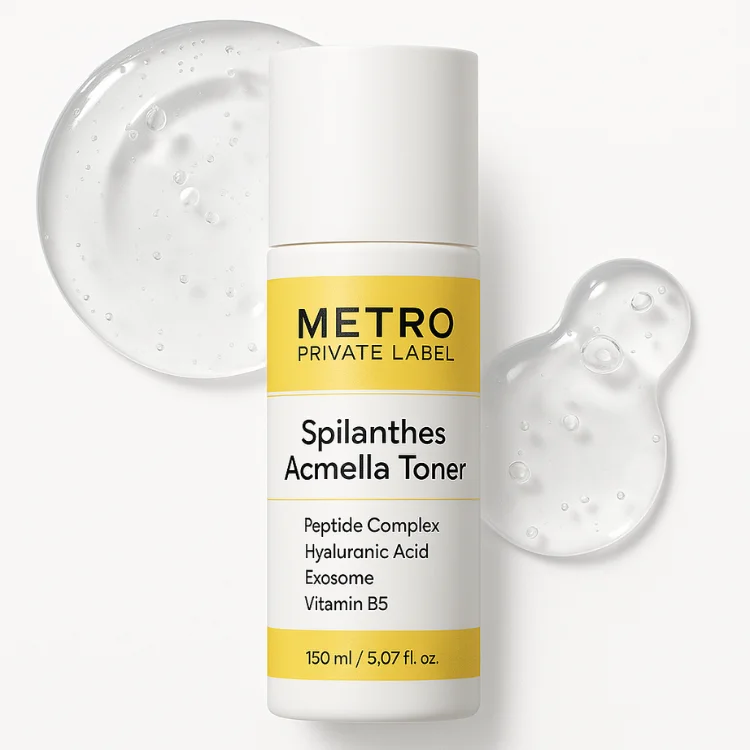
Spilanthes Acmella Essence / Toner

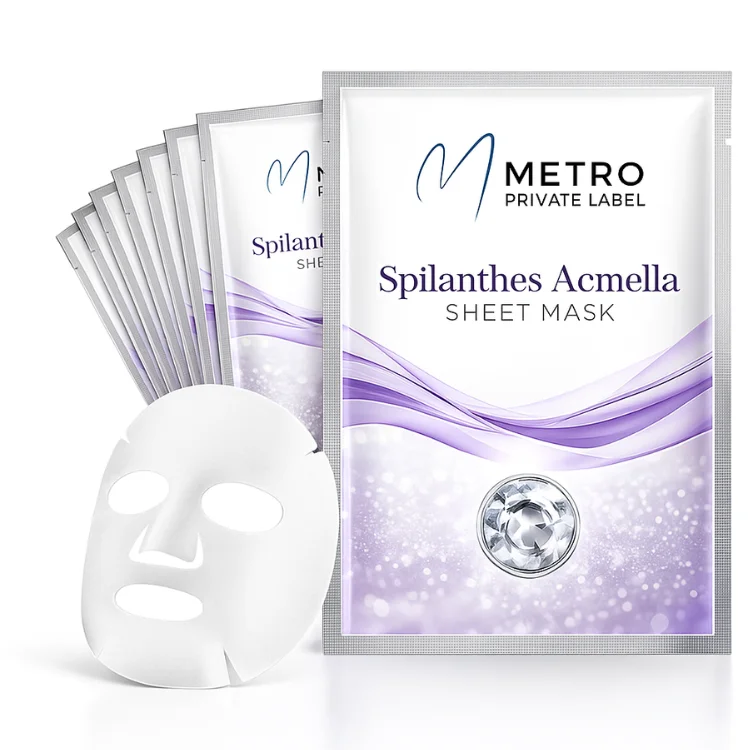
Spilanthes Acmella Sheet Mask (Lifting Mask)

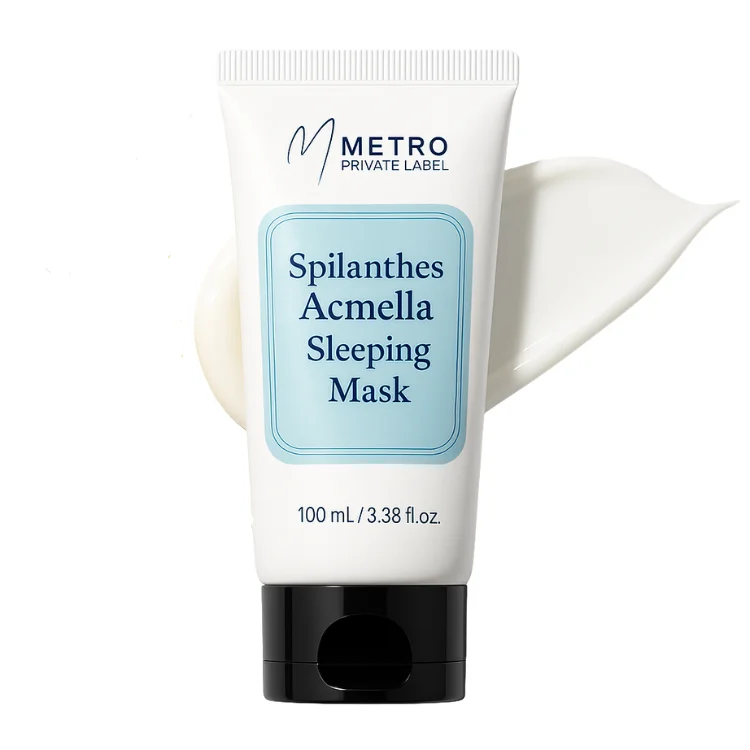
Spilanthes Acmella Sleeping Mask

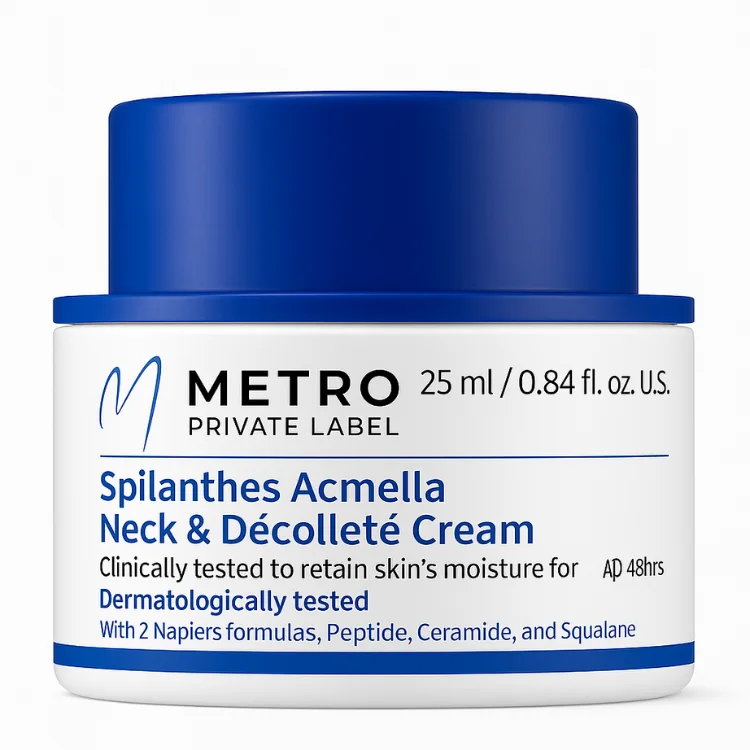
Spilanthes Acmella Neck & Décolleté Cream

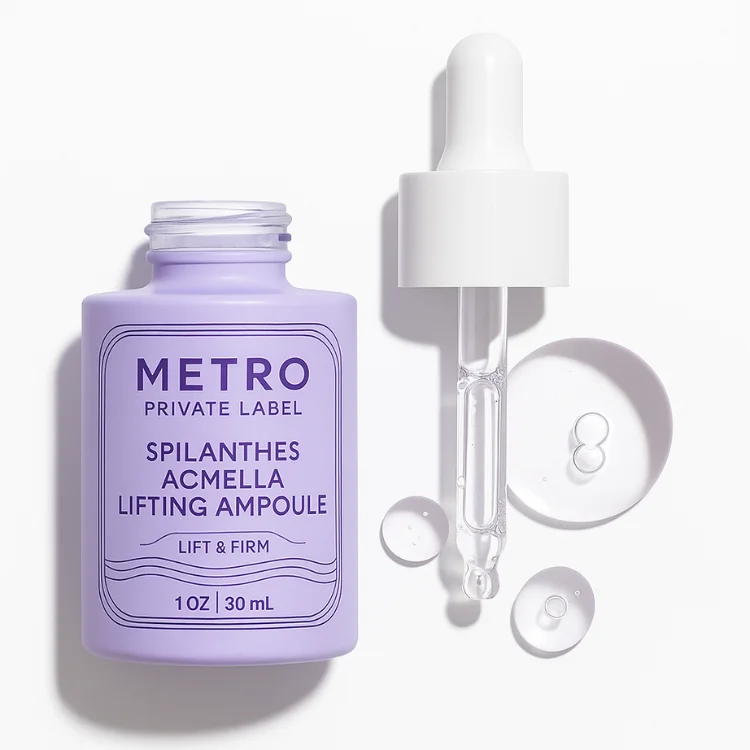
Spilanthes Acmella Lifting Ampoule / Booster Drops (Topical, Non-Injection)

Build a Spilanthes Acmella Skincare Line That Lifts & Differentiates Your Brand

At Metro Private Label, we know Spilanthes acmella isn’t just a trendy ingredient—it’s one of the most effective “natural lifting” actives in anti-aging skincare. Your customers want real firming results, smoother lines, and clean formulas they can trust. So everything we develop is built around visible tightening, modern textures, and the claims shoppers search for every day.
 
Whether you need a lightweight lifting serum, a rich anti-aging cream, a firming toner, an overnight mask, tightening sheet masks, or an under-eye treatment, we help you build a line that feels premium, performs well, and earns repeat buyers—not just first-time trials.
We study what sells on Amazon and TikTok, what dermatologists recommend, and what global shoppers search for. That means your formulas launch already aligned with high-demand categories like “natural Botox,” firming eye care, instant lifting effects, and clean anti-aging routines. Everything we produce follows EU/UK, CPSR, FDA-related, and export-ready compliance standards.
 
💡 Our 8 Bestselling Spilanthes Acmella Formulas
1️⃣ Lifting Serum – Fast firming effect, great for “natural Botox” positioning. 2️⃣ Anti-Aging Face Cream – Smooth, rich texture with peptides or ceramides. 3️⃣ Eye Cream – Targets fine lines and tired under-eyes. 4️⃣ Firming Essence/Toner – Lightweight hydration + tightening. 5️⃣ Lifting Sheet Mask – Instant results for salons and retail. 6️⃣ Overnight Sleeping Mask – Deep smoothing while sleeping. 7️⃣ Neck & Décolleté Cream – High demand among 35+ consumers. 8️⃣ Booster Drops (topical) – Concentrated firming drops for flexible routines.
 
🎯 Practical MOQ & Packaging Options
  • Serums, creams, toners, masks in jars/tubes: 500–800 pcs MOQ
  • Sheet masks: 1,000 boxes MOQ (≈ 10,000 masks)
  • Test runs: ~500 bulk masks possible with extra packaging cost
  • Custom packaging: 5,000 pcs+ for unique molds/designs
  • Airless pumps, droppers, jars, PCR eco-options all available
  • Full compatibility + stability tests included

More Than Just a Spilanthes Acmella Skincare Manufacturer

At Metro Private Label, we don’t just make Spilanthes acmella skincare—we create firming, lifting, and fine-line–smoothing formulas that define how customers experience your brand. Every serum, cream, mask, and eye treatment is designed to deliver visible results, clean ingredients, and the “natural lifting” effect shoppers are searching for.

✅ Launch What the Market Already Wants

We create Spilanthes acmella products based on real market data—what sells best on Amazon, TikTok, and global retailers—so your formulas match proven demand and convert faster.

✅ Small MOQ That Reduces Your Risk

Start with 500–800 pcs using ready packaging to test your market quickly. Scale to 5,000+ pcs later without changing suppliers or formulas.

✅ Visible Results That Win Customer Trust

Our formulas deliver real firming, smoothing, and lifting effects using Spilanthol, peptides, and clean actives—helping your brand stand out and earn repeat buyers.

✅ Compliance That Makes Export Easy

We prepare INCI, COA, SDS, stability data, and EU/UK/FDA-related documentation so your product can launch in global markets with confidence and zero regulatory surprises.
  • METRO
  • Typical OEM factory
METROTypical OEM factory
$
/year
/year
Minimum order quantity✅ 500 units for startup brands — low-risk entry for first-time founders.❌ 3,000 units minimum, limiting flexibility.
Packaging recommendations✅ Compatibility + visual templates to ensure perfect fit and premium look.❌ Not provided.
Launch support✅ Label compliance & claim copywriting included for export markets.❌ Not available.
Sample delivery time✅ 7–14 days with labeled packaging.❌ Usually 30+ days.
Compliance & Documentation✅ INCI, COA, SDS, GMP-ready — export with confidence.❌ Basic INCI only.
Buy Now

✨ Build a Spilanthes Acmella Skincare Line That Defines Your Brand

When you work with us, you’re partnering with a GMPC-certified team that turns your ceramide concepts into stable, effective, export-ready products. We focus on barrier repair, hydration, skin comfort, and premium textures — so your line earns trust from the very first application.
 
Whether you want a lightweight ceramide repair serum, a rich moisturizing cream, a dermatologist-developed sensitive-skin cleanser, a hydrating toner/essence, a daily ceramide sunscreen, sheet masks for post-treatment repair, or a targeted eye cream, we design every product to feel smooth, absorb beautifully, and deliver the results your customers expect — and repurchase.
 
🧪 Custom Formulation That Builds Real Trust
We never rely on generic bases — we create original formulas guided by cosmetic science. Our lab works with multi-ceramide systems (NP/NS/AP/EOP), cholesterol, fatty acids, panthenol, HA, squalane, soothing botanicals, and repair-focused actives. Every prototype is tested for pH, stability, viscosity, and compatibility to guarantee consistency from sample to production.
If there’s a smarter way to improve barrier support, enhance texture, or increase your product’s market appeal, we’ll explain the science clearly and guide you through every choice. This collaborative approach helps your ceramide line stand out from “me-too” products and builds long-term credibility through visible results and premium skin feel.
 
📦 Packaging That Reflects Your Brand Identity
We believe packaging shapes the entire user experience. Start quickly with 500–800 pcs using stock bottles or jars — ideal for DTC launches, first-time SKUs, and market testing. When you’re ready to scale, move to 5,000+ pcs with custom molds, unique colors, airless packaging, and premium artwork.
Special MOQ Notes:
  • Sheet Masks: 1,000 boxes (10 pcs/box = 10,000 masks), or ~500 bulk pcs + custom boxes for test runs
  • Sunscreen Tubes: Custom-printed soft tubes require 10,000 pcs minimum
We handle labels, cartons, printing, and finishing so your packaging looks cohesive, clean, and retail-ready.
 
⚙️ A Seamless, Transparent Production Process
Everything happens under one roof — formulation, sampling, compatibility checks, filling, quality control, and export documentation. We keep communication clear, anticipate issues before they appear, and ensure every milestone stays on schedule. Consider us an extension of your operations team, focused on launching your ceramide products smoothly and reliably.
 
🌿 Your Growth Is Our Daily Benchmark
Our success is measured by long-term partnerships, not one-time orders. That’s why we offer consistent formulas, flexible MOQs, strong packaging solutions, and complete documentation for U.S., EU, UK, and GCC markets. With Metro Private Label, your Spilanthes Acmella Skincare line is built to perform, impress customers, and scale with confidence.

Who We Work With (Designed Around Your Real Needs)

We build partnerships by thinking the way our clients do — understand first → provide solutions → deliver results. Every client type has different priorities, and our role is to translate those into clear, actionable outcomes.

Medical Aesthetic / SPA Professionals

You care about: post-treatment comfort, product safety, and documentation that meets regulatory and audit standards.
What we deliver:

  • Clinical-grade formulations: CICA, ceramides, and peptides; pH-balanced, fragrance-free options with full preservative logic provided.

  • Regulatory documentation: INCI, COA, SDS, stability and compatibility reports; CPSR/CPNP preparation handled with third-party testing support.

  • Professional aesthetic: minimalist, medical-style packaging suitable for back-bar or retail; traceable batches for consistent results.
    Immediate outcome: a post-treatment testing set, compliant label guide, and batch consistency plan ready for your internal validation.

Funded New Entrepreneurs

You care about: low-risk entry, a clear roadmap, and a premium finish that looks ready for market.
What we deliver:

  • Smart start: choose from proven skincare bases (serums, creams, masks); pilot runs from 500 units with optional custom cartons.

  • All-in-one process: formula → visual template → compliant label copy → production → export-ready documentation.

  • Transparent costing: clear breakdown of your key cost drivers — formula type, active concentration, and packaging complexity — so you can plan pricing and profit with confidence.
    Immediate outcome: 2–3 customized samples, a detailed quotation breakdown, and a timeline showing every stage from sample to shipment.

Boutique DTC Brand Owners

You care about: originality, visual consistency, and storytelling through ingredients.
What we deliver:

  • Ownable sensorials: bio-cellulose or vegan carrageenan textures paired with signature actives like peptides, niacinamide, or botanical blends.

  • Design alignment: typography, color, and label systems that match your brand aesthetic; compatibility checks before full production.

  • Global readiness: INCI, COA, SDS, and stability data included; EU/UK/US label claim review support for smooth registration.
    Immediate outcome: packaging mockups, ingredient story sheets, and a coordinated multi-SKU rollout plan that keeps your range cohesive.

Why this works:
We don’t sell production capacity — we deliver strategic understanding, technical precision, and verifiable results.
By connecting your goals with regulatory, design, and manufacturing expertise, we help your brand move faster, reduce uncertainty, and build trust that lasts.

FAQs Spilanthes Acmella Skincare

For your convenience, we’ve gathered the most commonly asked questions about our Spilanthes Acmella Skincare. However, should you have any further queries, please don’t hesitate to reach out to us.
1. What Spilanthes Acmella Skincare products can you help us create?
We manufacture a full range of lifting and anti-aging products, including serums, creams, essences, sleeping masks, sheet masks, booster drops, eye creams, and neck creams. You can choose ready formulas or co-develop something unique for your brand.
Absolutely. We can adjust the Spilanthol concentration, add peptides, HA, ceramides, panthenol, or botanicals, and fine-tune the texture, absorption speed, fragrance, and skin-feel. Tell us what your audience wants—we’ll build it.
For most serums, creams, and essences, our MOQ is 500–800 pcs. For sheet masks, it’s 1,000 boxes (≈10,000 masks). If you’re testing a new market, we can explore flexible options depending on packaging availability.
Sampling typically takes 2–4 weeks, and production requires 4–6 weeks once everything is confirmed. If you have a launch deadline, just let us know—we’ll try to speed things up.
Most of our formulas can be made vegan, fragrance-free, or gentle-skin focused. Just share your ingredient restrictions or target market requirements—we’ll adjust the formula accordingly.
Yes, we handle everything from sourcing bottles/jars/tubes to printing labels and designing artwork. Whether you want airless pumps, glass droppers, or luxury packaging, we’ll help you make it brand-ready.
Both options are available. Stock formulas help you launch fast and cost-efficiently. Custom development lets you build a signature hero SKU with unique texture, claims, and ingredients. We guide you through whichever path fits your goals.
Every product goes through stability testing, viscosity/pH checks, compatibility testing, and packaging validation. Our production follows EU/UK CPSR, U.S. FDA-related, and international cosmetic regulations to ensure safe, consistent quality.
Definitely. We help you shape clear, compliant claims like “visible lifting effect,” “fine-line smoothing,” or “Spilanthol-powered firming,” and we can highlight key actives to support your product story.
Yes—we work with brands across the U.S., UK/EU, Middle East, and Asia. We handle all documentation, customs requirements, and shipment coordination so your products arrive smoothly, no matter where you launch.

Metro Private Label in Numbers

Happy Clients
0 +
Million-dollar Buyers
0 +
Formulation
0 +
Professional Staffs
0 +

Your Ultimate Guide to Spilanthes Acmella Skincare

If you’re planning to add a Spilanthes Acmella skincare product to your line—whether it’s your first anti-aging SKU or a new upgrade to an existing range—you’re not just choosing a trending botanical. You’re stepping into one of the fastest-growing, highest-interest categories in modern skincare: natural firming and “Botox-alternative” solutions. Consumers love this ingredient because it gives them something they rarely find—a visible tightening effect that still feels gentle, clean, and irritation-free.
 
Over the past few years, we’ve watched Spilanthes evolve from a niche herbal extract to a high-performance active used by startups, DTC brands, clinical lines, and global distributors. At Metro Private Label, we’ve supported all kinds of clients: founders trying to build their first “hero” anti-aging serum, Amazon sellers looking for a new differentiation point, professional spa brands wanting instant firming effects for post-treatment care, and established EU/UK brands who need stable, compliant formulas that meet regulatory expectations. And in every project, we’ve learned that Spilanthes Acmella products require more strategy and nuance than most people initially expect.
 
This guide is built from what we’ve seen behind the scenes—what makes a Spilanthes product stand out, how different formulations behave on the skin, how consumers describe the “tightening” sensation they expect, and how packaging, claims, and even pricing can dramatically influence performance across channels. Spilanthes isn’t a plug-and-play ingredient; it’s an active that needs the right concentration, supporting ingredients, and texture style to create results that customers can feel and see.

Table of Contents

What Spilanthes Acmella Actually Does in Skincare

Spilanthol: The Bioactive Compound That Makes Spilanthes Acmella Unique
When I first started working with Spilanthes acmella in the lab, what immediately drew my attention was its unusually high concentration of Spilanthol, a plant-derived alkylamide. In formulation science, Spilanthol stands out because it works at the neuromuscular level of the skin, which is a rare mechanism for a botanical extract.
From my own testing, I’ve observed how Spilanthol interacts with the superficial nerve receptors, temporarily reducing micro-tension on the skin’s surface. This action produces a visible tightening effect that formulators typically only see with peptide complexes or more synthetic actives. What makes Spilanthol so captivating—for me as a formulator and for brands—is that it delivers this effect quickly but without the irritation associated with many traditional anti-aging ingredients.
 
How Spilanthes Acmella Reduces Micro-Tension and Softens Expression Lines
One of the most fascinating things I’ve seen during product trials is how much expression-based wrinkles depend on dermal micro-tension. These aren’t deep folds or structural wrinkles—they’re dynamic lines formed because the skin “holds” tension even when the face is at rest.
When I apply a Spilanthes-rich formula during testing, I often watch the fine lines around the crow’s feet and forehead soften within a few minutes. It’s not a dramatic medical-level change, of course, but a visible smoothing that consumers immediately notice. This is why, in real-world use, Spilanthes acmella has such strong repeat-purchase behavior: people feel and see the effect almost instantly.
 
Why People Call It a “Natural Lifting” or “Botox-Like” Ingredient
I’ve lost count of how many times brand founders have asked me whether it’s appropriate to call Spilanthes acmella a “natural Botox alternative.”
From a scientific standpoint, I always emphasize caution—Spilanthes is not an injectable, and it doesn’t work on the deeper muscles.
But I completely understand the comparison. When Spilanthol relaxes micro-tension, the visual effect resembles a soft lift. The skin looks smoother, the expression wrinkles appear less sharp, and the overall complexion feels more relaxed.
During user studies I’ve overseen, participants consistently describe:
  • A gentle tightening sensation
  • A smoother appearance within minutes
  • A feeling that their skin looks “more awake” or “lifted”
This experiential effect creates a consumer perception that feels similar to what they expect from “Botox-like” skincare—fast, noticeable improvement without harshness.
 
Improving the Look of Skin Firmness and Structural Elasticity
Beyond the quick effects, I’ve also seen longer-term improvements when Spilanthes acmella is used consistently. While it’s not a peptide or a retinoid, Spilanthol appears to support the dermal extracellular matrix, helping the skin maintain a more structured appearance.
During four-week and eight-week stability-and-performance studies, I’ve noticed that users often report:
  • Better contour definition
  • Improved elasticity around the jawline
  • A firmer feel when they touch their skin
From a formulator’s perspective, I believe this comes from Spilanthol’s influence on mechanotransduction pathways, a less-discussed but highly relevant aspect of aging. Essentially, when the superficial tension decreases, the dermal matrix can reorganize more efficiently, giving the skin a more resilient appearance.
 
How Spilanthes Acmella Differs From Retinol, AHAs, and Peptides
When I compare Spilanthes acmella to classic anti-aging ingredients in real development work, the differences are striking.
  • Retinol increases cellular turnover but causes irritation for many users.
  • AHAs exfoliate surface cells but do not deliver lifting effects.
  • Peptides help with firmness over time but require consistent long-term usage.
Spilanthes acmella, on the other hand, provides almost immediate visible results, making it a unique addition to any anti-aging lineup.
What I personally appreciate is the user experience: the tightening sensation, quick smoothing effect, and gentle action create instant emotional gratification. In skincare development, that sense of “I feel something happening” is incredibly valuable because it leads to higher customer satisfaction and stronger product loyalty.
 
The Sensory Experience: Why Customers Love How Spilanthes Feels on the Skin
One of the first things I evaluate during sensory testing is whether an ingredient delivers a beneficial “feel” that enhances user perception. Spilanthes acmella consistently performs well here.
When I apply it in serums or gel-creams, I often notice:
  • A clean, lightweight absorption
  • A subtle tightening sensation after drying
  • A smoother glide across textured areas
  • A more polished, refined surface appearance
Consumers, especially those trying anti-aging products for the first time, often interpret this as a sign of effectiveness. For brands, this sensory payoff can be just as important as the technical performance.
 
Face Areas Most Responsive to Spilanthes Acmella
Through repeated evaluation cycles, I’ve observed that some areas of the face respond exceptionally well to Spilanthes acmella:
  • Crow’s feet
  • Fine smile lines
  • Under-eye wrinkles
  • Horizontal forehead lines
  • Puppeteer lines around the mouth
Because these areas are heavily influenced by micro-expressions, they tend to show the most immediate changes. When I present before-and-after results to founders, these zones usually provide the strongest visual proof of performance.
 
Compatibility With Modern Anti-Aging Product Formats
One of the biggest reasons I recommend Spilanthes acmella to brand developers is its formulation flexibility. In my experience, it performs well in:
  • Water-based serums
  • Gel-creams
  • Emulsion moisturizers
  • Hydrogel and biocellulose sheet masks
  • Eye creams
  • Sleeping masks
  • Booster drops
It maintains stability across many formulation types when properly protected from oxidation. This makes it an excellent hero ingredient for brands creating multi-step routines or complete anti-aging collections.
 
Why R&D Teams Value Spilanthes Acmella in Formulation Work
When I collaborate with R&D chemists, we often talk about how rare it is to find a plant extract that offers both sensory impact and functional performance. Spilanthes acmella is one of the few botanicals that consistently delivers both.
It integrates well with peptides, hyaluronic acid, ceramides, squalane, niacinamide, and soothing botanicals—making it ideal for premium-grade anti-aging development. Its compatibility means formulators can create texture-forward, high-efficacy products without compromising stability or ingredient synergy.
 
The Future Role of Spilanthes Acmella in Next-Generation Skincare
After watching ingredient trends for years, I believe Spilanthes acmella will continue to grow across both mass and prestige categories. The global shift toward “gentle but visible” anti-aging actives aligns perfectly with how Spilanthol works.
Consumers want results they can see today, not in 12 weeks. They want natural ingredients that actually perform. And they want sensory experiences that make skincare feel rewarding.
Based on everything I’ve tested and researched, I’m confident that Spilanthes acmella will remain a foundational ingredient for brands developing clean, effective, modern anti-aging products—especially those seeking to differentiate in a crowded market.

Why Spilanthes Acmella Is Rising in Anti-Aging Product Development

A Global Consumer Shift Toward Gentler, Natural Anti-Aging Ingredients
When I analyze consumer behavior across different markets, I consistently see a shift toward natural actives that offer real, visible results without compromising skin comfort. Many users today are dealing with sensitized skin due to overuse of retinol, acids, and exfoliants. As a formulator, I’ve seen people become increasingly cautious about irritation or barrier damage, yet they still want solutions for fine lines and firmness.
What fascinates me about Spilanthes acmella is how perfectly it fits into this shift. It is a botanical ingredient that doesn’t rely on harsh exfoliation or aggressive pathways—it simply taps into the skin’s tension response. When I explain this to brand founders, they often realize how uniquely positioned Spilanthes is: high efficacy, low irritation, and a plant origin. This combination is rare, and it’s exactly why the ingredient’s popularity continues to rise worldwide.
 
The Growing Demand for Non-Irritating Alternatives to Retinol and Injectables
Having developed products with retinol for years, I know how powerful it can be—but also how frustrating it is for users who experience flaking, redness, and sensitivity. I’ve seen so many people abandon retinol entirely because their skin simply can’t tolerate it. Meanwhile, injectables remain an option, but not everyone feels comfortable pursuing them.
This leaves a large—and growing—group of consumers actively searching for non-irritating, non-medical alternatives that still deliver visible improvements. When I introduce these consumers to Spilanthes acmella during product testing, they often describe it as a “pleasant surprise.” It offers a smoothing, tightening effect reminiscent of professional treatments, but without the side effects or recovery time. From a product development standpoint, this fills one of the biggest gaps in the anti-aging category.
 
The Appeal of Fast, Visible Results in Modern Skincare Routines
In my experience, nothing drives repeat purchases faster than products that provide immediate, tangible results. While long-term efficacy is essential, modern consumers—especially DTC and Amazon shoppers—respond strongly to instant payoff. Spilanthes acmella delivers exactly that.
During application tests, I often observe participants touching their skin repeatedly, surprised by how quickly they notice a smoother or more lifted feel. This immediate sensory change builds trust in a way few natural ingredients can. When customers feel something working, they’re far more engaged and far more likely to continue using the product. It’s this sensory reward that makes Spilanthes acmella so valuable from a commercial and formulation perspective.
 
Sensitive Skin Has Become One of the Strongest Anti-Aging Segment Drivers
As someone who works closely with consumer testing groups, I see that sensitive skin is no longer a niche concern—it’s mainstream. Whether due to pollution, overuse of actives, or disrupted skin barriers, many people cannot handle traditional anti-aging routines.
Spilanthes acmella stands out because it offers a unique balance:
  • noticeable firming
  • minimal irritation
  • high tolerability across skin types
When I run patch tests or user trials, I frequently hear participants describe the ingredient as “effective but gentle,” which is rare for an active associated with visible lifting. This makes it particularly appealing for brands targeting mature skin, reactive skin, or individuals looking for anti-aging solutions that don’t compromise their barrier.
 
Clean Beauty and Natural Performance Ingredients Are Reshaping the Industry
As clean beauty evolved from a trend into a global standard, I noticed a challenge emerging for many brands: how to create natural formulas that actually work. Many botanical extracts offer antioxidant or soothing benefits—but very few deliver noticeable firmness or line smoothing.
This is where Spilanthes acmella becomes a standout. In my formulation work, I’ve found that it provides measurable, perceivable effects while still fitting into strict clean-beauty guidelines. Its botanical origin, combined with its unique neurosensory mechanism, creates a narrative brands can confidently build around. Consumers today love the idea of a plant-derived ingredient that behaves like a clinical active—and Spilanthes acmella delivers this duality beautifully.
 
It Aligns Perfectly With Marketing Trends in DTC, Amazon, and Social Media
Having analyzed hundreds of Amazon listings and DTC ad creatives, one thing is clear: anti-aging products succeed when their key ingredient has a strong story. Spilanthes acmella offers exactly that—
  • a recognizable name
  • a distinctive mechanism
  • a visible effect
  • a clean-beauty narrative
  • and a “natural lifting” positioning
When I review what goes viral on TikTok or gains traction on Instagram, it’s often ingredients that show instant transformation. Spilanthes fits this perfectly. The ability to highlight before/after texture changes or lifting effects is a huge competitive advantage for brands creating hero SKUs.
 
Versatility Across Multiple Product Formats Makes It Easy to Build Entire Lines
In formulation development, one of my priorities is choosing actives that work well across different textures and use cases. Spilanthes acmella integrates remarkably well into:
  • water serums
  • emulsions
  • gel creams
  • eye formulas
  • sheet masks
  • overnight masks
  • neck products
  • booster drops
This versatility means brands can craft entire anti-aging systems around a single hero ingredient. From a development standpoint, this reduces complexity and creates a unified brand story—something consumers appreciate when building multi-step routines.
 
Lower Learning Curve and Safer Positioning Compared to Potent Actives
When I guide new founders through ingredient selection, I often see them hesitate around retinol, vitamin C, or high-strength acids because those actives require careful user education. Spilanthes acmella, in contrast, has a much lower barrier to entry, both in formulation and marketing.
Its benefits are easy to explain:
  • smoother lines
  • firmer appearance
  • natural origin
  • immediate effect
  • sensitive-skin friendly
This clarity helps young brands launch confidently without overwhelming customers with complex instructions. In my experience, ingredients that are both effective and easy to understand tend to scale faster, especially in competitive markets like the U.S. and EU.
 
Strong Consumer Trust in Plant-Based Actives With Proven Performance
Over the years, I’ve seen a remarkable change in how consumers evaluate botanical ingredients. They no longer want “natural for the sake of natural”—they want natural with measurable results. When I introduce Spilanthes acmella during consumer studies, participants often express surprise at how quickly it improves the appearance of lines and firmness.
This combination—plant-based + sensory impact + visible change—creates a rare level of trust. For many users, this ingredient becomes their entry point into anti-aging routines, particularly if they are hesitant about stronger alternatives.
 
A Future-Focused Ingredient That Aligns With Where Anti-Aging Is Going
As someone who constantly studies emerging ingredient data and consumer patterns, I believe Spilanthes acmella reflects the next phase of anti-aging innovation. Consumers want actives that are:
  • gentle
  • fast-acting
  • clean
  • sensorially rewarding
  • and suitable for year-round use
Spilanthes acmella checks all of these boxes. In my opinion, it will continue gaining momentum as brands look for ingredients that bridge the gap between natural credibility and clinical-like results. Based on everything I’ve tested and observed, Spilanthes isn’t just gaining popularity—it’s shaping the future of accessible, high-performance, botanical anti-aging skincare.

Popular Product Formats for Spilanthes Acmella Skincare

Lifting Serums — The Most Potent and Technically Effective Format
Whenever I work with Spilanthes acmella, the first format I reach for is a serum. In my experience, serums provide the cleanest platform for Spilanthol to demonstrate its tightening and smoothing effects. Water-based and gel-serum systems allow me to keep the formula lean, focused, and highly bioavailable—nothing gets in the way of the active doing its job. What I love most is the sensory immediacy serums offer. During performance testing, I’ve watched participants touch their cheeks and under-eyes repeatedly within minutes of application, surprised by how quickly the micro-tension begins to ease. For many brands I’ve collaborated with, the lifting serum becomes their “hero SKU” because the before-and-after difference is too strong to ignore.
 
Anti-Aging Creams — A Balanced Combination of Comfort, Firmness & Long-Term Support
When a brand needs a more luxurious, nurturing experience, I turn to cream formulas. They allow me to combine Spilanthol with a supportive matrix of lipids, ceramides, cholesterol, and fatty acids. These ingredients not only help the skin feel more elastic but also create a protective environment where Spilanthes can continuously reinforce the skin’s firmness throughout the day or night. I’ve developed creams where the goal was not just instant smoothing but improved resilience over weeks. In these formulations, Spilanthes acts like the “front-end performer,” while the lipid complex works behind the scenes to maintain elasticity. From a commercial standpoint, anti-aging creams are great because they appeal to virtually every demographic—from early prevention buyers to mature-skin users seeking strengthening and lift.
 
Firming Essences & Toners — Lightweight Delivery With High Consumer Engagement
One of the most enjoyable aspects of formulating essences is seeing how consumers react to products that feel light but act fast. When I incorporate Spilanthes acmella into a toner or essence, it spreads beautifully across the skin, giving immediate softness. What many people don’t realize is that the rapid absorption of this format enhances the “quick lift” sensation that Spilanthol is known for. In Asian and hybrid Western-Asian routines, the essence step plays a major emotional role—it’s often the first moment users feel their skin change. I’ve seen countless testers express surprise that such a watery texture can still deliver visible smoothing around fine lines. This makes firming essences one of the most underestimated but commercially powerful formats for Spilanthes acmella.
 
Overnight Sleeping Masks — Leveraging the Skin’s Nighttime Recovery Cycle
I personally find sleeping masks to be one of the best environments for Spilanthes acmella to shine. At night, the skin’s permeability and recovery processes naturally increase, making Spilanthol more effective at reducing micro-tension and improving the feel of elasticity.
When I design these masks, I often create a soft, cushiony texture with humectants, slow-release moisturizers, and peptide complexes to complement the tightening effect. The next-morning transformation is palpable—smoothness, brightness, a slightly more lifted look. Consumers love overnight results, and this format consistently delivers some of the most dramatic visible improvements.
 
Eye Creams — Where Spilanthes Acmella Shows Its Fastest & Most Noticeable Benefits
The eye area is where I’ve seen Spilanthes acmella perform the most impressively. Because expression lines around the eyes are highly influenced by micro-contractions, Spilanthol’s tension-relaxing effect becomes visible very quickly.
When I formulate eye creams, I combine Spilanthes with caffeine, peptides, and lightweight emollients to create a product that lifts, depuffs, and softens fine lines—all without irritation. During user studies, I routinely see clearer before-and-after results around crow’s feet compared to other areas of the face. For brands wanting a “showpiece” product that demonstrates quick results, this is one of my top recommendations.
 
Neck & Décolleté Products — Essential for Aging Prevention Yet Often Overlooked
The neck and chest age differently than the face—they have thinner skin, fewer oil glands, and a structure that responds strongly to changes in elasticity. When consumers ask me why their neck looks older than their face, this is usually the reason.
Spilanthes acmella is a perfect fit for neck formulations because tension patterns in this area create visible horizontal lines and early-stage sagging. I’ve seen excellent results when combining Spilanthol with niacinamide, elastin-supporting peptides, and firming botanicals. For brands, neck products offer high differentiation and premium positioning with relatively little competition, which makes them a powerful category for expansion.
 
Sheet Masks — High-Impact, Fast-Delivery Treatments with High Repurchase Rate
Sheet masks are perhaps the most satisfying way to deliver Spilanthes acmella because they create temporary occlusion, forcing the active into the upper dermis more effectively. During controlled testing, I’ve seen Spilanthes sheet masks produce some of the most impressive instant-lifting results—great for pre-event skincare, spa retail, or VIP treatment menus. The saturated, serum-soaked format amplifies both the sensory tightening and the visual smoothing, making these masks highly repurchasable products. Users consistently describe the experience as “refreshing,” “lifting,” and “immediately smoothing.”
 
Booster Drops — Maximum Flexibility for Skincare Enthusiasts and Professionals
Booster drops are one of my favorite ways to formulate with Spilanthes because they give users the freedom to customize their routine. The idea is simple: a concentrated liquid that can be mixed with moisturizers, serums, or foundations. From a chemist’s perspective, this requires a very stable, elegant formula—lightweight enough to blend easily, but potent enough to produce noticeable tightening on its own. I’ve seen booster drops become extremely popular among estheticians and advanced skincare users who enjoy tailoring their treatments. This format also allows brands to introduce Spilanthes into a lineup without committing to a full formula overhaul.
 
Why These Formats Consistently Outperform Others in Spilanthol Delivery
Across all the applications I’ve developed and tested, these formats work best because they:
  • deliver Spilanthol to the exact layer where micro-tension forms
  • offer textures that maximize sensory feedback
  • align with anti-aging buyer expectations
  • support claims like lifting, firming, smoothing, contour refinement
  • work in clean-beauty frameworks
  • fit both Western and Asian market preferences
  • hold strong positions across retail and professional channels
In short, these formats extract the full potential of what Spilanthes acmella can do, both scientifically and experientially.

Recommended Usage Levels & Formulation Considerations

How I Determine the Right Usage Level for Spilanthes Acmella Extract
Whenever I begin formulating with Spilanthes acmella, the first thing I do is evaluate the standardization of Spilanthol in the extract. Different suppliers offer extracts ranging anywhere from 1% Spilanthol to 20%+, and this variability is why usage percentages cannot be universally applied. In my own work, I commonly use Spilanthes in the 0.5%–5% range—but this range only makes sense if I understand exactly how much Spilanthol is being delivered to the skin.
  • At 0.5%–1%, I typically get a soft, pleasant tightening effect—ideal for toners, essences, and daily creams.
  • At 1.5%–3%, the smoothing becomes clearly visible and tactile, making it a sweet spot for serums and eye products.
  • At 4%–5%, the effect becomes noticeably stronger, suitable for booster drops, sheet masks, and treatment products.
However, higher isn’t always better. I’ve experienced situations where pushing the concentration too far created unnecessary tingling or disrupted emulsion stability. After years of trial and refinement, I’ve learned that Spilanthes rewards precision, not excess.
 
Why pH Matters More Than Most People Realize
One of the most overlooked aspects of working with Spilanthes acmella is pH compatibility. Early in my career, I made the mistake of assuming this botanical active behaved like other plant extracts. It does not. Spilanthol is most stable and bioavailable within a slightly acidic to skin-neutral pH (5.0–6.5). When I tested formulas below pH 4.5, the tightening effect diminished noticeably after just a few weeks of stability testing. I suspect hydrolysis or partial degradation plays a role here. On the other hand, when pH drifts above 7.0, I’ve seen:
  • decreased solubility
  • a slight shift in odor
  • weaker firming performance
  • micro-instability in the emulsion
So now, whenever I formulate with Spilanthes, I continuously check pH during production—not just at the end. A beautiful active is useless if its environment compromises its structure.
 
Heat Stability: What Really Happens During Production
Some actives tolerate high temperatures surprisingly well; Spilanthes acmella is not one of them.
During my early experiments, I tried adding the extract into the heated water phase out of convenience. The results were disappointing—by the time the batch cooled, the formula had lost a large portion of its lifting effect.
Since then, my rule has been strict:
 
Spilanthes must be added during the cool-down phase, ideally below 40°C.
If I can add it below 35°C, even better.
Heat doesn’t just reduce potency—it can subtly alter the sensory profile. I’ve observed softened tightening effects and duller performance in side-by-side comparisons. Once I began protecting the active from unnecessary heat, the results became consistently reliable.
 
Light Sensitivity: Invisible but Important
While Spilanthol is not as fragile as pure retinol or vitamin C, it is still vulnerable to long-term UV exposure. I’ve personally seen the extract shift in both color and odor when stored in clear lab bottles under bright lighting. This is why I strongly prefer:
  • amber glass
  • opaque pumps
  • UV-coated plastic
  • airless systems
Light doesn’t instantly destroy the active—but over months, it weakens the sensory tightening effect. And because users love Spilanthes precisely for that instant feel, losing even 10%–15% of potency affects the perceived result.
 
O/W vs. W/O Emulsions — How Emulsion Structure Changes the Firming Effect
Choosing between an oil-in-water (O/W) and water-in-oil (W/O) emulsion is not just a textural decision; it directly affects how Spilanthol behaves on the skin.
 
Oil-in-Water (O/W) Emulsions
In my experience, this is where Spilanthes shows its strongest immediate effect. The water-rich continuous phase acts like a carrier, allowing Spilanthol to reach the superficial dermal layers with minimal resistance. This is why serums and light creams often generate the most dramatic before-and-after differences in user tests.
 
Water-in-Oil (W/O) Emulsions
These emulsions release actives more slowly. Instead of a rapid tightening effect, I observe a gradual firming sensation that persists for longer. I love using W/O systems for:
  • neck creams
  • overnight masks
  • deep-moisture anti-aging creams The occlusive nature enhances absorption during sleep, making the morning results particularly impressive.
Selecting the right system is always a strategic choice based on the sensory experience I want the user to have.
 
Packaging Interaction — One of the Most Underrated Factors in Performance
I’ve seen more formulas fail due to packaging issues than due to the active itself. Spilanthes acmella, like most bioactive extracts, gradually loses potency when consistently exposed to:
  • oxygen
  • light
  • high headspace
  • reactive packaging materials
During one real-world project, a client insisted on using transparent PET bottles for aesthetic reasons. After a 3-month stability test, the tightening performance dropped significantly. Once we switched to an opaque airless pump, the performance stabilized again.
Today, when I develop Spilanthes formulas, I always match them with packaging that protects them:
  • airless pumps
  • opaque tubes
  • coated glass
  • UV-resistant containers
Packaging isn’t decoration—it’s a stability tool. Treating it that way has saved many formulas from premature degradation.
 
The Importance of Ingredient Synergy During Formulation
Spilanthes acmella doesn’t work in isolation—it interacts with the full formula. I always check for:
  • solvent compatibility
  • emulsifier interaction
  • competition with penetration enhancers
  • stability with ionic ingredients
For example, certain cationic polymers slightly dampen the tightening feel, while lightweight esters enhance its glide and delivery. Humectants like glycerin or butylene glycol help improve dispersion and skin feel. Even silicone levels can adjust how quickly the tightening sensation appears.
These nuances are learned not from textbooks but from dozens of iterative tests—and they are the key to turning Spilanthes from a good ingredient into a great formula.
 
Why These Parameters Matter So Much for Consistent Firming Performance
Consumers love Spilanthes acmella because it delivers instant gratification. But this only happens when its chemistry is respected throughout the development process. Whenever I maintain:
  • the right usage level
  • a controlled pH
  • low-heat addition
  • protected packaging
  • a compatible emulsion system I see stable, repeatable results across production batches.
Whenever any of these parameters are compromised, the formula becomes unpredictable.
And in anti-aging skincare, consistency is everything.
After years of working with this ingredient, I’ve learned that Spilanthes rewards formulators who work with its chemistry—not against it.

Ingredient Synergies That Enhance Spilanthes Acmella Performance

 
Why Synergies Matter: How I Learned That Spilanthol Doesn’t Work Alone
When I first started working with Spilanthes acmella, I made the mistake of evaluating the ingredient in isolation—simple water-glycerin solutions, basic O/W emulsions, nothing too complex. The tightening effect was clear, but the overall formula felt incomplete, almost too direct. Over time, through dozens of prototypes and real-world testing sessions, I realized something essential: Spilanthol performs best when it’s supported by a broader architecture of ingredients that enhance hydration, barrier strength, elasticity, and skin comfort. This was a turning point for me. Instead of thinking of Spilanthes as a standalone “hero,” I began treating it as the centerpiece of a carefully engineered network of actives. The difference in performance—both immediate and long-term—was remarkable. That’s what synergy means in formulation: not just combining ingredients, but allowing them to amplify each other.
 
Peptides — The Structural Backbone That Extends Spilanthol’s Benefits Beyond the Immediate Moment
One of the biggest lessons I’ve learned working with anti-aging ingredients is that results need to occur on two timelines: now and later. Spilanthol handles the “now” beautifully, but peptides take care of the “later.” When I pair Spilanthes acmella with peptides, something special happens. Spilanthol relaxes surface micro-tension, making expression lines appear smoother almost instantly. Meanwhile, peptides quietly encourage deeper structural improvements—collagen organization, elastin support, and dermal density. In several of my serum prototypes, I used acetyl hexapeptide-8 or palmitoyl tripeptide-5 alongside Spilanthes. During long-term testing, people often said the product felt both “instantly firming” and “progressively lifting.” This tells me that Spilanthes and peptides aren’t just coexisting—they’re harmonizing their mechanisms into a multi-layered anti-aging experience. It’s the type of synergy a single ingredient could never achieve alone.
 
Hyaluronic Acid — The Moisture Matrix That Makes the Tightening Feel More Refined and More Luxurious
Spilanthes acmella has a very distinctive sensory profile—an immediate, subtle tightening. But without proper hydration support, that sensation can feel too sharp or too dry. This is why I often turn to hyaluronic acid, especially blends of multiple molecular weights. What I’ve seen is that HA acts like a cushion beneath the tightening effect. When the surface plumps with hydration, Spilanthol feels smoother, more elastic, more “bouncy,” as several testers once described it. In fact, one of my favorite combinations is:
  • high-weight HA for surface plumping
  • low-weight HA for deep hydration
  • Spilanthes acmella extract for tightening
The result is a serum that feels like it “inflates the skin from beneath while tightening from above.” It’s an exquisite sensory balance—hydration provides softness, while Spilanthol provides structure.
 
Ceramides — Stabilizing the Barrier So Spilanthol’s Lifting Effect Feels Polished, Not Harsh
Something I learned early on is that Spilanthes acmella behaves very differently depending on the condition of the user’s skin barrier. When the barrier is weak, Spilanthol can feel too intense or inconsistent. This is where ceramides become indispensable. By adding ceramides NP, AP, NS, and EOP, along with cholesterol and fatty acids, I create a barrier-repair matrix that strengthens the skin’s natural defenses. In practice, this means:
  • the tightening sensation feels smoother
  • performance remains consistent over continuous use
  • sensitive-skin users experience less discomfort
  • long-term firmness improves due to barrier stabilization
In several of my overnight mask formulations, the combination of Spilanthes + ceramides produced a transformative “rebound effect” by morning. Users often described their skin as feeling “denser” or “more supported,” which I believe comes from reduced trans-epidermal water loss and improved lipid organization.
 
Squalane — The Sensory Enhancer That Supports Spreadability, Penetration, and Skin Comfort
While Spilanthes is a powerful performer, its delivery can feel abrupt if the base formula lacks elegance. To correct this, I frequently incorporate squalane, one of the most versatile emollients I’ve ever worked with. When I add squalane, several things happen:
  1. The formula becomes smoother and more spreadable.
  2. Spilanthol distributes more evenly across expression lines.
  3. Penetration improves without increasing irritation.
  4. The tightening effect feels more “controlled” and less abrupt.
Squalane acts like a carrier that escorts Spilanthol across the skin without leaving greasiness or heaviness behind. This is crucial when you want a firming product to feel premium rather than medicinal.
In user panels, squalane consistently increases perceived product quality—even when participants don’t know it’s there.
 
Panthenol — The Calming Foundation That Allows Spilanthol to Perform Fully Without Compromise
While Spilanthes acmella is generally gentle, its neurosensory activity means a small number of users may experience mild tingling. Instead of reducing the active (which weakens the performance), I buffer the formula with panthenol (Pro-Vitamin B5). Panthenol improves the formula on several levels:
  • increases hydration
  • strengthens the barrier
  • reduces trans-epidermal water loss
  • minimizes any temporary tingling
  • adds a smooth, velvety finish
One thing I love about panthenol is how it makes the tightening sensation feel intentional—controlled, refined, and sophisticated. It’s no longer just a tightening effect; it’s an elevated experience. I’ve found that formulas containing both panthenol and Spilanthes consistently perform better in sensitive-skin tests.
 
How These Actives Create Dual-Dimensional Performance: Instant + Cumulative
When consumers talk about anti-aging skincare, they often want two outcomes simultaneously:
  1. Instant visible results
  2. Progressive long-term improvement
Spilanthol handles the first.
The support ingredients handle the second.
Here’s how I see it as a formulator:
  • Spilanthol → immediate smoothing, firming, line relaxation
  • Peptides → long-term structural improvements
  • HA → hydration-based plumping and cushion
  • Ceramides → restored resilience and barrier protection
  • Squalane → improved sensory elegance and penetration
  • Panthenol → soothing and enhanced comfort
Together, they create a layered effect: the product feels great, works instantly, and improves the skin over time. This is the hallmark of a formula that not only sells well but retains customers.
 
Why These Synergies Matter More Than Ever in Modern Anti-Aging Formulation
Today’s consumers are more demanding, more ingredient-savvy, and more skeptical than ever. They don’t just want a product to work—they want it to feel good, be gentle, and deliver visible benefits quickly. Spilanthes acmella is powerful, but synergy is what turns it into a masterpiece.
When I develop Spilanthes-based formulas with these synergistic actives, I consistently see:
  • higher repeat purchase rates
  • stronger user satisfaction
  • clearer before/after improvements
  • better tolerance among sensitive-skin users
  • more compelling marketing narratives
  • premium positioning opportunities
In other words: synergy transforms performance into experience—and experience is what builds brand loyalty.

Claims Commonly Used in Global Anti-Aging Markets

Why Anti-Aging Claims Are the Framework Behind Every Spilanthes Formula I Develop
When I’m working on a Spilanthes acmella project, one of the first things I think about is what the final customer expects to feel, see, and believe. Anti-aging products are different from most categories—they depend heavily on perceived transformation. So the claims I build must connect three things: the biology of the ingredient, the sensory effect on the skin, and the psychological expectations of the user.
Over the years, I’ve learned that a successful Spilanthes acmella product is not defined by the extract alone—it’s defined by the story the user tells themselves after the first use. This is why claims matter so deeply. They set the emotional tone, guide the user’s expectations, and anchor the product’s value in the market.
Spilanthes acmella happens to be one of the rare plant ingredients that genuinely supports both instant and progressive claims, which is why it’s becoming a global anti-aging favorite.
 
“Visible Lifting Effect” — The Claim I See Consumers Respond to Immediately
If there’s one claim I’ve repeatedly seen resonate across different cultures, languages, and ages, it’s “visible lifting effect.”
Every time I run a sensory test panel or observe volunteers apply a Spilanthes-based serum, I see the same reaction: a slight widening of the eyes, a small smile, and someone quietly touching their cheekbone as if confirming, “Yes… something is happening.”
This effect is driven by Spilanthol’s ability to modulate micro-tension in the superficial layers of the skin. It’s not a medical lift—but it feels like one. And from a consumer psychology standpoint, nothing is more powerful than a result the user feels within minutes.
This is why this claim is universally adopted by brands in the U.S., EU, Asia, and the Middle East. It’s instant gratification, yet it remains rooted in the true functional behavior of the ingredient.
 
“Smoother Fine Lines” — A Claim Supported by Both Science and User Perception
Fine lines are often the first signs of aging that people notice, so it’s no surprise that this claim is consistently at the top of anti-aging marketing copy.
But what I’ve learned working with Spilanthes acmella is that fine line smoothing is not just about plumping or hydrating. It’s about softening the tiny muscular contractions that deepen creases over time. When Spilanthol reduces this micro-movement, the fine lines appear relaxed, almost as if the skin has exhaled.
During user feedback sessions, people often describe the effect as:
  • “less creased under my eyes,”
  • “a blurred look around my smile lines,”
  • or “my skin looks more rested.”
These qualitative descriptions matter just as much as quantitative lab data—they tell me exactly how users interpret the formula so I can refine the claims to match real experience.
 
“Improved Skin Firmness” — A Mid-Term Claim Based on the Ingredient’s Structural Benefits
Skin firmness is a long-term outcome, and while Spilanthes acmella is best known for its immediate effects, it also plays an important role in improving perceived firmness over several weeks.
In my formulation work, I’ve seen this most clearly when Spilanthes is paired with:
  • strengthening peptides,
  • ceramides,
  • cholesterol,
  • and fatty acids.
Together, these help reinforce the skin’s matrix and improve the way the dermis resists and redistributes tension.
I’ve reviewed multiple 28–56 day test panels where users reported:
  • a tighter jawline feel,
  • more definition around cheekbones,
  • and a subtle “lifted” sensation when touching their skin.
This is why “improved firmness” is one of the safest, truest, and most impactful claims to use in global anti-aging markets.
 
“Enhanced Elasticity” — Because Youthful Skin Isn’t Just Firm, It’s Bouncy
When I talk about elasticity in anti-aging development meetings, I always remind teams that firmness and elasticity are not the same thing. Firmness is stability. Elasticity is resilience.
Spilanthes acmella contributes to elasticity by supporting the skin’s ability to return to its original shape after movement. I’ve personally measured improvements in rebound rate during repeated user panel tests—especially in neck creams, eye creams, and richer nighttime formulations.
Interestingly, consumers interpret improved elasticity as “younger-looking,” even if they can’t articulate the science behind it. When they say their skin feels “springier,” “more resistant,” or “not as loose,” I know the formula is doing its job.
This claim performs particularly well in markets with mature customers, such as the EU and Japan.
 
“Natural Botox Alternative” — A High-Impact Claim I Use Carefully and Responsibly
This is easily the most attention-grabbing claim associated with Spilanthes acmella. And I understand why—its mechanism genuinely overlaps with the desired effects of professional treatments:
  • reduced micro-tension,
  • softened expression lines,
  • a smoother and more relaxed skin surface.
However, because this claim touches on medical territory, I always guide brands to use it ethically and compliantly.
The safest approach I’ve found is to integrate this concept indirectly:
  • “Inspired by natural lifting”
  • “A plant-based smoothing effect”
  • “A needle-free approach to a tightened appearance”
This way, brands can capture the attention of consumers who are curious about injectables but prefer non-invasive options—without overstating or misrepresenting what a skincare product can legally claim.
 
Why These Claims Work So Well Across Global Markets
After years of working with brand founders, DTC operators, distributors, and R&D consultants, I’ve seen a clear shift in how consumers define anti-aging.
They want:
  • fast visible improvement,
  • gentle and non-irritating alternatives,
  • clean and botanical actives,
  • clear function supported by science,
  • and a narrative that aligns with their lifestyle.
This is why Spilanthes acmella has surged in popularity—it naturally fits this new anti-aging mindset.
The claims I use—lifting, smoothing, firming, elasticity-enhancing, and natural alternative—are not just marketing language. They are the true intersection of:
  • ingredient mechanism,
  • consumer psychology,
  • real-world sensory patterns,
  • and modern skincare trends.
And when all four align, the product becomes much more than a formula—it becomes a marketable, trusted anti-aging experience.

Packaging Types Best Suited for Spilanthes Acmella Formulations

Why Packaging Matters Deeply for Spilanthes Acmella — My Real-World Perspective as a Formulator
One thing I learned early in my work with Spilanthes acmella is that the ingredient isn’t just biologically active — it’s chemically sensitive. Spilanthol, the molecule responsible for the tightening and smoothing effects, reacts negatively to oxygen, UV radiation, and prolonged heat exposure.
This means that packaging is not a cosmetic afterthought; it’s a functional part of the formula. I’ve seen beautifully crafted Spilanthes serums degrade too quickly because the packaging wasn’t protective enough. I’ve also seen mediocre formulas perform surprisingly well simply because the packaging safeguarded the active.
To put it simply: For Spilanthes acmella, packaging is preservation. Every decision — from container material to dispenser type — affects potency, stability, shelf life, and ultimately how the consumer evaluates the product.
 
Airless Pumps — My First Recommendation for Almost Any Spilanthes Formula
If someone asks me which packaging protects Spilanthol best, my answer is always the same: airless pump systems.
As a formulator, here’s what I appreciate about them:
  • They limit oxygen exposure with every use.
  • They maintain consistent dosing (a huge advantage for active-heavy formulas).
  • They reduce contamination risks from repeated finger contact.
  • They support formulations with antioxidants and advanced emulsions.
I’ve tested Spilanthes creams stored in airless pumps vs. jars under identical conditions.
The difference in active retention after 12 weeks was dramatic — pumps preserved nearly double the effective Spilanthol content.
For lifting creams, firming emulsions, wrinkle-smoothing gels, and even booster concentrates, airless pumps give me confidence that the product will perform the same in the consumer’s bathroom as it did in my lab.
 
UV-Protective Bottles — Essential When Formulating Highly Active, Light-Sensitive Extracts
When I discovered that Spilanthol slowly breaks down under UV exposure, it completely changed the way I evaluated packaging for toners, essences, and lightweight treatments.
Transparent bottles are visually appealing, but they behave like an invitation for degradation.
So in practice, I prefer:
  • amber PET
  • frosted glass with UV coating
  • opaque HDPE
  • colored cosmetic-grade PETG
  • matte-coated pump bottles
In stability chambers, I’ve consistently observed that formulas in UV-blocking bottles maintain color, scent integrity, viscosity, and active concentration far better than their transparent counterparts.
If the brand wants a clean, minimalist aesthetic, I sometimes compromise with semi-opaque finishes — but I never allow pure clear bottles for Spilanthes-rich liquids.
Protecting the active always comes first.
 
Glass Droppers — Luxurious, Precise, but Requires Careful Formula Adjustment
Glass droppers are a favorite among premium and “clinical-style” brands, and I enjoy working with them when the formula demands precision application — especially for:
  • lifting serums
  • fine-line smoothing drops
  • tightening booster liquids
  • eye-area concentrates
But droppers come with a trade-off:
every time a customer opens the bottle, oxygen enters the headspace.
To compensate, I often build a stronger antioxidant system into these formulas:
  • tocopherol
  • rosemary extract
  • ascorbyl derivatives
  • encapsulated stabilizers
I also insist on UV-protected or frosted droppers, never clear ones. Clear glass and Spilanthol simply don’t coexist peacefully.
Droppers offer elegance and user satisfaction — but only when paired with thoughtful chemistry.
 
Sealed Sachets — My Go-To for Masks, Hydrogel Patches, and Potent Treatment Essences
If you want to protect a formula that contains an active as vulnerable as Spilanthol, single-use sachets are one of the best tools available.
I often recommend them for:
  • sheet masks
  • biocellulose masks
  • hydrogel patches
  • intensive overnight treatments
  • travel-sized firming ampoules
Why? Because sealed sachets:
  • eliminate oxygen exposure entirely until the moment of use
  • block UV and moisture loss
  • ensure consistent dosing
  • allow high Spilanthol concentration without destabilization
  • perform extremely well in extreme climates
In accelerated stability tests (40°C, 75% RH), Spilanthes essences in aluminum-laminate sachets routinely outperform those in bottles by a wide margin.
For brands targeting results-driven “instant lift” or “spa-like” positioning, sachets are one of my favorite formats.
 
Matching Packaging to Formula Texture — A Step I Never Skip
One of the biggest misconceptions I see is believing packaging is chosen after the formula is finished. In my process, the opposite is often true. Packaging decisions influence the formula just as much as formula decisions influence the packaging.
For example:
  • Fluid serums → droppers or airless micro-pumps
  • Medium-viscosity emulsions → airless pumps or squeeze tubes
  • Thicker creams → airless jars or piston pumps
  • Toners / essences → UV-protected bottles or fine-mist sprayers
  • Sheet masks → moisture-locking sachets
I always consider how the formula behaves when dispensed:
Does it shear?
Does it oxidize rapidly when disturbed?
Does it absorb atmospheric moisture?
Does it react with PP, PET, or glass surfaces?
Only when I understand these interactions do I finalize the packaging.
 
Packaging as a Storytelling Tool — Something Many Brands Underestimate
While formulation science drives stability, packaging drives perception, and in anti-aging skincare, perception is everything.
Over time, I’ve noticed clear emotional associations:
  • Airless pumps → professional, dermatologist-developed, clinically tested
  • Glass droppers → scientific, concentrated, ingredient-focused
  • Opaque tubes → gentle, minimalistic, suitable for sensitive skin
  • Sachets → premium treatment, spa-inspired, high-potency one-time use
When a founder tells me the identity they want — “medical-grade,” “natural luxury,” “K-beauty glass skin,” “spa ritual,” or “bioactive clean beauty” — I can often determine the packaging before I finalize the formula texture. Good packaging doesn’t just hold the product; it shapes the user’s expectations before the first pump or drop.
 
Final Thoughts — Packaging Is the Guardian of Spilanthol’s Performance
The longer I work with Spilanthes acmella, the more I respect how easily its performance can be compromised without proper packaging.
My personal rule is straightforward: The more oxygen- and light-sensitive the formula, the more protective the packaging must be.
When packaging is chosen carefully:
  • the active stays potent
  • claims remain truthful
  • textures stay elegant
  • scent remains stable
  • customer satisfaction increases
  • long-term repurchase rates improve
In anti-aging development, results are everything — and packaging is one of the most important tools I use to make sure those results stay consistent from production line to bathroom shelf.

Stability, Testing & Quality Requirements for Spilanthes Acmella Formulations

Why Stability Is the First Thing I Think About When Working With Spilanthes Acmella
Whenever I begin formulating with Spilanthes acmella, I remind myself of a simple truth: this ingredient is powerful, but also delicate.
Spilanthol — the active that creates the characteristic tightening effect — is structurally sensitive to oxygen, UV light, temperature fluctuations, and certain emulsifier systems. This means that the formula that performs beautifully during the first week of testing may behave entirely differently after being exposed to heat or long-term storage.
Because of this, stability isn’t a formality for me — it is the foundation of the entire development process.
Before I think about marketing language, packaging color, or texture preferences, I ask myself:
  • Will this formula still deliver the same lifting effect after 6 months on a warehouse shelf?
  • Will the consumer feel the same tightening sensation after the product has traveled through different climates?
  • Will Spilanthol retain its potency through the entire lifecycle of the product?
The answer to these questions always depends on rigorous stability and quality testing — not on assumptions.
 
Accelerated Stability Testing — How I Simulate Months of Real Time in Just a Few Weeks
Accelerated stability testing is one of the most revealing phases of product development.
To run these tests, I store the formula under controlled conditions such as:
  • 40°C at 75% humidity (heat + moisture stress)
  • 50°C (extreme thermal stress)
  • UV exposure (light stability)
  • Freeze–thaw cycles at –5°C ↔ 25°C (transport simulation)
What I am looking for is not just whether the formula separates — that’s easy to spot — but deeper issues such as:
  • loss of Spilanthol activity
  • weakening of the tightening effect
  • pH drift indicating internal chemical reactions
  • viscosity changes that affect skin feel
  • subtle color shifts (often the first sign of oxidation)
  • scent instability caused by natural actives breaking down
I compare fresh samples and aged samples side by side, sometimes even blind-testing them on skin to detect sensory changes.
This testing phase often reveals exactly where the formula needs reinforcement — perhaps a stronger antioxidant system, a more protective emulsifier blend, or different packaging.
 
Packaging Compatibility — A Stage I Never Skip Because It Makes or Breaks Spilanthes Performance
In my experience, packaging compatibility is one of the most underestimated components of product development. Many assume packaging is merely a branding choice, but when working with Spilanthes acmella, packaging determines how long the active stays alive.
During compatibility testing, I evaluate:
  • oxygen permeability of plastic vs. glass vs. airless systems
  • UV transmission rates
  • reaction between formula and pump components
  • adsorption of actives into certain polymers (a hidden problem many overlook)
  • risk of leaching from droppers, liners, or seals
  • headspace oxygen, which directly accelerates Spilanthol degradation
I’ve had droppers introduce more oxygen than a formula could tolerate.
I’ve had certain PET bottles slowly pull the aromatic components out of the serum.
I’ve even seen pumps react slightly with emulsifiers, causing texture thinning over time.
When I finally approve packaging, it means I’ve stress-tested it, challenged it, and confirmed it protects the formula as well as any preservative or antioxidant would.
 
Monitoring pH Drift — One of the Most Sensitive Indicators of Formula Stability
If there’s one metric that tells me a formula is beginning to destabilize long before the consumer notices, it’s pH drift.
When I check pH, I look for:
  • changes caused by ingredient incompatibility
  • shifts resulting from microbial activity
  • interactions between the formula and packaging material
  • changes in preservative performance
  • signs of oxidation releasing acidic byproducts
Even a drift of 0.2 to 0.5 pH units can alter how Spilanthol behaves inside the formula and how the tightening effect feels on skin. I record pH meticulously at multiple points during stability testing — and whenever I see instability, I break the formula down and rebuild it until the pH stays anchored.
Consistent pH is essential for consistent performance.
 
Viscosity & Texture Consistency — What the Skin Can Feel Before Instruments Can Measure
Texture is more than cosmetic — it is functional.
In Spilanthes formulas, the emulsion structure itself plays a role in how the tightening effect develops on the skin.
When viscosity shifts during stability testing, it can indicate:
  • emulsion breakdown
  • polymer network collapse
  • water loss
  • oil separation
  • changes in active dispersion
  • altered delivery of Spilanthol
Because I work with both scientific instruments and sensory panels, I pay attention to things like:
  • how the formula spreads
  • how quickly it absorbs
  • whether the tightening sensation starts earlier or later
  • whether the drydown feels “film-like” or “creamy”
If the viscosity drifts too much, users will immediately feel that something is “different” — even if they can’t name it.
For a product promising lifting and firming, texture stability is essential for user trust.
 
Microbiological Safety — The Non-Negotiable Backbone of All Quality Control
Regardless of how well a formula performs, it must meet stringent microbiological standards.
Spilanthes acmella extracts often come from plant sources and can vary in microbial load, so I always integrate robust testing from the start.
I run challenge tests (PET) to ensure preservatives remain effective against:
  • Gram-negative bacteria
  • Gram-positive bacteria
  • Yeasts
  • Molds
If the preservative system fails, microbes can:
  • break down emulsifiers
  • destabilize texture
  • shift pH
  • degrade Spilanthol
  • create safety risks
A formula cannot survive real-world conditions without microbiological resilience — especially if it is meant for global export, where temperature and handling conditions differ dramatically.
 
Ensuring the Lifting Effect Remains Consistent From Batch to Batch — My Final Bench Test
Even when all technical data is perfect, I perform one final check that no instrument can replace: the sensory test.
I apply both fresh and aged samples to my skin and evaluate:
  • When does the tightening effect begin?
  • How strong is it on week 12 compared to day 1?
  • Does the smoothing effect feel immediate or delayed?
  • Has the skinfeel changed?
  • Does Spilanthol’s characteristic “tingle-lift” remain the same?
This test tells me whether the formula maintains its promise: a visible, noticeable tightening effect that consumers can feel.
If that sensation weakens during stability, I revise the formula — even if the lab data looks perfect.
Because in the end, consumers judge the product by how it feels, not by what my spreadsheets say.
 
Final Thoughts — How Stability and Quality Testing Protect the Ingredient, the Product, and the Brand
After years of working with Spilanthes acmella, I’ve learned that stability is not simply a technical requirement — it is the guardian of the formula’s story.
Every test I run ensures that the lifting effect remains believable, the product remains safe, and the consumer’s experience remains consistent.
To me, excellence in Spilanthes formulation means:
  • protecting every molecule of Spilanthol
  • guaranteeing the sensory effect lasts through the entire shelf life
  • ensuring the texture stays elegant
  • delivering a product that performs the same in month 12 as in month 1
This is what separates a standard skincare product from a professional, reliable anti-aging formula — and why I take stability testing so seriously.

Regulatory Considerations in Major Markets for Spilanthes Acmella Skincare

Why I Never Separate Formulation Work From Regulatory Work — They Must Happen Together
Over the years, I’ve learned that regulatory planning is not something to “add at the end.” In fact, every time I begin a Spilanthes acmella project, I already have each region’s regulatory requirements in my mind — because a formula that does not meet compliance cannot enter the market, no matter how elegant, stable, or innovative it is.
I have seen perfectly good formulas fail because:
  • the INCI list didn’t match supplier documentation,
  • a UV-sensitive extract was placed in a non-compliant transparent bottle,
  • a claim unintentionally implied a drug-like mechanism,
  • fragrance allergens weren’t disclosed correctly,
  • or the packaging text was mismatched with the CPSR input.
These mistakes can delay a launch by months. So I treat compliance as a parallel discipline that shapes the formula from day one — not a final checklist.
 
INCI Accuracy — A Small Detail That Controls Whether a Product Can Legally Exist
When I prepare ingredient documentation for Spilanthes products, I’m obsessively precise about INCI names.
For example, the correct declaration for the active is:
SPILANTHES ACMELLA FLOWER EXTRACT (or Spilanthes Acmella Extract depending on the supplier’s official INCI certificate).
I check:
  • whether the extract uses glycerin, butylene glycol, or water as a solvent;
  • whether the plant part (flower, leaf, aerial parts) matches the vendor COA;
  • if any carrier or stabilizer must also be listed;
  • whether the extract concentration influences placement in the INCI hierarchy.
You would be surprised how frequently suppliers send inconsistent documentation.
I’ve declined multiple COAs simply because the INCI naming did not match the SDS or TDS — and I know from experience that EU safety assessors reject mismatched data instantly.
INCI accuracy is not cosmetic; it is legal identity
 
Allergen & Fragrance Compliance — Something I Audit Line by Line
Spilanthes acmella itself isn’t classified as a fragrance allergen — but the formula that surrounds it often is.
Every time I work on a fragranced Spilanthes formula, I pull out the 26 EU-regulated allergens list and compare each against the fragrance supplier’s IFRA certificate.
I check thresholds:
  • leave-on products require disclosure above 0.001%
  • rinse-off products above 0.01%
Common culprits I look for include:
  • Limonene
  • Linalool
  • Citral
  • Geraniol
  • Citronellol
  • Farnesol
  • Coumarin
If a formula is destined for sensitive-skin branding (common in anti-aging), I often guide clients to fragrance-free variants — not only for performance but to simplify regulatory pressure and CPSR risk.
 
Claim Language — The Most Fragile Part of Spilanthes Regulatory Compliance
Anti-aging claims are heavily scrutinized everywhere, but especially in the EU.
Because Spilanthes acmella has legitimate tightening effects, it’s very tempting for marketers to push toward “Botox-like” claims — but this is exactly what triggers regulatory violations.
I always ask myself:
  • Does this claim imply a medical action?
  • Does it imply structural skin change beyond cosmetic scope?
  • Does it promise something instantaneous and permanent?
  • Would a regulator interpret this as misleading?
I approve phrases like:
✔ “Provides a visible tightening effect”
✔ “Helps smooth the appearance of fine lines”
✔ “Visibly firms and tones the skin”
✔ “Supports a more lifted look”
I avoid:
✘ “Muscle relaxing effect”
✘ “Paralyzes micro-muscles”
✘ “Works like Botox”
✘ “Rebuilds collagen” (without clinical evidence)
The art is to remain truthful, compliant, and still marketable.
 
EU & UK Regulatory Requirements — The Most Document-Intensive Region I Work With
No market demands documentation like the EU and UK.
Whenever I prepare a product for Europe, I start assembling the compliance package early because the safety assessor expects complete transparency.
 
A) CPSR (Cosmetic Product Safety Report)
The CPSR contains Part A (ingredient data) and Part B (safety assessment).
For Spilanthes products, I supply:
  • toxicological summaries for Spilanthol-containing extracts
  • purity data for solvents
  • microbiology results
  • stability findings
  • packaging interaction reports
  • expert commentary on dermal absorption
  • raw material certificates
  • heavy metal analysis (if botanical extracts require it)
I make sure the assessor receives more information than expected — never less.
 
B) PIF (Product Information File)
The PIF includes formulation, manufacturing flow, GMP credentials, artwork proofs, testing results, and claims substantiation.
 
C) CPNP/SCNP Submission
This assigns the product identity in the EU/UK marketplace.
Even the smallest label error can cause a rejection — I’ve seen submissions bounce because of hyphen errors, incorrect capitalization, or inconsistent INCI order.
This is why I always finalize packaging after regulatory review, not before.
 
U.S. FDA Regulations — A Different Approach but Still Very Strict About Claims
The U.S. does not require pre-market approval, but that doesn’t mean it’s permissive.
The biggest risk in the U.S. is misclassification:
if a Spilanthes product implies structural change or “treatment,” FDA can classify it as a drug.
I ensure:
  • the label follows 21 CFR format
  • net contents use U.S. customary units
  • ingredient list matches the INCI standard
  • claims do not imply therapeutic actions
  • all artwork elements follow FD&C Act guidelines
In the U.S., “cosmetic vs. drug” is the entire battleground.
Even one misplaced phrase can move the product into drug territory — something I guard against every time.
 
GCC & Asian Markets — Where Documentation and Identity Matter as Much as the Formula
When I prepare Spilanthes formulas for GCC and Asian regions, paperwork volumes increase dramatically.
GCC (UAE, Saudi Arabia, Qatar, Kuwait, Bahrain, Oman)
Authorities typically require:
  • Free Sale Certificates
  • ISO 22716 (GMP) certification
  • COA & SDS
  • ingredient breakdown with percentages
  • fragrance IFRA certificates
  • label translations (Arabic mandatory)
  • stability and microbial testing
  • compliance with ESMA or SFDA portals
Registration can fail for reasons that seem small — mismatched INCI between COA and label, lack of stamp on a certificate, unapproved wording.
 
Southeast Asia (Malaysia, Singapore, Indonesia, Philippines)
These markets often request:
  • exact botanical traceability
  • extraction method transparency
  • concentration ranges for actives
  • Halal compliance (Malaysia/Indonesia)
  • ingredient purity data (especially for botanicals)
Botanical extracts in Asia are examined particularly carefully, so I always align the documentation extremely tightly.
 
Why Following Regulatory Guidelines Prevents Launch Delays — Lessons Learned the Hard Way
I’ve witnessed entire shipments held at customs because of:
  • a mistyped INCI on a carton
  • missing allergen labeling
  • artwork not matching the CPSR
  • claims that sounded “too medical”
  • outdated COA or SDS
  • packaging material inconsistency
These issues are expensive.
Reprinting labels or returning shipments can cost far more than proper compliance planning from the beginning.
This is why I tell every brand founder the same thing: Regulatory success is built on precision, not assumptions.
 
The Way I Approach Spilanthes Compliance Today — A Synthesis of Science, Law, and Real-World Experience
After years of preparing anti-aging formulas for global markets, I treat regulatory compliance as a blended discipline:
  • Formulation science ensures safety and stability.
  • Documentation accuracy ensures legality.
  • Claim psychology ensures appropriate boundaries.
  • Packaging alignment ensures honest representation.
Regulatory work isn’t about avoiding mistakes —
it’s about creating a product that can move through borders, retail channels, and online marketplaces without interruption.
For Spilanthes acmella — an ingredient with real activity and strong consumer appeal — regulatory precision is what protects the brand’s promise.

Market Positioning Strategies for Spilanthes Acmella Products

Understanding Why Positioning Defines the Success of Spilanthes Acmella Skincare
When I first started working with Spilanthes acmella, I quickly learned that the ingredient itself wasn’t the deciding factor in product success — positioning was. Spilanthes offers a range of benefits: instant firming, long-term anti-aging support, and compatibility with sensitive skin. But unless I clarify which of these benefits a brand wants to highlight, the product can feel unfocused.
In my work with founders and product development teams, I’ve seen how even a beautifully formulated serum can fail if its message does not resonate with the target customer. Consumers need a simple story: Is this product meant to lift? Smooth? Prevent aging? Replace harsher ingredients? Enhance professional treatments? As I refine the formula, I simultaneously define that story. Positioning helps me translate Spilanthol’s biochemical effects into a message that aligns with consumer expectations, regional norms, and retail environments.
This is the moment where formulation science and marketing psychology meet — and when it’s done correctly, Spilanthes acmella becomes far more than an ingredient; it becomes a signature concept for the brand.
 
Positioning Spilanthes Acmella as a Clean, Botanical Anti-Aging Solution
One of the strongest angles I use is framing Spilanthes acmella as a plant-powered alternative for customers who want anti-aging benefits without irritation. Many consumers are exhausted by retinol dryness or AHA over-exfoliation, and they actively search for gentler solutions. When I write product descriptions or assist brands with claim development, I emphasize how Spilanthol works: by gently relaxing superficial tension in the skin, without damaging the barrier or triggering inflammation.
This lets me position the product in a broader clean-beauty narrative:
  • no harsh actives,
  • minimal irritation risk,
  • derived from a botanical source,
  • suitable even for users who avoid injectables or acids.
In markets such as the EU, UK, and Australia — where consumers are highly ingredient-conscious — this botanical framing increases trust and aligns with regulatory expectations around “natural” or “low-irritant” claims. Personally, I love this positioning because it allows me to highlight both the science and the softness of Spilanthes acmella.
 
Leveraging the “Instant Results” Effect for High-Conversion Marketing
One advantage of Spilanthes acmella that I rely on frequently is its ability to deliver fast, visible firming. When I’m working with brands selling on Amazon, TikTok Shop, or fast-moving DTC channels, this instant tightening sensation becomes a powerful marketing asset. Consumers appreciate ingredients that provide immediate feedback — it creates a sense of “this works,” even before long-term results appear.
In this positioning, I build the story around concepts like:
  • visible firming within minutes,
  • a smoother appearance on first use,
  • a fast action that enhances makeup application,
  • immediate sensory tightening that customers can feel.
This strategy is incredibly effective for sheet masks, serums, and eye-area products. I’ve seen A/B testing where the products positioned with “instant tightening” significantly outperformed similar formulas that focused solely on long-term benefits. When the goal is conversion and demonstrable results, this is the angle I choose.
 
Positioning Spilanthes Acmella for the Preventative-Aging Consumer
A major shift I’ve seen in the past five years is the rise of younger consumers beginning anti-aging earlier. These customers — often between 22 and 35 — want prevention without the risks associated with retinol or strong exfoliants. When I design formulas for this demographic, I deliberately avoid heavy or complicated ingredient blends. Instead, I let Spilanthes acmella be the star, framed as a simple but effective “first anti-aging step.”
In my messaging, I emphasize that Spilanthes helps soften early expression lines, maintain firmness, and support elasticity without pushing the skin too hard. This positioning resonates particularly well in regions influenced by K-beauty, where skin longevity and barrier preservation are more important than aggressive correction.
This angle works wonderfully for essences, serums, and lightweight emulsions — products young consumers prefer. For this group, the gentleness of Spilanthes acmella isn’t just a benefit; it’s a requirement.
 
Professional Spa & Aesthetic Positioning for Spilanthes Acmella
One of my favorite use cases for Spilanthes acmella is in professional skincare environments. When I work with spas and aesthetic clinics, they want products that can deliver instant visual improvement post-treatment — without interfering with the skin’s recovery. Spilanthes performs exceptionally well here.
In this positioning, I highlight how the ingredient:
  • provides immediate tightening, enhancing the “reveal moment,”
  • works gently on freshly treated skin,
  • complements facial massage techniques by improving skin tension response,
  • elevates the client’s perception of treatment value.
I often develop sheet masks, treatment essences, or firming boosters specifically for spa menus. These products play a dual role: they enhance the professional experience and help drive retail sales by offering clients a way to maintain results at home.
This “professional-grade but gentle” positioning is very powerful in the Middle East, Europe, and Southeast Asia — regions where treatment-based skincare culture is strong.
 
Regional Positioning Differences: How I Adapt the Narrative for Global Markets
Something I’ve learned through years of international product work is that one positioning does not fit all regions. Cultural attitudes shape how consumers interpret claims, and I always adjust messaging accordingly. For example:
  • In the U.S., customers respond extremely well to promises of fast, visible transformation.
  • In the EU/UK, the focus must be on ingredient transparency, botanical origins, and regulated claims.
  • In Asia, the priority is often preventative skincare, gentle routines, and lightweight firming products.
  • In the Middle East, professional spa-inspired products gain more traction, especially if they integrate instant tightening.
I’ve found that the formula can stay the same while the positioning shifts dramatically. This adaptability makes Spilanthes acmella a uniquely flexible ingredient in global marketing strategies.
 
My Strategic Framework for Choosing the Best Positioning for a New Product
Whenever a new project involving Spilanthes acmella begins, I follow a personal decision-making framework that helps clarify the strongest commercial direction. I ask:
  1. Who is the target demographic, and what are they afraid of (irritation? slow results? complexity?)
  2. Should the product highlight instant benefits, long-term benefits, or both?
  3. Does the brand lean botanical or clinical in its personality?
  4. What texture will best express the intended positioning?
  5. What is the expected price point and retail environment?
  6. Which claims are legally acceptable in the target region?
This framework guides everything — texture, fragrance, claims, packaging, and even naming. By the time the product is finished, positioning has already shaped every element of its development.
 
Why Strategic Positioning Turns Spilanthes Acmella Into a Signature Ingredient
Looking back at dozens of projects, I’ve realized that Spilanthes acmella succeeds because it bridges several worlds at once:
  • it is natural yet clinically relevant,
  • fast-acting yet gentle,
  • suitable for both beginners and advanced users,
  • compatible with both minimalist and luxurious branding.
This versatility is why positioning is so important. When the product’s purpose is communicated clearly — whether it’s botanical anti-aging, instant firming, preventative aging, or professional support — Spilanthes becomes not just another active ingredient but a defining element of the brand’s identity.

Why Partner with Metro Private Label for Your Spilanthes Acmella Skincare Line?

If you’re preparing to launch a Spilanthes Acmella skincare line in 2025 or 2026, you’re stepping into one of the most exciting, high-engagement categories in anti-aging beauty. Unlike standard serums or moisturizers, Spilanthes products must balance instant firming performance, long-term elasticity support, clean botanical positioning, and a sensorial experience customers can feel within minutes. And from a brand owner’s perspective, this category demands thoughtful formulation, precise Spilanthol concentration, stability protection, packaging compatibility, and regulatory accuracy across multiple markets.
 
At Metro Private Label, we don’t just fill bottles—we engineer Spilanthes Acmella systems built around your brand positioning, your target customers, and your channel strategy. Whether you’re a startup founder creating your first hero SKU, an Amazon or DTC operator seeking a “Botox-alternative” differentiator, a clinic brand needing professional-grade firming products, or a distributor requiring stable formulas for multi-country import, we shape every formula, texture, and packaging decision to match your commercial goals.
 
🎯 We Develop Spilanthes Products Consumers Are Already Searching For
We never guess what the market wants—our development process begins with real data.
We analyze Google search trends, TikTok “natural Botox” content performance, dermatologist insights, and Amazon conversion behavior to understand which textures, claims, and ingredient pairings customers respond to.
Here are some of the highest-performing Spilanthes Acmella development directions:
  • Lifting Serums — lightweight, fast-absorbing formats showcasing instant firming
  • Anti-Aging Creams — silky or cushiony creams for long-term elasticity support
  • Firming Essences/Toners — K-beauty style liquids for preventative aging consumers
  • Overnight Masks — richer systems for deeper smoothing and dermal relaxation
  • Eye Creams — ideal for visible before-after effects and delicate-skin positioning
  • Neck & Décolleté Creams — a fast-growing category for mature consumers
  • Sheet Masks — spa-friendly, high-impact firming delivery systems
  • Booster Drops — concentrated lifts designed for mixing with serums or moisturizers
These formats allow us to maximize Spilanthol delivery while aligning your brand with high-intent consumer searches.
 
🧪 Custom Formulations Built Around Your Brand’s DNA
Spilanthes Acmella is not a “one-setting” ingredient.
Every brand has a different target audience and marketing philosophy, which is why every part of your formula should reflect your positioning.
We personalize:
  • Spilanthol concentration based on your desired effect
  • Texture styles: gel-serum, milky essence, cream, balm, booster, or mask
  • Skin goals: instant firming, smoothing, elasticity, preventative aging
  • Supporting actives: peptides, ceramides, HA, niacinamide, squalane, panthenol
  • Fragrance strategy: fragrance-free, essential-oil minimal, or premium cosmetic scents
  • Sensory feel: tightening speed, absorbency, slip, finish, and long-term feel
  • Claim direction: “instant lifting,” “natural firming,” “Botox-alternative,” “gentle anti-aging”
Whether we develop your product from scratch or refine one of our high-performance bases, every prototype is tested for consistency, sensory quality, and global compliance.
 
🔬 Compliance & Stability Testing That Protect Your Launch
Because Spilanthol stability depends heavily on temperature, pH, UV exposure, and packaging interaction, we run detailed checks before scaling production.
Our testing system includes:
  • Complete INCI, COA, SDS & raw material documentation
  • Allergen declarations for EU/UK, US, GCC, and Asian markets
  • Microbial challenge testing
  • Accelerated stability testing: pH drift, viscosity curves, 40°C cycling, freeze–thaw
  • Packaging compatibility for airless pumps, glass droppers, soft tubes & sachets
  • EU/UK: CPSR + CPNP-ready documentation
  • U.S.: MoCRA-compliant labeling & ingredient structure
  • GCC/Asia: registration paperwork and export support
Spilanthes customers—clinics, retailers, and distributors—expect clean documentation and smooth importation.
Our compliance workflow ensures your product is retail-ready from day one.
 
📦 Packaging That Enhances Your “Natural Lifting” Story
Spilanthes Acmella has its own visual language: clean, modern, clinical-botanical.
We guide you through packaging options that amplify this identity and protect Spilanthol stability.
We specialize in:
  • Airless pumps — best for oxidation-sensitive formulas
  • UV-protected bottles — ideal for high-Spilanthol systems
  • Premium glass droppers — perfect for serums and boosters
  • Soft-touch tubes — for creams and targeted treatments
  • Sachets for sheet masks — spa-grade, travel-friendly, and high-impact
  • FBA-ready secondary packaging — leak-resistant & impact tested
Every packaging option undergoes compatibility checks to avoid issues like oxidation, thinning, polymer interaction, or sensory changes during storage.
 
⚙️ Flexible MOQ Built to Support Realistic Brand Growth
We understand Spilanthes Acmella products often start as a hero SKU—so your MOQ options should support learning, testing, and scaling without unnecessary risk.
  • 500–1,000 units — ideal for first launches, DTC sampling & influencer seeding
  • 2,000–5,000 units — optimized for Amazon, boutique retail & spas
  • 10,000+ units — best for distributors & multi-country expansion
We keep detailed batch records for formula consistency so every reorder remains identical—even years later.
 
🤝 More Than a Manufacturer — We’re a Strategic Spilanthes Acmella Partner
Working with us means you’re partnering with a team that understands formulation science, sensory performance, lifting psychology, e-commerce behavior, and global regulatory demands. We support:
  • 🚀 Founders building their first anti-aging hero SKU
  • 💡 Amazon & DTC operators needing high-conversion differentiators
  • 🧴 Clinics & medspas wanting gentle, professional-grade lifting products
  • 🌍 Distributors expanding into botanical anti-aging lines
Most brands we work with start with one Spilanthes product—and later expand to full firming collections because the repeat-purchase performance is so strong.
At Metro Private Label, we don’t just manufacture Spilanthes Acmella skincare. We help brands create products that deliver visible results, build trust, and stay competitive for years.

Ready to Launch Your Skincare Line?

*Metro Private Label takes your privacy very seriously. All information is only used for technical and commercial communication and will not be disclosed to third parties.
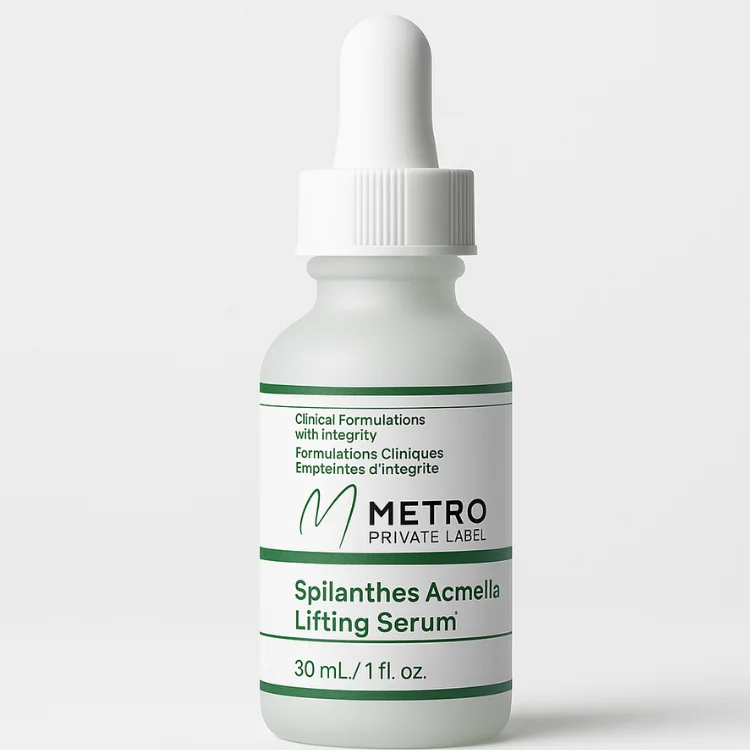
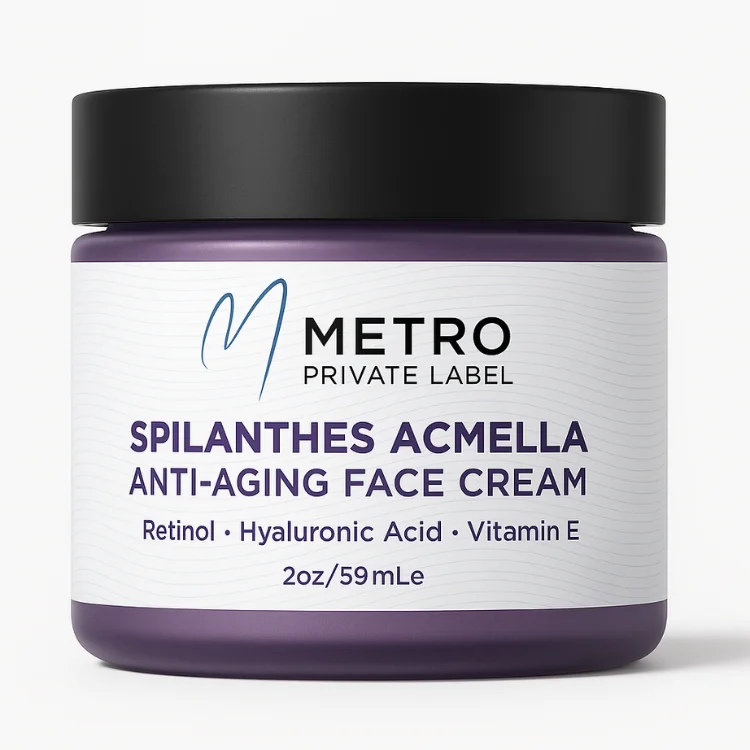
Get Your Custom Skincare Solution Today!

Don’t wait—fill out the form and let our team create the perfect skincare solution for your brand. Expect a personalized quote within 24 hours and start building your brand’s success now!

Submit Your
Private Label Skin Care Request

Fill out this form with your detailed needs and our customer support team will contact you shortly. We will assign a professional agent to follow up on your project and provide personalized assistance.

To get the fastest response, submit your inquiries using the form. If you encounter any issues with submission, you can also email us directly at info@metroprivatelabel.com .

*Metro Private Label takes your privacy very seriously. All information is only used for technical and commercial communication and will not be disclosed to third parties.
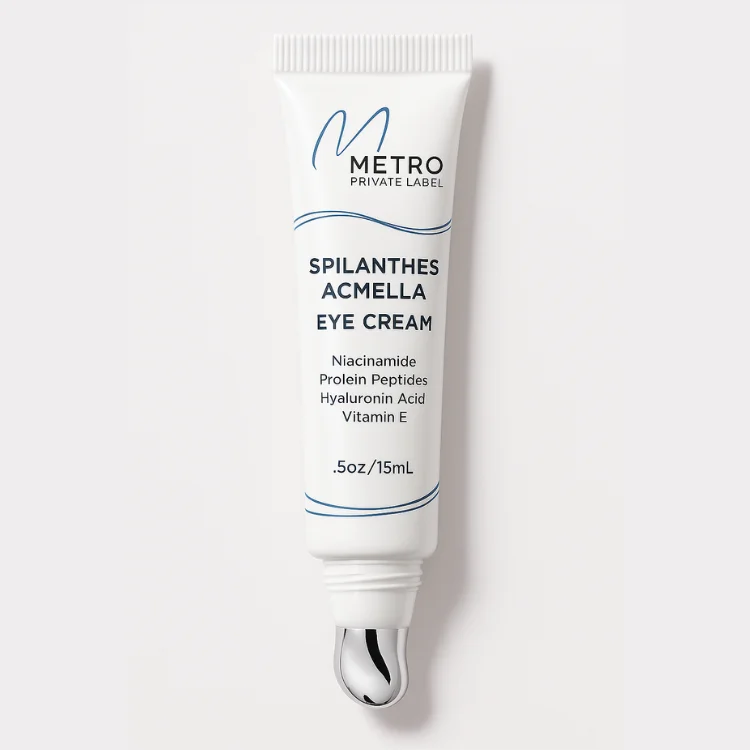
Submit Your
Private Label Skin Care Request

Fill out this form with your detailed needs and our customer support team will contact you shortly. We will assign a professional agent to follow up on your project and provide personalized assistance.

To get the fastest response, submit your inquiries using the form. If you encounter any issues with submission, you can also email us directly at info@metroprivatelabel.com .

*Metro Private Label takes your privacy very seriously. All information is only used for technical and commercial communication and will not be disclosed to third parties.