Your Trusted Eye Serum Manufacturer
We help skincare brands develop market-ready products with reliable formulations, professional packaging, and scalable manufacturing support—so you can launch confidently and grow your product line with a stable supply chain.

Private Label Eye Serum
At Metro Private Label, we understand that developing a private label eye serum is not simply about choosing a popular ingredient and putting it into a small bottle. Eye care is a competitive category, and customers usually buy because they are trying to solve a very specific concern — dark circles, puffiness, fine lines, loss of firmness, dryness, or tired-looking skin around the eyes. You may already know which type of customer you want to reach, whether you are adding an eye serum to an existing Amazon or Shopify skincare line, building a premium eye-care collection, supplying your retail channel, or creating a professional product for a clinic. What is often more difficult is deciding how the formula, texture, ingredients, packaging, price point, and product claims should work together. This is where we help. We work with you to develop eye serum directions that make commercial sense, from caffeine and brightening formulas for dark circles and puffiness to peptide, retinol, hyaluronic acid, vitamin C, or PDRN-based concepts for anti-aging and premium positioning.
From our experience working with skincare brands, a strong eye serum needs more than an impressive ingredient list. The eye area is delicate, so we pay close attention to texture, skin feel, ingredient compatibility, formula stability, and how the product will actually be used by the final customer. A lightweight serum designed for morning use has different requirements from a richer anti-aging treatment, while a caffeine roller serum for e-commerce needs a different product experience from a peptide or PDRN eye serum positioned for clinics or premium skincare brands. We also help you think through how ingredients can support the product story — for example, Caffeine and EGCG for a de-puffing concept, Peptides for firmness and fine-line positioning, Hyaluronic Acid and Panthenol for hydration, Vitamin C derivatives and Niacinamide for brightening, or Retinol and PDRN for more advanced anti-aging concepts. At the same time, packaging compatibility, dosage control, label claims, production consistency, and market-specific compliance all need to be considered before the product moves into mass production.
At Metro Private Label, we help you turn an eye serum idea into a product that is realistic to manufacture, clear to position, and easier to sell through your existing channel. Whether you are launching your first eye-care SKU, expanding a successful skincare range, developing a differentiated product for Amazon or Shopify, or building a professional retail line for your clinic or distribution network, we support the process from formula selection and sample testing to packaging coordination, production, and technical documentation such as INCI lists, COA, SDS, and product specifications. Our goal is not simply to manufacture another eye serum for you. We want to help you create a product with a clear reason to buy, reliable production quality, and enough flexibility to grow into a larger eye-care or skincare collection as your business develops.

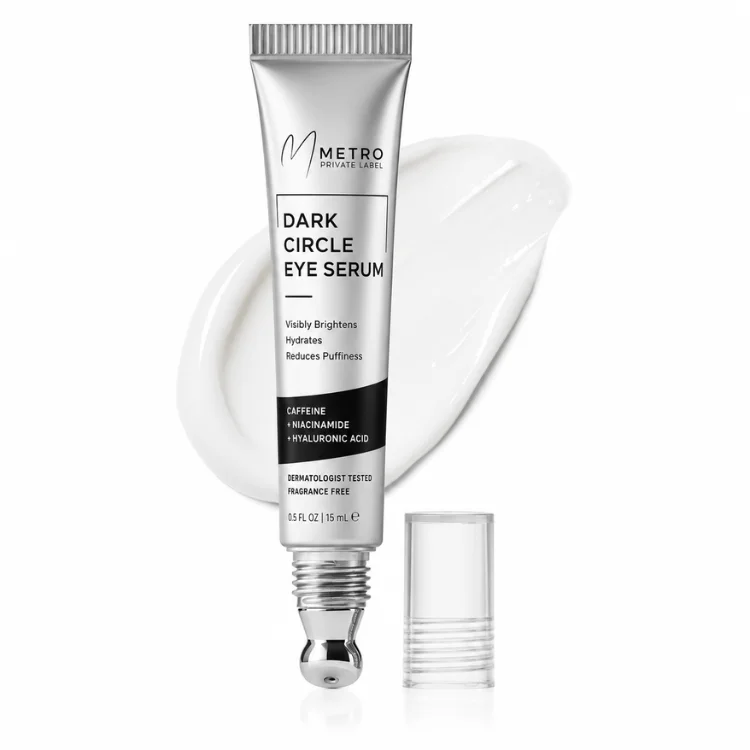
Dark Circle Eye Serum
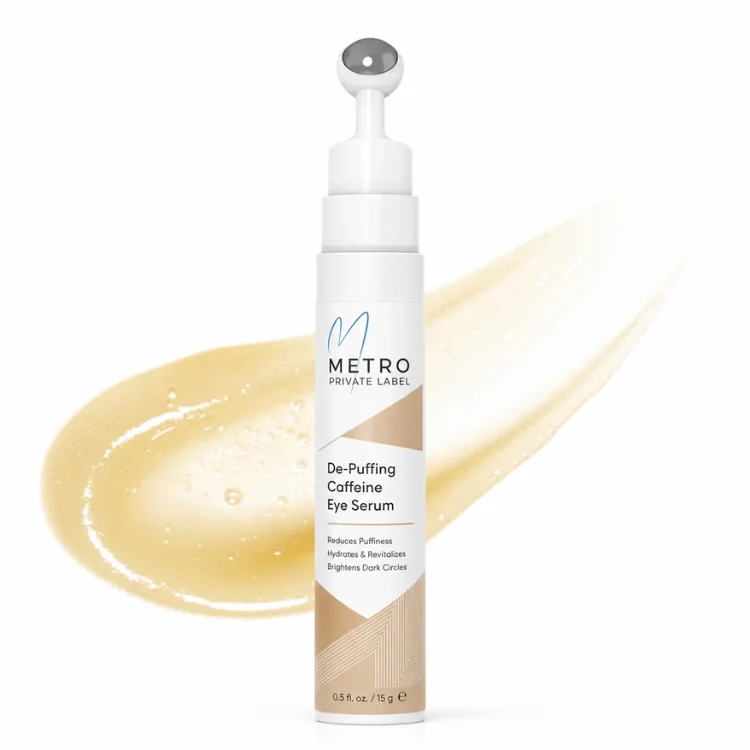
De-Puffing Caffeine Eye Serum
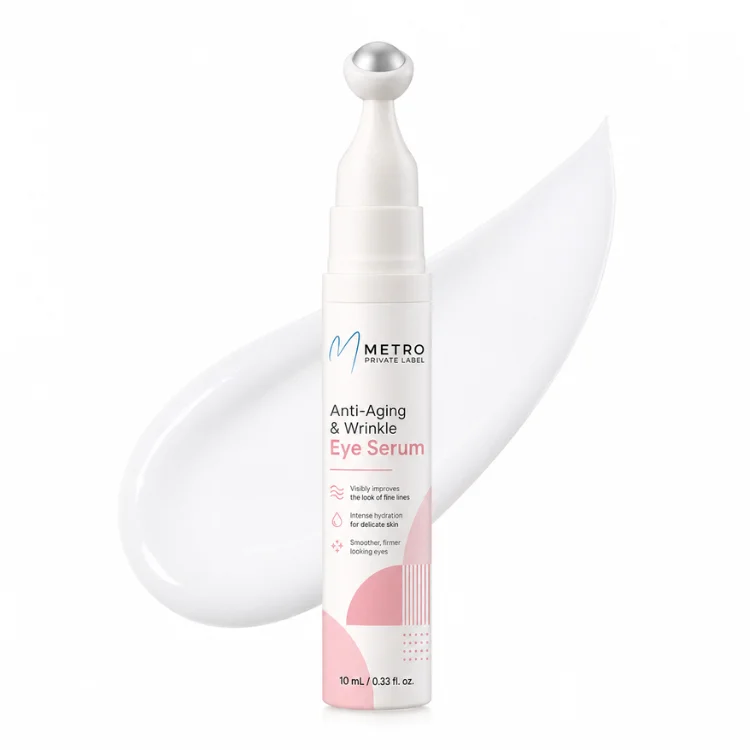
Anti-Aging & Wrinkle Eye Serum
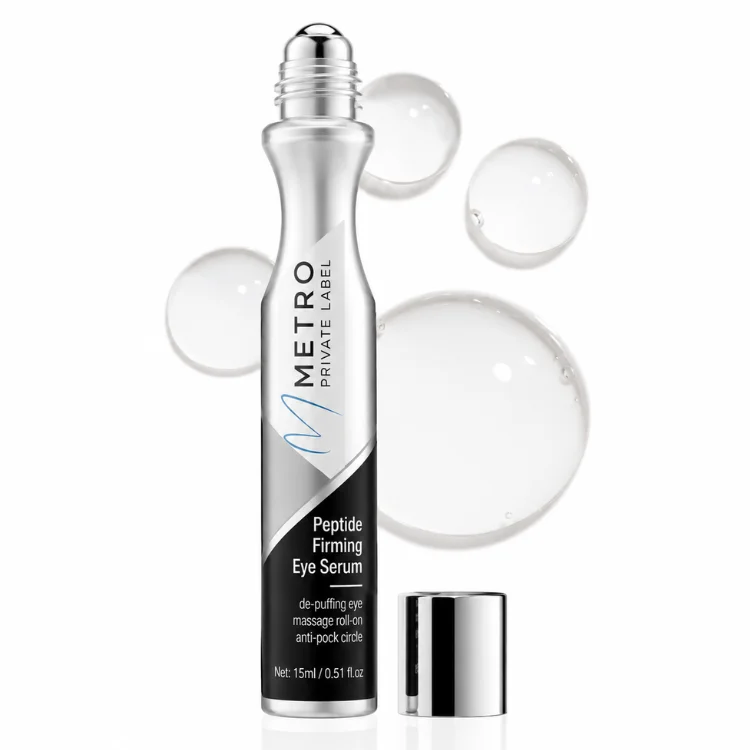
Peptide Firming Eye Serum
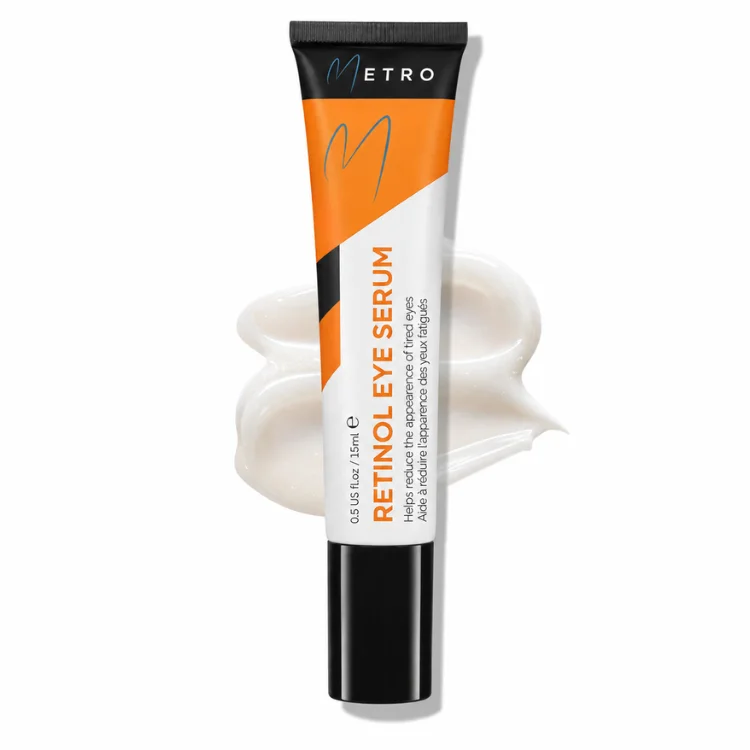
Retinol Eye Serum
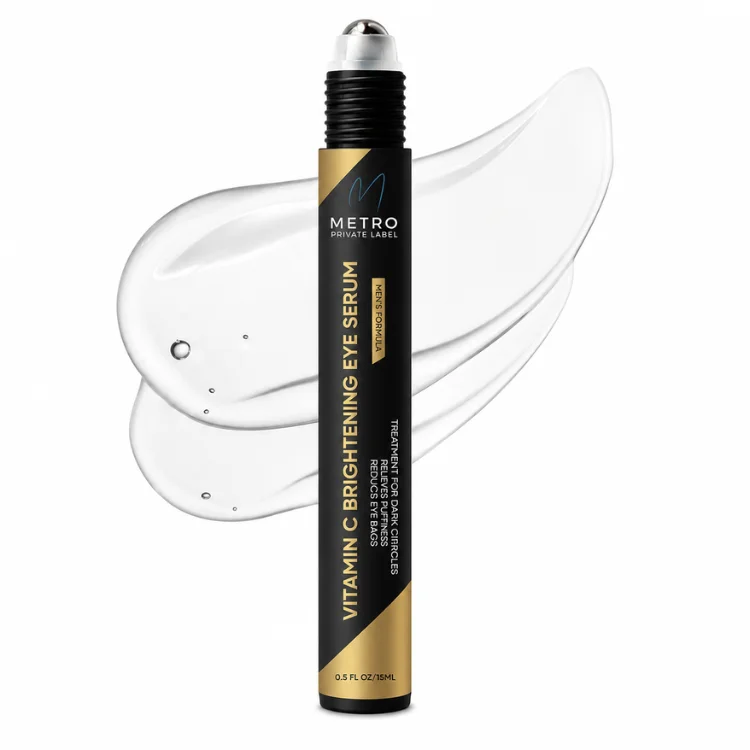
Vitamin C Brightening Eye Serum
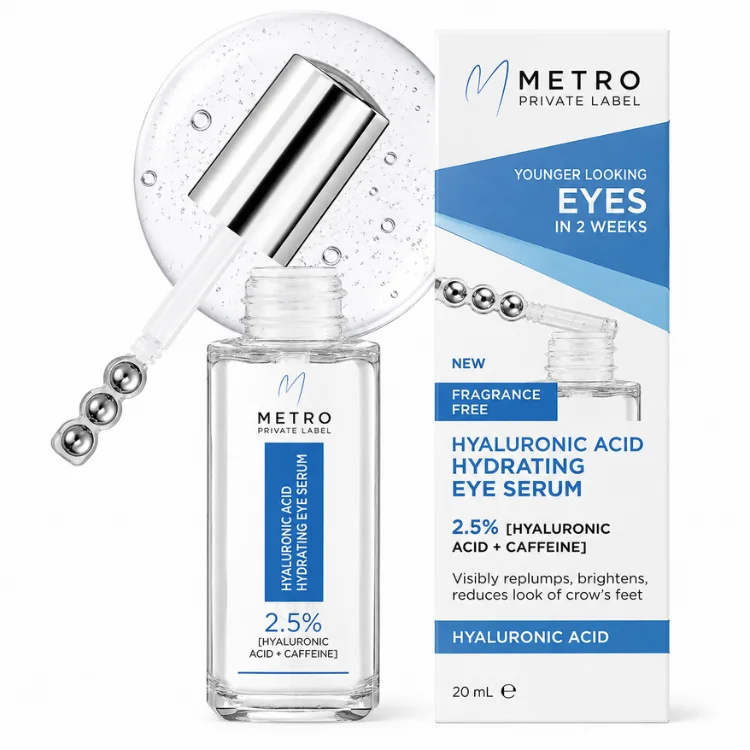
Hyaluronic Acid Hydrating Eye Serum
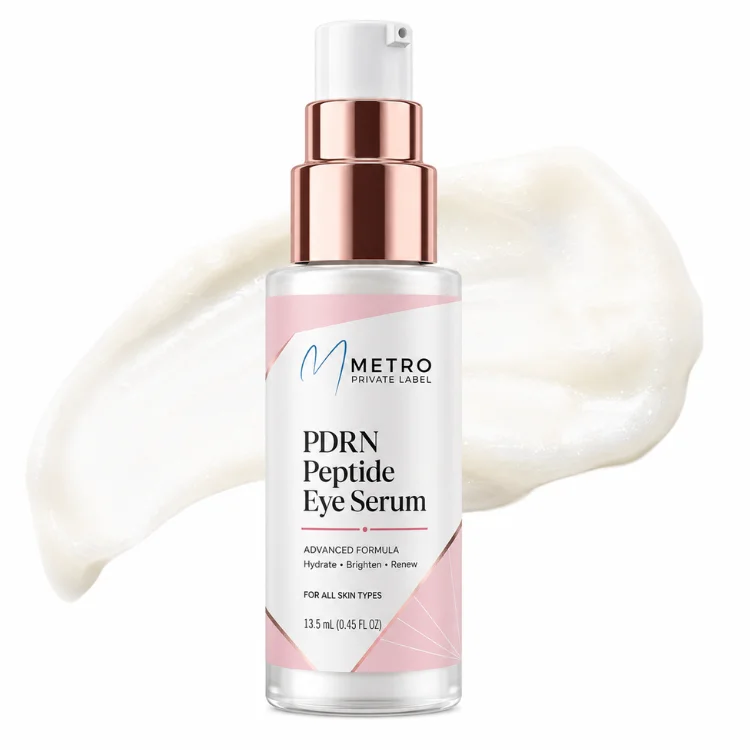
PDRN Peptide Eye Serum
Build a Private Label Eye Serum Line That Fits Your Market
If you are looking for a private label eye serum manufacturer, you are probably not simply searching for a factory that can fill a standard formula into a small bottle. You may already have an Amazon or Shopify brand, a skincare business, a clinic, or an established distribution channel and now need an eye serum that fits your customers, retail price, product positioning, and future SKU strategy.
You have come to the right place. At Metro Private Label, we understand that eye serum is a highly targeted category, and the strongest products are usually built around one clear customer concern. A caffeine eye serum for puffiness, a brightening serum for dark circles, a peptide formula for fine lines and firmness, and a PDRN or retinol eye treatment for premium anti-aging positioning all require different formulation logic, textures, packaging choices, and cost structures. Before recommending a formula, we first look at your target customer, sales channel, price level, product claims, and competitive positioning so that the final product has a realistic reason to exist in the market.
From what we see across skincare brands, eye serum performs best when customers can immediately understand what the product is designed to do. This is why we usually develop formulas around clear directions such as dark circles, puffiness, fine lines, firmness, hydration, brightening, or advanced anti-aging. Depending on your positioning, we can build concepts around Caffeine and EGCG for de-puffing, Peptides for firmness, Vitamin C derivatives and Niacinamide for brightening, Hyaluronic Acid and Panthenol for hydration, or Retinol and PDRN for more advanced age-supporting concepts. Our role is to help you select ingredients that strengthen the product story and user experience rather than adding unnecessary actives that increase cost without making the product easier to sell.
Our Core Private Label Eye Serum Products
Dark Circle Eye Serum: Developed for brands targeting tired-looking eyes, uneven tone, and visible dark-circle concerns. Common formulation directions include Caffeine, Niacinamide, Vitamin C derivatives, Peptides, and hydrating ingredients.
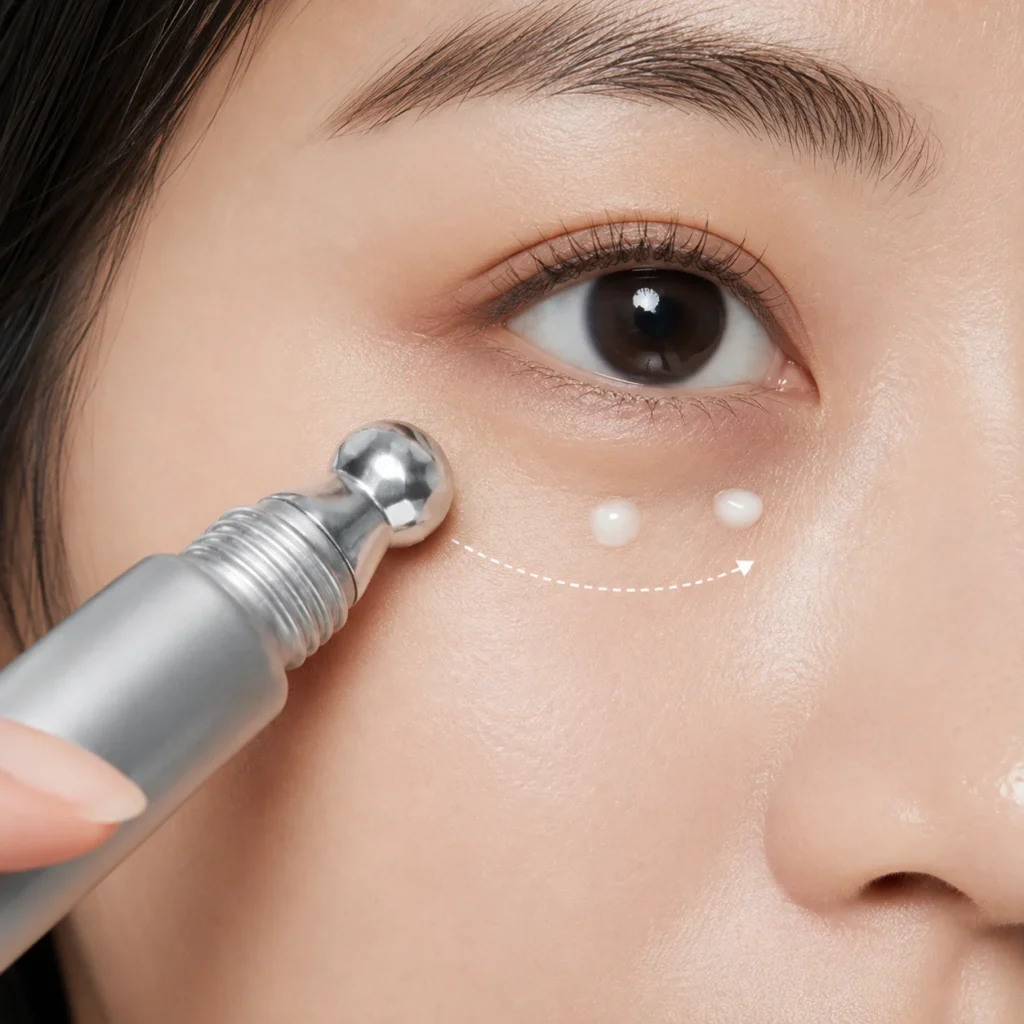
De-Puffing Caffeine Eye Serum: A strong option for Amazon, Shopify, TikTok, and daily-use eye-care products. We can develop lightweight serum or roller formats built around Caffeine, EGCG, Green Tea, and soothing hydration.
Anti-Aging & Wrinkle Eye Serum: Designed for fine lines, crow’s feet, loss of firmness, and mature-skin positioning. Formulas can be developed with Peptides, Retinoids, Bakuchiol, antioxidants, and skin-conditioning ingredients.
Peptide & Advanced Eye Serum: Suitable for premium skincare brands and clinics looking for stronger ingredient differentiation. Development directions can include Multi-Peptides, Copper Peptides, PDRN, Hyaluronic Acid, and other advanced eye-care concepts.
Manufacturing Support for Eye Serum Brands
We understand that developing an eye serum is not only about selecting a popular active ingredient. The eye area requires careful consideration of formula texture, ingredient compatibility, stability, dispensing control, packaging compatibility, production consistency, and market-specific claims.
Many brands come to us with a product concept but still need to answer practical questions such as:
Should the product focus on dark circles, puffiness, wrinkles, or multiple concerns?
Should Caffeine, Peptides, Retinol, Vitamin C, or PDRN become the hero ingredient?
Should the texture be a lightweight serum, gel serum, concentrated treatment, or roller format?
How can the product achieve a premium feel while staying within the target cost?
Which packaging format best supports dosage control, formula stability, and the customer experience?
At Metro Private Label, we support the development process from formula selection and customization to sample testing, packaging coordination, production, and technical documentation such as INCI lists, COA, SDS, and product specifications.
Our goal is simple: to help you turn an eye serum idea into a market-ready product with a clear reason to buy, a commercially realistic cost structure, reliable manufacturing quality, and enough flexibility to expand into a broader eye-care or skincare line as your business grows.

More Than Just a Private Label Eye Serum Manufacturer
At Metro Private Label, we understand that your goal is not simply to launch another eye serum. You need a product that fits your customers, supports your target price, communicates a clear reason to buy, and has the potential to generate repeat purchases across your sales channel.

Develop Eye Serum Products Around Real Market Demand
We first look at your target customers, sales channel, retail price, and product positioning. A caffeine eye serum for Amazon, a peptide serum for a premium skincare brand, and a PDRN eye serum for clinics all require different formula strategies, textures, packaging, and cost structures.
Reduce Development Risks Before Mass Production
Eye serum development involves more than choosing active ingredients. Formula stability, texture, absorption, ingredient compatibility, packaging dosage, user comfort, and target cost all need to work together. We review these factors early to reduce repeated sampling, unsuitable packaging, unexpected costs, and production delays.
Create Eye Serums Customers Understand and Repurchase
Customers respond better when they clearly understand what a product is designed to address. We build formulas around concerns such as dark circles, puffiness, fine lines, firmness, and hydration, using ingredients like Caffeine, Peptides, Vitamin C, Hyaluronic Acid, Retinol, or PDRN where appropriate.
Build a Manufacturing Partnership That Supports Growth
From formula selection and sampling to packaging, technical documentation, production, and repeat orders, we support the complete private label process. As your business grows, we can also help expand a successful eye serum into eye creams, eye patches, facial serums, or a broader skincare collection.
Build a Private Label Eye Serum Line Around Your Business Goals
At Metro Private Label, we understand that creating an eye serum is not simply about choosing a popular ingredient, selecting a bottle, and placing your logo on the packaging. If you already sell through Amazon, Shopify, retail stores, distribution channels, clinics, or professional beauty businesses, you need an eye serum that fits your customers, supports your target retail price, matches your brand positioning, and has the potential to become a profitable long-term SKU.
Many brands come to us with a clear direction: a caffeine serum for puffiness, a brightening serum for dark circles, a peptide formula for fine lines, a retinol treatment for anti-aging, or a premium PDRN eye serum. But the difference between an interesting concept and a commercially successful product usually comes from the decisions made before production begins. The formula needs to match the customer concern, the texture needs to feel appropriate for the delicate eye area, the packaging needs to deliver the right amount of product, and the final cost needs to leave enough room for your retail margin. This is where we believe a manufacturing partner should provide more than production capacity — we should help you make better product decisions.
Develop Eye Serum Products Based on Your Business Strategy
When we develop an eye serum, we do not begin by adding as many active ingredients as possible. We first look at who you are selling to, where the product will be sold, your target retail price, and the role the eye serum should play within your existing product range.An Amazon or Shopify brand may need a clear hero benefit such as de-puffing, dark-circle care, or visible firming that customers can understand quickly. A premium skincare brand may place more emphasis on texture, advanced peptide combinations, PDRN, packaging experience, and perceived value. A clinic may need a professional-looking eye treatment that fits naturally into an anti-aging or post-treatment skincare routine, while a distributor may prefer a proven formula that can be launched quickly and reordered consistently.We connect these commercial requirements with realistic formulation and packaging options so the product is designed around how you actually plan to sell it, rather than forcing your marketing team to create a story around a formula after production is complete.
Make Better Product Decisions Before Mass Production
Eye serum development involves more technical decisions than many brands initially expect. Because the eye area is delicate, ingredient concentration, irritation potential, texture, absorption, pilling, packaging dosage, formula stability, and compatibility between active ingredients all need to be considered carefully.For example, adding more caffeine does not automatically create a better de-puffing serum, and combining multiple peptides, retinoids, brightening ingredients, and advanced actives can increase cost and formulation complexity without making the product easier to market. A formula can also perform well in a laboratory sample but create problems later if the viscosity does not match the pump, rollerball, or airless packaging selected for production.Our role is not simply to produce whatever appears on the initial brief. We help identify these practical issues early and recommend adjustments before they become expensive problems. This can reduce unnecessary reformulation, repeated sampling, packaging changes, production delays, and unexpected costs before your bulk order begins.
Create Eye Serums Customers Want to Use Again
Customers may first notice your eye serum because of Caffeine, Peptides, Retinol, Vitamin C, Hyaluronic Acid, or PDRN, but they continue using it because the complete product experience works for them.That means the serum needs to spread easily around the eye area, absorb comfortably, layer well with other skincare or makeup, dispense the right amount, and communicate a benefit that customers can understand. A morning caffeine eye serum should feel different from a richer overnight retinol treatment, while a peptide or PDRN eye serum positioned at a premium price needs to deliver an experience that supports that positioning.We therefore look at ingredient story, texture, absorption, hydration, fragrance level, packaging usability, and overall product positioning together. Our goal is not to create the longest ingredient list. It is to help you create an eye serum that feels coherent, commercially understandable, and realistic for customers to include in their daily routine and repurchase.
Build a Product Foundation for Future Growth
Your first eye serum may begin as one hero SKU, but we also look at what the product could become if it performs well in your market. A successful caffeine or peptide eye serum can later expand into an eye cream, eye gel, hydrogel eye patch, facial serum, anti-aging cream, or a broader eye-care collection without losing the original product positioning.Thinking about this earlier can help maintain consistency across ingredients, packaging style, price architecture, and customer experience as your range grows.From formula selection and sample development to packaging coordination, technical documentation, bulk production, repeat orders, and future SKU expansion, we work with you throughout the development process.
Our goal is to help you create eye serum products that are not only possible to manufacture, but also easier to position, easier to sell, more reliable to reproduce, and capable of supporting the next stage of your brand growth.
FAQs Eye Serum
For your convenience, we’ve gathered the most commonly asked questions about our Eye Serum However, should you have any further queries, please don’t hesitate to reach out to us.
1. What types of private label eye serums can you manufacture?
We can develop a wide range of eye serum concepts based on different customer concerns and market positions, including Dark Circle Eye Serum, Caffeine De-Puffing Eye Serum, Anti-Aging & Wrinkle Eye Serum, Peptide Firming Eye Serum, Retinol Eye Serum, Vitamin C Brightening Eye Serum, Hyaluronic Acid Hydrating Eye Serum, and PDRN Eye Serum. We can also adjust the texture, active combination, positioning, and packaging according to whether you are selling through Amazon, Shopify, clinics, retail stores, or distribution channels.
2. Can you customize an eye serum formula for our brand?
Yes. We can start from one of our existing formulas and adjust the active ingredients, texture, skin feel, fragrance level, viscosity, and positioning, or develop a more customized formula around your product brief. We usually recommend first understanding what problem the product should solve, who will buy it, and what retail price you are targeting, because a formula for a mass-market caffeine eye serum should be developed very differently from a premium peptide or PDRN eye treatment.
3. What is your minimum order quantity for private label eye serum?
Our standard MOQ for customized eye serum projects normally starts from around 1,000 units per SKU, although the final MOQ can depend on the formula, packaging, printing method, and level of customization. If you are testing a new SKU, we can also discuss using an existing formula and available packaging to reduce development cost and make the first order easier to manage before you scale to larger quantities.
4. Can we order samples before starting mass production?
Yes, and we strongly recommend it. Sampling allows you to evaluate the texture, absorption, skin feel, packaging experience, and overall product direction before committing to bulk production. For eye serums in particular, small details such as tackiness, pilling, rollerball performance, pump dosage, or how the formula sits under makeup can affect the customer experience, so we prefer to identify and adjust these issues during the sample stage rather than after production.
5. How long does eye serum development and production usually take?
For most projects, initial samples can normally be prepared within around 7–14 days once the formula direction is confirmed, although fully customized formulas may require additional development and testing. After the formula, packaging, and artwork are approved, bulk production typically takes around 20–25 days depending on the order quantity and packaging schedule. If your launch date is important, we recommend discussing the timeline with us early so we can identify which parts of the project are most likely to affect delivery.
6. Can you help us choose and customize the packaging?
Yes. We can coordinate bottles, airless pumps, dropper bottles, rollerball packaging, labels, printed cartons, and outer shipping cartons based on your product positioning and sales channel. We do not look at packaging only from an appearance perspective; we also consider viscosity, dosage control, leakage risk, formula compatibility, shipping protection, and customer usability. For Amazon or e-commerce brands especially, packaging that looks attractive but leaks or damages easily during fulfillment can quickly become a costly problem.
7. What technical and regulatory documents can you provide?
Depending on the product and project requirements, we can provide supporting documents such as the INCI ingredient list, COA, SDS, product specifications, and manufacturing-related documentation available for the formula. If you are selling in markets such as the UK, EU, or U.S., we also recommend confirming your regulatory pathway before production begins, because label wording, claims, responsible-person requirements, safety assessment, and market registration responsibilities can vary by country. We help provide the manufacturing information needed to support that process, while market-specific product registration and final legal compliance should be reviewed according to the destination market.
8. How do you control the quality of eye serum during production?
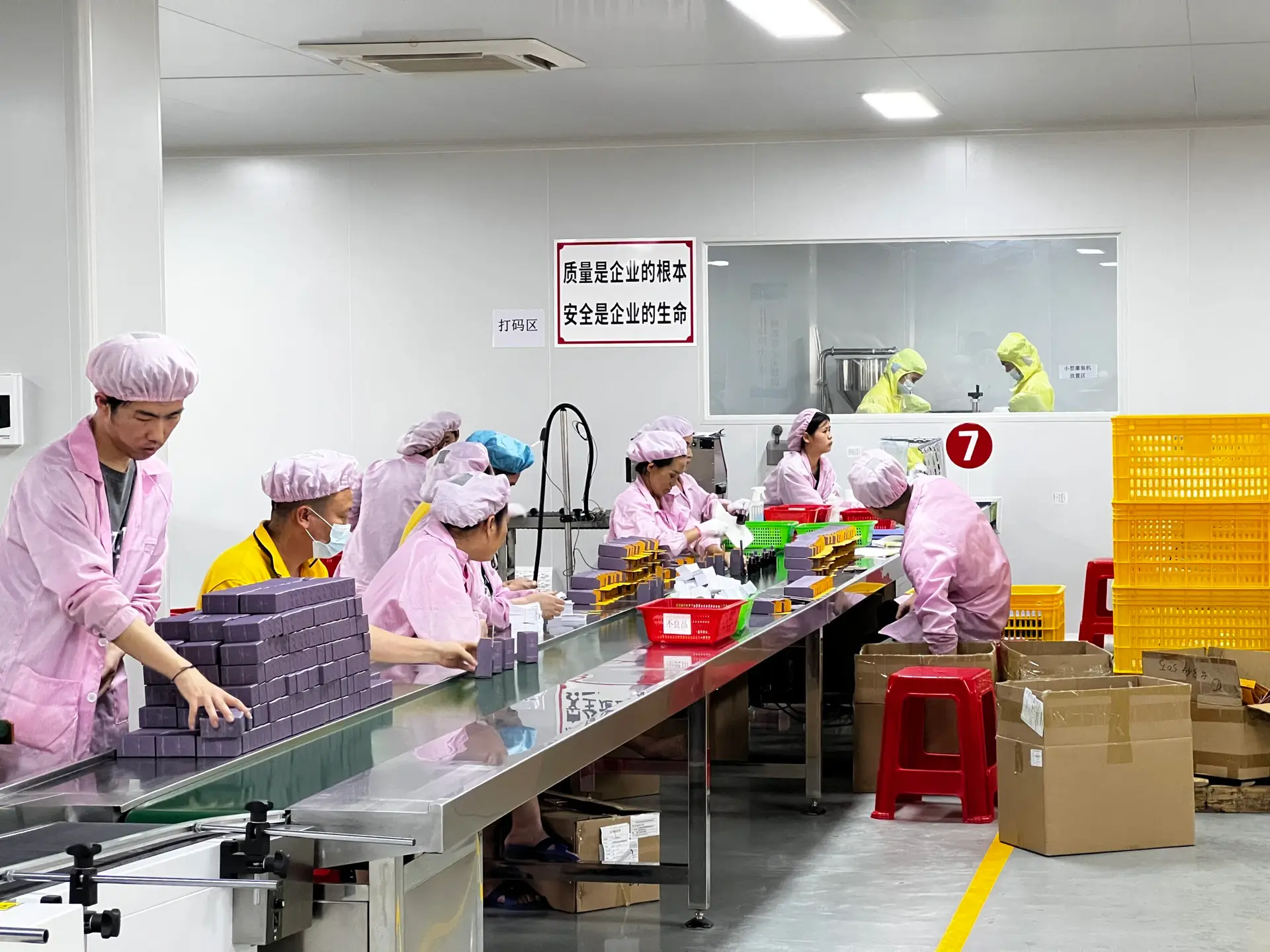
We control quality from raw material and bulk formulation through filling, packaging, and finished-product inspection. During development, we also pay close attention to formula stability, ingredient compatibility, viscosity, appearance, odor, packaging compatibility, and production consistency. Because eye serums often contain higher-value actives such as peptides, retinoids, vitamin C derivatives, or PDRN, we believe quality control should focus not only on whether the formula can be produced, but also on whether the same product can be reproduced consistently when you return for repeat orders.
9. Can you help us decide which eye serum concept is better for our market?
Yes. Many customers come to us with several ideas but are not sure which one should become the first SKU. We can discuss your target customer, existing products, sales channel, price range, competitors, and brand positioning before recommending a direction. For example, an Amazon seller may benefit from a clear Caffeine De-Puffing or Dark Circle Eye Serum that is easy for consumers to understand, while a premium skincare brand or clinic may prefer a Peptide, Retinol, or PDRN concept with stronger differentiation and a higher perceived value.
10. Can you support repeat orders and help us expand the product line later?
Yes. We see the first eye serum as the beginning of the relationship rather than a one-time production project. If the product performs well, we can support repeat production and help you expand into complementary products such as eye creams, eye gels, hydrogel eye patches, facial serums, moisturizers, or broader anti-aging and eye-care collections. Our goal is to help you build a supply chain that can grow with your sales, so you do not need to rebuild the formulation, packaging, and manufacturing process every time you add a new SKU.
What stood out to us was how quickly Metro Private Label understood the type of eye serum we wanted to launch and the customers we were targeting. They helped us compare different directions for dark circles, puffiness, and fine lines, then recommended a formula structure that made sense for our price point and online positioning. The process felt practical from the beginning, and we avoided spending time on ingredients that would have added cost without improving the product concept.
Ethan Calloway, E-commerce Product Managerfrom United States
We were looking for an eye serum that could fit into an existing skincare range rather than feel like a completely separate product. Metro Private Label helped us think through the texture, active ingredients, packaging, and retail positioning together. Their team was especially helpful in explaining what could realistically be achieved within our target cost, which made the development process much more straightforward.
Isabelle Moreau, Skincare Category Buyerfrom France
We already had a clear idea of the market we wanted to enter, but we needed a manufacturer who could challenge some of our assumptions before production. Metro Private Label gave us useful feedback on our peptide eye serum concept, including ingredient compatibility, texture, packaging dosage, and how the product would fit into our wider anti-aging range. That level of involvement made the project feel much more like product development than simple contract manufacturing.
Oliver Hargreaves, Beauty Brand Founderfrom United Kingdom
Our priority was to find a supplier that could provide consistent quality and clear communication for repeat orders. Metro Private Label guided us through formula confirmation, sampling, packaging coordination, and technical documentation without making the process unnecessarily complicated. We also appreciated that they were realistic about lead times and production requirements, which made planning much easier for our purchasing team.
Maren Vogel, Private Label Purchasing Specialistfrom Germany
We wanted an eye serum that felt professional enough for our clinic environment but was still comfortable for clients to use at home every day. Metro Private Label helped us develop the concept around hydration, firmness, and a premium skin feel rather than simply adding more active ingredients. Their attention to texture, packaging, and the overall customer experience helped us create a product that fits naturally into our retail skincare routine.
Claire Beaumont, Aesthetic Clinic Directorfrom Canada





Metro Private Label in Numbers
Happy Clients
0 +
Million-dollar Buyers
0 +
Formulation
0 +
Professional Staffs
0 +
Your Ultimate Guide to Eye Serum
If you’re planning to add an eye serum to your product lineup—whether it’s your first eye-care SKU, an extension of an existing anti-aging range, or a new product for Amazon, Shopify, clinics, or retail—you’re entering a category where customers usually buy for a very specific reason. Dark circles, puffiness, fine lines, firmness, hydration, and tired-looking eyes all create different product expectations, which means choosing the right formula is only one part of the decision. We’ve seen that eye serums perform better when the customer concern, hero ingredient, texture, packaging, retail price, and sales channel are connected from the beginning rather than developed separately. A caffeine roller serum, a peptide firming treatment, and a premium PDRN or retinal eye serum may all belong to the same category, but commercially they are very different products.
From our experience developing private label skincare, many eye serum projects become more complicated after the initial product idea is approved. Brands may start with a clear ingredient direction but later discover that the formula does not match the selected applicator, the packaging MOQ is higher than the formula MOQ, the texture pills under makeup, or the final landed cost no longer supports the intended retail price. We’ve also seen projects lose weeks because ingredients keep changing, packaging is confirmed too early, artwork needs revision, or compliance requirements are considered only after production planning has already started. These are not unusual exceptions; they are part of the real development process, and understanding them early can reduce unnecessary sampling, cost, and launch delays.
This guide is built around the decisions we see brands making before an eye serum reaches mass production. Instead of focusing only on ingredient benefits, we want to explain how to choose the right product concept for your market, plan a realistic MOQ, decide between ready and custom formulas, understand the true launch cost, select active ingredients without overcomplicating the formula, match packaging to product performance, manage development timelines, prepare testing and regulatory documents, and compare manufacturers before investing in samples. We also include a real development case to show what actually happens between the first brief and production. Our goal is to give you a clearer view of the commercial and manufacturing decisions behind eye serum development, so you can make better choices before committing time and budget to the project.
Table of Contents
How to Choose the Right Eye Serum Concept for Your Target Market
When I evaluate an eye serum project, I do not begin with the ingredient list. I begin with the commercial logic behind the product. In practice, the strongest eye serum concepts usually come from a clear connection between the customer concern, the sales channel, the target retail price, the desired market position, and the hero ingredient that supports that position. An Amazon seller looking for a simple de-puffing product is making a very different product decision from a clinic developing a premium anti-aging eye treatment or a beauty founder building a peptide-focused skincare line. I have seen many brands start in the opposite direction by choosing PDRN, peptides, caffeine, retinal, or another trending ingredient first and only later asking what problem the product should solve. That approach often creates unnecessary formulation complexity, higher costs, and weaker positioning. I prefer to define the market opportunity first, because once the commercial purpose is clear, the formula, packaging, texture, and ingredient strategy become much easier to develop coherently.
Start With the Customer Concern Before Choosing the Formula
The first question I ask is what the end customer is actually trying to improve, because “eye serum” by itself is too broad to define a useful product strategy. The customer may be worried about dark circles, morning puffiness, fine lines, dryness, loss of firmness, dullness, or a combination of these concerns, but I normally recommend identifying one primary problem and allowing the remaining benefits to support it. When a brand tries to position one eye serum as a dark-circle treatment, de-puffing product, wrinkle corrector, firming treatment, brightening serum, and hydration booster at the same time, the formula may sound impressive but the marketing message becomes difficult to understand. I have found that products are easier to position when the customer can immediately understand why they should use them. A de-puffing serum can still hydrate the skin, and a peptide eye serum can still support brightness, but the primary reason to buy should remain clear. This is why I see the customer concern as the starting point for formulation rather than something added later during marketing.
Understand the Difference Between Dark Circle and De-Puffing Eye Serum Concepts
I treat dark circles and puffiness as related but commercially different product opportunities because the customer expectations behind them are not identical. When I develop a dark-circle concept, I usually think about brightness, uneven-looking tone, tired-looking eyes, and the appearance of discoloration, which may lead to formulation directions involving niacinamide, vitamin C derivatives, caffeine, peptides, and hydrating ingredients. When I work on a de-puffing concept, I focus more on morning use, visible swelling, cooling sensation, lightweight texture, and ease of application, so caffeine, EGCG, green tea, soothing ingredients, and a rollerball or precision applicator may become more relevant. The difference is important because a product can technically contain the same hero ingredient but communicate a very different reason to buy. If a brand sells mainly through Amazon or TikTok Shop, I often prefer the clearer problem-solution language of “de-puffing” or “dark circles” because customers make faster decisions in those channels. If the brand has more room to educate consumers, the two concerns can sometimes be integrated into a broader eye-brightening concept, but I would still define which benefit leads the positioning before the formula is finalized.
Decide Whether Peptides or Retinoids Better Match the Customer
Peptide and retinoid eye serums both belong within the anti-aging category, but I do not consider them interchangeable because they attract different customers and create different expectations around usage. When I develop a peptide eye serum, I usually think about firmness, fine lines, elasticity, daily use, and a relatively accessible anti-aging message that can work for customers who want visible age-supporting benefits without a highly intensive treatment image. This makes peptides particularly useful for brands targeting a broad skincare audience or building an anti-aging range that customers can use consistently. Retinol or retinal eye serum creates a stronger active-treatment position and often appeals to more ingredient-aware customers, but it also requires more careful attention to concentration, tolerance, stability, packaging, usage instructions, and supporting ingredients. From a commercial perspective, I normally see peptides as easier to integrate into daily skincare and retinoids as better suited to brands that deliberately want a more advanced treatment proposition. The decision should therefore come from the target customer’s skincare knowledge, expectations, and willingness to use active ingredients rather than from which ingredient currently receives more attention online.
Match the Eye Serum Concept to the Sales Channel
I always consider the sales channel before I decide how complex or technical an eye serum concept should become, because the same formulation can perform very differently depending on where the customer discovers it. On Amazon, the product usually needs a clear benefit that can be understood quickly from the title, image, price, and review context, so concepts such as caffeine for puffiness, brightening for dark circles, or peptides for fine lines are relatively easy to communicate. On Shopify, I have more room to work with a brand story, ingredient education, before-and-after routines, and premium positioning, which makes advanced concepts such as PDRN, multi-peptide systems, retinal, or sophisticated antioxidant combinations more realistic. In clinics and aesthetic businesses, I often think about how the eye serum fits into an existing professional skincare routine, because the buyer may want a product that supports an anti-aging, hydration, or post-treatment retail program rather than a standalone trend product. Distributors and retail buyers look at the category differently again, because they need a concept that consumers can understand, a price that leaves enough channel margin, and a supply model that can support repeat orders. I do not believe there is one universally best eye serum concept; I believe the right concept is the one that fits the way the product will actually be sold.
Build the Formula Around the Target Retail Price
Retail price is one of the most important product-development variables I consider because it influences how much complexity the formula and packaging can realistically support. If the brand plans to retail an eye serum at a mass-market or accessible premium price, I usually focus on a clear hero benefit, a manageable active system, a comfortable texture, and packaging that looks professional without pushing the product cost too high. In this segment, a well-developed caffeine, hyaluronic acid, niacinamide, or peptide concept may create more commercial value than a formula overloaded with expensive actives. When I work on a premium eye serum, there is more room for advanced peptide systems, retinal, PDRN, more sophisticated textures, specialty packaging, and a stronger ingredient story, but I still expect the complete product experience to justify the higher retail price. I have seen brands spend heavily on expensive ingredients while using basic packaging or a texture that does not feel premium, and the final product then struggles to communicate its value. For me, premium positioning is not created by one costly active; it is created by consistency between formulation, texture, packaging, customer experience, and price.
Use Hero Ingredients to Support the Product Positioning
Once I understand the customer concern, sales channel, and target price, I use hero ingredients to strengthen the product concept rather than define it from the beginning. If the product is positioned around morning puffiness, caffeine and EGCG may make immediate commercial sense because consumers already associate those ingredients with de-puffing eye care. If the focus is firmness and fine lines, I may consider peptides or a multi-peptide system. If the goal is brightness, niacinamide and stable vitamin C derivatives may fit more naturally. Hyaluronic acid can support hydration and comfort, while retinol or retinal can create a more intensive anti-aging position. PDRN may work for a brand seeking a more advanced or premium skincare story, particularly when combined with peptides and hydration-supporting ingredients. I always ask whether the hero ingredient helps the customer understand the product more clearly. If the answer is no, then I question whether adding that ingredient improves the commercial concept or merely increases the formula cost.
Avoid Developing the Product Backwards From an Ingredient Trend
One of the most common problems I encounter in product development is what I describe as ingredient-first thinking. A brand sees an ingredient gaining attention on TikTok, Google, Amazon, or in Korean skincare, then asks for an eye serum based around that ingredient before deciding who the customer is, what retail price is realistic, or how the product will be differentiated. The result is often a technically complicated formula that later needs to be simplified because the ingredient cost is too high, the texture becomes difficult to optimize, the packaging requirement changes, or the final retail price no longer fits the original business model. I prefer to reverse that process. If a brand tells me it wants a $25 eye serum for Amazon, I will think very differently from the way I would approach a $90 clinic or prestige product. The formula, packaging, texture, and active concentration need to support the commercial model from the beginning. In my experience, brands save time and reduce unnecessary reformulation when they define the market first and allow the ingredient strategy to follow.
Make Sure the Eye Serum Fits the Wider Product Range
I rarely look at an eye serum as an isolated SKU because its role within the wider product line can affect both formulation and future sales. If a brand already has a peptide facial serum and anti-aging cream, a peptide eye serum may create a logical extension that customers can immediately understand. If the existing range focuses on brightening, a vitamin C or niacinamide eye serum may fit more naturally than introducing an unrelated retinol concept. For a clinic, I may think about how the eye serum works alongside a cleanser, repair serum, moisturizer, and sunscreen within a professional home-care routine. For a distributor, I may consider whether the eye serum complements products that are already performing well in the channel. I believe this kind of product-line consistency matters because customers are more likely to accept a new SKU when it feels connected to an existing brand promise. A strong eye serum should therefore solve a clear problem on its own while also strengthening the logic of the broader skincare collection.
Choose Different Eye Serum Concepts for Amazon, Shopify, Clinics, and Retail
When I simplify the channel decision, I generally find that Amazon favors eye serum concepts with an immediate problem-solution relationship, such as dark-circle care, caffeine de-puffing, peptide firming, or hydration, because the customer often compares several products within a short period of time. Shopify gives me more flexibility to work with advanced ingredient stories, premium textures, education, and brand philosophy, so concepts involving PDRN, retinal, sophisticated peptide systems, or higher-value anti-aging positioning can be easier to support. Clinics usually benefit from eye treatments that feel professional and fit into a broader skincare or treatment routine, which may make peptides, PDRN, hydration, repair, or advanced anti-aging concepts more appropriate. Retail and distribution channels usually require a balance between recognizable benefits, acceptable price points, visual shelf appeal, and consistent supply. I do not treat these as strict rules, but I use them as practical starting points because each channel creates a different purchasing environment and therefore rewards a different type of product clarity.
Keep the Product Easy to Understand Even When the Formula Is Advanced
The strongest eye serum concepts I work with are usually easy to explain even when the underlying formula is technically sophisticated. I want the buyer or consumer to understand the main concern, the hero benefit, and the reason for using the product without needing to study the full INCI list. This does not mean I believe formulas should be simplistic. A peptide eye serum may contain several supporting ingredients, and a PDRN or retinal formula may require carefully selected hydration, soothing, antioxidant, or barrier-support ingredients to create a better overall product. The important point is that those ingredients should support the same commercial story rather than compete for attention. When too many active ingredients are promoted equally, the product often becomes harder to position and more expensive to develop. I therefore try to keep the customer-facing message simple while allowing the formulation itself to remain intelligent and well structured.
When I choose an eye serum concept, I follow a sequence that starts with the customer and ends with the ingredient rather than the other way around. I first define the concern the product needs to address, then I look at the sales channel, target retail price, desired market position, and role within the wider product range before deciding which hero ingredient and formulation direction make the most sense. This process helps me avoid developing products around trends that may sound attractive but have no clear commercial purpose. In my experience, a successful eye serum is not simply the formula with the most fashionable actives; it is the product in which the customer concern, channel, price, positioning, texture, packaging, and ingredient story all support the same reason to buy. That is the approach I use when I want an eye serum concept to be commercially realistic rather than merely technically possible.
Private Label Eye Serum MOQ: How Much Should You Really Order for Your First Launch?
When brands ask about the MOQ for a private label eye serum, the question often sounds simple: “What is the minimum quantity I need to order?” But in practice, the more important question is how much commercial risk the brand is taking on if the product does not sell as expected. MOQ should never be viewed as a single production number because the real commitment includes formula, bottles, pumps, rollerballs, labels, cartons, decoration, shipping, testing, and the amount of inventory that may remain unsold after launch. A formula may be technically producible at 1,000 units, while the packaging supplier requires 3,000 pumps or the carton printer has a higher minimum quantity. This is why the lowest MOQ is not always the safest first order. The right quantity should give the brand enough inventory to launch properly, protect working capital, maintain reasonable unit economics, and still leave room to adjust the product after real market feedback starts coming in.
Formula MOQ and Packaging MOQ Are Not the Same Thing
One of the most common misunderstandings in private label skincare is assuming that the formula MOQ determines the MOQ for the entire finished product. In reality, an eye serum is made up of several independent supply chains, and each component can have a different production minimum. The bulk formula may be practical at 1,000 units, but the airless bottle, rollerball, dropper, pump, printed label, carton, inner tray, or decorative finish may each follow their own MOQ. This means a brand can order 1,000 finished units but still be required to purchase 2,000 or 3,000 pieces of certain packaging components. Those unused materials may stay in inventory for the next production run, but they still represent cash that has already been committed. For a first launch, it is important to understand this distinction early because a project that looks like a 1,000-unit order can quietly become a much larger investment once excess packaging inventory is included.
Why 1,000 Units Is Often a Practical Starting Point
For many private label eye serum projects, around 1,000 units per SKU is a commercially reasonable starting quantity because it can balance production efficiency with manageable inventory exposure. It is usually enough to support a proper launch across Amazon, Shopify, clinics, or a small retail network without forcing the brand into several thousand units before demand has been validated. However, 1,000 units should not be treated as a universal rule. An established e-commerce brand may sell through that quantity quickly, while a first-time founder with no customer base may take much longer. A distributor with several retail accounts may need more from the beginning, whereas a clinic launching one product into a small number of locations may prefer a more cautious approach. The important point is that MOQ should reflect the expected sales velocity, launch budget, reorder lead time, and channel strength rather than simply copying the quantity another brand happens to order.
The Lowest MOQ Does Not Always Mean the Lowest Risk
It is understandable that first-time buyers often search for the lowest possible MOQ because ordering fewer units feels safer, but very small production runs can create a different set of risks. Filling, production setup, QC, printing, packaging preparation, and labor costs are spread across fewer units, so the finished unit cost can rise significantly. The brand may then save money on inventory but lose too much margin on each sale, which can become especially problematic on Amazon or other channels where advertising, fulfillment, platform fees, and returns already reduce profitability. Low-volume projects may also have fewer packaging options, which can push the brand toward a bottle or decoration style that does not fully support the intended positioning. The safer first order is therefore not always the smallest number available. It is the quantity where inventory exposure, unit cost, margin, and launch flexibility are reasonably balanced.
Existing Packaging Usually Reduces First-Order Risk
For a new eye serum SKU, existing or commonly available packaging can often make the first launch much easier to manage. Standard airless bottles, rollers, droppers, tubes, and compatible cartons usually have lower minimum quantities, shorter lead times, and fewer development risks than fully customized components. This does not mean the finished product has to look generic. A brand can still create a distinctive presentation through label design, silk-screen printing, carton artwork, surface finishes, cap colors, and coordinated visual identity. In many first-launch projects, it makes more sense to direct budget toward formula quality, sampling, testing, compliance, photography, and customer acquisition instead of locking too much money into custom packaging before the product has proven sales. Once the SKU has demonstrated repeat demand, the brand is in a much stronger position to invest in a more exclusive packaging system.
Custom Packaging Can Change the Economics of the Entire Project
Custom packaging can improve differentiation, but it often changes the MOQ far more than the formula does. A custom mold, unique bottle shape, special cap, metallic coating, electroplating, gradient spray, soft-touch finish, custom-colored pump, or specialty rollerball may require minimum quantities of several thousand pieces. This can create a situation where the brand wants 1,000 finished eye serums but must still purchase 5,000 or even more packaging components. The unused packaging becomes future inventory, which means the brand is effectively prepaying part of the next production run before the first one has even been tested in the market. In my experience, custom packaging makes the most commercial sense when a brand already has a proven sales channel, strong confidence in repeat orders, and a clear plan to continue using the same package across future production. For an untested first SKU, flexibility is usually more valuable than maximum customization.
Mixed MOQ Is One of the Most Overlooked Cost Problems
A project can also become inefficient when different components have different minimum quantities. The formula may support 1,000 units, the bottle may also allow 1,000, but the carton supplier may require 2,000 and the custom pump color may require 3,000. This is what creates mixed MOQ pressure. The buyer must then decide whether to purchase extra packaging, change the decoration method, simplify the packaging design, or increase the finished-product quantity. The issue is not that any one supplier has an unreasonable MOQ; the problem is that several small mismatches can combine into a much larger investment than expected. Before approving packaging, the more useful question is not only “Can this component be made?” but also “At what quantity, and what happens to the unused balance?” That one question can prevent a first order from accumulating unnecessary packaging inventory that ties up cash for months.
First-Order Quantity Should Be Based on Sell-Through, Not Optimism
The safest way to decide how many units to order is to look at how quickly the sales channel can realistically absorb the inventory. A founder may strongly believe the eye serum will perform well, but confidence alone does not provide a sales forecast. Existing traffic, customer base, conversion rate, launch budget, retail locations, monthly skincare sales, distributor commitments, and current product performance provide much more useful information. A Shopify brand that already sells anti-aging products may be able to introduce 1,000 eye serums with relatively low risk because it has customers and traffic to support the launch. The same quantity can be much more difficult for a first-time founder with no audience and no tested advertising model. Inventory that moves slowly does not simply sit in a warehouse; it ties up money that may be needed for marketing, freight, compliance, content creation, or the next production run.
Reorder Lead Time Should Influence the First MOQ
Ordering too little can be just as disruptive as ordering too much, especially once an e-commerce product begins to gain traction. Eye serum replenishment is not instantaneous. Packaging availability, printing, bulk production, filling, QC, and international shipping all require time, and custom components can extend the schedule even further. If a brand waits until inventory is almost finished before placing the next order, a stockout can interrupt Amazon rankings, paid advertising, subscriptions, repeat purchases, retail supply, and customer confidence. This is why the first order should be planned together with a realistic reorder point. The brand needs enough stock to validate the market while still giving the supply chain time to produce the second batch. A slightly larger first order may sometimes be safer when the product is entering an established channel, while a smaller first order may be more appropriate when the concept itself is still being tested.
The Cheapest Unit Price Can Create the Most Expensive Launch
Unit price can be misleading when it is viewed without the full project economics. A supplier may offer a much lower price at 5,000 units than at 1,000 units, but that does not automatically mean the larger order is commercially better. The real cost of launching an eye serum includes not only the factory price but also unused packaging, sample development, testing, technical documentation, freight, duties, fulfillment, warehousing, platform fees, and the cost of any inventory that remains unsold. If a brand can only sell 1,500 units within a year, buying 5,000 just to achieve a lower unit price may lock far more cash into slow-moving stock than the saving justifies. A slightly higher unit price can sometimes be the better business decision because it gives the brand flexibility to test the SKU, learn from customer feedback, and scale only after the demand becomes clearer.
Shelf Life and Inventory Aging Should Be Part of MOQ Planning
Another reason to avoid over-ordering is that skincare inventory has a practical commercial life. Eye serums may contain sensitive or higher-value actives such as retinoids, vitamin C derivatives, peptides, or PDRN, and even when the formula has appropriate stability, the available shelf-life window still matters. Production, international shipping, customs clearance, warehouse storage, retail distribution, and customer sell-through all consume part of that time. If inventory moves too slowly, the brand may eventually need to discount products, manage retailer concerns, or write off stock approaching expiry. This is particularly important for distributors and international buyers because products may spend additional time moving through different layers of the supply chain. MOQ planning should therefore include not only how many units the business can afford to buy, but also how many units it can realistically sell while the product remains commercially attractive.
First-Time Founders Should Protect Working Capital
For a first-time founder, the most important MOQ decision may be how much money remains after the production order is paid. Manufacturing is only one part of the launch. The brand still needs to fund artwork, samples, compliance, shipping, photography, video, advertising, marketplace fees, fulfillment, returns, and potentially the second production run. It is common for inexperienced founders to spend most of their available budget on inventory because the larger order offers a better factory price, only to discover that they have too little cash left to generate demand. An eye serum sitting in a warehouse is still inventory, not revenue. A first order should therefore leave enough working capital to actually sell the product. In many cases, accepting a slightly higher unit cost in exchange for a more manageable first order creates a healthier launch than maximizing quantity from the beginning.
Experienced E-Commerce Brands Can Use MOQ More Aggressively
The calculation changes when the buyer already has a proven Amazon, Shopify, or TikTok Shop operation. Established operators often know their average monthly sales, advertising cost, customer acquisition rate, inventory turnover, and reorder pattern. In that situation, ordering the lowest possible quantity may create unnecessary supply risk. If a brand already has a strong anti-aging customer base and clear evidence that an eye serum fits its product range, a larger first production run can reduce unit cost and improve inventory security. The important difference is that the decision is supported by data rather than hope. This is why MOQ should never be treated as the same number for every buyer. A 1,000-unit order can be too large for one founder and too small for another, even when both are launching an almost identical eye serum.
Clinics and Distributors Need a Different MOQ Logic
Clinics and distributors often have more predictable channel access than first-time direct-to-consumer founders, but their demand pattern also needs to be evaluated differently. A clinic group can estimate how many units each location may sell through consultations, treatment programs, and home-care recommendations, while a distributor can evaluate how many retail accounts, salons, or local buyers are likely to take the first shipment. In these cases, it is often more useful to calculate expected channel consumption than to focus only on the factory minimum. If twenty clinics can each sell a predictable number of eye serums over several months, the first-order quantity becomes easier to justify. For distributors, the ability to reorder the same formula and packaging consistently is often more important than extreme customization because supply interruptions can affect several downstream customers at once.
Use the First Production Run to Learn About the Product
The first order should not only test whether consumers are willing to buy the eye serum; it should also generate information about how the product behaves in the real market. Customer reviews may reveal that the rollerball dispenses too slowly, the pump delivers too much serum, the texture pills under makeup, the carton damages too easily during fulfillment, or the positioning is not as clear as expected. This feedback can improve the second production run, but only if the brand still has the flexibility to make changes. Ordering too much custom packaging at the beginning can make those adjustments difficult because thousands of unused bottles or cartons may still need to be consumed. A good first-order strategy therefore creates enough inventory to produce meaningful market data without locking the brand into decisions that cannot easily be changed.
Plan the First Order With the Second Order in Mind
A strong MOQ strategy should prepare for success as well as protect against failure. If the first 1,000 eye serums sell faster than expected, the brand needs to know whether the same formula, bottle, pump, carton, and decoration can be reproduced quickly. Custom components with long lead times can become a serious problem if the product suddenly gains traction. At the same time, leftover packaging inventory from the first order can sometimes be useful because it shortens the second production cycle, provided the brand still wants to use the same components. The most scalable setup is usually one that allows the brand to move from 1,000 units to 3,000 or 5,000 units without redesigning the entire product. That flexibility can be more valuable than squeezing the first MOQ to the absolute lowest number possible.
The right MOQ for a private label eye serum is not simply the smallest quantity a manufacturer is willing to produce. It is the quantity that balances inventory risk, unit cost, packaging commitments, working capital, shelf life, channel demand, and reorder timing. A formula MOQ of 1,000 units does not automatically mean every bottle, pump, rollerball, carton, and decoration can also be produced economically at 1,000 pieces, and those differences can materially change the real investment behind the project. The safest first launch is usually not the order with the lowest unit price or the smallest possible quantity, but the one that gives the brand enough inventory to test the market properly, enough margin to operate sustainably, and enough flexibility to adjust or scale once real sales data begins to replace assumptions.
Ready Formula vs. Custom Eye Serum Formula: Which Development Route Makes More Sense?
When brands begin developing a private label eye serum, one of the first decisions is whether to start with an existing formula or invest in a fully customized one. I do not see either route as automatically better because the right choice depends on the business model, launch timeline, budget, target customer, sales channel, and how much differentiation the product actually needs. A distributor testing a new SKU through an existing retail network may gain more value from a proven formula that can reach the market quickly, while an experienced skincare founder building a premium peptide or retinal collection may have a stronger reason to customize texture, active combinations, sensory experience, and product positioning. The mistake I see most often is assuming that “custom formula” automatically means “better brand.” In reality, customization only creates value when the changes support a clear commercial purpose. Otherwise, it can add development time, sampling rounds, testing requirements, cost, and production complexity without giving the customer a meaningful reason to choose the product.
What a Ready Formula Actually Means
A ready formula is not necessarily a cheap or generic formula; it simply means the manufacturer already has a developed base that has been produced, evaluated, and can usually move into sampling much faster than a new formula built from the beginning. For an eye serum, this could be an existing caffeine, peptide, hyaluronic acid, brightening, or anti-aging formulation that can later be adjusted through packaging, fragrance level, texture, or selected supporting ingredients depending on the project. The commercial advantage is predictability. The brand can understand the basic texture, ingredient direction, approximate cost, and production feasibility much earlier, which reduces uncertainty during the first launch. This route is often suitable for distributors, clinic owners, and e-commerce operators who care more about speed, reliable quality, and clear product positioning than creating a completely exclusive INCI list.
When a Ready Formula Makes More Commercial Sense
A ready formula usually makes the most sense when the brand needs to launch quickly, test demand, or control the initial development budget. If a distributor already knows that dark-circle or de-puffing eye products sell well through its network, it may not need months of formulation work to create a completely original caffeine serum. The real opportunity may come from packaging, pricing, brand presentation, and reliable supply rather than formula novelty. The same logic applies to an Amazon or Shopify operator testing a new eye-care category. If the product concept is still unproven, it can be commercially safer to validate whether customers will buy the SKU before investing heavily in custom development. In this situation, speed to market and reduced development risk often create more value than technical uniqueness.
When a Custom Eye Serum Formula Is Worth the Investment
Custom formulation becomes more valuable when the brand already has a clear product strategy and needs the formula to support something specific that an existing base cannot deliver. This could involve a particular peptide system, a defined retinal level, a premium PDRN concept, a specific texture, fragrance-free positioning, compatibility with an existing product range, or a sensory profile that is important to the brand identity. Experienced beauty founders usually have stronger reasons for customization because they can explain what they want to change and why that change matters to the customer. In these projects, the goal is not simply to create a different ingredient list. The formula may need to fit a broader anti-aging collection, match an established texture standard, support a certain retail price, or provide a product experience that is consistent with the rest of the brand. When the commercial purpose is clear, the additional development work can be justified.
Development Time Is One of the Biggest Differences
Ready formulas generally shorten the early development stage because the basic formulation already exists, while a custom eye serum may require several rounds of laboratory work before the product reaches an acceptable version. A brand using an existing formula can often move directly into sample evaluation, packaging selection, artwork, and production planning. A custom formula may begin with ingredient screening, concentration decisions, texture development, pH adjustment, compatibility work, and repeated samples before the brand is ready to approve the final direction. The difference becomes particularly important when a launch is tied to a seasonal campaign, Amazon inventory window, retail buyer deadline, or new product collection. I often find that brands underestimate how much time can be consumed by small changes. A request to make the serum lighter, reduce tackiness, change a hero active, or improve absorption may sound simple, but each adjustment can affect several other parts of the formula and create another evaluation cycle.
Sampling Rounds Can Change the Real Cost of Customization
Sampling is another area where custom development becomes more demanding. A ready formula may only require one or two evaluations if the brand mainly wants to confirm texture and packaging compatibility, while a custom formula can go through several rounds before the buyer is satisfied. Each round creates additional time for laboratory work, shipping, internal review, customer feedback, and reformulation. The problem is not that multiple samples are inherently negative; they are sometimes necessary when the target product is highly specific. The issue is when a brand begins customization without a clear brief and changes direction after every sample. One round may focus on peptides, the next may add PDRN, then caffeine is introduced, then the texture is changed to a gel, and later the packaging is changed again. At that point, the project is no longer refining a concept; it is still searching for one. A clear product brief before sampling can save more time and money than any individual formulation shortcut.
Formula Differentiation Should Be Meaningful, Not Decorative
One of the strongest reasons to choose custom development is differentiation, but I believe this word is often misunderstood. A formula is not meaningfully differentiated just because it contains one additional botanical extract or uses a slightly different ingredient percentage. Real differentiation should affect the product positioning, customer experience, or reason to buy. For example, a peptide eye serum designed for a mature-skin brand may justify a carefully selected multi-peptide system and richer texture, while a morning de-puffing serum may create stronger differentiation through a lightweight caffeine formula paired with a cooling rollerball. If the customer cannot understand the difference, then the customization may exist only inside the INCI list. I prefer to ask whether the change creates a stronger product story, better sensory experience, more suitable usage occasion, or clearer fit within the brand range. If it does none of these things, the additional development cost may not be commercially useful.
Testing Requirements Increase as the Formula Becomes More Customized
The deeper the formula changes, the more important it becomes to evaluate stability, ingredient compatibility, microbiological performance, packaging compatibility, and consistency before mass production. An established formula normally has more historical information behind it, while a new combination of actives, a different pH range, a new texture system, or a more sensitive ingredient can introduce new variables. This does not mean every custom formula is unstable; it means the development team has less prior production history to rely on. Eye serum also has specific user-experience expectations because the product is applied close to the eyes and often layered with moisturizer, sunscreen, or makeup. A formula that pills, leaves residue, dispenses poorly, or changes texture over time can become a commercial problem even if the ingredient list looks impressive. This is why deeper customization should be accompanied by enough development and evaluation time rather than rushed to production simply to meet a launch date.
MOQ Can Be Affected by More Than the Formula
Brands sometimes assume that custom formula development automatically requires a dramatically higher MOQ, but in practice the formula is only one part of the equation. Packaging, printing, custom colors, special decoration, and active ingredient sourcing can all influence the minimum quantity. A ready formula paired with standard packaging may support a relatively manageable first order, while a custom formulation using a specialty active and custom bottle can create multiple MOQ requirements across different suppliers. If the brand also requests an exclusive packaging mold, special pump, or unique decoration, the project can become much larger than expected. This is why I prefer to evaluate the formula and packaging strategy together. There is little value in designing a highly customized eye serum for a 1,000-unit launch if one critical component can only be purchased economically at 5,000 units.
Development Cost Should Be Measured Against Commercial Value
The cost difference between ready and custom formula projects should not be evaluated only by asking how much the sample fee or formulation fee is. The real cost includes time, repeated sampling, testing, packaging changes, delayed launch opportunities, internal decision-making, and the amount of working capital tied up before the first sale. A custom formula may be completely justified for a premium brand with an established customer base and a clear $70 retail price, while the same development approach may be excessive for a first-time founder trying to test a $20 eye serum. I look at whether the additional investment can reasonably support higher pricing, stronger customer retention, clearer differentiation, or future product-line expansion. If the customization does not improve any of those areas, the brand may simply be spending more money to arrive at a product that customers perceive as similar to existing alternatives.
Packaging Flexibility Can Sometimes Matter More Than Formula Exclusivity
For eye serum, the package can influence the customer experience almost as much as the formula. A caffeine serum in a cooling rollerball communicates a different usage occasion from the same type of formula in a dropper bottle, while an airless pump can create a more controlled and premium application experience for peptides or retinal. This means a ready formula can still become highly differentiated through packaging, dispensing method, artwork, carton design, and product positioning. Brands often focus heavily on formula exclusivity while underestimating how much customers actually interact with the packaging every day. From a commercial perspective, a well-matched formula and applicator may create more perceived value than making small custom ingredient changes that the customer never notices. This is particularly relevant for brands that want differentiation but are not yet ready to invest in full custom formulation.
Future Exclusivity Should Be Discussed Before Development Begins
If exclusivity is important to the brand, it should be clarified early because different manufacturers can define formula ownership and exclusivity differently. A ready formula is usually part of the manufacturer’s existing library and may be supplied to more than one customer, while a genuinely custom formula can sometimes support stronger exclusivity arrangements depending on the development agreement, investment level, and intellectual-property terms. However, exclusivity itself should not be confused with market success. A formula can be exclusive and still lack a compelling customer proposition. The more important question is whether the brand has created a product concept that competitors cannot easily copy through positioning, packaging, customer experience, pricing, and brand identity. Formula exclusivity can strengthen that advantage, but it should support the business strategy rather than become the only reason for choosing custom development.
Speed to Market Can Be a Competitive Advantage
In fast-moving skincare categories, speed can be more valuable than perfect uniqueness. Ingredient trends such as PDRN, retinal, peptides, or caffeine can create short periods when customer demand grows quickly, especially across TikTok, Amazon, and DTC channels. A brand that spends six months developing a highly customized formula may enter the market after competitors have already established reviews, advertising data, and customer recognition. This does not mean brands should rush poor products to market, but it does mean that development depth should match the commercial opportunity. An existing formula can allow a brand to test demand while the category is still growing, and deeper customization can follow in later product generations once the brand has real customer feedback. In some cases, the smarter strategy is not “custom now or never,” but “launch a strong version first, learn from the market, then customize where the data shows it matters.”
First-Time Founders Often Over-Customize Too Early
One pattern I see repeatedly is inexperienced founders asking for complete customization before they have validated the product category, retail price, customer acquisition cost, or sales channel. They may request ten or more hero ingredients, exclusive packaging, a unique texture, custom fragrance, and multiple claims because they believe these elements are necessary to look like an established brand. The result can be a long and expensive development process before the business has sold a single unit. In many cases, the brand would learn more by launching a well-positioned ready or semi-custom formula, collecting customer feedback, and then using that information to improve the next version. Customization works best when it solves a known problem. When the brand has no market data yet, excessive customization often solves hypothetical problems and creates real development costs.
Experienced Brands Can Use Customization More Strategically
The calculation is different for an experienced beauty founder or established brand because there is usually more information behind the product brief. The team may already know which textures customers prefer, which ingredients fit the brand, what retail price the channel supports, how quickly inventory sells, and how the eye serum should complement existing SKUs. In that situation, customization can be much more targeted. Instead of changing everything, the brand may focus on a specific peptide system, a more elegant texture, a defined retinal concentration, or a packaging format that improves the user experience. These focused changes usually create more value than broad customization because every development decision is tied to something the business already understands about its customer.
Distributors and Clinics Often Need Reliability More Than Formula Novelty
Distributors and clinics frequently have a different set of priorities from consumer brands. A distributor may care more about stable supply, clear pricing, broad customer appeal, and the ability to reorder several SKUs consistently. A clinic may want an eye serum that feels professional, fits into an existing treatment routine, and performs reliably for clients using it at home. In both cases, a proven ready formula can be commercially stronger than an unnecessarily complex custom product if it allows faster launch and more predictable supply. Customization still has value when the buyer needs a specific professional positioning or wants the product to align with an established protocol, but the development route should reflect the actual business model rather than the assumption that every serious brand needs a unique formula.
A Hybrid Development Route Is Often the Most Practical Choice
The choice between ready formula and custom formula does not always need to be absolute. In many projects, the most efficient route is to begin with an established base and make targeted adjustments that support the brand’s positioning. This might involve modifying the texture, changing selected actives, removing fragrance, adjusting viscosity for a rollerball, strengthening the peptide system, or adapting the formula to a different retail price. This semi-custom approach can preserve much of the development speed and production history of an existing formula while creating enough differentiation to fit the brand more closely. I often find this route commercially sensible because it focuses resources on the changes customers are actually likely to notice rather than rebuilding every part of the formula from zero.
The decision between a ready formula and a custom eye serum should come from the business strategy, not from the belief that one development route is more professional than the other. Ready formulas can offer faster launch, lower development risk, fewer sampling rounds, more predictable costs, and easier first-order planning, making them especially useful for distributors, clinics, e-commerce testing, and newer brands. Custom formulas can create stronger differentiation, more precise product positioning, and better alignment with an established brand range when the buyer has a clear reason for those changes. The key question is not whether the formula is custom, but whether the customization creates enough commercial value to justify the additional time, testing, cost, and complexity. In practice, the strongest projects are usually the ones where every change has a reason behind it and where the development route matches the maturity of the business, the expectations of the customer, and the reality of the sales channel.
How Much Does It Really Cost to Launch a Private Label Eye Serum?
When buyers ask how much it costs to launch a private label eye serum, the conversation often begins with one number: the EXW price per bottle. That number matters, but it rarely tells the whole story. In practice, the actual launch investment is built from several layers, including the formula, hero actives, primary packaging, printing or decoration, cartons, sampling, testing, compliance support, freight, duties, fulfillment, and the amount of working capital tied up before the first sale. This is why two eye serums with the same 15 mL fill volume can have very different commercial economics. A simple caffeine and hydration formula in standard packaging may be relatively straightforward to produce, while a PDRN, multi-peptide, retinal, or advanced anti-aging formula can involve higher raw-material costs, more demanding packaging, additional testing considerations, and a more premium presentation. I therefore prefer to look at the complete cost structure rather than compare products only by factory price, because the real question is not “How cheap can I manufacture this bottle?” but “Can this product reach the market at a cost that still leaves enough margin to support advertising, distribution, reorders, and long-term growth?”
The Formula Cost Is Only the First Layer of the Budget
The bulk formula is the most obvious part of the product cost, but even here the price can vary significantly depending on what the brand is trying to achieve. A lightweight caffeine and hyaluronic acid eye serum may use relatively familiar raw materials and a straightforward texture system, while a premium peptide, retinal, PDRN, or growth-factor-inspired concept may require more expensive actives, tighter concentration control, more sophisticated stabilizing systems, or more time during formulation development. Texture also matters because a basic water-based serum and a silky emulsion-serum or gel treatment can require different emulsifiers, rheology modifiers, preservation systems, and production processes. The important point is that formula cost should be connected to the product’s market role. If the brand plans to retail the serum at an accessible price, there is little commercial value in building a formula so expensive that the finished margin becomes too narrow. A higher-cost formula only makes sense when the brand can translate that investment into stronger positioning, pricing, or customer value.
Hero Actives Can Change the Economics Quickly
Hero ingredients are often where the formula cost begins to change more dramatically. Caffeine, hyaluronic acid, niacinamide, and some standard peptides can be integrated into many commercial formulations without completely changing the cost structure, while PDRN, advanced peptide complexes, retinal, encapsulated retinoids, specialized antioxidants, or proprietary active systems can increase the cost much more quickly. The concentration also matters. A brand may see an ingredient trending online and ask for the highest possible level, but higher concentration does not automatically create a better commercial product. It can affect stability, texture, irritation potential, solubility, and the total cost of each unit. I usually look at whether the chosen active supports the product’s positioning strongly enough to justify the cost. If the ingredient is only there because it is fashionable, the brand may be paying more for a formulation story that customers do not actually understand or value.
Packaging Can Cost as Much as the Formula
Packaging is one of the most underestimated parts of an eye serum budget. A standard dropper bottle, rollerball, precision tube, or airless pump can create very different unit costs even before decoration is added. Material, bottle weight, applicator quality, pump mechanism, cap construction, color, and supplier MOQ all influence the final number. For eye serum in particular, the dispensing system is not only a visual choice. A rollerball may reinforce a cooling or de-puffing concept, while an airless pump may support a more premium anti-aging position and provide controlled dosage. The packaging also needs to work with the viscosity of the formula. A bottle that looks inexpensive during sourcing can become costly later if it leaks, dispenses poorly, scratches easily, or creates customer complaints. This is why I treat packaging cost as part of product performance rather than simply decoration.
Printing and Decoration Can Quietly Increase the Unit Cost
The difference between a simple label and a fully decorated package can be substantial, especially at lower order quantities. Pressure-sensitive labels are usually more flexible for smaller runs, while silk-screen printing, hot stamping, electroplating, gradient spraying, UV coating, metallic finishes, soft-touch surfaces, and custom colors can add both cost and MOQ requirements. These treatments can make an eye serum look much more premium, but they should support the intended retail position rather than be added automatically. A $25 e-commerce eye serum may not need the same decoration system as a $90 clinic or prestige product. I often see brands spend too much on decorative effects because they want the bottle to feel luxurious, then discover that the added packaging cost leaves too little margin for marketing and distribution. The visual experience matters, but it should be proportionate to the product’s channel and target price.
The Carton Is Part of the Economics, Not an Afterthought
A folding carton may look like a small cost item, but it can influence the total project budget in several ways. Paper quality, printing coverage, foil stamping, embossing, matte or glossy lamination, inserts, window structures, and custom sizes all affect the unit price and printing MOQ. Cartons also matter for e-commerce because they need to protect the bottle during fulfillment and still arrive in a condition that supports the brand image. If the product is sold through retail, the carton may carry regulatory information, barcode requirements, usage instructions, and the visual hierarchy that helps the product compete on shelf. A very premium carton can be worthwhile for high-margin products, but for a lower-priced first launch, a clean and well-designed standard structure may create better economics. The carton should support the product rather than become an expensive object that the customer immediately throws away.
Sampling Costs Are Part of the Development Budget
Sampling is another area that first-time founders often forget when calculating the launch budget. Even when the initial sample fee appears small, the real cost can grow if the project goes through multiple revisions, different packaging samples, international courier charges, and repeated evaluations. A ready formula may need only minor adjustments, while a custom retinal, peptide, or PDRN eye serum can require several rounds before the texture, absorption, color, viscosity, and overall user experience are approved. Each round takes time as well as money. I do not view sampling as wasted cost because it is far cheaper to identify a problem at the laboratory stage than after mass production, but I do recommend entering the process with a clear brief. The more frequently the brand changes direction during sampling, the more the development budget expands without necessarily improving the final commercial concept.
Testing Can Be a Meaningful Cost Depending on the Project
Testing requirements can vary significantly depending on the formula, destination market, claims, and level of customization. Stability, packaging compatibility, microbiological evaluation, challenge testing, and other product assessments may all become relevant depending on the project. An existing formula with established production history may require a different level of additional validation from a newly customized formula containing multiple sensitive actives. Eye serum also has a demanding usage area, so texture stability, dispensing behavior, pilling, residue, and packaging interaction deserve careful attention even when the formulation itself appears technically sound. Testing should not be viewed as a cost that simply makes the quotation more expensive. It is part of reducing the risk that the product fails after money has already been committed to packaging and production.
Compliance Costs Depend on Where the Product Will Be Sold
The market destination can change the total launch cost because regulatory responsibilities are not identical across the U.S., UK, EU, Canada, or other markets. The factory may provide manufacturing documents such as the INCI list, COA, SDS, and product specifications, but the brand may still need market-specific safety assessments, responsible-person services, product notifications, label reviews, claims substantiation, or other compliance work depending on the country. This is especially important for first-time founders because they sometimes assume that receiving a COA or SDS from the manufacturer means the product is automatically ready for sale everywhere. In reality, the cost of compliance needs to be included before the retail price is finalized. Otherwise, the brand may discover additional regulatory expenses after the packaging artwork has already been approved.
Freight Can Change the Real Cost More Than Buyers Expect
The EXW unit price does not include the cost of moving the product from the factory to the market, and international freight can materially change the economics of a first order. Eye serum itself is small, but the outer cartons, glass bottles, airless packaging, protective inserts, and retail boxes add volume and weight. Shipping by air can shorten the launch timeline but increase landed cost, while sea freight may reduce freight cost but require a longer planning cycle. Duties, customs clearance, local delivery, insurance, and warehouse receiving can add additional costs depending on the destination. This is why I prefer to compare products using landed cost rather than factory cost alone. A serum that looks cheaper at the factory can become more expensive after packaging weight, freight, and import charges are included.
EXW Price and Landed Cost Are Two Different Numbers
This distinction is one of the most important for e-commerce operators and inexperienced founders. EXW price tells the buyer what the finished product costs at the factory gate. Landed cost tells the buyer what it costs to have that sellable unit available in the destination market. The difference can include export handling, international freight, duties, customs brokerage, local transport, warehousing, and sometimes fulfillment preparation. If a buyer compares suppliers only on EXW price, they may choose a cheaper bottle or heavier packaging that later increases freight and fulfillment cost. A realistic product budget therefore needs to ask how much each unit costs once it is ready to sell, not simply once it leaves the production line.
Retail Margin Should Be Calculated Before the Formula Is Finalized
One of the biggest mistakes I see is setting the product cost first and only later asking what the retail price should be. I prefer the opposite approach. If the brand knows it wants to retail the eye serum at a particular price, the target landed cost should be calculated backward from that number while leaving room for marketing, discounts, distributor margin, marketplace fees, fulfillment, returns, and profit. A Shopify brand may have more pricing flexibility than an Amazon seller competing in a crowded category, while a retail distributor may need enough margin for both the distributor and the store. A clinic may be able to support a higher retail price because the product is sold through professional recommendations. The manufacturing budget should reflect these channel realities. A formula can be technically excellent and still be commercially weak if the cost structure leaves no room for the business model to work.
A Basic Eye Serum and a Premium Eye Serum Should Not Be Compared Only by Cost per Bottle
This is particularly important when comparing a simple caffeine and hydration formula with a PDRN, multi-peptide, or retinal eye serum. The basic product may use familiar ingredients, standard packaging, and a simpler development path, while the premium formula may require more expensive actives, stronger formula protection, more controlled packaging, additional development work, and higher-end decoration. Looking only at the difference in unit price ignores the reason the two products are designed differently. The correct question is whether the premium concept can support a higher retail price, stronger positioning, or a more valuable customer experience. If it cannot, then the extra manufacturing cost may not be justified. If it can, then the higher cost may be commercially rational rather than simply expensive.
First-Time Founders Should Budget for the Entire Launch, Not Just Inventory
For a new founder, manufacturing can easily consume too much of the available cash because the unit price feels like the most concrete expense. The problem is that inventory does not generate revenue by itself. The brand still needs photography, content, advertising, website or marketplace setup, fulfillment, compliance, samples for influencers or buyers, returns, and enough cash to reorder if the product performs well. Spending the majority of the budget on a highly customized formula and premium packaging may leave too little money to create demand. In my experience, a slightly simpler first product with healthier working capital often has a better chance of surviving the launch stage than a technically impressive product that leaves no budget for customer acquisition.
E-Commerce Operators Need to Include Platform and Acquisition Costs
For Amazon, Shopify, and other online channels, landed product cost is only the beginning of the commercial calculation. Amazon sellers may also face FBA fees, storage, advertising, returns, discounting, and marketplace commissions, while Shopify operators need to budget for paid traffic, payment processing, fulfillment, content, and customer service. If the eye serum costs too much to manufacture relative to the intended retail price, the brand may discover that every sale looks profitable before advertising but becomes unprofitable after acquisition costs are included. This is why experienced operators usually pay attention not only to unit cost but also to contribution margin. The manufacturing price has to leave enough room for the realities of selling the product, not only producing it.
Distributors and Retail Buyers Need a Margin Structure That Works Across Multiple Layers
A distributor may buy the eye serum from the manufacturer and then resell it to retailers, clinics, pharmacies, or beauty stores, which means the product needs enough margin to support several businesses in the chain. If the factory cost is too high, either the distributor margin becomes unattractive or the final shelf price becomes too expensive for the category. This is why distributors often prefer proven formulas, manageable packaging, and predictable pricing rather than unnecessary complexity. The product does not need to be the cheapest available, but every layer of the channel needs a reason to carry it. A formula that looks premium at the factory level can become commercially difficult if the retail price required to support all margins is far above what customers are willing to pay.
Clinics Can Support Higher Product Costs When the Positioning Is Strong
Clinic and aesthetic channels can sometimes support a different cost structure because products are sold through professional trust, treatment routines, and existing customer relationships. A peptide, retinal, or PDRN eye serum may justify more sophisticated formulation and packaging if it fits naturally into a premium anti-aging or home-care program. The clinic may not need to compete directly with the lowest Amazon price because the product is being recommended within a service environment. However, the product still needs a sensible margin and a clear reason for the customer to repurchase. A high-cost formula does not automatically become a strong clinic product; the texture, packaging, product story, and daily usability still need to support the professional positioning.
The First Order Should Leave Room for the Second Order
I also consider future cash requirements when evaluating the true launch cost. If the first production run sells faster than expected, the brand needs enough working capital to reorder before the existing inventory is exhausted. If all available cash was used on the first batch, strong sales can actually create a supply problem because the business cannot finance the second production quickly enough. This is particularly important when custom packaging has long lead times or when the formula uses specialty actives that need advance sourcing. A healthy launch budget should therefore include not only the cost of entering the market but also the ability to continue supplying the market if the product succeeds.
The real cost of launching a private label eye serum is not one factory price multiplied by the order quantity. It is the combined investment in the formula, hero actives, packaging, decoration, carton, samples, testing, compliance, freight, duties, fulfillment, and working capital needed to bring the product from concept to a sellable SKU. This is why I do not believe buyers should compare a basic caffeine eye serum and a premium PDRN, peptide, or retinal treatment only by cost per bottle. The better comparison is whether each product’s landed cost fits the intended retail price, sales channel, margin structure, and customer positioning. EXW price tells you what it costs to manufacture the product; landed product economics tells you whether the business behind that product has a realistic chance of working. For a first launch, that second number is usually the more important one.
How to Choose Eye Serum Active Ingredients Without Overcomplicating the Formula
When brands develop an eye serum, ingredient selection often becomes the most exciting part of the project—and also one of the easiest places to make the formula unnecessarily complicated. I regularly see product briefs that include caffeine, peptides, niacinamide, vitamin C, hyaluronic acid, PDRN, retinal, ceramides, ectoin, botanical extracts, antioxidants, and several other actives in the same concept because the brand wants the product to look more valuable on paper. The problem is that a longer ingredient list does not automatically create a better eye serum. Every active brings its own concentration range, solubility requirements, pH preferences, stability considerations, irritation potential, cost, and influence on texture. A strong eye serum usually starts with a clear customer concern and then uses a small number of well-chosen hero and supporting ingredients to reinforce that positioning. The commercial goal should be to create a formula that is easy to understand, stable enough to manufacture consistently, comfortable enough for daily use, and differentiated enough to support the brand’s price and market position.
Start With the Product Positioning Before Choosing the Actives
The first question I consider is not which ingredient is currently trending, but what the product is supposed to be known for. If the eye serum is intended for morning puffiness, the ingredient strategy should support that use case. If the primary concern is dark circles, the formulation direction should focus on brightening and tired-looking skin. If the product is positioned around fine lines and firmness, peptides or retinoids may become more relevant. This sounds straightforward, but many brands build the formula in the opposite order by collecting attractive ingredients first and trying to create the marketing message afterward. That often leads to a product with several competing claims and no clear hero benefit. I prefer to define one primary concern, one supporting concern, and then choose the actives that make those two ideas stronger. This approach usually produces a cleaner formulation strategy and a clearer product story.
Caffeine and EGCG Work Best When the Product Has a Clear De-Puffing Role
Caffeine is one of the easiest ingredients for customers to understand in eye care, which makes it commercially useful for de-puffing and tired-eye positioning. When combined with EGCG or green tea derivatives, the concept can also support an antioxidant and refreshing story that works particularly well for morning-use products. The formulation itself, however, still needs to be designed around how the customer will actually use it. A caffeine eye serum that is sticky, dries too slowly, or pills under concealer can quickly create negative feedback even if the hero ingredient is familiar. I therefore look at caffeine as part of a complete de-puffing concept rather than a reason to keep adding more actives. A lightweight texture, good spreadability, controlled hydration, and compatible packaging can contribute as much to the user experience as increasing the number of ingredients on the label.
Niacinamide and Vitamin C Derivatives Can Support a Clear Brightening Concept
For dark-circle and brightening eye serums, niacinamide and stable vitamin C derivatives can create a more coherent direction than simply combining every brightening ingredient available. The eye area is delicate, so the objective is not to build the most aggressive brightening system possible. The formulation needs to balance visible product positioning with comfort, stability, and realistic daily use. Niacinamide can fit naturally into a brightening and barrier-support story, while suitable vitamin C derivatives can strengthen antioxidant and radiance positioning without necessarily creating the same formulation challenges associated with some highly reactive forms. What matters commercially is that the brand can explain the concept clearly. “Brightening eye serum with niacinamide and vitamin C” is easier for customers to understand than a formula containing six unrelated brightening actives that each require a paragraph of explanation.
Peptide Systems Should Be Built Around a Specific Anti-Aging Message
Peptides are attractive in eye serum because they fit naturally with firmness, fine lines, elasticity, and premium anti-aging positioning, but “peptide formula” can mean many different things. I do not believe that simply adding several peptides creates meaningful differentiation. A better approach is to define what the peptide system is supposed to support and then build the formula around that role. A daily peptide eye serum may focus on firmness and smoothness with a lightweight, comfortable texture, while a more premium treatment may combine several complementary peptides with hydration and antioxidant support. The challenge is that peptide-rich formulas can become expensive quickly, especially when the brand chooses proprietary complexes or higher-cost actives. This is where commercial discipline matters. If the target retail price cannot support the ingredient cost, a simpler and better-positioned peptide system may create more value than an impressive formula that leaves too little margin.
Hyaluronic Acid and Panthenol Make Sense When Hydration Is the Main Experience
Hydration is often treated as a secondary benefit, but for many eye serums it can be the foundation of the entire product experience. Hyaluronic acid, panthenol, humectants, soothing ingredients, and barrier-supporting components can create a comfortable formula for dry, tight, or tired-looking eye areas without making the product feel overly active. This can be especially useful for sensitive-skin brands, clinics, or customers who want a daily eye serum that layers easily with other skincare. The important formulation question is how much hydration the texture can carry before the serum becomes sticky or heavy. High levels of humectants can sound attractive in a brief, but if the finished product leaves tackiness or interferes with makeup, the user experience may suffer. I normally look for balance between immediate skin feel, hydration retention, and the way the product behaves within the rest of the skincare routine.
Retinal and Retinol Require More Discipline Than Trend-Driven Formulation
Retinoids can give an eye serum a stronger advanced-aging position, but they also require more careful product development than many brands initially expect. Concentration, tolerance, light sensitivity, oxidation, packaging protection, supporting ingredients, and usage instructions all become more important when retinol or retinal is part of the concept. This is why I do not treat retinoids as ingredients that should simply be added because they are popular. A brand targeting experienced skincare customers may benefit from a well-structured retinal or retinol eye serum, but the product needs to feel deliberate from formula through packaging. Adding several exfoliating, brightening, and anti-aging actives around the retinoid can make the formula more difficult to tolerate without necessarily making it easier to sell. In this category, restraint is often a sign of stronger product development rather than a lack of ambition.
PDRN and Peptides Can Support Premium Advanced-Skincare Positioning
PDRN has become increasingly attractive to brands looking for a more advanced or premium skincare story, particularly when paired with peptides, hydration support, or barrier-focused ingredients. From a product-development perspective, however, the value comes from how the concept is structured rather than from putting PDRN next to every trending active. A premium eye serum may use PDRN as the hero ingredient, peptides as the anti-aging support, and hyaluronic acid or panthenol to improve daily usability. That creates a coherent story around advanced eye care without turning the formula into a collection of unrelated trends. This is particularly important because premium actives can increase the raw-material cost quickly. If the product is positioned for clinics, high-end DTC brands, or advanced skincare customers, the formula, packaging, texture, and price all need to support the same level of perceived value.
The Real Question Is How Many Hero Ingredients the Product Actually Needs
This is one of the most important questions in formulation, and the answer is usually fewer than the brand initially expects. A strong eye serum does not need ten hero ingredients competing for attention. In many cases, one primary hero ingredient and two or three supporting actives are enough to create a complete and commercially understandable concept. The primary active gives the customer a reason to notice the product, while the supporting ingredients improve the overall benefit, comfort, or formulation performance. Once too many hero ingredients are added, the product becomes harder to explain and more expensive to develop. I often ask whether each active contributes to the same product story. If one ingredient supports puffiness, another supports pigmentation, another focuses on wrinkles, another on barrier repair, and another on exfoliation, the formula may be trying to solve too many problems at once. A focused formula usually produces stronger positioning than an overloaded one.
More Actives Can Create Stability Problems
Every additional active adds another variable to the formulation system. Some ingredients prefer different pH ranges, some may interact with metal ions or antioxidants, some are more sensitive to light or oxygen, and others may affect viscosity or preservation. A combination that looks attractive in a marketing brief may therefore require substantial development work before it becomes stable enough for production. This is especially relevant in eye serum because the product is usually lightweight, and even small changes in viscosity, color, clarity, or odor can be noticeable to customers. The more complex the active system becomes, the more carefully the formulator needs to evaluate how those ingredients behave together over time. This does not mean complex formulas should be avoided, but the complexity should have a commercial reason behind it.
pH Requirements Can Limit Which Ingredients Work Well Together
pH is another reason ingredient selection cannot be based only on marketing trends. Many actives have preferred pH ranges for stability or performance, and combining ingredients with very different requirements can make the formula more difficult to optimize. The brand may request several actives that individually look compatible with the concept but together force compromises in stability, texture, or ingredient performance. This is why I prefer to consider the formulation environment as a system rather than evaluate each active independently. If two ingredients create unnecessary formulation conflict without adding meaningful value to the customer proposition, removing one may produce a stronger product overall. A well-balanced formula is not defined by how many actives it contains, but by how effectively those ingredients can coexist in a stable and usable system.
Solubility Can Affect Texture, Appearance, and Production Consistency
Solubility is another practical issue that buyers rarely see when they are selecting ingredients from marketing decks or supplier presentations. Some actives dissolve easily in water, while others require specific solvents, emulsifiers, carriers, or processing conditions. When too many poorly compatible ingredients are combined, the formula may develop cloudiness, sediment, separation, crystallization, or texture changes over time. These problems can become especially visible in transparent or semi-transparent eye serums where customers expect a clean and elegant appearance. Solubility can also affect scale-up because a formula that works in a small laboratory batch may behave differently when produced at larger volume if mixing, temperature, or addition sequence is not properly controlled. This is one reason why an ingredient-rich brief should always be translated into a realistic manufacturing system before the final formula is approved.
Irritation Potential Matters More Around the Eye Area
The skin around the eyes is one of the reasons I am cautious about formulas that combine too many high-activity ingredients. A brand may want brightening, anti-aging, smoothing, and renewal benefits in one product, but the more intensive the formula becomes, the greater the need to consider user tolerance. Retinoids, acids, strong brightening systems, certain botanical extracts, fragrance components, and high levels of multiple actives can increase the chance that the product feels uncomfortable for some users. This does not mean the formula needs to be completely basic, but it does mean the product should be designed around realistic daily use. An eye serum that customers stop using after several days because it feels too aggressive is not commercially stronger than a simpler formula they can comfortably incorporate into their routine for months.
Texture Can Be Damaged by Ingredient Overload
Texture is often where overly ambitious ingredient briefs reveal their weaknesses. A brand may want a lightweight, silky, fast-absorbing eye serum while also requesting high levels of humectants, multiple peptide complexes, botanical extracts, oils, antioxidants, PDRN, and several other actives. Each addition can influence viscosity, tackiness, slip, drying time, and after-feel. At some point, the desired ingredient list and the desired sensory experience may conflict. This is why I see texture as part of the formulation strategy rather than something that can be fixed at the end. For e-commerce and prestige eye serums especially, the feel of the product can directly influence reviews and repeat purchases. If simplifying the active system produces a cleaner texture and better customer experience, that can create more commercial value than preserving every ingredient in the original brief.
Target Cost Should Influence the Ingredient Strategy From the Beginning
Ingredient selection also needs to fit the economics of the product. A formula containing multiple proprietary peptides, PDRN, retinal, premium botanical extracts, and advanced delivery systems may be technically interesting, but it may not make sense for a product expected to retail at an accessible price. I prefer to define the target cost early so the formulation team can allocate the budget intelligently. This often means deciding which ingredient truly deserves to be the hero and which benefits can be supported through more cost-efficient components. The goal is not to make the cheapest formula possible; it is to spend the ingredient budget where the customer can actually perceive the value. A well-positioned caffeine and peptide eye serum with strong texture may outperform a much more expensive formula that customers cannot understand.
Marketing Clarity Should Be Treated as a Formulation Requirement
One of the most overlooked consequences of ingredient overload is that the marketing team eventually has to explain the formula to customers. If the product contains fifteen active ingredients with completely different functions, the brand may struggle to decide what should appear on the front label, product title, Amazon listing, advertising creative, and social content. A clear formula naturally creates clearer marketing. A caffeine and EGCG eye serum can be positioned around puffiness and tired-looking eyes. A peptide serum can focus on firmness and fine lines. A PDRN and peptide serum can support a premium advanced-aging message. This clarity is valuable because customers make purchasing decisions quickly. I consider marketing simplicity an important part of formulation quality because a technically sophisticated formula that cannot be explained clearly may have limited commercial advantage.
Supporting Ingredients Are Often More Important Than They Look
Hero ingredients receive most of the marketing attention, but supporting ingredients can determine whether the final product feels good enough for customers to keep using it. Humectants, emollients, soothing agents, antioxidants, chelators, stabilizers, preservatives, and texture modifiers may not appear in the headline, but they help create the stability, comfort, spreadability, and shelf performance that define the actual experience. This is why I do not believe every ingredient needs to become a marketing claim. Some ingredients should simply do their technical job well. A strong formulation often has a relatively simple consumer-facing story supported by a more complex technical structure in the background. That separation between marketing hero and formulation support is healthy because it keeps the product easy to understand without compromising performance.
First-Time Founders Usually Benefit From a More Focused Formula
New founders often feel pressure to make their first product look highly innovative, so they try to include every ingredient they have seen performing well online. The problem is that the first launch already carries enough uncertainty around pricing, packaging, advertising, customer acquisition, and inventory. Adding unnecessary formulation complexity creates more variables before the market has provided any feedback. A focused formula built around one strong customer concern usually gives the brand a cleaner launch and clearer data. If customers respond well, the next SKU can introduce a different active story or a more advanced treatment direction. I would rather see a founder build a coherent caffeine de-puffing serum or peptide firming serum than launch one product that attempts to be a de-puffing, brightening, retinol, peptide, PDRN, barrier-repair treatment all at once.
Established Brands Can Use More Complex Active Systems When the Strategy Justifies It
More experienced brands can sometimes support a more sophisticated ingredient strategy because they already understand their customers, price architecture, and product-development standards. A brand with an existing peptide collection may have a legitimate reason to build an eye serum around the same peptide philosophy, while a premium anti-aging brand may have the retail price and customer education needed to support PDRN, retinal, or a more advanced active system. The difference is that the complexity serves an existing brand strategy rather than trying to create one. In these cases, I still recommend keeping the hero benefit clear, but the formulation can become more technically sophisticated because the business already knows how to communicate and sell that level of product.
Choosing eye serum ingredients should not begin with a list of whatever is currently trending. A stronger formulation starts with a clear customer concern, sales channel, retail price, product positioning, and desired user experience, then selects the hero and supporting ingredients that make that concept stronger. Caffeine and EGCG can support de-puffing, niacinamide and vitamin C derivatives can strengthen brightening, peptides can support firmness and fine lines, hyaluronic acid and panthenol can create a hydration-focused experience, retinoids can support advanced aging, and PDRN with peptides can create a more premium skincare position. The important question is not how many of these ingredients can fit into one bottle, but how many are actually needed to make the product commercially clear and technically sound. In practice, the strongest eye serum is rarely the one with the longest active list. It is the one where the formulation, stability, texture, cost, packaging, and marketing story all support the same reason to buy.
Eye Serum Packaging Guide: Airless Pump, Rollerball, Dropper or Tube?
When brands ask which packaging is best for an eye serum, the discussion often begins with appearance: whether the product should look premium, clinical, minimalist, or suitable for Amazon and retail. In practice, I see packaging as a much more technical decision because the bottle, applicator, and formula need to work as one system. A beautiful rollerball is not useful if the serum is too viscous to flow around the ball, and an expensive airless pump can still create a poor customer experience if one press dispenses far more product than the eye area needs. The same applies to droppers and precision tubes. Viscosity, flow behavior, dosage, formula sensitivity, residue, leakage risk, filling process, shipping conditions, and customer usage all influence whether a package is actually suitable. This is why I prefer to confirm the product concept and formula direction before finalizing packaging. The best package is not simply the one that looks most attractive on a product page; it is the one that protects the formula, dispenses it consistently, supports the intended usage experience, survives transportation, and still fits the target retail price.
Packaging Should Be Chosen Around the Formula and Usage Experience
The first thing I consider is how the eye serum is supposed to behave when the customer uses it. A lightweight caffeine serum designed for morning de-puffing may need a completely different applicator from a richer peptide or retinal treatment intended for nighttime use. The viscosity determines how easily the formula moves through a pump, nozzle, dropper, or rollerball, while the usage amount determines how much product should be released each time. Eye serum is usually used in very small quantities, so dosage control becomes especially important. If the applicator releases too much product, customers may feel the serum is wasteful or sticky; if it releases too little, they may need several attempts and become frustrated. Packaging also affects the perceived positioning. A metal rollerball can reinforce a cooling concept, while an airless pump may communicate a more protected and premium treatment format. I therefore look at formula texture, customer routine, dosage, positioning, and packaging together rather than making each decision separately.
Rollerball Packaging Works Best for Cooling and De-Puffing Concepts
Rollerball packaging can be very effective for caffeine, de-puffing, morning-use, or tired-eye concepts because the applicator itself becomes part of the product experience. The rolling movement gives customers a controlled way to apply serum around the eye area, while metal applicators can create a cooling sensation that supports the positioning. However, the formula needs to move around the ball easily enough to maintain consistent dispensing. If the serum is too thick, the ball may rotate without transferring enough product; if the formula is too thin, too much liquid can accumulate around the opening or leak during transportation. The size of the ball, housing tolerance, material, and formula viscosity all need to work together. This is why I do not approve a rollerball simply because the brand likes the appearance. I prefer to test the filled package, rotate it repeatedly, leave it in different positions, and observe whether the dispensing experience remains consistent over time.
Rollerball Performance Can Change After the Formula Sits in the Package
One issue that is easy to miss during initial sampling is that a rollerball can perform well immediately after filling but behave differently after the formula has remained in contact with the applicator for a longer period. Product can dry around the ball, residue can accumulate, viscosity can change slightly with temperature, and certain formulations can increase friction between the ball and the housing. This means the customer experience should be evaluated after storage rather than only on the day the sample is prepared. I have seen cases where the first few applications felt smooth but the roller later became harder to move or dispensed unevenly. For a product whose marketing depends heavily on the applicator experience, this is a significant issue. A rollerball should therefore be tested as part of the finished system, not treated as a decorative accessory added after formulation.
Airless Pumps Offer Better Dosage Control and a More Protected Product Position
Airless packaging is often a strong choice for peptide, retinal, PDRN, or more premium anti-aging eye serums because it can provide controlled dispensing and reduce repeated exposure of the bulk product to air during normal use. The package can also support a more clinical or treatment-oriented visual identity. However, the pump output needs to be appropriate for the eye area. A standard facial-serum pump may dispense too much product in one press, which makes a technically premium package feel poorly designed in everyday use. The formula viscosity also needs to match the pump mechanism. If it is too thick, the pump may struggle to prime or deliver consistently; if it is too thin, the output can feel uncontrolled. I therefore look closely at pump dosage, return speed, priming performance, residual product, and how easily the customer can control a partial press before approving this format.
Airless Packaging Needs to Be Tested With the Actual Formula
An airless bottle can look ideal on paper but still create problems once it is filled with the finished serum. Different internal piston systems, pump chambers, valves, and bottle dimensions behave differently depending on viscosity and fill level. A formula that works well in one airless package may not perform identically in another. In some cases, the pump can lose prime, leave more residual product than expected, or dispense inconsistently near the end of the bottle. These details matter because customers often interpret packaging problems as product-quality problems. If a premium eye serum stops dispensing while visible product remains inside, the customer does not usually blame the packaging supplier; they blame the brand. This is why filled-package testing is one of the most important steps before committing to large-volume packaging production.
Dropper Bottles Are Familiar but Not Always Ideal for Eye-Area Dosage
Dropper bottles are visually familiar because consumers associate them with facial serums and concentrated skincare, which can make them attractive to brands that want a classic premium-serum appearance. They also allow customers to see and control the liquid relatively easily. However, eye serum is usually applied in much smaller quantities than a full-face serum, so the dropper can release more product than necessary. Customers may also dispense the formula onto a fingertip, palm, or directly near the eye, creating inconsistency in dosage and usage. From a formulation perspective, frequent opening and closing also exposes the product differently from an airless system. I still consider droppers suitable for certain lightweight eye serums, especially when the brand already uses the same packaging language across a facial-serum collection, but I would not choose them only because “serums normally come in droppers.” The application experience needs to make sense for the specific product.
Dropper Design Can Influence Leakage and Shipping Performance
The dropper assembly itself also deserves careful evaluation because the glass pipette, bulb, collar, wiper, and bottle neck need to seal correctly during transport and repeated use. If the fit is poor, product can accumulate around the neck, leak into the carton, or create a messy appearance after several uses. Temperature changes and air pressure during international shipping can make these problems more noticeable. A brand selling through Amazon or DTC fulfillment needs to think about this very differently from a product sold directly from a clinic shelf. Even a small amount of leakage can stain the carton, damage labels, or trigger negative reviews. For that reason, I prefer to test filled units under realistic transport and storage conditions rather than evaluating an empty package only from a visual sample.
Precision Nozzle and Tube Packaging Can Provide Excellent Control
Precision nozzles and small tubes can be very practical for lightweight eye serums, gel treatments, and targeted anti-aging products because they allow controlled dispensing directly onto the fingertip or eye area. They can also reduce the amount of packaging space and weight compared with heavier glass bottles, which may be helpful for e-commerce shipping. The challenge is making sure the nozzle opening matches the viscosity. If the opening is too small, the customer may need to squeeze excessively; if it is too large, the product can dispense too quickly. Formula can also remain around the nozzle after use, creating residue that dries or affects the appearance of the package. The cap design, nozzle geometry, wall thickness, and formula flow all influence the experience. When these details are matched correctly, a precision tube can feel very efficient and professional, but when they are not, the package can quickly feel cheap or inconvenient.
Product Residue Around the Nozzle Is a Small Issue That Creates a Big Customer Impression
Residue is one of those manufacturing details that rarely appears in a design presentation but becomes obvious after customers use the product for several weeks. Some serum textures leave a small amount of product around the outlet after dispensing, and this residue can dry, discolor, or transfer onto the cap. The problem becomes more visible with pigmented formulas, botanical extracts, retinal products, or serums with higher solids content. A package may therefore look perfect when freshly filled but less attractive after repeated use. I pay attention to how the formula breaks away from the nozzle, whether the cap contacts the outlet, and how easy the package is to keep clean. These details may appear minor during development, but they strongly influence perceived quality because the customer interacts with the dispensing area every day.
Formula Viscosity Is One of the Most Important Packaging Variables
Viscosity is often treated as a formulation preference, but it directly determines which packaging systems will work reliably. A very lightweight serum may flow well through a rollerball or dropper but leak more easily if the seal is weak, while a thicker gel-serum may provide a more premium skin feel but struggle with certain pumps or roller mechanisms. The problem is that brands sometimes approve the packaging first and later ask the laboratory to modify the formula to fit it. This reverses the development logic. Increasing or reducing viscosity can affect texture, absorption, stability, and ingredient delivery, so packaging should not force unnecessary formula compromises. The better approach is to define the desired user experience, create a realistic formula texture, and then evaluate packaging that can dispense that formula consistently.
Pump Output Needs to Match the Small Application Area
Eye serum dosage is one of the most overlooked packaging details. The eye area requires relatively little product, but many standard skincare pumps are designed for facial serum or lotion quantities. If one full press releases more serum than needed for both eyes, customers may either waste product or learn to perform an awkward partial press. This creates a mismatch between package engineering and product use. A smaller-dose pump can improve the experience, but it may also have different supplier availability, MOQ, and cost. I therefore consider dosage output early in the packaging process rather than waiting until the first production sample. A premium product should feel controlled from the first press, and dosage consistency is part of that perception.
Packaging Compatibility Is More Than Whether the Bottle Can Hold the Formula
Compatibility testing should consider how the formula interacts with the complete packaging system over time. The product may contact plastic components, metal springs, gaskets, adhesives, coatings, liners, and internal pump parts, and these materials can behave differently depending on the formula. Changes in color, odor, viscosity, swelling, corrosion, leakage, or dispensing performance may appear gradually rather than immediately. Sensitive active systems can also increase the importance of light and oxygen protection. I therefore do not consider an empty packaging sample sufficient evidence that the package is suitable. The actual filled product needs to be observed under appropriate conditions because the interaction between formula and package is part of the finished-product stability.
Transportation Testing Matters More for E-Commerce Brands
For Amazon, Shopify, TikTok Shop, and other e-commerce channels, the package must survive a supply chain that is often much harsher than a retail shelf. Products can be exposed to vibration, pressure, heat, cold, repeated handling, and different orientations during international freight and final-mile delivery. A rollerball or dropper that performs perfectly while standing upright in a laboratory may leak when stored horizontally for several days. A pump can become damaged if the cap does not protect it properly, while a carton that looks elegant may crush too easily during fulfillment. This is why I evaluate e-commerce packaging not only by how it looks in photography but also by how it behaves after shipping. A slightly heavier or better-sealed package can sometimes create more commercial value than a more decorative option if it reduces returns and negative reviews.
Packaging Weight and Size Affect the Real Cost of the Product
Another factor that brands sometimes underestimate is the impact of package weight and volume on freight and fulfillment economics. A heavy glass bottle may create a premium feel, but if the product is sold internationally or through FBA, that additional weight can influence freight, storage, and fulfillment cost. A bulky carton can also increase volumetric shipping charges. For a premium clinic product, the higher packaging cost may be acceptable because the retail price can absorb it, while a mass-market or Amazon eye serum may need a more efficient structure. I therefore look at packaging as part of the landed cost, not just the factory cost. The most attractive bottle is not always the most profitable package once transport and fulfillment are included.
Primary Packaging Should Support the Product Positioning
The package also needs to communicate the right commercial message. A cooling metal rollerball naturally supports a caffeine or de-puffing story, while a small airless pump can reinforce advanced peptide, retinal, or PDRN positioning. A precision tube may work well for a clinical or dermatologist-inspired concept, while a dropper can connect the eye serum visually with an existing facial-serum collection. The key is consistency between the formula, the way the customer uses it, and the story the packaging tells. I do not believe premium positioning requires the heaviest bottle or most complicated decoration. A well-chosen package that feels logical and easy to use can create stronger perceived value than an expensive component that looks impressive but performs poorly.
Choose Packaging With Reorders and Scalability in Mind
Packaging decisions should also consider what happens after the first production run. A custom rollerball, special pump color, molded cap, or unique bottle can create strong differentiation but may have higher MOQs and longer replenishment lead times. If the eye serum sells faster than expected, a packaging component with a long production cycle can become the bottleneck that causes a stockout. Standard or semi-custom packaging may be easier to reorder and scale from 1,000 units to 3,000 or 5,000 units without redesigning the product. For a first launch, that flexibility can be extremely valuable. Once sales are proven, the brand can decide whether deeper packaging customization is commercially justified.
Do Not Approve the Bottle Before the Formula Is Ready
The most common packaging mistake I see is approving a bottle too early because the brand has fallen in love with the design. The packaging is ordered or reserved before the final viscosity, texture, active system, and dosage requirements are confirmed, and the formula team is then asked to make the product fit the container. This can lead to the serum being too thick for a rollerball, too thin for a nozzle, incompatible with the pump output, or difficult to dispense consistently. The brand may then need to change either the formula or the package after time and money have already been invested. In my experience, the better sequence is to define the product concept, develop a realistic formula direction, shortlist packaging options, test the actual formula inside them, and only then approve the final component for mass production.
Test the Filled Package, Not Just the Empty Component
An empty bottle can tell you how the packaging looks and feels, but it cannot tell you whether the finished product will work. The real evaluation starts after the formula is filled. The product should be dispensed repeatedly, stored in different positions, exposed to reasonable temperature variation, and observed for leakage, residue, pump performance, roller movement, viscosity changes, and customer usability. For premium eye serum, I also pay attention to whether the package still looks clean after repeated use because fingerprints, residue, scratched coatings, and loose caps can quickly reduce perceived value. Filled-package testing is one of the simplest ways to identify problems before the brand commits to thousands of units.
Choosing packaging for an eye serum is not primarily a design decision. It is a formula, dispensing, stability, transportation, cost, and customer-experience decision that happens to be visible on the outside. Rollerballs can work extremely well for cooling and de-puffing concepts when viscosity and ball movement are matched correctly. Airless pumps can provide controlled dosage and a more protected premium position when the pump output suits the small eye-area application. Droppers remain visually familiar but may offer less precise dosage and require careful leakage control, while precision tubes and nozzles can create an efficient targeted experience when the outlet is matched to the formula. The biggest mistake is choosing the package before the formula is sufficiently defined. In practice, the strongest eye serum packaging is the one that works with the formula from the first application to the last, survives the supply chain, supports the product positioning, and does not create problems that customers only discover after the product reaches the market.
From Product Brief to First Production Run: A Real Private Label Eye Serum Development Case Study
Most private label eye serum projects look straightforward when they are reduced to a finished bottle: choose the active ingredients, approve a texture, select packaging, and move into production. The reality is usually more complicated. One real custom development project I worked on involved a caffeine + niacinamide under-eye serum where the customer wanted a creamy texture that still felt light around the eyes and, importantly, did not pill during use. On paper, caffeine and niacinamide were familiar ingredients and the concept sounded relatively simple. The real development work was not about proving that those two ingredients could exist in an eye serum. It was about turning the brief into a formula whose texture, absorption, packaging behavior, production feasibility, and cost could work together. I use this project because it shows something that is easy to miss when looking only at ingredient lists: most of the difficult decisions in private label development happen between the initial idea and the first scalable formula, not when the product is already sitting in the bottle.
The Initial Product Brief Was Clearer About Experience Than Ingredient Quantity
The most useful part of the original brief was that the product was not defined only as “a caffeine eye serum.” The direction combined caffeine and niacinamide with a specific sensory requirement: the serum needed a creamy, comfortable texture without the pilling that can make an eye product frustrating when it is layered with other skincare. That distinction matters because an ingredient request tells a formulator what needs to be present, while a texture and usage requirement tells us how the finished product needs to behave. In eye care, this can be more important than adding another fashionable active. The eye area uses a small amount of product, often under moisturizer, sunscreen, concealer, or foundation, so a serum that looks elegant in a laboratory sample but rolls into residue during layering can quickly become a customer-experience problem. The brief therefore gave us two development targets at the same time: maintain the intended caffeine and niacinamide positioning while creating a texture that felt richer than a watery serum without becoming heavy, sticky, or prone to pilling.
The First Development Challenge Was Balancing Creaminess With Layering Performance
“Creamy but non-pilling” sounds like a simple sensory instruction, but from a formulation perspective those two requirements can pull the formula in different directions. Increasing structure can create more cushion and a richer skin feel, but the polymers, humectants, emulsifying components, and other texture-building materials also influence drying behavior and how the serum interacts with products applied before or after it. This is why I would not solve the brief by simply making the serum thicker. The more important question was what kind of creaminess the customer actually needed. An eye serum should spread easily in a small area, give enough slip to avoid excessive rubbing, settle into the skin relatively quickly, and leave a surface that can accept the next skincare or makeup layer. In this type of project, pilling is not an isolated defect that can always be corrected at the end. It is often the result of how the complete formula structure behaves on skin, which means texture has to be considered from the beginning rather than treated as a final cosmetic adjustment.
Sampling Was Used to Narrow the Formula, Not Simply to Show the Customer a Product
For custom serum development, the project process starts from a concept brief and normally moves through two or three laboratory samples before the formula is finalized. I see those samples as decision-making tools rather than miniature versions of the final production batch. The purpose is to evaluate whether the formula is moving toward the intended experience and to identify what still needs refinement before money is committed to packaging and production. With an under-eye serum, I pay attention not only to what the sample feels like immediately after application but also to spreading, absorption, tackiness, residue, how much product is needed for both eyes, and whether rubbing or layering encourages pilling. A sample can contain the requested actives and still miss the brief if the customer has to work too hard to spread it or if the finish conflicts with makeup. This is why several controlled sample rounds are generally more useful than producing many versions with completely different ingredient systems. The goal is to narrow the variables until the formula has a clear identity.
Formula Revision Is About Understanding Why the Texture Misses the Brief
The most valuable part of a revision is not the fact that something changed; it is understanding why the change was necessary. With a creamy eye serum, the temptation can be to keep increasing viscosity until the texture feels richer, but viscosity and sensory quality are not the same thing. A higher-viscosity formula can still feel sticky, drag during application, or leave more material on the skin surface, which may increase the chance of pilling. A lighter formulation can sometimes feel more elegant if the slip, cushion, and after-feel are balanced correctly. In projects like this, I look at the entire texture system rather than trying to solve every complaint by adding another raw material. If a formula feels too tacky, the answer may involve rebalancing the humectant load or the structure rather than hiding the tackiness with fragrance or silicones. If it pills, the interaction of the film-forming and thickening system needs attention. This is where formulation experience matters most because the brief describes what the customer experiences, while the technical team has to translate that experience into changes that can still remain stable and manufacturable.
Caffeine and Niacinamide Still Had to Serve the Product Concept Rather Than Dominate It
Another lesson from this type of project is that recognizable ingredients should support the product rather than control every development decision. Caffeine fits naturally with an under-eye concept because customers already associate it with tired-looking eyes and de-puffing positioning, while niacinamide gives the formula a familiar brightening and skin-conditioning story. But once those actives are selected, continuously increasing their levels does not automatically improve the product. Around the eye area, user comfort, formula compatibility, pH, stability, and the overall skin feel remain important. If the concentration strategy makes it more difficult to achieve the creamy, non-pilling texture the product was supposed to deliver, then the formula can become technically impressive but commercially weaker. The customer does not use an ingredient percentage in isolation; the customer uses the finished serum. I therefore see the formulation hierarchy as very clear: the actives need to support the promise, while the complete formula needs to support actual daily use.
Packaging Compatibility Could Only Be Evaluated After the Formula Direction Was Stable
Once the formula direction is sufficiently defined, packaging compatibility becomes the next practical test because the package cannot be evaluated independently from the serum inside it. The development process for this type of custom serum includes testing the finalized formula with the selected packaging rather than assuming that an attractive bottle will automatically work. A creamy under-eye serum creates different dispensing requirements from a very watery facial serum. The viscosity affects pump performance, nozzle behavior, drop formation, residual product, and how consistently the customer can obtain a small dose. This is why I am cautious when buyers purchase packaging before the formula has reached a stable direction. If the component is confirmed too early, the formulation team can end up being asked to redesign the texture around a bottle instead of choosing a bottle that works with the intended texture. That reversal can create unnecessary compromises in skin feel and additional sample rounds.
Packaging Development Can Become the Longest Part of the Project
One of the less obvious lessons in custom skincare development is that laboratory formulation is not always the longest stage. For this type of custom project, the normal R&D framework can take roughly 15–30 days, while custom packaging sourcing can take around 30–45 days when new or more specialized components are involved. Final production may then require another 30–40 days, giving a total custom-launch framework of roughly 90–120 days depending on the complexity of the project. These figures are not a promise that every eye serum takes exactly the same amount of time; they show why a buyer should look at the full development chain rather than ask only how quickly the factory can mix and fill the serum. A formula may be approved while packaging is still being produced, artwork may still need confirmation, and compatibility still needs to be considered before the bulk order is released. The calendar is therefore determined by several dependent decisions, and changing one of them late can affect everything that follows.
The MOQ Decision Had to Reflect the Custom Development Route
A fully customized formulation also has different commercial economics from simply selecting an existing formula. In the documented development framework for custom serum projects, the custom route typically begins from around 1,000 units, while the formula itself can carry a higher unit cost than white-label or hybrid options because the project involves more development work and potentially more specialized ingredients. This matters because the customer is not only buying 1,000 bottles of serum; the project also contains R&D time, multiple samples, packaging coordination, and the risk that the first version needs refinement before approval. A buyer who is still unsure whether the category will sell may therefore be better served by a less customized route, while deeper customization makes more sense when the brand knows why the texture and formula need to be different. In this case, the non-pilling creamy under-eye experience was a legitimate formulation target rather than customization for its own sake, which is an important distinction when deciding whether the extra development work is commercially justified.
Cost Control Was About Protecting the Product Experience, Not Removing Everything Expensive
When a custom serum exceeds the target budget, the easiest response is to begin removing ingredients, but I do not think that is always the right way to reduce cost. Cost adjustment should begin by identifying which elements actually create the reason to buy. For a caffeine + niacinamide under-eye serum, the recognizable active story needs to remain credible, but the creamy, non-pilling experience is also part of the commercial value because it affects whether the customer enjoys using the product. Removing the wrong structural components simply to achieve a lower formula cost could undermine the sensory requirement that justified the custom development in the first place. The better trade-off is normally to separate the essential features from decorative complexity. I would protect the hero concept, daily-use comfort, stability, and packaging function first, then question any ingredient, decoration, or secondary feature that adds cost without making those core elements stronger.
Moving From a Laboratory Sample to Production Requires Another Level of Discipline
A laboratory sample proves that the formula can be made at small scale, but the first production run tests whether it can be reproduced under manufacturing conditions. Batch size changes the way ingredients are dispersed, hydrated, heated, cooled, and mixed, and this can influence viscosity and appearance if the production process is not controlled properly. A creamy serum is particularly sensitive to this because a small viscosity shift can change both skin feel and dispensing performance. This is why scale-up is not simply a matter of multiplying every laboratory quantity by a larger number. The production sequence, mixing time, temperature control, bulk appearance, pH, viscosity, filling behavior, and packaging output all need to remain within the intended range. From a buyer’s perspective, this part of manufacturing is mostly invisible, but it is what determines whether the tenth production batch can feel like the first approved sample.
The First Production Run Is the Beginning of Commercial Validation, Not the End of Development Thinking
One distinction I think is important in any real case study is the difference between manufacturing approval and market validation. The retained project information confirms the custom development direction and the process used to move a formula toward production, but it does not preserve verified data on the customer’s final retail launch, sales volume, return rate, customer reviews, or reorder performance. I would rather state that limitation clearly than invent a successful outcome for the sake of making the case study sound complete. In a real business, the first production run only tells us that the formulation and manufacturing system have reached a point where the product can enter the market. The next set of useful information comes from actual customers: whether they like the texture, whether the package dispenses correctly after weeks of use, whether the serum layers well in real routines, whether complaints appear repeatedly, and whether the product earns repeat purchase. Those findings should inform the second production run rather than being replaced by assumptions.
What This Project Taught Me About Eye Serum Development
Looking back at this caffeine + niacinamide under-eye serum project, the most useful lesson is that successful custom development does not come from making the formula as complicated as possible. The meaningful challenge was creating a creamy under-eye experience without allowing that richness to become tacky or prone to pilling. The hero ingredients gave the product its market direction, but the texture requirement determined much of the real formulation work. Sampling helped narrow the formula, packaging compatibility had to be evaluated after the texture became stable, and the project timeline depended on more than laboratory R&D alone. What I take from projects like this is that customization is most valuable when it solves a specific product problem that customers can actually experience. A brand rarely wins because its ingredient list is longer than its competitors’. It has a better chance when the formulation, texture, package, cost, and manufacturing process all support the same clear product idea.
A real private label eye serum project rarely moves in a straight line from ingredient brief to mass production. The initial idea needs to be translated into measurable product behavior, samples need to reveal what still does not match the intended experience, formulation changes need a clear reason, and the package needs to be tested with the actual serum rather than selected in isolation. This caffeine + niacinamide under-eye serum is a useful example because the challenge was not discovering a new hero ingredient; it was turning familiar ingredients into a creamy, non-pilling product that could realistically progress toward scalable manufacturing. That is where much of the value in custom development actually sits. The formula has to be technically possible, but it also has to feel right, dispense correctly, fit the project economics, and remain reproducible once laboratory work becomes real production. For buyers evaluating a private label eye serum project, understanding those decisions is far more useful than seeing only the finished bottle and assuming the path to get there was simple.
How Long Does Private Label Eye Serum Development Really Take—and What Usually Causes Delays?
When buyers ask how long it takes to develop a private label eye serum, they often expect a simple answer such as “samples take 7–14 days and production takes 20–30 days.” Those numbers can be useful, but they describe only two parts of a much longer process. In reality, the complete project begins when the product brief is created and does not end until the finished goods have passed quality checks and are ready to ship. Between those points, the brand still needs to confirm the formula direction, evaluate samples, approve revisions, select packaging, finalize artwork, produce packaging materials, complete bulk manufacturing, inspect the finished product, and arrange transportation. I therefore look at eye serum development as a chain of dependent decisions rather than a factory countdown. If every decision is clear and approved on time, the project can move efficiently. If ingredients, packaging, claims, or artwork keep changing, a project that looked like a one-month production job can easily become a three- or four-month launch process.
The Timeline Starts With the Product Brief, Not the First Sample
The development clock really begins when the brand defines what it wants to make. A useful eye serum brief should clarify the primary concern, hero ingredients, target customer, sales channel, retail positioning, preferred texture, packaging direction, ingredient restrictions, destination market, and approximate target cost. When these points are clear, the formulation team can choose a realistic development route much faster. When the brief is vague, the first sample often becomes an experiment rather than a refinement. A customer may initially ask for a “premium anti-aging eye serum,” then later decide that it should focus on dark circles, add caffeine, remove fragrance, include PDRN, change to retinal, and still remain within the original cost target. Every change affects what comes next. In my experience, a clear brief can save more time than trying to accelerate laboratory work later because it reduces the number of decisions that need to be reopened.
Formula Direction Should Be Confirmed Before Sampling Begins
Once the brief is understood, the next stage is deciding whether the product should use a ready formula, a modified existing base, or a fully custom formulation. This decision has a direct impact on the timeline. An existing caffeine, peptide, or hydrating eye serum can move into sample evaluation relatively quickly because the basic formulation structure is already established. A more customized PDRN, retinal, multi-peptide, or highly specific sensory concept requires more development work because ingredient compatibility, pH, viscosity, stability, and texture all need to be considered together. The important point is that sampling should begin from a defined direction. If the customer is still deciding between three completely different concepts while the laboratory is already preparing samples, time is being spent before the product strategy itself is stable.
The First Sample Is Usually the Beginning of the Decision Process
A first sample should not be viewed as the final formula in miniature. It is the first opportunity to compare the written brief with the actual user experience. For an eye serum, I look at texture, spreadability, absorption, tackiness, residue, pilling, color, odor, viscosity, and how much product is needed around both eyes. The customer may discover that a formula described as “lightweight” feels too watery, or that a premium peptide serum feels too sticky under makeup. These observations are normal and useful. What causes delay is not that a revision is needed, but how long it takes to receive specific feedback. If a sample arrives and remains unreviewed for two weeks, or several decision-makers give conflicting comments, the development schedule stops even though the laboratory is ready to continue. Sample lead time and customer evaluation time therefore need to be treated as two separate parts of the project.
Formula Revisions Can Add More Time Than the First Sample
Formula revision is often the stage where project timelines begin to expand. A small sensory adjustment, such as reducing tackiness or improving absorption, may be relatively straightforward, but changing the hero active or adding several new ingredients can effectively reopen the formulation. If a customer approves a peptide eye serum and then decides after the second sample that PDRN, caffeine, niacinamide, and retinal should all be added, the laboratory is no longer fine-tuning the same product. The active system, stability, texture, cost, and potentially packaging requirements all need to be reassessed. This is why I encourage brands to separate “refinement” from “redesign.” Refinement makes an approved concept better; redesign changes the concept itself. Both are possible, but they should not be expected to take the same amount of time.
Final Formula Approval Should Come Before Packaging Is Locked
Packaging and formula development often overlap, but the final packaging choice should not be locked too early. A rollerball, airless pump, dropper, or precision nozzle each has different requirements around viscosity and dosage. If the buyer purchases packaging before the formula direction is sufficiently stable, the project can become unnecessarily difficult. The serum may later prove too thick for the rollerball, too thin for the nozzle, or poorly matched to the pump output. The laboratory then has to modify the formula around a component that has already been purchased, even if doing so weakens the intended texture. I prefer to shortlist packaging during formula development and perform final compatibility checks once the formula is close to approval. This keeps both decisions moving without forcing one to compensate for the other.
Packaging Production Often Takes Longer Than Buyers Expect
Packaging is one of the most common reasons the total project takes longer than the formula itself. A standard bottle or existing component may be available relatively quickly, but custom colors, silk-screen printing, spraying, metallic finishes, electroplating, hot stamping, custom pumps, molded caps, or special applicators add additional production and approval stages. The buyer may need to confirm color samples, printing position, surface finish, logo size, and final decoration before the supplier can begin mass production. If the selected packaging supplier has a long production queue or several components come from different factories, the timeline becomes even more dependent on coordination. This is why a laboratory sample being approved does not mean the finished eye serum can immediately enter bulk production. The packaging materials still need to exist, arrive, and pass incoming checks before filling can begin.
Custom Colors Can Create Several Rounds of Confirmation
Color matching looks simple on a digital artwork file, but physical packaging can behave very differently. A brand may specify a particular beige, gold, pink, or metallic tone based on a screen reference, while the actual appearance changes depending on plastic material, glass transparency, spraying method, lighting, and surface finish. A custom-colored cap may not match a sprayed bottle even when both are based on the same Pantone reference. If the buyer expects perfect visual consistency, several rounds of physical samples may be required before approval. Each round involves preparation, courier time, evaluation, and another supplier adjustment. For a brand with a strict visual identity, this process is worthwhile, but it needs to be included in the schedule rather than treated as an instant packaging change.
Artwork Errors Can Stop Production Even When Everything Else Is Ready
Artwork is another stage that buyers sometimes underestimate because it appears to be a design task rather than part of manufacturing. In reality, the label, silk-screen file, carton dieline, barcode, ingredient list, warnings, usage instructions, batch area, and regulatory information all need to fit the actual packaging dimensions. A design can look correct on a PDF and still fail during production if the bleed is wrong, the text sits too close to a fold, the barcode is too small, or the print area does not match the bottle. If the formula and packaging are ready but the artwork is still being corrected, production cannot proceed. I have found that artwork delays are especially common when the designer works from estimated dimensions before the final component is confirmed. Using the actual packaging specification and checking the final file before printing can prevent several unnecessary revisions.
Claims Can Delay the Project When They Are Added Too Late
Claims are another reason projects can slow down after the formula is already developed. A brand may begin with a simple “brightening eye serum” concept and later decide that the carton should include stronger language around wrinkles, dark circles, lifting, repair, or clinical performance. These claims may require additional review, evidence, or changes depending on the destination market. If the claims change after the artwork is finalized, both the packaging file and sometimes the supporting documentation need to be updated. This is why I prefer to discuss the main product claims during the brief stage rather than after the formula is approved. Marketing and regulatory decisions should develop alongside the product instead of appearing only when the carton is ready to print.
Compatibility Testing Can Force the Formula or Package Back Into Revision
Even when the formula and packaging look suitable independently, the filled product still needs to behave correctly over time. Compatibility evaluation can reveal leakage, changes in viscosity, discoloration, residue around the nozzle, pump failure, rollerball sticking, swelling of plastic components, or other problems that are not visible during an empty-package inspection. If an issue appears, the team has to decide whether it is easier to change the packaging or adjust the formula. Either choice can affect the schedule. This is why compatibility testing should not be treated as a final administrative step. It is one of the points where two previously approved parts of the project are tested as one finished system, and occasionally that system needs another round of work before mass production is safe to approve.
Packaging Components Rarely Arrive at Exactly the Same Time
A finished eye serum may require a bottle, pump, cap, label, carton, inner tray, shrink film, and shipping carton, and these components can come from several different suppliers. Even when every supplier gives a reasonable lead time, the factory can only begin final filling and assembly when the critical materials are available together. One component arriving five days late can delay the entire production run because there may be no practical way to finish the product without it. This is particularly common with custom components or decoration processes that need to move through several subcontractors. Good scheduling therefore depends on identifying the longest-lead component early and building the project around that item rather than assuming all packaging will move at the same speed.
Bulk Production Is Only One Stage of the Final Manufacturing Process
Once the formula, packaging, artwork, and materials are approved, the project can move into bulk manufacturing, but even this stage involves more than mixing the serum. Raw materials need to be prepared, the bulk batch needs to be produced according to the approved process, and key characteristics such as appearance, pH, viscosity, odor, and consistency need to be checked before filling. The product then moves through filling, assembly, coding, packing, and finished-goods inspection. For a normal project, this stage may take roughly several weeks depending on order quantity, production scheduling, and packaging complexity. The important distinction is that “production lead time” normally begins after the project is ready for production. It does not include the weeks spent making decisions before the production order can actually be released.
Scale-Up Can Reveal Differences From the Laboratory Sample
A formula approved in a small laboratory batch still needs to be reproduced consistently at production scale. Larger equipment changes mixing energy, heating and cooling behavior, ingredient addition time, and batch movement, all of which can influence a sensitive serum texture. A creamy eye serum may become slightly thicker or thinner if the production process is not controlled carefully, while a transparent gel may reveal air bubbles or clarity differences that were less noticeable in a laboratory beaker. This is why scale-up follows the approved process rather than simply multiplying the sample formula. The objective is for the production batch to remain within the expected range of the approved sample, and any significant difference needs to be understood before filling thousands of units.
Quality Control Happens After Production, Not Before the Shipping Truck Arrives
Buyers sometimes calculate their launch date by adding production days directly to the order date, but finished products still need quality checks before release. Filling quantity, appearance, packaging assembly, printing position, batch coding, carton condition, leakage, and other agreed inspection points may need to be verified. If defects are found, sorting, reworking, or replacing packaging components can add additional time. This is especially important with highly decorated packaging because scratches, printing defects, loose caps, or color inconsistencies may not affect the serum itself but can still make the finished product unacceptable for retail. QC therefore needs its own place in the project calendar rather than being compressed into the final day of production.
Shipment Is Part of the Launch Timeline
The project does not end when the finished goods leave the production line. International buyers still need to consider export preparation, booking, customs, international freight, destination clearance, local transport, and warehouse receiving. Air freight can shorten transit significantly but changes the landed cost, while sea freight is more economical for larger orders but can add several weeks to the schedule. Amazon sellers may also need additional time for labeling, FBA preparation, appointment booking, and inventory receiving before the product becomes available for sale. For this reason, I always separate “factory completion date” from “market-ready date.” A brand planning a launch campaign around the factory completion date may discover that the finished stock is still somewhere between the factory and the fulfillment center.
The Biggest Delays Usually Come From Decisions, Not Manufacturing
When I look back at delayed private label projects, the factory production stage is often not the main problem. The larger delays usually come from decisions that remain open for too long or keep changing after approval. Ingredient lists are revised repeatedly, packaging is selected late, custom colors go through several rounds, artwork dimensions are incorrect, claims are changed after printing files are prepared, or the formula is modified after packaging compatibility work has already started. Each change appears manageable when viewed alone, but several changes across a project can add weeks. This is why the fastest projects are not necessarily the ones with the simplest formulas; they are usually the ones where the buyer has a clear product strategy and makes decisions in the right order.
A Realistic Project Schedule Needs Buffer Between Stages
I do not recommend building a launch plan where every stage begins the exact day the previous one is expected to finish. Samples can be delayed in courier transit, a packaging supplier can require another color confirmation, a raw material may take longer to arrive, or a customer may need additional time to review artwork. A realistic schedule includes some buffer between critical milestones so that one small delay does not immediately affect the launch campaign. This is particularly important when the brand has already paid for advertising, booked influencers, arranged retailer promotions, or committed to a fixed seasonal launch. Manufacturing schedules work best when the commercial team understands that development contains variables and avoids making external commitments before the critical technical approvals are complete.
Experienced Buyers Usually Save Time Before Production Starts
Established e-commerce operators, beauty founders, distributors, and clinics often move through development more efficiently because they already know which decisions need to be made. They may arrive with a clear target retail price, packaging reference, ingredient restrictions, claims direction, and approval process, which allows the supplier to work within a defined framework. First-time founders often need more time because they are learning the process while making product decisions, and that is completely normal. The mistake is assuming that both projects should have the same development timeline. A first-time founder may benefit from using an existing formula and standard packaging to reduce the number of open decisions, while an experienced brand may be able to manage a more customized project because its internal product-development process is already established.
The real lead time for a private label eye serum is much longer than the number of days required to prepare a sample or fill the finished bottles. A complete project moves from product brief to formula direction, first sample, customer evaluation, revision, final formula, packaging confirmation, artwork, packaging production, compatibility evaluation, bulk manufacturing, quality control, and finally shipment. Any one of these stages can become a bottleneck if ingredients keep changing, packaging is confirmed too late, custom colors require repeated approval, artwork dimensions are wrong, claims need revision, or components arrive at different times. In my experience, the most effective way to shorten the timeline is not to pressure the production line at the end of the project; it is to reduce uncertainty at the beginning. When the product concept is clear, decisions are made in the right order, and formula, packaging, compliance, and artwork are developed as connected parts of the same project, the entire launch becomes faster and far more predictable.
What Testing and Regulatory Documents Does a Private Label Eye Serum Actually Need?
When buyers ask which documents they need for a private label eye serum, I often find that several completely different concepts have been grouped together under the word “compliance.” An INCI list, COA, SDS, microbiological report, stability test, safety assessment, Product Information File, and market notification may all relate to the same product, but they do not serve the same purpose and they are not interchangeable. The most important distinction is that documents supplied by the manufacturer help describe, manufacture, test, and assess the product, while the legal requirements for placing that eye serum on the market depend on where it will actually be sold. A factory can provide an ingredient list and production documentation, but those documents do not automatically give a brand permission to sell the product throughout the UK, EU, United States, or every other market. For a buyer, the useful question is therefore not simply “Which certificates can the factory give me?” but “Which information comes from the manufacturer, which assessments must be completed for my destination market, and who is legally responsible for making sure the finished product complies?” That distinction can prevent a considerable amount of confusion late in a project.
Factory Documentation and Market Compliance Solve Different Problems
I separate documentation into two broad layers when reviewing an eye serum project. The first layer comes from product development and manufacturing and includes information such as the ingredient composition, specification, quality data, manufacturing information, and supporting test results. The second layer concerns placing the finished cosmetic on a specific market and can involve a qualified safety assessment, a Product Information File, a locally established Responsible Person, notification through the relevant system, compliant labeling, and evidence supporting the claims being made. In the EU, Regulation (EC) No 1223/2009 requires a safety assessment and Cosmetic Product Safety Report before market placement, requires the Responsible Person to maintain a Product Information File, and requires product notification through the CPNP. Great Britain operates its own framework requiring a UK Responsible Person and notification to OPSS through the SCPN before a cosmetic is made available there. This is why receiving a folder of factory documents should be viewed as an important part of the compliance process, not as the end of it.
The INCI List Identifies What Is in the Formula
The INCI list is one of the first documents a brand normally requests because it identifies the cosmetic ingredients using internationally recognized cosmetic ingredient names and becomes important for safety assessment, label preparation, regulatory review, and marketing analysis. For an eye serum, the INCI can tell the buyer whether the formula contains caffeine, niacinamide, peptides, hyaluronic acid, retinal, PDRN-related materials, preservatives, fragrance components, and the functional ingredients required to build the complete formulation. However, an INCI list alone does not tell a safety assessor everything needed to determine whether the finished product is safe. Concentrations, raw-material specifications, impurity information, toxicological data, intended use, exposure, and other technical information may also be relevant. Under the EU cosmetic safety framework, the safety report considers the qualitative and quantitative composition as part of the safety information, which is one reason manufacturers and safety assessors often need to exchange more information than what eventually appears on the consumer ingredient label. I therefore see the INCI as the foundation for understanding the formula, but not as a substitute for the safety file behind it.
A COA Shows Batch or Material Quality Information, Not Market Approval
A Certificate of Analysis, or COA, is commonly requested because it provides quality information related to a raw material or finished-product batch according to defined specifications. Depending on what is being documented, it may include characteristics such as appearance, odor, pH, viscosity, microbiological limits, assay values, or other relevant parameters. For buyers, a COA is useful because it helps demonstrate that the product or material was evaluated against agreed quality criteria. What it does not do is certify that the eye serum is legally approved for every destination market. I often see first-time buyers treat “COA available” as equivalent to “the product is compliant,” but these are two different questions. The COA helps answer whether the batch meets specified quality parameters; market compliance asks whether the finished product, safety assessment, ingredients, labeling, claims, Responsible Person arrangements, and notification satisfy the regulations where it will be sold.
An SDS Has a Different Purpose From a Cosmetic Safety Assessment
The Safety Data Sheet, usually called an SDS, is another document frequently requested during international sourcing, but it should not be confused with the Cosmetic Product Safety Report used for EU or GB cosmetic compliance. An SDS communicates information relevant to chemical hazards, handling, storage, occupational exposure, and transportation or supply-chain considerations where applicable. It can therefore be useful for importers, logistics providers, warehouses, or other parties handling materials or products. A cosmetic safety assessment answers a different question: whether the finished cosmetic is safe for human health under normal and reasonably foreseeable conditions of use. In the EU, that assessment must be reflected in the Cosmetic Product Safety Report and carried out by a suitably qualified safety assessor; Great Britain similarly requires a qualified professional to complete the cosmetic product safety assessment before the product is placed on the market. An SDS may therefore be an important supporting document in a project, but it is not a replacement for the market-specific cosmetic safety assessment.
The Product Specification Defines What the Finished Eye Serum Is Supposed to Be
The product specification is less visible to consumers but extremely important for manufacturing consistency and repeat orders. It defines the agreed characteristics the finished eye serum should meet, which may include appearance, color, odor, pH, viscosity, fill quantity, microbiological limits, or other product-specific parameters. I see this document as the bridge between the formula approved during development and the batches that need to be reproduced six months or two years later. If a buyer approves a lightweight gel-serum with a defined viscosity range and then receives a much thicker product on a repeat order, the specification provides an objective reference for evaluating whether the batch remains within the agreed standard. It is also useful when technical information needs to be shared with regulatory consultants or safety assessors because it describes the finished product more precisely than a marketing description such as “premium anti-aging eye serum.”
Microbiological Quality Deserves Extra Attention for Eye-Area Products
Microbiological testing is particularly important for water-containing cosmetics because the finished product needs to remain within appropriate microbiological quality limits throughout its intended use and shelf life. Eye-area products deserve careful consideration because they are used close to a particularly sensitive area. The EU Cosmetic Product Safety Report requirements specifically call for particular attention to microbiological specifications for cosmetics used around the eyes, among other higher-sensitivity use cases. For an eye serum, microbiological evaluation may therefore include assessment of the finished-product microbial quality as well as the effectiveness of the preservation system where relevant. From a manufacturing perspective, this is not simply a document that should be collected because a buyer asked for it. Water activity, preservation, packaging, manufacturing hygiene, raw materials, and consumer use all influence microbiological risk. A formula that looks stable and feels excellent can still be commercially unacceptable if microbiological control has not been properly considered.
Stability Testing Answers Whether the Formula Can Remain Acceptable Over Time
Stability testing evaluates whether the eye serum remains physically and chemically acceptable under defined storage conditions rather than only looking correct on the day the laboratory sample is prepared. Over time, a formula can change in color, odor, pH, viscosity, clarity, texture, or overall appearance, and some active systems may require greater attention to oxidation, light, or temperature. This becomes particularly relevant for eye serums using ingredients such as retinoids, vitamin C systems, peptides, or other advanced actives whose formulation environment needs to remain controlled. EU safety-report requirements explicitly include the physical and chemical characteristics and stability of the cosmetic product under reasonably foreseeable storage conditions, while GB guidance also identifies product stability as information relevant to the PIF and safety assessment. In practice, I consider stability information valuable not because it produces another certificate for the buyer, but because it helps establish whether the product can realistically maintain its intended quality through manufacturing, shipping, warehousing, retail, and consumer use.
Packaging Compatibility Testing Looks at the Formula and Container as One Product
An eye serum formula can be stable in a laboratory container and still develop problems once it is filled into the final rollerball, airless pump, tube, or dropper bottle. Packaging compatibility work examines whether the formula and its container continue to function together over time. This can reveal changes such as leakage, discoloration, material swelling, residue around the nozzle, pump failure, rollerball sticking, changes in viscosity, or interactions with internal packaging components. For an airless peptide serum, the formula may remain chemically acceptable but the pump may stop dispensing consistently. For a caffeine rollerball, the bulk may remain stable while residue around the ball gradually affects application. I therefore see compatibility testing as part of finished-product development rather than merely a packaging check. GB guidance on the safety file explicitly identifies information about what has been used to package the cosmetic product as part of the material relevant to product safety. The customer ultimately uses the formula and package together, so regulatory and quality thinking should evaluate them as the same commercial product.
Test Reports Feed Into the Safety Assessment but Do Not Replace It
One of the most useful ways to understand cosmetic documentation is to see test reports as evidence that feeds into a wider safety evaluation. Stability data, microbiological information, preservative performance, raw-material data, packaging information, exposure conditions, and formulation composition can all help a qualified assessor understand the finished eye serum. The assessor then considers the product as a whole and reaches a safety conclusion based on the available evidence. In the EU, the Cosmetic Product Safety Report is a central element of the Product Information File, and the safety assessor must have specified qualifications in pharmacy, toxicology, medicine, or a similar discipline. This distinction matters because brands sometimes ask the manufacturer for one single “safety certificate,” when in reality the safety conclusion may depend on a collection of technical information originating from the formula developer, raw-material suppliers, packaging suppliers, laboratory testing, and the qualified assessor.
The Product Information File Is Much More Than a Folder of Factory Certificates
For brands entering the EU or Great Britain, the Product Information File is one of the most misunderstood requirements. A PIF is not simply a folder containing an INCI list, COA, and SDS. Under the EU framework, it includes the product description, Cosmetic Product Safety Report, manufacturing method and GMP statement, evidence supporting claimed effects where justified, and specified animal-testing information; the Responsible Person must keep the file accessible and maintain it for ten years after the last batch is placed on the market. Great Britain has a comparable PIF requirement, and current government guidance explains that it contains the safety report and supporting information covering areas such as manufacturing, stability, microbiological quality, preservation, impurities, packaging, intended use, and exposure. The factory may provide substantial technical input to this file, but responsibility for maintaining the legally required PIF rests with the Responsible Person rather than automatically with the overseas manufacturer.
The Responsible Person Is the Key Link Between Manufacturing and Market Compliance
For UK and EU buyers, understanding the Responsible Person role is more useful than simply asking whether the factory has exported to Europe before. In the EU, only cosmetic products for which an EU-established legal or natural person is designated as the Responsible Person can be placed on the market, and that Responsible Person carries defined regulatory obligations. In Great Britain, products likewise need a Responsible Person established in the UK, who is responsible for ensuring requirements are met, maintaining the PIF, making the required notification, and addressing safety and claims obligations. If a Chinese factory manufactures the eye serum for a British brand, this does not automatically make the Chinese manufacturer the GB Responsible Person. The parties need to understand the regulatory structure before launch so it is clear who collects the technical information, who commissions the safety assessment, who keeps the PIF, who submits the notification, and whose address must appear where required.
EU and Great Britain Should Not Be Treated as One Notification Route
Another common mistake is continuing to speak about “UK/EU compliance” as if one notification covers both markets. The EU uses the Cosmetic Products Notification Portal, or CPNP, and the European Commission states that a product notified through the CPNP does not require further national notification within the EU. Great Britain operates separately: cosmetic products made available in England, Scotland, and Wales must be notified to OPSS using the Submit Cosmetic Product Notifications service before market placement. Northern Ireland follows a different route linked to the EU framework, so buyers selling across the UK should confirm exactly where the product will be placed rather than assuming one GB process applies everywhere. For a private label project, this is why I prefer to confirm the destination market during formula and artwork development rather than asking about compliance only when finished products are ready to ship.
Label Compliance Is Part of the Product, Not Just Graphic Design
A packaging designer may see the carton as a visual branding surface, while a regulatory reviewer sees it as part of the legally presented cosmetic product. Information such as ingredient declaration, nominal content, Responsible Person details, batch identification, precautions, product function where necessary, durability information, country of origin for imported products, and language requirements may need to be considered depending on the market. Great Britain’s current guidance, for example, specifies several mandatory consumer-information elements and requires relevant information to be clearly presented in English. The exact requirements should therefore be checked before artwork is released for printing. I have seen projects lose unnecessary time because the graphic design was finalized first and the compliance review happened afterward, forcing the brand to resize text, change claims, add information, or remake the carton dieline. Regulatory review belongs inside packaging development rather than at the end of it.
Claims Need Evidence, Not Just Attractive Marketing Language
Claims substantiation is another area where factory documentation and market responsibility intersect. A brand may want to describe an eye serum as brightening, smoothing, firming, reducing the appearance of fine lines, improving the look of dark circles, or providing long-lasting hydration, but the strength and wording of those claims should reflect the evidence available. EU cosmetic rules prohibit presenting a cosmetic as having characteristics or functions it does not possess, and the PIF can require proof of the claimed effect where justified by the nature or effect of the product. Great Britain similarly requires the Responsible Person to be able to substantiate product claims and states that cosmetic labeling and advertising must not imply characteristics or functions the product does not have. For buyers, the practical lesson is to decide the core claims early because a stronger claim can change what supporting data is needed, and changing the claims after packaging is printed can become an expensive correction.
Eye Serum Ingredients Also Need to Be Reviewed Against the Destination Market
A formula that can technically be manufactured is not automatically suitable for every market. Cosmetic regulations can restrict or prohibit particular substances, specify conditions of use, or impose concentration and labeling requirements. This is especially relevant when brands request trending actives, high concentrations, unusual delivery systems, nanomaterials, or ingredients that sit close to the boundary between cosmetic and other regulatory categories. The safety assessor and Responsible Person need the final quantitative formula and relevant raw-material data so they can evaluate the product against the requirements of the destination market. In practice, I prefer to identify the target market before the final sample is approved. Discovering after mass production that an ingredient level, claim, or labeling approach needs to change is much more expensive than addressing the issue during formulation.
Who Is Responsible for What in a Private Label Project?
The simplest way I explain responsibility is that the manufacturer, brand, regulatory professionals, and Responsible Person contribute different parts of the same compliance chain. The manufacturer normally controls the formulation and production information, provides available technical documents and test data, maintains manufacturing quality systems, and communicates changes that may affect the finished product. Qualified laboratories or specialists generate certain testing and assessment evidence. The safety assessor evaluates the finished cosmetic using the relevant technical information. The Responsible Person carries the market-facing legal obligations assigned to that role, including ensuring the required safety assessment and PIF are in place, handling notification, and ensuring labeling and claims comply with the applicable framework. The brand still has an important role because it decides how the product is marketed, where it is sold, and what claims appear to consumers. Treating compliance as “the factory’s job” or “the consultant’s job” oversimplifies a process that depends on information moving accurately between all of these parties.
Why Documentation Should Be Planned Before Mass Production
I see the best results when documentation planning begins during product development rather than after manufacturing has finished. Once the destination market is known, the brand can identify the safety-assessment pathway, Responsible Person requirements, label information, intended claims, and supporting technical data before the formula and packaging are locked. This also helps avoid repeated work. If the safety assessor identifies a formulation question before mass production, it can still be addressed relatively easily. If a label review finds a missing requirement before printing, the artwork can still be changed digitally. If the same issues are discovered after 3,000 cartons have been printed or the finished serum has already been filled, the correction becomes much more expensive. Compliance does not need to slow the project when it is incorporated into the development sequence; it becomes a source of delay mainly when it is treated as the last box to check.
The documents needed for a private label eye serum should be understood as parts of a system rather than a checklist of certificates. The INCI explains what the formula contains, the COA helps document quality against defined specifications, the SDS serves a different safety and supply-chain purpose, the product specification defines the intended finished-product characteristics, and microbiological, stability, and packaging compatibility work provide evidence about how the product performs and remains suitable over time. Those technical materials can then support broader market requirements such as a cosmetic safety assessment, Product Information File, Responsible Person arrangements, notification, label review, and claims substantiation. In the EU, the Responsible Person, CPSR, PIF, CPNP notification, and compliant claims form part of the regulatory framework; Great Britain has its own Responsible Person and SCPN route. The most important lesson for a buyer is therefore simple: factory documentation supports compliance, but it is not the same as permission to sell everywhere. The earlier the brand understands who is responsible for each part of the process, the easier it becomes to move an eye serum from a technically finished formula to a product that is genuinely ready for its intended market.
How to Compare Private Label Eye Serum Manufacturers Before You Start Sampling
When buyers search for the “best private label eye serum manufacturer,” “eye serum manufacturer China,” or “OEM eye serum supplier,” they are usually no longer researching the product category. They are trying to decide which supplier is worth investing time, samples, packaging work, and eventually production money into. The difficulty is that most manufacturer websites use similar language: professional R&D, low MOQ, high quality, one-stop service, fast lead time, and global support. Those claims are not necessarily false, but they are too broad to help a buyer understand how the supplier actually works once the project becomes specific. I therefore prefer to compare manufacturers through operational questions rather than marketing phrases. A good supplier should be able to explain how it interprets the product brief, how sampling decisions are made, what the MOQ includes, how the formula interacts with packaging, what documentation is available, how revisions are handled, and whether the same quality can be reproduced on the second and third order. These details usually reveal much more about manufacturing capability than a long list of certifications or generic promises.
Start by Seeing Whether the Manufacturer Actually Understands Your Product Brief
The first thing I look at is how the supplier responds to the brief. If the buyer asks for a caffeine eye serum for puffiness, the answer should not immediately become a list of ten unrelated eye serum formulas. A capable manufacturer should first understand the target concern, texture preference, sales channel, retail positioning, ingredient restrictions, packaging direction, and whether the project is intended to be ready-formula, semi-custom, or fully custom. The quality of the first response often tells me whether the supplier is treating the project as product development or simply trying to push an existing formula. A manufacturer that asks why the product needs to be different, how it will be sold, and what kind of customer will use it is usually easier to work with than one that only asks for quantity and packaging artwork. The goal is not to find a supplier that says yes to everything, but one that understands what the brand is actually trying to build.
Ask Whether “Customization” Means Real Development or Minor Ingredient Changes
Many manufacturers use the word “custom” very loosely, so I always recommend asking what that term actually means in practice. Some suppliers may offer a ready formula with one or two actives adjusted, while others can genuinely modify texture, active systems, viscosity, fragrance level, pH range, sensory profile, or packaging compatibility. Neither model is automatically better, but the buyer needs to know which one is being offered. If a brand wants a premium peptide or retinal eye serum with a very specific texture and performance target, simply adding one extra ingredient to an existing base may not provide meaningful differentiation. On the other hand, if the goal is to launch quickly and test the market, full formula development may be unnecessary. The important comparison is whether the supplier can explain the difference between ready formula, semi-custom, and true custom development clearly and whether the proposed route matches the commercial purpose of the project.
Compare What the MOQ Actually Includes
MOQ is one of the easiest areas for supplier comparisons to become misleading. A manufacturer may advertise 500 or 1,000 units, but that number may refer only to the formula or filling quantity rather than every component of the finished product. The bottle supplier may have a higher minimum, the pump color may require more pieces, the carton printer may have its own MOQ, and special decoration may create another threshold entirely. I prefer to ask whether the quoted MOQ includes the formula, bottle, pump, label, carton, printing, and any special decoration, and what happens if one component has a higher minimum than the finished-product order. A low advertised MOQ is only useful if the buyer understands how much packaging inventory and cash commitment sit behind it. The supplier that gives the clearest explanation is often more valuable than the one that simply presents the lowest number.
Check Whether the Formula and Packaging Are Developed as One System
Eye serum packaging is not just a visual decision, so I pay attention to whether the manufacturer evaluates the formula together with the applicator. A rollerball needs the right viscosity and flow behavior, an airless pump needs appropriate dosage and priming performance, a dropper needs acceptable leakage control, and a precision nozzle needs to dispense the serum cleanly without leaving excessive residue. If the supplier discusses packaging only in terms of color, shape, and printing, there may be a gap between packaging sourcing and formulation development. I prefer manufacturers that can explain how they will test the actual filled component, because many real problems only appear after the formula and package interact. A bottle may look perfect when empty and still perform poorly once filled. That distinction is especially important for eye serum because the dosage is small and customers notice dispensing problems quickly.
Understand the Sampling Process Before You Pay for Samples
Sampling should have a defined purpose and sequence. I normally want to know how the supplier moves from brief to first sample, how feedback is recorded, how many revision rounds are realistic, and what kind of changes can be made without restarting the development process. A good sampling process should help narrow the formula rather than generate endless versions with no clear direction. For eye serum, I would expect evaluation around texture, absorption, tackiness, pilling, viscosity, color, odor, residue, and applicator experience. The manufacturer should also be able to explain what information it needs from the buyer after each sample. If the sampling process is vague, the project can become slow and expensive because every round becomes another experiment. A supplier with a structured sampling process usually helps the buyer make decisions faster and reduces the chance of changing the concept repeatedly.
Ask What Happens When the Formula Needs Revision
Formula revisions are normal, but the way the manufacturer handles them tells me a lot about the quality of the development process. If a sample feels too sticky, pills under makeup, or dispenses poorly through the package, the supplier should be able to explain what type of adjustment may solve the problem and whether that change affects stability, active concentration, cost, or packaging. I am cautious when the answer is simply “we can change it” without explaining the consequence. A good revision process should preserve the original product objective while correcting specific weaknesses. It should also distinguish between a refinement and a redesign. Reducing tackiness is a refinement; replacing the main peptide system with retinal and adding several new actives is a new formula direction. That difference matters because the development time, testing, and cost are not the same.
Compare Which Tests Are Actually Performed
The phrase “quality tested” is too broad to be useful, so buyers should ask what is actually evaluated before production. Depending on the project, this may include stability, microbiological quality, preservative performance, packaging compatibility, pH, viscosity, appearance, odor, and finished-product checks. Eye serum requires particular attention to texture, dispensing, residue, and user comfort because the product is used close to the eyes and often layered with other skincare or makeup. A manufacturer does not need to perform every possible test on every project, but it should be able to explain which tests are relevant to the specific formula and why. I find that suppliers who can describe the purpose of each test are usually more credible than those who simply provide a long list of test names without connecting them to the actual product.
Review the Documentation Before Assuming the Product Is Market-Ready
Documentation should also be compared carefully because different manufacturers provide different levels of technical support. Buyers commonly request INCI lists, COA, SDS, product specifications, test reports, and manufacturing information, but those documents do not automatically mean the finished product is legally ready for every market. A serious supplier should understand the difference between factory documents and market-level requirements such as safety assessments, Product Information Files, Responsible Person arrangements, notifications, label compliance, and claims substantiation. I do not expect a manufacturer to replace the buyer’s regulatory professional, but I do expect it to provide accurate technical information and communicate clearly about what is available. If a supplier says “we have all certificates, so you can sell anywhere,” I would treat that as a warning sign rather than a strength.
Look at How the Manufacturer Controls Bulk Consistency
The approved laboratory sample is only useful if the manufacturer can reproduce the same product at scale. I therefore pay attention to how bulk production is controlled once the formula moves from a small sample to a larger batch. Parameters such as pH, viscosity, appearance, odor, color, filling quantity, and packaging assembly should remain within agreed ranges. This is especially important for eye serum because small changes in viscosity can affect both texture and dispensing performance. A creamy peptide serum that becomes much thicker in bulk may no longer work well with the original pump, while a lightweight roller serum that becomes too thin may create leakage or over-dispensing. The supplier should be able to explain how the approved sample is translated into production specifications and how deviations are handled before filling begins.
Ask How Repeat Orders Are Managed
A supplier should be evaluated not only on the first order but also on what happens when the product needs to be reordered. I want to know whether the formula specification is retained, whether the same packaging components can be sourced again, whether raw-material substitutions are controlled, and whether any changes are communicated before production. Repeat-order consistency is often more important than the first sample because the brand needs customers to receive the same product several months later. A manufacturer that can make an attractive first batch but cannot reproduce the same texture, color, or packaging on the second order creates more risk than a supplier with a slightly less impressive presentation but stronger process control. For e-commerce brands and distributors, repeatability directly affects reviews, inventory planning, and customer trust.
Compare Lead Time Based on the Full Project, Not Only Production Days
Manufacturers often quote short production lead times, but buyers should ask what those numbers actually begin from. A statement such as “production takes 20 days” may only apply after the formula, packaging, artwork, payment, and raw materials are fully confirmed. The total project can be much longer once sampling, revisions, custom packaging, printing, compatibility checks, and shipping are included. I therefore compare suppliers based on how clearly they explain the complete timeline. A realistic schedule is usually more valuable than an aggressively short promise that depends on every component being immediately available. The supplier that identifies the longest-lead item early and explains where delays usually occur is often easier to plan with than one that simply promises the fastest production date.
Clarify Who Owns the Formula and What “Exclusive” Really Means
Formula ownership should be discussed before the project becomes expensive because different manufacturers use different development models. A ready formula normally remains part of the supplier’s existing library, while a fully custom formula may have different ownership or exclusivity arrangements depending on the contract, development investment, and intellectual-property terms. Buyers should not assume that paying a sample fee automatically gives them exclusive rights to the formula. The same applies to packaging molds and tooling. If the brand pays for a custom mold, the agreement should clarify who owns it, where it is stored, whether it can be used for another customer, and what happens if the manufacturing relationship ends. These questions can feel unnecessary during the early stages, but they become important once the brand has invested in a successful product and wants to protect the work.
Check Whether Packaging Tooling and Custom Components Can Be Reused
Custom packaging can create long-term value, but only if the buyer understands how the tooling and components will be managed. If a mold is created for a bottle, cap, or applicator, the supplier should clarify whether future production can use the same tooling and what maintenance or replacement costs may appear later. The same applies to custom-colored pumps, decorative parts, and specialty materials. I prefer to know whether these components can be reordered at the same MOQ and lead time or whether every production run will require another large minimum. A package that looks very exclusive may become difficult to scale if the supplier cannot reproduce it consistently or if the tooling arrangement is unclear.
Ask What Is Not Included in the Quotation
One of the most important supplier-comparison questions is also one of the simplest: what does the quotation exclude? A unit price may include formula, filling, and standard packaging but exclude samples, testing, custom decoration, cartons, printing plates, molds, freight, duties, regulatory work, artwork adjustment, or additional packaging inventory. Two suppliers can therefore quote very different prices while actually offering different scopes. I prefer to compare quotations line by line rather than only looking at the final number. The cheaper supplier may simply have excluded more costs. A transparent quotation should make it easy to understand what is included, what is optional, and what may change if the formula or packaging specification changes later.
Observe How the Supplier Responds When You Ask Difficult Questions
I learn a lot about a manufacturer from how it responds when the answer is not convenient. If a requested concentration is unrealistic, the supplier should explain why. If the selected packaging may not work with the formula, it should say so before the buyer places the order. If the target cost is too low for the requested active system, the supplier should discuss trade-offs rather than silently reduce quality or promise something impossible. I do not consider constant agreement a sign of good service. In product development, honest disagreement can protect the project. A manufacturer that is willing to explain limitations, cost implications, and technical risks is often more useful than one that says yes to every request just to secure the order.
Evaluate Communication Quality Before You Commit to a Complex Project
Private label development involves many small decisions, so communication quality becomes part of operational capability. I look at whether the supplier keeps technical information organized, whether sample feedback is recorded accurately, whether packaging changes are documented, and whether the same question receives a consistent answer from different team members. A complex eye serum project can easily involve formulation, packaging, artwork, regulatory documents, and logistics at the same time. Poor communication creates mistakes even when the factory itself is technically capable. The buyer should therefore evaluate not only response speed but also response quality. A fast reply that does not answer the question is less useful than a clear explanation that helps the project move forward.
Compare Suppliers Based on How They Handle Problems, Not Only How They Present Capabilities
Every manufacturer can show successful products, but problems reveal more about the real operating system. I would want to know what happens if the formula and packaging are incompatible, if a printed carton has a color difference, if a pump fails during testing, or if the bulk texture does not match the approved sample. The important question is not whether problems ever happen; manufacturing always contains variables. The more useful comparison is whether the supplier identifies the cause, communicates it clearly, proposes practical options, and prevents the same issue from repeating. A supplier that hides problems until the last moment can create much more risk than one that identifies them early and works through them transparently.
Do Not Let Certifications Replace Operational Due Diligence
Certifications and quality systems matter, but they should not become a shortcut for evaluating the project itself. A manufacturer may hold ISO, GMP, or other relevant certifications and still have weak packaging coordination, unclear formula ownership, poor revision control, or inconsistent communication. I see certifications as evidence that a quality framework exists, but I still want to understand how that framework is applied to the specific eye serum project. The buyer should look at development records, specifications, testing logic, production control, and repeat-order processes in addition to the certificate list. The strongest supplier is not necessarily the one with the longest certification page; it is the one that can show how quality controls influence the actual decisions behind the product.
Sampling Should Be Used to Evaluate the Supplier as Well as the Formula
The sample stage is not only an opportunity to judge the eye serum. It is also the first practical test of the manufacturing relationship. I pay attention to whether the sample matches the brief, whether feedback is understood correctly, how revisions are explained, whether documents are provided consistently, and whether packaging suggestions make technical sense. A beautiful first sample can be impressive, but the way the supplier handles the second sample often tells me more. If feedback is ignored, changes are undocumented, or the formula shifts unexpectedly, those issues may become much more serious once thousands of units are involved. Sampling should therefore be treated as supplier due diligence rather than only product testing.
Comparing private label eye serum manufacturers is not about finding the supplier with the lowest MOQ, the fastest quotation, or the longest list of marketing claims. The more useful comparison is whether the manufacturer understands the brief, can explain the difference between ready and custom development, gives a transparent MOQ structure, evaluates the formula and packaging together, runs a clear sampling process, performs appropriate testing, provides accurate technical documentation, controls bulk consistency, and can reproduce the product reliably on future orders. Formula ownership, packaging tooling, excluded costs, revision procedures, and communication quality also matter because they affect the relationship long after the first sample is approved. In my experience, the best way to distinguish marketing claims from operational capability is to ask detailed questions before sampling begins and pay attention to how clearly the supplier answers them. The manufacturer that can explain what happens when things do not go perfectly is often more trustworthy than the one that only tells you how good everything will be.
Ready to Launch Your Skincare Line?
*Metro Private Label takes your privacy very seriously. All information is only used for technical and commercial communication and will not be disclosed to third parties.