Your Trusted Dog Spray Manufacturer

We help you launch faster, start smaller, and stand out with custom formulas, pro-grade quality, and trend-driven skincare that sells — all built to grow with your brand.

Private Label Dog Spray

At Metro Private Label, we know that a successful dog spray isn’t just about masking odors — it’s about helping your brand deliver real freshness, visible coat improvement, and everyday safety that pet owners can trust. That’s why we design our private label dog spray solutions around clear use scenarios, proven deodorizing systems, and scalable market positioning, not generic formulas.
 
From instant odor-neutralizing mass-market sprays and alcohol-free, lick-safe daily deodorizing mists, to probiotic-inspired freshening sprays, premium fragrance cologne sprays, and professional detangling & shine leave-in mists, our portfolio reflects exactly what today’s pet brands, groomers, and e-commerce sellers are launching — and what pet owners are actively buying. We study best-selling pet care products, ingredient trends, grooming routines, and real consumer feedback, so the dog sprays we manufacture for you stay relevant, differentiated, and ready to sell.
 
As your manufacturing partner, we don’t just fill a bottle — we help you build a complete spray SKU that fits your brand strategy. Whether you’re targeting a value-driven deodorizing spray for high-frequency household use, a fragrance-first cologne for boutique branding, or a gentle daily grooming mist for professional or home use, we’ll tailor the formula logic, key actives, texture, fragrance profile, claims, and packaging to match your positioning, channel, and target customer.

Pet Deodorizing Spray

Daily Odor Control Spray (Alcohol-Free & Lick-Safe)

Functional Probiotic Deodorizing Spray

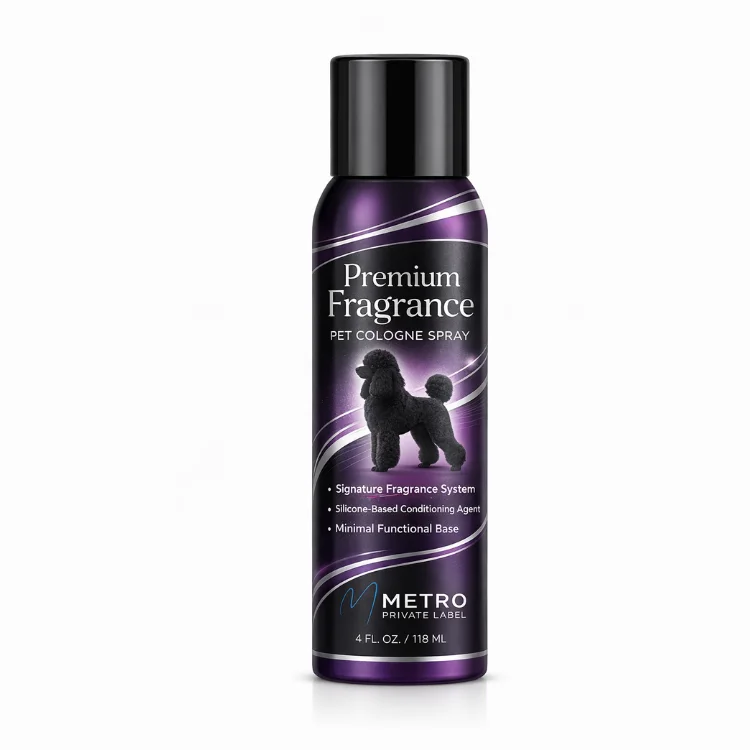
Premium Fragrance Dog Cologne Spray

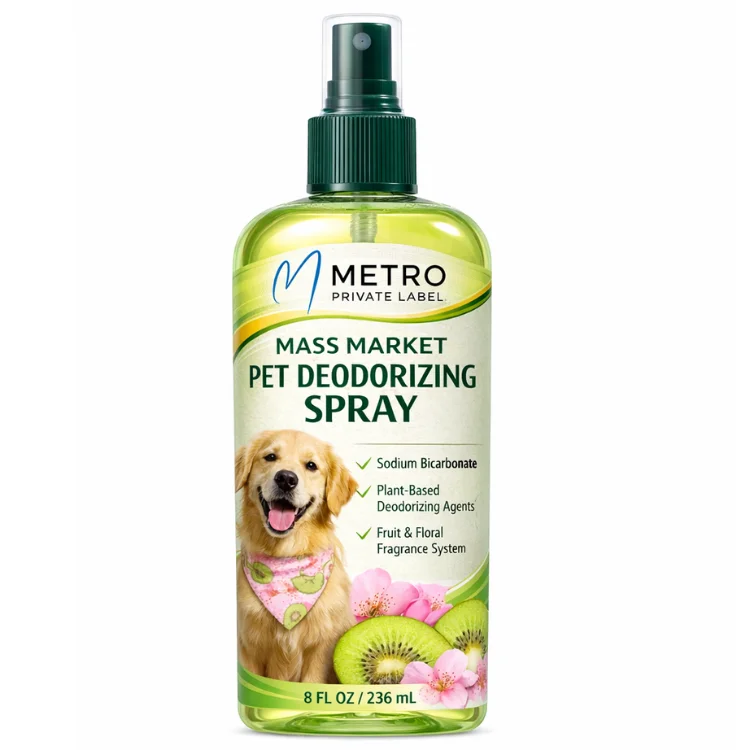
Mass Market Deodorizing Spray

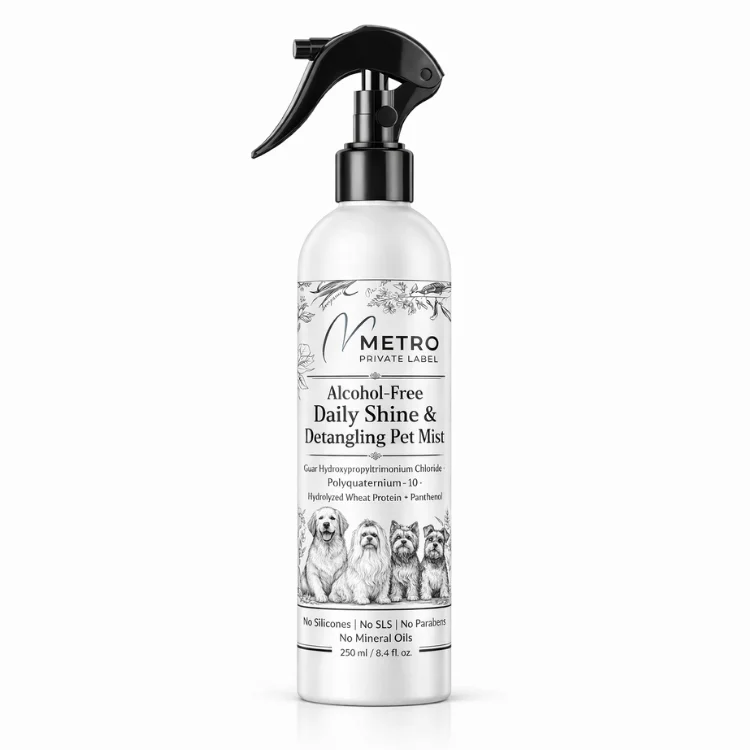
Pet Detangling Spray (Leave-In)

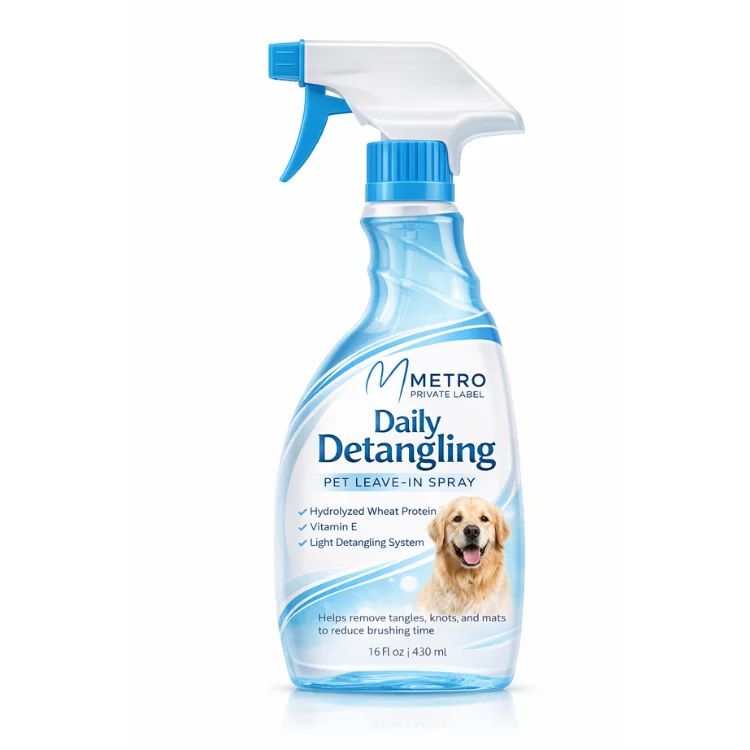
Daily Detangling Leave-In Spray

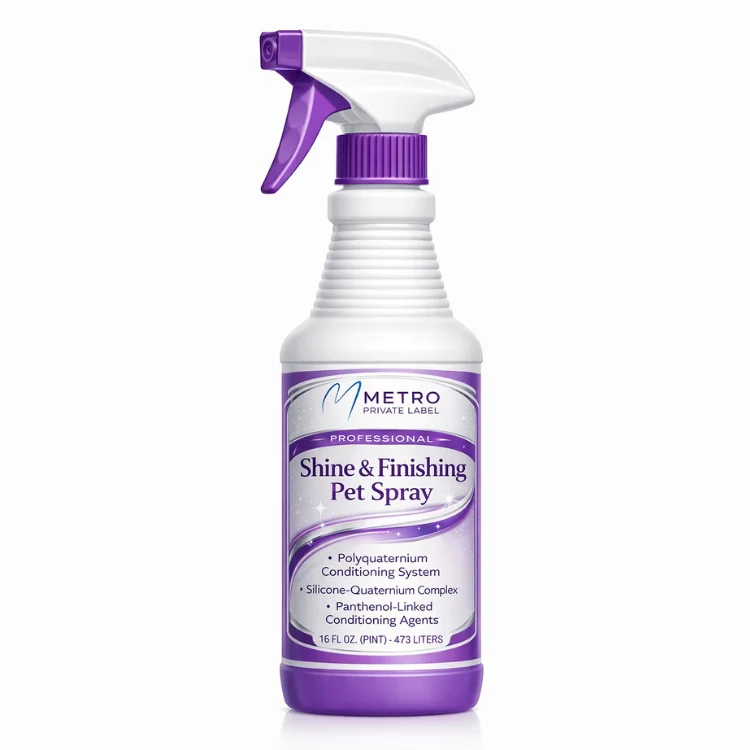
Professional Shine & Finishing Spray

Build a Dog Spray Line That Actually Sells

At Metro Private Label, we understand that a successful dog spray isn’t just about fragrance or freshness — it’s about helping your brand deliver noticeable odor control, safe daily use, and clear functional value that pet owners trust. Today’s customers are far more selective. They care about safety, performance, ingredients, and whether a product fits into their daily pet-care routine. That’s why every dog spray we manufacture is built around real market demand, proven deodorizing and grooming systems, and clear use scenarios.
 
Whether you’re launching a daily deodorizing spray, an alcohol-free and lick-safe odor control mist, a probiotic freshening spray, a premium dog cologne, or a professional grooming spray, we design each formula to help your brand stand out from day one. Our development decisions are guided by what sells on Amazon, what pet brands successfully scale through DTC, and what groomers and pet owners consistently value in real-world use — so your dog spray doesn’t just sound good on paper, it performs in the market.
As your manufacturing partner, we also make sure every dog spray formula is export-ready and production-stable, with clear ingredient logic and packaging compatibility. That means you can launch, test, and scale your pet spray line with confidence, knowing it’s built on safe, consistent, and commercially proven foundations.
 
💡 Our 8 Most In-Demand Private Label Dog Spray Types
1️⃣ Pet Deodorizing Spray Everyday freshness solutions designed to neutralize pet odors between baths.
2️⃣ Daily Odor Control Spray (Alcohol-Free & Lick-Safe) Gentle, daily-use sprays combining instant deodorizing with long-term odor control.
3️⃣ Functional Probiotic Deodorizing Spray Microbiome-inspired formulas that balance odor management with skin-friendly care.
4️⃣ Premium Fragrance Dog Cologne Spray Fragrance-first sprays created for boutique branding and long-lasting scent experience.
5️⃣ Mass Market Deodorizing Spray Cost-effective, fast-acting odor neutralization designed for high-frequency household use.
6️⃣ Pet Detangling Spray (Leave-In) Lightweight grooming sprays that improve brushability and reduce coat tangling.
7️⃣ Daily Detangling Leave-In Spray Gentle, everyday grooming formulas for smooth brushing and coat maintenance.
8️⃣ Professional Shine & Finishing Spray High-performance grooming sprays developed for groomers, show prep, and final coat finish.
 
🎯 MOQ & Packaging Options (Built for Real Pet Brands)
At Metro Private Label, we keep dog spray projects practical, scalable, and launch-friendly:
  • Product MOQ Most dog spray formulas start from 500–800 units, depending on formula type and packaging.
  • Custom Packaging MOQ Fully customized bottles, colors, or printing typically start from 3,000 pieces.
  • Packaging Formats Available We support a wide range of spray and grooming formats, including: • PET or HDPE spray bottles • Fine mist and trigger sprayers
  • Included Support Every project includes formula stability testing, packaging compatibility checks, filling guidance, and transport suitability review — so your dog spray performs consistently from factory to end customer.

More Than Just a Dog Spray Manufacturer

At Metro Private Label, we don’t just manufacture dog spray products — we help shape how pet owners experience your brand. Every deodorizing spray, grooming mist, or fragrance cologne we produce is designed to deliver noticeable results, everyday safety, and a clear purpose, not just a label on a bottle. Today’s pet customers care about odor control, ingredient safety, and daily usability, and we build every dog spray with those expectations in mind.

✅ Launch What the Market Already Wants

We develop dog spray formulas based on real demand, not assumptions. By tracking top-selling pet care SKUs, grooming trends, ingredient preferences, and buyer feedback across e-commerce and professional channels, we help you launch products that already fit the market. From daily deodorizing sprays and alcohol-free, lick-safe formulas to probiotic freshening sprays and grooming mists, our dog spray portfolio reflects categories that pet brands are actively scaling — so you enter with lower risk and faster traction.

✅ Small MOQ That Reduces Your Risk

We make it easy to start small and grow without friction. You can launch your dog spray line with 500–800 units using ready packaging to test demand and validate your concept. When sales grow, scaling to 3,000+ units with custom packaging or larger production runs is straightforward — no reformulation, no supplier switch, and no disruption to your brand roadmap.

✅ Visible Results That Win Customer Trust

Pet owners repurchase products that actually work — and we never lose sight of that. Our dog spray formulas focus on real performance, using proven deodorizing systems, gentle conditioning agents, microbiome-inspired ingredients, and coat-friendly actives. The result is effective odor control, improved coat feel, and safe daily use, helping your spray become a dependable, repeat-purchase SKU rather than a one-time trial.

✅ Compliance That Makes Export Easy

We prepare your dog spray for international markets from day one. From INCI lists, COA, SDS, stability and compatibility testing to export-ready documentation, we help ensure your products meet regulatory expectations before they ship. Whether you sell in the US, Europe, the Middle East, or through global e-commerce platforms, we help you launch smoothly — without delays, rework, or compliance surprises.
  • METRO
  • Typical OEM factory
METROTypical OEM factory
$
/year
/year
Minimum order quantity✅ 500 units for startup brands — low-risk entry for first-time founders.❌ 3,000 units minimum, limiting flexibility.
Packaging recommendations✅ Compatibility + visual templates to ensure perfect fit and premium look.❌ Not provided.
Launch support✅ Label compliance & claim copywriting included for export markets.❌ Not available.
Sample delivery time✅ 7–14 days with labeled packaging.❌ Usually 30+ days.
Compliance & Documentation✅ INCI, COA, SDS, GMP-ready — export with confidence.❌ Basic INCI only.
Buy Now

✨ Build a Dog Spray Line That Goes Beyond Expectations

When you work with Metro Private Label, you’re not just choosing a factory — you’re partnering with a GMPC-certified manufacturer that helps turn dog spray ideas into stable, effective, and market-ready products. We focus on real odor control, daily safety, grooming performance, and brand-ready textures, so your sprays don’t just sound good on paper — they earn trust with every use.
 
Whether you’re launching a daily deodorizing spray, an alcohol-free & lick-safe odor control mist, a probiotic freshening spray, a premium dog cologne, or a professional grooming finish spray, we design each formula to spray evenly, perform consistently, and fit naturally into real pet-care routines. The goal isn’t a one-time trial — it’s a dog spray your customers come back to.
🧪 Custom Formulation That Builds Real Brand Credibility
We don’t rely on generic bases or one-size-fits-all formulas. Every dog spray is developed with practical formulation logic and real market insight.
Our lab works with proven deodorizing systems, microbiome-inspired ingredients, gentle conditioning agents, and coat-friendly actives — carefully balanced to match your target customer, usage frequency, and brand positioning. Each prototype goes through stability testing, pH control, spray performance checks, and packaging compatibility reviews before moving forward.
If there’s a better way to improve odor longevity, reduce residue, refine spray feel, or enhance coat smoothness, we explain the trade-offs clearly and guide you through the decision. This collaborative process helps your dog spray stand apart from generic, “me-too” products and build long-term trust through performance.
 
📦 Packaging That Matches Your Brand Vision
We know packaging plays a major role in how your dog spray is perceived — especially in e-commerce and professional channels.
You can start quickly with 500–800 units using our ready stock spray bottles and mist systems, ideal for DTC launches, market testing, or first SKUs. When you’re ready to scale, we support 3,000+ units of fully customized packaging, including custom colors, finishes, sprayer types, and premium printing that reflects your brand’s quality.
Packaging Notes:
  • Dog Spray (deodorizing, grooming, cologne): 500–800 pcs with stock packaging
  • Fully customized bottles & sprayers: 3,000 pcs minimum
  • Gallon-size options: available for grooming salons, refill programs, and B2B distribution
We manage labels, cartons, printing, and finishing — so everything arrives cohesive, clean, and retail-ready.
 
⚙️ A Clear, Reliable Production Process
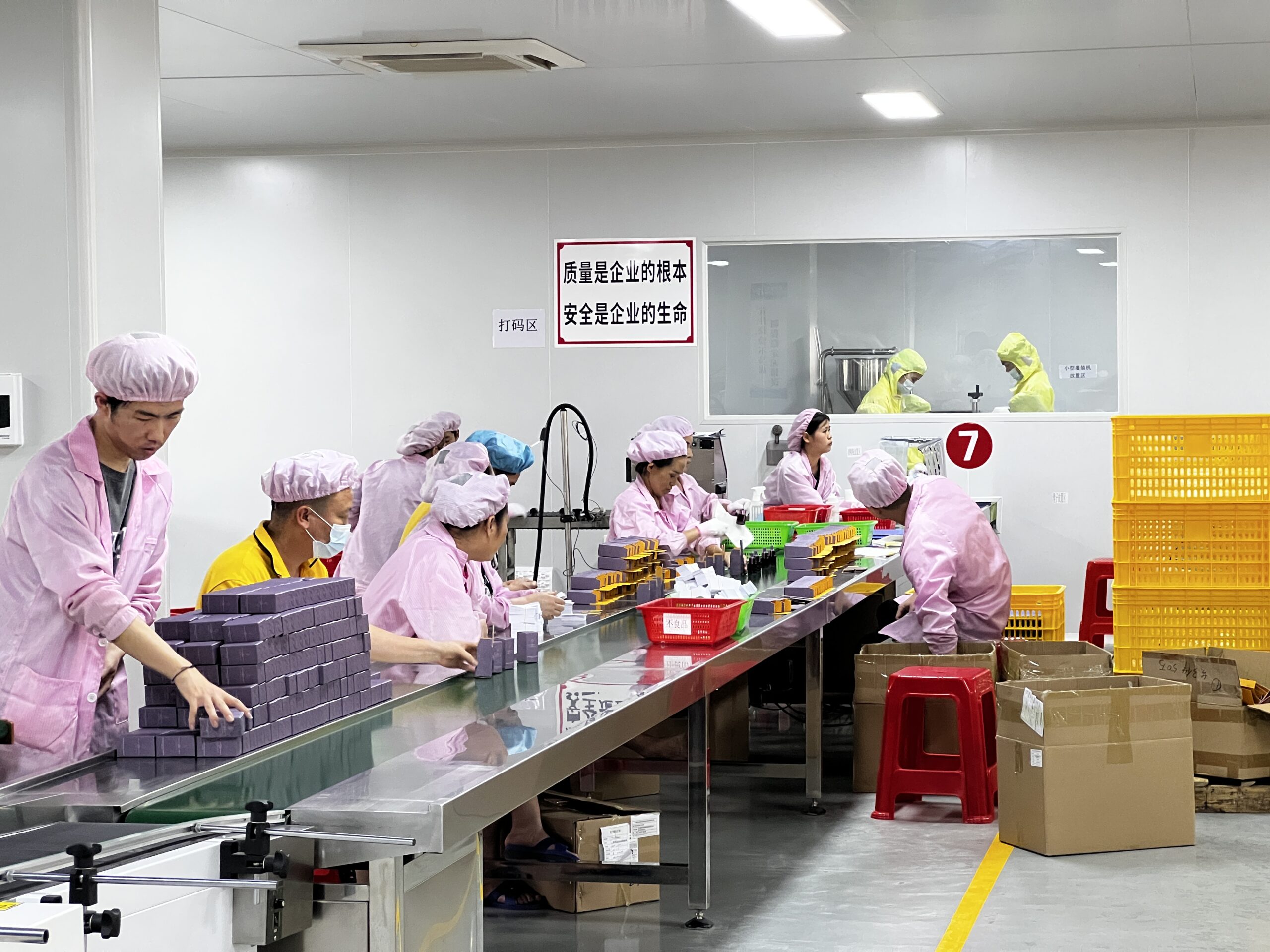
From formulation and sampling to filling, quality control, and export documentation, everything runs through a coordinated, transparent workflow. We keep communication straightforward, flag potential issues early, and set timelines that make sense for real launches.
Think of us as an extension of your operations team — focused on helping you launch a high-performing, reliable dog spray line without unnecessary delays or surprises.
 
🌿 Built for Growth, Not One-Time Orders
We measure success by how well your brand scales. That’s why we support flexible MOQs, stable formulas, scalable packaging, and complete documentation for the U.S., EU, UK, GCC, and other global markets.
With Metro Private Label, your dog spray line is designed to launch smoothly, perform consistently, and grow confidently across every channel you sell in.

Who We Work With (Designed Around Your Real Needs)

We build partnerships by thinking the way our clients do — understand first → provide solutions → deliver results. Every client type has different priorities, and our role is to translate those into clear, actionable outcomes.

Medical Aesthetic / SPA Professionals

You care about: post-treatment comfort, product safety, and documentation that meets regulatory and audit standards.
What we deliver:

  • Clinical-grade formulations: CICA, ceramides, and peptides; pH-balanced, fragrance-free options with full preservative logic provided.

  • Regulatory documentation: INCI, COA, SDS, stability and compatibility reports; CPSR/CPNP preparation handled with third-party testing support.

  • Professional aesthetic: minimalist, medical-style packaging suitable for back-bar or retail; traceable batches for consistent results.
    Immediate outcome: a post-treatment testing set, compliant label guide, and batch consistency plan ready for your internal validation.

Funded New Entrepreneurs

You care about: low-risk entry, a clear roadmap, and a premium finish that looks ready for market.
What we deliver:

  • Smart start: choose from proven skincare bases (serums, creams, masks); pilot runs from 500 units with optional custom cartons.

  • All-in-one process: formula → visual template → compliant label copy → production → export-ready documentation.

  • Transparent costing: clear breakdown of your key cost drivers — formula type, active concentration, and packaging complexity — so you can plan pricing and profit with confidence.
    Immediate outcome: 2–3 customized samples, a detailed quotation breakdown, and a timeline showing every stage from sample to shipment.

Boutique DTC Brand Owners

You care about: originality, visual consistency, and storytelling through ingredients.
What we deliver:

  • Ownable sensorials: bio-cellulose or vegan carrageenan textures paired with signature actives like peptides, niacinamide, or botanical blends.

  • Design alignment: typography, color, and label systems that match your brand aesthetic; compatibility checks before full production.

  • Global readiness: INCI, COA, SDS, and stability data included; EU/UK/US label claim review support for smooth registration.
    Immediate outcome: packaging mockups, ingredient story sheets, and a coordinated multi-SKU rollout plan that keeps your range cohesive.

Why this works:
We don’t sell production capacity — we deliver strategic understanding, technical precision, and verifiable results.
By connecting your goals with regulatory, design, and manufacturing expertise, we help your brand move faster, reduce uncertainty, and build trust that lasts.

FAQs Dog Spray

For your convenience, we’ve gathered the most commonly asked questions about our Dog Spray . However, should you have any further queries, please don’t hesitate to reach out to us.
1. What types of dog spray can you manufacture?
We manufacture a full range of private label dog sprays, including deodorizing sprays, alcohol-free & lick-safe daily sprays, probiotic deodorizing sprays, premium dog cologne sprays, detangling leave-in sprays, and professional grooming shine & finishing sprays. You can choose from our proven formula systems or work with us to fine-tune one specifically for your brand.
Yes — customization is a big part of what we do. We can adjust odor-control systems, fragrance strength, ingredient focus, spray feel, residue level, and usage positioning (daily use vs professional). If you tell us your target customer and sales channel, we’ll help shape a formula that fits both.
Most dog spray projects start at 500–800 units per SKU when using stock packaging. For fully customized bottles, colors, or printing, MOQs typically start from 3,000 units. We’re flexible and always try to recommend an option that lets you test the market without overcommitting.
Sampling usually takes 2–4 weeks, depending on formula complexity and revisions. Mass production typically takes 4–6 weeks after sample approval. If you’re working toward a launch deadline, let us know early — we’ll plan timelines realistically and flag any risks upfront.
Yes. Many of our dog spray formulas are designed specifically for frequent, everyday use, including alcohol-free and lick-safe options. We focus on gentle deodorizing systems, coat-friendly conditioning agents, and ingredient logic that supports repeated application without irritation.
Absolutely. We support bottle selection, sprayer types, label layout, printing, and outer packaging. You can start with ready stock packaging for speed or move into fully customized bottles and finishes as you scale. We’ll also check packaging compatibility to make sure the spray performs properly.
We offer both. You can launch quickly using our ready, market-tested formulas, or co-develop a custom formula tailored to your brand story and target market. We’ll explain the pros, costs, and timelines for each option so you can decide with confidence.
Every dog spray goes through stability testing, pH control, spray performance evaluation, and packaging compatibility checks. We manufacture under GMPC standards and follow strict internal quality control to ensure consistency from sampling to full production.
Yes. We help you define clear, realistic, and market-appropriate claims, such as “odor-neutralizing,” “alcohol-free,” “lick-safe,” “daily grooming,” or “professional finishing.” We’ll also help highlight key ingredients and usage benefits in a way that supports both compliance and marketing.
Yes. We work with brands worldwide and support export-ready documentation, shipping coordination, and compliance preparation for the U.S., EU, UK, Middle East, and other global markets. Our goal is to make your dog spray launch smooth — without delays or surprises.

Metro Private Label in Numbers

Happy Clients
0 +
Million-dollar Buyers
0 +
Formulation
0 +
Professional Staffs
0 +

Your Ultimate Guide to Dog Spray

If you’re planning to add a Dog Spray to your product lineup—whether it’s your first functional pet care SKU or an expansion of an existing grooming range—you’re not just choosing a spray format. You’re stepping into one of the most repeat-driven and trust-sensitive categories in modern pet care. Dog sprays are not impulse products. Pet owners expect them to work gently, consistently, and safely, especially when they’re used between baths or as part of daily routines.
 
We’ve watched the dog spray category evolve from simple fragrance mists into purpose-driven products: deodorizing sprays for everyday odor control, alcohol-free and lick-safe formulas for frequent use, probiotic sprays for long-term balance, and grooming sprays designed for professional-level coat performance. At Metro Private Label, we’ve worked closely with first-time pet brand founders building their initial lineup, DTC and Amazon sellers optimizing for reviews and repurchase, grooming chains looking for performance-first formulas, and distributors who need stable, compliant products that scale across markets. And in every case, dog sprays require far more strategic thinking than most people expect.
 
This guide is built from what we’ve learned behind the scenes—what actually makes a dog spray succeed in the market, how different spray types serve different user expectations, why “daily use,” “lick-safe,” and “professional” are not interchangeable claims, and how formulation, packaging, MOQ planning, and positioning quietly determine whether a product becomes a routine staple or a one-time trial.

Table of Contents

Understanding the Main Categories of Dog Spray

When I work with pet brands and professional buyers, I often notice that dog spray is treated as a single, interchangeable product. In reality, this category is much more layered and nuanced. Dog sprays exist to solve different problems at different moments in a pet’s routine, and understanding these distinctions early can completely change how a product line is built, positioned, and scaled. What I want to share here is not theory, but how these categories actually function in the market and why they matter from a B-side decision-making perspective.
 
Deodorizing Sprays: A Practical Solution for Real-Life Odor Moments
Deodorizing sprays are usually where most brands start, and for good reason. In my experience, this category addresses one of the most immediate and universal needs in pet care: managing unpleasant odors between baths. These sprays are typically used after outdoor activities, long walks, or simply during daily life when a full wash isn’t practical.
What’s important to understand is that deodorizing sprays are designed to neutralize or reduce odor, not to condition the coat or replace shampoo. When brands position them too broadly, customers often expect more than the product is meant to deliver. The most successful deodorizing sprays are very clear about their role: fast freshness, easy application, and noticeable improvement in smell. This clarity keeps expectations aligned and prevents unnecessary dissatisfaction.
 
Daily Odor Control Sprays: Built Around Frequency and Safety
Daily odor control sprays take the deodorizing concept one step further, and this is where I see many brands struggle if they haven’t thought things through. The key difference here is frequency of use. Products intended for daily or frequent application must be designed with a different mindset, especially when it comes to ingredient selection and overall gentleness.
From what I’ve seen, daily-use sprays are often chosen by pet owners who care deeply about routine maintenance rather than quick fixes. These customers want reassurance that the product can be used repeatedly without irritation or discomfort. That’s why daily odor control sprays often emphasize alcohol-free systems and more balanced deodorizing mechanisms. For brands, understanding this category helps avoid overstating performance while strengthening trust through responsible positioning.
 
Probiotic Dog Sprays: When Odor Control Meets Long-Term Thinking
Probiotic dog sprays are a category that often attracts brands looking for a more science-driven or modern story. In my conversations with founders, this category usually comes up when they want to go beyond masking odors and instead talk about managing odor at its source.
What’s important here is perspective. Probiotic sprays aware not magic solutions, and they shouldn’t be treated as such. They work best when positioned as part of a long-term care approach, especially for pets with recurring odor issues. Brands that succeed with this category are the ones that clearly explain why probiotics are included and how they fit into a broader hygiene routine. Without that clarity, the concept can feel vague or confusing to buyers and end customers alike.
 
Fragrance Cologne Sprays: Scent as Brand Identity, Not Function
Fragrance-focused dog cologne sprays sit in a very different emotional and commercial space. When I evaluate this category, I always remind brands that the primary value here is experience, not function. These sprays are about how a pet smells, how the brand feels, and how the product fits into a lifestyle narrative.
Problems arise when fragrance sprays are marketed as odor solutions. Customers who buy cologne-style sprays are usually looking for pleasant, lasting scents rather than technical odor neutralization. Brands that respect this distinction tend to build stronger emotional connections with their audience. In my view, fragrance sprays work best when they are treated as an extension of brand personality rather than a functional hygiene product.
 
Grooming-Focused Sprays: Performance You Can See and Feel
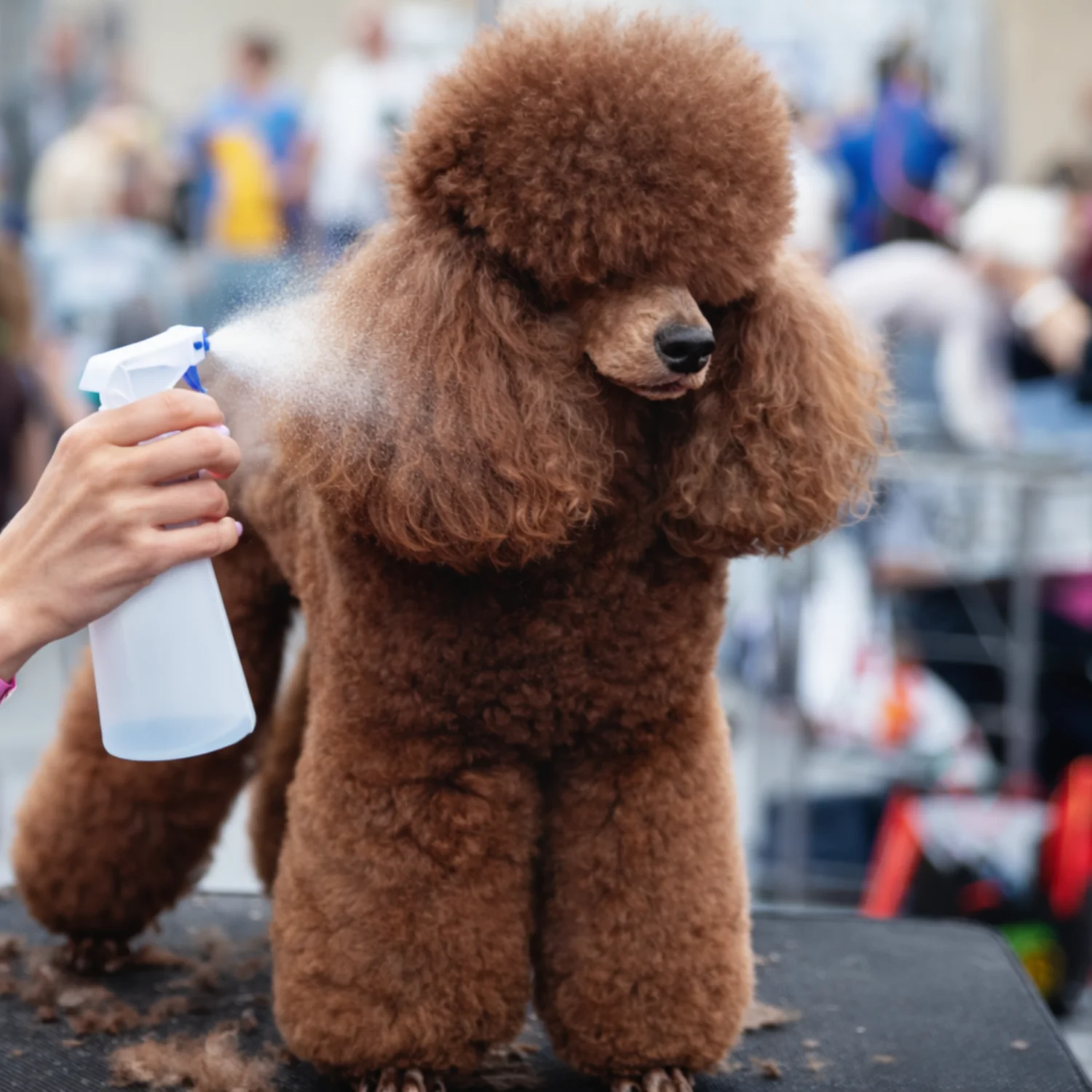
Grooming sprays are where dog spray products become highly performance-driven. This category includes detangling sprays, shine sprays, and finishing mists that are designed to support brushing, styling, and coat presentation. Unlike deodorizing or fragrance sprays, these products are judged almost immediately during use.
From my experience observing professional grooming environments, the key criteria here are slip, smoothness, manageability, and consistency. Groomers rely on these sprays as tools, not extras. For brands, understanding this category is critical because grooming sprays serve a different audience with different expectations. Mixing grooming claims with odor-control messaging often dilutes both and makes the product harder to understand.
 
Why Clear Categories Shape Stronger Product Lines
Over time, I’ve come to realize that most product line issues don’t start in the lab, but in the planning stage. When brands fail to clearly define what role each dog spray plays, they often end up with overlapping SKUs that compete with each other rather than complement one another.
By clearly understanding these categories from the beginning, brands can make better decisions about naming, claims, pricing, and even packaging. Each spray earns its place in the lineup because it solves a specific problem at a specific moment. That clarity not only helps customers choose the right product, but also allows brands to build dog spray lines that feel intentional, credible, and sustainable over the long term.

Deodorizing Spray vs Grooming Spray: Different Jobs, Different Expectations

When I look at dog spray products from a B2B perspective, one of the most common misunderstandings I encounter is the assumption that all sprays do roughly the same thing. Because they share a similar format, deodorizing sprays and grooming sprays are often grouped together, even though they serve fundamentally different purposes. Over time, I’ve learned that this confusion doesn’t just affect how products are formulated, but also how they are communicated, sold, and repurchased. Clarifying the difference between these two categories is one of the most effective ways to strengthen a product line and reduce long-term customer dissatisfaction.
 
Deodorizing Sprays Are About Timing and Situational Use
Deodorizing sprays exist for moments when a dog smells unpleasant but a bath is either inconvenient or unnecessary. In real-life usage, these products are applied quickly, often without much preparation, and usually in everyday environments like the home, the car, or after outdoor activity. From what I’ve observed, customers reach for deodorizing sprays when they want an immediate improvement in smell, not a change in coat condition.
The success of a deodorizing spray is judged almost entirely by odor perception. If the smell is noticeably better right after application and remains acceptable for a reasonable period, the product is considered effective. Any additional benefits, such as light conditioning or softness, are secondary and rarely influence purchasing decisions. When brands overextend deodorizing sprays by promising grooming or styling benefits, customers start expecting results that fall outside the product’s core purpose, which often leads to disappointment rather than satisfaction.
 
Grooming Sprays Are Evaluated Through Hands-On Performance
Grooming sprays, on the other hand, are used with intention and attention. When I watch how groomers and experienced pet owners use these products, the focus is on how the coat behaves during brushing and handling. These sprays are applied before or during grooming sessions, not as a quick fix, and they are judged in real time.
Performance indicators such as slip, detangling efficiency, shine, and overall coat manageability matter far more than fragrance. A grooming spray that smells pleasant but does not reduce resistance during brushing is often dismissed as ineffective. In professional settings, these products are considered functional tools. Groomers rely on consistent results across different coat types, and any variability can quickly erode trust in the product.
 
Fragrance Plays a Different Role in Each Category
One detail I always pay close attention to is how fragrance is treated in deodorizing versus grooming sprays. In deodorizing sprays, scent is often part of the solution. Whether through masking or neutralizing unpleasant odors, fragrance contributes directly to the perceived effectiveness of the product. Customers expect to notice a change in smell immediately.
In grooming sprays, fragrance takes on a supporting role. It should not interfere with the grooming process or overpower the experience. Many professionals prefer minimal or subtle scent profiles so that fragrance does not clash with other products used during grooming. When brands fail to recognize this difference, they risk creating products that satisfy neither category fully.
 
What Happens When the Two Roles Are Blended
In my experience, products that try to be both strong deodorizing sprays and high-performance grooming sprays often struggle in the market. This is not because the idea is impossible, but because the messaging becomes unclear. Customers are left wondering whether the product should be used casually between baths or as part of a grooming routine.
This confusion shows up quickly in reviews and repeat purchase behavior. A customer who expected odor control may complain that the scent does not last long enough, while a groomer may find the same product too fragrance-heavy and lacking in grooming performance. In both cases, the issue lies not in the formula itself, but in misaligned expectations created by unclear positioning.
 
Clear Functional Separation Leads to Stronger Brand Trust
Over time, I’ve noticed that brands with clearly separated deodorizing and grooming spray lines tend to build stronger trust with their customers. Each product has a well-defined role, and customers learn when and why to use it. This clarity reduces hesitation during purchase and increases confidence in recommending the product to others.
From a product line strategy standpoint, separating these functions allows brands to expand more logically. New SKUs can be added to address specific needs without cannibalizing existing products. Communication becomes simpler, customer education becomes easier, and the overall brand feels more intentional and professional.
 
Why Expectations Matter More Than Features
What ultimately determines whether a dog spray succeeds is not the number of features it claims, but whether it meets the expectations it sets. In my view, deodorizing sprays and grooming sprays succeed when they stay focused on their primary job and communicate that job clearly. When customers understand exactly what a product is designed to do, satisfaction increases, complaints decrease, and repurchase becomes far more likely.
By respecting the different roles these sprays play, brands can avoid common pitfalls and create product lines that feel purposeful, credible, and built for long-term success rather than short-term appeal.

What “Daily Use” Really Means in Dog Spray Products

When I hear someone describe a dog spray as “safe for daily use,” I always slow the conversation down. Over the years, I’ve learned that this phrase carries far more weight than most people realize. To many brands, “daily use” sounds like a reassuring marketing label. To experienced buyers and professionals, it’s a promise about tolerance, consistency, and long-term behavior. Understanding what that promise truly involves is essential if a product is meant to earn trust rather than just initial attention.
 
Daily Use Is Defined by Repetition, Not First Impression
The first thing I consider when evaluating daily-use positioning is not how the product performs on the first spray, but how it behaves after repeated application. A daily-use dog spray is designed to be applied again and again, sometimes every day for weeks, without the owner thinking twice about it.
This repeated contact changes everything. Ingredients that feel perfectly acceptable in occasional-use products can start to show drawbacks over time. Residue may build up, coat texture may change, or sensitive skin may react subtly rather than immediately. From my perspective, daily-use suitability is about how quietly and reliably a product fits into a routine, not how impressive it feels in a single moment.
 
Why Alcohol-Free Systems Become a Practical Necessity
One of the most important distinctions I’ve observed in daily-use dog sprays is the role of alcohol. Alcohol can deliver fast-drying and immediate freshness, which explains why it appears in some odor-control products. However, when a spray is used frequently, alcohol can contribute to dryness or discomfort, especially on dogs with sensitive skin or thinner coats.
That’s why alcohol-free systems are so often associated with credible daily-use positioning. This choice is not driven by trends, but by practicality. A product meant for repeated application should feel neutral and unobtrusive, not sharp or drying. In my experience, pet owners may not always articulate this technically, but they sense it very quickly in day-to-day use.
 
Gentle Deodorizing Is About Consistency Over Power
Another area where daily-use products differ from occasional sprays is deodorizing strategy. Daily-use dog sprays are not designed to overpower strong odors in one dramatic application. Instead, they aim to maintain freshness gradually and consistently.
From what I’ve seen, customers who choose daily-use sprays value predictability. They want a product that keeps things under control without drawing attention to itself. Aggressive deodorizing systems might feel effective at first, but over time they can feel intrusive or uncomfortable. Daily-use sprays work best when they focus on balance rather than intensity, delivering subtle, repeatable results that align with routine care.
 
Ingredient Suitability Is About the Whole Formula, Not One Claim
When brands talk about daily-use positioning, I often notice an overemphasis on individual ingredient claims. In practice, daily-use tolerance has very little to do with whether one ingredient sounds gentle on paper. What matters is how the entire formula behaves as a system over repeated use.
Even ingredients with a reputation for gentleness can feel unpleasant if the formula leaves buildup, alters coat texture, or creates a sticky or heavy feel over time. Daily-use dog sprays should feel almost invisible after application. From my perspective, that “invisible” quality is one of the hardest things to achieve and one of the clearest signs that a formula has been thoughtfully designed.
 
Daily Use Also Implies Higher Responsibility in Communication
One aspect that often gets overlooked is how daily-use positioning affects brand communication. When a product is described as suitable for everyday use, customers assume a higher level of safety and comfort, even if they don’t consciously analyze why.
This means brands need to be especially careful with how they describe performance. Overstated claims can create unrealistic expectations and undermine trust when the product is used repeatedly. In my experience, the most successful daily-use sprays are positioned around maintenance and comfort rather than transformation. They promise stability, not dramatic change, and that honesty resonates over time.
 
Long-Term Trust Is the Real Measure of Daily Use
Ultimately, I believe daily-use positioning is less about formulation buzzwords and more about long-term outcomes. Products that feel fine at first but cause discomfort or dissatisfaction after weeks of use often generate quiet churn rather than loud complaints. Customers simply stop repurchasing.
By contrast, daily-use dog sprays that perform gently and consistently tend to become staples. They may not generate dramatic first impressions, but they build loyalty through reliability. From a strategic standpoint, understanding what “daily use” really means helps brands protect their reputation, reduce negative feedback, and create products that remain relevant well beyond their initial launch.
For me, that long-term trust is the true benchmark of a daily-use dog spray, and it’s why this distinction deserves far more attention than it usually gets.

Lick-Safe and Alcohol-Free Claims: When They Matter Most

When I review dog spray concepts or read how brands describe their products, “lick-safe” and “alcohol-free” are two claims that immediately catch my attention. Not because they are trendy, but because they signal how seriously a brand has thought about real-life usage. In my experience, these claims are not universally necessary for every dog spray, but when they are relevant, they become absolutely critical. Understanding when and why they matter helps brands avoid empty labeling and build genuine trust with buyers and end users.
 
Lick-Safe Is About Dog Behavior, Not Just Ingredients
The first thing I always remind myself is that dogs don’t use products the way humans do. Dogs lick. They lick their paws, their legs, their sides, and often the very areas where sprays are applied. When a dog spray is intended for frequent use or applied to easily reachable parts of the body, lick-safe positioning stops being a “nice to have” and becomes a core concern.
From what I’ve seen, pet owners rarely calculate exposure in a scientific way, but they are highly sensitive to perceived risk. Even small, repeated ingestion over time creates anxiety if the product doesn’t clearly communicate safety. Lick-safe claims work because they align with instinctive owner behavior. They reassure people at the exact moment they hesitate before spraying something their dog might ingest later.
 
Alcohol-Free Signals Comfort Over Time, Not Just Clean Beauty
Alcohol-free claims are often misunderstood as purely marketing-driven, but in practice, they are deeply connected to long-term comfort. Alcohol can provide quick evaporation and an immediate sense of freshness, which is why it appears in some sprays designed for occasional or emergency use.
However, when a product is positioned for daily or frequent application, alcohol becomes a liability rather than an advantage. Over time, it can contribute to dryness, coat dullness, or subtle irritation that doesn’t always show up immediately. In my experience, owners may not identify alcohol as the cause, but they notice when a product feels less comfortable to use over weeks rather than days. Alcohol-free positioning signals that a spray is designed to live in a routine, not just deliver a fast sensory hit.
 
Frequent Application Changes the Risk Conversation
One detail I always focus on is how often a product is meant to be used. A spray applied once a week and a spray applied every day are fundamentally different in how they should be evaluated. Lick-safe and alcohol-free claims matter most when exposure is repeated and cumulative.
With frequent application, even mild discomfort can add up. Dogs may scratch more, avoid being sprayed, or show subtle changes in coat feel. Pet owners are quick to notice these shifts, even if they don’t articulate them in technical terms. When brands acknowledge frequent use through thoughtful claims, they demonstrate that they understand this cumulative reality rather than treating all sprays as equal.
 
How These Claims Shape Formulation Decisions Behind the Scenes
From a formulation standpoint, lick-safe and alcohol-free positioning affects far more than one or two ingredient choices. Removing alcohol changes how odor control is achieved, how fragrance behaves, and how quickly the product dries. Lick-safe positioning often leads to more conservative decisions around fragrance intensity and overall residue.
What I’ve learned is that these formulas tend to prioritize neutrality. They are not meant to announce themselves loudly after application. Instead, they should fade into the background of daily care. This “quiet performance” is actually one of the hardest things to design well, but it’s also what separates a genuinely daily-use product from one that only works occasionally.
 
Sensitive Skin Makes These Claims Non-Negotiable
When a dog spray is positioned for sensitive skin, the importance of lick-safe and alcohol-free claims increases significantly. Sensitive skin changes the tolerance threshold, and buyers know this. Even professional groomers and distributors become more cautious because they are responsible for many different dogs with varying reactions.
In these cases, such claims are not just reassurance for consumers, but risk management tools for B2B buyers. They reduce the likelihood of negative reactions, complaints, or lost confidence. From what I’ve seen, products that combine sensitive-skin positioning with vague safety language struggle to earn repeat trust, no matter how well they perform initially.
 
Buyer Trust Varies by Market, but Expectations Are Converging
Different regions emphasize these claims differently, but the overall direction is clear. Across markets, buyers are becoming more informed and less tolerant of loosely defined promises. Even in regions where lick-safe or alcohol-free language is not yet standard, trust is increasingly built on transparency and consistency.
In my experience, brands that use these claims carefully and back them with clear logic tend to perform better over time. Buyers may not always praise these details explicitly, but they reward them through repeat orders and long-term loyalty. On the other hand, when claims feel superficial or inconsistent, trust erodes quietly but quickly.
 
Why Responsible Use of These Claims Protects the Brand Long-Term
Ultimately, I see lick-safe and alcohol-free positioning as long-term brand decisions rather than short-term marketing tools. Products designed for frequent use are judged slowly, over weeks and months, not in a single application. If a spray causes concern or discomfort after repeated use, customers don’t always complain—they simply stop buying.
Brands that understand when these claims truly matter tend to build quieter, stronger loyalty. The product becomes something owners feel comfortable using without second thoughts. For me, that confidence is the real value behind lick-safe and alcohol-free claims. When applied thoughtfully, they align formulation, communication, and real-world behavior in a way that supports lasting success in the dog spray category.

Probiotic Dog Sprays: Functional Benefit or Marketing Differentiator?

When probiotic and microbiome-inspired dog sprays first started appearing more frequently in product discussions, I remember feeling both curious and cautious. Curious, because the logic behind them made sense on a conceptual level. Cautious, because I’ve seen many ingredients rise quickly on the back of strong narratives and then fade just as fast when expectations aren’t managed properly. Over time, I’ve come to believe that probiotic dog sprays can be genuinely valuable products—but only when brands understand why they exist, what role they play, and what they are not meant to do.
 
Why Probiotics Entered the Dog Spray Category in the First Place
From my perspective, probiotics entered the dog spray conversation as a response to a limitation in traditional deodorizing products. Many classic sprays rely heavily on fragrance or immediate odor neutralization. They work in the short term, but they don’t always address recurring odor patterns, especially in dogs that smell again quickly after bathing.
As pet owners became more familiar with microbiome concepts through skincare, nutrition, and wellness, the idea of supporting balance rather than overpowering symptoms became more appealing. Probiotic dog sprays grew out of this shift. They offered brands a way to talk about odor management that felt more thoughtful, more scientific, and more aligned with long-term care rather than instant masking.
 
What Probiotic Dog Sprays Are Actually Designed to Do
One point I always try to clarify is that probiotic dog sprays are not emergency products. They are not designed for moments when a dog suddenly smells bad and needs an immediate fix. Instead, they are usually positioned as maintenance tools, meant to be used consistently over time.
In practical use, these sprays are most relevant for dogs with recurring odor issues, sensitive skin, or situations where frequent bathing is not ideal. The idea is not to eliminate odor instantly, but to help reduce the conditions that allow odor to return quickly. When brands understand this role, probiotic sprays make sense as part of a routine rather than as a standalone solution.
 
The Gap Between Scientific Language and Real-World Expectations
One challenge I’ve noticed is the gap between how probiotics are described and how customers expect them to perform. Words like “microbiome” and “balance” sound sophisticated, but they can also create unrealistic assumptions if not explained carefully.
In my experience, probiotic dog sprays work best when brands communicate gradual, supportive benefits instead of dramatic change. These products often feel subtle. Their value shows up over time through reduced odor recurrence and improved tolerance, not through an immediate sensory impact. When brands respect this reality, probiotics add credibility. When they promise instant transformation, trust erodes quickly.
 
Probiotics as a Signal of Brand Philosophy
Beyond function, probiotics often serve as a signal. When I see probiotics included in a dog spray, I immediately associate the brand with ingredient awareness and long-term thinking. This can be powerful, especially for premium or DTC-focused brands that want to differentiate themselves from purely fragrance-driven products.
However, this signal only works if it’s consistent. If probiotics appear in one product without any supporting logic elsewhere in the range, they can feel like decoration rather than intention. Brands that succeed with probiotics tend to build a broader story around gentle care, routine maintenance, and balance, making the ingredient feel purposeful rather than opportunistic.
 
How Probiotic Sprays Fit Into a Complete Product Line
When I evaluate whether probiotic sprays make sense for a brand, I always look at the wider product architecture. Probiotic sprays fit best in lines that already include daily-use products, sensitive-skin positioning, or routine grooming solutions. They work especially well as complementary products alongside basic deodorizing sprays, offering a more advanced option for customers with ongoing needs.
In contrast, brands focused solely on fast turnover or impulse-driven purchases often struggle to fully leverage probiotics. Without education and context, the benefit can feel abstract, and the product may not meet customer expectations.
 
The Risk of Treating Probiotics as a Short-Term Trend
One of the biggest risks I see is treating probiotics as a quick differentiator rather than a strategic choice. When ingredients are added primarily to follow trends, they often lose relevance once the trend fades or competition increases.
From what I’ve observed, brands that commit to probiotics thoughtfully tend to invest in clear explanations and consistent messaging. They help customers understand what the product does, what it supports, and what it does not promise. This approach may feel slower, but it builds much stronger loyalty than chasing attention with buzzwords.
 
When Probiotic Dog Sprays Truly Deliver Value
In the end, I believe probiotic dog sprays deliver real value when they are positioned as supportive, routine-focused products rather than miracle solutions. They are most effective for brands that prioritize long-term care, sensitive-skin considerations, and maintenance over instant results.
When probiotics are aligned with a brand’s philosophy and product roadmap, they can deepen trust and strengthen differentiation. When they are treated as a marketing shortcut, they often disappoint. For me, that distinction is the key to deciding whether probiotic dog sprays are a functional benefit or simply a temporary talking point.

How Professional Groomers Evaluate Dog Sprays

When I spend time talking with professional groomers or simply watching how they work in a real salon environment, I’m always reminded that their relationship with dog sprays is very different from that of everyday pet owners. For groomers, a spray is not a “nice-to-have” add-on or a lifestyle product. It’s a working tool that has to earn its place on the counter every single day. Over time, I’ve learned that groomers evaluate sprays through a very practical lens, shaped by speed, repetition, and hands-on results rather than marketing language.
 
Efficiency Is the First Filter, Not a Bonus
The first thing I notice about professional groomers is how strongly they value efficiency. Their days are structured around appointments, drying times, and workflow rhythm. When a groomer reaches for a spray, they are not thinking about brand stories or trend positioning. They are thinking about whether this product will help them finish the job faster and with less effort.
A spray that applies evenly, activates immediately, and doesn’t require repeated spraying fits naturally into a groomer’s routine. On the other hand, a spray that clogs, sprays inconsistently, or requires constant adjustment quickly becomes a frustration. In my experience, groomers have very little patience for products that interrupt their flow. Even a technically good formula can be rejected if it slows them down in practice.
 
Coat Performance Is Judged Through Repetition, Not First Use
One of the biggest differences I see between groomers and consumers is how performance is evaluated. Groomers don’t judge a spray based on one dog or one session. They judge it after using it on dozens of dogs, across different coat types, over time.
When a spray is applied, groomers immediately feel how the coat responds. They pay attention to slip during brushing, how easily tangles release, and whether the coat becomes more manageable without feeling coated or heavy. These sensations matter far more than any written claim. If brushing feels easier and more controlled, the spray passes the test. If not, it doesn’t matter how appealing the packaging looks.
 
Slip and Brushability Define Real Value
From what I’ve observed, slip is one of the most critical performance indicators for groomers. A good grooming spray reduces friction between brush and coat, allowing groomers to work faster and with less strain. This isn’t just about convenience. Over the course of a full day, reduced resistance can significantly impact physical fatigue.
Brushability also needs to be consistent. A spray that works well on one coat type but poorly on another creates unpredictability. Groomers prefer products that behave reliably across a wide range of dogs. In professional environments, consistency often outweighs specialization.
 
Shine Is About Balance, Not Visual Drama
When non-professionals talk about shine, they often imagine a dramatic, glossy finish. Groomers see shine differently. For them, shine is about balance and health, not spectacle. A grooming spray should enhance the coat’s natural appearance without making it look artificial or oily.
I’ve noticed that groomers are quick to reject sprays that create excessive gloss or attract dust after grooming. Shine should feel like a quiet improvement rather than a bold statement. When a dog leaves the salon, the goal is a clean, well-finished look that holds up for hours, not a shiny surface that fades or becomes sticky.
 
Drying Behavior Has a Direct Impact on Workflow
One factor that is often overlooked outside professional circles is drying behavior. In a salon, drying time affects scheduling, energy use, and overall efficiency. A grooming spray that leaves the coat damp for too long or interferes with airflow can slow everything down.
From what I’ve seen, groomers strongly prefer sprays that settle quickly into the coat and do not extend drying time. Even a slight delay becomes noticeable when repeated across multiple dogs in a day. This is why sprays that feel acceptable in home use can perform poorly in professional settings.
 
Consistency Over Time Builds Long-Term Trust
Another thing I’ve learned from observing groomers is how sensitive they are to inconsistency. Because they use the same products repeatedly, small changes become obvious very quickly. Variations in texture, slip, or spray pattern can disrupt routines and reduce confidence.
Groomers tend to be loyal once they find a product that works reliably. That loyalty, however, is fragile. If a spray behaves differently from one batch to another, trust erodes fast. In professional environments, predictability is valued more than novelty.
 
Fragrance Is Secondary and Sometimes Unwanted
Fragrance is rarely a deciding factor for groomers. While a neutral or pleasant scent is appreciated, strong fragrance is often seen as unnecessary or even problematic. Groomers layer multiple products during a session, and overpowering scents can clash or linger in an unpleasant way.
In my experience, groomers are far more forgiving of a spray that smells subtle or neutral than one that interferes with the overall grooming experience. Performance always comes first, and fragrance is tolerated only when it stays out of the way.
 
Why Groomer Priorities Matter for B2B Decision-Making
Understanding how groomers evaluate dog sprays is essential for suppliers and distributors serving professional channels. Products designed primarily for consumer appeal often struggle in salons because they prioritize scent, visual appeal, or novelty over functional performance.
When sprays are selected with groomer priorities in mind, adoption is smoother, complaints decrease, and repeat purchasing becomes more likely. Groomers don’t need to be convinced with slogans. They trust products that quietly support their work, respect their time, and deliver consistent results.
In my experience, the most successful professional grooming sprays are the ones that almost disappear into the routine. They don’t demand attention. They simply perform. And in a professional environment, that quiet reliability is the highest compliment a product can earn.

Packaging and Spray Performance: What Actually Affects User Experience

When people evaluate a dog spray, they usually start by talking about the formula. I understand why—ingredients feel tangible and easy to compare. But after years of seeing how products perform in the real world, I’ve learned that user experience is just as much a packaging story as it is a formulation story. In many cases, what users love or hate about a spray has less to do with what’s inside the bottle and more to do with how that liquid actually reaches the dog’s coat.
 
Spray Performance Is a Chain, Not a Single Decision
One thing I always remind myself is that spray performance is never created by one decision alone. It’s the result of a chain of interactions between the formula, the spray mechanism, and the bottle itself. If one link in that chain is weak, the entire experience suffers.
From the user’s point of view, this chain is invisible. They don’t separate formula from packaging in their mind. If the spray feels uneven, leaks, or stops working halfway through the bottle, the product is judged as unreliable. Even a well-designed formula can be perceived as low quality when the packaging fails to support it.
 
The Spray Mechanism Shapes First Impressions Immediately
The spray mechanism is often the very first thing users interact with, and in my experience, it sets the tone for everything that follows. The moment the trigger is pressed, users subconsciously assess control, comfort, and predictability.
A spray that delivers a smooth, consistent mist feels intentional and professional. A spray that sputters, releases uneven bursts, or requires excessive force creates frustration almost instantly. I’ve seen products lose customer trust within the first few uses simply because the spray mechanism didn’t behave as expected. Once that doubt sets in, it’s difficult to reverse.
 
Mist Quality Influences Both Application and Perceived Safety
Mist quality is closely tied to how safe and comfortable the product feels during use. A fine, evenly distributed mist allows the user to control application and avoid oversaturating the coat. This is especially important for daily-use or grooming sprays, where precision matters.
From what I’ve observed, dogs themselves often react differently depending on mist quality. A harsh spray pattern can startle them, while a softer mist tends to be better tolerated. Even though this detail is rarely mentioned in reviews, it quietly shapes the overall experience and influences whether owners feel confident using the product again.
 
Bottle Material Affects More Than Aesthetics
Bottle material is another factor that tends to be underestimated. Many people think of bottle choice as a visual or branding decision, but in practice, it affects durability, stability, and long-term performance.
Over time, I’ve seen how certain materials can warp slightly, lose structural integrity, or interact poorly with specific formulas. These changes don’t always happen immediately. They often appear weeks or months later, which makes them especially damaging because customers interpret them as signs of declining quality. A bottle that feels sturdy and stable throughout its life reinforces trust, while one that degrades quietly undermines it.
 
Viscosity Compatibility Is Where Good Products Often Fail
One of the most common technical issues I encounter is poor viscosity compatibility between the formula and the spray system. Every sprayer is designed to handle a specific viscosity range, and when a formula falls outside that range, problems are almost guaranteed.
If the formula is slightly too thick, clogging and uneven spray patterns become more likely over time. If it’s too thin, dripping, leaking, or over-application can occur. What makes this particularly challenging is that these issues don’t always appear during short-term testing. They often surface after repeated use, temperature changes, or extended storage, which is exactly when customers start forming long-term opinions.
 
How Packaging Issues Turn Into Customer Complaints
What I find most interesting is how packaging problems are translated into customer feedback. Users rarely identify the technical cause. Instead, they describe symptoms: the spray stopped working, it leaks, it sprays everywhere, or it feels inconsistent.
Once these complaints appear, the product’s reputation starts to suffer, even if the formula itself is sound. In many cases, customers don’t give the product a second chance. They simply move on. This is why I believe packaging decisions are among the most high-risk and high-impact choices in dog spray development.
 
Consistency Over the Life of the Product Matters More Than Perfection on Day One
Another lesson I’ve learned is that consistency over time matters more than perfect performance on the first use. A spray that works beautifully at the beginning but degrades halfway through the bottle creates disappointment. Users feel misled, even if the early experience was positive.
Reliable packaging maintains the same spray behavior from the first use to the last. That consistency reinforces the feeling that the product is well made and thoughtfully designed. When that consistency is missing, trust erodes quietly but steadily.
 
Packaging Is Part of Product Strategy, Not an Afterthought
Over time, I’ve stopped thinking of packaging as a finishing step and started viewing it as part of product strategy. Packaging determines how the formula is experienced, how confidently it’s used, and how often it’s repurchased.
In my experience, dog sprays that succeed in the market are not just those with good formulations. They are the ones where formula, spray mechanism, bottle material, and viscosity are designed to work together as a system. When that system is aligned, the product feels effortless and dependable. When it isn’t, even the best formula struggles to shine.
That’s why, for me, packaging is never just about looks. It’s about performance, trust, and the small details that quietly decide whether a dog spray becomes a repeat-buy staple or a one-time experiment.

MOQ Planning: Launching Without Overcommitting

When I sit down with pet brand founders or professional buyers who are planning a new dog spray launch, the conversation almost always circles back to MOQ. It’s where excitement meets hesitation. Everyone wants enough volume to feel “real,” but no one wants to be trapped by inventory before the market has spoken. Over time, I’ve learned that MOQ planning is not a procurement problem. It’s a strategic exercise in risk control, learning speed, and future optionality.
 
MOQ Is About Commitment Level, Not Just Quantity
One of the first things I try to clarify is that MOQ is not simply the smallest number a factory will accept. It represents how much commitment a brand is willing to make before it has real market feedback. The moment inventory is produced, decisions become harder to reverse. Cash is locked, storage becomes an issue, and pressure to “make it sell” increases.
From my experience, brands that treat MOQ as a strategic commitment rather than a technical minimum make calmer decisions. They understand that the first run is not a verdict on the brand’s future, but a controlled experiment. That mindset alone often leads to better outcomes.
 
Testing the Market Is About Learning, Not Playing It Safe
Many brands say they want to “test the market,” but what that actually means varies widely. In my view, testing is not about choosing the smallest possible MOQ out of fear. It’s about choosing a volume that allows meaningful learning.
If the quantity is too small, brands struggle to gather real data. They may sell out quickly, but they learn very little about repeat purchasing, operational challenges, or customer behavior over time. If the quantity is too large, every slow-moving unit feels like a mistake. The most effective test runs I’ve seen are those that last long enough to reveal patterns, not just initial curiosity.
 
Stock Packaging as a Strategic Buffer
Stock packaging is often misunderstood as a compromise or a sign of being “early stage.” In practice, I see it as a strategic buffer. It allows brands to separate product validation from packaging commitment, which is an important distinction.
Using stock packaging reduces lead times and lowers upfront investment. More importantly, it keeps decisions reversible. If the formula, positioning, or pricing needs adjustment after launch, the brand can respond without being constrained by thousands of custom-printed units. From my perspective, stock packaging creates breathing room at a stage where flexibility is far more valuable than visual perfection.
 
Early Packaging Decisions Shape Long-Term Flexibility
One subtle but important lesson I’ve learned is that early packaging choices echo far into the future. Even when using stock packaging, the format itself matters. Some bottle shapes and spray systems scale easily into custom production later, while others force a redesign once volumes increase.
Brands that think one step ahead choose packaging that can evolve. The external look may change, but the user experience remains familiar. This continuity protects brand recognition and reduces friction when scaling. When early decisions ignore this, brands often face unnecessary resets that cost time, money, and momentum.
 
The Hidden Cost Side of MOQ Decisions
MOQ discussions usually focus on unit price, but in my experience, the hidden costs are often more impactful. Storage fees, slow-moving inventory, cash flow pressure, and psychological stress all come into play once production is complete.
I’ve seen brands with attractive per-unit costs struggle operationally because they overcommitted early. Conversely, I’ve seen brands pay slightly higher unit costs but move faster, adjust quicker, and ultimately reach scale more smoothly. MOQ planning is not about optimizing one number. It’s about balancing visible and invisible costs.
 
Planning for Scale Without Forcing It
One of the healthiest approaches I’ve encountered is planning for scale without forcing it. This means ensuring that formulas, compliance documentation, and packaging concepts are compatible with larger volumes, while still launching at a manageable size.
In practice, this approach keeps doors open. When demand increases, the brand can scale without reformulating or rethinking the entire product. When demand grows slowly, the brand has room to adjust without panic. To me, this is the difference between being prepared and being overcommitted.
 
How MOQ Choices Affect Team Confidence and Execution
Something that rarely gets discussed openly is how MOQ decisions affect the people behind the brand. Overcommitting creates constant pressure. Marketing becomes reactive, pricing decisions become emotional, and every slow week feels personal.
I’ve noticed that brands with balanced MOQ strategies operate differently. Their teams are more willing to test marketing angles, listen to feedback, and refine their approach. Confidence improves execution quality, and execution quality often matters more than initial volume decisions.
 
Treating MOQ as a Learning Phase, Not a Final Step
In the end, I see MOQ planning as a learning phase rather than a milestone to “get through.” The first production run teaches lessons that no forecast can fully capture. Those lessons inform the second run, which is usually more confident, better aligned, and more profitable.
Brands that respect this process tend to grow steadily. They don’t rush scale, but they’re never unprepared for it. From my experience, that balance is what allows dog spray brands to launch thoughtfully, adapt intelligently, and expand without unnecessary regret.

Building a Complete Dog Spray Product Line

When I analyze dog spray brands that manage to grow year after year, one thing becomes very clear to me: their success rarely comes from a single “perfect” product. Instead, it comes from how thoughtfully their product line is structured. Building a complete dog spray lineup is not about releasing many SKUs quickly. It’s about designing a small, coherent system where each spray serves a distinct purpose, speaks to a specific user mindset, and supports the brand’s long-term growth rather than short-term spikes.
 
Why One Spray Is Rarely Enough for Long-Term Growth
I’ve seen many brands launch with a single dog spray and do reasonably well at the beginning. At first, this feels efficient and focused. One formula, one message, one inventory stream. But as time passes, limitations start to appear. Customers begin asking questions the product cannot answer. Some want something gentler. Others want stronger odor control. Some are attracted by scent, while others care more about grooming performance.
When one product tries to cover all these needs, it usually becomes vague. It no longer feels purpose-built. In my experience, this is where brands start to feel stuck. Sales don’t collapse, but growth slows because the product can’t naturally evolve with the customer.
 
Entry-Level Deodorizing Sprays Create the First Point of Trust
Most strong product lines begin with an entry-level deodorizing spray, and I don’t think that’s accidental. This type of spray solves a very clear and relatable problem: unpleasant odor between baths. There is very little education required, and customers immediately understand when and why to use it.
From my perspective, this product is not meant to be impressive. It’s meant to be reliable. When customers try it and feel that it does exactly what it claims, trust is established. That trust becomes the foundation for everything that follows. Without this accessible entry point, brands often struggle to bring new customers into their ecosystem.
 
Daily-Use Sprays Turn Occasional Buyers Into Habit Users
Daily-use sprays represent a different stage in the customer relationship. These products are chosen not because something went wrong, but because the customer wants to maintain a standard. In my experience, this is where brands begin to build real loyalty.
Daily-use sprays succeed when they feel safe, gentle, and easy to integrate into routine care. They are not about dramatic change. They are about consistency. When customers find a daily-use spray they trust, it becomes a default choice rather than a considered purchase. That shift from decision-making to habit is one of the most powerful drivers of long-term revenue.
 
Premium and Fragrance-Focused SKUs Add Emotional Depth
One of the most underestimated roles in a dog spray lineup is the premium or fragrance-focused SKU. These products are not strictly necessary from a functional standpoint, but they are incredibly important from a brand standpoint.
What I’ve observed is that these sprays allow customers to engage with the brand on an emotional level. They are about pleasure, identity, and lifestyle rather than problem-solving. Including this type of product creates a higher price tier that feels justified, not forced. It also gives loyal customers a reason to upgrade, gift, or indulge, which adds depth to the brand relationship.
 
Professional Grooming Sprays Strengthen Brand Authority
Professional grooming sprays play a unique role in a complete lineup. Even when a brand’s main audience is consumers, having a grooming-focused product sends a powerful signal. It suggests that the brand understands performance, not just presentation.
From what I’ve seen, professional sprays are judged very strictly. They must deliver real slip, manageability, and consistency. When a brand includes a product that meets professional standards, it elevates the perceived credibility of the entire range. Distributors, groomers, and even end consumers often view the brand as more serious and technically competent as a result.
 
Clear Line Architecture Makes Pricing Feel Logical
One of the biggest advantages of a structured product line is pricing clarity. When each spray has a defined role, pricing becomes intuitive rather than confusing. Entry-level products are accessible. Daily-use sprays sit in the core range. Premium and professional sprays naturally command higher prices.
In my experience, customers are far more comfortable paying more when they understand why. Clear line architecture reduces price resistance because the value proposition is obvious. This clarity also makes promotions and bundles easier to design without undermining perceived value.
 
A Product Line Creates Natural Customer Progression
What I find particularly powerful about a well-built lineup is how it guides customers over time. Many customers don’t start at the top. They begin with a basic deodorizing spray. As their needs evolve, they explore daily-use options. Later, they may add a premium fragrance spray or a grooming-focused product.
This progression happens organically when the lineup is structured around real usage moments. Brands don’t need to push aggressively. The products themselves create a path. From a growth perspective, this is far more sustainable than relying on constant new customer acquisition.
 
Expansion Without Overlap Protects Brand Focus
One common fear I hear is that adding more SKUs will dilute the brand. In my experience, dilution only happens when products overlap in purpose or message. When each spray has a clearly defined job, expansion actually sharpens focus.
A complete dog spray line doesn’t mean offering everything. It means covering the most important use cases without redundancy. This kind of discipline keeps the brand coherent while still allowing it to grow.
 
Thinking in Systems Instead of Individual Products
Ultimately, the biggest shift I’ve seen successful brands make is moving from product thinking to system thinking. Each dog spray is no longer an isolated item. It’s part of a connected structure that supports different needs, price points, and stages of the customer journey.
When brands adopt this mindset, decisions become clearer. New launches feel intentional. Marketing becomes easier. Customers feel guided rather than overwhelmed. In my experience, this is how dog spray brands move from short-term success to long-term stability. A complete product line isn’t about doing more—it’s about building smarter, with purpose and direction from the very beginning.

What to Look for When Evaluating a Dog Spray Manufacturer

When brands reach the stage of seriously evaluating dog spray manufacturers, I often notice a subtle shift in mindset. The excitement of product ideas is still there, but it’s now mixed with uncertainty. This is usually the point where people realize that choosing a manufacturer is not just a purchasing decision. It’s a structural decision that will shape how smoothly the product is developed, how it performs months after launch, and how easily the brand can grow. From my experience, the most costly mistakes rarely come from choosing the “wrong formula.” They come from choosing the wrong partner.
 
Process Transparency Tells You How Reality Will Look, Not the Pitch
The first thing I pay attention to is how clearly a manufacturer explains their process. Not the polished version, but the real one. I want to understand what happens when a sample needs adjustment, how feedback is handled, and how decisions are documented internally.
Manufacturers with transparent processes tend to explain timelines, limitations, and trade-offs upfront. They don’t oversimplify. In my experience, this transparency is a strong indicator of how issues will be handled later. Every project encounters friction at some point. When the process is clear, friction is manageable. When it isn’t, even small problems become stressful and time-consuming.
 
Sampling Accuracy Reflects Internal Discipline
Sampling is one of the most revealing stages of the entire collaboration. I always look closely at how samples are prepared and explained. A sample should not be a “best possible version” that can’t be replicated later. It should be a realistic preview of what production will deliver.
When a manufacturer treats samples as production-representative, it shows internal discipline and respect for the buyer’s decision-making process. Inconsistent sampling, unexplained differences, or constant changes without clear reasoning often signal deeper control issues. From what I’ve seen, brands that experience surprises at scale usually had subtle warning signs during sampling.
 
Formulation Stability Shows Whether the Manufacturer Thinks Long-Term
Stability is not just a technical checkbox. It’s a mindset. I’ve seen brands rush past this stage because everything “looks fine” initially, only to face separation, scent changes, or spray performance issues months later.
When I evaluate a manufacturer, I pay attention to how they talk about stability. Do they consider different storage conditions, seasonal temperature changes, and real usage patterns? Or do they only focus on short-term appearance? Manufacturers who think in longer timelines tend to build products that age predictably rather than unpredictably. That predictability is what protects brand reputation after launch, not just during it.
 
Scalability Is About Repeatability, Not Capacity Alone
Many manufacturers talk about capacity, but capacity alone doesn’t guarantee scalability. What I really look for is repeatability. Can the same formula, texture, and spray performance be delivered consistently as volumes increase?
In my experience, scalability problems often show up when a product starts selling well. Raw material sourcing changes, packaging suppliers shift, or quality control processes are stretched. A manufacturer who has already thought through these scenarios will usually ask better questions early. They design formulas and packaging systems that can grow without constant adjustment. That foresight is incredibly valuable when momentum starts building.
 
Documentation Support Determines How Far the Product Can Travel
Documentation is rarely the most exciting topic, but it’s one of the most decisive. I’ve learned to evaluate documentation support early because it directly affects market access. Clear ingredient lists, safety data, test reports, and compliance documentation are what allow products to move smoothly across borders and platforms.
Manufacturers who treat documentation as an integral part of the process tend to prevent delays and last-minute surprises. Those who treat it as an afterthought often slow projects down right when speed matters most. From my perspective, strong documentation support is not just about compliance. It’s about operational confidence.
 
Communication Style Predicts the Real Working Relationship
Beyond technical ability, I always pay close attention to how communication feels. Are questions answered directly or deflected? Are risks explained honestly or avoided? Is there a willingness to say no when something isn’t feasible?
In my experience, the tone of early communication is rarely accidental. Manufacturers who communicate clearly and set realistic expectations tend to remain steady partners under pressure. Those who overpromise early often struggle when reality intervenes. Since product development is never perfectly linear, this communication style becomes a defining factor in how smoothly challenges are resolved.
 
Price Should Be Evaluated in Context, Not Isolation
Price matters, but I’ve learned to be cautious about treating it as the primary filter. A lower price often hides costs that only appear later, such as delays, rework, quality inconsistencies, or rushed decisions.
When I evaluate pricing, I try to understand what is included and what is not. Is quality control built into the quote? Are revisions expected or discouraged? Does the price reflect stability testing, documentation, and consistency? In my experience, the most expensive option is often the one that looks cheapest at the beginning but creates problems later.
 
Early Decisions Shape the Entire Product Lifecycle
What many buyers don’t realize is that choosing a manufacturer is not a one-time event. It shapes the entire lifecycle of the product. How easily it can be improved, how confidently it can be scaled, and how resilient it is when unexpected challenges appear.
From my experience, the best manufacturers combine clear processes, disciplined sampling, stable formulations, scalable systems, and honest communication. When these elements are present, projects move forward with far less friction. When they are missing, even strong product ideas struggle to survive execution.
In the end, evaluating a dog spray manufacturer is about more than getting a product made. It’s about choosing who will support your brand’s decisions, protect your reputation, and grow with you over time. That perspective, more than any checklist, is what leads to better sourcing decisions.

Why Partner with Metro Private Label for Your Dog Spray Line?

Entering a High-Repeat, Trust-Driven Pet Care Category
If you’re planning to launch a Dog Spray line in 2026 or 2027, you’re entering one of the most efficient and repeat-purchase–driven segments in modern pet care. Dog sprays are no longer simple fragrance mists. Today, pet owners expect clear functionality—effective odor control, daily-use safety, coat comfort, and formulations they feel confident using between baths. The strongest dog spray products succeed because they fit naturally into everyday routines and earn trust through consistent performance, not gimmicks.
 
Real-World Experience Across Brands, Channels, and Markets
Over the years, we’ve worked with first-time pet brand founders building their initial SKU, Amazon and DTC operators focused on reviews and repurchase rates, grooming chains demanding performance-first formulas, and distributors who need products that remain stable across climates and regulations. Across all these projects, one thing is consistent: dog sprays look simple, but getting them right requires far more strategic thinking than most brands expect.
 
Built from What We See Behind the Scenes
Everything we do is shaped by what we see every day inside production and across global markets. We focus on what actually makes a dog spray succeed—how different spray types are used in real life, why “daily use” and “lick-safe” claims matter, how spray performance affects grooming efficiency, and why packaging decisions often determine customer satisfaction as much as the formula itself. Our goal is to help brands avoid costly trial-and-error and make informed decisions from the very beginning.
 
Developing Dog Sprays Pet Owners Are Already Buying
We don’t build products based on assumptions. Our development approach is guided by real market behavior—how pet owners search, choose, and repurchase dog spray products across Amazon, DTC channels, grooming salons, and retail. By tracking usage scenarios, grooming habits, and consumer expectations around odor control, safety, and coat feel, we focus on formats that consistently perform instead of chasing short-lived trends.
 
Custom Formulation That Reflects Your Brand Positioning
There is no single “best” dog spray. Every brand serves a different audience with different priorities. That’s why we tailor formulation logic to match your positioning—whether that means a mass-market deodorizing spray, an alcohol-free daily-use option, a probiotic concept, a fragrance-forward cologne, or a professional grooming spray. Texture, spray feel, scent profile, viscosity, and stability are all developed together so the product performs consistently from sampling to scale.
 
Compliance and Stability That Protect Your Launch
Dog spray products may seem straightforward, but compliance and stability are where many launches fail. We prepare every project to be export-ready, not just launch-ready. That includes ingredient review, INCI accuracy, stability and compatibility testing, microbial control, and documentation aligned with US, EU, and UK requirements. Proper preparation is what allows brands to scale without relabeling, reformulation, or unexpected delays.
 
Packaging That Supports Performance and Real-World Use
Packaging is not just about appearance—it directly affects spray performance and user experience. We help brands select and test spray mechanisms, bottle materials, and formats that work with the formula, not against it. Whether the goal is daily home use, professional grooming efficiency, or e-commerce durability, packaging is chosen to prevent common issues like clogging, leakage, uneven misting, or degradation during transport.
 
Flexible MOQ Options That Match Real Growth Paths
Most successful brands don’t start with a full line. They launch one strong dog spray SKU, learn from the market, and expand from there. We support that reality with flexible MOQs that allow brands to test demand without overcommitting. As volumes grow, we maintain formula consistency, packaging continuity, and documentation alignment so scaling doesn’t introduce new risks.
 
A Long-Term Dog Spray Manufacturing Partner
Working with Metro Private Label means partnering with a team that understands formulation science, spray performance, grooming behavior, packaging logistics, and global compliance. Many of our clients begin with a single dog spray and later expand into complete pet care ranges because the category performs best when it’s built with clarity and structure.
At Metro Private Label, we don’t just manufacture dog spray products. We help brands create sprays that work reliably in real routines, remain compliant across markets, scale smoothly in production, and earn long-term customer trust. Our role is to make sure your dog spray line isn’t just launch-ready—but built for sustainable growth.

Ready to Launch Your Skincare Line?

*Metro Private Label takes your privacy very seriously. All information is only used for technical and commercial communication and will not be disclosed to third parties.
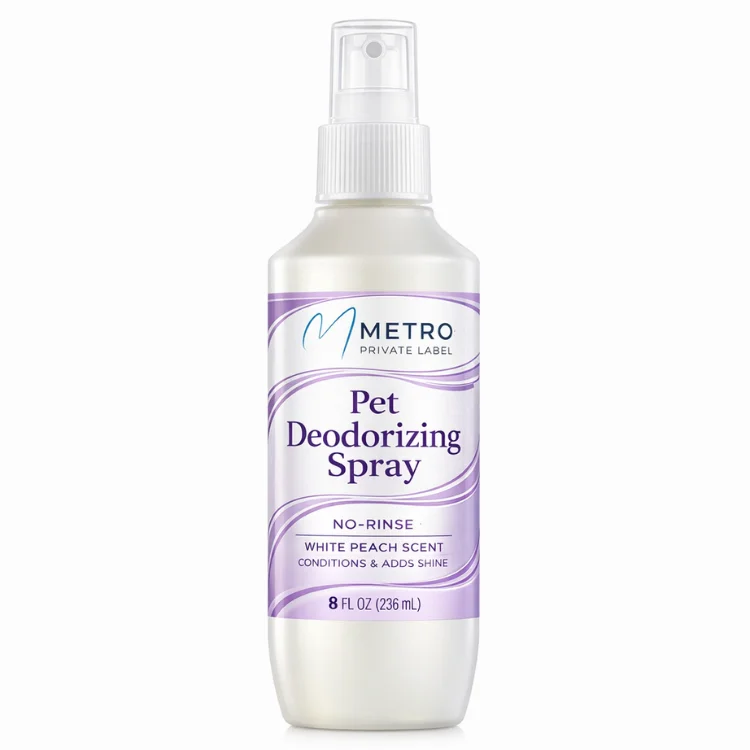
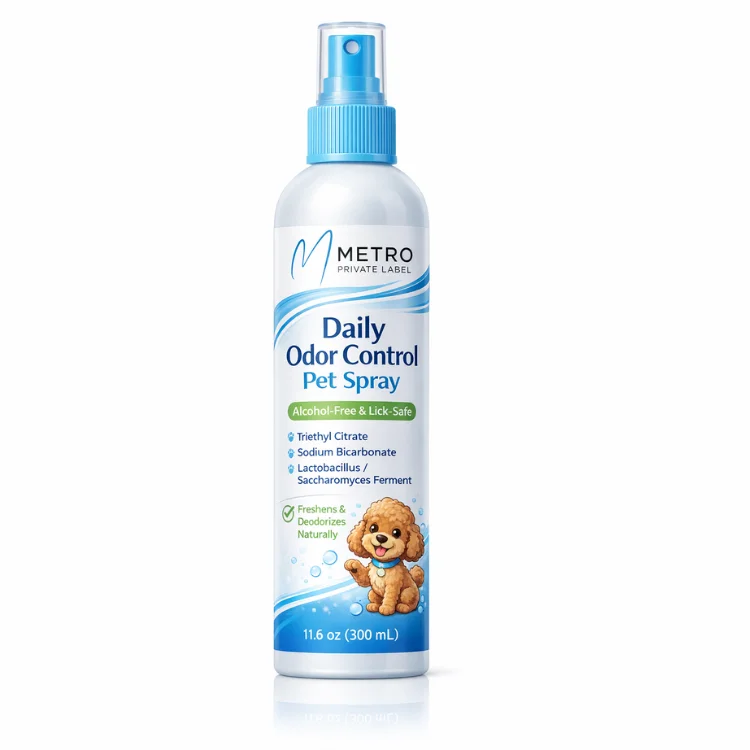
Get Your Custom Skincare Solution Today!

Don’t wait—fill out the form and let our team create the perfect skincare solution for your brand. Expect a personalized quote within 24 hours and start building your brand’s success now!

Submit Your
Private Label Skin Care Request

Fill out this form with your detailed needs and our customer support team will contact you shortly. We will assign a professional agent to follow up on your project and provide personalized assistance.

To get the fastest response, submit your inquiries using the form. If you encounter any issues with submission, you can also email us directly at info@metroprivatelabel.com .

*Metro Private Label takes your privacy very seriously. All information is only used for technical and commercial communication and will not be disclosed to third parties.
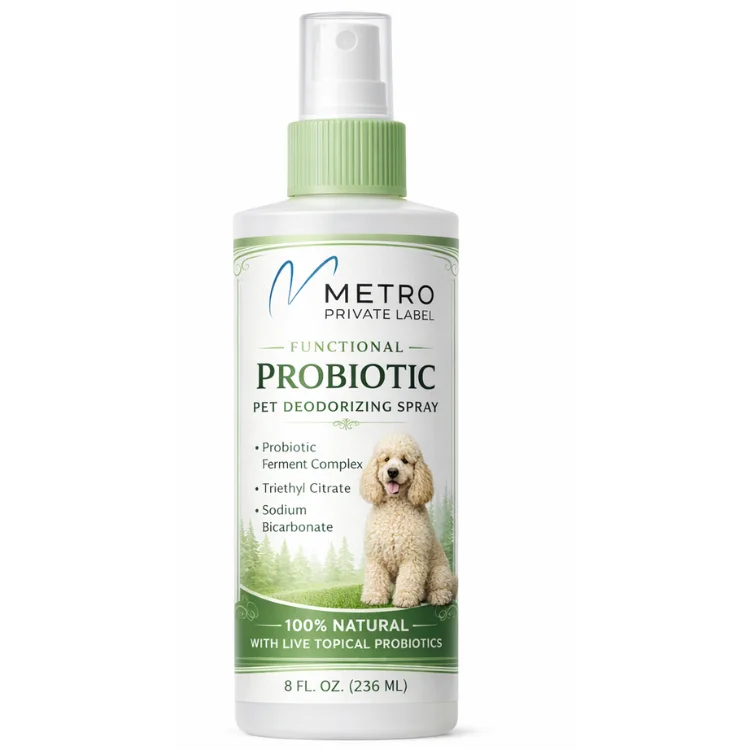
Submit Your
Private Label Skin Care Request

Fill out this form with your detailed needs and our customer support team will contact you shortly. We will assign a professional agent to follow up on your project and provide personalized assistance.

To get the fastest response, submit your inquiries using the form. If you encounter any issues with submission, you can also email us directly at info@metroprivatelabel.com .

*Metro Private Label takes your privacy very seriously. All information is only used for technical and commercial communication and will not be disclosed to third parties.