Your Trusted Anti-Aging Skincare Product Manufacturer
We help skincare brands develop market-ready products with reliable formulations, professional packaging, and scalable manufacturing support—so you can launch confidently and grow your product line with a stable supply chain.

Private Label Anti-Aging Skincare
At Metro Private Label, we understand that anti-aging skincare is not just about adding retinol or peptides into a formula. It is about helping your brand create products that customers can clearly understand, trust, and repurchase. That’s why we build our private label anti-aging skincare solutions around real market demand, proven active ingredients, and product formats that already have strong buying intent.
From retinol and retinal serums to peptide firming formulas, anti-aging face creams, night repair creams, wrinkle-correcting treatments, lifting moisturizers, eye creams, and complete anti-aging routine kits, our product range is designed around what today’s shoppers are already searching for on Amazon, Google Shopping, TikTok, and professional skincare channels. We look at top-selling products, ingredient trends, texture preferences, price positioning, and customer reviews, so the products we develop for you are not only manufacturable, but also easier to position and sell.
As your manufacturing partner, we do more than produce skincare products. We help you turn an anti-aging idea into a market-ready SKU. Whether you are an e-commerce brand looking for a fast-launch hero product, a beauty founder building a premium anti-aging line, a distributor needing ready-to-label formulas, or a clinic owner creating professional home-care products, we can support the formula, packaging, compliance documents, and production process behind your launch.

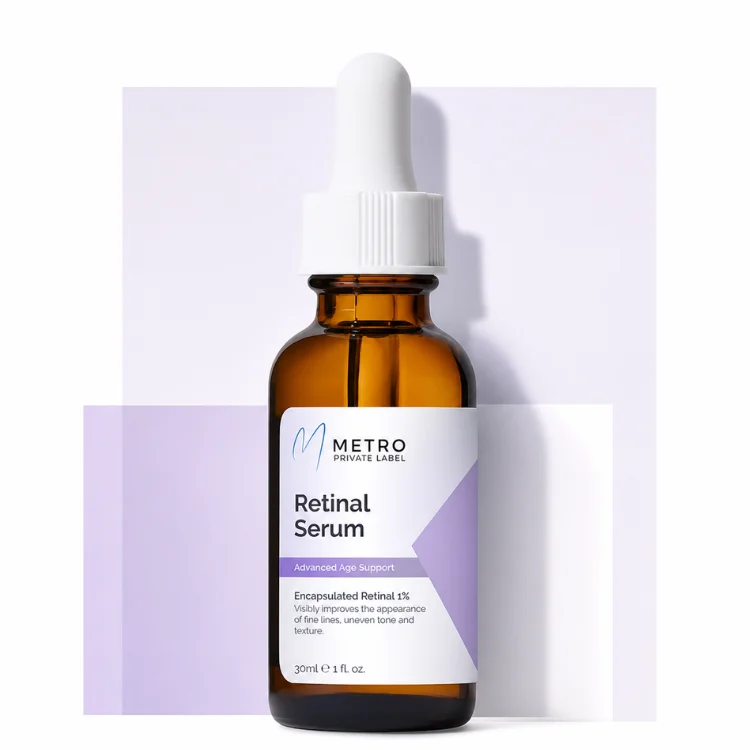
Retinol / Retinal Serum
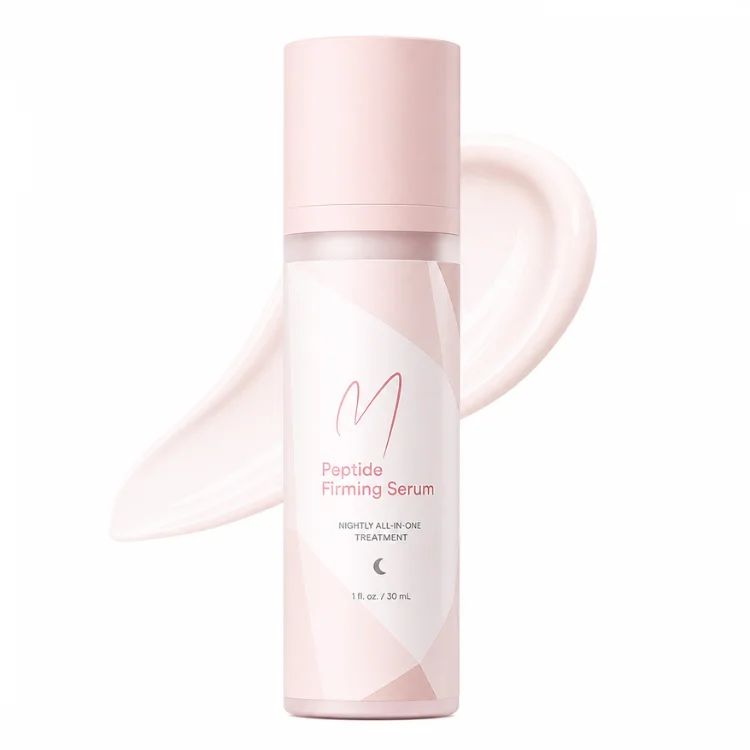
Peptide Firming Serum
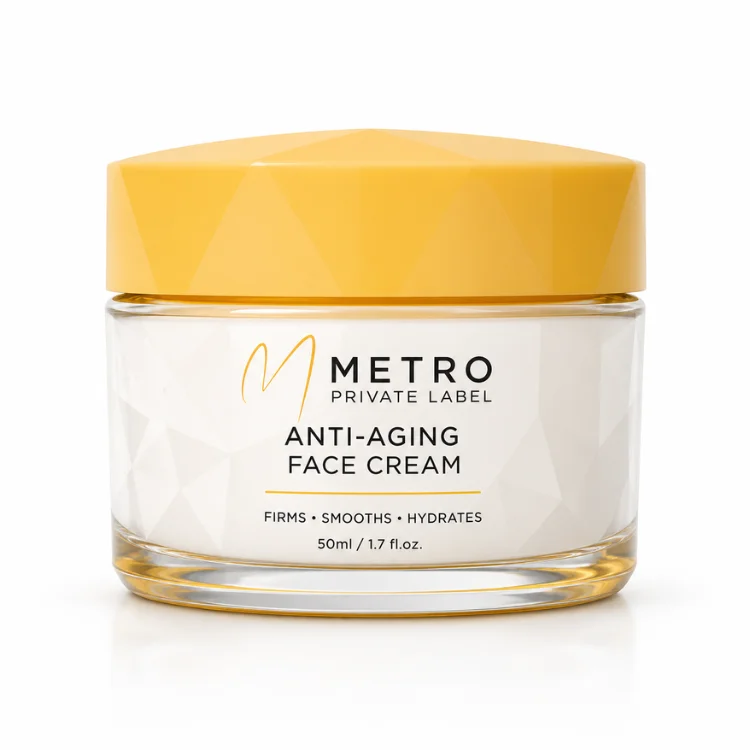
Anti-Aging Face Cream
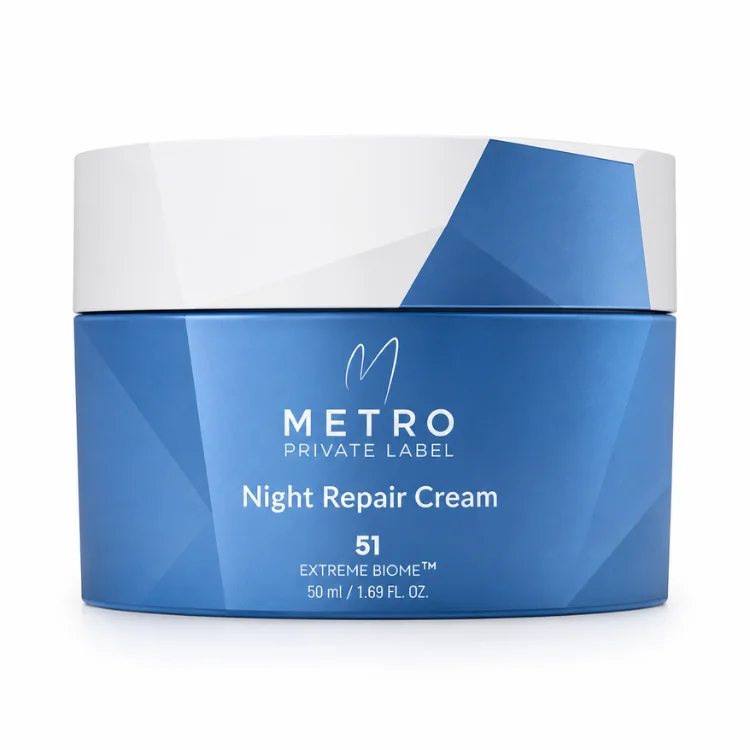
Night Repair Cream
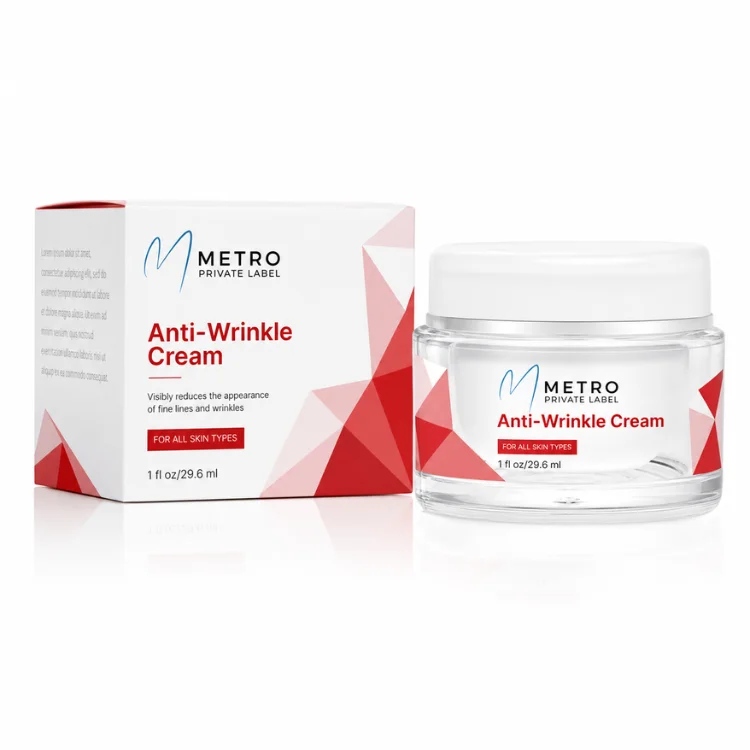
Anti-Wrinkle Cream
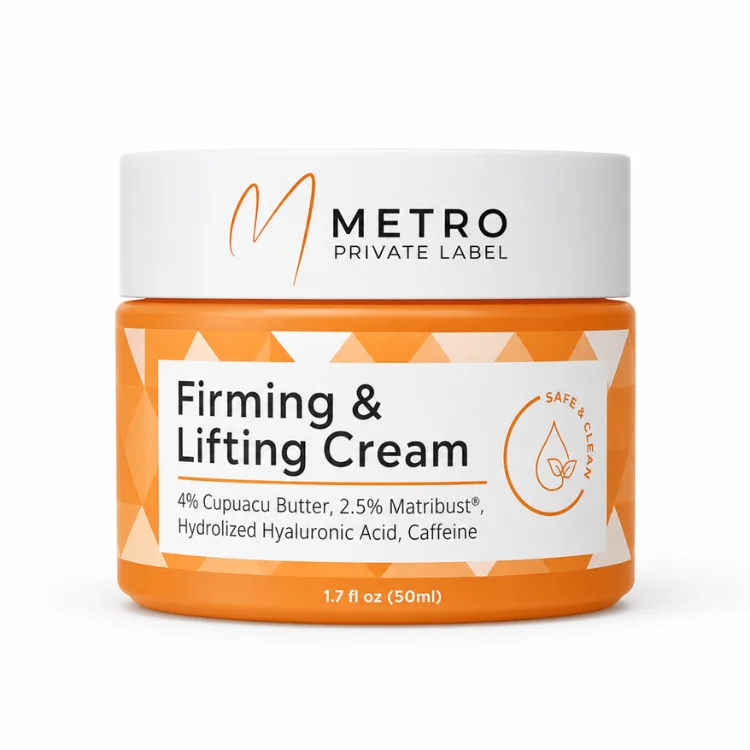
Firming & Lifting Cream
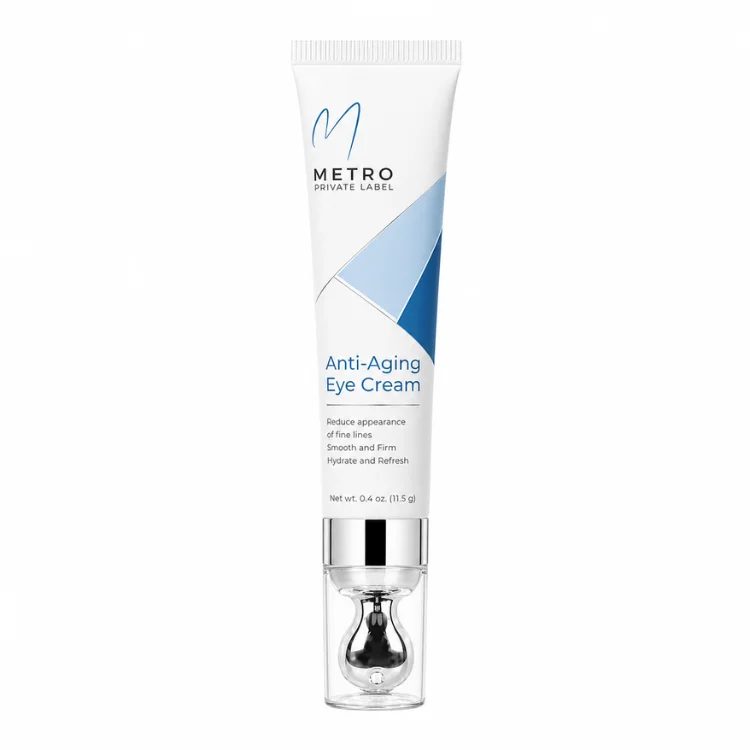
Anti-Aging Eye Cream
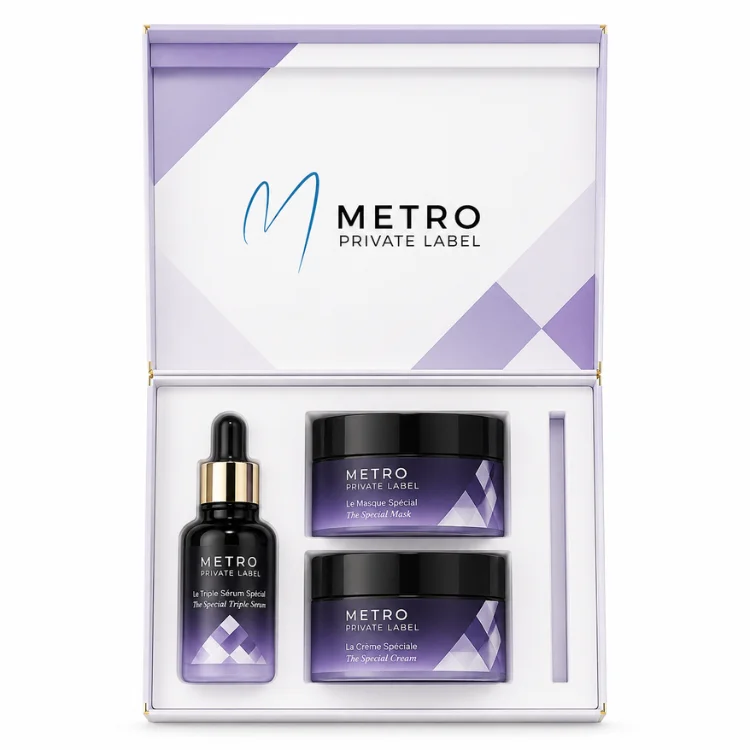
Anti-Aging Skincare Set / Routine Kit
Build a Private Label Anti-Aging Skincare Line That Actually Sells
At Metro Private Label, we don’t see anti-aging skincare as just another product category. We see it as one of the most competitive and commercially valuable areas in skincare, where the right product can become a long-term hero SKU, and the wrong product can quickly disappear in a crowded market.
In this category, a product only works when the formula, texture, packaging, and positioning match how your customers actually buy and use anti-aging skincare. That’s why we don’t approach private label anti-aging skincare as generic OEM production. We help you define the right product direction based on your sales channel and target audience.
Whether you are launching a retinol serum for Amazon, a peptide cream for a premium DTC brand, a repair-focused product for clinic customers, or a full anti-aging routine kit for retail, every decision is made around how the product will sell—not just how it looks on paper.
Our 8 Core Private Label Anti-Aging Skincare Types
Retinol / Retinal Serum: A strong entry product for anti-aging brands. It is built around skin renewal, fine lines, wrinkles, and night-care routines, making it ideal for Amazon, Shopify, and TikTok-driven launches.
Peptide Firming Serum: A premium serum direction focused on firmness, elasticity, and “collagen support” positioning. It works well for brands that want a gentler anti-aging story beyond retinol.
Anti-Aging Face Cream: The core daily-use SKU in most anti-aging lines. It supports hydration, barrier care, and long-term repeat purchases, making it suitable for both e-commerce and retail channels.
Night Repair Cream: Designed for overnight recovery and renewal. This type fits strong anti-aging search intent because customers often connect night care with visible skin repair.
Anti-Wrinkle Treatment Cream: A problem-solution product focused on fine lines and wrinkles. It is easier for customers to understand because the benefit is direct and specific.
Firming & Lifting Cream: A higher-value product direction built around visible firmness, lifting, and sculpting claims. It is especially suitable for mature-skin positioning and premium skincare lines.
Anti-Aging Eye Cream: A key add-on SKU for fine lines, puffiness, and dark circles. It works well in bundles and helps increase average order value.
Anti-Aging Skincare Set / Routine Kit: A full routine solution that may include serum, cream, eye cream, and night treatment. This is ideal for DTC brands, clinics, and distributors who want to sell a complete system rather than one product.
MOQ & Production Strategy Built for Real Anti-Aging Launches
We also believe it is important to be transparent about how anti-aging skincare production actually works. This category is closely connected to active ingredients, texture stability, packaging compatibility, and customer expectations.
Our standard MOQ usually starts from 1,000 units per SKU when using stock packaging. This gives brands a realistic starting point for a real market launch, without forcing them into an overly large first order.
For clients who are already selling through Amazon, Shopify, TikTok Shop, clinics, or retail channels, this quantity is usually enough to support a proper product launch, collect customer feedback, and plan the next restock.
If you are planning to scale, we can also help you structure production in stages—from first launch batch to repeat orders and larger production runs—so your supply chain stays stable as your sales grow.
Our goal is not just to give you an MOQ number. We help you build an anti-aging skincare production plan that fits your budget, your sales channel, and your timeline.

More Than Just a Private Label Anti-Aging Skincare Manufacturer
At Metro Private Label, we don’t just produce anti-aging skincare—we help you create products customers actually want to use again. In this category, success isn’t about having a product. It’s about delivering visible results, clear positioning, and a user experience that builds trust and repeat purchases.

Built Around What Already Sells
We don’t ask you to guess what might work. We guide you toward anti-aging products customers already recognize and search for, such as retinol serums, peptide formulas, repair creams, eye treatments, and routine kits. These are proven categories across Amazon, DTC brands, and retail, making your positioning easier and more effective.

Designed for Real Market Launch
Anti-aging skincare production is shaped by more than just formula—it depends on packaging, pricing, and realistic order size. Our typical starting point is around 1,000 units per SKU, allowing you to launch a structured product, not just samples, while keeping your initial investment manageable and commercially practical.
Consistency That Protects Your Reviews
In anti-aging skincare, customers notice small differences. If texture, absorption, or performance changes between batches, reviews drop quickly. We focus on keeping every production run consistent, from formula stability to packaging compatibility, so your customers get the same experience every time and your product can scale with confidence.
Support That Helps You Move Faster
We know your goal is not just to develop a product, but to launch and sell it. That’s why we support formula direction, packaging coordination, labeling guidance, and production planning. Instead of managing factory details, you can stay focused on your sales channel and move forward with more speed and clarity.
✨ Build a Private Label Anti-Aging Skincare Line That Performs in the Real Market
When you work with Metro Private Label, you’re not just choosing a manufacturer—you’re working with a team that understands how anti-aging products perform after launch. Success isn’t about complex formulas. It’s about visible results, texture, and whether customers trust it enough to repurchase.
Anti-aging skincare is highly experience-driven. Customers notice how a serum absorbs, how a cream feels, and whether results are clear over time. If the product feels too heavy, too weak, or inconsistent, customers won’t complain—they simply won’t come back for a second purchase.
Whether you’re launching a retinol serum for e-commerce, a peptide cream for premium positioning, a repair product for clinics, or a full routine kit, we build every project around real usage. Texture, absorption, stability, and packaging all directly impact performance—and we help you get these right early.
🧪 Formulation Built for Real Product Experience
We don’t rely on generic formulas. Every anti-aging product we develop is designed around real use—how it feels during application, how it absorbs, and how it performs across different skin types and environments. This ensures your product delivers a consistent and realistic customer experience.
From balancing active ingredients like retinol and peptides to adjusting texture and absorption, we focus on performance, not just claims. We also ensure stability across batches, so your product performs the same way every time, helping you build trust and long-term repeat usage.
📦 Packaging & MOQ That Match Real Launch Needs
Anti-aging skincare production is closely linked to packaging, positioning, and realistic order size. Our typical starting point is around 1,000 units per SKU, allowing you to launch a complete product instead of a small test batch while keeping your investment controlled and commercially practical.
This structure works well for Amazon launches, Shopify brands, clinic retail, and distributors testing new SKUs. From bottle selection to labeling and outer packaging, we help you align everything with your sales channel, so your product arrives safely and supports your pricing strategy.
⚙️ A Clear and Efficient Production Process
We keep the process simple and structured, so you always know what comes next. From initial concept and sampling to packaging confirmation and production scheduling, each step is designed to move your project forward without unnecessary delays or confusion.
This is especially important if you are working with launch timelines, seasonal demand, or fast-moving channels like Amazon or TikTok. Whether you are launching your first product or scaling an existing SKU, we help you stay on track and reduce uncertainty.
🌿 Built for Brands Ready to Launch and Scale
We don’t measure success by production volume—we measure it by how your product performs after launch. That’s why everything we do is built around repeat use, consistent quality, and long-term scalability, not just short-term delivery.
From the first sample to full production, we focus on helping you create anti-aging products that customers keep using and keep buying. With Metro Private Label, your skincare line is not just manufactured—it is built to perform, built to scale, and built to grow with your brand.
FAQs Anti-Aging Skincare
For your convenience, we’ve gathered the most commonly asked questions about our Anti-Aging Skincare. However, should you have any further queries, please don’t hesitate to reach out to us.
1. What types of anti-aging skincare can you manufacture?
We focus on product types that already have strong market demand, including retinol serums, peptide firming serums, anti-aging creams, night repair creams, eye creams, and routine kits. You can choose from proven formulas or develop a custom product that fits your brand positioning and target customers.
2. Can you help us customize the formula for our brand?
Yes, we customize formulas based on your market and positioning. We adjust active ingredients, texture, absorption, and skin feel to match your target audience. Whether you want a lightweight serum or a rich cream, we help you build a product that fits your concept and sells clearly.
3. What is your minimum order quantity (MOQ)?
Our standard MOQ starts at around 1,000 units per SKU when using stock packaging. This allows you to launch a real product, not just samples, while keeping your initial investment manageable. We can also suggest options to help you start lean and scale as your sales grow.
4. How long does it take from sampling to production?
Sampling usually takes around 7–14 working days, depending on formula complexity. Production typically takes 4–6 weeks after final confirmation. If you have a specific launch timeline, we can help you plan the process more efficiently and avoid unnecessary delays.
5. Can you provide compliance documents for Amazon or EU markets?
Yes, we support basic compliance requirements such as INCI lists, MSDS, COA, and labeling guidance. For EU or UK markets, we can also coordinate with partners for CPSR and notification support. Our goal is to help you reduce compliance risks and launch with confidence.
6. Do you offer ready-made formulas or only custom development?
We offer both. You can start with our ready-to-use formulas for faster launch and lower cost, or develop a custom formula for stronger differentiation. We will guide you based on your timeline, budget, and whether your focus is speed or long-term brand positioning.
7. Can you help with packaging and labeling?
Yes, we support bottle sourcing, label sizing, and packaging coordination. We help you choose packaging that fits your channel, whether it is Amazon, DTC, clinic retail, or distribution. Our goal is to make sure your product looks right and performs well in real use.
8. How do you ensure product quality and consistency?
We focus on consistency across every batch, including formula stability, texture, and packaging compatibility. This is especially important for anti-aging skincare, where customers notice small differences. Our process helps you maintain product quality, protect reviews, and support long-term growth.
9. Can you help us build a full anti-aging product line?
Yes, we can help you plan from a single SKU to a complete product system. For example, starting with a serum, then expanding into creams, eye products, and sets. We focus on building a structure that supports repeat purchases and makes your brand easier to scale.
10. Do you work with international clients and ship globally?
Yes, we work with brands worldwide. We support export documentation, packaging requirements, and shipping coordination. Whether you are selling in the US, EU, or other markets, we help you manage the process so your products arrive safely and meet your local requirements.
What stood out to us was how quickly Metro Private Label understood our product direction. We needed a retinol serum that could compete in a crowded market, and they helped us refine the texture, packaging, and positioning. The entire process felt structured, and we were able to launch on schedule.
Emily Carter, E-commerce Brand Ownerfrom United Kingdom
We already had a clear concept for our anti-aging line, but we needed a factory that could execute it properly. Metro Private Label helped us translate our ideas into a stable, high-quality formula. Communication was efficient, and the final product matched both our expectations and our pricing strategy.
Lucas Martin, Founderfrom France
We were looking to create a professional anti-aging product for our clinic clients, and Metro Private Label made the process much easier than expected. They guided us through formulation, packaging, and compliance, so we could focus on our treatments. Our customers have responded very positively to the results.
Sophie Dubois, Clinic Ownerfrom Australia
What impressed us most was how practical their approach is. Instead of overcomplicating the formula, they focused on what would actually work for our customers. From sampling to production, everything was handled professionally, and the product has performed well in our online channel.
Olivia Thompson, Product Managerfrom United States
What we appreciated most was their ability to translate our ideas into something practical. We had a clear concept, but Metro Private Label helped refine the formula, packaging, and positioning so everything worked together. The final sheet mask line feels cohesive and ready for long-term growth, not just a one-off launch.
Hannah Schneider, Product Managerfrom Germany






Metro Private Label in Numbers
Happy Clients
0 +
Million-dollar Buyers
0 +
Formulation
0 +
Professional Staffs
0 +
Your Ultimate Guide to Anti-Aging Skincare
If you’re planning to build or expand an anti-aging skincare line—whether it’s your first product or a new addition to an existing range—you’re not just choosing another category. You’re entering one of the most competitive yet scalable segments in skincare. Anti-aging products have strong and consistent demand because they address visible concerns that customers are actively searching for. When positioned correctly, they don’t just generate initial sales—they become part of long-term routines, driving repeat purchases and stable growth rather than one-time transactions.
Over the years, we’ve seen anti-aging skincare evolve from simple “wrinkle care” into a much broader category shaped by different product directions such as retinol, peptides, barrier repair, and multi-step routines. What makes this category challenging is not demand, but execution. From our experience at Metro Private Label, brands succeed when they align formula logic, texture experience, packaging functionality, pricing strategy, and compliance requirements from the beginning. Anti-aging products may appear straightforward on the surface, but the difference between products that scale and those that stall usually comes down to how these elements work together in real use.
This guide is built from what we’ve learned working across different anti-aging product types, sales channels, and market conditions. Instead of focusing only on ingredients or trends, we want to share how these products actually perform once they reach customers. Decisions such as choosing the right product format for your channel, balancing visible results with daily usability, selecting packaging that protects both formula and user experience, planning production quantities that match your sales speed, and preparing compliance documentation early all play a role in whether your product becomes a long-term seller or simply another short-lived launch.
Table of Contents
How to Choose the Right Anti-Aging Product Type for Your Business Model
When I look at anti-aging skincare from a business perspective, I never start with ingredients or trends. I start with one practical question: where will this product actually be sold, and how will customers experience it? Over time, I’ve seen that the success of a product is rarely decided by how advanced the formula is, but by how well the product type fits the business model behind it. When that alignment is clear, everything becomes easier—positioning, pricing, and even repeat purchase behavior.
Understanding Why Product Type Is a Strategic Decision
I’ve learned that choosing a product type is not a creative decision—it’s a structural one. A serum, a cream, or a routine kit is not just a format; it defines how the product is perceived, how it is used, and how often it is repurchased. If I choose the wrong format, I am not just making a small adjustment later—I am creating friction across the entire business, from marketing to inventory planning.
What often gets overlooked is that customers don’t evaluate products in isolation. They compare them within familiar categories. If the product type fits into something they already understand, such as a retinol serum or a firming cream, the decision becomes faster and more intuitive. If it doesn’t, the product requires more explanation, which directly affects conversion.
E-commerce Brands: Designing for Speed, Clarity, and Conversion
When I analyze e-commerce channels, especially Amazon or Shopify, I notice that customer attention is extremely limited. People are not reading deeply—they are scanning. This is why product types like serums and creams consistently outperform more complex formats. They communicate purpose instantly, and that clarity reduces hesitation.
In this environment, I always think about how quickly the customer can answer three questions: what is this, what does it do, and is it relevant to me? A retinol serum answers all three within seconds. A vague or overly complex product does not. This is why simple, benefit-driven formats tend to convert better and scale faster in digital channels.
Clinics and Aesthetic Channels: Building Around Function and Trust
When I shift my perspective to clinics or aesthetic environments, the priorities change completely. The product is no longer competing for attention—it is supporting a professional service. In this context, I focus less on marketing language and more on how the product performs in a controlled, repeat-use environment.
Here, the product must integrate into an existing treatment flow. It needs to feel reliable, predictable, and safe across different skin conditions. I’ve noticed that in these settings, consistency matters more than innovation. A product that behaves the same way every time builds trust, while even small inconsistencies can quickly undermine it.
Distributors and Retail Buyers: Thinking in Terms of Movement and Repeatability
When I consider distributors or retail buyers, I approach product selection differently again. Their focus is not on storytelling or differentiation at the beginning—it is on whether the product can move. They are thinking in terms of shelf performance, reorder cycles, and how easily a product can be understood by a wide audience.
From my experience, products that are too complex or too niche tend to slow things down. On the other hand, clearly positioned products with familiar formats tend to move faster, because they reduce the need for explanation at the point of sale. This is why simplicity, in this case, is not a limitation—it is an advantage.
How Product Type Influences Pricing and Perceived Value
One thing I always pay attention to is how product type shapes pricing expectations. Customers do not evaluate price in isolation—they compare it within a category. A serum can often justify a higher price point because it is perceived as concentrated and targeted, while a cream is expected to deliver daily value over time.
If the product type and pricing are misaligned, it creates confusion. I’ve seen products struggle not because they were overpriced, but because they were positioned in the wrong category for that price level. Choosing the right format early helps avoid this mismatch and creates a more natural pricing structure.
Why Getting the Format Right Early Changes Everything
Looking back at different projects, I’ve noticed a clear pattern: when the product type is chosen correctly from the beginning, the entire process becomes more efficient. Marketing becomes clearer, customer feedback is easier to interpret, and scaling decisions feel more structured.
On the other hand, when the format is wrong, everything becomes reactive. Adjustments need to be made after launch, messaging becomes unclear, and growth slows down. This is why I see product type selection not as a small step, but as one of the most important strategic decisions in building an anti-aging skincare line.
Retinol vs Peptides: Understanding Two Core Anti-Aging Directions
When I evaluate anti-aging skincare from a business and product perspective, I rarely treat retinol and peptides as simple ingredient choices. In my experience, they represent two fundamentally different directions in how a product is positioned, how it is experienced, and how customers decide to trust it. Choosing between them is not just about formulation—it is about defining the role your product will play in a customer’s routine and in your overall product strategy.
Why Retinol Became the Standard for Visible Transformation
When I think about retinol, I immediately associate it with transformation. Over the years, it has become one of the most recognized ingredients in anti-aging, largely because it is directly linked to visible outcomes such as smoother texture, reduced fine lines, and improved skin tone. This strong association gives retinol products a clear advantage in communication, especially in competitive environments where attention is limited.
However, I’ve also learned that this strength comes with complexity. Retinol is not a passive ingredient. It requires careful handling in formulation, clear guidance in usage, and realistic expectation-setting. Customers often expect fast results, but they may also experience dryness or irritation if the product is not balanced properly. This means that every retinol-based product carries both opportunity and responsibility in how it is introduced and supported.
The Practical Challenges Behind Retinol-Based Products
From my perspective, one of the most overlooked aspects of retinol products is how much they depend on user experience over time. The first impression matters, but the second and third uses are what determine whether a customer continues. If the product feels too harsh, too unstable, or inconsistent, it quickly loses trust, even if the initial results seem promising.
This is why I see retinol as a direction that requires precision. It is not just about including the ingredient, but about controlling its behavior within the formula, the packaging, and the usage routine. When all these elements are aligned, retinol can become a powerful driver of perceived effectiveness and premium positioning.
Why Peptides Represent a Different Philosophy
When I shift my focus to peptides, the entire approach feels different. Instead of aiming for immediate transformation, peptide-based products are built around gradual improvement and long-term skin support. This creates a more stable and predictable experience, which is often easier for customers to integrate into their daily routines.
What stands out to me is how peptides allow for a more comfortable entry into anti-aging. There is less concern about irritation, and the messaging tends to feel more reassuring. This makes peptide-based products particularly effective for customers who are cautious, sensitive, or just beginning to explore anti-aging solutions.
How Peptides Shape Brand Perception
From a brand perspective, I’ve noticed that peptides often create a more approachable and flexible identity. They can be positioned as premium, but without the intensity that comes with stronger actives. This allows brands to build a sense of trust and consistency over time, rather than relying on bold claims.
In many cases, this leads to stronger long-term relationships with customers. A product that feels comfortable and reliable is more likely to be used consistently, and consistency is what ultimately drives repeat purchases. This is why peptide-based products often play a key role in building sustainable product lines.
Matching Ingredient Direction with Target Audience
Whenever I need to decide between retinol and peptides, I always return to the target audience. If the audience is experienced, results-driven, and willing to accept a more active routine, retinol naturally becomes the stronger choice. It aligns with their expectations and gives them a clear sense of progress.
On the other hand, if the audience values comfort, safety, and ease of use, peptides provide a better fit. They reduce friction in the decision-making process and make the product feel more accessible. I’ve found that this alignment between product behavior and customer mindset is one of the most important factors in long-term success.
Pricing, Positioning, and Perceived Value
Another aspect I pay close attention to is how these two directions influence pricing. Retinol products are often perceived as high-performance treatments, which allows them to justify a more focused, results-driven pricing structure. Customers expect to pay for effectiveness, but they also expect that effectiveness to be delivered clearly.
Peptide-based products, in contrast, rely more on overall experience and quality perception. Texture, absorption, and comfort play a larger role in how value is judged. If the product feels refined and consistent, customers are more likely to accept the price, even if the results are more gradual.
Building a Clear and Scalable Product Direction
Looking at the bigger picture, I’ve learned that the most important decision is not which ingredient to use, but which direction to commit to. Retinol represents a more direct, performance-focused approach, while peptides represent a more balanced, long-term strategy. Both can be effective, but they serve different purposes.
From a business standpoint, clarity is more important than complexity. When the direction is clear, it becomes much easier to expand into additional products, maintain consistent messaging, and build a recognizable identity. This is what ultimately allows an anti-aging line to grow beyond a single product and become a structured, scalable system.
What Makes an Anti-Aging Product Commercially Viable
When I assess whether an anti-aging product will succeed commercially, I rarely start with the ingredient list. Over time, I’ve realized that commercial viability is not defined by how advanced a formula looks, but by how well it translates into a clear, repeatable user experience. A product becomes viable when customers understand it quickly, feel it immediately, and trust it enough to come back to it again.
Why Ingredient Lists Rarely Reflect Real Market Performance
One of the most common mistakes I see is overestimating the value of complex ingredient combinations. On paper, a formula may look impressive, filled with trending actives and high percentages, but that does not guarantee it will perform in the hands of a real user. Customers do not evaluate formulas the way developers do. They are not comparing ingredient lists—they are reacting to how the product feels and whether it delivers a result they can recognize.
In many cases, I’ve seen simpler formulas outperform more complex ones because they are easier to understand and more consistent in performance. This has led me to believe that the real challenge is not adding more ingredients, but making sure every component contributes to a clear and reliable experience.
Texture as the First Point of Judgment
Before any long-term anti-aging benefit becomes visible, texture already shapes the customer’s opinion. I always pay close attention to how a product spreads across the skin, how it feels during application, and how it settles afterward. These details may seem small, but they form the first impression, and that impression is difficult to change.
If a product feels too heavy, too greasy, or overly sticky, it creates hesitation. Even if the formula is effective, the user may not continue using it long enough to see results. On the other hand, a well-balanced texture encourages consistency, and consistency is what ultimately allows the product to prove its value.
Absorption and After-Feel Define Daily Usability
Beyond texture, I focus heavily on absorption and what I often refer to as the “after-feel.” This is the moment after the product has settled, when the user decides whether it fits comfortably into their routine.
If the product absorbs cleanly and leaves the skin feeling smooth and balanced, it signals quality. If it leaves residue, tightness, or discomfort, it introduces friction into daily use. I’ve found that this stage is where many products lose their potential, because even minor discomfort can discourage long-term use.
Clarity of Benefit as a Conversion Driver
Another factor I always analyze is how clearly the product communicates its benefit. Customers rarely spend time decoding multiple claims or technical descriptions. They are looking for a simple, direct answer to what the product will do for them.
If the positioning is too broad or too abstract, it becomes difficult for the product to stand out. I’ve seen products fail not because they lacked effectiveness, but because the benefit was not communicated in a way that felt immediate and relevant. Clear positioning reduces hesitation and makes the decision process faster.
The Risk of Mismatch Between Formula and Expectation
From my experience, many commercially unsuccessful products suffer from a mismatch between what they promise and what they deliver. A product may claim strong anti-aging results but feel too mild, or it may contain powerful actives but feel too harsh for regular use.
This misalignment creates confusion and disappointment. Customers may try the product once, but without a consistent and satisfying experience, they are unlikely to return. Over time, this leads to weak retention, which is one of the biggest barriers to scaling a product.
Why Repeat Purchase Is the Real Measure of Success
When I evaluate a product’s long-term viability, I focus less on the first sale and more on what happens afterward. A commercially viable product is one that fits naturally into a routine and delivers a reliable experience over time.
Repeat purchase is not driven by claims—it is driven by consistency. If the product feels right, performs predictably, and aligns with customer expectations, it becomes part of daily use. This is what transforms a product from a one-time purchase into a stable revenue driver.
Aligning Experience, Positioning, and Performance
Looking at the bigger picture, I’ve come to see commercial viability as a result of alignment. The formula, texture, absorption, and positioning must all point in the same direction. If any one of these elements is out of place, it creates friction that affects the entire product experience.
When everything is aligned, the product becomes easier to understand, easier to use, and easier to trust. This alignment is what allows a product to move beyond initial interest and become something that customers rely on consistently.
A Practical Perspective on Building Viable Products
From a practical standpoint, I always approach anti-aging product development with the user experience in mind. Instead of asking how strong or advanced a formula is, I ask how it will feel, how it will be used, and how easily the customer can recognize its value.
This shift in perspective changes the way decisions are made. It leads to products that are not only technically sound, but also commercially realistic. In my experience, this is what ultimately determines whether a product remains a concept or becomes something that can truly scale in the market.
How to Structure an Anti-Aging Product Line for Growth
When I think about building an anti-aging skincare line, I don’t approach it as a product list. I approach it as a system that needs to evolve over time. Growth in this category rarely comes from launching many products at once. It comes from building a clear structure where each product has a purpose, and each addition strengthens the overall line rather than diluting it.
Why Starting with Fewer SKUs Creates More Clarity
In the early stages, I’ve often seen brands make the mistake of trying to cover too many concerns at once. The result is usually a collection of products that lack focus and are difficult for customers to understand. When I structure a product line, I prefer to begin with one or two core SKUs that clearly define what the brand stands for.
This initial simplicity creates clarity not only for the customer, but also for internal decision-making. It becomes easier to refine positioning, adjust pricing, and understand what is working. Instead of managing multiple variables at once, the brand can concentrate on building momentum around a strong foundation.
The Strategic Role of a Serum as an Entry Point
When I look at high-performing anti-aging brands, I often notice that the serum plays a central role in attracting new customers. Serums are typically associated with targeted benefits, which makes them easier to communicate and more appealing in competitive environments.
From my perspective, the serum is often the first interaction a customer has with the brand. It sets expectations for performance, texture, and overall experience. Because of this, the serum should not only deliver visible benefits but also feel distinctive enough to leave a strong impression. This is what creates interest and encourages further exploration of the product line.
Why Creams Build Routine and Long-Term Value
After the initial entry point, I always consider how the product line fits into daily routines. This is where creams become essential. Unlike serums, which are often used for targeted concerns, creams are used consistently, often twice a day.
I’ve found that this consistency is what builds familiarity and trust. A well-formulated cream that feels comfortable and reliable becomes part of the customer’s daily habit. Over time, this repeated use strengthens the relationship with the brand and increases the likelihood of repeat purchases. In many cases, the cream becomes the product that sustains long-term revenue.
Supporting Products That Expand the Experience
Once the core routine is established, I see supporting products as a way to deepen the customer’s engagement. These products, such as eye creams or night treatments, address more specific concerns and extend the functionality of the line.
What I’ve observed is that these additions work best when they feel like a natural extension of the existing products. Instead of introducing something completely different, they should enhance what is already working. This creates a more cohesive experience and makes it easier for customers to adopt multiple products without confusion.
How Product Structure Influences Customer Behavior
One of the most valuable insights I’ve gained is how strongly product structure influences purchasing behavior. When products are clearly connected and easy to understand as a system, customers are more likely to adopt more than one item.
If the structure feels fragmented, customers tend to make isolated purchases and stop there. But when the relationship between products is clear, it encourages progression from one step to the next. This progression not only increases overall value per customer, but also strengthens brand loyalty over time.
Gradual Expansion as a Controlled Growth Strategy
In my experience, the most effective product lines grow gradually rather than all at once. Each new SKU is introduced with a clear purpose, often based on what customers are already using and what they are likely to need next.
This approach allows the brand to stay responsive to real demand instead of relying on assumptions. It also reduces risk, because each addition is supported by existing performance data. Over time, this creates a more stable and scalable product line that evolves with the market rather than trying to predict it entirely in advance.
Aligning Product Line Structure with Pricing Strategy
Another aspect I always consider is how the structure of the product line supports pricing. Different product types naturally carry different perceived values. A serum may be positioned as a high-performance item, while a cream represents daily reliability, and a supporting product adds incremental value.
When these roles are clearly defined, pricing becomes easier to justify. Customers understand why each product exists and how it fits into their routine. This alignment between structure and pricing helps reduce hesitation and creates a more consistent purchasing experience.
Building a System That Supports Long-Term Growth
When I step back and look at the bigger picture, I see that the goal is not to build a collection of products, but a system that customers can rely on. Each product should contribute to a larger structure that feels logical and complete.
From my perspective, this is what allows an anti-aging skincare line to grow sustainably. When the system is clear, customers know where to start, how to expand, and why to continue. This clarity transforms individual products into a cohesive experience, which is ultimately what drives long-term growth.
MOQ Planning: Balancing Risk and Scalability
When I approach minimum order quantity, I don’t treat it as a fixed rule set by a factory. I treat it as a strategic lever that shapes how a product enters the market and how safely it can grow. In anti-aging skincare, where positioning, pricing, and customer expectations are tightly connected, MOQ decisions often determine whether a launch feels controlled or pressured from the very beginning.
Why MOQ Should Be Treated as a Business Decision
In many early-stage projects, I notice that MOQ is viewed as a constraint that needs to be negotiated down. Over time, I’ve learned that this mindset can be limiting. MOQ is not just about how many units need to be produced—it reflects how the entire supply chain is structured, from sourcing to production efficiency.
When I treat MOQ as a business decision, I begin to evaluate how it fits into the broader strategy. I consider how much inventory the business can realistically manage, how quickly it can be converted into sales, and how much flexibility is needed after launch. This approach allows MOQ to become part of planning, rather than something that disrupts it.
Testing the Market Without Overcommitting
In situations where the product is new or the market response is uncertain, I often lean toward a more cautious starting point. A smaller initial order allows room to observe how the product behaves once it reaches customers. This includes not only sales performance, but also feedback related to texture, packaging, and perceived value.
What I find valuable in this stage is the ability to make adjustments. If the product needs refinement or repositioning, it is much easier to do so when inventory levels are manageable. While the cost per unit may be higher at this stage, the reduction in overall risk often justifies the decision.
Understanding the Economics Behind Larger Orders
At the same time, I recognize that larger production volumes offer clear advantages. As quantities increase, manufacturing becomes more efficient, and the cost per unit decreases. This can create stronger margins and more competitive pricing in the market.
However, I’ve seen that these advantages only become meaningful when the product has consistent demand. If the product does not move at the expected pace, the benefits of lower cost are quickly overshadowed by the burden of excess inventory. This is why I always evaluate cost efficiency in relation to sales velocity, rather than in isolation.
Matching Order Size to Real Sales Behavior
One of the most practical ways I approach MOQ planning is by estimating how the product will move once it is launched. I try to understand whether the sales cycle will be fast and continuous or slower and more gradual. This assessment influences how comfortable I feel with a larger or smaller order.
When sales are expected to be fast, a larger order can support momentum and reduce the risk of stock interruptions. When demand is less predictable, a smaller order provides flexibility and reduces pressure. Aligning order size with expected sales behavior helps create a more balanced and manageable launch.
The Influence of Distribution Channels on MOQ
Another factor I always consider is the nature of the distribution channel. Different channels operate with different rhythms and expectations. E-commerce platforms often require quicker replenishment cycles, while distributors may work with larger, less frequent orders. Clinics may generate steady but moderate demand over time.
Understanding these patterns helps me decide how much inventory is appropriate. If the order size does not match the channel’s behavior, it can lead to inefficiencies, either through overstocking or through frequent shortages. In my experience, aligning MOQ with channel dynamics is essential for smooth operations.
Managing Cash Flow and Operational Flexibility
MOQ decisions are closely tied to cash flow. Larger orders require more capital upfront, which can limit flexibility in other areas such as marketing or product development. Smaller orders preserve liquidity but may increase production costs.
I’ve found that the goal is not to minimize cost at all times, but to maintain a balance between efficiency and flexibility. Having room to respond to market feedback, adjust strategy, or invest in growth often provides more long-term value than achieving the lowest possible unit cost from the start.
Planning for Growth Through Staged Orders
Instead of trying to determine the perfect order size from the beginning, I often think in terms of stages. The first order serves as a test, the second as a refinement, and later orders as a scaling phase. This gradual approach allows decisions to be based on real performance rather than assumptions.
As data becomes available, it becomes easier to adjust quantities with confidence. This reduces uncertainty and creates a more structured path toward growth. In many cases, this staged strategy proves more sustainable than attempting to optimize everything in a single step.
Building a Supply Strategy That Can Adapt Over Time
When I look at MOQ planning from a broader perspective, I see it as part of building a resilient supply strategy. The objective is not to find a single ideal number, but to create a system that can adapt as the business evolves.
A flexible approach to MOQ allows for adjustments without disrupting operations. It supports both cautious market entry and confident scaling when demand becomes clear. In my experience, this adaptability is what enables a product to transition from an initial launch to a stable and growing presence in the market.
Packaging Choices That Affect Customer Experience and Reviews
When I evaluate anti-aging skincare, I’ve learned that packaging is not something that sits outside the product—it actively shapes how the product performs in real life. A formula may be well-developed in a lab, but once it reaches the customer, packaging becomes the interface between the product and daily use. This is where many hidden issues either appear or are successfully prevented.
Why Packaging Directly Impacts Product Performance
Over time, I’ve realized that packaging is not only about protecting the product physically, but also about maintaining its intended function. Anti-aging formulas often contain active ingredients that are sensitive to air, light, or contamination. If the packaging does not control these exposures properly, the product can gradually lose effectiveness before the customer even finishes using it.
From my perspective, this makes packaging part of the formulation system rather than a separate layer. A well-chosen container helps preserve stability, consistency, and performance across the entire usage cycle.
The Real Cost of Poor Packaging Decisions
In many cases I’ve observed, packaging problems are not immediately visible during development or sampling. They tend to appear after shipping, storage, or repeated use. Leakage during transit, pump failure, or contamination from repeated opening can quickly turn into customer dissatisfaction.
What stands out to me is how quickly these issues affect perception. Customers rarely separate packaging from the product itself. If something goes wrong, they do not analyze the cause—they simply conclude that the product is unreliable. This is why packaging mistakes often have a much greater impact than expected.
How Daily Usability Shapes Customer Experience
When I consider packaging choices, I always think about how the product will be used in a real routine. Anti-aging skincare is not a one-time experience—it is used consistently over weeks or months. This means that even small inconveniences become more noticeable over time.
If a dropper dispenses unevenly, if a pump requires too much force, or if the product is difficult to control, it creates friction in daily use. On the other hand, packaging that feels smooth, predictable, and easy to handle encourages consistency. In my experience, this ease of use is one of the key factors behind long-term customer satisfaction.
Choosing Formats That Protect Sensitive Formulas
For anti-aging products, I often focus on packaging types that minimize exposure and maintain stability. Airless pump systems, for example, reduce contact with air and help preserve ingredients that degrade over time. Dropper bottles allow for controlled dosing, which is especially useful for concentrated serums.
I’ve found that sealed and stable containers play an important role in maintaining performance from the first use to the last. When the product behaves consistently throughout its lifecycle, it reinforces trust and reduces the likelihood of negative feedback.
Packaging and Its Influence on Perceived Quality
Another aspect I pay close attention to is how packaging influences perception. Before customers evaluate the formula, they interact with the container. The weight, texture, and functionality of the packaging all contribute to their initial impression of quality.
In my experience, customers often associate smooth dispensing, secure closure, and clean design with reliability. When packaging feels inconsistent or fragile, it introduces doubt, even if the product itself performs well. This connection between physical experience and perceived value is often underestimated.
The Link Between Packaging, Reviews, and Returns
One of the most practical lessons I’ve learned is how directly packaging affects customer reviews. Issues such as leakage, breakage, or inconsistent dispensing often lead to negative feedback, regardless of the product’s intended performance.
Returns are also strongly influenced by packaging reliability. A product that arrives damaged or does not function as expected creates immediate dissatisfaction. Preventing these issues through thoughtful packaging choices is often far more effective than trying to resolve them after the fact.
Balancing Visual Appeal with Functional Reliability
While visual design plays an important role in attracting attention, I’ve found that it should never compromise usability. Packaging that looks premium but performs poorly can quickly lead to frustration. On the other hand, packaging that balances aesthetics with functionality creates a more complete and satisfying experience.
This balance is especially important in anti-aging skincare, where customers expect both effectiveness and refinement. The packaging should support the product’s purpose while also reinforcing its positioning in the market.
Packaging as a Long-Term Driver of Product Success
When I step back and look at packaging decisions over time, I see them as long-term investments rather than short-term choices. The right packaging supports product stability, enhances usability, and strengthens customer confidence.
In my experience, these factors directly influence repeat purchases, brand trust, and overall product performance in the market. Packaging is not just about presentation—it is a critical part of how a product succeeds after it leaves the production stage.
Understanding Basic Compliance Requirements in Key Markets
When I think about anti-aging skincare from a global business perspective, compliance is one of the first areas I take seriously, not the last. Over time, I’ve seen that many delays, listing issues, and even failed launches are not caused by the product itself, but by gaps in regulatory preparation. Compliance, in my view, is not just about meeting rules—it is about ensuring the product can move smoothly from production to real market presence.
Why Compliance Shapes Market Entry More Than Expected
In many early-stage projects, compliance is treated as something to “handle later,” once the product is ready. From my experience, this approach often creates unnecessary pressure. Regulatory requirements influence how a product is labeled, described, packaged, and even how it is positioned in the market.
What I’ve learned is that compliance is deeply connected to how a product is introduced. If these elements are not aligned early, adjustments later can become time-consuming and costly. This is why I always see compliance as part of the initial planning process rather than a final step.
Ingredient Labeling (INCI) as a Universal Standard
One of the most fundamental elements I focus on is the ingredient list. The INCI system is the global standard for naming cosmetic ingredients, and it plays a critical role in how products are reviewed and approved across different regions.
From my perspective, accuracy and consistency here are essential. A properly structured INCI list not only ensures regulatory acceptance, but also supports transparency. Customers, platforms, and regulators all rely on this information, and even small inconsistencies can create complications.
Safety Documentation and Its Practical Importance
Beyond labeling, safety documentation forms the backbone of compliance. Documents such as safety data sheets, certificates of analysis, and stability-related records provide the necessary evidence that a product is safe for use.
What stands out to me is how often these documents are requested at different stages, not just by regulators but also by distributors and online platforms. Having them prepared early creates a smoother process and reduces the risk of interruptions when moving toward sales.
Packaging Compliance and Labeling Requirements
Packaging is another area where compliance plays a more important role than many expect. Information such as net content, usage instructions, warnings, batch numbers, and manufacturer details must be presented clearly and correctly.
In my experience, small labeling errors can have a large impact. A missing detail or incorrect format may require relabeling or even delay shipments. This is why I always treat packaging compliance as part of product design, not something to adjust at the last moment.
Understanding Differences Between Key Markets
When I look at different regions, I notice that compliance is not a one-size-fits-all process. Each market has its own expectations and level of strictness. European markets, for example, often require more structured documentation and formal notification processes.
The United States tends to focus more on labeling accuracy and safety responsibility, but platform requirements can still be demanding. Recognizing these differences early helps avoid unnecessary delays and allows for better planning when entering multiple markets.
The Growing Influence of E-commerce Platforms
One of the most significant changes I’ve observed is the increasing role of platforms such as Amazon. In many cases, these platforms enforce their own requirements that go beyond basic regulations.
From my experience, anti-aging skincare products are often subject to closer scrutiny because of their claims and ingredient profiles. Platforms may request documentation to verify product safety, labeling accuracy, and claim support. Preparing for these requirements early helps avoid listing delays or removals.
Why Early Preparation Reduces Risk
Looking back at different projects, I’ve found that the timing of compliance preparation makes a significant difference. When documentation and labeling are addressed early, the transition from production to market becomes much more predictable.
If compliance is left until the final stage, it often leads to rushed adjustments, increased costs, and potential delays. Early preparation creates flexibility and allows for smoother coordination between production, packaging, and distribution.
Compliance as a Foundation for Scalable Growth
When I step back and consider the bigger picture, I see compliance as more than a requirement—it is a foundation for scalability. A product that meets regulatory and platform expectations from the beginning can move across markets more easily and expand without constant rework.
In my experience, this consistency is what supports long-term growth. It allows the focus to remain on product performance and market development, rather than on resolving avoidable issues. Compliance, when handled properly, becomes an advantage rather than a limitation.
How Clinics Integrate Anti-Aging Products Into Treatment Systems
When I look at how clinics use anti-aging skincare, I immediately notice that the logic is very different from retail or e-commerce. In a clinic setting, products are not designed to stand alone or compete for attention. They are built into a structured treatment system, where every product has a defined role, and every step contributes to a controlled outcome.
Why Anti-Aging Products Are Not Standalone in Clinics
In my experience, clinics rarely introduce a product without context. Every recommendation is tied to a treatment, a skin condition, or a long-term plan. This means the product is not judged by how attractive it looks on its own, but by how well it supports a specific result within a broader system.
This approach changes how products are selected. Instead of asking whether a product is popular or trending, the question becomes whether it fits into a treatment sequence. If it does not align with that sequence, it becomes difficult to use consistently, regardless of its formulation quality.
Supporting Procedures Instead of Replacing Them
One of the most important roles I see for anti-aging skincare in clinics is supporting professional procedures. Treatments such as resurfacing, microneedling, or other advanced interventions often create controlled changes in the skin. The products that follow are expected to stabilize and extend these results.
From my perspective, this is where product design becomes highly specific. The goal is not to replicate the effect of the procedure, but to protect and maintain it. A well-integrated product works quietly in the background, reinforcing what has already been achieved rather than trying to compete with it.
The Critical Role of Post-Treatment Recovery
Recovery is one of the most sensitive phases in any treatment system, and I’ve found that product selection during this stage requires careful consideration. After many procedures, the skin becomes more reactive, which means that even small formulation details can have a noticeable impact.
In this phase, I focus on products that feel predictable and controlled. Texture, absorption, and tolerance become more important than strong claims. A product that supports recovery without introducing additional stress helps maintain the integrity of the treatment process and reduces the risk of negative reactions.
Transitioning from Recovery to Maintenance
Once the initial recovery phase is complete, I often see the system shift toward maintenance. This is where anti-aging products begin to play a more visible role in the client’s daily routine. The objective is no longer just to protect the skin, but to sustain the improvements that have already been achieved.
From my experience, this transition needs to feel natural. The products should integrate smoothly into everyday use, without requiring significant adjustments. When this transition is handled well, it creates continuity between the clinic experience and at-home care, which strengthens long-term results.
Structuring Products Around Treatment Phases
When I analyze well-functioning clinic systems, I notice that products are typically organized around clear phases. There is a preparation phase, where the skin is conditioned before treatment, a recovery phase, where stability is prioritized, and a maintenance phase, where results are extended.
This structure simplifies decision-making for both practitioners and clients. Each product has a clear purpose, and its role within the system is easy to understand. From my perspective, this clarity is essential for ensuring that products are used correctly and consistently.
How System-Based Thinking Influences Customer Behavior
One of the most interesting patterns I’ve observed is how a structured system changes the way clients engage with products. When products are introduced as part of a complete routine, clients are more likely to follow through with multiple steps rather than selecting a single item.
This creates a more cohesive experience, where each product reinforces the others. Over time, this approach not only improves results but also increases the likelihood of repeat purchases, as the routine becomes part of the client’s ongoing care.
Building Trust Through Consistency and Predictability
In a clinical environment, trust is closely linked to consistency. Clients expect the same level of performance every time they use a product, especially when it is connected to a professional treatment. Any variation in texture, absorption, or effect can quickly affect confidence.
From my experience, products that behave consistently across different uses and conditions help reinforce both the treatment and the overall system. This reliability becomes a key factor in maintaining long-term client relationships.
Viewing Anti-Aging Skincare as a Long-Term System
When I step back and look at the bigger picture, I see that clinics do not treat anti-aging skincare as individual products. They treat it as a long-term system designed to support skin health over time. Each product contributes to a sequence that begins with treatment and continues through maintenance.
This system-based approach creates a more controlled and predictable experience. It aligns product use with treatment goals and ensures that every step has a purpose. In my experience, this is what allows clinics to achieve consistent results and build lasting trust with their clients.
Ready Formula vs Custom Development: A Practical Comparison
When I compare ready-made formulas with custom development, I don’t see a “better” option. I see two different paths that solve different business problems. One prioritizes speed and efficiency, while the other prioritizes control and differentiation. The key is not choosing what sounds more advanced, but choosing what fits the current stage and direction of the business.
Why Ready Formulas Accelerate Market Entry
In many projects I’ve reviewed, the biggest challenge is not creating a formula, but getting to market at the right time. This is where ready-made formulas become extremely practical. They already have a structure, stability profile, and a proven usage experience, which removes a large part of the development timeline.
From my perspective, this allows brands to shift their focus earlier toward positioning, packaging, and sales execution. Instead of spending months refining a formula, the product can move into real market testing much faster. This speed often creates an advantage, especially in fast-moving channels where timing directly affects performance.
The Real Financial Impact of Choosing Ready Formulas
Another aspect I always consider is how each path affects resource allocation. Custom development is not just a one-time cost—it involves multiple rounds of testing, revisions, and adjustments. Each step adds time and expense, which can quickly accumulate.
With ready-made formulas, much of this process is already completed. This reduces upfront investment and allows resources to be directed toward areas that directly influence sales, such as branding, advertising, and distribution. In many cases, this balance creates a more stable starting point for a new product.
Why Custom Development Creates Stronger Differentiation
When I shift my focus to long-term brand building, I start to see the value of custom development more clearly. A custom formula allows for precise control over how a product feels, performs, and is perceived. This level of control can help create a distinct identity that is harder to replicate.
From my experience, differentiation is not just about using different ingredients. It is about shaping the entire product experience, from texture and absorption to how the product fits into a routine. Custom development provides the flexibility to refine these details in a way that aligns closely with a brand’s vision.
The Hidden Complexity Behind Custom Formulas
However, I’ve also learned that custom development is rarely as straightforward as it appears. Each adjustment in formulation can affect stability, texture, and overall performance. This creates a process that requires careful testing and iteration.
In practice, this means that timelines are longer and decisions need to be more deliberate. Without a clear direction, the process can become inefficient, with multiple revisions that do not necessarily improve the final outcome. This is why I see clarity of concept as essential before entering custom development.
How Time Influences the Decision
Time is one of the most important factors I consider when choosing between these two paths. If the goal is to launch quickly and start generating feedback, ready-made formulas provide a clear advantage. They allow the product to reach the market and begin building data that can inform future decisions.
If the timeline allows for deeper development, custom formulas can create a stronger foundation for long-term positioning. The additional time invested can result in a product that feels more refined and aligned with the brand’s identity.
Aligning the Decision with Business Stage
In my experience, the stage of the business often determines which approach makes more sense. For early-stage brands, the priority is usually validation. They need to understand whether the product concept works and how customers respond. In this case, speed and flexibility are more valuable than perfect differentiation.
For more established brands, the focus often shifts toward strengthening identity and expanding the product line. At this stage, custom development can provide the depth needed to stand out and maintain consistency across multiple SKUs.
Managing Risk Through a Balanced Approach
One approach I’ve found effective is to view these options as complementary rather than mutually exclusive. A brand may begin with ready-made formulas to establish presence and gather insights, then move into custom development as it grows.
This allows risk to be managed more effectively. The initial phase provides real market feedback, while later development builds on that foundation with more targeted refinement. Over time, this creates a product line that is both practical and differentiated.
Thinking Beyond the Formula Itself
When I step back and look at the broader picture, I realize that the decision is not only about formulation. It is about how the product fits into a larger system that includes branding, pricing, and customer expectations.
A ready-made formula can still feel unique if it is positioned correctly, while a custom formula can struggle if it lacks clear direction. This is why I always consider how the formula choice interacts with the rest of the business strategy.
Choosing Based on Direction, Not Preference
In the end, I’ve learned that the most effective decisions come from clarity rather than preference. The question is not which option sounds better, but which one aligns with the current priorities of the business.
When the decision is made with a clear understanding of goals, resources, and timeline, both ready-made and custom approaches can lead to successful outcomes. The difference lies in how well the choice supports the path the brand is trying to build.
Common Mistakes When Launching Anti-Aging Skincare
When I look back at anti-aging skincare projects that failed to gain traction, I rarely see a problem with effort or intention. Most of the time, the issue comes from a disconnect between how the product was designed and how it is actually experienced by customers. In this category, success is not determined by how advanced a formula looks, but by how clearly it fits into real use and real expectations.
Why Overcomplicated Formulas Create More Problems Than Value
One of the most common patterns I notice is the tendency to overbuild the formula. It often starts with a good intention—to include multiple active ingredients, to cover more benefits, or to create something that feels “complete.” But in practice, this often leads to a product that is difficult to position and even harder to understand.
From my experience, customers do not evaluate complexity as value. They look for clarity. When too many ingredients are combined without a clear hierarchy, the message becomes diluted. The product may sound impressive, but it becomes difficult for the customer to answer a simple question: what is this product really for?
The Hidden Risk of Unclear Product Positioning
Another mistake I frequently encounter is vague or overly broad positioning. A product may claim to hydrate, firm, brighten, repair, and protect all at once, but this often weakens its impact rather than strengthening it.
In real market conditions, customers are not comparing every detail. They are scanning quickly and looking for something that matches a specific need. When the positioning is not focused, the product fails to connect, even if it is technically well-developed. I’ve seen many strong formulas struggle simply because they could not communicate a clear purpose.
Pricing That Does Not Match Perception
Pricing is another area where small misalignments can create significant resistance. I’ve seen products priced at a premium level without delivering a matching experience, and I’ve also seen products priced too low, which unintentionally signals lower quality.
What I’ve learned is that pricing is not just a financial decision—it is part of the product’s communication. It tells the customer what to expect. If the price and the experience do not align, it creates hesitation. Customers may question whether the product is worth trying, even before they experience it.
Unrealistic Expectations and Their Long-Term Impact
In anti-aging skincare, expectations are often shaped by bold claims. While these claims can attract attention initially, they can also create a gap between expectation and reality. I’ve seen products that generate strong initial interest but fail to retain customers because the experience does not match the promise.
From my perspective, managing expectations is a critical part of building trust. A product that delivers consistent, realistic results over time often performs better than one that promises dramatic changes but cannot sustain them. Trust is built through reliability, not exaggeration.
The Problem of Not Defining a Clear Audience
Another issue I often observe is the absence of a clearly defined audience. When a product is designed for “everyone,” it lacks direction. Decisions around texture, absorption, and positioning become less focused because there is no specific user in mind.
In my experience, clarity about the target audience simplifies everything. It shapes how the product feels, how it is used, and how it is communicated. Without this clarity, the product may function well, but it struggles to connect with any particular group of customers.
Why Strong Formulas Still Fail in the Market
One of the most important lessons I’ve learned is that a technically sound formula does not guarantee success. Stability, ingredient quality, and formulation balance are essential, but they are not enough on their own.
Customers do not evaluate products based on technical specifications. They evaluate based on experience. If the product feels too heavy, absorbs poorly, or does not deliver a noticeable benefit, it will not be used consistently. Without consistent use, even the best formula cannot demonstrate its value.
The Role of Experience in Driving Repeat Purchases
When I analyze successful products, I notice that they are designed around repeat use. The texture feels right, the application is easy, and the benefit is clear enough to recognize over time. This creates a positive cycle where the customer continues using the product and becomes more confident in it.
In contrast, products that create friction—whether through confusing messaging, inconsistent texture, or unrealistic expectations—struggle to build this cycle. Without repeat use, the product cannot sustain growth, regardless of its initial appeal.
Why Simplicity Often Outperforms Complexity
One of the most consistent insights I’ve gained is that simplicity tends to perform better in real market conditions. This does not mean the product is basic or lacking in innovation. It means that every element is aligned toward a clear purpose.
A simple, well-positioned product is easier to communicate, easier to understand, and easier to integrate into a routine. This clarity reduces hesitation and makes it more likely that customers will try and continue using the product.
Building Products That Work Beyond the Concept Stage
When I step back and look at these common mistakes, I see a pattern. Many products are designed to look good in development, but not enough attention is given to how they will perform after launch.
From my perspective, the goal is to build products that translate smoothly from concept to real use. This means aligning formulation, positioning, pricing, and user experience from the beginning. When these elements work together, the product becomes more than just an idea—it becomes something that can actually succeed in the market.
Why Partner with Metro Private Label for Your Anti-Aging Skincare Line
When we work with brands entering the anti-aging skincare category, we always start by resetting one key expectation. Anti-aging products may look simple on the surface, but in reality, they are one of the most experience-driven categories in skincare. Customers notice how quickly a serum absorbs, how a cream feels over time, and whether they see or feel a difference after consistent use. That’s why we don’t approach this as standard OEM production. We approach it as building a product that needs to perform reliably in real-life routines. When formulation, texture, packaging, and positioning are aligned from the beginning, the result is not just a launch—it’s a product customers continue to use and reorder.
Why We Always Start From the Market, Not Just the Formula
One of the biggest differences in how we work is where we begin. We don’t start by asking what ingredients you want in your anti-aging product. We start by understanding where you plan to sell it and who your customer is. Over time, we’ve seen many technically strong formulas fail because they didn’t match how customers actually evaluate products in their specific channel.
When we work with you, we look closely at your main sales environment. If your focus is Amazon or fast-moving e-commerce, we guide the product toward clear benefits, fast absorption, and easy repeat use. If you are building a DTC brand, we think more about sensory experience, packaging identity, and how the product fits into a lifestyle routine. If your focus is clinics or professional channels, we prioritize safety, consistency, and long-term skin compatibility. By starting from the market instead of the formula, we help you create something that is easier to position, easier to communicate, and easier to sell.
How We Turn a Concept Into a Product Customers Actually Use
Many brands come to us with a strong idea, but anti-aging skincare is one of those categories where execution matters more than the concept itself. Customers don’t evaluate your product by reading technical details. They evaluate it the moment they apply it.
What we focus on is the real user experience. We refine how the product spreads, how quickly it absorbs, how it feels during the day or night, and how the skin feels after consistent use. If a serum feels sticky, if a cream feels too heavy, or if the result is unclear, customers notice immediately and often don’t return. We adjust formulation and texture so the experience feels natural, predictable, and easy to trust. That’s what turns a product from something customers try once into something they keep using.
Why We Build Every Project for Speed, Clarity, and Repeat Production
From our experience, most delays in anti-aging product development are not caused by technical difficulty, but by unclear structure. When decisions are made without a defined sequence, projects slow down and become difficult to manage. That’s why we always build a clear and structured process from the beginning.
We define each stage step by step, from initial direction and sampling to packaging confirmation and production planning. Every step connects logically to the next, so progress feels continuous instead of fragmented. At the same time, we are not only thinking about your first order. We structure everything so your product can be reproduced consistently and scaled without disruption. This means you are not just launching once—you are building something that can grow.
How We Align Formula, Texture, and Packaging Into One System
One of the most common issues we see in anti-aging skincare is misalignment. A formula may be strong, but the texture feels off. The product may be positioned as premium, but the packaging does not support that perception. Customers notice these inconsistencies immediately, even if they cannot explain them.
What we do differently is treat everything as one system. We look at how the formula behaves during use, how the texture feels on the skin, and how the packaging protects and delivers the product. This is not just about appearance—it is about creating a consistent experience from the first use to the last. When everything works together, customers feel more confident, and that confidence directly translates into better reviews and stronger repeat purchases.
Why We Integrate Compliance Early Instead of Fixing It Later
In many projects, compliance is handled at the end, which often leads to delays and last-minute adjustments. We approach it differently by integrating compliance into the process from the beginning.
We consider your target market early, whether it is the United States, the European Union, or other regions, and align ingredient selection, labeling, and documentation accordingly. This ensures that when your product is ready for production, it is also ready for sale. For you, this means fewer surprises, fewer revisions, and a more predictable timeline. It also means your product can move into your sales channel without unnecessary friction.
How We Help You Start at the Right Scale
Anti-aging skincare production is closely tied to both formulation batching and packaging supply, which means extremely low starting quantities are often not practical. We are always transparent about this, because it directly affects cost, consistency, and production stability.
Instead of pushing unrealistic starting points, we help you choose the right scale based on your business model. For most projects, starting around 1,000 units per SKU allows for stable production and a cost structure that supports real market pricing. Our goal is not just to help you start, but to help you start in a way that is operationally and commercially sustainable.
Why We Focus on Long-Term Product Performance
For us, success is not defined by one production run. It is defined by how your product performs after it reaches the market. Anti-aging skincare is built on repeat use, which means consistency over time matters more than short-term impact.
As your brand grows, you may refine your formula, expand your range, or adjust your positioning. We stay aligned with that process, helping you evolve while maintaining consistency. This continuity allows you to build on what works instead of starting over.
How We Help You Build an Anti-Aging Product That Scales
At the end of the day, what we help you create is not just a skincare product. It is a product designed for real-world performance. Every decision we make, from formulation balance to packaging durability, is based on how your customer will actually use it.
We’ve seen how the right structure can turn a simple product into a strong, repeat-driven SKU. When everything is aligned, your product becomes easier to position, easier to sell, and easier to reorder. That is what we focus on when we partner with you—not just helping you launch, but helping you build something that can grow consistently over time.
Ready to Launch Your Skincare Line?
*Metro Private Label takes your privacy very seriously. All information is only used for technical and commercial communication and will not be disclosed to third parties.