Your Trusted Dry Shampoo Sheets Manufacturer
We help skincare brands develop market-ready products with reliable formulations, professional packaging, and scalable manufacturing support—so you can launch confidently and grow your product line with a stable supply chain.

Private Label Dry Shampoo Sheets
At Metro Private Label, we know that developing private label dry shampoo sheets is about more than putting a cleansing formula onto a sheet. What matters is how the product fits your existing hair care range, where customers will use it, and whether it offers a practical alternative to traditional dry shampoo sprays. An Amazon or Shopify brand may want portable, no-rinse shampoo sheets that stand out in a crowded hair care market, while an experienced beauty founder might focus on cooling scalp care or lightweight volumizing products. A distributor may prefer established formulas with convenient retail packaging, while a salon owner might see an opportunity to offer customers an easy way to refresh their hair between washes. That is why we start by understanding your sales channels, target price, product positioning, and expected order quantity before recommending a suitable product direction.
Once we understand your requirements, we focus on the formulation and sheet materials that determine how the product actually performs. We generally explore four product directions: cooling and refreshing, volumizing, smoothing, and fragrance-free dry shampoo sheets. Each requires a different approach. Cooling sheets may use carefully balanced refreshing ingredients to help remove sweat and surface oil, while volumizing versions focus on refreshing oily roots without leaving hair feeling heavy or flat. Smoothing sheets may incorporate lightweight conditioning agents to improve manageability, whereas fragrance-free options prioritize a simple, comfortable cleansing experience without added perfume. We also pay attention to the sheet’s texture, liquid absorption, cleansing performance, fragrance, residue, and scalp comfort. For pre-moistened sheets, preservation, moisture retention, and packaging seal integrity are equally important. A formula that feels good during initial sampling still needs to remain stable, hygienic, and consistent throughout storage, shipping, and everyday use.
For us, the goal is not simply to produce another dry shampoo sheet. We want to help you develop a product that makes commercial sense, fits your customers’ daily routines, and supports long-term sales. That might mean creating compact travel packs for an e-commerce brand, developing a differentiated scalp-refreshing formula for an experienced beauty founder, or preparing practical ready-to-label options for a distributor. We help coordinate the development process, from formula selection and sample evaluation to sheet material assessment, packaging customization, production planning, and relevant technical documentation, including INCI lists, product specifications, and available COA or SDS documentation where applicable. We also consider your target market’s labeling requirements and appropriate cosmetic claims before production. By addressing these details early, we aim to reduce unnecessary revisions, improve product consistency, and help you build a dry shampoo sheet range that customers will want to purchase again.

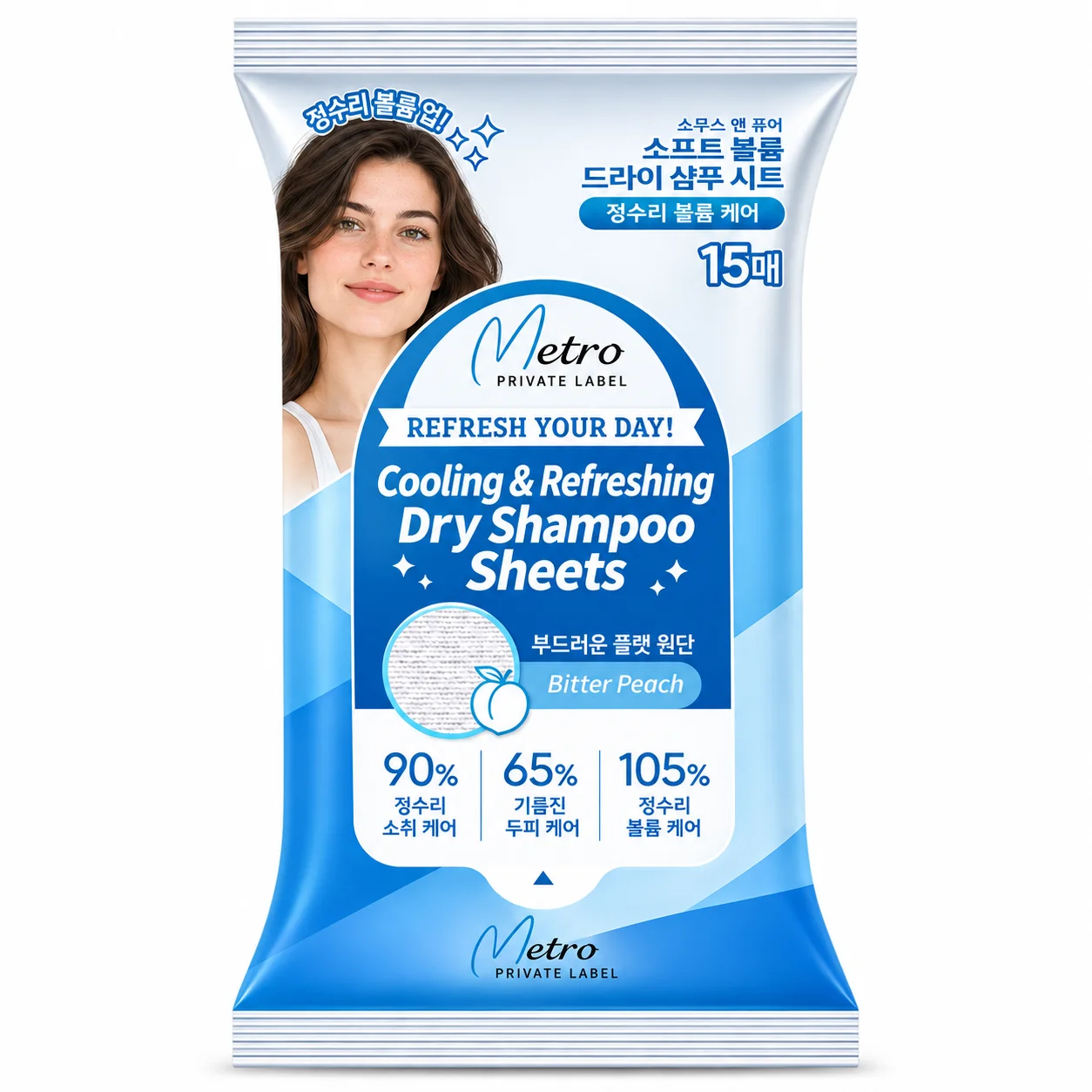
Cooling & Refreshing Dry Shampoo Sheets
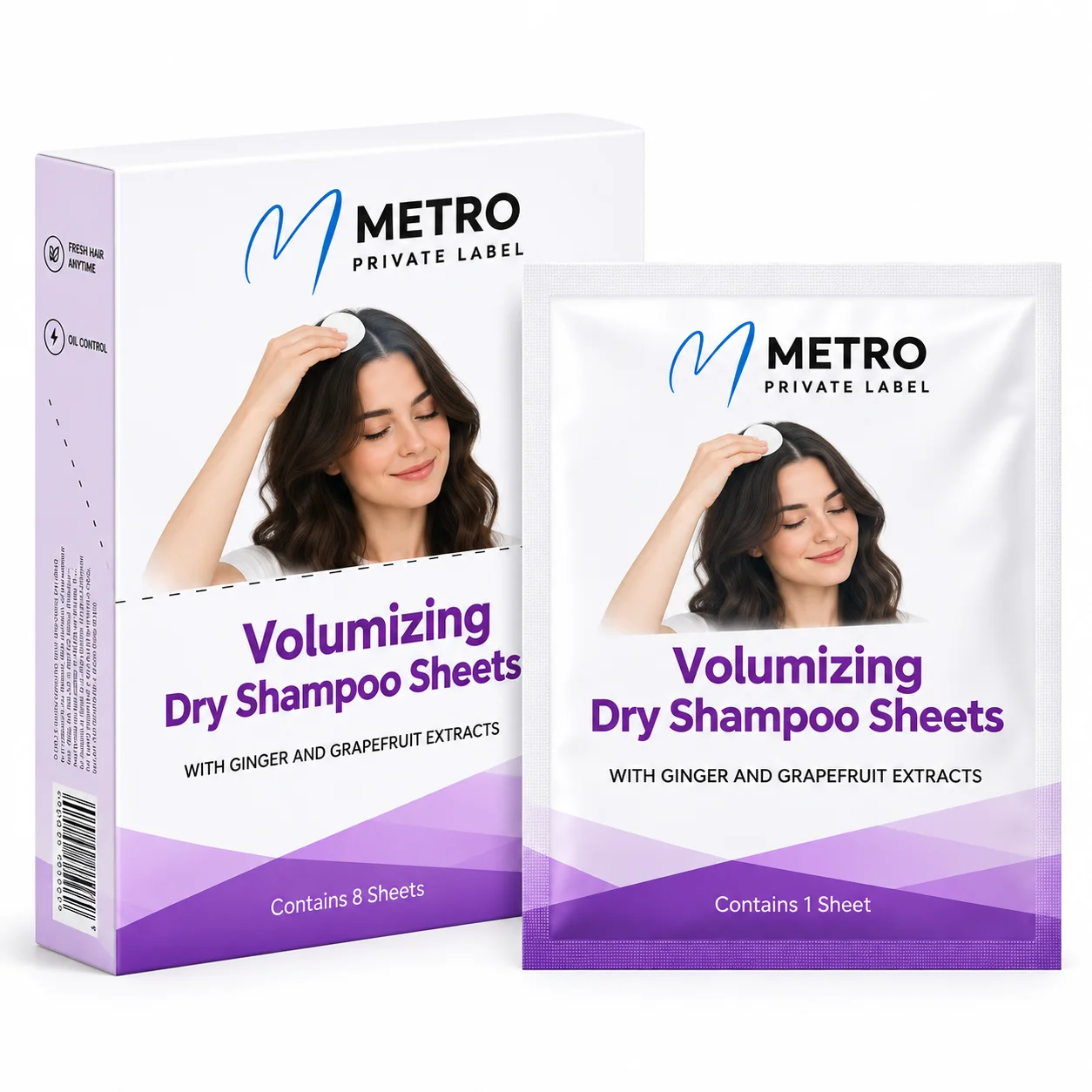
Volumizing Dry Shampoo Sheets
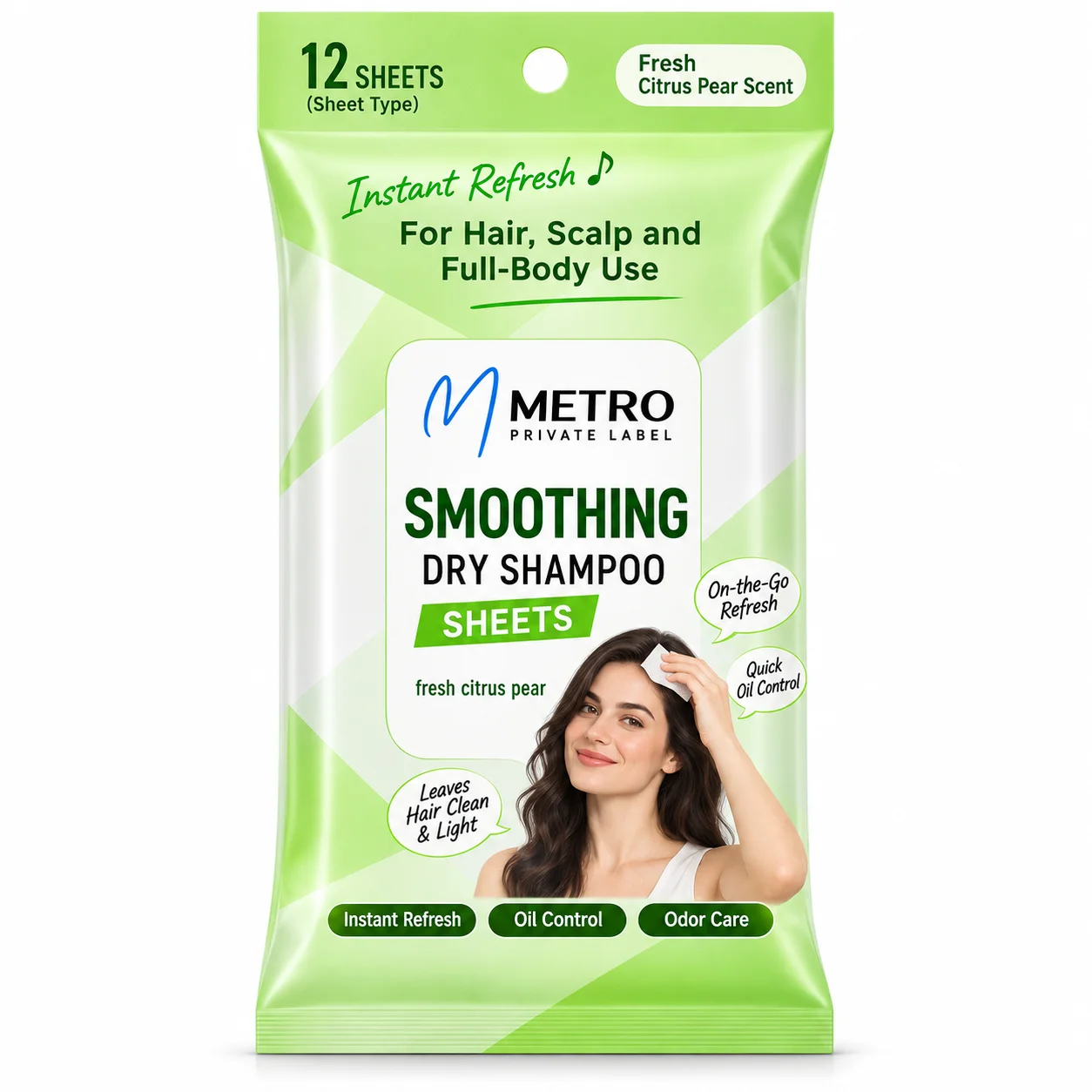
Smoothing Dry Shampoo Sheets
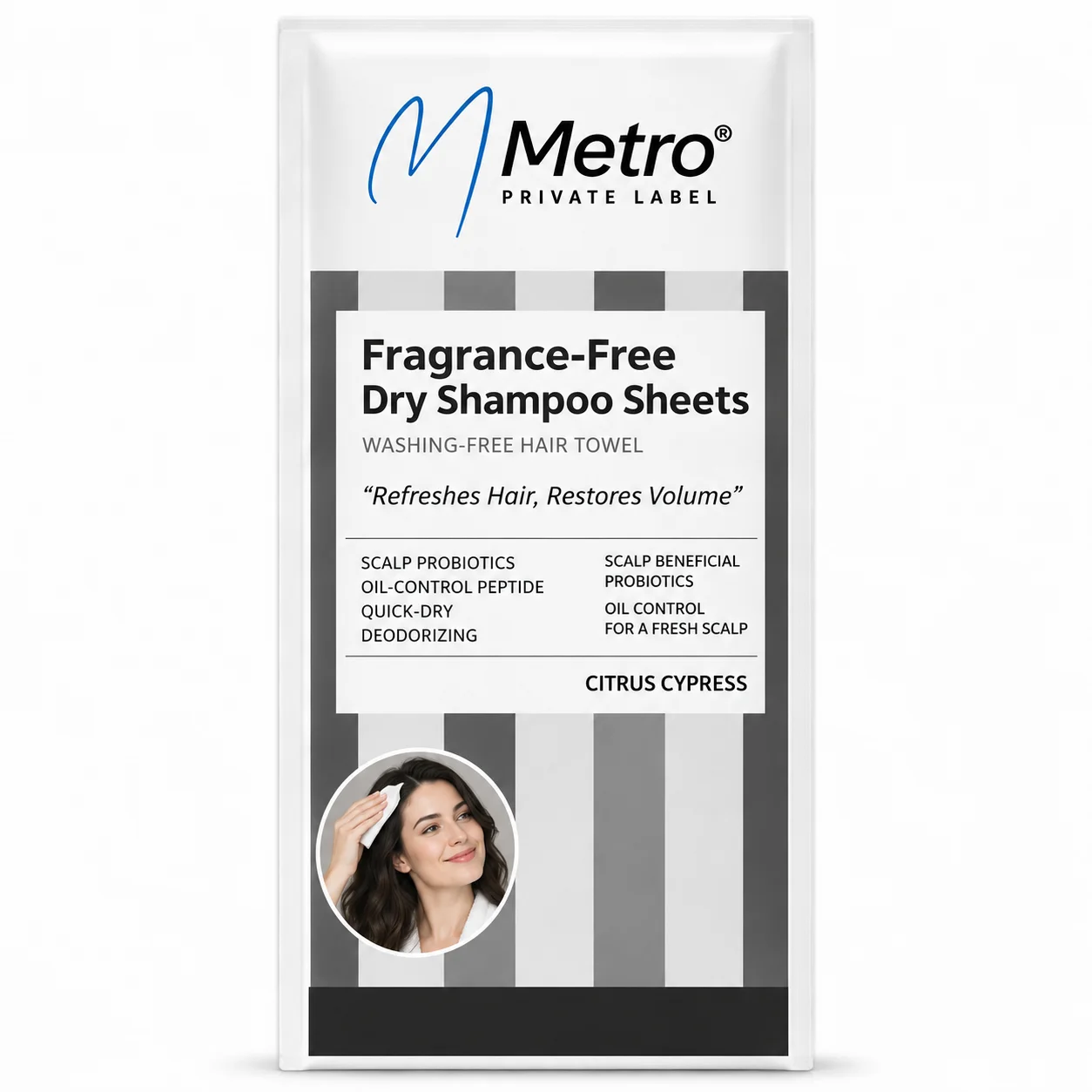
Fragrance-Free Dry Shampoo Sheets
Build a Private Label Dry Shampoo Sheets Line That Fits Your Market
If you’re looking for a private label dry shampoo sheets manufacturer, chances are you’ve already noticed the growing variety of waterless haircare products in the market. You might be expanding an established Amazon or Shopify haircare range, developing a portable alternative to traditional dry shampoo sprays, or introducing a convenient scalp-refreshing product for retail distribution. But turning that opportunity into a successful product involves more than choosing a fragrance or putting cleansing ingredients onto a sheet. You need the right formulation, suitable sheet materials, reliable packaging, and a retail price that makes sense for your business. That’s where we believe our manufacturing experience and practical product development approach can make a difference.
At Metro Private Label, we start by understanding how you plan to sell and position your dry shampoo sheets. An e-commerce brand may want cooling or volumizing sheets that offer a clear point of difference, while an experienced beauty founder might be developing a premium fragrance-free scalp care product. A distributor may prefer established formulations in compact, retail-ready packs, while a salon brand might want convenient hair-refreshing wipes that complement its existing product collection. Before recommending a product direction, we discuss your target customers, expected retail price, preferred sheet count, packaging format, customization needs, and launch schedule. We want to help you develop something that your customers will understand, enjoy using, and have a reason to purchase again.
We also know that dry shampoo sheets can look similar on the shelf but perform very differently during use. A refreshing sheet should help remove sweat and excess surface oil without leaving the scalp uncomfortable, while a volumizing version needs to refresh the roots without making hair feel heavy or sticky. Smoothing sheets require a careful balance of cleansing and lightweight conditioning ingredients, and fragrance-free versions need to deliver a pleasant experience without relying on perfume. We pay particular attention to the nonwoven material, cleansing solution, liquid loading, residue, fragrance, preservation, and packaging seal integrity. A sheet that performs well when freshly produced still needs to retain its moisture and provide a consistent experience after storage, shipping, and repeated opening.
Our Core Private Label Dry Shampoo Sheets Products
Cooling & Refreshing Dry Shampoo Sheets: A practical option for haircare brands targeting active lifestyles, travel, commuting, and post-workout refreshment. We can explore no-rinse cleansing formulations designed to remove surface sweat and excess oil while providing a fresh, comfortable scalp sensation. Depending on your positioning, ingredients such as menthol, selected cooling agents, or botanical extracts may be considered. We focus on balancing the cooling sensation, cleansing performance, fragrance, and scalp comfort to avoid an overly strong or irritating experience.
Volumizing Dry Shampoo Sheets: Developed for brands targeting flat, oily hair and customers who want to refresh their roots between washes. We can explore lightweight cleansing systems and suitable conditioning ingredients that help reduce oily buildup without weighing hair down. Unlike traditional powder-based dry shampoos, pre-moistened sheets require a different formulation approach, particularly when balancing oil removal, residue, and the appearance of volume. We evaluate how the formula interacts with hair roots and sheet materials, with particular attention to avoiding stickiness, visible residue, or an excessively heavy finish.
Smoothing Dry Shampoo Sheets: A suitable direction for premium haircare brands and professional salon retail collections. These sheets combine convenient hair refreshing with lightweight conditioning to help improve manageability and reduce the appearance of flyaways. Depending on the desired product performance, we may explore ingredients such as panthenol, selected conditioning polymers, and compatible lightweight conditioning agents. We pay attention to how the formula spreads through the hair, whether it leaves unwanted residue, and how well the conditioning effect balances with the cleansing function. The goal is a practical product that refreshes hair without making it feel coated or greasy.
Fragrance-Free Dry Shampoo Sheets: A valuable option for brands targeting fragrance-conscious customers or developing minimalist scalp care collections. We can explore fragrance-free cleansing formulations using gentle surfactant systems, humectants, and carefully selected supporting ingredients without added perfume. However, fragrance-free does not automatically mean irritation-free, so ingredient compatibility, preservative performance, and appropriate product testing remain important. We focus on comfortable application, effective surface cleansing, minimal residue, and suitable packaging to create a convenient everyday hair-refreshing product.
Manufacturing Support for Dry Shampoo Sheet Brands
We understand that experienced buyers aren’t simply looking for another supplier offering generic hair wipes. An e-commerce operator may need a differentiated formula, compact packaging suitable for fulfillment, and dependable replenishment. A beauty industry founder may focus on cleansing performance, scalp comfort, ingredient selection, and how the product fits into a broader haircare range. A distributor often prefers straightforward private labeling, clear pricing, and established product options, while a professional salon brand may prioritize product experience and attractive retail presentation. Our approach is to understand these commercial priorities before recommending unnecessary customization or additional development costs.
That’s why we work through the practical decisions that influence the finished product early in development. Should your dry shampoo sheets focus on cooling, volume, smoothing, or fragrance-free cleansing? Would individually sealed sachets or resealable multi-sheet packs better suit your sales channel? What sheet dimensions, thickness, texture, and liquid content provide the right balance between usability and cost? For pre-moistened sheets, we also consider formulation compatibility, microbiological quality, preservative effectiveness, moisture retention, and packaging performance. These details matter because insufficient liquid, poor sealing, or excessive residue can quickly turn a promising product into a source of customer complaints.
We also help coordinate the stages involved in bringing your private label dry shampoo sheets to market, including formulation assessment, sample development, sheet material selection, packaging customization, production planning, and relevant technical documentation. Depending on the confirmed product and manufacturing arrangement, this may include INCI information, product specifications, available COA or SDS documentation, and appropriate quality testing. We discuss minimum order quantities, packaging costs, production lead times, and market-specific labeling requirements before moving toward mass production. Our goal is to help you make informed manufacturing decisions, avoid unnecessary revisions, and develop a dry shampoo sheet product that can support reliable replenishment and future growth of your haircare brand.

More Than Just a Private Label Dry Shampoo Sheets Manufacturer
At Metro Private Label, we know you’re not simply looking for a factory to produce dry shampoo sheets. You need a product that fits your market, offers a clear selling point, and leaves enough room for healthy profit margins. Whether you’re expanding an existing haircare brand, developing a differentiated product, or sourcing ready-to-label sheets for retail distribution, we focus on helping you make practical decisions that reduce development costs, simplify production, and support repeat orders.

Develop Products Your Customers Actually Want
We help you choose dry shampoo sheet products based on your sales channels and customer needs. From cooling and volumizing to smoothing and fragrance-free options, we focus on practical benefits that are easy to communicate and sell, helping you avoid investing in products with unclear market positioning.
Reduce Development Costs and Production Risks
We evaluate formulations, sheet materials, moisture retention, and packaging compatibility before mass production. By identifying potential problems during sampling and testing, we help you reduce unnecessary revisions, avoid costly packaging mistakes, and minimize the risk of customer complaints.
Build Products That Encourage Repeat Purchases
We focus on what customers actually experience: effective hair refreshing, comfortable scalp feel, minimal residue, and convenient application. Our goal is to help you deliver consistent product quality that supports positive reviews, customer satisfaction, and repeat purchases.
Protect Your Margins With Practical Manufacturing Solutions
We help balance formulation costs, sheet materials, packaging options, and order quantities against your target retail price. Whether you need compact travel packs or retail-ready multi-sheet packaging, we aim to provide cost-effective manufacturing options that support competitive pricing and sustainable profit margins.
Build a Private Label Dry Shampoo Sheets Line Around Your Business Goals
At Metro Private Label, we know that developing private label dry shampoo sheets is about more than choosing a cleansing formula and adding your logo to the packaging. If you already sell through Amazon, Shopify, TikTok Shop, salons, or retail channels, you need a product that fits your customers, target price, and existing haircare range. You might be introducing cooling sheets for active lifestyles, volumizing wipes for oily roots, or fragrance-free options for everyday scalp care. Each direction has different formulation, packaging, and manufacturing requirements. We believe a good manufacturing partner should do more than follow your instructions. We want to help you identify better product opportunities, avoid unnecessary costs, and make informed decisions before production begins. That’s how we aim to deliver value beyond the finished product.
Develop Dry Shampoo Sheets That Fit Your Sales Strategy
We start by understanding your customers, sales channels, and product positioning. An e-commerce brand may need portable dry shampoo sheets with recognizable benefits and competitive pricing, while an experienced beauty founder may prioritize differentiated formulations and premium packaging. A distributor might prefer established formulas that can be launched quickly, while a salon brand may want refreshing or smoothing sheets that complement its existing haircare products. We use these differences to guide product selection, sheet count, fragrance, packaging, and manufacturing costs. Our goal is to help you develop products that make sense for your business rather than simply offering the same formula to every customer.
Avoid Costly Mistakes Before Mass Production
Dry shampoo sheets may appear simple, but small manufacturing details can affect customer satisfaction. A cleansing formula that leaves sticky residue can make hair feel worse, while unsuitable sheet materials may release too little liquid during application. Poor packaging seals can also cause pre-moistened sheets to dry out before customers finish using them. That’s why we evaluate formulation compatibility, sheet texture, liquid loading, preservation, moisture retention, and packaging performance during development. We also consider how the product will be stored and shipped. Identifying these issues before mass production helps reduce unnecessary revisions, product complaints, and costly packaging changes.
Create Products That Encourage Repeat Purchases
We believe customers may purchase dry shampoo sheets because of their convenience, but their actual experience determines whether they buy again. Cooling sheets should leave the scalp feeling refreshed without an overwhelming sensation, while volumizing options should help refresh oily roots without weighing hair down. Smoothing sheets need to improve manageability without excessive residue, and fragrance-free versions should offer comfortable cleansing without added perfume. We focus on balancing cleansing ingredients, conditioning agents, sheet materials, and application performance rather than simply adding more ingredients. Our aim is to help you deliver a consistent product experience that supports customer satisfaction, positive reviews, and repeat sales.
Keep Product Quality and Profit Margins Balanced
We understand that a successful product needs to work financially, not just perform well during sampling. That’s why we consider formulation complexity, nonwoven materials, sheet dimensions, liquid content, packaging, and order quantities alongside your target retail price. Individually wrapped sheets may suit premium travel collections, while resealable 12- or 20-sheet packs may offer a more practical cost structure for e-commerce and wholesale distribution. We help you compare these options and understand where customization adds meaningful value. Rather than encouraging unnecessary spending, we want to help you invest in product features customers will notice while maintaining competitive pricing and healthier profit margins.
Build a Reliable Foundation for Future Product Growth
We also look beyond your first order because dry shampoo sheets can become part of a broader haircare collection. Cooling sheets may complement scalp-refreshing sprays, volumizing versions can extend an existing styling range, and fragrance-free options may suit minimalist haircare collections. Planning these connections early helps maintain consistent product positioning, packaging, and pricing as your brand expands. At Metro Private Label, we help coordinate product development, sampling, sheet material selection, packaging customization, production planning, quality evaluation, and relevant technical documentation. We also consider your target market’s labeling requirements and appropriate cosmetic claims before production. Our goal is to help you launch efficiently, reduce avoidable manufacturing problems, and build products that are practical to replenish as your business grows.
FAQs Dry Shampoo Sheets
For your convenience, we’ve gathered the most commonly asked questions about our Dry Shampoo Sheets. However, should you have any further queries, please don’t hesitate to reach out to us.
1. What types of dry shampoo sheets can you manufacture?
We offer several product development directions, including cooling and refreshing, volumizing, smoothing, and fragrance-free dry shampoo sheets. Depending on your target market, we can explore different cleansing formulas, sheet materials, fragrances, and packaging formats. We’ll help you choose an option that fits your existing haircare range and customers’ needs.
2. Can you customize the dry shampoo sheet formula for our brand?
Yes. We can work with you on cleansing performance, cooling sensation, fragrance, conditioning ingredients, and scalp comfort. Whether you want lightweight volumizing sheets or a gentle fragrance-free option, we’ll evaluate suitable ingredients and sheet materials. Our goal is to create a product with clear benefits that fits your brand positioning and target retail price.
3. What is your minimum order quantity (MOQ) for dry shampoo sheets?
Our MOQ depends on the packaging format. For individually wrapped sheets packed in boxes of 10, the minimum is 1,000 boxes per SKU, equivalent to 10,000 individually wrapped sheets. For resealable multi-sheet packs, the MOQ starts at 10,000 packs per SKU. We’ll help you compare packaging options and calculate the investment required before you commit.
4. How long does sampling and mass production take?
The timeline depends on whether you choose an existing formula or require custom development. Sampling generally involves confirming the cleansing solution, sheet material, fragrance, and packaging compatibility. Once you approve the samples and packaging, we’ll confirm the production schedule based on material availability and order quantity. We prefer giving you a realistic timeline rather than promising an unrealistic delivery date.
5. Can you develop vegan, alcohol-free, or fragrance-free dry shampoo sheets?
Yes, we can explore formulations designed around specific ingredient requirements, including vegan, alcohol-free, and fragrance-free options. We’ll review your preferences alongside cleansing performance, preservation, and product stability. If you need certifications or specific claims for your market, let us know early so we can evaluate the necessary ingredient documentation and testing requirements.
6. Can you help with custom packaging and private label design?
Absolutely. We can help you evaluate individually wrapped sachets, 10-sheet retail boxes, and resealable multi-sheet packaging. We also support label and packaging coordination based on your brand requirements. We’ll consider moisture retention, sealing performance, printing costs, and shipping practicality to help you choose packaging that looks professional without creating unnecessary expenses.
7. Do you offer ready-to-label formulas and fully customized products?
We can discuss both options based on available formulations and your product requirements. An existing formula may reduce development time and cost, making it practical for distributors or brands testing a new category. If you need differentiated performance, ingredients, or packaging, we can explore custom development. We’ll explain the cost and MOQ differences before recommending a direction.
8. What quality testing do you perform on dry shampoo sheets?
We pay attention to formulation stability, cleansing performance, microbiological quality, preservative effectiveness, and compatibility between the liquid, sheet material, and packaging. Moisture retention and seal integrity are particularly important for pre-moistened sheets. We’ll discuss the appropriate testing plan before production and identify any additional third-party testing needed for your product or target market.
9. Can you provide regulatory documents and support product claims?
Yes. We can help prepare relevant product information, including INCI ingredient lists, product specifications, and available COA or SDS documentation where applicable. We can also review proposed cosmetic claims such as cooling, refreshing, oil control, or smoothing against the formulation and supporting evidence. Market-specific compliance and any required independent assessments should be confirmed before your product launches.
10. Can you ship private label dry shampoo sheets internationally?
Yes. We work with international buyers and can help coordinate shipping arrangements for markets such as the United States, Canada, the UK, and the EU. Depending on your shipment requirements, we can discuss available freight options, export documentation, and delivery arrangements. We’ll also help you consider packaging dimensions, shipment weight, and freight costs when planning your order.
We wanted to introduce dry shampoo sheets as a convenient alternative to traditional sprays in our existing haircare range. Metro Private Label helped us understand the differences between cooling, volumizing, and fragrance-free options, along with the packaging costs involved. What stood out was their practical approach to product development. They considered our target retail price, shipping requirements, and customer experience instead of simply recommending the most expensive formulation.
Megan Whitcomb, E-commerce Brand DirectorUnited States
Our main concern was finding the right balance between effective hair refreshing and a comfortable, lightweight finish. Metro Private Label explained how the cleansing solution, sheet material, and liquid content could affect the final product. During our discussions, they also highlighted potential issues with moisture retention and packaging seals. We appreciated that they were willing to explain the technical limitations rather than promise that every customization idea would work.
Leonie Krüger, Haircare Product Development LeadGermany
We were exploring dry shampoo sheets for our existing retail channels and needed a supplier who understood pricing and minimum order quantities. Metro Private Label clearly explained the difference between individually wrapped sheets and multi-sheet packaging, which helped us evaluate the investment required. Their communication was straightforward, especially when discussing available formulations, packaging options, and production planning. That made our initial product assessment much easier.
Jasper van Leeuwen, Retail Distribution ManagerNetherlands
We were interested in offering portable hair-refreshing sheets as an additional retail product for our salons. Metro Private Label understood that our customers would care more about convenience, fragrance, and how their hair felt afterward than a long list of ingredients. Their suggestions helped us focus on a smoothing and refreshing product concept with practical packaging. We especially appreciated their attention to the everyday experience of using the product.
Clara Montoro, Professional Salon Group DirectorSpain
When we started exploring fragrance-free dry shampoo sheets, we had a clear product concept but needed guidance on formulation and packaging. Metro Private Label helped us understand why removing fragrance doesn't automatically make a formula suitable for every scalp type. They also discussed preservation, sheet compatibility, and moisture protection in a way that was easy to follow. Their approach helped us make more informed decisions without adding unnecessary complexity to the product.
Élodie Marchand, Beauty Brand FounderFrance





Metro Private Label in Numbers
Happy Clients
0 +
Million-dollar Buyers
0 +
Formulation
0 +
Professional Staffs
0 +
Your Ultimate Guide to Dry Shampoo Sheets
If you’re planning to add dry shampoo sheets to your haircare range—whether you’re expanding an established Amazon or Shopify brand, developing a portable scalp-refreshing product, or introducing a new SKU for retail distribution—you’re exploring a niche category with practical commercial opportunities. Unlike traditional dry shampoo sprays, pre-moistened sheets offer a convenient way to refresh oily hair and scalp without conventional washing. Japanese and Korean haircare brands have already introduced cooling, volumizing, smoothing, and fragrance-free versions, showing how the same product format can serve different customer needs. However, turning this concept into a product customers will purchase again requires more than attractive packaging. Cleansing performance, hair feel, portability, and retail pricing all need to work together.
At Metro Private Label, we understand that dry shampoo sheets may look simple, but the manufacturing decisions behind them can significantly affect product quality and profitability. The cleansing formula needs to work with the nonwoven material, release enough liquid during application, and leave hair feeling refreshed without excessive moisture or sticky residue. Packaging must also protect the sheets from drying out during storage and everyday use. We’ve learned from cosmetic product development that these practical details deserve attention before mass production, especially when brands must balance custom formulations, packaging costs, minimum order quantities, and reliable replenishment. A product that performs well during sampling still needs to remain consistent when manufactured, shipped, and sold through different channels.
This guide is designed to help you understand the commercial and technical decisions involved in developing private label dry shampoo sheets. We’ll explore actual market products, formulation and sheet material differences, ready-made versus custom development, packaging options, manufacturing costs, quality testing, and regulatory requirements for international markets. We’ll also examine a documented industry development case to illustrate the challenges behind bringing a sheet-based cleansing product from concept to market. Our goal is to share practical insights that help you evaluate suppliers more confidently, avoid unnecessary development expenses, choose products that fit your sales channels, and build a more reliable foundation for future orders.
Table of Contents
What Are Dry Shampoo Sheets and How Are They Different From Traditional Dry Shampoo?
Dry shampoo sheets are portable haircare products designed to refresh oily hair and scalp without conventional washing. However, not all products marketed as dry shampoo sheets work in the same way. Some use pre-moistened fabrics to remove surface oil, sweat, and impurities, while others rely on absorbent paper to reduce visible greasiness. Traditional dry shampoo sprays and powders work differently again, primarily by absorbing excess sebum without physically removing it from the hair. These distinctions are particularly important when evaluating private label manufacturing opportunities because they affect formulation technology, product performance, packaging requirements, and production costs. From a product development perspective, understanding how each format works is more useful than simply comparing ingredient lists or following the latest haircare trend. The right choice depends on the problem customers want to solve, how they intend to use the product, and whether the manufacturing process can consistently deliver the expected experience.
How Do Pre-Moistened Dry Shampoo Sheets Work?
Pre-moistened dry shampoo sheets, also called no-rinse shampoo wipes or dry shampoo tissues, use a cleansing solution absorbed into a nonwoven fabric. When the sheet is wiped across the scalp and hair roots, its moisture, cleansing ingredients, and physical contact help remove some surface oil, sweat, and impurities. Depending on the intended performance, the solution may contain mild surfactants, humectants, lightweight conditioning agents, and fragrance. Products such as Kao Merit dry shampoo sheets demonstrate how this format can be positioned around convenient hair and scalp refreshing without conventional shampooing. What makes this technology interesting is that the cleansing formula cannot be evaluated independently from the sheet material. A soft, absorbent fabric may feel comfortable against the scalp but release too little solution, while a heavily saturated sheet can leave hair noticeably damp. The balance between fabric texture, liquid loading, cleansing performance, and residue determines whether the product feels genuinely convenient. Another consideration is that pre-moistened sheets are not a complete replacement for regular shampooing. They can provide useful refreshing between washes, but removing heavy styling-product buildup or accumulated scalp impurities generally requires more thorough cleansing. For commercial product development, this means the strongest positioning is often quick, targeted refreshing rather than promising the same performance as a conventional hair wash.
How Are Oil-Absorbing Dry Shampoo Sheets Different?
Oil-absorbing dry shampoo sheets work more like facial blotting papers than traditional cleansing wipes. They typically use absorbent paper or specialized sheet materials, sometimes combined with oil-absorbing powders, to collect excess sebum from the hairline, bangs, or roots. Instead of wiping the scalp with a liquid solution, the customer presses the sheet against oily areas to reduce visible shine and greasiness. This approach is particularly relevant when someone wants to improve the appearance of oily hair without adding moisture or disturbing an existing hairstyle. The distinction becomes clearer when considering actual usage situations. Someone dealing with oily bangs during a working day may prefer a dry blotting sheet, while a customer leaving the gym may want a pre-moistened wipe that helps remove sweat and surface impurities. From a manufacturing perspective, the absorbency, strength, texture, and structure of the paper become central to performance. A sheet that absorbs oil quickly but tears easily, leaves powder residue, or becomes saturated after minimal contact may disappoint customers despite attractive packaging. I would also consider whether the sheet works effectively across different hair textures and oil levels, since performance on a small section of fine hair may differ from application around thicker roots. For brands evaluating this category, the key is to recognize that dry blotting sheets primarily address visible oiliness rather than providing the broader cleansing experience associated with pre-moistened shampoo wipes.
How Do Traditional Dry Shampoo Sprays and Powders Compare?
Traditional dry shampoos are commonly sold as aerosol sprays or loose powders, using ingredients such as starches, silica, and other absorbent materials to reduce the appearance of oily roots. Aerosol sprays distribute these ingredients through a pressurized dispensing system, while loose powders are applied directly to the hair. Both formats can temporarily improve the appearance of greasiness, and some also provide texture or apparent volume, which explains their established position in the haircare market. However, absorbing oil is not the same as removing it. Traditional dry shampoo particles generally remain in the hair until they are brushed or washed away, potentially contributing to buildup or visible residue, particularly on darker hair or after repeated applications. Pre-moistened dry shampoo sheets can physically transfer some oil and impurities onto the sheet, while dry blotting papers absorb oil into their material. Each format therefore offers a different balance of convenience, application control, cleansing effect, and styling performance. Aerosol sprays may be more practical when customers want fast application across larger sections of hair or additional root texture, whereas sheets can appeal to those seeking localized refreshing without spraying powder into the surrounding environment. I wouldn’t position sheets as universally superior because they also have limitations, including the amount of hair they can effectively treat and the need to manage moisture or oil absorption during application. The more useful commercial question is which format provides the most convenient solution for a specific customer routine.
Why Are Dry Shampoo Sheets Relevant to Travel, Fitness, and Everyday Haircare?
The commercial appeal of dry shampoo sheets becomes clearer when considering how people manage their hair throughout the day. Someone leaving a fitness class may want to refresh sweaty roots before returning to work, while a frequent traveler may need a compact product that fits easily into a handbag or carry-on. Commuters, festival attendees, and customers with oily bangs may also appreciate a quick solution that doesn’t require access to a shower or conventional shampoo. These situations create opportunities for brands to position dry shampoo sheets around convenience, portability, and targeted hair refreshing rather than presenting them as complete replacements for regular washing. A fitness-oriented brand may find cooling wipes relevant to its existing product range, while a premium haircare collection might explore smoothing or fragrance-free versions. Packaging also plays a significant role in whether the product fits its intended market. Individually wrapped sheets can be convenient for occasional use and travel, while resealable multi-sheet packs may offer better value for customers who refresh their hair regularly. However, individually wrapped products can involve higher packaging costs, while multi-sheet packs require careful attention to resealing performance and moisture retention after opening. Pre-moistened formats may also be subject to applicable travel liquid restrictions, depending on the destination and transport rules. For established e-commerce brands and distributors, I believe the most practical opportunity is to identify where dry shampoo sheets solve a recurring problem that existing products do not address conveniently. A clear usage occasion, understandable benefit, and appropriate retail pack size are often more commercially valuable than an unnecessarily complicated formula.
Why Does the Product Format Matter When Choosing a Manufacturer?
One manufacturing reality that deserves more attention is that dry shampoo sheets, oil-blotting papers, aerosol sprays, and loose powders may require entirely different production technologies. Pre-moistened shampoo sheets involve preparing a stable cleansing solution, selecting compatible nonwoven materials, controlling liquid distribution, and sealing the finished sheets in moisture-resistant packaging. Microbiological quality, preservative effectiveness, formulation compatibility, and moisture retention are particularly important because the product must remain suitable for use throughout its intended shelf life. Dry oil-blotting sheets involve different material and processing requirements, potentially including specialized absorbent paper, powder-coating processes, and precision cutting. Aerosol dry shampoos introduce another set of considerations, including pressure-rated packaging, propellant handling, and specialized filling equipment, while loose powders require appropriate blending and powder-filling systems. A manufacturer experienced in conventional skincare liquids or creams is therefore not automatically equipped to produce every type of dry shampoo product. This distinction also explains why minimum order quantities and manufacturing quotations can differ significantly between formats that appear similar in online product listings. For pre-moistened sheets, costs may depend on nonwoven material specifications, liquid loading, sachet or multi-sheet packaging, printing requirements, and sealing equipment. Dry blotting sheets may have a different cost structure driven by substrate selection, coating processes, cutting, and paper packaging. Before requesting quotations, I recommend confirming the intended product function, sheet technology, packaging structure, and expected customer experience. A cooling scalp wipe and a dry oil-absorbing paper may both be described as dry shampoo sheets, but their development requirements, quality risks, and production processes are fundamentally different. Understanding these differences helps buyers compare suppliers more accurately, avoid misleading price comparisons, and select a product format that can be manufactured consistently at a commercially sustainable cost.
Is There Real Market Demand for Private Label Dry Shampoo Sheets?
Dry shampoo sheets have an established retail presence in Japan and South Korea, where brands have introduced portable no-rinse products for refreshing oily hair, managing sweat, improving hair appearance, and maintaining freshness between washes. However, the availability of these products does not automatically mean the category has strong consumer demand in every market. What I find more useful is examining how existing brands position their products, which problems they emphasize, and how much customers are being asked to pay. Products from Kao Merit, Ariul, MUJI, and Diane Perfect Beauty show that dry shampoo sheets can serve different purchasing motivations, from everyday scalp refreshing to travel convenience and lightweight hair styling. For established haircare brands, e-commerce operators, and distributors, the commercial opportunity depends on whether these benefits are relevant to their existing customers and whether the expected retail price can support manufacturing, marketing, and distribution costs.
What Do Japanese and Korean Dry Shampoo Sheet Products Reveal About Consumer Demand?
Japan provides several useful examples of how dry shampoo sheets are positioned in an established haircare market. Kao’s Merit range includes refreshing sheets with a verbena and lemon fragrance and a smoothing version designed to help manage hair after activities such as commuting or exercise. MUJI offers waterless shampoo sheets in a 12-sheet pack, emphasizing convenient cleansing without water, fragrance-free positioning, and straightforward everyday use. Diane Perfect Beauty takes another approach with hair-and-body dry shampoo wipes, offering both fragranced and fragrance-free versions. In South Korea, Ariul’s Smooth & Pure range includes Cooling Fresh and Soft Volume options, while BY_OUR has introduced dry shampoo pads positioned around scalp refreshing and root volume. These examples demonstrate that brands are not simply selling a sheet containing cleansing ingredients. They are connecting the product to recognizable consumer concerns, such as sweaty roots, flat hair, unwanted odors, or the inconvenience of washing and drying hair during a busy day. I consider this an important distinction because the same underlying product format can support different commercial positioning strategies. However, product availability and multiple variants demonstrate that manufacturers and retailers see potential in the category; they do not independently establish market size, repeat-purchase frequency, or sales growth.
How Are Existing Brands Differentiating Their Dry Shampoo Sheets?
Looking at established retail products, I notice that differentiation is generally built around a specific benefit rather than an unusually complicated formulation. Kao Merit separates its refreshing and smoothing products according to the experience customers want after application, while Ariul distinguishes between cooling and volume-oriented versions. MUJI focuses on practical waterless cleansing and fragrance-free simplicity, whereas Diane Perfect Beauty extends the product’s usefulness by positioning certain sheets for both hair and body. DEEPEER offers another direction with its Perfume No-Wash Dry Shampoo Tissue, using fragrance as part of the refreshing experience. These differences reveal several purchasing motivations: customers may want to feel cleaner after exercise, reduce the appearance of oily roots, improve hair manageability, avoid strong fragrances, or carry a convenient product while traveling. For beauty brands evaluating private label opportunities, this suggests that a clear and understandable product benefit may be more valuable than adding numerous fashionable ingredients. A volumizing product, for example, needs to demonstrate an acceptable hair feel and visible styling benefit rather than rely entirely on ingredient claims. Similarly, a cooling sheet should provide a pleasant refreshing sensation without becoming uncomfortable. I would evaluate the intended customer experience first and then determine whether the formulation and sheet material can realistically support that positioning.
What Do Retail Prices and Pack Sizes Tell Us About Market Positioning?
Retail pricing offers useful clues about how brands position dry shampoo sheets, although prices vary considerably between domestic markets and international resellers. In the retail listings reviewed in November 2026, Ariul’s Smooth & Pure Dry Shampoo Sheets were listed by Olive Young Global at approximately US$6 for 15 sheets, while NatureLab USA listed Diane Perfect Beauty Dry Shampoo Wipes at US$6 for 12 sheets. In Japan, MUJI listed its 12-sheet waterless shampoo pack at ¥390, and a Japanese retailer listed Kao Merit Refreshing Dry Shampoo Sheets at approximately ¥708 for 20 sheets. At a higher international retail price, DEEPEER’s 20-sheet Perfume No-Wash Dry Shampoo Tissue was listed by Skin Seoul at approximately US$12.40. These examples suggest that dry shampoo sheets can be marketed across accessible everyday-use and more specialized beauty-product price points, although different currencies, regional distribution costs, promotions, and retailer markups prevent direct comparisons. Pack sizes also reveal different usage expectations. A 12- or 15-sheet pack may be positioned as a portable personal care item, while a 20-sheet pack may offer greater perceived value for more frequent use. From a commercial perspective, I would examine retail price per pack alongside sheet dimensions, material quality, liquid content, and packaging structure. A lower retail price may encourage trial purchases, but it also leaves less room for manufacturing costs, fulfillment fees, advertising, and distributor margins. An attractive retail price is only commercially useful when the complete cost structure supports a sustainable business model.
Should Dry Shampoo Sheets Be Sold as a Standalone Product or a Complementary Haircare SKU?
One of the most important decisions is whether dry shampoo sheets should become a standalone product or an addition to an existing haircare range. A standalone launch requires customers to understand the product’s purpose, recognize its benefits, and choose it over familiar alternatives such as aerosol dry shampoo, powder, or conventional hair wipes. This can increase the importance of product demonstrations, educational content, and customer acquisition costs, particularly in markets where dry shampoo sheets are less familiar. By contrast, an established haircare brand already selling shampoo, conditioner, scalp serum, or styling products may have a more natural opportunity to introduce sheets as a complementary SKU. A volumizing sheet could extend a range targeting oily or flat hair, while cooling wipes could complement scalp-refreshing products. Professional salon brands may position sheets as convenient between-appointment retail products, and distributors could evaluate them alongside existing travel-size personal care collections. I generally see greater commercial logic in connecting the product to an established customer need rather than treating the sheet format itself as the main selling point. The strongest approach depends on the brand’s current audience, existing purchasing behavior, and ability to explain when and why the product should be used.
What Are the Biggest Limitations to Dry Shampoo Sheet Market Growth?
Despite the presence of recognizable retail products, dry shampoo sheets face several barriers that deserve attention before a brand commits to commercial inventory. Consumer familiarity is one of them. Traditional dry shampoo sprays are already widely understood, while sheet-based products may require additional explanation about how to apply them, whether they leave hair wet, and how effectively they control oil. Some consumers may also confuse pre-moistened shampoo wipes with dry oil-blotting papers, even though the products function differently. Another consideration is perceived value. Customers familiar with a spray containing many applications may question whether a pack of 12 or 20 disposable sheets offers sufficient value, especially if they need multiple sheets to refresh thicker or longer hair. Packaging waste, moisture loss after opening, fragrance preferences, and the time required to wipe different sections of the scalp can also influence satisfaction. These limitations do not eliminate the commercial opportunity, but they affect product positioning and customer expectations. In my view, brands should avoid assuming that portability alone guarantees repeat purchases. The product must provide a noticeable benefit, remain convenient during actual use, and offer acceptable value compared with competing formats. These factors are especially important for Amazon and Shopify operators, where customer reviews, repeat-purchase behavior, and fulfillment costs can directly affect profitability.
How Can Brands Validate Demand Before Investing in Manufacturing?
Before committing to a private label dry shampoo sheet project, I would separate evidence of retail availability from evidence of actual customer demand. Competitor listings can reveal product positioning, pack sizes, pricing, and available variants, but they rarely disclose reliable sales volumes or profitability. Google Shopping results are useful for identifying existing products, while keyword research can help assess how consumers search for terms such as dry shampoo sheets, dry shampoo wipes, no-rinse shampoo, and scalp refreshing wipes. However, keyword volume alone does not establish purchase intent, and searches for traditional dry shampoo may not translate directly into demand for sheet-based products. I would also examine verified customer reviews, recurring complaints, competitor advertising, and whether similar products are being replenished or expanded across retail channels. For an established e-commerce brand, surveying existing customers or testing product concepts with a small qualified audience may provide more relevant evidence than relying on broad industry forecasts. Distributors can assess whether retailers have a recognizable use case and an acceptable selling price, while salon operators may obtain useful feedback from existing clients. Manufacturing economics must be considered alongside this research, particularly because packaging formats and minimum order quantities can create substantial differences in initial inventory investment. The most useful validation question is not simply whether dry shampoo sheets already exist, but whether a specific group of customers has a recurring problem, understands the product’s benefit, and is willing to purchase it at a price that supports the intended distribution model.
Is Private Label Dry Shampoo Sheets a Worthwhile Business Opportunity?
I consider private label dry shampoo sheets a credible niche product opportunity, but not one that should be evaluated solely on the assumption that Asian beauty trends will become equally popular in Western markets. Existing Japanese and Korean products demonstrate several viable positioning directions, including refreshing, volumizing, smoothing, fragrance-free, and multi-purpose hair-and-body care. Their retail presence provides useful evidence that the product format can be manufactured, packaged, distributed, and marketed to consumers. What remains less certain is the scale of demand within individual markets, how frequently customers will repurchase, and whether the economics remain attractive after manufacturing, logistics, and customer acquisition costs. For established haircare brands, the category may offer a practical way to introduce a differentiated product without changing the positioning of their entire collection. For distributors and professional salon businesses, its potential may depend more heavily on accessible pricing, convenient packaging, and straightforward product education. Ultimately, I believe the most commercially sensible decision comes from combining competitor research with direct customer feedback, realistic cost calculations, and a clearly defined sales channel. A product does not need to become a mass-market bestseller to justify development, but it does need enough identifiable demand and repeat-purchase potential to support a sustainable business.
Which Types of Dry Shampoo Sheets Are Most Suitable for Private Label Brands?
Private label dry shampoo sheets are not a single product category with identical benefits. Existing Japanese and Korean haircare brands have introduced different versions designed for scalp refreshing, root volume, hair manageability, and fragrance preferences. The four most practical directions to evaluate are cooling and refreshing, volumizing, smoothing, and fragrance-free dry shampoo sheets. Each serves a different consumer need and requires careful consideration of cleansing ingredients, sheet materials, application experience, and product positioning. From a commercial perspective, I believe the most important decision is not how many variations a brand can develop, but which benefits are relevant to its existing customers and sales channels. An established Amazon haircare brand may benefit from a clearly differentiated volumizing product, while a distributor may prefer a broadly appealing refreshing formula. Understanding these differences helps buyers avoid unnecessary product development costs and build a collection that is easier to explain, market, and replenish.
Cooling and Refreshing Dry Shampoo Sheets for Active Lifestyles
Cooling and refreshing dry shampoo sheets are among the most recognizable product directions in the existing market, particularly in Japanese haircare. Products such as Kao Merit Refreshing Dry Shampoo Sheets and Ariul Smooth & Pure Cooling Fresh Dry Shampoo Tissue illustrate how brands connect this format with sweat, oiliness, and the desire to feel refreshed without washing hair. These products are especially relevant to consumers who exercise, commute in hot weather, travel frequently, or want to refresh their scalp during a busy day. Their main appeal comes from convenience and an immediate sensory experience rather than long-term hair treatment. For private label brands, this creates a relatively straightforward marketing message because customers can understand when and why they might use the product. However, developing an effective cooling sheet requires more than adding menthol or a strong fragrance. The cleansing solution needs to balance surface oil removal, cooling intensity, evaporation, and scalp comfort. Menthol and certain cooling agents can produce an unpleasant sensation when used excessively, while high levels of volatile ingredients may contribute to dryness or discomfort for some users. Fragrance can improve the perception of freshness, but it should not be presented as proof that the product has removed unwanted odors. I would evaluate how the formula performs immediately after application and whether the hair remains comfortable once the refreshing sensation fades. Sheet absorbency, liquid loading, and packaging moisture retention are also important because customers expect a consistent experience from the first sheet to the last. For e-commerce operators and distributors, this category may provide an accessible entry point because its usage occasions are easy to demonstrate through product images, videos, and customer education.
Volumizing Dry Shampoo Sheets for Oily and Flat Hair
Volumizing dry shampoo sheets target a more specific concern: hair that becomes flat, greasy, or visually weighed down between washes. Ariul’s Smooth & Pure Soft Volume Dry Shampoo Tissue demonstrates how manufacturers can position sheet-based products around root freshness and the appearance of volume rather than basic cleansing alone. This distinction matters because consumers accustomed to traditional powder-based dry shampoos may expect a similar lifting effect from a pre-moistened sheet, even though the two formats work differently. Traditional dry shampoo powders can create texture by depositing absorbent particles around the roots, while pre-moistened sheets primarily rely on wiping away some surface oil and refreshing the hair. Removing excess oil may help roots appear less weighed down, but it does not automatically produce substantial or lasting volume. Formulation development therefore requires careful attention to the balance between cleansing performance, lightweight conditioning, residue, and the amount of moisture transferred to the hair. A sheet that leaves roots too wet may temporarily make the hair appear flatter, while excessive conditioning agents can undermine the intended volumizing benefit. For brands developing this category, I would pay particular attention to application tests on fine hair, oily roots, and different hair densities rather than relying entirely on laboratory observations of the cleansing solution. The product’s instructions also need to explain how customers should apply the sheet and allow their hair to settle after use. Commercially, volumizing sheets may be particularly relevant to established haircare brands already selling products for fine hair, oily scalps, or root styling. They offer a natural opportunity to expand an existing collection, provided the volume-related claims are supported by the finished product’s actual performance.
Smoothing Dry Shampoo Sheets for Hair Manageability and Everyday Styling
Smoothing dry shampoo sheets combine convenient hair refreshing with a secondary benefit related to hair manageability. Kao Merit offers a smoothing version positioned around refreshing the scalp while helping hair look more manageable, including situations involving disheveled bangs or marks left by tied hair. This is an interesting product direction because it moves dry shampoo sheets beyond oil control and into everyday styling convenience. Consumers may want to refresh their hair before a meeting, after commuting, or when their hairstyle becomes untidy during the day. However, the formulation presents a different challenge from cooling or volumizing versions. Smoothing performance often depends on conditioning ingredients that improve hair feel, reduce friction, or help control visible flyaways, but excessive deposition can make the roots feel greasy or coated. Depending on the formulation system, suitable ingredients may include panthenol, compatible conditioning polymers, or carefully selected silicone-based ingredients. The choice must account for the fact that these materials are being delivered through a pre-moistened sheet rather than a conventional leave-in serum or conditioner. A formula that feels smooth on the hair lengths may be too heavy when applied directly around the scalp. I consider this balance particularly important because customers purchasing a dry shampoo product generally expect their hair to feel cleaner and lighter after use. Application testing should therefore examine residue, drying behavior, combability, and the appearance of hair after repeated use. From a market positioning perspective, smoothing sheets may be suitable for premium haircare brands, professional salons, and established styling collections. Their strongest commercial advantage is the combination of refreshing and manageable-looking hair, provided the product delivers both benefits without compromising the primary cleansing experience.
Fragrance-Free Dry Shampoo Sheets for Minimalist Haircare Collections
Fragrance-free dry shampoo sheets offer a different form of differentiation because their appeal is based on ingredient preferences rather than a highly noticeable sensory effect. Some consumers prefer personal care products without added perfume, particularly when they already use fragranced styling products or want to avoid strong scents throughout the day. This creates an opportunity for brands developing minimalist haircare collections or extending fragrance-free shampoo and scalp care ranges into portable formats. However, I think it is important to distinguish fragrance-free positioning from products specifically developed and tested for sensitive scalps. A fragrance-free formula does not automatically mean the product is hypoallergenic, non-irritating, or suitable for every consumer with scalp sensitivity. Surfactants, preservatives, cooling ingredients, botanical extracts, and other components can still influence individual skin tolerance. Even ingredients selected primarily for cleansing or preservation may have noticeable natural odors, which can make fragrance-free formulation more challenging than simply removing perfume from an existing product. Development should focus on mild cleansing performance, ingredient compatibility, acceptable natural odor, preservation, and comfortable application without relying on fragrance to create a perception of freshness. If a brand intends to market the product specifically for sensitive scalps, additional consideration should be given to the intended claims, ingredient selection, and appropriate product testing. From a commercial perspective, fragrance-free sheets may be especially relevant to existing brands whose customers already purchase unscented or minimalist personal care products. For those brands, consistency with the wider product range may be more valuable than introducing another strongly fragranced variation.
How Should Private Label Brands Choose Between These Four Product Types?
Choosing between cooling, volumizing, smoothing, and fragrance-free dry shampoo sheets requires more than identifying which product sounds most innovative. The decision should begin with the brand’s existing customer base, product positioning, sales channels, and the specific problem the new product is expected to solve. An Amazon or Shopify brand selling scalp-refreshing products may find cooling sheets easier to introduce because the customer already understands the benefit of refreshing oily or sweaty roots. A haircare brand focused on fine hair may have a stronger reason to explore volumizing sheets, while a professional salon collection could position smoothing sheets as a convenient product for maintaining hairstyles between appointments. Fragrance-free versions may fit naturally into an established minimalist haircare range, but their positioning should reflect genuine consumer preferences rather than unsupported assumptions about sensitive skin. I would also consider how much additional product education each variation requires. Cooling and refreshing benefits are relatively easy to communicate through usage occasions, while volumizing and smoothing claims may require stronger demonstrations of visible results. The target retail price matters as well. A premium DTC brand may have more flexibility to invest in specialized ingredients and packaging, while a distributor supplying multiple retail outlets may prioritize familiar benefits and a more accessible cost structure. The most suitable category is ultimately the one that connects a recognizable customer need with achievable product performance and realistic manufacturing economics.
Is It Better to Launch One Dry Shampoo Sheet Product or Several Variations?
Although offering four product types can make a private label collection appear more comprehensive, launching every variation at once is not necessarily the most practical commercial strategy. Each additional formula may introduce separate sampling, ingredient sourcing, stability evaluation, packaging specifications, inventory requirements, and minimum order quantities. Even when two products use the same sheet dimensions and packaging structure, changes to fragrance, conditioning agents, or cleansing ingredients can affect preservation, residue, and material compatibility. This means expanding the product range can increase development complexity before there is enough evidence that customers want multiple versions. For an established e-commerce brand introducing dry shampoo sheets for the first time, I would generally evaluate one product with a clearly defined benefit before investing in a broader collection. Customer feedback, sales performance, product reviews, and repeat purchases can then provide evidence for subsequent variations. A distributor with several established retail channels may have a different approach, particularly if buyers have already expressed interest in multiple product functions. Even then, consolidating compatible packaging specifications can make purchasing and replenishment easier. For example, using consistent sheet dimensions and a common retail pack structure across suitable formulas may simplify packaging design, warehousing, and future product extensions, although formula-specific compatibility and testing requirements still need to be addressed. In my view, the strongest long-term product range is not necessarily the one with the greatest number of SKUs. It is the collection where each variation has a distinct commercial purpose, delivers a consistent user experience, and contributes enough sales value to justify its manufacturing and inventory commitments.
Ready-Made vs Custom Dry Shampoo Sheets: Which Manufacturing Approach Makes More Sense?
Choosing between ready-made and custom dry shampoo sheets is one of the most important decisions when planning a private label haircare product. Ready-made formulations offer a more established starting point, often reducing development complexity, sampling costs, and the time required to prepare for production. Custom formulations provide greater flexibility to differentiate cleansing performance, fragrance, cooling sensation, conditioning benefits, and overall application experience. However, customization also introduces technical considerations that are easy to underestimate, particularly when the cleansing solution must remain compatible with nonwoven sheet materials and moisture-resistant packaging. From a manufacturing perspective, I don’t believe custom development is automatically the better choice simply because it sounds more exclusive. The right approach depends on the brand’s existing sales channels, target retail price, customer expectations, launch schedule, and whether the intended product improvements justify the additional investment. Understanding these trade-offs early can help avoid unnecessary formulation changes and make the entire sourcing process more predictable.
What Are the Advantages of Ready-Made Dry Shampoo Sheet Formulas?
Ready-made dry shampoo sheets generally use an established cleansing formulation and sheet material combination that a manufacturer has previously developed or produced. This approach can be particularly practical for e-commerce operators expanding an existing haircare range or distributors introducing waterless cleansing products into established retail channels. Instead of beginning with ingredient screening and multiple formulation trials, buyers can evaluate an existing product’s cleansing performance, fragrance, sheet texture, liquid content, and packaging options before deciding whether it fits their market. Where the existing formula has already undergone relevant stability, microbiological, and packaging evaluations, it may also reduce some development uncertainty, although the available testing must still be checked against the intended packaging, claims, and destination market. The main commercial advantage is that buyers can spend more time evaluating retail positioning and less time resolving basic formulation problems. However, ready-made does not necessarily mean finished goods are sitting in a warehouse or that production can begin immediately. Nonwoven materials, printed packaging, fragrance availability, and production scheduling can still influence lead times and minimum order quantities. I would also distinguish between an established formula and a genuinely production-proven formula, because a supplier may describe a laboratory sample as ready-made even when it has limited commercial manufacturing history.
When Does Custom Dry Shampoo Sheet Development Offer Greater Value?
Custom formulation becomes more valuable when a brand has a clearly defined customer need that existing products do not adequately address. An established haircare brand targeting oily, fine hair may want a lightweight cleansing system that refreshes the roots without reducing apparent volume, while a premium scalp care brand may prefer a fragrance-free formula with carefully selected ingredients and a comfortable application experience. Fitness-oriented brands might explore a specific cooling sensation, whereas professional salon collections may prioritize smoothing benefits and minimal residue. These requirements can justify adjustments to cleansing agents, humectants, conditioning ingredients, fragrance, or liquid loading, provided the changes produce meaningful differences in the finished product. However, I would be cautious about treating ingredient exclusivity as the main reason for customization. Adding a fashionable botanical extract or increasing the concentration of a recognizable ingredient does not automatically improve cleansing performance or create a more competitive product. What matters is whether customers can notice and appreciate the difference during actual use. A genuinely useful custom formulation should support a clear product benefit, fit the brand’s pricing strategy, and offer an experience that is difficult to achieve through a readily available alternative. Otherwise, the additional development work may provide limited commercial value.
Why Can Small Formula Changes Create Unexpected Manufacturing Problems?
One issue I frequently consider in cosmetic product development is that seemingly minor ingredient changes can influence the behavior of an entire formulation. For example, a buyer may request removing alcohol, replacing a preservative, increasing fragrance, or adding a botanical extract without expecting any major technical consequences. However, these adjustments can affect solubility, pH, preservative effectiveness, odor, and formula stability. In pre-moistened dry shampoo sheets, the challenge becomes more complicated because the liquid is stored in prolonged contact with a nonwoven material and sealed packaging. Certain ingredients may interact with the sheet fibers, partition between the liquid and packaging materials, or behave differently after the solution has been absorbed into the substrate. Increasing fragrance concentration may create solubility problems or alter the product’s residue, while adding conditioning polymers can change how the solution releases from the sheet and how the hair feels after application. Even switching to a different nonwoven material can influence liquid distribution and the amount of formula transferred during use. This is why I would never assume that an existing stability or preservative test result automatically remains applicable after a material formulation change. The technical significance of each modification needs to be evaluated, and additional testing may be necessary before the revised product is approved for commercial production.
How Do Raw Material Requirements and MOQ Affect Custom Development Costs?
Customization affects more than the price of the cleansing formula itself. Specialized ingredients, fragrances, nonwoven materials, and printed packaging may come with supplier minimum order quantities that are substantially higher than the amount required for an initial production batch. A brand requesting a specific cooling ingredient or exclusive fragrance may need to account for the supplier’s minimum purchase quantity, even if the finished product uses only a small proportion of that material. Similarly, changing the sheet’s thickness, fiber composition, dimensions, or texture may require a separate material sourcing arrangement rather than using an existing production specification. Individually sealed sachets and resealable multi-sheet packs can also have different printing and converting requirements, which may influence the minimum order quantity and total packaging investment. I find that buyers sometimes focus heavily on the factory’s quoted unit price without considering these additional commitments. A custom ingredient may increase cost only slightly per sheet but create a much larger upfront expenditure if the supplier requires purchasing several kilograms or an entire material roll. Before selecting a customized specification, I would examine how much material will be consumed in the first order, whether unused stock can be stored appropriately, and whether future production volumes justify the purchase. These questions become particularly important when the product has not yet established reliable repeat sales.
How Does Customization Affect Sampling, Testing, and Production Lead Times?
Ready-made and custom dry shampoo sheets can follow very different development timelines, even when their finished packaging looks nearly identical. With an established formula, sampling may mainly involve evaluating the existing cleansing solution, sheet feel, fragrance, and available packaging. A custom product may require several development rounds to balance oil removal, cooling intensity, residue, scalp comfort, and liquid release. Additional evaluations may be needed if the formula includes new ingredients or uses a different nonwoven substrate. Stability testing, microbiological assessment, preservative effectiveness testing where applicable, and packaging compatibility studies can also influence the schedule. For pre-moistened sheets, moisture retention deserves particular attention because a sample that performs well immediately after production may behave differently after prolonged storage or repeated opening of a resealable pack. I would also consider how custom packaging affects the production plan. A standard sachet structure may be easier to source than a specially printed laminate with unusual dimensions or barrier requirements, while a custom fragrance may need additional procurement time. These considerations mean that the overall timeline is not determined by formulation work alone. In practice, delays often arise when the formula is approved but the packaging specification, artwork, material supply, or required testing remains unresolved. Establishing a clear development sequence before purchasing materials helps reduce unnecessary changes and improves production planning.
Should Brands Customize the Formula, Packaging, or Both?
Not every successful private label dry shampoo sheet needs a completely original formulation. In some cases, packaging differentiation provides greater commercial value than changing a cleansing system that already performs well. A travel-focused brand may benefit from individually wrapped sheets that fit easily into a handbag or gym kit, while a retailer targeting everyday use may prefer resealable packs containing multiple sheets. Premium brands might prioritize packaging materials, visual presentation, or fragrance, while an established scalp care brand may find more value in improving the cleansing experience or reducing unwanted residue. I would evaluate these decisions based on the customer’s purchasing motivation rather than automatically recommending extensive customization. However, packaging changes should not be treated as purely decorative. Switching from individually sealed sachets to a resealable multi-sheet pack can alter moisture retention, exposure during consumer use, and the overall conditions under which the formulation must remain stable and adequately preserved. Changes to sheet count, folding arrangement, or packaging dimensions may also influence liquid distribution and sealing consistency. A practical approach is to identify which elements of the existing product already meet customer expectations and customize only the areas where a noticeable benefit or commercial advantage can be achieved. This can help preserve development efficiency while still creating a product that fits the brand’s identity.
How Can Buyers Decide Whether Customization Is Worth the Investment?
The most useful way to evaluate customization is to compare its additional cost and technical complexity against the business benefit it is expected to create. For an established Amazon or Shopify brand, the value may come from a product benefit that can be demonstrated clearly, improved customer satisfaction, or stronger compatibility with an existing haircare range. For distributors, a reliable ready-made formula with suitable packaging and competitive pricing may be more attractive than an exclusive formulation requiring longer development and larger inventory commitments. Experienced beauty founders may have stronger reasons to invest in customization when their brand positioning depends on a specific sensory experience, ingredient philosophy, or product performance requirement. Professional salon operators may prioritize comfortable application and consistent results over elaborate ingredient claims. I would begin by assessing whether the proposed change solves a documented customer problem, whether the finished product can deliver the intended difference, and whether the target retail price can absorb the additional cost. If the customization requires substantial testing, new raw material purchases, or a higher MOQ, the expected commercial benefit should be strong enough to justify those commitments. Conversely, if an existing formula already meets the intended performance and customer expectations, changing it simply to claim exclusivity may introduce more risk than value.
What Is the Most Practical Manufacturing Strategy for Long-Term Growth?
For brands entering the dry shampoo sheet category, I generally see value in separating the initial product launch from longer-term product development ambitions. An established formula can provide a practical starting point for evaluating customer response, retail pricing, and repeat-purchase potential, provided its quality and market suitability have been properly verified. Once the brand has meaningful sales data and customer feedback, it may become easier to identify which improvements justify custom development. For example, repeated complaints about excessive moisture, weak refreshing performance, or unwanted fragrance would provide clearer direction than making speculative ingredient changes before launch. This approach does not mean every brand should begin with a standard formula. Businesses with established technical requirements, a distinctive product concept, or strong evidence of unmet customer demand may benefit from customization from the beginning. The important principle is to match the level of development investment with the strength of the commercial opportunity. I believe the most effective manufacturing decisions are those that balance recognizable product benefits, stable quality, realistic costs, and repeatable production. Whether the final choice is ready-made, partially customized, or fully developed from scratch, the product should be selected because it supports the business model—not simply because one manufacturing approach sounds more advanced than another.
How Do Formula Ingredients, Sheet Materials, and Liquid Content Affect Product Performance?
The performance of dry shampoo sheets depends on more than the cleansing ingredients listed on the packaging. For pre-moistened dry shampoo sheets, the finished product is a combination of a liquid cleansing formula, nonwoven fabric, controlled liquid content, and protective packaging. Each component influences how effectively the sheet removes surface oil, how comfortable it feels against the scalp, and whether hair remains fresh without becoming excessively wet or sticky. A formula that performs well during laboratory development may behave differently once absorbed into a sheet, especially when the material retains too much liquid or releases it unevenly during application. From a manufacturing perspective, I consider the interaction between the formula and sheet material one of the most important factors in product quality. Understanding these relationships helps brands evaluate samples more accurately, avoid unnecessary formulation changes, and develop products that deliver a consistent user experience after commercial production.
How Do Cleansing Ingredients Influence Dry Shampoo Sheet Performance?
The cleansing system determines how effectively a pre-moistened dry shampoo sheet can loosen and help remove surface oil, sweat, and impurities from hair and scalp. Unlike conventional shampoo, which uses water and rinsing to carry away cleansing ingredients and accumulated dirt, no-rinse sheets rely on a relatively small amount of liquid and the physical wiping action of the fabric. This means the surfactant system must provide sufficient cleansing without leaving an uncomfortable residue. Depending on the formulation, mild nonionic or amphoteric surfactants may be considered, but their suitability depends on concentration, solubility, scalp tolerance, and interaction with other ingredients. A higher surfactant concentration does not necessarily produce a better product because excess cleansing agents may remain on the hair after application, potentially causing tackiness, irritation, or an undesirable coated feeling. Humectants such as glycerin, propanediol, or betaine can help support moisture balance and application comfort, although excessive levels may increase stickiness or slow the drying process. Conditioning ingredients, including panthenol and selected lightweight polymers, may improve hair feel and manageability, but they must be carefully balanced to avoid weighing down the roots. Preservatives are equally important because water-containing sheets can create conditions that support microbial growth if the formulation is inadequately protected. I would therefore evaluate the cleansing system as a complete formulation rather than judging individual ingredients separately. The objective is to remove enough surface oil to provide a noticeable refreshing effect while leaving the hair comfortable, manageable, and free from excessive residue.
Why Does Nonwoven Sheet Material Matter as Much as the Formula?
Nonwoven sheet materials influence how the cleansing solution is absorbed, retained, and transferred during application. Common material options include viscose, lyocell, polyester, polypropylene, and different fiber blends, each offering distinct characteristics in softness, strength, absorbency, and liquid release. Cellulose-based fibers generally provide good moisture absorption, while synthetic fibers can contribute mechanical strength and structural stability. Blended materials are often evaluated to balance these properties, although the final performance also depends on how the fabric is manufactured. For example, hydroentangled or spunlace nonwoven materials can offer a soft, flexible structure suitable for personal care wipes, but different fiber compositions and fabric specifications can produce noticeably different application experiences. Sheet thickness, basis weight, surface texture, and fiber bonding also affect how the material behaves when saturated with liquid. A thicker sheet may feel more substantial and provide greater liquid-holding capacity, but it can increase material costs and may not release the cleansing solution as efficiently as expected. A thinner sheet may reduce packaging volume and cost but could tear, stretch, or bunch up during use if its wet strength is insufficient. Surface texture introduces another consideration because a slightly textured sheet may improve contact with hair roots and scalp, while an excessively rough material can create unnecessary friction. I believe brands should compare sheet materials using the intended cleansing formula rather than selecting them based only on softness or price. A premium-feeling fabric is not automatically the most effective option if it retains too much liquid or becomes difficult to handle around thicker hair.
How Does Liquid Content Affect Cleansing Performance and Hair Feel?
Liquid content, often described in manufacturing as lotion loading or wet pick-up, determines how much cleansing solution is distributed throughout each sheet. This is one of the most sensitive variables in pre-moistened dry shampoo sheet development because the product needs enough liquid to refresh the hair without leaving it excessively damp. A sheet with insufficient liquid may feel almost dry, provide weak cleansing performance, or become uncomfortable when repeatedly rubbed against the scalp. Conversely, an over-saturated sheet can release more solution than the hair requires, potentially causing temporary wetness, flattened roots, slower drying, or visible residue. Liquid loading is influenced by the dry weight, dimensions, absorbency, and structure of the nonwoven material, so the same amount of cleansing solution will not necessarily perform equally across different fabrics. Manufacturers may express loading as the weight of liquid relative to the dry sheet weight, but there is no single ideal ratio for every dry shampoo sheet. I find it more useful to evaluate how much liquid actually transfers during application rather than focusing only on how much liquid was added during production. A highly absorbent material may retain considerable moisture while releasing relatively little during wiping, whereas another fabric may deliver liquid more quickly and create a wetter finish. The appropriate balance depends on the intended application area, cleansing performance, hair type, and expected drying experience. For volumizing dry shampoo sheets, this is particularly important because excessive moisture can temporarily flatten fine hair, undermining the very benefit the product is intended to provide.
Why Can Dry Shampoo Sheets Leave Hair Sticky, Heavy, or Greasy?
Unwanted residue is one of the most important product development risks because customers generally expect dry shampoo sheets to leave their hair feeling fresher and lighter. Stickiness or heaviness may result from several interacting factors, including excessive humectants, unsuitable conditioning polymers, high surfactant concentrations, fragrance solubilizers, or excessive liquid transfer. For example, glycerin can support moisture retention within a formulation, but an unnecessarily high concentration may contribute to a tacky finish when the cleansing solution remains on hair after application. Similarly, conditioning polymers that improve softness in a rinse-off product may create an unwanted coating when delivered through a no-rinse sheet. Fragrance and solubilizing systems also need attention because poorly balanced formulations can produce uneven deposition, changes in clarity, or an oily sensation. The sheet material can influence these problems by controlling how much solution reaches the hair and whether the liquid is released evenly. I would also consider the differences between hair types when assessing performance. Fine hair can show reduced volume after relatively small amounts of residue, while thicker or more textured hair may respond differently to the same formulation. Application technique matters as well, since wiping repeatedly over the same area can transfer more solution than intended. A useful evaluation should examine hair immediately after application and again after it has dried, rather than relying only on the initial refreshing sensation. A product that feels pleasantly moist during use but leaves the roots sticky afterward may struggle to achieve consistent customer satisfaction, regardless of how appealing its ingredient list appears.
How Do Preservatives and Sheet Materials Affect Product Stability?
Preservation becomes particularly important when a water-based cleansing formula is absorbed into nonwoven material and stored in sealed packaging. The formulation must remain adequately protected against microbial contamination during its intended shelf life and foreseeable consumer use. However, preservative effectiveness cannot always be assessed by testing the liquid formula alone. Some preservative ingredients may interact with the sheet fibers or packaging materials, potentially changing the amount available in the liquid phase. The sheet material, product pH, fragrance components, packaging structure, and manufacturing environment can also influence the overall microbiological risk. This is why preservation systems should be evaluated in the context of the finished product. ISO 11930 provides a recognized framework for assessing the antimicrobial protection of cosmetic products, but the appropriate testing approach depends on product characteristics and microbiological risk assessment. Packaging also changes the conditions of use. An individually sealed sheet is generally exposed only when opened, while a resealable multi-sheet pack may be opened repeatedly, introducing additional opportunities for moisture loss and contamination. These differences can influence preservation and packaging requirements even when both formats contain the same cleansing solution. I would also pay attention to physical stability, including changes in odor, color, liquid distribution, and the condition of the nonwoven material during storage. A formula that remains stable in a glass laboratory container does not automatically guarantee that the finished sheets will perform consistently after months of contact with fabric and flexible packaging. Testing needs to reflect the actual commercial product rather than treating its individual components as independent systems.
Why Can a Formula Work Well in the Laboratory but Fail After Production?
One manufacturing issue that deserves more attention is the difference between evaluating a cleansing solution in a laboratory container and evaluating the same solution after it has been absorbed into hundreds or thousands of nonwoven sheets. In a laboratory beaker, it is relatively straightforward to observe clarity, odor, pH, and physical stability. However, these observations do not fully represent how the liquid will behave during impregnation, folding, stacking, sealing, storage, and consumer application. The nonwoven material may absorb certain components differently, affecting the liquid released during wiping. In multi-sheet packs, liquid distribution can also become inconsistent if the impregnation process is not properly controlled, potentially leaving some sheets wetter than others. Production equipment introduces additional variables, including dosing accuracy, line speed, sheet positioning, folding consistency, and sealing conditions. Packaging compatibility presents another challenge because inadequate barrier properties or imperfect seals may allow gradual moisture loss, changing the product’s performance before its intended expiry date. These issues become especially significant when moving from manually prepared samples to automated commercial production. I believe this is why a successful laboratory sample should be treated as an important development milestone rather than final proof of manufacturing readiness. Pilot-scale evaluation, appropriate stability testing, and finished-pack inspections help determine whether the approved product can be reproduced consistently under actual production conditions.
How Should Brands Evaluate Dry Shampoo Sheet Samples Before Approving Production?
Evaluating dry shampoo sheet samples should involve more than checking whether the fragrance is pleasant or the fabric feels soft. The finished product needs to be assessed as a complete cleansing system under realistic conditions of use. I would begin by considering whether a single sheet provides enough liquid and surface area for the intended application, how easily it moves across the scalp and hair roots, and whether it retains sufficient strength when wet. The cleansing performance should be evaluated on hair with realistic levels of surface oil or sweat, rather than only on freshly washed hair. It is equally important to observe the condition of the hair after application, including temporary wetness, drying time, residue, manageability, and whether the product affects apparent root volume. Where appropriate, comparison testing against a reference product can help reveal differences that are difficult to judge from ingredient specifications alone. For commercial development, I would also examine samples after storage rather than relying exclusively on freshly prepared sheets. Testing the first and last sheets in a resealable pack can provide useful information about moisture distribution and the effects of repeated opening. Packaging integrity, microbiological quality, and stability results should be considered alongside these practical assessments. Consistent performance across different samples is particularly important for e-commerce brands and distributors because variation between production batches can lead to customer complaints, negative reviews, and unnecessary replenishment problems.
How Can Brands Balance Product Performance, Material Quality, and Manufacturing Costs?
The final challenge is finding a specification that delivers reliable performance without making the product unnecessarily expensive to manufacture. Higher-cost nonwoven materials, increased liquid loading, specialized conditioning ingredients, and elaborate packaging may improve certain aspects of the product, but they do not always create benefits that customers can recognize. A thicker sheet, for example, may improve perceived quality and durability while increasing material consumption and package size. Increasing liquid content may make the product feel more saturated but could also increase residue, packaging requirements, and shipping weight. Similarly, adding multiple conditioning ingredients may support a premium product concept while making the formula more difficult to balance for lightweight root cleansing. I would approach these decisions by identifying the performance characteristics that matter most for the intended customer. Cooling sheets should provide effective refreshing and a comfortable sensation, volumizing products should avoid excessive moisture and residue, and smoothing versions should improve manageability without leaving the roots greasy. Once those requirements are defined, sheet materials, formulation complexity, and liquid loading can be evaluated against the target manufacturing cost. This approach is particularly valuable for established haircare brands and distributors because the final product must not only perform well during sampling but also support realistic retail margins and consistent replenishment. Ultimately, the best dry shampoo sheet formulation is not simply the most advanced liquid or the most expensive fabric. It is a well-matched combination of ingredients, nonwoven material, liquid content, and packaging that delivers the intended customer experience consistently throughout the product’s commercial life.
What Are the Minimum Order Quantities and Packaging Options for Dry Shampoo Sheets?
The minimum order quantity (MOQ) for private label dry shampoo sheets depends on more than the number of sheets a manufacturer can produce. Packaging structure, sheet count, printing requirements, material availability, and production efficiency all influence the minimum quantity and initial investment. Two common options are individually wrapped sheets packed into retail boxes and resealable multi-sheet packs, but their manufacturing processes and cost structures are quite different. For example, one manufacturing arrangement may require 1,000 retail boxes containing 10 individually wrapped sheets each, while another may require a minimum of 10,000 resealable multi-sheet packs. These are examples of specific production arrangements rather than universal industry standards. What I find particularly important is that buyers often compare MOQ figures without considering what each quantity actually represents. A quotation for 1,000 boxes and another for 10,000 packs cannot be compared fairly until the number of sheets, packaging materials, production requirements, and total purchasing commitment are clearly defined.
How Does MOQ Work for Individually Wrapped Dry Shampoo Sheets?
Individually wrapped dry shampoo sheets are typically sealed in separate sachets before being assembled into retail boxes or other secondary packaging. In a production arrangement with a minimum order quantity of 1,000 boxes containing 10 individually wrapped sheets each, the total order represents 10,000 individual sheets and 10,000 sealed sachets. This format can be attractive to e-commerce brands, travel-oriented product ranges, and premium haircare collections because customers can carry individual sheets without opening an entire multi-sheet package. Each sachet also remains sealed until use, which can help protect its moisture content and reduce exposure to contamination during normal handling. However, the production process involves more packaging operations than simply filling a resealable pouch. The manufacturer must control sheet folding, liquid dosing, individual sachet sealing, printing or labeling, and final box assembly. These additional materials and operations can increase the packaging cost per sheet, even when the total number of sheets is relatively small. I would also consider the relationship between the retail box quantity and the brand’s target selling price. A 10-sheet box may be convenient for occasional refreshing, but if individual sachet packaging makes the finished product too expensive, customers may compare its value unfavorably with traditional dry shampoo sprays or larger wipe packs. The commercial advantage therefore depends on whether portability, hygiene, and convenience justify the additional packaging cost.
What Is the MOQ for Resealable Multi-Sheet Dry Shampoo Packs?
Resealable multi-sheet packaging places several pre-moistened dry shampoo sheets inside one pouch, usually with a resealable label or closure system that allows customers to remove sheets individually. In some manufacturing arrangements, the minimum order quantity for this format begins at 10,000 finished packs per SKU. However, the total number of sheets depends on how many are included in each pack. A 10,000-pack order containing 12 sheets per pack represents 120,000 sheets, while the same number of packs containing 20 sheets requires 200,000 sheets. This distinction is important because a multi-sheet MOQ may appear straightforward until the buyer calculates the total quantity of nonwoven material, cleansing solution, packaging, and finished inventory involved. Unlike individually wrapped sheets, multi-sheet packs generally use one primary outer package for several sheets, potentially reducing packaging material consumption per sheet. However, they introduce different technical requirements. The pouch must maintain adequate moisture retention during storage and after repeated opening, while the resealable closure needs to remain functional throughout normal consumer use. Sheet folding and stacking must also allow customers to remove individual sheets without excessive tearing or pulling out multiple sheets at once. From a commercial perspective, this format may suit brands targeting regular use or offering a lower cost per sheet, but the higher total sheet quantity can create a substantially larger initial purchasing commitment.
Why Can Two Dry Shampoo Sheet Quotations Have Very Different Costs?
One of the most common misunderstandings in private label sheet manufacturing is assuming that equal sheet quantities should produce similar quotations. In reality, the packaging structure can create significant differences in material consumption, labor, machine operations, and production efficiency. Consider an individually wrapped order containing 10,000 sheets packed into 1,000 retail boxes. Every sheet requires its own primary sachet, and the finished sachets must then be packed into boxes. Now compare that with a resealable format containing the same total number of sheets, such as 500 packs with 20 sheets each. Although the sheet quantity is identical, the second format uses fewer primary packages and eliminates individual sachet sealing and retail-box assembly if no secondary box is required. However, that 500-pack example may fall below a manufacturer’s minimum production quantity, making it commercially unavailable at the quoted scale. This is why I would examine both the theoretical cost per sheet and the actual minimum order commitment. Formula cost, nonwoven material specifications, liquid loading, packaging laminate, printing, sealing operations, inspection requirements, and outer-carton configuration all contribute to the final price. A lower packaging cost per sheet may not compensate for an order quantity that requires purchasing far more inventory than the business can realistically sell. The most useful comparison is therefore the total initial investment, finished-unit cost, and expected inventory turnover rather than the quoted MOQ alone.
How Do Packaging Materials and Barrier Properties Affect Product Shelf Life?
Packaging is particularly important for pre-moistened dry shampoo sheets because the finished product depends on retaining enough cleansing solution to remain effective throughout its intended shelf life. Individually wrapped sachets and resealable multi-sheet pouches commonly use flexible packaging materials selected for their moisture-barrier properties, sealing performance, and compatibility with the formulation. Depending on the product requirements, packaging may involve multilayer plastic films, metallized structures, or other suitable barrier laminates. However, the appearance or thickness of a package does not automatically establish its moisture protection. Water vapor transmission, seal integrity, film compatibility, and storage conditions all influence how effectively the packaging protects the sheets. I would pay particular attention to products containing volatile fragrance components or other ingredients whose concentration may change through evaporation or interaction with packaging materials. Individually sealed sachets generally protect each unused sheet until its package is opened, whereas multi-sheet packs depend on the outer seal and the consumer’s ability to close the package properly after each use. If the resealable label loses adhesion or the closure does not form an adequate barrier, the remaining sheets may gradually lose moisture. This can affect cleansing performance, fragrance perception, and overall customer satisfaction. Packaging compatibility and moisture-retention testing should therefore reflect the actual commercial structure rather than relying only on material supplier specifications.
How Do Sheet Count and Packaging Size Influence Retail Pricing?
The number of sheets per pack affects perceived value, manufacturing cost, packaging dimensions, shipping weight, and how frequently customers may need to reorder. A compact pack containing 10 or 12 sheets can support travel-oriented positioning because it takes up relatively little space and offers a convenient quantity for occasional use. A larger 20-sheet pack may appear more economical to consumers who refresh their hair frequently, although the final value depends on retail pricing and the number of sheets required per application. I think brands should be careful about choosing sheet counts solely because similar products use them. A product intended for quick refreshing around the hairline may require fewer sheets per use than one marketed for broader scalp cleansing. Sheet dimensions and liquid content also influence consumption, meaning that a larger sheet may provide a different user experience from a smaller one even when both packages contain the same number of pieces. For established e-commerce brands, packaging size affects fulfillment fees, storage efficiency, and the selling price required to maintain margins. Distributors must also consider wholesale price expectations, shelf space, and retail turnover. A premium product may justify individually wrapped sheets with more elaborate presentation, while a value-oriented product may benefit from a simple resealable format. I would work backward from the intended usage frequency and target retail price before deciding on the final sheet count and packaging dimensions.
How Do Custom Printing and Packaging Procurement Affect MOQ?
Custom packaging often influences minimum order quantities because packaging suppliers have their own printing, converting, and material purchasing requirements. A manufacturer may be able to produce a relatively small quantity of dry shampoo sheets, but a custom-printed sachet or pouch may require a larger material order to justify printing setup and processing. Printing methods, color requirements, laminate structures, packaging dimensions, and specialized finishes can all affect minimum material purchases. For individually wrapped products, artwork may need to be prepared for both the sachets and retail boxes, creating separate packaging components with their own specifications and production schedules. Resealable multi-sheet packs may require printed flexible film, resealable labels or closures, and suitable folding arrangements. I find it important to clarify whether the manufacturer’s MOQ reflects the finished-product production requirement, the packaging supplier’s minimum purchase quantity, or a combination of both. These distinctions affect how buyers evaluate quotations and plan future orders. A custom packaging supplier may deliver more printed material than is consumed during the first production run, and any remaining stock may involve storage conditions, ownership arrangements, and future usability considerations. Packaging artwork changes between orders can also make previously purchased materials unusable. For brands still testing market demand, selecting an established packaging structure with suitable customization options may reduce unnecessary complexity, provided it meets the intended product and regulatory requirements.
How Does Packaging Choice Affect Inventory and Storage Requirements?
Packaging selection affects not only manufacturing costs but also the quantity and condition of finished inventory that a brand must manage. Individually wrapped sheets packed into retail boxes may provide a relatively manageable initial finished-unit quantity when the MOQ is 1,000 boxes, although each box contains multiple sachets and requires corresponding storage space. A 10,000-pack minimum for resealable multi-sheet products can represent a much larger finished-goods commitment, especially when each pack contains 12 or 20 sheets. This difference becomes commercially important when customer demand has not yet been established. Slow-moving inventory ties up working capital, increases storage expenses, and reduces flexibility if product positioning or packaging needs to change. Pre-moistened products also require appropriate storage conditions to help maintain package integrity and formulation stability. Excessive heat, prolonged exposure to sunlight, unsuitable humidity conditions, or physical damage to flexible packaging may compromise product quality, depending on the materials and formulation involved. I would also consider transportation and warehouse handling, particularly for e-commerce brands shipping individual retail units through fulfillment networks. Packaging that becomes punctured, compressed, or poorly sealed during distribution can create moisture loss and customer complaints. These risks make inventory planning and packaging durability part of the purchasing decision rather than issues to address only after production.
Which Packaging Format Makes More Sense for Different Sales Channels?
The best packaging format depends on how customers will purchase, carry, store, and use the product. For Amazon and Shopify operators, individually wrapped sheets may provide a strong convenience message, particularly when marketed for travel, gym bags, commuting, or occasional hair refreshing. However, additional sachet and box costs must be considered alongside marketplace fees, fulfillment expenses, and advertising costs. Resealable multi-sheet packs may offer a more competitive cost per sheet and suit customers who use the product regularly, but they require careful attention to closure performance and the total inventory investment. Experienced beauty founders may prioritize packaging that supports their brand positioning, which could involve premium sachets, compact travel packs, or more specialized retail presentation. Distributors often focus on landed cost, shelf efficiency, consumer price expectations, and replenishment practicality, while professional salon operators may prefer formats that are convenient for retail display or supplementary customer purchases. I wouldn’t assume that one packaging structure is universally better. The decision should reflect the intended consumer behavior, actual manufacturing economics, and expected sales volume. A technically suitable package that customers find inconvenient or too expensive can be just as commercially problematic as a lower-cost package that fails to retain moisture properly.
How Should Buyers Compare MOQ and Packaging Before Placing an Order?
Before approving a commercial order, I recommend comparing dry shampoo sheet quotations using the complete retail unit rather than focusing on the factory’s stated minimum quantity. The comparison should account for the number of sheets per pack, sheet dimensions, nonwoven specifications, cleansing solution quantity, packaging structure, printing requirements, testing responsibilities, production lead time, and total finished inventory. It is equally important to confirm whether packaging materials are already available or require custom procurement, whether unused materials are included in the quotation, and how changes to artwork or sheet count could affect future orders. For an individually wrapped format, a 1,000-box order containing 10 sheets per box represents 10,000 individual units of sheet consumption. For a multi-sheet format requiring 10,000 packs, the total production quantity can be substantially greater, depending on the selected sheet count. These differences can influence cash flow, storage commitments, and the amount of time needed to sell the initial inventory. From my perspective, the most practical packaging decision is not necessarily the one with the lowest unit cost or smallest stated MOQ. It is the structure that protects product quality, supports a realistic retail price, and allows the business to manage its initial investment and future replenishment with confidence. Understanding these factors before production helps buyers avoid misleading quotation comparisons and select a manufacturing arrangement that fits their actual sales model.
How Much Does Private Label Dry Shampoo Sheet Manufacturing Cost?
The manufacturing cost of private label dry shampoo sheets depends on the cleansing formula, nonwoven fabric, liquid content, packaging structure, production quantity, and level of customization. Unlike conventional bottled haircare products, pre-moistened dry shampoo sheets involve both cosmetic formulation and specialized sheet-converting and packaging processes, meaning that the cost of the cleansing solution is only one part of the finished product. Individually wrapped sheets may require more packaging materials and sealing operations, while resealable multi-sheet packs can offer a different cost structure but often involve larger minimum order commitments. What I find particularly important is the difference between the factory price, the landed cost after international shipping and import charges, and the actual cost of selling the product through Amazon, Shopify, or wholesale distribution. A product with an attractive factory quotation can still become commercially difficult if fulfillment fees, advertising expenses, packaging development, and slow-moving inventory are not considered. For established brands and distributors, understanding the complete cost structure is essential for setting realistic retail prices and protecting long-term profit margins.
What Are the Main Cost Components of Dry Shampoo Sheet Manufacturing?
The manufacturing cost of pre-moistened dry shampoo sheets generally includes the cleansing solution, nonwoven material, liquid impregnation, folding and converting, primary packaging, printing, quality control, and factory production overhead. The relative contribution of each component depends on the product specification and packaging format. The cleansing formula may contain mild surfactants, humectants, conditioning ingredients, preservatives, and fragrance, but increasing ingredient complexity does not necessarily create a proportionate improvement in product performance. Nonwoven materials introduce another significant variable because fiber composition, basis weight, thickness, softness, and absorbency influence both raw material consumption and application experience. For example, a thicker sheet may feel more substantial but use more material per piece, while a thinner substrate may reduce cost but require careful evaluation of wet strength and durability. Production costs also depend on the equipment and operations required to impregnate, fold, seal, inspect, and pack the sheets. I would avoid judging a quotation solely by the cost of the cleansing ingredients because the sheet substrate and packaging system may contribute substantially to the overall manufacturing expense. A lower-cost formulation combined with unnecessarily expensive packaging can result in a higher finished-unit price than a more carefully balanced product using suitable materials and a simpler packaging structure.
How Do Cleansing Formulas, Nonwoven Materials, and Liquid Loading Affect Costs?
Formulation and material costs are closely connected because the amount of cleansing solution required depends partly on the sheet’s dimensions, dry weight, absorbency, and liquid-release characteristics. A cooling dry shampoo sheet may require selected refreshing ingredients, while a smoothing version could involve additional conditioning materials that influence both ingredient costs and residue. However, raw material prices should always be considered alongside ingredient concentrations and actual consumption per sheet. An expensive ingredient used at a low concentration may contribute less to the finished cost than a relatively inexpensive ingredient used in larger quantities. The same principle applies to nonwoven materials. A heavier fabric generally consumes more material, but reducing fabric weight too aggressively can compromise strength, liquid retention, or the customer’s perception of quality. Liquid loading introduces another trade-off. Increasing the amount of cleansing solution raises formula consumption and finished-product weight, yet excessive liquid can leave hair damp or sticky and increase packaging demands. I would therefore evaluate the cost per usable sheet rather than simply trying to minimize the price of the fabric or liquid. A cheaper sheet that releases insufficient cleansing solution or tears during application may cause customers to use multiple sheets, reducing perceived value and potentially increasing negative reviews. The most commercially sensible specification is one that provides adequate cleansing performance, comfortable application, and consistent material quality without unnecessary consumption of ingredients or packaging resources.
Why Do Individually Wrapped Sheets and Multi-Sheet Packs Have Different Manufacturing Costs?
Packaging format can significantly influence the cost of private label dry shampoo sheets because individually wrapped sachets and resealable multi-sheet packs require different materials and processing operations. Individually wrapped sheets are sealed separately, usually in flexible moisture-resistant sachets, before being assembled into retail boxes. For example, a production order of 1,000 boxes containing 10 individually wrapped sheets each requires 10,000 sheets, 10,000 individual sachets, and 1,000 retail boxes. This structure offers practical advantages for travel and occasional use, but each sachet requires packaging material and a sealing operation, increasing the cost per sheet. In contrast, a resealable pack containing 20 sheets uses one primary outer package for multiple sheets, potentially reducing packaging material consumption per sheet. However, it requires appropriate barrier properties, reliable resealing performance, and suitable sheet folding and dispensing arrangements. Multi-sheet packaging may also involve a much larger initial production commitment. Under a manufacturing arrangement requiring 10,000 packs, a 20-sheet format represents 200,000 sheets, compared with only 10,000 sheets in the individually wrapped example. I think this distinction explains why buyers should never compare packaging options solely by the price per sheet. One format may offer a lower manufacturing cost per piece while requiring substantially more capital for the first order. The better commercial choice depends on expected sales volume, retail pricing, and how quickly the business can sell and replenish its inventory.
How Does Production Quantity Influence Unit Price and Initial Investment?
Production quantity affects manufacturing costs because certain expenses are incurred regardless of whether the factory produces a small or large order. Equipment preparation, material procurement, production setup, quality inspections, and packaging adjustments all require resources that must be distributed across the finished quantity. Larger production runs can reduce the allocated cost per unit, particularly when raw materials and packaging components can be purchased efficiently and the production line operates with fewer interruptions. However, I believe buyers should distinguish a lower unit price from a lower overall business risk. A distributor purchasing 10,000 multi-sheet packs may receive a more competitive price per retail unit than a brand ordering 1,000 individually wrapped boxes, but the distributor also assumes a larger inventory commitment. If the product sells more slowly than expected, warehousing expenses, working capital requirements, and potential product aging may offset some of the manufacturing savings. Custom materials can create additional complications because a supplier may require purchasing more nonwoven fabric or printed packaging than the initial production consumes. Before increasing an order solely to obtain a better price, I would examine the expected monthly sales volume, inventory turnover, storage conditions, and realistic replenishment schedule. A modest improvement in unit cost is rarely worthwhile if it requires holding inventory far beyond the business’s expected sales cycle.
What Is the Difference Between Cost per Sheet, Cost per Retail Pack, and Landed Cost?
One of the most useful distinctions in private label dry shampoo sheet pricing is understanding the different ways manufacturing costs can be expressed. Cost per sheet refers to the allocated cost of an individual sheet, although buyers must confirm whether the quotation includes its packaging and associated production operations. Cost per retail pack includes the sheets and the agreed finished packaging, such as individual sachets, an outer box, or a resealable pouch. Landed cost goes further by considering the expense of bringing the finished goods to the destination, including applicable freight, insurance, import duties, customs clearance, and handling charges. To illustrate the difference, suppose a hypothetical 10-sheet retail box has a factory price of US$2.40, equivalent to US$0.24 per sheet. If international freight, import-related charges, and receiving expenses add US$0.50 per box, the landed cost becomes US$2.90, or US$0.29 per sheet. These figures are illustrative calculations rather than verified factory quotations or market averages. The distinction matters because a brand may initially calculate its margin using the US$2.40 factory price, overlooking the additional costs incurred before the product is ready for sale. I would also confirm the quotation’s Incoterms, since an EXW price and a DDP price allocate transportation, customs responsibilities, and costs differently. Import taxes that are recoverable under the buyer’s accounting arrangements should also be treated differently from nonrecoverable duties and expenses. Accurate landed-cost calculations provide a more reliable foundation for comparing suppliers and setting retail prices.
How Should Amazon Sellers Calculate Dry Shampoo Sheet Profit Margins?
Amazon sellers need to evaluate manufacturing costs alongside marketplace referral fees, fulfillment charges, advertising expenses, returns, and inventory storage. Consider a hypothetical 10-sheet dry shampoo product selling for US$12.99, with a landed cost of US$2.90 per retail box. Assuming a 15% referral fee, the marketplace commission would be approximately US$1.95. If fulfillment costs US$3.10, advertising averages US$1.70 per unit sold, and a further US$0.45 is allocated to returns and related variable expenses, the remaining contribution would be approximately US$2.89 per box, or 22.2% of the selling price. This is an illustrative contribution margin before fixed overhead, income taxes, and other unallocated business expenses, not a guaranteed net profit. Actual Amazon fees depend on marketplace, category classification, product dimensions, shipping weight, and the applicable fee schedule. In the United States, Amazon’s published Beauty, Health and Personal Care referral-fee structure currently distinguishes products priced at US$10 or less from higher-priced products, making retail pricing an important variable. Fulfillment charges and seasonal adjustments also need to be verified. What I find particularly relevant for dry shampoo sheets is that compact packaging does not automatically guarantee low fulfillment costs. Carton dimensions, package thickness, unit weight, and fulfillment requirements can still influence the final expense. For an established Amazon operator, the manufacturing price should therefore be evaluated backward from the expected selling price and realistic marketplace costs, rather than assuming that a large difference between factory cost and retail price represents available profit.
How Should Wholesale Distributors Evaluate Dry Shampoo Sheet Manufacturing Costs?
Wholesale distributors operate under a different pricing structure because they must leave sufficient margin for both their own business and the retailers purchasing from them. Consider a hypothetical dry shampoo sheet product with a landed cost of US$1.85 per retail pack, which the distributor sells to retailers for US$3.60. The distributor’s gross profit would be US$1.75 per pack, representing a gross margin of approximately 48.6% before warehousing, sales commissions, customer discounts, and other operating expenses. If the retailer subsequently sells the same product for US$7.99, its gross margin would be approximately 54.9% before its own expenses. These numbers are illustrative and assume a suitable product specification and purchasing arrangement rather than representing an actual supplier offer. In practice, distributors must consider whether their retail customers can support the proposed selling price, how much shelf space the product occupies, and whether the product is likely to generate regular replenishment orders. A distributor may prefer an established refreshing formula with economical packaging rather than a more specialized product requiring extensive development and higher ingredient costs. However, purchasing a larger quantity at a lower factory price creates inventory risk if retailers are unfamiliar with dry shampoo sheets or consumer demand is uncertain. I would evaluate the manufacturer’s quotation alongside expected wholesale pricing, retailer margins, freight allocation, and inventory turnover. A product offering attractive theoretical margins but requiring excessive stock commitments may be less commercially appealing than a slightly more expensive product with predictable demand and faster replenishment.
Why Can Premium DTC Brands Accept Higher Manufacturing Costs?
Premium direct-to-consumer brands may have greater flexibility to invest in specialized formulations, individual sachet packaging, fragrance development, and distinctive product presentation because they control more of the customer-facing retail experience. However, higher retail prices do not automatically translate into stronger profitability. A premium 10-sheet dry shampoo product might hypothetically retail for US$18.00 with a landed cost of US$3.70. If direct fulfillment and delivery cost US$4.20, payment processing costs US$0.65, customer acquisition averages US$5.25, and US$0.50 is allocated to returns and other variable expenses, the remaining contribution would be approximately US$3.70 per order, or 20.6% of revenue before fixed overhead and taxes. These are illustrative assumptions, not observed market prices or typical customer acquisition costs. The example demonstrates why a brand selling at a higher retail price may still retain a relatively modest contribution after marketing and delivery expenses. Premium packaging may improve the perceived value of the product, but individually wrapped sachets, custom printing, and additional product development can increase both initial investment and replenishment costs. I would therefore evaluate whether customers genuinely value the additional features enough to support the intended selling price. For DTC brands with established customer relationships, dry shampoo sheets may also work as a complementary product within haircare bundles, potentially distributing fulfillment and acquisition costs across a larger order. The commercial advantage comes from aligning product differentiation with customer willingness to pay, rather than simply selecting the most expensive available materials.
What Hidden Costs Should Buyers Consider Before Approving a Manufacturing Quotation?
Several expenses can be overlooked when a buyer evaluates only the quoted price of finished dry shampoo sheets. Custom packaging development may involve artwork preparation, printing plates, setup charges, film trials, and compatibility evaluations. Specialized nonwoven materials or fragrance ingredients may require minimum purchases that exceed the quantities consumed during the first production run, creating excess material inventory and possible storage costs. Testing expenses can also vary depending on the formulation, packaging, target market, and available supporting documentation. For pre-moistened products, stability evaluation, microbiological testing, preservative effectiveness assessment where appropriate, and packaging moisture-retention studies may be necessary to support product quality. International orders introduce further expenses, including freight insurance, customs brokerage, duties, import fees, domestic transportation, and warehouse receiving. Depending on the destination market, product safety documentation, labeling review, and regulatory compliance activities may involve additional costs that are not included in the manufacturer’s quotation. I would also consider financial exposure from changes made after sampling approval. Revising a custom-printed pouch, modifying the fragrance, or switching sheet materials can make previously purchased components unusable and may require additional testing. Another less obvious expense is the cost of defective or slow-moving inventory. If seals fail, sheets dry out, or product reviews reveal an unacceptable application experience, the resulting refunds, replacements, and lost sales can exceed the savings achieved through cheaper materials. This is why I consider packaging validation and quality planning part of cost management rather than optional technical expenses.
Why Does the Lowest Factory Quotation Not Always Deliver the Best Profit Margin?
The lowest quotation is not necessarily the most profitable manufacturing option because product quality, packaging reliability, operational efficiency, and inventory turnover all influence the final financial outcome. Imagine comparing two hypothetical suppliers offering the same 10-sheet retail format, one at US$1.90 per pack and another at US$2.20. The first supplier appears cheaper by US$0.30, but that saving may disappear if the packaging has a higher defect rate, the sheets release liquid inconsistently, or the product requires additional inspection and replacement handling. The higher-priced product may provide better commercial value if its material specifications, packaging performance, and quality consistency reduce these downstream costs. However, a higher price alone does not prove better manufacturing quality, so buyers should assess samples, testing evidence, production specifications, and actual supplier capabilities before making that judgment. Freight and packaging dimensions can also change the comparison. A compact, well-designed retail pack may reduce shipping and storage expenses, while an unnecessarily bulky box can increase fulfillment costs without improving the customer experience. I would compare suppliers using the same finished-product specifications, delivery terms, inspection requirements, and packaging standards wherever possible. This makes it easier to identify whether a price difference comes from genuine manufacturing efficiency or from differences in what is included. The objective is not simply to purchase the cheapest dry shampoo sheets, but to achieve the lowest sustainable cost for a product that meets customer expectations.
How Can Brands Build a More Sustainable Dry Shampoo Sheet Pricing Strategy?
A sustainable pricing strategy begins with the target customer and sales channel, then works backward through the commercial costs the product must support. An Amazon seller should account for marketplace fees, fulfillment, advertising, returns, and replenishment, while a distributor must leave sufficient margin for both wholesale operations and downstream retailers. A premium DTC brand may accept higher formulation and packaging costs when those investments support meaningful differentiation and customer willingness to pay, but customer acquisition and individual-order delivery costs still need to be considered. I recommend evaluating manufacturing quotations under realistic sales scenarios rather than relying only on an optimistic retail price. The analysis should consider expected selling price, landed cost, variable selling expenses, inventory turnover, and the additional investment required for customization or packaging development. For dry shampoo sheets, this is especially important because sheet count, liquid loading, packaging format, and minimum order quantity are closely connected. A lower cost per sheet may require a larger production commitment, while a smaller initial order may carry higher packaging costs but preserve more working capital. Neither approach is automatically better. From my perspective, the strongest commercial decision is the one that balances product performance, reliable manufacturing, realistic initial investment, and a contribution margin that remains attractive after the costs of bringing the product to customers are included. A competitively priced dry shampoo sheet product becomes a worthwhile business opportunity when its quality, retail positioning, and supply chain can support consistent sales and profitable repeat orders.
What Quality Tests and Regulatory Requirements Apply to Dry Shampoo Sheets?
Quality testing and regulatory compliance are essential considerations when developing private label dry shampoo sheets, particularly for products intended for the United States, European Union, and United Kingdom. Unlike dry oil-blotting papers, pre-moistened dry shampoo sheets contain a water-based cleansing solution that remains in prolonged contact with nonwoven fabric and flexible packaging. This creates specific quality challenges involving microbiological contamination, preservative effectiveness, formulation stability, moisture retention, and packaging compatibility. A product that performs well during initial sampling may develop fragrance changes, excessive residue, or moisture loss after extended storage. Regulatory requirements introduce another layer of responsibility because ingredient documentation, safety assessments, labeling, and product notifications vary between markets. From a manufacturing perspective, I consider quality testing and compliance preparation part of product development rather than administrative tasks completed after production. Understanding these requirements early helps brands avoid preventable delays, rejected inventory, unexpected testing expenses, and problems that could affect future replenishment.
Why Is Microbiological Testing Important for Pre-Moistened Dry Shampoo Sheets?
Pre-moistened dry shampoo sheets require particular attention to microbiological quality because their water-containing formulations can support microbial growth if the product is not adequately preserved or manufactured under suitable hygienic conditions. Contamination may originate from raw materials, processing water, production equipment, nonwoven fabrics, the manufacturing environment, or handling during filling and packaging. Unlike conventional rinse-off shampoos, these sheets are applied directly to hair and scalp without a subsequent water rinse, making the microbiological quality of the finished product especially important. ISO 17516 provides a recognized framework for evaluating microbiological limits in cosmetic products, including the assessment of overall microbial counts and specified microorganisms. However, testing the bulk cleansing solution alone does not necessarily demonstrate that the impregnated sheets are microbiologically suitable. The final product includes the liquid, fabric, and packaging system, all of which can influence contamination risks. I would therefore pay attention to the microbiological condition of the finished sheets and the manufacturing controls used to prevent contamination during production. A satisfactory test result from one sample is valuable, but it should be supported by appropriate raw material controls, hygienic manufacturing procedures, batch records, and a defined quality-release process. For established haircare brands and distributors, these measures help reduce the risk of microbial failures that could result in complaints, product withdrawals, or interrupted sales.
How Is Preservative Effectiveness Evaluated in Dry Shampoo Sheets?
Preservative effectiveness is different from simply confirming that a freshly manufactured product has a low microbial count. A product may initially meet microbiological specifications but still lack sufficient protection against contamination during storage or normal use. This is particularly relevant to resealable multi-sheet packs, which customers may open repeatedly over several weeks. ISO 11930 provides a recognized approach for evaluating the antimicrobial protection of cosmetic products through preservative efficacy testing and microbiological risk assessment. In practice, the appropriate evaluation depends on the formula, packaging, intended use, and overall microbiological risk. One technical detail I find especially important is that preservatives may interact with nonwoven fibers or packaging materials, potentially affecting their availability within the cleansing solution. Changes to pH, fragrance, surfactants, or botanical ingredients can also influence preservative performance, meaning that replacing one ingredient may require reassessing the preservation system. The final impregnated sheet should therefore be considered when determining the appropriate testing approach, rather than assuming results from the liquid formula automatically apply to every material and packaging combination. I would also distinguish between individually sealed sachets and multi-sheet packs because their exposure conditions are different. Preservative testing helps establish whether the formulation has adequate antimicrobial protection under the evaluated conditions, but it does not replace proper manufacturing hygiene or guarantee that contamination can never occur.
What Stability and Compatibility Tests Should Dry Shampoo Sheets Undergo?
Stability testing helps determine whether dry shampoo sheets maintain acceptable physical, chemical, microbiological, and sensory characteristics during their intended shelf life. For pre-moistened products, this involves evaluating more than the appearance of the cleansing solution in a laboratory container. The finished sheets may experience changes in fragrance, color, pH, liquid distribution, sheet texture, or residue after prolonged storage. For example, a formula containing fragrance components may gradually develop a different odor, while certain conditioning ingredients can affect the way the liquid transfers onto hair after extended contact with the nonwoven material. Packaging compatibility introduces additional considerations because flexible films, adhesives, seals, and the sheet substrate may interact with ingredients over time. Accelerated stability studies can help identify potential problems under elevated-temperature or other stressed conditions, while real-time monitoring provides additional evidence of how the product behaves during storage. However, accelerated testing should not be treated as an automatic guarantee of a particular shelf life without appropriate scientific justification. I would also consider transportation conditions, especially for products shipped internationally through environments where temperatures may fluctuate. A formula that remains stable in a sealed laboratory bottle may not deliver the same performance after being absorbed into fabric, folded, sealed, and stored for several months. This is why stability and compatibility assessments should reflect the actual finished product and packaging configuration intended for commercial sale.
Why Are Packaging Seal Integrity and Moisture Retention Critical?
Packaging failures are among the most commercially significant risks for pre-moistened dry shampoo sheets because moisture loss directly affects how customers experience the product. Individually wrapped sachets rely on consistent heat sealing and suitable moisture-barrier materials to protect each sheet until opening. Resealable multi-sheet packs introduce additional challenges because the primary package must retain moisture during storage while allowing customers to remove sheets repeatedly. If a sachet has an incomplete seal or a resealable label gradually loses adhesion, the cleansing solution may evaporate, leaving the remaining sheets insufficiently moist for effective use. Packaging evaluation should therefore consider seal integrity, moisture-barrier performance, material compatibility, and the mechanical durability of the package during handling and distribution. For multi-sheet formats, simulated opening and resealing can provide useful information about how the product behaves during normal consumer use. I would also examine whether liquid distribution remains consistent throughout the pack, since sheets near different positions may experience different moisture conditions depending on the folding and stacking arrangement. A product can meet its initial quality specifications and still generate complaints if customers find that the final sheets have dried out before the package is finished. This makes packaging performance a product-quality requirement rather than simply a design consideration. Investing in suitable barrier materials and validated sealing conditions can help reduce returns, protect customer satisfaction, and support more reliable retail replenishment.
What Quality-Control Problems Can Occur During Mass Production?
Moving from laboratory samples to commercial production introduces variables that may not be obvious during initial product development. Pre-moistened dry shampoo sheets typically require controlled liquid impregnation, sheet folding, cutting, packaging, and sealing processes. If liquid dosing varies, some sheets may feel excessively wet while others release too little cleansing solution. Incorrect folding or material tension can cause sheets to tear, stretch, or become difficult to remove from multi-sheet packs. Sealing temperature, pressure, alignment, and contamination around the seal area can also affect packaging integrity. I consider these process-related issues particularly important because a formula can remain chemically stable while the finished product still fails to meet customer expectations. A practical quality-control system should therefore define measurable specifications for sheet dimensions, material characteristics, liquid content, pack weight, appearance, packaging integrity, and other relevant acceptance criteria. Finished-product microbiological testing and batch traceability may also form part of the release procedure. Where applicable, manufacturing quality systems can follow principles described in ISO 22716, which provides guidelines for cosmetic production, control, storage, and shipment. Buyers should understand how the manufacturer identifies nonconforming products, records deviations, and confirms that finished batches meet the approved specifications. The objective is not simply to produce a satisfactory first sample, but to ensure that commercial batches can reproduce the approved product consistently.
What Are the Regulatory Requirements for Dry Shampoo Sheets in the United States?
Dry shampoo sheets marketed for cosmetic hair and scalp refreshing are generally evaluated under United States cosmetic requirements, provided their intended use and claims do not place them within another regulatory category. Under the Federal Food, Drug, and Cosmetic Act and the Modernization of Cosmetics Regulation Act of 2022 (MoCRA), cosmetic businesses have responsibilities relating to product safety, labeling, and applicable regulatory submissions. MoCRA requires responsible persons to maintain records supporting adequate safety substantiation, while covered cosmetic manufacturing facilities and responsible persons must comply with applicable facility registration and product listing requirements, subject to statutory exemptions. Facility registration and product listing are not FDA product approvals, and the FDA does not generally approve cosmetic formulations before marketing, apart from certain color additive requirements. For private label buyers, I would pay particular attention to ingredient declarations, required label information, safety substantiation, adverse event responsibilities, and the appropriate identification of the responsible person. The exact regulatory obligations depend on the business arrangement, product characteristics, and whether relevant exemptions apply. Another important consideration is product positioning. Claims such as refreshing hair, reducing the appearance of oiliness, or improving manageability generally fit cosmetic purposes, while claims to treat dandruff, prevent scalp infections, or stimulate hair growth may trigger drug-related requirements. I believe these distinctions should be addressed before labels and marketing materials are finalized, because changing a product’s regulatory classification after manufacturing can create substantial additional costs.
What Documents Are Required to Sell Dry Shampoo Sheets in the European Union?
Dry shampoo sheets placed on the European Union market as cosmetic products must comply with Regulation (EC) No 1223/2009 and other applicable EU requirements. One of the most important obligations is the appointment of an EU-established Responsible Person, who is accountable for ensuring that the cosmetic product meets the relevant regulatory requirements. Before the product is placed on the market, a Cosmetic Product Safety Report (CPSR) must be prepared following an appropriate safety assessment, and the Responsible Person must maintain a Product Information File (PIF). The PIF includes information identifying the product, the safety report, manufacturing and good manufacturing practice information, and supporting evidence for relevant cosmetic claims. The product must also be notified through the Cosmetic Products Notification Portal (CPNP) before being placed on the EU market. Labeling requirements include relevant ingredient declarations, Responsible Person information, batch identification, nominal contents where applicable, durability information, precautions, and other mandatory particulars. Required language information must also be considered for the intended Member States. I would emphasize that providing an INCI list is only one part of this process. The safety assessor may require quantitative formulation information, ingredient safety data, microbiological assessments, stability information, packaging details, and evidence supporting the intended product use. Ingredient restrictions and labeling obligations can also change over time, making current regulatory review important before commercial approval. For brands entering multiple EU markets, preparing a complete and consistent technical information package early can reduce duplication and prevent delays during safety assessment and product notification.
How Do UK Cosmetic Requirements Differ From EU Requirements?
Cosmetic products sold in Great Britain, covering England, Scotland, and Wales, must comply with the applicable GB cosmetics regulatory framework. Although many of its principles remain similar to EU cosmetic requirements, Great Britain has its own Responsible Person and notification arrangements. A product placed on the GB market generally requires a UK-established Responsible Person, an appropriate Cosmetic Product Safety Report, and a Product Information File maintained according to the applicable requirements. Cosmetic products must also be notified to the Office for Product Safety and Standards through the Submit Cosmetic Product Notifications (SCPN) service before being made available to consumers. The labeling must include the required product information, including relevant ingredients, Responsible Person details, batch identification, and appropriate warnings or instructions. Northern Ireland should be considered separately because relevant EU cosmetic rules continue to apply under the Windsor Framework, including the EU notification arrangements. From a practical sourcing perspective, I would avoid assuming that a product prepared for EU distribution can automatically be sold in Great Britain using exactly the same regulatory documentation and packaging. Some technical information may be reusable, but Responsible Person arrangements, notification obligations, label details, and applicable requirements must be confirmed for each destination. This matters particularly for e-commerce brands selling through both UK and EU marketplaces, where regulatory differences may influence packaging artwork, product listings, and the timing of commercial launches.
Why Are INCI Lists, SDS, COA, and Safety Assessments Not Interchangeable?
One misunderstanding I frequently encounter in cosmetic sourcing discussions is the assumption that receiving an INCI list, Safety Data Sheet (SDS), and Certificate of Analysis (COA) means a finished product is fully compliant for international sale. These documents serve different purposes and cannot automatically replace the safety and regulatory information required in each market. An INCI ingredient list identifies the cosmetic ingredients using recognized naming conventions, but it generally does not disclose the full quantitative formulation or establish that the finished product is safe under its intended conditions of use. An SDS communicates relevant chemical hazard, handling, storage, and transportation information where applicable, but it is not the same as a cosmetic safety assessment. A COA typically records specific test results or confirms that a material or finished batch meets defined specifications, although the content depends on the product and testing arrangement. A Cosmetic Product Safety Report, by contrast, involves a structured assessment of the finished cosmetic product’s safety based on its composition, exposure, toxicological information, and other relevant evidence. In the EU and GB, the CPSR forms an essential part of the PIF, while US safety substantiation is governed by its own requirements. I would therefore review these documents according to their actual purpose rather than treat them as a generic compliance package. Buyers should also clarify who will provide quantitative formula data, who is responsible for arranging any necessary third-party assessments, and whether existing test reports correspond to the exact formulation and packaging being purchased.
How Do Product Claims Affect Testing and Regulatory Classification?
Product claims influence both the testing evidence required and the regulatory category under which dry shampoo sheets may be marketed. Common cosmetic positioning includes refreshing the scalp, helping remove surface oil, improving hair manageability, or providing a cooling sensation. These benefits can be commercially meaningful, but they should reflect the actual performance of the finished product and be supported by appropriate evidence. A claim such as reducing visible oiliness may require a different evaluation approach from a claim about increasing apparent root volume or suitability for sensitive scalps. Terms such as hypoallergenic, dermatologist-tested, or suitable for sensitive skin can also create additional substantiation expectations and should not be used simply because a formula is fragrance-free. I would be particularly cautious with statements suggesting medical treatment or physiological effects. Claims relating to dandruff treatment, scalp infections, disease prevention, or hair-growth stimulation may move the product beyond ordinary cosmetic positioning, especially in the United States. In the EU and UK, the product’s overall presentation, intended use, and applicable regulatory framework must also be considered. Another practical issue is ensuring that marketing claims remain consistent across product packaging, websites, advertising, and marketplace listings. A manufacturer may approve a cosmetic formula for refreshing hair, but a brand can introduce regulatory risk by later advertising the same product as a medical scalp treatment. Reviewing claims before packaging production is therefore an important way to avoid costly artwork changes, unsupported promises, and potential marketplace compliance problems.
What Should Buyers Confirm Before Approving Commercial Production?
Before approving mass production, I believe professional buyers should have a clear understanding of both the product’s technical specifications and the regulatory responsibilities associated with its intended market. The approved formulation should match the version evaluated during sampling, including relevant ingredient concentrations, sheet material specifications, liquid loading, fragrance, and packaging structure. Quality testing should address the product’s actual risks, particularly microbiological quality, preservation, stability, moisture retention, and packaging performance. Buyers should also understand which tests have already been completed, whether the reports apply to the final commercial specification, and whether additional testing is necessary before launch. For international distribution, the responsible parties for regulatory documentation, safety assessment, product notification, labeling review, and import compliance should be identified before production begins. I would also confirm how batch traceability, product specifications, deviations, and finished-product release decisions will be documented. If any significant formulation, sheet material, or packaging changes occur after approval, their impact on existing testing and regulatory documentation should be assessed before proceeding. These discussions may seem more detailed than simply confirming MOQ and delivery time, but they help prevent much larger commercial problems. A dry shampoo sheet product is not truly ready for market simply because the factory can produce it. It needs to demonstrate consistent quality, suitable safety support, appropriate regulatory preparation, and a manufacturing process capable of reproducing the approved product. Addressing these requirements before commercial production provides a stronger foundation for reliable distribution, customer satisfaction, and long-term replenishment.
A Real 0-to-1 Dry Shampoo Sheets Project: From Product Concept to First Production
Developing dry shampoo sheets from an initial idea into a commercially available product involves more than preparing a cleansing formula and selecting a suitable fabric. One particularly useful real-world example is Kao Corporation’s 3D Space Shampoo Sheet, originally developed to help astronauts clean their hair without conventional washing. The project eventually progressed from a specialized hygiene problem to practical product development, user evaluation, and a limited retail launch in Japan in April 2023. What makes this case valuable is not the unusual space-related concept, but the manufacturing challenges behind it. The development team had to balance cleansing performance, liquid absorption, nonwoven material strength, application comfort, and packaging portability while working within strict usage constraints. I find this example particularly relevant to private label product development because it demonstrates how a seemingly simple cleansing sheet can require several rounds of material and formulation decisions before becoming a commercially viable product.
How Did the Original Product Concept Develop Into a Manufacturing Project?
The project began with a specific problem rather than a general desire to introduce another haircare product. Washing hair aboard the International Space Station is difficult because water is limited, and free-floating liquid droplets create additional complications in a weightless environment. Conventional shampooing also requires several steps that are inconvenient under these conditions. Kao’s researchers recognized an opportunity to develop a cleansing sheet that could remove sweat and sebum from the scalp without rinsing, while remaining easy to handle and comfortable to use. According to the company’s development history, the team focused on three performance requirements: cleansing effectiveness, convenience, and comfort. This defined the product more clearly than starting with a list of fashionable ingredients or copying an existing dry shampoo. In November 2021, Kao announced that its 3D Space Shampoo Sheet had been selected for use aboard the International Space Station through a Japan Aerospace Exploration Agency initiative. The product was subsequently used during astronaut Koichi Wakata’s mission from October 2022 to March 2023. From a commercial development perspective, the important lesson is that the team established the actual usage problem before deciding on the formulation and material technology. This approach is equally relevant to beauty brands developing products for travel, post-workout refreshing, or situations where conventional hair washing is inconvenient.
What Went Wrong With the Initial Sheet Design?
One of the most revealing parts of the project was the difficulty of combining effective scalp contact with sufficient liquid absorption. Kao’s development team recognized that an ordinary flat cleansing wipe might struggle to reach the scalp through the hair, so they explored a three-dimensional textured nonwoven sheet. However, the initial development encountered a material conflict. When the raised sections became wet with cleansing solution, they softened and could collapse during use. Making those sections more rigid improved their ability to maintain shape but reduced their capacity to absorb liquid. An early prototype therefore used a dry sheet and cleansing solution separately, but this arrangement was less convenient for astronauts working in a weightless environment. The team eventually developed a structure using three layers of different materials pressed together to form a single nonwoven sheet, balancing liquid absorption with sufficient structural strength. Researchers also adjusted the height and number of raised sections to improve scalp contact and comfort. I consider this a particularly useful example of why sheet material selection cannot be separated from formulation development. A material may appear suitable when dry but behave differently after impregnation, and improving one characteristic can create problems elsewhere. For ordinary private label dry shampoo sheets, the same principle applies to absorbency, wet strength, thickness, liquid release, and the finished application experience.
How Did the Cleansing Formula Evolve During Development?
The cleansing solution presented another challenge because the product needed to work without rinsing and meet restrictions on certain volatile ingredients aboard the International Space Station. Kao therefore developed an alcohol-free cleansing solution intended to help transfer sebum from the scalp while minimizing uncomfortable residue. This required a different formulation approach from conventional rinse-off shampoo, where surfactants and loosened impurities are normally removed with water. The development team also considered how much liquid should reach the scalp and how the formula would feel after application. A pleasant refreshing sensation was important, but the product could not rely on the same ingredient choices commonly used in ordinary refreshing haircare products. Fragrance was also considered as part of the overall experience. These decisions illustrate an important formulation trade-off: adding more cleansing ingredients or increasing liquid content does not necessarily improve a no-rinse product. Excessive liquid can leave hair damp, while unsuitable surfactants or conditioning ingredients may create residue that undermines the intended refreshing effect. When evaluating similar products, I would pay particular attention to how the hair feels after drying, not just the immediate sensation during application. The finished product must provide enough cleansing action to be useful while remaining comfortable when its ingredients are left on the hair and scalp.
What Did Actual User Testing Reveal About Product Performance?
The project included evaluation by astronauts, providing feedback under the conditions the product was originally designed to address. In a March 2023 interview published by Japan’s National Museum of Emerging Science and Innovation, Kao researchers described how astronaut feedback helped them assess cleansing performance, ease of use, and application comfort. The textured surface allowed the sheet to make contact with the scalp, while visible oil and dirt collected on the raised sections provided a tangible indication of cleaning. Users also responded positively to the massaging sensation created by the sheet’s structure. Another important detail was the product’s hand-fitting design, which helped maintain control during use. These observations mattered because the product was not intended merely to contain a functional cleansing solution; it needed to make the entire process easier and more comfortable than the available alternatives. However, the publicly available feedback should not be confused with a complete quantitative performance study. The published accounts describe user experiences and design decisions but do not disclose detailed cleansing percentages, statistical comparisons, or a full laboratory test protocol. For commercial haircare development, this distinction is important. Positive user feedback can help identify product advantages, but measurable claims about oil removal, volumizing, or long-lasting freshness require appropriate supporting evidence.
How Were Packaging and Portability Considered Before Commercial Launch?
Packaging became an important part of the finished product because the cleansing sheets needed to remain convenient, protected, and ready for use without additional preparation. When Kao introduced its Space Shampoo Sheet for retail sale, the product was offered in packs containing six individually wrapped sheets. Each sheet was packaged separately, making the product portable and allowing individual sheets to remain sealed until use. The commercial version retained the functional sheet design developed for space use while introducing retail-oriented presentation. This provides an interesting example of how packaging supports the product’s intended usage rather than serving only a decorative purpose. For a pre-moistened cleansing sheet, packaging also has technical responsibilities, including maintaining sufficient moisture, protecting the formulation, and preventing seal failures during storage and transportation. The publicly available project information does not provide detailed packaging barrier specifications, moisture-loss results, or seal-integrity measurements, so those performance outcomes cannot be independently established from the published case. Nevertheless, the individually wrapped format demonstrates how a product originally developed for a specialized environment can be adapted for portable retail use. For private label buyers, the broader lesson is to evaluate packaging structure alongside the formulation and sheet material, particularly when deciding between individually sealed sachets and resealable multi-sheet packs.
How Did the Project Move From Development to Commercial Sales?
The progression from technical development to consumer retail is particularly relevant to brands evaluating an unfamiliar product category. Kao’s 3D Space Shampoo Sheet was selected for the International Space Station program in 2021, used during the 2022–2023 mission, and subsequently introduced as a commercial product through the company’s FUNTECH Lab&Biz initiative. Pre-orders began on March 15, 2023, followed by a limited launch on Rakuten Ichiba on April 3, 2023. The retail package contained six individually wrapped sheets, although Kao’s official launch announcement did not disclose a suggested retail price or the initial commercial production quantity. Japanese reporting later described strong initial interest and a rapid sellout of the limited release, with the company intending to review customer feedback and purchasing data before determining broader commercialization. I find this sequence particularly meaningful because the company did not need to assume that successful technical development automatically guaranteed mass-market demand. The product had demonstrated its usefulness in a specialized environment, but the commercial launch still provided an opportunity to evaluate how ordinary consumers responded to its benefits, presentation, and value proposition. The publicly disclosed information does not establish the initial manufacturing cost, production yield, retail margin, or total development investment. Those missing figures are important because a technically successful product can still face commercial limitations if manufacturing costs or customer acquisition expenses exceed what the market can support.
What Quality Verification Was Needed Before the Product Could Be Released?
The publicly documented case confirms that Kao evaluated practical cleansing performance, sheet structure, application comfort, and usability during development, but it does not disclose the complete commercial quality-control dossier. There are no publicly established batch-level results in the sources reviewed for preservative effectiveness, microbiological limits, accelerated stability, package moisture retention, or production inspection acceptance rates. I would avoid interpreting the product’s successful launch as evidence that any particular unpublished test was performed or passed. For a comparable pre-moistened dry shampoo sheet project, the technical evaluation would need to address the stability of the cleansing solution, compatibility with the nonwoven material, microbiological quality, adequate preservation, packaging seal integrity, and consistency of liquid loading. It would also be important to confirm that the finished sheets maintain their intended cleansing performance after storage and that the commercial production process can reproduce the approved sample. This distinction between publicly reported product development and documented manufacturing release is valuable for professional buyers. A product may have convincing consumer feedback and still require a structured technical review before commercial distribution. The relevant questions are whether the final specification has been properly evaluated, which test results are available, and who is responsible for confirming that production batches meet the agreed quality requirements.
What Can Private Label Brands Learn From This Real Development Project?
The most useful lesson from Kao’s Space Shampoo Sheet project is that successful product development begins with a clearly defined problem and progresses through practical decisions about the entire product system. The team did not simply place an existing shampoo formula onto a standard wipe. It had to rethink how the sheet contacted the scalp, how much cleansing solution it could hold, how the material retained its shape, and how the product could be used without additional water or complicated handling. The initial difficulty with the raised sheet structure is especially relevant because it demonstrates that an apparently minor material issue can determine whether the whole product concept is practical. The later commercial launch also illustrates why technical feasibility and consumer demand should be evaluated separately. For an established e-commerce brand, this may mean developing one clear product direction and testing customer response before expanding into several variants. An experienced beauty founder may place greater emphasis on formulation differentiation and material performance, while a distributor may prioritize practical packaging, achievable retail pricing, and reliable replenishment. I believe the broader value of a real 0-to-1 project is that it exposes the trade-offs hidden behind a finished retail product. The strongest product development decisions are rarely about adding the greatest number of ingredients or the most elaborate features. They are about resolving specific problems, validating the finished product under realistic conditions, and ensuring that the resulting manufacturing specification makes commercial sense.
How Do You Choose a Reliable Dry Shampoo Sheets Manufacturer for Long-Term Supply?
Choosing a reliable dry shampoo sheets manufacturer involves much more than comparing unit prices, minimum order quantities, or advertised production capacity. For established haircare brands, e-commerce operators, and distributors, the real challenge is finding a supplier that can consistently reproduce the approved product while managing formulation quality, nonwoven materials, packaging reliability, and production schedules. This becomes particularly important for pre-moistened dry shampoo sheets because the cleansing solution, fabric, and packaging must work together throughout the product’s intended shelf life. A manufacturer may produce an excellent initial sample but struggle to maintain the same liquid content, sheet texture, fragrance, or seal quality across larger production batches. From a sourcing perspective, I believe the most valuable supplier is not necessarily the one offering the lowest quotation or claiming the largest factory capacity. It is the one that can clearly explain its manufacturing responsibilities, demonstrate meaningful quality controls, manage unexpected production problems, and support reliable replenishment as the brand grows. Understanding these capabilities before placing the first order can help buyers reduce supply chain risks and avoid costly supplier changes later.
Does the Manufacturer Control the Actual Dry Shampoo Sheet Production Process?
One of the first questions I would investigate is whether the supplier manufactures dry shampoo sheets directly or coordinates production through specialized subcontractors. Pre-moistened dry shampoo sheets involve several processes, including cleansing solution preparation, nonwoven material sourcing, liquid impregnation, cutting or folding, sealing, and final packaging. Some cosmetic manufacturers may control formulation development and quality management internally while outsourcing sheet converting or sachet packaging to a specialized facility. Others may purchase finished sheets from third-party producers and focus primarily on branding and distribution. Neither arrangement is automatically unsuitable, but the difference affects technical control, production flexibility, quality accountability, and delivery schedules. A supplier that controls the impregnation process can potentially make adjustments to liquid loading and production settings more directly, while a company relying on external processors may need additional coordination when problems occur. I would want to understand which production stages are performed internally, which are subcontracted, and who approves changes to materials or manufacturing parameters. It is also worth confirming whether the supplier has experience producing pre-moistened hair cleansing sheets specifically, since manufacturing conventional skincare liquids or dry oil-blotting papers requires different processes. A transparent explanation of the production arrangement is generally more useful than a broad claim that the company operates a large cosmetics factory.
How Can Buyers Evaluate the Manufacturer’s Quality Management System?
A manufacturer’s quality management system should provide reasonable confidence that products can be manufactured consistently rather than relying on occasional inspections of finished goods. For cosmetic manufacturing, ISO 22716 offers recognized guidelines covering production, quality control, storage, and shipment, although buyers should verify the actual scope of any claimed certification and whether relevant subcontracted activities are covered by appropriate controls. For dry shampoo sheets, I would pay attention to how the manufacturer manages incoming nonwoven materials, cleansing ingredients, packaging components, production hygiene, and finished-product specifications. A reliable system should define requirements for sheet dimensions, fabric characteristics, liquid content, package integrity, appearance, and relevant microbiological quality parameters. It should also establish how production deviations are recorded, investigated, and resolved before products are released. One issue that experienced buyers sometimes underestimate is that a satisfactory final inspection cannot compensate for poorly controlled manufacturing conditions. If liquid impregnation varies throughout a production run, sampling only a few finished packages may fail to reveal the full extent of the inconsistency. Process controls, documented inspections, equipment maintenance, and batch records therefore provide important additional safeguards. I would also examine how the supplier handles nonconforming materials and whether rejected products are physically separated from acceptable inventory. These details reveal more about manufacturing reliability than promotional photographs of production lines or general statements about strict quality control.
How Should Formula Ownership and Product Specifications Be Defined?
Formula ownership is an important consideration when choosing between an established private label formulation and a fully customized dry shampoo sheet product. Buyers sometimes assume that paying a development fee automatically gives them exclusive ownership of the formula, but this depends on the development agreement and the intellectual property terms established with the manufacturer. An existing formula may remain the manufacturer’s proprietary technology, while a custom-developed formulation may involve different arrangements for exclusivity, usage rights, confidentiality, and transferability. I would clarify these conditions before committing significant funds to development, particularly when a brand plans to build long-term differentiation around a specific product. Even where the manufacturer retains ownership of the underlying formula, the buyer should have clearly approved product specifications that define what must be supplied consistently. For pre-moistened dry shampoo sheets, these specifications may include the approved formula version, nonwoven material composition, basis weight, sheet dimensions, liquid loading, fragrance requirements, packaging structure, and relevant quality criteria. It is also important to establish whether changes to raw materials or production methods require written approval. A manufacturer may consider a replacement ingredient technically equivalent, but the customer could notice differences in fragrance, residue, cleansing performance, or scalp comfort. Clear contractual responsibilities and controlled specifications help reduce misunderstandings and provide a more stable foundation for repeat orders.
What Should the Sample Approval Process Include Before Mass Production?
Sample approval should confirm more than whether the product looks attractive and feels pleasant during its first application. I would distinguish between early laboratory samples, packaging prototypes, and samples representative of the intended commercial manufacturing process. A laboratory sample may demonstrate that a cleansing formula provides acceptable oil removal and scalp comfort, but it may not reveal how the same solution performs when impregnated into nonwoven fabric using production equipment. Similarly, a manually sealed sachet may not accurately represent the seal integrity or liquid distribution achieved during automated production. For dry shampoo sheets, the approved reference should include the actual sheet material, formula, liquid loading, fragrance, folding arrangement, and packaging configuration wherever practical. Buyers should also evaluate the product under realistic conditions, including application to oily roots, drying behavior, residue, sheet strength, and ease of removing individual sheets from the package. I consider it particularly useful to retain approved reference samples because they provide a practical basis for evaluating future production batches. However, reference samples should be supported by measurable specifications rather than relying entirely on subjective comparisons of appearance or fragrance. When the factory and buyer agree on clear acceptance criteria before production, disagreements over product quality become easier to resolve and the supplier has a more reliable standard to reproduce.
What Testing Capabilities Should a Dry Shampoo Sheets Manufacturer Have?
Testing capabilities are especially important for pre-moistened dry shampoo sheets because the product combines a water-containing formula with absorbent fabric and flexible packaging. A supplier should be able to explain how it evaluates formulation stability, microbiological quality, preservative effectiveness, sheet compatibility, and moisture retention. Depending on the product’s risk assessment, relevant testing may include microbiological limits evaluated using recognized methods such as ISO 17516 and preservative effectiveness assessment using ISO 11930. Not every test needs to be performed in the manufacturer’s own laboratory, and qualified third-party testing can be a sensible arrangement. What matters is whether the manufacturer understands which evaluations are necessary, can provide appropriate samples, and can interpret the findings before approving commercial production. I would pay particular attention to whether existing test reports correspond to the final formula and packaging configuration. A preservative effectiveness result from an earlier liquid formulation may not automatically support a revised formula stored in a different nonwoven material. Similarly, a stability result obtained from individually sealed sachets may not adequately represent the moisture-loss risks of a resealable multi-sheet pack. If the manufacturer claims a particular shelf life or product benefit, buyers should understand what evidence supports that claim. For international brands, it is also important to distinguish general manufacturing quality reports from the safety substantiation and regulatory documents required in the intended market.
How Can Buyers Confirm Packaging Consistency and Moisture Protection?
Packaging consistency is one of the most important factors in maintaining dry shampoo sheet quality because even a well-developed formulation can become commercially unacceptable if the package allows excessive moisture loss. Individually wrapped sachets require suitable barrier materials and reliable seals, while resealable multi-sheet packs must protect unused sheets throughout repeated opening and closing. I would evaluate whether the manufacturer has experience working with the intended packaging structure and whether its sealing equipment can consistently achieve the required specifications. Seal strength, packaging dimensions, alignment, contamination around sealing areas, and compatibility between the cleansing solution and flexible packaging materials all deserve attention. For multi-sheet packs, the resealable label or closure should remain functional throughout the expected usage period. Another potential problem is inconsistent liquid distribution, where sheets near the top or bottom of the pack feel noticeably different. These issues may not be obvious in a freshly prepared sample but can become more apparent after storage or transportation. Custom packaging also introduces procurement risks because printed films, specialized laminates, and resealable closures may depend on suppliers with their own minimum order quantities and production schedules. I would confirm whether packaging components are qualified before bulk purchasing and whether changes to film structure or suppliers require additional evaluation. Reliable packaging is not simply about appearance; it protects the product’s intended performance and reduces the risk of returns, complaints, and damaged customer relationships.
Why Are Batch Traceability and Defect Responsibilities Important?
Batch traceability becomes especially valuable when a quality problem appears after finished products have entered commercial distribution. A reliable manufacturer should be able to connect each finished production lot with relevant raw material batches, nonwoven material specifications, packaging components, production records, and quality inspection results. If a customer reports dried-out sheets, an unusual fragrance, or inconsistent liquid content, this information helps determine whether the problem relates to a particular material batch, production period, or packaging operation. Without adequate traceability, investigating an isolated defect may become difficult, potentially forcing a brand to take broader corrective action than necessary. I would also clarify how the manufacturer handles confirmed defects before placing an order. The purchasing agreement should explain the applicable acceptance criteria, inspection process, notification period, investigation responsibilities, and available remedies if goods fail to meet the agreed specifications. Responsibility may depend on whether the issue originated in manufacturing, customer-supplied packaging, transportation, storage, or another identified cause. For example, damaged cartons during shipping and defective sachet seals caused during production may require different investigations and contractual remedies. A professional supplier should be willing to discuss these scenarios openly rather than assuming that every problem can be resolved through informal negotiation. Clear defect-handling procedures protect both parties and make long-term cooperation more predictable.
How Do Raw Material Substitutions and Custom Packaging Affect Replenishment?
A manufacturer that can complete the first production order is not necessarily prepared to support consistent replenishment. Dry shampoo sheets depend on multiple materials that may be sourced from different suppliers, including nonwoven fabric, cleansing ingredients, fragrances, flexible packaging films, and resealable closures. Changes in the availability of any one component can affect the production schedule or finished-product consistency. For example, a supplier may propose replacing a nonwoven fabric with another material of similar thickness, but differences in fiber composition, absorbency, or surface texture can influence how the cleansing solution transfers during application. Fragrance substitutions may create detectable sensory changes, while switching packaging films can affect seal performance and moisture protection. I would therefore examine how the manufacturer qualifies alternative materials and whether substitutions require customer approval, compatibility assessment, or additional testing. Custom-printed packaging introduces another challenge because printing and converting lead times may not align with the factory’s production schedule. A manufacturer may have sufficient filling capacity but still be unable to begin production because the required packaging has not arrived. For e-commerce operators with established sales volumes, these delays can lead to inventory shortages and lost selling opportunities. The practical solution is to establish realistic material procurement timelines, maintain controlled specifications, and identify critical components that require earlier replenishment planning.
Can the Manufacturer Support Predictable Lead Times and Inventory Planning?
Production lead time should be evaluated as a complete supply chain process rather than the number of days required to operate the manufacturing line. For dry shampoo sheets, the overall schedule may include formula confirmation, raw material procurement, nonwoven sourcing, packaging printing, production preparation, impregnation and sealing, quality testing, and final shipment arrangements. Some activities can occur simultaneously, while others must be completed in sequence. I would ask manufacturers to distinguish the lead time for an initial custom order from the timeline for repeat orders using approved materials and unchanged specifications. The first order may require additional time for sampling, artwork confirmation, testing, or specialized packaging procurement, while subsequent orders may move more efficiently if the same components remain available. However, repeat production should not be assumed to be immediate because manufacturing capacity, supplier stock, inspection schedules, and logistics conditions can still change. For established Amazon and Shopify brands, replenishment planning should account for manufacturing lead time, international transit, customs clearance, warehouse receiving, and a suitable safety-stock allowance. Distributors may need additional time for regional distribution and retailer deliveries. I believe a supplier that communicates realistic schedules and identifies potential material shortages early is more commercially useful than one that repeatedly promises unusually fast production without explaining how those commitments will be achieved. Predictability often creates greater long-term value than a slightly shorter but unreliable quoted lead time.
How Should Buyers Evaluate a Manufacturer’s Ability to Support Future SKU Expansion?
Long-term supply planning should also consider whether the manufacturer can support additional dry shampoo sheet variations without creating unnecessary complexity. An established brand might begin with a cooling and refreshing product, then introduce volumizing, smoothing, or fragrance-free versions after evaluating customer response. Although these products may share similar packaging formats, each variation can introduce changes to fragrance, cleansing ingredients, conditioning systems, preservation, and finished-product performance. I would therefore examine whether the manufacturer can maintain controlled formula versions, manage multiple SKUs, and distinguish raw materials and packaging components during production. Standardizing suitable elements, such as sheet dimensions or certain packaging structures, may improve procurement efficiency and simplify inventory management. However, using the same packaging format does not eliminate the need to evaluate compatibility and stability for different formulations. Another consideration is whether increasing production quantities will affect the approved product. A formula that performs consistently during a small production run should continue to meet the same specifications when processed at a higher volume, but changes to equipment, production speed, or material handling may require additional process verification. A dependable supplier should be able to explain how scale-up, specification changes, and production scheduling will be managed as the product range grows. For buyers building a long-term haircare collection, this capability can reduce the need to qualify new suppliers every time another SKU is introduced.
What Ultimately Defines a Reliable Dry Shampoo Sheets Manufacturing Partner?
After considering production capability, quality management, formulation ownership, testing, packaging, and replenishment, I believe the strongest supplier evaluation comes down to consistency and accountability. A manufacturer does not need to perform every activity internally to be reliable, but it should understand its supply chain, control the specifications that influence product quality, and take responsibility for coordinating the processes it has agreed to manage. Buyers should be able to obtain clear explanations of how samples are approved, how finished batches are inspected, how material changes are controlled, and how quality problems are investigated. The quotation should also reflect the agreed product specification rather than an undefined combination of ingredients, materials, and packaging assumptions. For established e-commerce brands, dependable replenishment can protect product availability and customer satisfaction, while distributors need stable quality and predictable costs across multiple orders. Experienced beauty founders may place additional value on technical communication and the ability to maintain a differentiated formulation over time. Professional salon businesses often require products that deliver a consistent experience because customer trust is closely connected to repeat retail purchases. From my perspective, the best manufacturing decision is not simply choosing the factory that can deliver the first order at the lowest price. It is selecting a supplier capable of reproducing the approved product, managing manufacturing risks transparently, and maintaining a dependable supply chain as commercial demand develops.
Ready to Launch Your Skincare Line?
*Metro Private Label takes your privacy very seriously. All information is only used for technical and commercial communication and will not be disclosed to third parties.