Your Trusted NAD+ Skincare Manufacturer
We help skincare brands develop market-ready products with reliable formulations, professional packaging, and scalable manufacturing support—so you can launch confidently and grow your product line with a stable supply chain.

Private Label NAD+ Skincare
At Metro Private Label, we understand that developing a NAD+ skincare product is not simply about finding a factory that can add a trending ingredient into a formula. Many brands approach NAD+ because they see the growing demand for advanced anti-aging and longevity skincare, but the real challenge is turning this concept into a product that customers understand, trust, and are willing to purchase. You may already have a brand direction, sales channel, or target customer in mind, but questions around formula positioning, ingredient combinations, packaging, pricing, and production feasibility can make the development process complicated. This is where we help. We work with you to evaluate the right product format, whether it is a NAD+ serum as a hero e-commerce product, a daily-use NAD+ cream for repeat purchase, an eye treatment for premium positioning, or a complete anti-aging skincare range.
From our experience working with skincare brands, the strongest NAD+ products are not created by simply highlighting the ingredient name. Customers need a clear reason why they should choose your product instead of another anti-aging serum or cream in the market. We help brands build a stronger product story by combining NAD+ with complementary ingredients such as Peptides for firming and aging concerns, Ceramides and Ectoin for skin barrier support, Hyaluronic Acid for hydration, or antioxidant ingredients for environmental stress protection. At the same time, we understand that advanced skincare products need more than attractive ingredient lists. Formula stability, texture, packaging compatibility, manufacturing consistency, and regulatory requirements all influence whether a product can successfully reach the market and generate repeat sales.
At Metro Private Label, we help you move from a NAD+ skincare idea to a commercially realistic product. Whether you are launching your first anti-aging SKU, expanding an existing skincare line, or creating a premium longevity-focused collection, we support each stage of development — from formula selection and sample testing to packaging coordination, production, and technical documentation such as INCI lists, COA, SDS, and product specifications. Our goal is not only to manufacture your NAD+ skincare product, but to help you create a product with a clear market position, reliable quality, and the foundation needed for long-term brand growth.

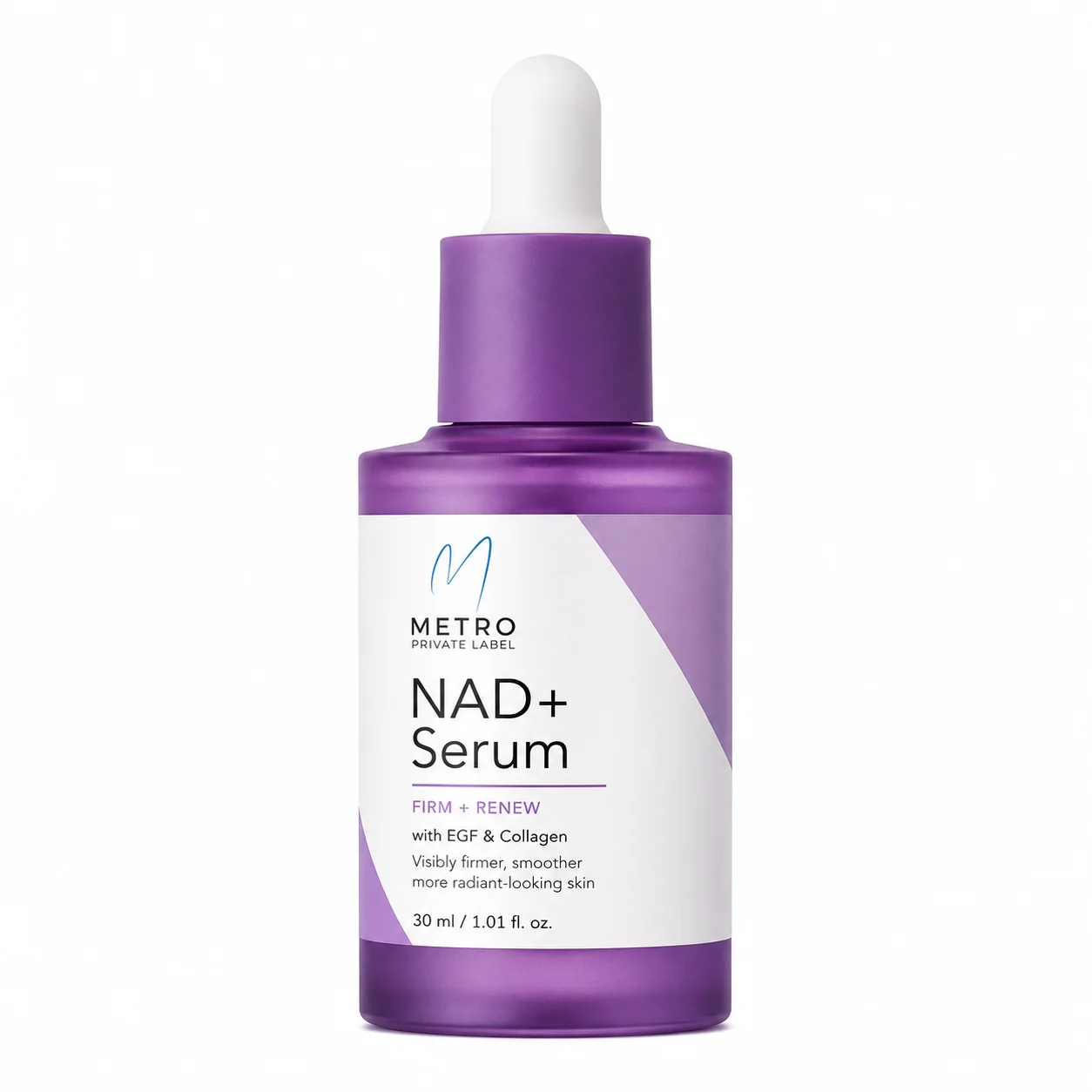
NAD+ Serum
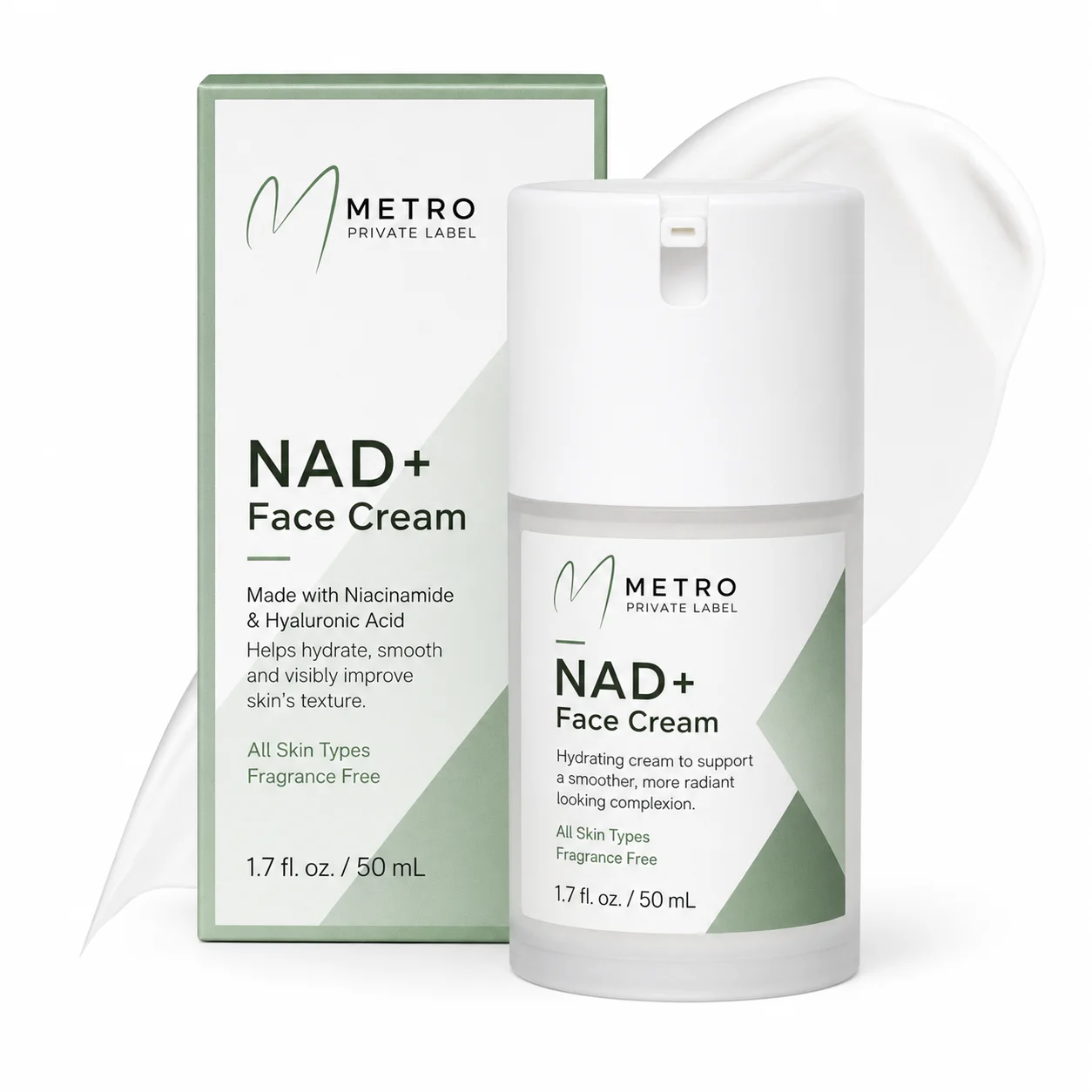
NAD+ Face Cream / Moisturizer
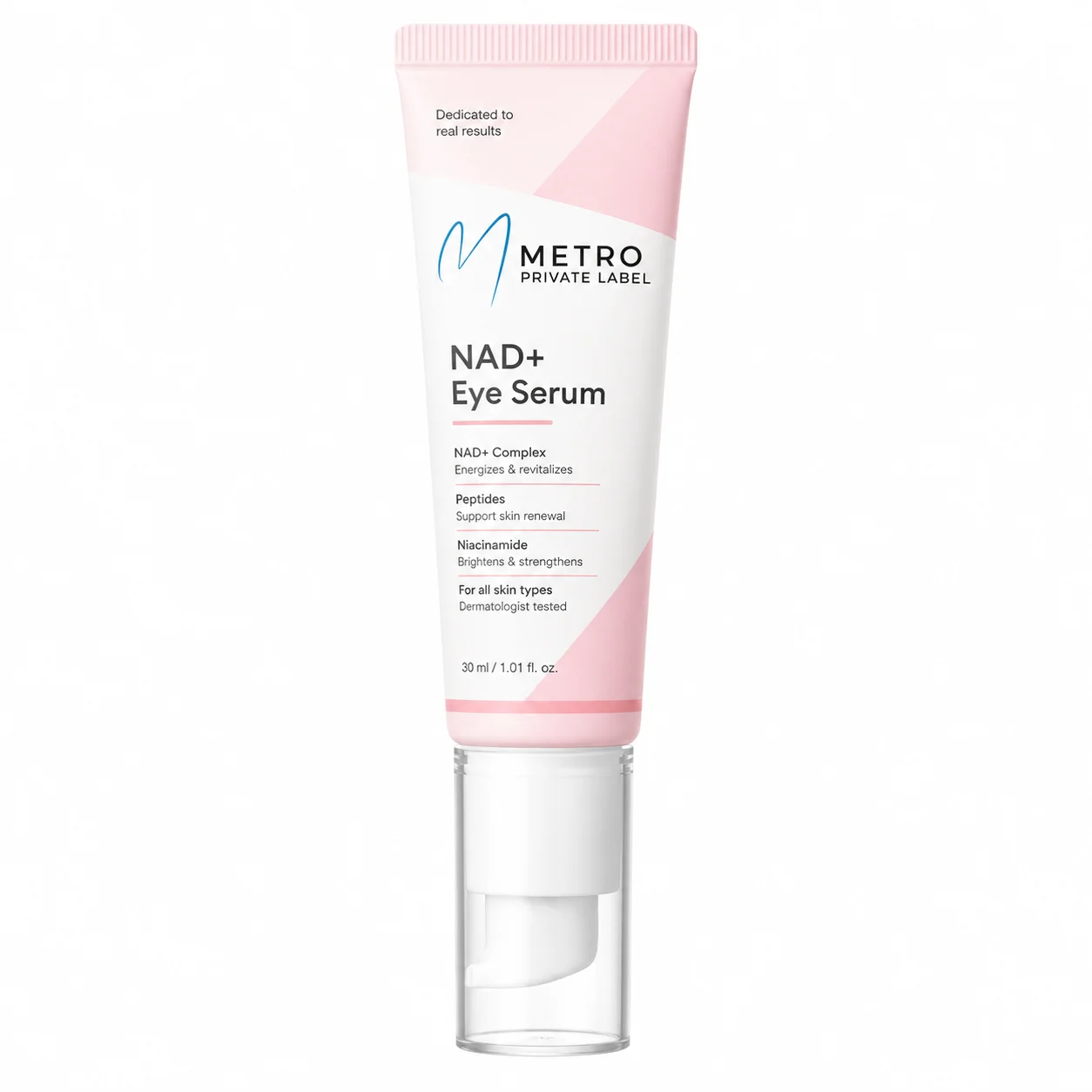
NAD+ Eye Care
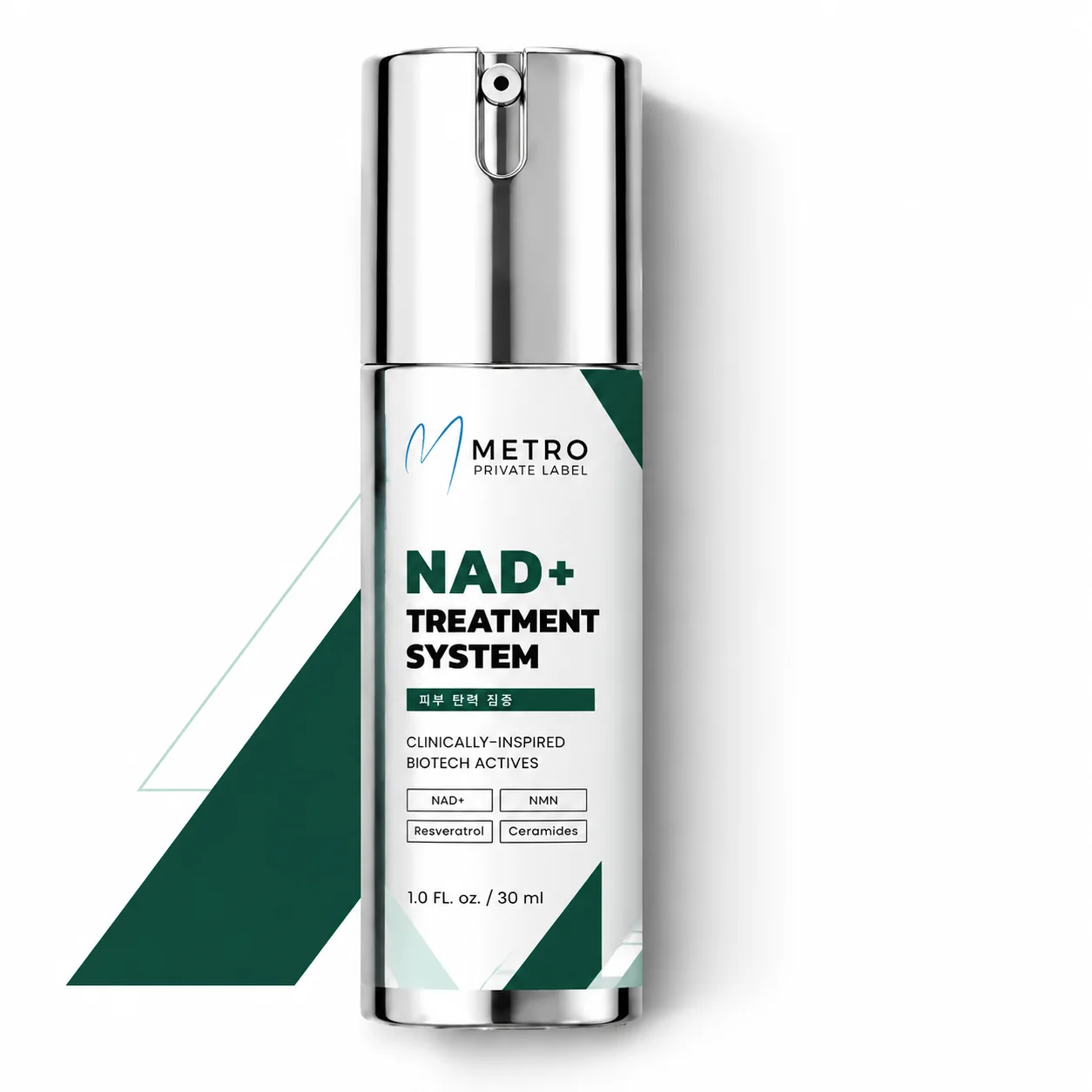
NAD+ Treatment / Ampoule / Booster
Build a Private Label NAD+ Skincare Line That Fits Your Market
If you are looking for a private label NAD+ skincare manufacturer, you are probably not only searching for a factory that can add NAD+ into an existing formula. You may already have an e-commerce brand, skincare business, clinic, or distribution channel and need a product that matches your customers, pricing strategy, brand positioning, and long-term growth plan.
You have come to the right place. At Metro Private Label, we understand that a successful NAD+ skincare product needs a clear commercial purpose behind the formula. A premium NAD+ serum designed as an e-commerce hero SKU, a daily NAD+ cream for repeat customers, and a professional NAD+ treatment product for clinics all require different formulation approaches, textures, packaging choices, and cost structures. Before recommending a formula, we first look at your target market, sales channel, product positioning, and customer expectations to make sure the final product has a realistic path to market.
From what we see in the market, NAD+ skincare performs best when it is developed around a clear skincare concept rather than simply promoting the ingredient itself. Brands are using NAD+ to build stories around advanced anti-aging, skin longevity, firming, barrier support, and premium skincare routines. Depending on your product goals, NAD+ can be combined with Peptides for firming and aging concerns, Ceramides and Ectoin for barrier support, Hyaluronic Acid for hydration, or antioxidant ingredients for a more complete healthy-aging positioning. We help you select the right product format and formulation direction based on what your customers actually need, rather than adding unnecessary ingredients that increase cost without improving the product value.
Our Core Private Label NAD+ Skincare Products
NAD+ Serums: A popular hero product format for Amazon, Shopify, and premium skincare brands. We develop lightweight and concentrated serum concepts focused on anti-aging, firming, hydration, and skin longevity positioning.
NAD+ Face Creams: Daily-use moisturizers and advanced anti-aging creams designed for different markets, climates, skin types, and retail price levels. Suitable for brands looking to build strong repeat-purchase products.
NAD+ Eye Care: Premium eye cream and eye serum formats developed around fine lines, firmness, hydration, and targeted anti-aging concerns. Ideal for brands looking to expand into higher-value skincare categories.
NAD+ Treatment Products: Advanced formats such as ampoules, boosters, and concentrated treatments designed for professional skincare brands, premium beauty lines, and customers seeking intensive anti-aging solutions.
Manufacturing Support for NAD+ Skincare Brands
We understand that developing NAD+ skincare is not only about choosing a trending ingredient. A successful product also depends on formula stability, ingredient compatibility, texture experience, packaging selection, production consistency, and compliance requirements.
Many brands come to us with a product idea but need support answering important questions:
Should NAD+ be the hero ingredient or combined with other actives?
Should the product be positioned as a serum, cream, or professional treatment?
How can the formula achieve a premium feel while maintaining a realistic target cost?
Which packaging format is suitable for stability and customer experience?
At Metro Private Label, we support you throughout the development process, including formula selection, customization, sample development, packaging coordination, stability evaluation, bulk production, and technical documentation such as INCI lists, COA, SDS, and product specifications.
Our goal is simple: to help you transform a NAD+ skincare concept into a market-ready product that fits your brand positioning, meets customer expectations, and provides a reliable foundation for repeat orders and long-term product expansion.

More Than Just a Private Label NAD+ Skincare Manufacturer
At Metro Private Label, we understand that your goal is not simply to add NAD+ to a bottle and launch another anti-aging product. You need a skincare product that fits your customers, supports your target retail price, communicates a clear market position, and has the potential to generate repeat purchases. That is why we look beyond the ingredient itself and focus on the commercial value behind the product before moving into formulation and production.

Develop NAD+ Products Around Your Market Opportunity
We first look at your business model, target customers, sales channel, and the role this product should play in your skincare range. A NAD+ serum designed as an e-commerce hero product, a premium NAD+ cream for a complete anti-aging routine, and a professional NAD+ treatment product for clinics all require different formulation strategies, textures, packaging solutions, and cost structures. We use this information to recommend a product direction that makes sense for your brand instead of creating a formula without a clear market purpose.
Reduce Development Risks Before Production
NAD+ has strong positioning around advanced anti-aging and skin longevity, but the ingredient alone does not guarantee a successful product. Formula stability, ingredient compatibility, texture experience, packaging protection, production consistency, and target cost all need to work together. During the development process, we help review these important factors early to reduce unnecessary formula adjustments, packaging issues, unexpected costs, and delays before mass production.
Create Products Customers Understand and Want to Repurchase
Customers may discover your product because of NAD+, but they decide to repurchase based on the complete product experience. A successful skincare product needs the right balance between ingredient story, visible product benefits, comfortable texture, daily usability, and brand positioning. We help you build NAD+ formulas with complementary ingredients such as Peptides, Ceramides, Ectoin, Hyaluronic Acid, or antioxidants based on your target market and product concept, rather than simply adding more active ingredients.
Build a Long-Term Manufacturing Partnership
From initial formula selection and sample development to packaging coordination, technical documentation, bulk production, and repeat orders, we support the complete private label journey. As your brand grows, we can help you expand from a single NAD+ hero product into a broader anti-aging skincare collection with consistent quality and supply support. This allows you to focus on building your brand, growing your sales channels, and connecting with customers while we manage the manufacturing process behind your products.
Build a Private Label NAD+ Skincare Line Around Your Business Goals
At Metro Private Label, we understand that creating a NAD+ Skincare product is not simply about selecting a trending ingredient, choosing a package, and placing your logo on the label. If you are building a skincare brand, selling through Amazon, Shopify, retail channels, distribution networks, or professional beauty businesses, you need a product that fits your customers, supports your target price, matches your market positioning, and has the potential to become a long-term revenue driver.
Many brands approach us with a clear product idea: a NAD+ anti-aging serum, a firming cream, a premium night treatment, or a complete healthy-aging collection. However, the difference between an idea and a successful product comes from the decisions made before production starts. The right formula needs to match customer expectations, the texture needs to support the brand positioning, the packaging needs to protect the product, and the cost structure needs to make commercial sense. This is where we believe a manufacturing partner should bring experience and guidance—not just production capacity.
Develop Products Based on Your Business Strategy
When we develop a NAD+ Skincare product, we do not start by simply adding more active ingredients or following every market trend. We first understand your customers, sales channel, price range, and the role this product needs to play in your brand.A NAD+ serum for an e-commerce brand may require a strong hero-product concept, an attractive ingredient story, and a competitive cost structure. A premium skincare line may focus more on luxurious texture, advanced active combinations, and packaging experience. A clinic or distributor may need reliable formulas, coordinated product ranges, and consistent supply support.We connect these commercial requirements with realistic formulation options, helping you choose a product direction that has a stronger chance of success in your market.
Make Better Product Decisions Before Mass Production
NAD+ has gained attention as an advanced anti-aging and skin longevity ingredient, but a successful product depends on much more than the ingredient name on the front label.During development, we consider factors such as ingredient compatibility, formula stability, oxidation control, packaging protection, texture experience, production cost, and target concentration. These details can directly affect the final product quality, customer experience, and your overall investment.Our role is not only to produce what you request. We also help identify potential issues early and provide practical recommendations before they become expensive changes during production. By making smarter decisions at the beginning, you can reduce unnecessary sampling, reformulation, packaging adjustments, and launch delays.
Create Products Customers Want to Use Again
Customers may discover your product because of NAD+, but they continue buying because the product fits into their daily skincare routine.That is why we focus on the complete product experience, including texture, absorption, comfort, ingredient synergy, fragrance level, packaging usability, and overall positioning. A lightweight NAD+ serum, a nourishing night cream, an eye treatment, or a professional skincare product should not only sound impressive—it should also feel effective and enjoyable during everyday use.We help brands create NAD+ formulations that combine strong ingredient concepts with practical skincare experiences, making products easier for customers to understand, trust, and repurchase.
Build a Product Foundation for Future Growth
Your first NAD+ product may start as a single hero SKU, but we believe successful brands should think beyond the first launch.A well-positioned NAD+ serum can become the foundation for a broader healthy-aging collection, including creams, eye treatments, night products, cleansers, masks, or advanced treatment formats. By considering your future product expansion from the beginning, we can help create a more consistent brand direction across multiple SKUs.From formula selection and sample development to packaging coordination, technical documentation, bulk production, and repeat-order support, we work as your manufacturing partner throughout the process.
Our goal is to help you create NAD+ Skincare products that are not only possible to manufacture, but also meaningful for your customers, competitive in your market, and capable of supporting long-term brand growth.
FAQs NAD+ Skincare
For your convenience, we’ve gathered the most commonly asked questions about our NAD+ Skincare. However, should you have any further queries, please don’t hesitate to reach out to us.
1. What types of NAD+ Skincare products can you manufacture?
At Metro Private Label, we support a wide range of NAD+ Skincare formats, including NAD+ serums, face creams, night creams, eye creams, facial masks, cleansers, treatment products, and other advanced skincare formats.
You can start with one of our existing mature formulas for a faster launch, or develop a customized product based on your target customers, sales channel, price positioning, and brand concept. We help you choose the format that makes the most commercial sense instead of simply following ingredient trends.
2. Can you help us customize a NAD+ Skincare formula for our brand?
Yes. We understand that every skincare brand has different customers, positioning, and product goals.
We can help adjust the formulation direction based on your needs, including texture, active ingredient combinations, skin benefits, fragrance preference, packaging requirements, and target cost. Whether you are looking for a lightweight NAD+ serum for e-commerce, a premium anti-aging cream, or a professional skincare product for clinics, we work with you to create a formula that fits your market.
3. What is your minimum order quantity (MOQ) for NAD+ Skincare products?
Our standard MOQ usually starts from 1,000 units per SKU, depending on the formula, packaging, and customization requirements.
For brands launching their first product, we can help you evaluate different options to control the initial investment, such as using mature formulas, available packaging solutions, or starting with a focused hero product. Our goal is to help you launch efficiently while keeping future expansion opportunities in mind.
4. How long does it take to develop and produce NAD+ Skincare products?
The timeline depends on whether you choose a ready formula or a fully customized development.
For mature formulas, sampling is usually faster and production can move forward once the sample, packaging, and documents are confirmed. For customized formulas, additional time may be needed for formula adjustment, testing, and stability evaluation.
We normally guide each project through formula confirmation, sample approval, packaging preparation, production, quality inspection, and shipment coordination to help you build a realistic launch schedule.
5. Are your NAD+ Skincare formulas suitable for clean beauty, vegan, or cruelty-free brands?
Yes. Many of our NAD+ Skincare formulas can be developed to support clean beauty positioning, vegan requirements, and cruelty-free market expectations.
We understand that different markets have different ingredient preferences and compliance requirements. During development, we can review your ingredient standards, prohibited lists, and positioning goals to create a formula that better matches your target customers.
6. Can you help with NAD+ Skincare packaging and product design?
Yes. We provide complete packaging support to help turn your formula into a market-ready product.
Our team can assist with packaging sourcing, bottle and jar selection, label printing, box packaging, artwork coordination, and production matching. Whether you are creating a premium anti-aging line with luxury packaging or a practical e-commerce product focused on cost efficiency, we help you find a solution that matches your brand positioning.
7. Do you offer both private label and custom NAD+ Skincare development?
Yes. We support both options.
If you want a faster launch, you can select from our existing NAD+ Skincare formulas and customize branding, packaging, and product presentation. If you have a specific concept, ingredient combination, texture, or market requirement, we can work with you on a customized formulation.
We usually recommend the development approach based on your timeline, budget, sales channel, and long-term brand strategy.
8. What quality testing and documentation do you provide for NAD+ Skincare products?
We understand that brands need more than a finished product—they need confidence in product quality and market preparation.
Depending on the project requirements, we can provide available technical documents such as INCI lists, COA, SDS, product specifications, and other manufacturing-related documents. We also conduct product evaluations, stability considerations, packaging compatibility checks, and quality inspections during production.
Our goal is to help you launch products with a reliable manufacturing foundation.
9. Can you help us create product positioning and ingredient stories for NAD+ Skincare?
Yes. We understand that a successful skincare product needs a clear reason for customers to choose it.
Our experience allows us to help you organize the product concept around different market directions, such as healthy-aging, antioxidant protection, skin recovery, hydration, firmness, or premium skincare routines.
We can also provide ingredient information and technical support to help you communicate the product benefits more clearly while keeping claims realistic and market-appropriate.
10. Do you work with international brands and support global shipments?
Yes. We work with skincare brands, e-commerce businesses, distributors, and professional beauty companies from different markets worldwide.
We support international customers through the complete process, including product development, documentation preparation, packaging coordination, production management, and shipment arrangement.
Whether you are launching your first NAD+ Skincare product or expanding an existing skincare range, we aim to become a reliable manufacturing partner who understands both product quality and business growth.
What we valued most about working with Metro Private Label was their ability to connect product development with our actual market needs. Instead of only discussing ingredients, their team helped us evaluate the product format, texture, packaging direction, and target customer expectations. This made the development process much more efficient and gave us confidence that the final NAD+ skincare product would have a stronger commercial fit.
Amelia Foster, Beauty Product Managerfrom Australia
Metro Private Label provided the kind of support we were looking for from a manufacturing partner. We had a general idea for a premium NAD+ anti-aging product, but their team helped us refine the concept into a more practical formula and production plan. Their honest feedback on ingredients, packaging, and cost structure helped us avoid unnecessary changes before moving forward.
Marcus Bennett, Founder & Brand Consultantfrom United Kingdom
We appreciated how Metro Private Label approached our project with both technical knowledge and commercial awareness. They explained how different formulation choices could influence stability, customer experience, and product positioning. Their support made it easier for us to select the right NAD+ skincare direction for our market instead of simply choosing the most complicated formula.
Charlotte Dubois, Purchasing Managerfrom France
Launching a new skincare product requires many decisions, and Metro Private Label helped make the process much clearer. Their team supported us from formula selection to packaging coordination and provided practical suggestions based on our sales goals. The final NAD+ skincare product matched the quality level and positioning we wanted for our online customers.
Nathan Williams, E-commerce Brand Ownerfrom United Kingdom
We were looking for a manufacturing partner who could understand the needs of professional skincare customers, not just provide a standard formula. Metro Private Label helped us develop a NAD+ product concept that matched our treatment philosophy and customer expectations. Their attention to texture, user experience, and product presentation helped us create something our clients could easily incorporate into their daily skincare routine.
Sophie Laurent, Spa & Wellness Directorfrom Canada


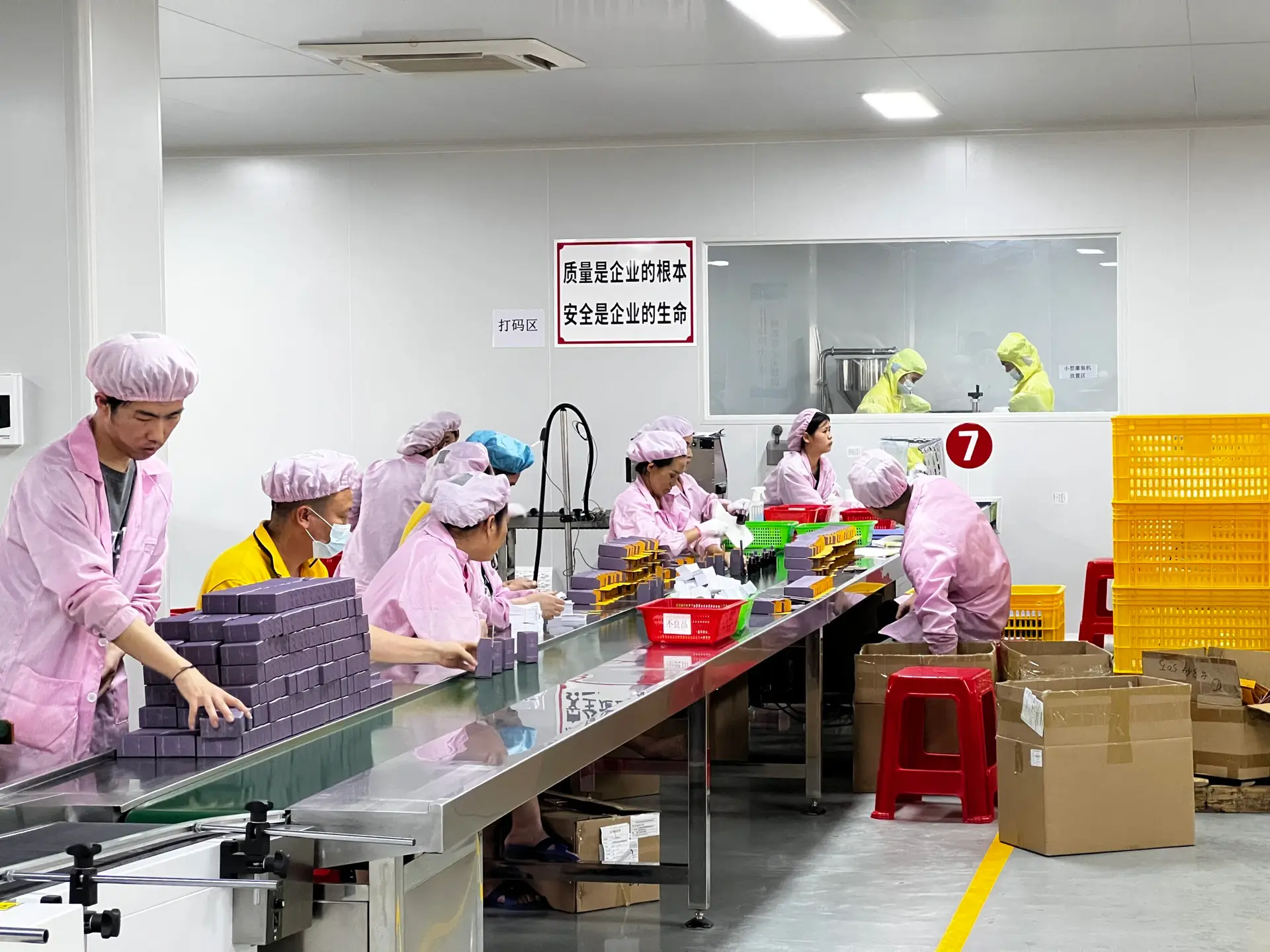




Metro Private Label in Numbers
Happy Clients
0 +
Million-dollar Buyers
0 +
Formulation
0 +
Professional Staffs
0 +
Your Ultimate Guide to NAD+ Skincare
If you’re planning to develop a NAD+ skincare product—whether it’s your first advanced anti-aging SKU or an expansion of an existing healthy-aging range—you’re not simply following another ingredient trend. You’re entering one of the fastest-growing directions in premium skincare, where customers are becoming more interested in skin longevity, advanced aging care, and long-term skin health concepts. NAD+ has gained attention because it allows brands to create products around a more sophisticated anti-aging story while still connecting with everyday skincare routines. When developed with the right formula strategy, texture, packaging, and market positioning, NAD+ skincare can become a repeat-purchase product rather than a short-term trend-driven launch.
Over the past few years, we’ve seen NAD+ skincare move from a niche ingredient concept into a growing category for e-commerce brands, professional beauty channels, aesthetic clinics, and premium skincare businesses. At Metro Private Label, we’ve learned that successful NAD+ products are rarely created by simply adding NAD+ or related ingredients into an existing formula. The brands that perform better usually begin by understanding their target customers, sales channels, product positioning, and commercial goals before making formulation decisions. A premium NAD+ serum, a daily healthy-aging cream, and a professional treatment product may all use the same ingredient direction, but they require completely different approaches in terms of texture, supporting ingredients, packaging, pricing, and customer experience.
This guide is based on what we’ve learned from developing skincare products and supporting brands through different stages of product creation. Instead of only discussing the science behind NAD+, we want to share how NAD+ skincare concepts are transformed into practical market-ready products. From selecting the right product format and building a balanced formula to choosing packaging that protects the product, controlling development costs, preparing technical documentation, and planning future SKU expansion, every decision influences whether a product becomes a sustainable brand asset or simply another skincare launch that struggles to stand out.
Table of Contents
How to Launch a NAD+ Skincare Product From Idea to Market: A Real Brand Development Journey
Launching a NAD+ skincare product is becoming an attractive opportunity for brands entering the healthy-aging and advanced skincare market. However, from my experience working with skincare businesses, many founders underestimate the difference between having a product idea and creating a commercially successful product. A good concept needs to be translated into a clear market position, suitable formula direction, practical packaging solution, realistic cost structure, and a product experience that customers are willing to purchase repeatedly.
When I work with brands developing NAD+ skincare products, I do not start with the ingredient list. I start by understanding the business goal behind the product. Is the brand trying to create an Amazon hero SKU, expand an existing anti-aging range, develop a professional clinic product, or build a premium skincare collection? The answer determines almost every decision that follows, from product format and formulation strategy to packaging and production planning.
Start With Market Positioning Before Developing a NAD+ Formula
Before discussing NAD+ concentration or supporting ingredients, I always encourage brands to define where the product should compete in the market. Many first-time founders believe the strongest product is the one with the most advanced ingredients, but in reality, successful skincare products usually win because customers clearly understand their purpose and value.
For example, a NAD+ serum targeting online customers may need a different approach compared with a professional clinic product. An e-commerce brand may focus on a clear anti-aging story, attractive packaging, and a texture that customers enjoy using daily. A clinic may focus more on treatment support, professional positioning, and customer trust after procedures. Although both products use NAD+ as a key concept, their commercial strategies are completely different.
This is why I spend time understanding the target customer, selling channel, retail price expectation, and long-term product strategy before recommending a development direction. A formula should support the business, not become the business.
Choosing the Right Product Format for Your NAD+ Skincare Concept
The product format is another decision that can strongly influence market performance. When brands approach me, many immediately assume that a NAD+ serum is always the best option because serums are commonly associated with concentrated active skincare. While a serum can be an excellent hero product, it is not the only successful direction.
A NAD+ face cream may work better for customers who prefer a simple daily routine, while a night cream can support a premium recovery concept. Eye treatments can target a more specific anti-aging concern, and professional treatment products can help aesthetic clinics create a complete customer journey beyond in-clinic services.
In my experience, the best format is not determined by the ingredient alone. It depends on customer habits, price positioning, competition, and how the product fits into the overall skincare routine. A product that customers understand and consistently use has a much stronger opportunity to generate repeat purchases.
Formula Development: Creating a Product That Works Commercially
When developing NAD+ skincare formulas, I always focus on balance. A formula needs to be innovative enough to attract attention, but practical enough to manufacture consistently and sell profitably. This is where many brands encounter difficulties because they initially focus too much on adding more active ingredients.
I have seen founders create concepts that include NAD+, peptides, antioxidants, brightening ingredients, repair ingredients, and multiple trending components in one formula because they want to create a “premium” product. However, this often creates challenges. The product message becomes unclear, formulation complexity increases, development costs rise, and the final product may not provide a better customer experience.
A stronger approach is building a formula around a clear purpose. If the product is positioned as a healthy-aging serum, every ingredient should support that story. If it is designed for barrier support, hydration and comfort may become more important. The goal is not to create the most complicated formula; the goal is to create the most suitable formula for the intended customer.
Case Study: From an Anti-Aging Concept to a Commercial NAD+ Serum
One NAD+ skincare project I worked on started with a founder who wanted to create a premium anti-aging serum for customers interested in advanced skincare. The initial concept was ambitious because the founder wanted to combine NAD+ with many popular active ingredients to create a highly differentiated product.
During the development discussion, I noticed that the biggest challenge was not the ingredient quality but the overall product strategy. By adding too many active ingredients, the product story became difficult to communicate. Customers could see many ingredients on the label, but they could not immediately understand the main reason why they should choose this product.
At the same time, the formula complexity increased the development cost and created additional stability considerations. When we reviewed the target retail price and expected margin, it became clear that the original concept would make the product harder to position commercially.
Instead of continuing to increase formula complexity, I suggested simplifying the direction and focusing on a clearer healthy-aging concept. We adjusted the ingredient strategy, reviewed packaging compatibility, and aligned the product design with the target customer and sales channel.
The final result was not the product with the longest ingredient list, but a more balanced NAD+ serum concept that had a clearer market message, stronger commercial feasibility, and better potential for long-term brand development.
This experience reflects something I often share with skincare founders: a successful product is not created by adding everything possible into one bottle. It is created by making the right decisions at every stage, from market positioning to final production.
NAD+ Serum vs Peptide Serum: How Skincare Brands Choose the Right Anti-Aging Positioning
When skincare brands explore new anti-aging product opportunities, one of the most common questions I hear is whether NAD+ serum or peptide serum represents the better investment direction. Many founders and product managers search for comparisons because they want to understand whether NAD+ is a meaningful long-term skincare opportunity or simply another ingredient trend that will disappear after market attention shifts.
From my experience working with skincare brands, I believe this question is often approached from the wrong angle. The decision between NAD+, peptides, retinol, or other active ingredients is not only a formulation decision. It is a commercial positioning decision. A successful skincare product is not created because it contains the most popular ingredient; it succeeds because the ingredient story matches customer expectations, market demand, selling channels, and the overall brand strategy.
When I evaluate an anti-aging skincare concept, I do not start by asking which ingredient is trending. I first look at who the target customer is, what problem the product is solving, how the product will be marketed, and where it will be sold. A premium DTC skincare brand, an Amazon beauty operator, an aesthetic clinic, and an established skincare company expanding its range may all need completely different product directions even if they are targeting the same anti-aging category.
NAD+ vs Peptides: Different Ingredients, Different Market Stories
The biggest difference between NAD+ and peptides is not simply their technical function in a formula; it is the consumer story they create. NAD+ is usually positioned around skin longevity, advanced aging care, and science-driven skincare concepts, while peptides are more commonly associated with firmness, elasticity, and collagen-support positioning. Understanding this difference helps brands decide which ingredient direction fits their customers and commercial goals.
When I look at NAD+ skincare opportunities, I see a category that is attracting attention from customers who are interested in the future of skincare, prevention-focused routines, and advanced healthy-aging concepts. NAD+ allows brands to create a more premium and innovative product story because consumers increasingly want skincare that feels supported by scientific research and modern biotechnology. This positioning can work particularly well for brands that want to move beyond traditional anti-aging claims and create a more differentiated market identity.
However, I also believe brands need to be realistic about NAD+. NAD+ does not automatically replace every other active ingredient, and simply adding NAD+ to a formula does not guarantee commercial success. Customers may initially notice a product because NAD+ appears on the label, but they continue purchasing because the product provides a satisfying experience, fits their daily routine, and communicates a clear benefit. The strongest NAD+ products are usually those where the ingredient supports a complete product concept rather than becoming the only marketing message.
Peptides represent a different commercial opportunity. Because peptide skincare has already gained strong consumer awareness, many customers immediately connect peptides with firming, anti-aging, and skin-support benefits. For brands that want a more familiar entry point into the premium anti-aging market, peptides can provide an easier communication path. Customers generally understand what peptide products are designed for, which can reduce the education required before purchase.
At the same time, the peptide market is highly competitive. Many brands already use peptide claims, so the challenge becomes differentiation. A peptide serum cannot rely only on the ingredient name; it needs a stronger product story through formulation design, texture, packaging, target customer positioning, and overall brand experience.
Choosing Between NAD+, Peptides, Retinol, and Hyaluronic Acid Based on Customer Needs
When brands compare anti-aging ingredients, I usually recommend looking at the customer expectation behind each category rather than simply comparing ingredient popularity. Different ingredients naturally create different product positioning, and choosing the right direction depends on the role the product needs to play in the market.
NAD+ is often connected with skin longevity, advanced aging care, and premium science-focused skincare. Peptides are commonly associated with firmness, elasticity, and collagen-support concepts. Retinol has a long-established reputation around renewal, skin texture improvement, and traditional anti-aging performance. Hyaluronic acid is strongly connected with hydration, moisture retention, and a plumping skin experience.
This means there is no universal answer to which ingredient is “best” for an anti-aging skincare brand. A premium skincare company targeting educated consumers may benefit from the advanced positioning of NAD+. A brand looking for a broader consumer appeal may find peptides easier to communicate. A professional clinic may combine multiple ingredient stories to create a treatment-based skincare routine. The ingredient choice should always support the customer journey rather than simply follow market excitement.
I often see brands make the mistake of selecting ingredients first and trying to build a customer story afterward. They may decide to launch NAD+, peptides, or another trending active because competitors are doing it, but they have not considered why their own customers would choose this product. The strongest brands usually work in the opposite direction: they identify their customer, understand the customer’s concern, and then select the ingredient direction that creates the strongest commercial connection.
Real Industry Insight: Why Brands Fail When They Sell Ingredients Instead of Solutions
One pattern I have repeatedly observed in skincare product development is that many brands focus too heavily on ingredient lists while ignoring the actual customer buying decision. A long ingredient list may look impressive internally, but customers do not purchase products because they understand every ingredient inside the formula. They purchase because they believe the product can improve their skincare routine and solve a specific concern.
I remember working with a skincare entrepreneur who initially wanted to create a premium anti-aging serum by combining NAD+, multiple peptides, several antioxidants, and various trending botanical extracts into one formula. The original idea was that more active ingredients would create a stronger product. However, during development, we discovered that the product story became unclear. The formula became more complex, the cost increased, and it became difficult to explain the main benefit to customers.
Instead of continuing to add ingredients, the development direction was adjusted. The focus shifted toward creating a clear healthy-aging concept with NAD+ as the hero ingredient, supported by carefully selected complementary ingredients that matched the target customer expectations. Packaging was also reviewed because the formula positioning required a premium presentation and sufficient protection during storage and transportation. By simplifying the concept, the final product became easier to manufacture, easier to market, and more aligned with the intended retail positioning.
This example reflects a common reality in the skincare industry: successful products are not always the ones with the most complicated formulas. They are the products where the ingredient strategy, customer expectation, price positioning, and daily user experience work together.
How I Evaluate NAD+ Skincare Opportunities for Long-Term Brand Growth
When I help brands evaluate whether NAD+ skincare is the right direction, I look beyond the first product launch. A successful hero product should have the potential to become the foundation of a wider skincare range. A NAD+ serum may later expand into a night cream, eye treatment, moisturizer, or professional treatment product depending on customer response and market opportunity.
The most important question is not whether NAD+ is better than peptides or whether one ingredient will dominate the market. The more valuable question is whether the product concept creates a clear reason for customers to choose it, use it consistently, and purchase again.
From my perspective, the future of anti-aging skincare will not be defined by one single ingredient. Brands that succeed will be those that understand customer needs, build meaningful product stories, and create formulas that balance innovation with practical everyday use.
NAD+ provides an exciting opportunity because it represents a new direction in healthy-aging skincare, but its commercial value depends on how intelligently brands position and develop the product. The ingredient creates interest, but the complete product experience creates long-term success.
How Much Does It Cost to Develop a Private Label NAD+ Skincare Product?
When brands search for “NAD+ serum manufacturing cost” or “private label skincare cost,” they are usually trying to understand one important business question: how much investment is required before they can bring their product idea to market? From my experience working with skincare entrepreneurs, I find that many new founders initially expect a simple answer, such as a fixed cost per bottle or a standard development fee. However, the reality is that NAD+ skincare development involves multiple decisions that directly influence the final investment, including formula complexity, active ingredient selection, packaging strategy, minimum order quantity, testing requirements, documentation, and production scale.
I always explain to brands that developing a skincare product is not simply about manufacturing a formula and putting it into a container. A commercially successful NAD+ product needs to fit the target customer, selling channel, retail price, and long-term brand strategy. A first-time entrepreneur launching an online serum brand may need to control initial investment and reduce inventory risk, while an established skincare company may focus more on customization, premium packaging, and product differentiation. The right development approach depends on the business goal behind the product.
When I evaluate a NAD+ skincare project, I do not start with the question “How much is the cheapest way to make this product?” Instead, I look at where investment creates real customer value and where unnecessary complexity can increase cost without improving the commercial opportunity.
Understanding What Determines NAD+ Skincare Development Cost
The total cost of developing a NAD+ skincare product is influenced by how much customization and market positioning a brand wants to achieve. Formula development is usually one of the first factors to consider because it determines both the uniqueness of the product and the complexity of bringing it into production. Some brands choose an existing mature NAD+ formula with small modifications, allowing them to launch faster and reduce development uncertainty. Others want a completely customized formula with unique ingredient combinations, textures, claims direction, or sensory experience, which naturally requires more development work and evaluation.
From my experience, customization should always have a clear commercial reason. I have seen brands add multiple trending ingredients because they believe a longer ingredient list creates a stronger product, but this often creates unnecessary challenges. A more complicated formula may increase raw material costs, stability evaluation requirements, production difficulty, and development time, while making the product story harder for customers to understand. The strongest formulas are usually not the ones with the most ingredients; they are the ones where every ingredient supports the target customer, product positioning, and expected retail price.
For NAD+ skincare, the formula direction should be connected to the customer story. A premium healthy-aging serum may combine NAD+ with carefully selected supporting ingredients to create an advanced skincare concept, while a more accessible daily serum may focus on a simpler and easier-to-understand positioning. The development cost should always support the business objective rather than simply increase technical complexity.
How Active Ingredients Influence Product Investment
When brands develop NAD+ skincare, many founders focus on the cost of NAD+ itself, but the real formula investment usually comes from the complete ingredient system. NAD+ can be positioned as the hero ingredient, but the final product experience depends on how it works together with supporting ingredients, texture, stability, and customer expectations.
In my experience, the most successful anti-aging products are rarely built around one ingredient alone. They are developed around a clear consumer benefit. A NAD+ serum targeting advanced healthy-aging customers may include supporting ingredients related to hydration, antioxidant protection, or skin barrier support. However, every additional active ingredient needs to be evaluated from both a technical and commercial perspective. The question is not whether another ingredient can be added; the question is whether that ingredient improves the product enough to justify the additional cost.
This is especially important for new brands with limited launch budgets. Investing heavily in unnecessary formulation complexity can reduce resources available for packaging, marketing, inventory, and customer acquisition. A commercially balanced formula often provides a stronger foundation for long-term growth than an expensive formula that customers do not fully understand.
Packaging Decisions Can Change the Overall Product Cost
Packaging is another major factor that influences NAD+ skincare development cost because it affects not only manufacturing expense but also brand perception. Many first-time entrepreneurs focus heavily on the formula but underestimate how strongly packaging influences customer expectations, especially in the premium skincare market.
A NAD+ serum positioned as an advanced anti-aging product may require packaging that communicates quality while also protecting formula performance. Standard glass dropper bottles with customized labels can be a practical choice for brands testing the market because they provide a professional appearance without excessive upfront investment. On the other hand, brands targeting a luxury skincare audience may choose customized bottles, premium finishing, upgraded cartons, or special packaging details to support a higher retail price.
I usually recommend brands consider packaging as part of their commercial strategy rather than simply a production requirement. The right packaging decision depends on the customer profile, selling channel, and price positioning. A premium package may create stronger customer perception, but it only makes sense if the target market is willing to support the higher product value.
How MOQ and Production Scale Affect Your Investment
Minimum order quantity is one of the most important considerations for new skincare brands because it directly affects both unit cost and financial risk. Many first-time entrepreneurs want to start with the lowest possible quantity because they are still testing market acceptance. While smaller production runs reduce inventory pressure, the unit cost is usually higher because manufacturing preparation, packaging purchasing, and production processes are spread across fewer units.
As production volume increases, brands can usually achieve better cost efficiency through improved purchasing and manufacturing optimization. However, I always advise brands not to focus only on achieving the lowest possible unit price. Producing too much inventory before confirming customer demand can create unnecessary cash flow pressure and limit future product adjustments.
For many new NAD+ skincare brands, a balanced approach is often more practical: start with a manageable MOQ, validate customer response, collect market feedback, and increase production volume once the product demonstrates commercial potential. The goal is not only to reduce production cost but to create a sustainable business model.
Testing, Documentation, and Compliance Considerations
Another important cost factor that brands often overlook is testing and technical documentation. A skincare product entering commercial markets requires more than an attractive formula and packaging design. Brands need confidence that the product is stable, safe, and supported by the appropriate technical information.
Depending on the target market and sales channel, brands may require documents such as ingredient information, product specifications, COA, SDS, stability evaluation, and other supporting materials. These elements may not be visible to the end customer, but they play an important role when working with distributors, retailers, or expanding into new markets.
From my perspective, investing in proper technical preparation during development can prevent larger problems later. Product delays, formula adjustments, packaging incompatibility, or missing documentation can create additional costs after launch. Planning these requirements early helps brands build a stronger foundation for long-term growth.
Example Development Scenario: Launching a First NAD+ Serum SKU
To understand how these decisions influence cost, I often use the example of a first-time entrepreneur launching one NAD+ serum SKU with an initial quantity of 1,000 units. The founder wants a premium-looking product but also needs to control investment because the brand is still validating market demand.
In this situation, choosing an existing NAD+ serum formula with targeted modifications can be a practical starting point. Instead of developing a completely new formula from zero, the brand can adjust specific elements such as texture, supporting ingredients, fragrance preference, or positioning direction while benefiting from an existing formulation foundation. This approach can reduce development time and lower the risk associated with creating an entirely new product.
For packaging, the brand may begin with standard premium packaging, such as a quality glass bottle, customized label, and carton design. This allows the product to look professional while maintaining a reasonable initial budget. If the product performs well, the brand can later upgrade to more customized packaging for future production runs.
Another option is investing in premium packaging from the beginning. A customized bottle design, luxury finishing, and enhanced packaging experience can help support a higher retail price and stronger brand positioning. However, this approach requires more upfront investment and makes more sense for brands that already understand their target customers and market positioning.
The difference between these approaches is not simply cost. It is about choosing the right level of investment based on business objectives. A new entrepreneur may prioritize flexibility and lower risk, while an established brand may prioritize differentiation and premium presentation.
How I Recommend Brands Plan Their NAD+ Skincare Investment
When brands ask me about NAD+ skincare development costs, I believe the most important question is not “How cheaply can we produce this product?” The better question is “Where should we invest to create real customer value and long-term business potential?”
A successful NAD+ skincare product requires balance between formula strategy, packaging experience, production planning, and market positioning. Spending more money does not always create a better product, and reducing cost does not always create a stronger business. The brands that perform well are usually those that understand which decisions influence customer perception and which investments create meaningful commercial advantages.
NAD+ skincare represents an exciting opportunity because it connects with the growing interest in healthy-aging and science-driven beauty. However, the success of a product depends on much more than the ingredient itself. By making thoughtful decisions throughout development, brands can create products that are practical to manufacture, easier to market, and capable of supporting long-term growth.
Common Mistakes Brands Make When Launching NAD+ Skincare Products
When brands search for “NAD skincare product mistakes” or “why skincare products fail,” they are usually not looking for another explanation of ingredients. They are looking for practical lessons that can help them avoid wasting time, money, and resources during product development. From my experience working with skincare brands, I have seen many promising concepts struggle not because the ingredient idea was wrong, but because important commercial decisions were made too late.
Launching a NAD+ skincare product requires more than choosing a trending active ingredient and creating attractive packaging. A successful product needs the right balance between formulation strategy, customer expectations, packaging performance, production feasibility, and sales channel requirements. Many mistakes happen because brands focus on one part of the product while overlooking how every decision affects the final commercial outcome.
I often tell founders that skincare development is not only a manufacturing process; it is a decision-making process. The choices made at the beginning of development will influence product cost, launch timeline, customer perception, and long-term scalability. Understanding common mistakes before starting can help brands create products that are not only exciting at launch but also sustainable in the market.
Mistake 1: Adding Too Many Active Ingredients Without a Clear Product Strategy
One of the most common mistakes I see in NAD+ skincare development is the belief that adding more active ingredients automatically creates a stronger product. Many brands approach development with a list of popular ingredients they want to include, such as NAD+, peptides, antioxidants, botanical extracts, vitamins, and multiple skin-support ingredients. The intention is understandable because brands want to create a premium and powerful formula, but more ingredients do not always create more customer value.
From a commercial perspective, a product needs a clear reason for customers to choose it. When too many active ingredients are combined into one formula, the product story can become confusing. Instead of communicating one strong benefit, the brand may end up explaining many different benefits without a clear focus. Customers may see a long ingredient list, but they may not understand whether the product is mainly for healthy aging, firming, hydration, barrier support, or another skincare concern.
From a formulation perspective, increasing the number of active ingredients can also create additional challenges. Every ingredient needs to work together in terms of compatibility, stability, texture, and overall performance. Some active ingredients may require specific formulation conditions, and combining multiple sensitive ingredients can increase the difficulty of creating a stable product. This can lead to longer development time, additional sample adjustments, and higher production costs.
I have worked with brands that initially wanted to create a “maximum active” anti-aging serum because they believed a more complex formula would justify a premium price. During development, we often found that simplifying the concept created a stronger commercial product. By selecting NAD+ as the hero ingredient and adding only supporting ingredients that matched the target customer, the product became easier to explain, easier to manufacture, and more aligned with the brand positioning.
The goal of a NAD+ skincare product should not be creating the longest ingredient list. The goal should be creating a formula where every ingredient has a clear purpose and supports the customer experience.
Mistake 2: Choosing Packaging Before Understanding Formula Requirements
Another mistake I frequently see is brands selecting packaging based only on appearance before understanding the technical requirements of the formula. Packaging is an important part of skincare branding, especially for premium anti-aging products, but it is not only a design decision. The packaging needs to protect the formula, support product performance, and create a positive user experience.
Many founders begin with a beautiful bottle design because they want the product to look premium. However, some formulas have specific requirements related to light exposure, oxidation, air contact, dispensing method, and ingredient stability. A packaging choice that looks attractive during the design stage may create problems later if it does not match the formula characteristics.
For NAD+ skincare products, this consideration is especially important because brands often position these products around advanced skincare technology and premium performance. The packaging experience needs to support that positioning while also protecting the product during storage, transportation, and daily use. A package that does not dispense the product properly, allows unnecessary exposure, or creates difficulty for customers can negatively affect the overall brand experience.
I have seen situations where brands invested significant time creating packaging designs but later needed to adjust their choices because the formula performance required different protection. These changes can create additional costs, delays, and unnecessary development work. This is why I believe formula direction and packaging strategy should be considered together from the beginning.
The best packaging decision is not always the most expensive option. It is the option that balances product protection, customer expectations, manufacturing practicality, and brand positioning. A well-designed package should support the formula rather than create limitations for it.
Mistake 3: Developing Products Without Considering the Sales Channel
One of the biggest reasons skincare products fail is that brands develop a product first and think about the sales channel afterward. In reality, the product concept, formula, packaging, pricing, and marketing message should be influenced by where the product will be sold.
A NAD+ serum designed for Amazon, for example, may require a different strategy from a product developed for a premium DTC website, aesthetic clinic, or distributor network. Amazon customers often compare products quickly based on price, reviews, benefits, ingredients, and visual presentation. The product needs a clear message that customers can understand within a short decision-making process.
A DTC skincare brand may have more opportunity to educate customers through storytelling, brand philosophy, ingredient education, and a complete skincare routine. In this situation, a more premium concept with stronger brand differentiation may be valuable because the customer relationship is built over time.
Aesthetic clinics often have different requirements because the product needs to fit professional recommendations and post-treatment skincare routines. The texture, positioning, packaging, and product explanation may need to support a professional environment rather than only consumer marketing.
Distributors may focus more on commercial practicality, including price structure, product consistency, documentation, packaging requirements, and the ability to expand into multiple SKUs.
I often remind brands that there is no universally perfect NAD+ skincare formula. The right product depends on who will sell it, who will buy it, and how the customer will understand its value. A product designed without considering the sales channel may look impressive but struggle to achieve commercial success.
Mistake 4: Focusing on the Ingredient Trend Instead of the Customer Problem
Another mistake I often observe is brands developing products around an ingredient trend instead of a customer need. NAD+ has gained attention because consumers are increasingly interested in healthy aging, advanced skincare technology, and science-driven beauty. However, the ingredient itself is not the reason customers continue purchasing a product.
Customers purchase because they believe the product fits their skincare goals and lifestyle. They want to know how the product fits into their routine, why they should use it, and what makes it different from other products they already know.
A successful NAD+ product requires translating the ingredient into a meaningful customer benefit. For one brand, the story may focus on advanced healthy-aging skincare. For another, it may focus on premium daily treatment. For another, it may become part of a professional skincare program.
The strongest brands understand that ingredients create interest, but product positioning creates demand.
Mistake 5: Underestimating the Importance of Long-Term Product Planning
Many new brands focus entirely on the first product launch and do not consider what happens after the initial SKU. However, skincare brands are rarely built around only one product. A successful hero product often becomes the foundation for future expansion.
When developing a NAD+ serum, I encourage brands to consider how the product may connect with future products, such as moisturizers, eye treatments, night creams, or complete healthy-aging routines. This does not mean creating multiple products immediately, but it means making decisions that allow future growth.
For example, choosing a consistent packaging style, defining a clear ingredient philosophy, and building a recognizable product story can make future expansion easier. Brands that think beyond the first purchase order often create stronger long-term opportunities.
How I Recommend Brands Approach NAD+ Skincare Development
When I look at successful NAD+ skincare launches, I rarely see products succeed because they simply followed the latest ingredient trend. The stronger examples usually come from brands that made thoughtful decisions early: they understood their customer, selected a focused formula direction, chose suitable packaging, and developed a product that matched their sales channel.
The biggest lesson I have learned from working with skincare businesses is that avoiding mistakes is often more valuable than adding more features. A product does not become stronger because it is more complicated. It becomes stronger when every decision supports the same commercial goal.
NAD+ represents an exciting opportunity in the healthy-aging skincare market, but success depends on how brands transform the ingredient into a complete customer experience. By avoiding common development mistakes and making decisions based on market reality, brands can create products that are easier to launch, easier to sell, and more capable of generating long-term growth.
NAD+ Skincare Product Development Guide: How to Choose the Right Formula Direction
When brands search for “NAD skincare formulation guide,” they are usually trying to answer a deeper question: how do I turn NAD+ from a trending ingredient into a commercially successful skincare product? From my experience working with skincare businesses, I have found that many founders understand the marketing potential of NAD+ but are uncertain about what happens after selecting the ingredient. They want to know which supporting ingredients make sense, what type of product format fits their customers, how to balance performance and cost, and how to avoid creating a formula that looks impressive on paper but fails commercially.
I believe the most important part of NAD+ skincare development is not simply adding a powerful ingredient into a serum or cream. A successful formula needs to connect three different areas: ingredient science, customer expectations, and commercial positioning. A premium anti-aging serum, a daily healthy-aging moisturizer, and a professional clinic treatment product may all include NAD+, but the formulation strategy behind each product should be completely different. The right direction depends on who will use the product, where it will be sold, and what problem the product is designed to solve.
Understanding the Role of NAD+ in Modern Skincare Formulation
Before developing any NAD+ skincare product, I always recommend brands first understand what role NAD+ should play inside the overall product concept. NAD+ has attracted attention because it is associated with skin longevity, advanced aging care, and science-driven skincare positioning. However, from a formulation perspective, NAD+ is not a replacement for every other active ingredient, and it does not automatically create a successful product simply because it appears on the label.
In many conversations with brands, I notice a common misunderstanding: they believe the hero ingredient alone creates the product value. In reality, customers rarely repurchase a product only because of an ingredient name. They continue using products because the formula feels comfortable, fits their daily routine, matches their expectations, and delivers a complete skincare experience. NAD+ provides a strong product story, but the supporting formulation, texture, packaging, and positioning determine whether that story becomes commercially meaningful.
For example, a brand targeting premium anti-aging customers may use NAD+ as part of a skin longevity concept, while another brand targeting younger consumers may position the same ingredient around maintaining skin quality and preventive care. The ingredient direction may be similar, but the product strategy and formula priorities can be completely different.
Choosing Supporting Ingredients That Create a Clear Product Story
One of the most important decisions during NAD+ skincare development is selecting supporting ingredients that strengthen the formula without making the product confusing. I often see brands trying to include every trending ingredient because they believe a longer ingredient list creates a more premium product. However, more ingredients do not always create more value. In many cases, a focused formula with a clear purpose creates a stronger market position.
For a premium NAD+ anti-aging serum, combining NAD+ with peptides and barrier-support ingredients can create a more complete healthy-aging concept. NAD+ supports the advanced skincare story, peptides help communicate firming and skin-quality benefits, while barrier-support ingredients improve comfort and daily usability. This type of formula direction is often suitable for brands selling through premium e-commerce channels where customers expect both scientific credibility and an enjoyable skincare experience.
For a daily healthy-aging cream, the formula direction may be different. Instead of focusing heavily on treatment-style ingredients, the priority may shift toward hydration, softness, skin comfort, and long-term routine use. A customer who purchases a daily moisturizer may not be looking for an intensive treatment product; they may want a reliable product that supports healthier-looking skin over time.
This is why I believe formula development should begin with the customer journey rather than the ingredient trend. The question is not “what ingredients can we add?” but “what product experience does this customer actually need?”
Developing a Premium NAD+ Serum With Advanced Anti-Aging Positioning
A premium NAD+ serum is one of the most common product directions brands explore because serums are often viewed as concentrated treatment products and can support higher-value positioning. However, creating a premium serum requires more consideration than simply increasing active ingredients.
When I evaluate this type of project, I look at how the formula communicates value from the first application. Premium customers expect a product that feels sophisticated, absorbs comfortably, layers well with other skincare products, and matches the price they are paying. This means the formulation needs to balance active ingredients with sensory performance.
A NAD+ serum combined with peptides and barrier-support ingredients can create a strong positioning because it connects advanced skincare science with practical daily use. However, the formula still needs discipline. Adding too many peptides, antioxidants, botanical extracts, and functional ingredients can increase development complexity, raise production costs, and make the final marketing message less clear.
In my experience, successful premium skincare products are not necessarily the products with the most complicated formulas. They are usually the products where every ingredient has a clear purpose and contributes to a consistent customer experience.
Creating a Daily Healthy Aging Cream Around Comfort and Routine Use
A daily NAD+ cream requires a different approach because the product needs to become part of the customer’s everyday habit. Unlike a concentrated serum that may be positioned as a treatment step, a cream often needs to provide comfort, hydration, and long-term usability.
When developing this type of product, I focus more on the balance between performance and user experience. Customers using a daily cream expect a pleasant texture, smooth application, suitable absorption, and compatibility with their existing skincare routine. A formula that feels too heavy may limit usage, while a formula that feels too light may not meet expectations from customers seeking premium anti-aging care.
For this reason, NAD+ creams are often developed with hydration-focused ingredients and barrier-support systems. The goal is not only to communicate advanced skincare technology but also to create a product customers naturally want to use every morning or evening.
I often explain to brands that repeat purchases are created through consistency. A customer may discover a product because of NAD+, but they continue buying because the product fits into their lifestyle.
Developing Professional NAD+ Products for Aesthetic Clinics
Professional clinics usually approach skincare products from a different perspective because their customers rely on expert recommendations. In this environment, the product needs to support professional credibility, treatment positioning, and a clear explanation from practitioners.
When I work on clinic-focused concepts, I consider how the product fits into the overall customer experience. A clinic product does not always need the largest number of active ingredients. Instead, it needs a clear purpose, reliable quality, professional presentation, and a formula that practitioners feel confident recommending.
NAD+ can work well in this category because it supports a science-based healthy-aging story. However, the product still needs to be practical for real-world use. The texture, packaging format, instructions, and product positioning all influence whether customers understand the value behind the product.
A successful professional skincare product is not only about formulation performance. It is also about helping professionals communicate why the product belongs in their clients’ skincare routines.
Why Texture, Stability, and Packaging Matter in NAD+ Formula Development
One area that many new brands underestimate is the relationship between formulation, packaging, and stability. A skincare product is not successful simply because the ingredient selection looks impressive. The formula must remain stable throughout production, transportation, storage, and customer usage.
During NAD+ product development, I pay close attention to factors such as ingredient compatibility, oxidation risks, packaging protection, and overall product stability. These details can directly influence product quality and customer satisfaction. A formula that performs well during initial testing but changes during storage can create significant commercial problems after launch.
Texture is equally important because skincare is a sensory product. Customers judge products through application experience. Absorption speed, skin feel, finish, and comfort all influence whether they continue using the product.
This is why professional formula development requires both technical knowledge and market understanding. The best formula is not only scientifically interesting; it also needs to perform reliably in the customer’s daily routine.
How Brands Should Choose the Right NAD+ Formula Direction
When choosing a NAD+ skincare formula direction, I believe brands should focus less on chasing ingredient popularity and more on building a product with a clear commercial purpose. The right formula depends on the target customer, sales channel, price positioning, and long-term brand strategy.
A premium anti-aging serum may benefit from NAD+ combined with peptides and barrier support to create an advanced treatment concept. A daily healthy-aging cream may focus more on hydration and comfort to encourage consistent use. A professional clinic product may require a stronger treatment-oriented story supported by practitioner confidence.
The most successful NAD+ skincare products are created when science, customer needs, and commercial strategy work together. NAD+ provides an exciting opportunity for brands entering the healthy-aging category, but the ingredient itself is only the beginning. The real value comes from transforming that ingredient into a product customers understand, enjoy using, and are willing to purchase again.
How Aesthetic Clinics Can Create a NAD+ Skincare Homecare Product Line
When aesthetic clinics search for “clinic skincare product line development,” they are usually looking for more than another retail product to place at the reception counter. From my experience working with skincare businesses, I have found that many clinics already have valuable customer trust, professional treatment experience, and direct relationships with clients, but they often miss the opportunity to continue supporting customers after they leave the clinic. A well-developed NAD+ skincare homecare line can help clinics extend the treatment experience into daily routines, create additional revenue opportunities, and build stronger long-term relationships with their clients.
I believe the most successful clinic skincare products are not created by simply putting a professional logo on a standard formula. They are built around the customer journey. A client does not visit an aesthetic clinic only to purchase a product; they come because they trust professional advice and want visible improvement. The role of a NAD+ skincare homecare line is to continue that professional guidance between treatments, helping customers maintain their skincare goals while giving clinics a stronger connection with their clients beyond the treatment room.
Transforming Professional Treatments Into Daily Skincare Routines
For many aesthetic clinics, the customer journey traditionally ends after the treatment session. A client receives a professional facial, skin rejuvenation procedure, or anti-aging treatment, then returns weeks or months later when they need another appointment. However, I have seen that the strongest clinic brands create a complete skincare ecosystem where professional treatments and homecare products support each other.
The transition usually begins with the professional treatment experience. During a consultation, the clinic identifies the customer’s skin concerns, such as visible signs of aging, loss of firmness, uneven skin appearance, or reduced skin comfort. After the treatment, the clinic can recommend a NAD+ skincare routine designed to support the customer’s ongoing skincare goals at home.
This creates a natural connection between treatment and product usage. Instead of the product feeling like an additional purchase, it becomes part of the professional recommendation. The customer understands that the homecare product is not replacing the treatment but helping maintain and support the results between visits.
Over time, this approach creates a repeat purchase cycle. A customer may initially purchase a NAD+ serum after a treatment, continue using it daily, and return for product replenishment while scheduling future clinic services. This creates a stronger relationship between the clinic and customer while improving the overall customer experience.
Building a Professional NAD+ Skincare Positioning for Clinics
One of the biggest advantages aesthetic clinics have is professional credibility. Customers often trust clinic recommendations more than general skincare advertisements because the recommendation comes from someone who has evaluated their skin condition and understands their needs.
When developing a NAD+ homecare line for clinics, I believe the product positioning should reflect this professional environment. The focus should not only be on ingredient trends but also on creating a clear reason why the product belongs in a clinic setting. NAD+ naturally fits into advanced skincare and healthy-aging conversations, but the final product story needs to connect with real customer concerns.
For example, a clinic may position a NAD+ serum around advanced aging care, skin quality maintenance, and professional-inspired daily skincare. A NAD+ cream may focus more on hydration, barrier support, and long-term skin comfort. A treatment-focused product may emphasize a more intensive skincare experience suitable for customers who are already investing in professional procedures.
The key is creating a product concept that matches the clinic’s expertise. Customers should feel that the product is an extension of the clinic’s professional approach rather than simply another cosmetic item available online.
Designing Products That Match Clinic Customer Expectations
Clinic customers often have different expectations compared with general skincare consumers. They usually expect stronger product stories, higher perceived value, and a more premium experience because they associate the clinic environment with expertise and quality.
When I evaluate clinic skincare projects, I always consider how the product will be experienced by the customer from consultation to daily usage. The formula, packaging, texture, and communication all need to support the professional positioning.
Packaging plays an especially important role in clinic products. Customers purchasing from aesthetic clinics often expect packaging that feels trustworthy, clean, and premium. The design should communicate quality and professionalism while still being practical for daily use. A well-designed bottle, airless pump, or premium jar can strengthen the customer’s perception before they even apply the product.
The product texture is equally important. A clinic-recommended skincare product needs to feel comfortable because customers are more likely to continue using products they enjoy applying. A technically advanced formula that feels unpleasant or difficult to integrate into a routine may reduce long-term compliance.
For this reason, successful clinic products balance professional positioning with everyday usability. The product needs to feel advanced enough for the clinic environment but simple enough for customers to use consistently at home.
Creating Customer Education Around NAD+ Skincare
Aesthetic clinics have another advantage that traditional beauty brands often struggle to build: direct customer education. Clinics can explain why a product is recommended, how it fits into a routine, and what customers should realistically expect from continued use.
When introducing NAD+ skincare, education becomes especially important because many customers may not understand what NAD+ means or why it is relevant to their skin. The clinic does not need to create complicated scientific explanations. Instead, the focus should be on connecting the ingredient story with customer concerns.
For example, customers may understand concepts such as maintaining healthier-looking skin, supporting skin quality, or building a consistent anti-aging routine more easily than technical ingredient explanations alone. The clinic team can explain how the product fits into their overall skincare plan and why regular use matters.
I believe education is one of the biggest differences between successful clinic products and ordinary retail products. When customers understand why they are using a product and how it supports their goals, they are more likely to continue purchasing and recommending it.
Improving Customer Retention Through Homecare Programs
For aesthetic clinics, the long-term value of a skincare product line is not only the initial product sale. The bigger opportunity is improving customer retention and increasing the lifetime value of each client.
A customer who only visits occasionally for treatments has limited interaction with the clinic. However, a customer who uses a clinic-recommended NAD+ skincare routine every day maintains a continuous connection with the clinic brand. Each product purchase becomes another opportunity for communication, follow-up, and future treatment recommendations.
Many successful clinics develop their product strategy around this idea. The treatment creates the initial trust, the homecare product maintains daily engagement, and future appointments continue the professional relationship. This creates a cycle where customers feel supported throughout their skincare journey rather than only during clinic visits.
From my perspective, the strongest clinic skincare lines are not designed simply to increase product sales. They are designed to improve the customer’s overall experience while creating a sustainable business model for the clinic.
Planning a NAD+ Skincare Line That Can Grow With the Clinic
Aesthetic clinics do not always need to launch a large product range from the beginning. In many cases, starting with one focused hero product can be a more practical approach. A well-positioned NAD+ serum, for example, can become the foundation of a future healthy-aging skincare collection.
As customer demand grows, clinics can expand into complementary products such as NAD+ creams, eye treatments, masks, or professional-use products. The important factor is maintaining consistency across the range so customers recognize the connection between each product.
When developing a clinic skincare line, I always recommend thinking beyond the first product launch. The formula direction, packaging style, customer education strategy, and product positioning should allow room for future expansion.
A successful NAD+ skincare homecare line is not created only through manufacturing. It is created by understanding the clinic’s customers, the treatment experience, and the long-term relationship between professional care and daily skincare. When these elements work together, a clinic can transform NAD+ skincare from a simple retail product into a valuable part of its overall customer journey.
NAD+ Skincare Packaging Guide: How Brands Choose Packaging for Premium Anti-Aging Products
When brands search for “best packaging for serum” or compare “airless pump vs dropper serum,” they are usually not only trying to choose a container. From my experience working with skincare businesses, I have found that packaging decisions often become one of the most underestimated factors during product development. Many founders initially focus heavily on the formula, active ingredients, and marketing story, but the packaging decision can directly influence formula stability, customer perception, shipping costs, and the overall commercial success of the product.
For NAD+ skincare products, this decision becomes even more important because these products are usually positioned in the premium anti-aging or healthy-aging category. Customers purchasing advanced skincare products expect more than a functional formula. They expect the entire experience, from opening the package to applying the product, to match the value they paid. At the same time, brands need packaging that protects the formula, fits the target retail price, and works efficiently within their sales channel.
I always explain to brands that the most expensive packaging is not necessarily the best choice. A heavy glass bottle may look luxurious, but it may create unnecessary shipping costs for an e-commerce brand. A simple package may reduce costs, but it may not communicate enough value for a premium clinic product. The right packaging decision comes from balancing formula requirements, brand positioning, customer expectations, and business goals.
Why Packaging Selection Should Start With Formula and Market Positioning
Many brands make the mistake of choosing packaging based only on appearance. They select a bottle design they like first and then try to adapt the formula afterward. In my experience, this approach often creates unnecessary limitations because packaging and formulation are closely connected. A skincare container is not only a visual element; it is part of the product performance system.
When developing NAD+ skincare products, I usually consider several questions before recommending a packaging direction. How sensitive is the formula to air and light exposure? What is the texture of the product? Will customers use it once or twice daily? Is the product designed for Amazon, direct-to-consumer sales, retail shelves, or professional clinics? These factors influence whether a dropper bottle, airless pump, glass container, or premium jar is the more suitable option.
For example, a lightweight NAD+ serum designed as a premium online hero product may benefit from a packaging format that communicates concentration and advanced skincare science. A richer anti-aging cream may require a different approach because customers expect a more luxurious application experience. The packaging needs to support the product story rather than simply decorate it.
Dropper Bottles for NAD+ Serums: Premium Appearance With Traditional Skincare Recognition
Dropper bottles remain one of the most familiar packaging choices for premium facial serums because customers naturally associate this format with concentrated treatments and active ingredients. When a customer sees a serum inside a glass dropper bottle, they often expect a more advanced formula compared with a basic moisturizer or cleanser.
From a branding perspective, this makes dropper bottles attractive for NAD+ serum products. The application process itself creates a premium skincare ritual. Customers measure a few drops, apply the serum carefully, and feel that they are using a concentrated treatment product. For brands building an anti-aging or healthy-aging story, this experience can support the perceived value of the product.
However, I also remind brands that appearance alone should not determine the packaging choice. Dropper bottles expose the formula to more air during repeated usage compared with some closed dispensing systems. For formulas containing sensitive active ingredients, stability considerations become very important. The bottle material, formula design, antioxidant system, and production process all need to work together.
For this reason, I see dropper bottles as a strong option when the product concept focuses on premium serum positioning and the formula has been properly evaluated for compatibility. They are not automatically the best solution for every NAD+ product, but they remain one of the most recognizable formats in the premium skincare market.
Airless Pumps: A Balance Between Formula Protection and Daily Convenience
Airless pump packaging has become increasingly popular among skincare brands because it provides a different value proposition compared with traditional droppers. Instead of creating a treatment ritual, airless packaging focuses more on protection, convenience, and consistent product dispensing.
For NAD+ skincare products, this format can be particularly attractive because many brands want to communicate advanced technology while also providing customers with an easy daily skincare experience. Customers can dispense the right amount quickly, avoid touching the formula directly, and use the product confidently as part of their routine.
From a commercial perspective, airless pumps are often suitable for brands selling through e-commerce because they provide practical advantages during transportation and daily usage. They can also support premium positioning when combined with thoughtful design and quality materials.
However, I always emphasize that not every formula works perfectly with every airless pump. The viscosity of the product, internal pump structure, and dispensing performance need to be evaluated together. A thick cream, lightweight serum, and gel formula may require different packaging solutions. Packaging development should therefore involve both formulation knowledge and packaging engineering.
Glass Bottles: Creating a Luxury Image While Managing Practical Challenges
Glass bottles are often chosen by brands that want to create a premium and sophisticated image. The weight, transparency, and overall appearance of glass can help customers perceive the product as higher value, which is why many luxury skincare brands continue using glass packaging.
For NAD+ skincare brands targeting premium customers, professional clinics, or luxury retail environments, glass can create a strong brand impression. Customers often associate glass packaging with quality, elegance, and a more elevated skincare experience.
However, I believe brands need to evaluate the entire business model before choosing glass. Glass is heavier, more fragile, and usually more expensive to transport compared with many plastic alternatives. For brands selling internationally through e-commerce channels, these factors can significantly influence logistics costs and customer experience.
The decision should therefore depend on the product positioning. A premium clinic product with a higher retail price may justify glass packaging, while a fast-growing online brand may prefer a lighter and more practical solution. The best packaging is not always the one that looks most luxurious; it is the one that supports the brand’s long-term commercial strategy.
Premium Jars for NAD+ Anti-Aging Creams and Treatment Products
Premium jars continue to have an important role in the skincare industry, especially for richer creams, night treatments, and luxury anti-aging products. Unlike serums where customers often expect a precise dispensing experience, creams inside jars can create a more traditional skincare ritual.
For NAD+ night creams or intensive treatment products, jars can communicate nourishment, richness, and premium care. The physical experience of opening the jar and applying the cream can become part of the customer’s evening skincare routine.
However, jar packaging also requires careful consideration because customers directly interact with the product. The formula needs to maintain good stability, and the overall product design should encourage proper usage. For certain advanced formulas, brands may prefer airless jars or alternative dispensing systems to improve protection.
In my experience, premium jars work best when the brand wants to emphasize luxury, comfort, and sensory experience. They are not simply containers; they become part of how customers perceive the value of the skincare routine.
Choosing the Right Packaging Based on Sales Channel and Customer Expectations
One of the biggest lessons I have learned from skincare product development is that packaging decisions should always consider where the product will be sold. The same NAD+ formula may require completely different packaging depending on whether it is sold through Amazon, Shopify, retail stores, or aesthetic clinics.
For e-commerce brands, packaging needs to survive transportation, reduce damage risk, and provide a good unboxing experience. Customers cannot touch the product before purchase, so the visual presentation becomes an important part of building trust. At the same time, excessive packaging costs can reduce profit margins, especially during early-stage growth.
For aesthetic clinics, packaging often needs to communicate professionalism and expertise. Customers are purchasing based on trust in the clinic’s recommendation, so the product appearance should support that professional relationship. For retail brands, shelf visibility and customer recognition may become more important because the product competes directly with other brands.
This is why I believe packaging should always be developed around the complete business model. The right question is not “Which packaging looks the most expensive?” but “Which packaging creates the best balance between formula protection, customer experience, and commercial success?”
Building NAD+ Skincare Packaging That Supports Long-Term Brand Growth
A successful NAD+ skincare product is created when the formula, packaging, positioning, and customer experience work together. Packaging should protect the product, communicate the right value, and support how customers actually use it every day.
Throughout product development, I have seen brands achieve better results when they treat packaging as a strategic decision rather than a final design choice. The bottle, pump, jar, or container should reflect the product’s purpose and help customers understand why the product deserves attention.
For brands entering the NAD+ skincare market, the goal should not be to choose the most expensive packaging option. The goal should be to create a product experience that feels premium, performs reliably, and makes commercial sense. When packaging supports both the formula and the customer journey, it becomes more than a container—it becomes part of the reason customers trust, use, and repurchase the product.
Real Case Study: Developing a NAD+ Skincare Line for an E-commerce Beauty Brand
When buyers search for a “NAD skincare brand case study,” they are usually not looking for another explanation of what NAD+ is. They want to understand what really happens when a skincare idea moves from an early concept into a commercial product. From my experience working with beauty businesses, I have found that many founders already understand market trends and know which ingredients attract attention, but the difficult part is making the right decisions before production begins. Choosing the product format, defining the positioning, controlling development costs, and creating a product customers will actually repurchase are the real challenges behind successful skincare launches.
In this case study, I want to share the development journey of a NAD+ skincare project for an e-commerce beauty brand that already had an anti-aging customer base. The brand was not starting from zero; they understood their customers and already had experience selling skincare products. Their goal was to create a premium hero product that could strengthen their existing product range and give customers a more advanced healthy-aging skincare option.
The biggest lesson from this project was that a successful NAD+ skincare product is not created by simply adding a trending ingredient into a bottle. The ingredient creates attention, but the final product needs to connect customer expectations, product experience, manufacturing feasibility, and long-term brand strategy.
Initial Situation: An Established Beauty Brand Looking for Its Next Hero SKU
The brand approached the project because they wanted to expand beyond their existing anti-aging products and introduce a more advanced skincare concept. Their customers were already interested in improving visible signs of aging, maintaining skin quality, and using premium skincare products, so NAD+ appeared to be a natural direction for their next product development.
From my perspective, this was a strong opportunity because the brand already had something many new skincare companies struggle to build: customer trust. However, having an audience does not automatically mean a new product will succeed. The new NAD+ product needed to give customers a clear reason to buy, fit naturally into their existing skincare routine, and provide enough differentiation from other anti-aging products already available in the market.
During the initial discussion, the brand had a general direction: they wanted a premium NAD+ product with a strong anti-aging story. Their first idea was to create a highly concentrated serum because serums are often perceived as advanced treatment products and can support premium pricing. At the same time, they also considered a cream format because many anti-aging customers prefer products that provide comfort, nourishment, and daily usability.
The project therefore started with a fundamental question: should the product be positioned as an intensive treatment experience or as a daily healthy-aging solution? This decision would influence everything that followed, including formulation strategy, packaging selection, customer communication, and future product expansion.
Main Challenges: Turning an Ingredient Trend Into a Commercial Product
The first challenge was choosing the right product format. Many brands assume that the most advanced ingredient should always be placed into a serum because serums are associated with higher concentrations and premium positioning. However, I believe the product format should always follow customer behavior rather than ingredient popularity.
A serum may be the better choice for customers who are actively searching for targeted anti-aging treatments and are comfortable adding multiple steps into their skincare routine. A cream may be more suitable for customers who want a simple daily product that supports long-term skin comfort and healthy aging. Both formats can work, but they communicate different product values.
The second challenge was managing formula complexity and production cost. Initially, the brand wanted to combine NAD+ with multiple popular anti-aging ingredients because they believed a longer ingredient list would make the product appear more powerful. This is a common situation I see during skincare development. Brands often focus on how many active ingredients they can include rather than whether each ingredient has a clear purpose.
However, adding more ingredients does not always create a better product. It can increase formulation difficulty, raise production costs, create more complicated marketing claims, and introduce additional stability considerations. The goal was not to create the most complicated formula; the goal was to create a formula where every component supported the product positioning.
The third challenge was differentiation. NAD+ has strong market interest, but more brands are beginning to explore similar concepts. Simply placing “NAD+” on the label would not be enough. The product needed a clearer commercial story that customers could understand quickly, especially in an e-commerce environment where purchasing decisions are often made through product pages and online reviews.
Development Process: Building the Product Around Customer Needs
The development process began with market positioning rather than formula selection. I believe this is one of the most important steps that many new brands overlook. Before discussing ingredients, we first considered who the customer was, how they would discover the product, what price range they expected, and what role the product would play in their skincare routine.
Because the brand operated through e-commerce channels, the product needed to communicate value clearly. Online customers cannot physically test texture, packaging quality, or application experience before purchase, so every element of the product needed to support confidence. The formula, packaging, product story, and visual presentation all needed to work together.
After reviewing the positioning, the formula direction became more focused. Instead of building a formula around as many active ingredients as possible, the development strategy shifted toward creating a balanced healthy-aging concept. NAD+ remained the hero ingredient, while supporting ingredients were selected based on their ability to improve the overall product experience and strengthen the intended skincare message.
This approach also helped control development costs. By avoiding unnecessary ingredients and focusing on the customer benefit, the product became easier to manufacture, easier to explain, and more commercially practical. In my experience, the strongest skincare formulas are not always the ones with the longest ingredient lists; they are the ones where customers clearly understand the value.
Packaging development was another important part of the process. The brand initially preferred a luxury-style package because they wanted to create a premium impression. However, we evaluated packaging from a broader business perspective, considering formula protection, shipping conditions, customer expectations, and overall cost structure.
For an e-commerce brand, packaging needs to achieve a balance. It needs to feel premium when customers receive the product, but it also needs to be practical for international transportation and repeat purchasing. A beautiful package that creates excessive cost or increases shipping risks may not support long-term business growth.
The final stage involved sample evaluation, where we reviewed the complete product experience rather than only the formula itself. Texture, absorption, packaging compatibility, and customer usability all influenced the final decision. This stage is where many theoretical ideas become real product decisions, because a formula that looks good on paper may still require adjustments when customers actually use it.
Final Result: Creating a NAD+ Product Concept That Could Grow With the Brand
The final outcome of this project was not simply a NAD+ skincare product. It was a complete product concept designed around the brand’s existing customers, target pricing, and future expansion opportunities.
The product direction created a stronger connection between ingredient story and customer needs. Instead of marketing NAD+ as only a trendy ingredient, the product was positioned around a broader healthy-aging experience that customers could understand and incorporate into their daily routine.
The development decisions also created opportunities for future product expansion. A successful NAD+ hero product can become the foundation for a wider skincare range, including complementary products such as eye treatments, night creams, masks, or other advanced aging-care solutions. This is especially important for e-commerce brands because long-term growth usually comes from building a connected product ecosystem rather than relying on a single SKU.
From a manufacturing perspective, the project also demonstrated the importance of making commercial decisions early. When brands clearly define their target customer, product positioning, and sales strategy before production, they can reduce unnecessary development changes and create products with stronger market potential.
Industry Insight: What Brands Can Learn From This NAD+ Skincare Case
This NAD+ skincare development journey reflects a common challenge in the beauty industry. Many founders have good ideas and understand what customers are interested in, but they underestimate how many decisions are required between the initial concept and the final product launch.
From my experience, successful skincare brands do not win simply because they choose the newest ingredient. They succeed because they understand how to transform an ingredient into a meaningful customer experience. The formula must make sense, the packaging must support the product, the positioning must be clear, and the entire concept must fit the business model.
NAD+ represents an exciting opportunity in the healthy-aging skincare category because it matches growing consumer interest in advanced and science-driven beauty. However, the ingredient itself is only the starting point. The real value comes from developing a product that customers understand, enjoy using, and are willing to purchase again.
A strong skincare product is created when market insight, formulation strategy, packaging decisions, and commercial goals work together. This is what transforms a skincare idea from a simple concept into a sustainable product opportunity.
How to Choose a NAD+ Skincare Manufacturer: Questions Brands Should Ask Before Production
When brands search for a “NAD skincare manufacturer” or “how to choose a skincare manufacturer,” they are usually not only looking for a factory that can produce skincare products. They are trying to reduce uncertainty before investing in formula development, packaging, inventory, and market launch. From my experience working with skincare businesses, I have noticed that many founders already have a clear product idea, but they often underestimate how many decisions need to be made between a concept and a successful commercial product.
A reliable NAD+ skincare manufacturer should not only provide manufacturing capacity. They should understand formulation logic, market positioning, production risks, documentation requirements, and long-term product development. The right partner can help brands avoid expensive mistakes before production begins, while the wrong supplier may create problems that only appear after significant time and budget have already been invested.
For this reason, I believe brands should evaluate manufacturers based on more than price. A successful skincare product depends on many connected factors, including formula performance, customer expectations, packaging suitability, production consistency, and the ability to support future growth.
Choose a Manufacturer That Understands Formula Development
One of the most important questions brands should ask before choosing a NAD+ skincare manufacturer is whether the company truly understands formula development or only focuses on production. Many manufacturers can follow an existing formula and fill products into packaging, but developing a commercially successful NAD+ product requires deeper understanding of ingredients, texture, stability, and customer expectations.
When brands approach NAD+ skincare development, they often start with the ingredient itself. They may want to create a NAD+ serum because of the growing interest in healthy aging, skin longevity, and advanced anti-aging concepts. However, the success of the final product depends on how NAD+ is positioned within the complete formula. The manufacturer should be able to discuss whether the product should focus on skin recovery, firmness, antioxidant support, hydration, or premium anti-aging positioning, and how supporting ingredients should work together.
In my experience, a professional manufacturer should not simply accept every ingredient request. Sometimes adding more active ingredients creates a weaker commercial product because the formula becomes expensive, difficult to explain, harder to stabilize, or disconnected from the target customer. A good manufacturing partner should be willing to explain these challenges and help brands create a formula that has a clear purpose instead of simply creating a list of trending ingredients.
Ask Whether the Manufacturer Can Support Compliance and Product Documentation
Many brands focus heavily on formula and packaging but only consider documentation after production has started. This can create unnecessary delays, especially for companies selling internationally or preparing to work with retailers, distributors, or professional channels.
When evaluating a NAD+ skincare manufacturer, I recommend understanding what technical support they can provide throughout the development process. A professional manufacturer should understand the importance of product information, including ingredient documentation, product specifications, safety-related files, and manufacturing records required for different markets.
From what I have seen, documentation is not just administrative paperwork. It is part of building trust between brands, customers, distributors, and regulatory partners. A product that looks ready from the outside can still face challenges if supporting documents are incomplete or difficult to obtain.
For brands planning long-term growth, choosing a manufacturer who understands documentation from the beginning can make future expansion much smoother. Whether the goal is entering new countries, working with professional channels, or increasing retail opportunities, strong documentation support creates a stronger foundation.
Choose a Partner Who Can Identify Production Risks Before They Become Problems
One major difference between an ordinary supplier and an experienced skincare manufacturer is how they handle potential problems before mass production. A manufacturer should not only tell brands what is possible; they should also explain what risks may exist and how those risks can be managed.
NAD+ skincare development involves many technical considerations, including ingredient compatibility, formula stability, packaging protection, texture performance, and production consistency. For example, a formula may look attractive on paper but require adjustments because the active ingredient combination affects stability or because the chosen packaging does not provide the protection the product needs.
I believe early communication about risks is one of the most valuable services a manufacturer can provide. If problems are discovered during mass production, the cost of correction can be much higher compared with identifying them during the development stage. A manufacturer who can explain these issues clearly helps brands make better decisions before investing in larger quantities.
The goal is not to avoid challenges completely because every product development project involves adjustments. The goal is to identify challenges early and solve them in a controlled way.
Understand Whether the Manufacturer Thinks About Your Target Market
A skincare product is not successful only because the formula is technically good. It also needs to match the customers who will buy it and the channel where it will be sold. This is why brands should choose a manufacturer who understands commercial positioning, not only production.
Different sales channels require different product strategies. A NAD+ serum developed for Amazon may need a clear ingredient story, competitive pricing, practical packaging, and strong customer appeal within seconds. A premium DTC skincare brand may focus more on unique formulation concepts, luxury packaging, and customer experience. An aesthetic clinic may require professional positioning, treatment compatibility, and products that support customer education after procedures.
From my perspective, the same NAD+ ingredient can create very different products depending on the business model behind it. A manufacturer who understands your target market can help you make better decisions about product format, formula complexity, packaging selection, and cost structure.
This market understanding is especially important for new brands because many product failures do not happen because the formula is poor. They happen because the product does not match the customer’s expectations, price range, or buying environment.
Evaluate Their Ability to Support Repeat Orders and Future Product Expansion
Many brands focus only on the first production order, but a successful skincare business depends on consistency after launch. A manufacturer should be evaluated not only by how they handle your first batch but also by whether they can support your growth when demand increases.
After a successful NAD+ product launch, many brands naturally want to expand into additional products, such as eye creams, night treatments, moisturizers, or complementary healthy-aging products. A strong manufacturing partner should understand how the first product can become part of a larger product strategy.
In my experience, repeat orders reveal the true quality of a manufacturing relationship. During the first order, everything is new and both sides are highly focused. However, long-term cooperation depends on consistent quality, reliable production schedules, clear communication, and the ability to solve problems quickly.
Brands should therefore ask potential manufacturers how they manage repeat production, quality control, and future product development. A supplier who understands long-term partnership can provide much more value than a company focused only on completing a single order.
Why Choosing Only the Lowest Price Can Create More Costs Later
Price is an important consideration, especially for startups and growing skincare businesses. However, choosing a NAD+ skincare manufacturer only because they provide the lowest quotation can create unexpected problems later.
Manufacturing cost is influenced by many factors, including formula complexity, ingredient selection, packaging materials, production processes, testing requirements, and documentation support. A lower initial price may not always represent a lower overall project cost if it leads to repeated sampling, formula adjustments, packaging problems, or production delays.
I have seen many brands spend additional time and money solving issues that could have been avoided by selecting a manufacturer based on experience and communication quality. The cheapest supplier may complete production, but a professional partner helps reduce unnecessary risks throughout the entire development process.
The better approach is to evaluate the total value of the partnership. A manufacturer who provides practical guidance, identifies problems early, and supports commercial decision-making can create more value than simply offering a lower unit price.
Building a Strong Partnership With the Right NAD+ Skincare Manufacturer
Choosing the right NAD+ skincare manufacturer is ultimately about finding a partner who understands your business goals, customer expectations, and long-term vision. The best manufacturing relationships are built when both sides focus on creating a successful product rather than simply completing a transaction.
From my experience, brands achieve better results when their manufacturing partner can connect formula development, packaging decisions, technical support, and commercial positioning together. This approach helps transform an ingredient idea into a product that customers understand, enjoy using, and continue purchasing.
NAD+ skincare has strong potential within the healthy-aging category, but the ingredient alone does not guarantee success. The manufacturer you choose will influence how effectively your idea becomes a stable, scalable, and market-ready product. Asking the right questions before production is one of the most important steps brands can take to build a stronger foundation for long-term growth.
How to Build a Complete NAD+ Healthy Aging Skincare Collection Beyond One Hero Product
When brands search for “how to build a skincare product line” or “anti-aging skincare collection strategy,” they are usually thinking beyond a single product launch. A hero SKU can help attract customers and validate market demand, but long-term skincare brands rarely grow by relying on one product forever. From my experience working with skincare businesses, I have seen that the strongest brands gradually build a product ecosystem around a clear customer need, allowing customers to discover more products, create stronger routines, and continue purchasing over time.
NAD+ skincare is a good example of this approach. Many brands begin with a NAD+ serum because serums are easy to position as advanced treatment products and often become the central product in an anti-aging range. However, the real commercial opportunity comes from understanding how this hero product can expand into a complete healthy-aging routine. The goal is not simply to create more SKUs, but to develop products that naturally support the customer journey from first purchase to long-term skincare habits.
Start With a Strong NAD+ Hero Product That Defines Your Brand Position
The first stage of building a NAD+ healthy-aging skincare collection is creating a hero product that clearly communicates what your brand represents. In many cases, this begins with a NAD+ serum because consumers already understand serums as concentrated treatment products with targeted benefits. A well-developed NAD+ serum can become the foundation of the entire product line by introducing customers to the brand’s approach to advanced aging care, skin recovery, and long-term skin health.
However, I believe the biggest mistake brands make is treating the hero product as only an ingredient story. A successful NAD+ serum needs a clear reason for customers to choose it. The product positioning, texture, supporting ingredients, packaging experience, and price point all influence how customers perceive its value. A premium serum for a DTC beauty brand may focus on luxurious texture, advanced ingredients, and a sophisticated healthy-aging story, while a product designed for e-commerce marketplaces may require a clearer benefit message, stronger visual appeal, and a more accessible price structure.
During development, I usually encourage brands to think about the customer’s daily skincare routine rather than only the ingredient list. Customers are not purchasing NAD+ because they want a scientific ingredient sitting on their shelf. They are purchasing because they want to improve the appearance of aging skin, maintain a healthier-looking complexion, and find a product they feel comfortable using consistently. The hero product should therefore create trust and provide a foundation for future product expansion.
Expand Into Supporting Products That Strengthen the Customer Routine
Once a NAD+ serum establishes the brand’s position, the next opportunity is developing supporting products that solve additional customer needs. This stage is where a single product begins transforming into a complete skincare collection. Instead of asking customers to purchase unrelated products from different brands, a well-designed product line allows them to build a routine around one trusted concept.
A NAD+ face cream is often one of the most natural extensions because it supports the same healthy-aging positioning while providing hydration, barrier support, and daily comfort. While the serum may represent a concentrated treatment step, the cream becomes the product customers use every day. This combination creates a stronger routine because the products serve different purposes while sharing the same brand story.
Eye treatments are another valuable addition because the eye area is one of the first places consumers associate with visible signs of aging. A NAD+ eye product can focus on hydration, firmness, and improving the appearance of fine lines while maintaining consistency with the overall anti-aging concept. For premium brands, an eye treatment can also increase the perceived value of the collection because customers often view eye care as a specialized and higher-positioning category.
Night creams provide another expansion opportunity because nighttime skincare is strongly connected with recovery and renewal concepts. Many consumers already associate evening routines with intensive care, making a NAD+ night cream a natural product for brands that want to build a more premium healthy-aging category. The key is ensuring each product has a clear role instead of simply repeating the same formula idea in different packaging.
Build a Complete Healthy Aging Routine Around Customer Behavior
The third stage of product expansion is creating a complete healthy-aging skincare routine that covers more steps of the customer journey. At this stage, brands move beyond individual products and begin building a category presence. The goal is not to increase the number of products randomly, but to create a logical system where each product supports another part of the customer’s skincare experience.
A cleanser can become the first step of the routine by preparing the skin before treatment products are applied. A NAD+ mask or intensive treatment product can provide an occasional care experience for customers who want additional support beyond their daily routine. These products also create opportunities for seasonal launches, gift sets, and promotional bundles, helping brands increase customer engagement without depending only on the original hero product.
From my perspective, successful skincare collections are built around routines because customers naturally think in routines. They do not only ask, “Which serum should I buy?” They also ask, “What should I use before this?” “What should I apply after this?” and “How can I improve my overall skincare results?” Brands that understand these questions can create collections that feel more complete and valuable.
For example, a customer who purchases a NAD+ serum may later add a moisturizer because they want additional hydration, then purchase an eye treatment because they become more focused on visible aging concerns. Over time, the brand becomes part of their daily skincare habit rather than a single product purchase.
Use Product Expansion to Create Stronger Customer Lifetime Value
One of the biggest advantages of building a NAD+ skincare collection is the ability to increase customer lifetime value. A single SKU can generate initial sales, but a complete product ecosystem creates more opportunities for repeat purchases and stronger customer relationships.
Many growing skincare brands eventually discover that customer acquisition costs are increasing. When every customer only purchases one product once, the business becomes dependent on constantly finding new buyers. However, when customers trust the brand and adopt multiple products within a routine, the business becomes more sustainable.
I have seen that product expansion works best when each new SKU has a clear purpose. Adding products simply because competitors have more items usually creates unnecessary inventory complexity and marketing challenges. The better approach is to understand customer needs and develop products that naturally answer the next question customers have after using the first product.
A NAD+ skincare collection should therefore grow in stages. The first product builds awareness and trust. Supporting products deepen the relationship. A complete routine strengthens customer loyalty and creates a stronger brand position within the healthy-aging category.
Real Industry Insight: Successful Brands Build Ecosystems, Not Just Products
One pattern I have repeatedly observed in the skincare industry is that successful brands rarely depend on one hero product forever. Even when a single SKU becomes popular, long-term growth usually comes from expanding around the same customer problem with complementary solutions.
A brand that launches a NAD+ serum successfully has already achieved something important: it has identified a customer group interested in healthy aging and advanced skincare. The next step is understanding what additional products can support that same customer. This may include hydration, barrier support, eye care, overnight recovery, or professional treatment-inspired products.
The strongest collections feel connected because customers understand why each product exists. The formulas, packaging, messaging, and product experience all communicate the same brand philosophy. This creates stronger recognition and makes it easier for customers to continue their journey with the brand.
For brands entering the NAD+ skincare category, the opportunity is not only creating one innovative product. The bigger opportunity is building a complete healthy-aging solution that customers can trust, use regularly, and continue exploring as their skincare needs evolve.
A successful NAD+ skincare line is not built by launching the most products possible. It is built by understanding customers deeply, creating products with clear roles, and developing a collection that grows together with the brand.
Ready to Launch Your Skincare Line?
*Metro Private Label takes your privacy very seriously. All information is only used for technical and commercial communication and will not be disclosed to third parties.