Your Trusted Collagen Melting Patch Manufacturer
We help skincare brands develop market-ready products with reliable formulations, professional packaging, and scalable manufacturing support—so you can launch confidently and grow your product line with a stable supply chain.


Private Label Collagen Melting Patch
At Metro Private Label, we see collagen melting patches differently from traditional masks. This isn’t just another skincare format—it’s a water-activated delivery system designed to create visible, immediate hydration and plumping effects that today’s consumers actively look for. That’s why we build our private label collagen melting patch solutions around real usage scenarios—how customers actually apply them, what results they expect the next morning, and how these products perform in fast-moving channels like Amazon and TikTok.
From PDRN-infused glow patches designed for “glass skin” positioning, to peptide-based anti-aging patches targeting smile lines and forehead wrinkles, and barrier-repair formulas for sensitive or post-treatment skin, our development approach is always aligned with what is already selling. We don’t guess trends—we study top-performing SKUs, user feedback, and ingredient positioning so the products you launch are not only innovative, but commercially relevant.
As your manufacturing partner, we don’t just produce a patch—we help you define how it wins in your market. Whether you’re building a hero SKU for e-commerce, expanding a clinic retail line, or launching a new anti-aging concept, we support you across formulation logic, activation experience (mist + melt system), packaging formats, and compliance requirements. The goal is simple: to help you create a collagen melting patch that not only looks unique—but actually performs, converts, and scales.

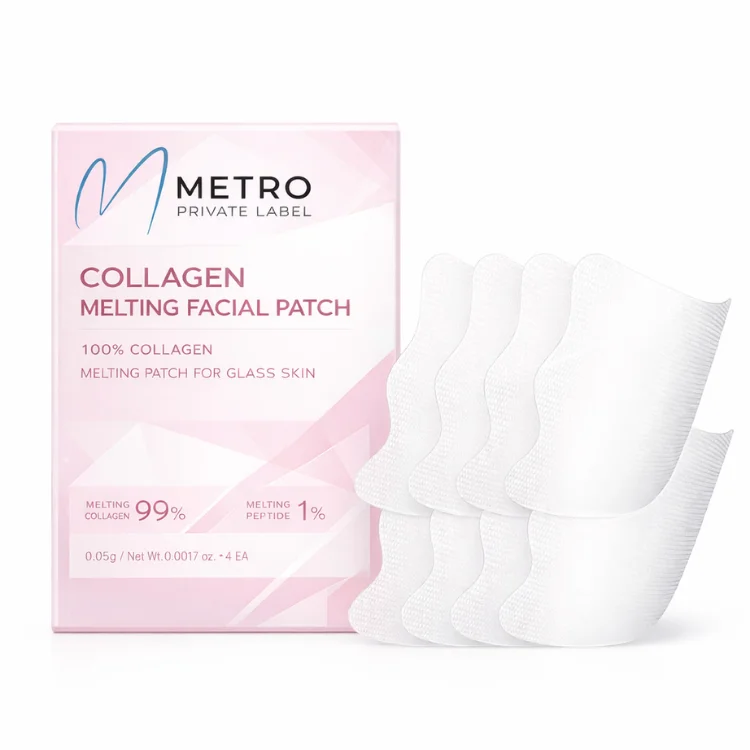
Collagen Melting Facial Patch
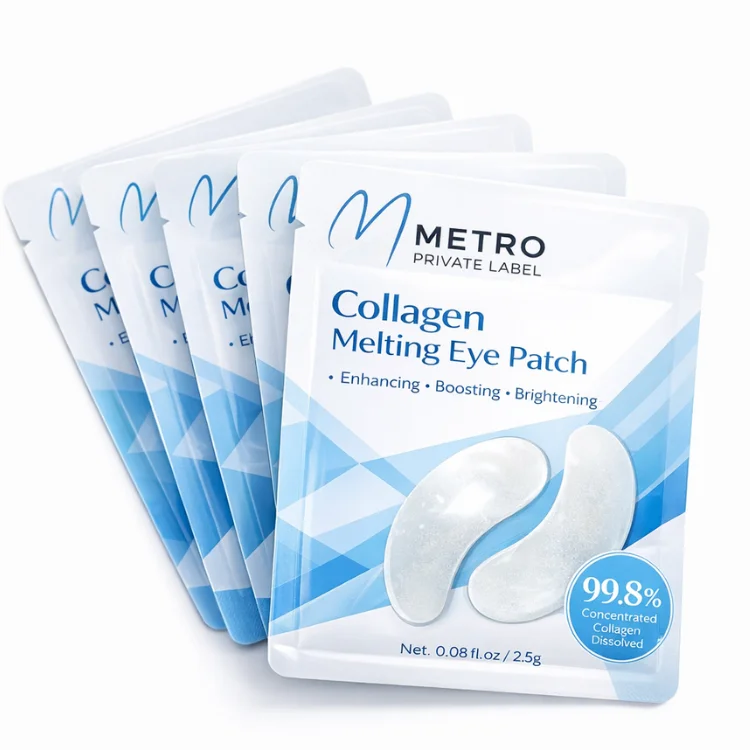
Collagen Melting Eye Patch
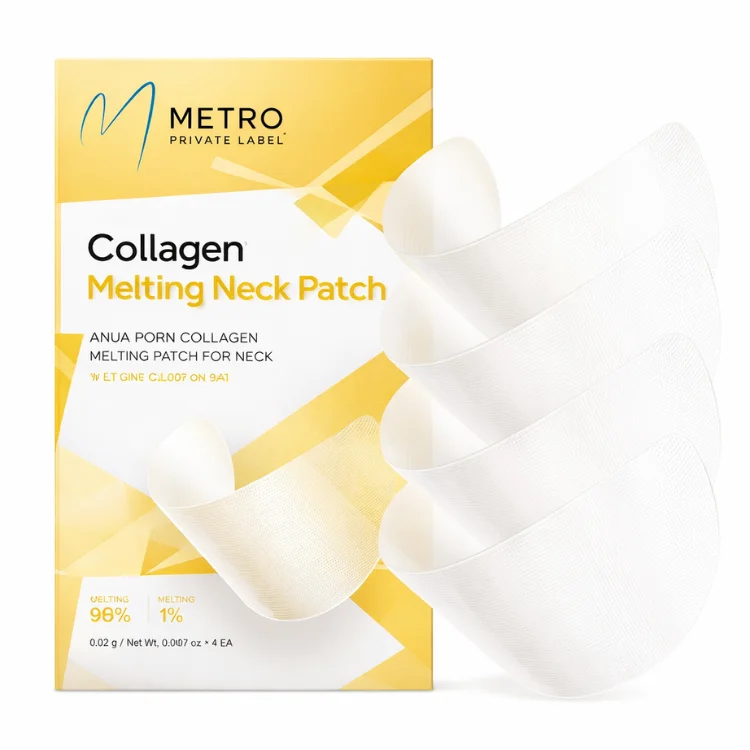
Collagen Melting Neck Patch
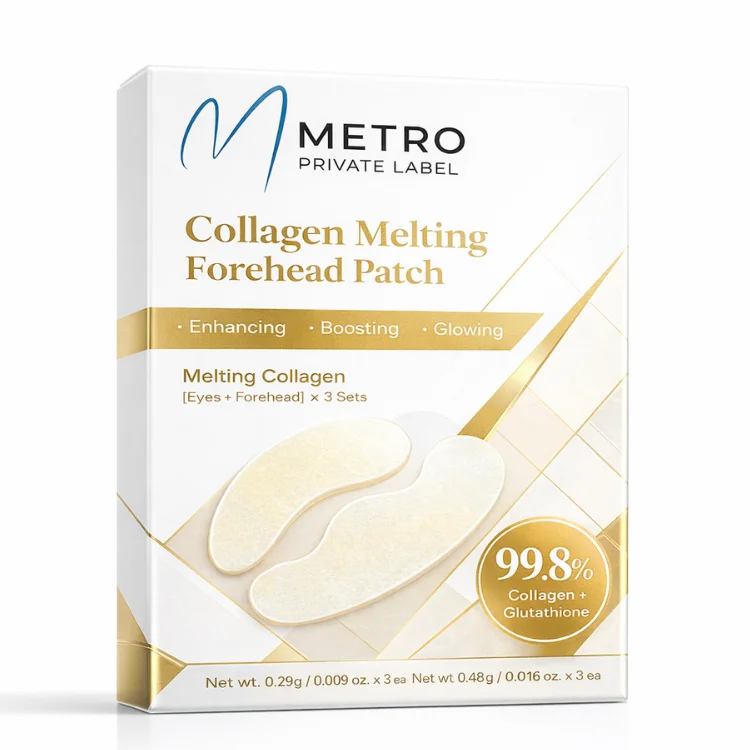
Collagen Melting Forehead Patch
Build a Private Label Collagen Melting Patch Line That Actually Sells
At Metro Private Label, we don’t see collagen melting patches as just another skincare trend. We see them as a high-concentration delivery format that only works when the product experience, usage method, and market positioning are all aligned. Because in reality, this is not a traditional mask—customers need to understand how to activate it, how it performs, and what kind of result to expect. If that part is unclear, even a good formula won’t convert.
That’s why we don’t approach collagen melting patches as a generic product. We help you define a clear direction based on how your product will actually be sold—whether it’s a “glass skin” hydration concept for TikTok, a targeted anti-aging solution for Amazon, or a clinic-grade repair product for professional use. From ingredient structure to activation method (mist + dissolve system), everything needs to match your audience and channel.
We’ve seen many brands struggle with this category—not because the idea is wrong, but because the execution is off. A patch that doesn’t dissolve properly, a formula that feels ineffective, or a usage process that confuses customers will quickly lead to mixed reviews. That’s why we guide you early—helping you align product structure, user experience, and positioning before you go into production. The goal is simple: build something that not only looks innovative, but actually performs and sells.
As your manufacturing partner, we focus on helping you build collagen melting patch products that are designed for real market environments. Whether you’re launching a hero SKU for e-commerce, creating a differentiated DTC concept, or developing a professional clinic line, we support you across formulation direction, sampling, packaging coordination, and compliance. We help you move faster, reduce trial-and-error, and launch with more confidence.
💡 Our 4 Core Private Label Collagen Melting Patch Types
1️⃣ Facial Collagen Melting Patch (Smile Lines / Cheek Area)
This is the most commercially visible format, designed for areas like nasolabial folds and cheeks. It delivers strong “instant plumping” positioning and works especially well for social media-driven brands. When paired with the right messaging, this type is highly effective for creating a hero SKU.
2️⃣ Collagen Melting Eye Patch (High-Volume Daily Use SKU)
The eye area remains one of the highest-demand categories. This format focuses on hydration, smoothing, and overnight skin recovery. It’s easier for customers to understand and adopt, making it ideal for repeat purchase models across Amazon and retail channels.
3️⃣ Collagen Melting Neck Patch (Premium Anti-Aging Segment)
Neck care is a growing category with higher perceived value. This type targets visible lines and skin laxity, allowing brands to position a more premium anti-aging product. It’s especially suitable for brands expanding beyond basic SKUs into higher-margin segments.
4️⃣ Forehead / Targeted Collagen Melting Patch (Function-Driven SKU)
Designed for expression lines such as forehead wrinkles, this type is more “result-focused” and appeals to performance-driven customers. It works well for e-commerce brands that rely on clear before-and-after positioning and targeted solutions.
🎯 MOQ & Production Strategy (Built for Real Product Launch)
We understand that this category is not about testing random ideas—it requires clear positioning and a defined go-to-market plan. That’s why our standard MOQ starts from 10,000 patches per SKU, which equals 2,000 boxes (5 patches per box).
This production level allows us to ensure:
- Stable product structure and dissolving performance
- Consistent filling and patch quality
- Reliable packaging and user experience
- Better cost control for competitive pricing
More importantly, this MOQ is designed for clients who are ready to launch and sell, not just explore. Whether you are preparing for an Amazon launch, scaling a DTC brand, or supplying a clinic or retail channel, this setup ensures your product is built for real market performance—not just small-scale testing.
Our goal is not simply to meet a minimum order. We help you build a product that is aligned with your channel, your audience, and your growth plan—so your collagen melting patch line is ready to convert, scale, and repeat.

More Than Just a Private Label Collagen Melting Patch Manufacturer
At Metro Private Label, we don’t just produce collagen melting patches—we help you build a product that customers can actually understand, use correctly, and come back to. This category only works when the experience is clear. If the patch doesn’t dissolve properly or the usage feels confusing, it quickly leads to mixed reviews. That’s why we focus on making your product simple to use, easy to communicate, and aligned with how your customers already shop and make decisions.

Built Around What Already Sells
We don’t ask you to guess what might work. We guide you toward product formats that customers already recognize—such as eye patches, smile line patches, or targeted anti-aging areas—so your product is easier to position and faster to convert. When the format is familiar, your marketing becomes clearer, your customer education becomes easier, and your chances of repeat purchase increase significantly.

Designed for Real Market Launch
We structure production around brands that are ready to sell, not just test ideas. With a starting MOQ of 10,000 patches per SKU (2,000 boxes), you’re able to launch with a stable product, consistent quality, and a cost structure that actually supports your pricing and margins. This helps you avoid the common problem of launching too small, only to face quality issues or pricing pressure later.
Consistency That Protects Your Reviews
In this category, small issues quickly become big problems. If the patch dissolves unevenly or the result feels inconsistent, customers notice immediately. We focus on making sure your product performs the same way every time—so your reviews stay stable, your return rates stay low, and your product has a better chance to scale instead of being replaced.
Support That Helps You Move Faster
We know your goal is not just to develop a product, but to launch it. That’s why we support you with the key things that usually slow brands down—ingredient documentation, label guidance, and packaging coordination—so you can move forward without unnecessary delays. Instead of figuring everything out yourself, you can focus on building your brand and getting your product into the market faster.
✨ Build a Private Label Collagen Melting Patch Line That Performs Beyond Expectations
When you work with Metro Private Label, you’re not just choosing a collagen melting patch manufacturer—you’re working with a team that understands how this product actually performs in the real market. In this category, success is not defined by how advanced the formula sounds, but by how clearly the product works for the customer. If the patch doesn’t dissolve properly, if the usage feels confusing, or if the result isn’t noticeable, customers lose trust quickly. And once that happens, it’s very difficult to recover.
Collagen melting patches are highly experience-driven. Customers notice everything—from how fast the patch dissolves, how it feels during use, to how their skin looks the next morning. If the process feels complicated, they won’t use it consistently. If the result feels unclear, they won’t repurchase. What really drives growth is a product that delivers a visible hydration and plumping effect while still being easy to use and easy to understand. That’s exactly where we focus—helping you create collagen melting patches that customers feel confident using and buying again.
Whether you’re launching a hydration-focused “glass skin” concept, a targeted anti-aging patch for expression lines, or a clinic-style repair product, we structure every project around how your customers will actually use it. Details like dissolving speed, activation method, skin feel, and packaging experience all directly impact how your product performs in the market. We help you get these right from the beginning—so your product is not just ready to launch, but ready to compete.
🧪 Formulation Built for Real Results
We don’t rely on generic structures or one-size-fits-all formulas. Every collagen melting patch we develop is built around real usage scenarios—how the patch dissolves, how the actives are released, and how the skin feels after application.
From balancing collagen content and humectants for a visible plumping effect, to ensuring the patch dissolves evenly without residue, to creating a skin finish that feels hydrated rather than sticky, we focus on what your customer actually experiences. We also consider how the formula behaves during storage, how stable it remains over time, and how consistent it performs across batches.
Our goal is simple—we help you build a product that doesn’t just sound innovative, but actually delivers results your customers can see and feel.
📦 Packaging & MOQ That Support Real Launch Conditions
We understand that collagen melting patches are not a low-commitment product. This category requires a clear positioning and a structured launch plan, which is why our standard MOQ starts from 10,000 patches per SKU (2,000 boxes with 5 patches per box).
This allows us to maintain stable patch structure, consistent dissolving performance, and reliable packaging compatibility—ensuring your product performs the same way from the first unit to the last. It also gives you a cost structure that supports real pricing strategy, rather than forcing you into low-margin positioning.
From sachet packaging to box design and labeling, we help you align your packaging with how your product will actually be sold—whether that’s e-commerce, clinic retail, or distribution—so your product arrives in the hands of your customer exactly as intended.
⚙️ A Clear and Efficient Production Process
We keep the entire process structured and easy to follow, so you always know what comes next. From initial concept and sampling to packaging confirmation and production scheduling, every step is designed to help you move forward without unnecessary delays.
This is especially important for brands working with launch timelines, seasonal demand, or fast-moving sales channels. Whether you’re preparing for a new product launch or expanding an existing line, we help you stay on track and reduce the uncertainty that often slows projects down.
🌿 Built for Brands Ready to Launch and Scale
We don’t measure success by production—we measure it by how your product performs after it reaches the market. That’s why we focus on building collagen melting patches that are stable, easy to use, and aligned with real customer expectations.
From the first sample to full production, everything is designed to support repeat purchase, positive reviews, and long-term growth. With Metro Private Label, your collagen melting patch line is not just manufactured—it’s built to launch smoothly, perform consistently, and scale with your brand.

FAQs Collagen Melting Patch
For your convenience, we’ve gathered the most commonly asked questions about our Collagen Melting Patch . However, should you have any further queries, please don’t hesitate to reach out to us.
1. What types of collagen melting patches can you manufacture?
We focus on formats that are already proven to sell in the market. This typically includes eye patches, smile line patches, forehead patches, and neck patches—each designed for a specific use area and customer need. Instead of offering random variations, we guide you toward the formats that are easier for customers to understand, adopt, and repurchase.
2. Can you customize the formula to match our brand positioning?
Yes, and this is where we add the most value. We don’t just adjust ingredients—we help you define how your product should feel and perform. Whether you want a stronger “instant hydration” effect, a smoother dissolving experience, or a more premium anti-aging positioning with peptides or PDRN, we tailor the formula to match your target customer and pricing strategy.
3. What’s your minimum order quantity (MOQ)?
Our standard MOQ starts from 10,000 patches per SKU, which equals 2,000 boxes (5 patches per box). This level allows us to maintain stable structure, consistent dissolving performance, and reliable product quality. More importantly, it helps you launch with a cost structure that actually supports real selling, not just small-scale testing.
4. How long does it take from sampling to production?
In most cases, sampling takes around 7–14 working days, followed by a short observation period. Once everything is confirmed, production typically takes 4–6 weeks depending on packaging and scheduling. We keep the process clear so you always know where things stand and what comes next.
5. How does the collagen melting patch actually work?
This is a water-activated system, not a traditional mask. After placing the patch on the skin, it needs to be activated with a mist or toner to dissolve the collagen layer and release the actives. We help you structure both the product and the usage instructions clearly, so your customers understand how to use it and what results to expect.
6. Can you support packaging and product presentation?
Yes, we help you coordinate the full packaging setup—from sachets and inner trays to outer boxes and labeling. Since this product requires a clear usage experience, we also guide you on how to present instructions and positioning, so your packaging supports both usability and conversion.
7. Do you offer ready formulas or only custom development?
We mainly focus on structured, customized development based on proven product directions. Instead of offering generic stock formulas, we guide you to build a product that fits your market, your channel, and your brand positioning—so you’re not just launching something quickly, but launching something that can actually sell.
8. How do you ensure product consistency and quality?
Consistency is critical for this category. We control factors like patch thickness, dissolving speed, and active distribution to make sure each batch performs the same way. This helps you avoid customer complaints, reduce return rates, and build a product that can generate stable reviews over time.
9. Can you help with compliance and documentation?
Yes, we support you with key documentation such as INCI lists, MSDS, and basic regulatory guidance. For brands selling in the US, EU, or other regulated markets, we help you prepare the necessary information so your product can move forward without unnecessary delays or compliance issues.
10. Do you work with international clients?
Yes, most of our clients are based in the US, Europe, and other international markets. We support you through the full process—from development and production to packaging and shipping coordination—so you can focus on launching and selling while we handle the manufacturing side.
What stood out to us was how well Metro Private Label understood the product beyond just manufacturing. They guided us on how the collagen patch should actually be used and positioned, which made a big difference when we launched. The final product felt clear to customers, and that directly reflected in our early reviews.
Emma Collins, Brand Founderfrom United Kingdom
We move fast in e-commerce, so speed and clarity matter. Metro Private Label gave us a very structured process—from sampling to packaging—so we didn’t lose time figuring things out. The product quality was consistent, and more importantly, it performed well with our customers, which is what really matters.
Jason Miller, E-commerce Directorfrom United States
We had a very specific vision for how the collagen melting patch should feel and perform. What I appreciated was that their team could translate that into a workable formula and explain the logic behind it. Communication was smooth, and the final result matched our expectations very closely.
Sophie Laurent, Product Managerfrom France
For us, reliability is everything. Metro Private Label was clear about MOQ, lead time, and what could realistically be achieved. There were no surprises during production, and the consistency between batches gave us confidence to continue scaling the product.
Liam O’Connor, Directorfrom Ireland
We were looking for a product that felt professional and easy for our clients to use at home. Metro Private Label helped us structure the product in a way that fits into our treatment routines. The feedback from our clients has been very positive, especially in terms of hydration and overall skin feel.
Isabella Rossi, Clinic Ownerfrom Italy







Metro Private Label in Numbers
Happy Clients
0 +
Million-dollar Buyers
0 +
Formulation
0 +
Professional Staffs
0 +
Your Ultimate Guide to Collagen Melting Patch
If you’re planning to introduce collagen melting patches into your product line—whether as your first targeted anti-aging SKU or as an upgrade to your existing skincare range—you’re not just adding another format. You’re stepping into a category where customer experience defines everything. Unlike traditional creams or sheet masks, collagen melting patches are judged in real time. Customers expect to see the patch dissolve evenly, feel immediate hydration, and understand exactly how the product works from the first use. When done right, this category doesn’t just generate initial interest—it builds strong repeat purchase because the experience becomes part of a routine rather than a one-time trial.
Over the past few years, we’ve seen collagen melting patches move from a niche, curiosity-driven format into a commercially viable and scalable product direction across e-commerce, DTC brands, and professional skincare channels. What we’ve learned is that success in this category rarely comes from the concept alone. It comes from how well the product is executed behind the scenes. Brands that perform well are the ones that align patch structure, dissolving behavior, packaging clarity, and pricing strategy from the very beginning. On the surface, many products in this space look similar, but in practice, small differences in activation speed, consistency, and user understanding have a direct impact on reviews, customer trust, and long-term sales performance.
This guide is built from our experience developing collagen melting patch products across different markets and customer types. Instead of focusing only on formulation theory, we want to show you how these products actually perform in real commercial environments. We’ll walk through how to choose formats that match your sales channel, how to create a user experience that customers immediately understand, how to balance performance with comfort, and how to structure your launch in a way that reduces risk while keeping scalability in mind. Because in this category, success is not about having a unique idea—it’s about building a product that customers can quickly trust, easily use, and consistently come back to.
Table of Contents
How to Choose the Right Collagen Melting Patch Format for Your Market
When I work with brands on collagen melting patch projects, I’ve found that the most important decision is rarely the formula—it’s the format. This is a category where customer understanding comes before ingredient complexity. If the format is clear, the product becomes easy to explain, easy to position, and much easier to sell. If the format is unclear, even a well-developed formula can struggle because customers don’t immediately understand how or why to use it. That’s why I always guide brands to define the format first, because it shapes everything that follows—from marketing messaging to customer expectations and ultimately conversion.
Why Format Is the First Real Decision
In my experience, most brands initially focus on actives like collagen, peptides, or PDRN, assuming that these will drive performance. But what I’ve consistently seen is that customers don’t experience ingredients first—they experience the format. The moment they see the product, they ask simple questions: where do I apply this, how do I use it, and what result should I expect? If those answers are not immediately clear, hesitation begins. That hesitation often leads to lower conversion, weaker reviews, and slower growth. When I choose the right format with a client, I’m essentially removing that friction before the product even reaches the customer.
How Each Format Signals a Different Value to the Customer
When I look at different collagen melting patch formats, I don’t see variations—I see different commercial roles. An eye patch, for example, naturally communicates hydration, refresh, and daily usability. Customers are already familiar with this format, so they adopt it quickly and are more likely to repurchase without needing much education. When I shift to smile line or nasolabial patches, the message becomes more targeted. These formats signal correction and visible improvement, attracting customers who are actively looking to address a specific concern rather than maintain general skin health. Forehead patches take this even further by positioning the product as a solution for expression lines, often appealing to a more performance-driven audience. Neck patches, on the other hand, introduce a premium layer to the product line. They are associated with long-term care and tend to attract customers who are already invested in anti-aging routines and are willing to pay for perceived effectiveness. Each format, in my view, is a different language that speaks to a different type of buyer.
How I Align Format with the Way You Sell
One of the biggest mistakes I see is choosing a format without considering how the product will actually be sold. I always start by asking where your product will live—because that determines how quickly it needs to be understood. If you are selling through e-commerce channels like Amazon or TikTok, the decision window is very short. Customers scroll quickly, and they don’t have time to learn a new concept. In these cases, I usually recommend starting with formats that are already familiar, because they reduce the need for explanation and increase the chance of immediate conversion. If your brand is more focused on storytelling or building a differentiated identity, I may guide you toward more targeted formats that allow for deeper positioning and stronger messaging. For clinic-based businesses, I look at how the product fits into an existing treatment or routine, because the format needs to feel like a natural extension of what the client is already experiencing in that environment. The format is never chosen in isolation—it is always chosen in context.
How the Right Format Simplifies Your Entire Marketing Strategy
When the format is correct, everything becomes easier. I’ve worked with brands where the product almost sells itself because the format immediately communicates its purpose. The customer doesn’t need to read long descriptions or watch multiple videos to understand how to use it. This reduces the burden on your marketing and allows you to focus on refining your message rather than explaining your product. On the other hand, when the format is misaligned, I often see brands compensating with overly complex marketing, which rarely works. Customers don’t want to figure things out—they want clarity. By choosing the right format from the beginning, I help you create a product that feels intuitive, which directly improves both conversion and customer satisfaction.
How I Think About Format in Terms of Long-Term Growth
For me, format is not just about launching a single product—it’s about building a foundation for your entire line. When I select a format with a client, I’m already thinking about what comes next. A strong initial format can naturally expand into related products, creating a more cohesive and scalable product system. For example, starting with a widely accepted format allows you to build trust quickly, and once that trust is established, you can introduce more targeted or premium variations. This creates a smoother growth path without forcing your customers to constantly relearn how to use your products. That’s why I always treat format as a strategic decision. When it’s chosen correctly, it doesn’t just make your first launch easier—it makes your entire brand easier to grow.
What Makes a Collagen Melting Patch Actually “Work”
When I evaluate a collagen melting patch, I don’t begin by asking what ingredients are inside—I begin by asking how the user will experience it from the first second of application to the moment they look at their skin afterward. In this category, I’ve seen countless products that look almost identical in packaging and claims, yet perform completely differently in real use. What I’ve learned over time is that success here is not defined by formulation complexity, but by how clearly and consistently the product delivers a result the customer can feel, understand, and trust. If that experience feels uncertain at any point, the product immediately loses its commercial strength, regardless of how well it was designed on paper.
Why Experience Always Overrides Ingredient Claims
When I work with brands, one of the first things I explain is that collagen melting patches are not judged the same way as serums or creams. Customers don’t read through the INCI list before forming an opinion—they form their judgment during use. I’ve seen formulations with excellent ingredient structures still struggle in the market simply because the experience didn’t match expectations. If the patch feels difficult to use, if the dissolving process is unclear, or if the result is not immediately noticeable, customers won’t connect the product to its ingredient value. What I focus on instead is translating formulation into a sensory experience that feels intuitive and rewarding, because that is what actually drives positive reviews and repeat purchase.
The Science and Perception of Even Dissolving
From a technical perspective, the dissolving behavior of the patch is one of the most critical performance indicators, but from a user perspective, it’s also one of the most emotional moments. I pay close attention to how the patch reacts once it comes into contact with moisture or skin temperature. If the dissolution starts unevenly, or if certain areas break down faster than others, the user begins to question whether they applied it correctly or whether the product itself is unstable. That hesitation is enough to weaken trust. In contrast, when the patch dissolves in a smooth, controlled, and uniform way, it creates a sense of precision and reliability. The user feels that the product is engineered properly, even if they don’t understand the technical details behind it. That perception alone significantly improves how the product is received.
Activation Timing and the Psychology of Control
Another detail I always refine is the activation timing of the patch. This is something many brands underestimate, but it has a direct impact on user confidence. If the patch activates too slowly, the user may feel nothing is happening and start doubting the effectiveness. If it activates too quickly without control, the experience can feel messy or unpredictable. What I aim to create is a balanced activation window where the user can clearly see and feel the transition, but still maintain control over the process. This moment of transformation is not just functional—it’s psychological. It reassures the user that the product is working exactly as intended, and that sense of control is what makes the experience feel premium rather than experimental.
Skin Feel as the Final Proof of Performance
Once the patch has fully dissolved, everything comes down to how the skin feels and looks. This is the moment where the product either confirms its value or fails to justify itself. From my experience, customers are not necessarily expecting dramatic, instant anti-aging effects, but they are expecting a clear signal that something has happened. That signal usually comes through hydration, smoothness, and a subtle plumping effect that makes the skin look more refreshed. If the skin feels tight, sticky, or unchanged, the entire experience collapses, because the user cannot connect the process they just went through with a visible benefit. I always design formulations with this final moment in mind, because this is what determines whether the customer feels satisfied enough to use the product again.
Consistency as the Foundation of Scalable Success
One of the biggest challenges in this category is not achieving good performance once, but achieving it every time. I’ve seen products that perform beautifully in initial testing but fail to maintain that same experience across batches or over time. For the customer, even a small inconsistency—such as one patch dissolving differently from another—is enough to create doubt. And once doubt appears, it quickly translates into mixed reviews. That’s why I place a strong emphasis on stability, material control, and production precision. A collagen melting patch must deliver the same dissolving behavior, the same skin feel, and the same overall experience every single time it is used. This level of consistency is what allows a product to move beyond initial sales and become a reliable, repeat-purchase item.
When a Product Truly “Works” in the Market
In my view, a collagen melting patch truly “works” when the customer never has to think about whether it works. The process feels natural, the transformation is easy to follow, and the result is clear enough to validate the experience. There is no confusion, no second-guessing, and no need for explanation. Everything aligns—from the moment the patch touches the skin to the moment the customer decides they want to use it again. That clarity is what builds trust, and trust is what turns a single product into a scalable SKU. When I develop or refine a product in this category, this is always the standard I aim for—not just performance in theory, but performance that makes sense to the person actually using it.
How E-commerce Brands Turn This Into a High-Converting SKU
When I work with e-commerce brands on collagen melting patches, I always remind them that this is not a category where complexity wins—it’s a category where clarity wins. Online, customers don’t have the time or patience to analyze multiple variations, compare ingredient lists, or interpret technical claims. They make decisions quickly, often within seconds, based on how clearly they understand what the product does and how confident they feel about the result. What I focus on is helping brands shape a product that communicates instantly, performs predictably, and fits naturally into the way people already shop and buy online. That’s what turns a product from “interesting” into something that actually converts.
Why Simple, Clear Messaging Always Outperforms Complexity
The first thing I look at is how easily the product can be explained in a single line. If I cannot summarize the benefit clearly, I know the customer won’t understand it either. In my experience, the best-performing collagen melting patches are built around very direct, outcome-driven messages such as instant hydration, overnight glow, or targeted wrinkle smoothing. These are not just marketing phrases—they are decision triggers. When a customer sees a product and immediately recognizes how it fits their need, the barrier to purchase drops significantly. I’ve seen brands try to combine too many benefits into one product, thinking it adds value, but in reality, it creates confusion. What consistently works better is narrowing the message, making it sharper, and allowing the customer to instantly say, “This is exactly what I’m looking for.”
Why I Always Recommend Starting With One Strong Hero SKU
One pattern I’ve seen repeatedly is brands launching multiple variations at the same time, hoping to increase their chances of success. From a production standpoint, that might seem efficient, but from a conversion standpoint, it often does the opposite. When customers are faced with too many options, especially in a relatively new format like collagen melting patches, they hesitate instead of deciding. That hesitation directly reduces conversion rates. This is why I always guide brands to start with one hero SKU that carries a clear identity and purpose. A single product allows you to concentrate your messaging, optimize your visuals, and gather focused feedback from the market. It also makes your advertising more efficient, because you are not splitting attention across multiple directions. Once that hero SKU proves itself, expanding into additional variations becomes a strategic move rather than a gamble.
Designing the Product for How People Actually Shop Online
When I think about product design, I don’t just think about the formula or packaging—I think about how the product will appear in a scrolling environment. Whether it’s Amazon, TikTok, or Shopify, customers are not reading—they are scanning. This means the product needs to communicate visually before it communicates verbally. Collagen melting patches have a natural advantage here because of their dissolving transformation, but that advantage only works if it is made obvious. I often advise brands to highlight the moment of dissolving and the immediate post-use skin effect, because these are the moments that capture attention. If a customer can understand what the product does just by looking at it, without needing explanation, the conversion process becomes much smoother. In my experience, the brands that win are not the ones with the most advanced formulations, but the ones that present their product in the most intuitive way.
Aligning Expectation, Experience, and Outcome
One of the most critical factors I focus on is alignment between what the product promises and what it actually delivers. In e-commerce, expectations are set very quickly, often through a single image or headline. If the experience does not match that expectation, the impact is immediate and visible in customer reviews. I’ve seen products lose momentum not because they didn’t work, but because they didn’t work in the way customers expected them to. For example, if a product is positioned as delivering instant hydration, the user needs to feel that hydration immediately after use. If it’s marketed as an overnight treatment, the result needs to be noticeable the next morning. This alignment is what protects your conversion rate over time. It ensures that customers feel their expectations were met, which directly influences whether they leave positive feedback or return for another purchase.
How I Think About Reviews Before the Product Even Launches
Before a product even goes to market, I already think about how customers will describe it in their reviews. This might sound unusual, but it’s one of the most effective ways to design for long-term success. If a customer cannot clearly explain what the product did for them, the review becomes vague and less persuasive. What I aim for is a product experience that is easy to describe, such as “it dissolved smoothly,” “my skin felt instantly hydrated,” or “I could see a difference the next morning.” These types of statements are not just feedback—they are conversion tools for future customers. When reviews are clear and consistent, they reduce uncertainty for new buyers and strengthen trust in the product. Over time, this creates a self-reinforcing cycle where good reviews drive more sales, and more sales generate more reviews.
Building a SKU That Is Ready to Scale, Not Just Launch
For me, a high-converting SKU is not defined by its first month of sales, but by its ability to sustain and grow over time. That means the product needs to be simple enough to communicate repeatedly, consistent enough to deliver the same experience every time, and flexible enough to expand into a broader product line when needed. I always encourage brands to think beyond the initial launch and consider how the product will perform after hundreds or thousands of units have been sold. Can it maintain the same quality? Can the message stay consistent across different channels? Can it support future variations without losing its core identity? When these elements are in place, the product doesn’t just convert—it becomes a stable foundation for scaling the entire brand.
Collagen Melting Patch vs Traditional Masks: What’s the Real Difference
When I introduce collagen melting patches to brands, I always pause at this point, because this is where many misunderstandings begin. On the surface, it’s easy to categorize them alongside sheet masks or hydrogel patches, but in reality, they operate on a completely different logic. Over time, I’ve seen products fail not because they lacked performance, but because customers approached them with the wrong expectations. If someone expects a wet, passive masking experience and instead encounters a dry patch that needs activation, the gap between expectation and reality creates confusion immediately. That’s why, from the very beginning, I always frame this category not as an alternative mask, but as a different system entirely—one that requires a different way of thinking, using, and communicating.
The Shift From Liquid-Based to Dry Delivery Systems
When I analyze the core difference, I always start with the delivery system, because this is where everything changes. Traditional masks are built around liquid saturation. The actives are already dissolved in a serum, and the mask simply acts as a carrier that keeps the liquid in contact with the skin. The experience is predictable, but also relatively passive. Collagen melting patches, on the other hand, are built as a dry system. The actives are structured into a solid matrix that remains stable until it meets moisture. Only at that point does the transformation begin. What I find particularly important here is that this is not just a formulation detail—it fundamentally changes how the product behaves, how it is perceived, and how it needs to be explained. If this shift is not clearly communicated, customers may interpret the product as incomplete or ineffective, simply because it does not behave like what they are used to.
Why the Application Process Feels Completely Different
When I observe users interacting with both formats, the difference in behavior is immediately obvious. With a traditional mask, the process is almost automatic. You apply it, wait, and remove it. There is very little thought involved. With a collagen melting patch, the process becomes more deliberate. The user needs to understand placement, moisture activation, and the gradual transformation that happens on the skin. This introduces a layer of interaction that can either feel premium or confusing, depending on how well it is guided. I always tell brands that this is where they have an opportunity to stand out. If the process is explained clearly, the user feels involved and engaged. If not, the same process can feel uncertain and lead to hesitation. The difference lies not in the product itself, but in how the experience is framed before the customer even opens the package.
Moisture Activation as Both a Strength and a Risk
One of the most critical aspects I always emphasize is the role of moisture. In traditional masks, hydration is built into the product from the beginning. In collagen melting patches, hydration is the trigger. This means the user becomes part of the activation process, whether consciously or not. If the skin is properly prepared or slightly damp, the patch begins to dissolve in a controlled and visible way. This creates a very satisfying experience, because the user can literally see the product working. However, if this step is misunderstood or skipped, the patch may not dissolve as expected, leading to immediate doubt. From my experience, this is one of the biggest reasons why some products in this category receive mixed feedback. It’s not that the formulation is ineffective, but that the activation step was not clearly communicated. That’s why I always treat moisture activation not just as a technical requirement, but as a key part of the product story.
The Difference in Skin Feel and Sensory Feedback
Another aspect I pay close attention to is how the skin feels after use, because this is where customers subconsciously compare the two formats. Traditional masks often leave behind a noticeable layer of serum, which can feel rich, heavy, or even slightly sticky depending on the formulation. This creates an immediate sense of “treatment,” but it doesn’t always translate to comfort or repeat use. Collagen melting patches, when designed properly, deliver a much more controlled finish. The actives are absorbed through the dissolving process, leaving the skin feeling hydrated but not overloaded. I’ve found that this creates a different kind of satisfaction—one that feels cleaner, more precise, and more aligned with modern skincare preferences. However, this also means that brands need to guide customers away from expecting a “wet mask” feeling and toward appreciating a more refined result.
How Expectation Management Directly Impacts Reviews
If there is one pattern I have seen consistently, it is that expectation management determines how the product is reviewed. When customers understand that they are using a dry, transforming system, they approach the experience with curiosity and openness. They pay attention to how it dissolves, how their skin feels, and how the result develops over time. In these cases, feedback is usually positive and descriptive. On the other hand, when customers expect a traditional mask and receive something entirely different, the same product can feel confusing or underwhelming. This often shows up in reviews as uncertainty rather than clear criticism. From my perspective, this is where many brands lose potential momentum. The product itself may be strong, but the lack of clear communication weakens its perceived performance. That’s why I always treat education as part of the product design, not something added afterward.
Why This Difference Creates a Stronger Market Position
Over time, I’ve come to see this difference not as a challenge, but as one of the strongest advantages of collagen melting patches. In a market where traditional masks are already highly saturated, offering something that behaves differently immediately creates distinction. But differentiation alone is not enough—it needs to be understood. When customers recognize that they are using a product that activates on contact, transforms visibly, and delivers actives in a more controlled way, it elevates the entire experience. It feels more advanced, more intentional, and more aligned with innovation-driven skincare trends. This perception allows brands to position their product at a higher value level, rather than competing on price or familiarity. In my experience, the brands that succeed in this category are not the ones that try to make collagen melting patches feel like traditional masks, but the ones that clearly show why they are not the same at all.
How to Position Your Product for Different Sales Channels
When I work with collagen melting patches, one of the most important realizations I’ve had over time is that the product itself is only half of the equation. The other half is where and how it is sold. I’ve seen the exact same formula generate strong sales in one channel while struggling in another, and the difference almost always comes down to positioning. Each sales environment has its own rhythm, its own expectations, and its own way of building trust. What I focus on is not changing the product, but reshaping how the product is presented so that it fits naturally into the way customers already think and make decisions in that channel. When that alignment is right, everything feels easier—from customer understanding to conversion to repeat purchase.
How I Shape Positioning for Amazon: Speed, Clarity, and Instant Trust
When I approach Amazon, I always assume the customer is in a hurry. They are comparing multiple products, scanning quickly, and making decisions based on very limited attention. In this environment, I strip the product down to its most essential promise and make sure that promise is immediately visible. I don’t try to educate too much upfront, because that creates friction. Instead, I focus on what the customer can understand in seconds—what the product does, how fast it works, and what result they can expect. With collagen melting patches, I emphasize visible transformation and immediate benefits, because these are the triggers that drive clicks and purchases. I also think carefully about how the product will look in thumbnails and short videos, because that first impression often determines whether the customer even reads further. From my experience, success on Amazon comes from reducing thinking and increasing confidence as quickly as possible.
How I Approach DTC: Building Meaning Beyond the Product
When I move into DTC, my mindset changes completely. Here, I don’t assume the customer is rushing—I assume they are curious. They are more willing to read, to understand, and to connect with the brand on a deeper level. This allows me to expand the story behind the product. I focus on explaining why collagen melting patches exist, how the dry-to-active transformation works, and what makes this format different from traditional skincare. I also spend more time connecting the product to a broader routine or lifestyle, because DTC customers are not just buying functionality—they are buying a perspective. In this channel, I’ve found that ingredient logic becomes more powerful when it is explained in context, rather than listed as features. The goal is to make the customer feel that the product was designed intentionally, not just assembled. When that feeling is established, trust grows naturally, and conversion follows.
How I Position for Clinics: Trust Is Built Through Control and Consistency
When I work with clinics or aesthetic professionals, I shift my focus toward reliability and professional credibility. In this environment, the product is not just being evaluated by the end user, but also by the practitioner who is recommending it. This changes the dynamic completely. I think about how the product fits into treatment workflows, how it can be explained during consultation, and how it performs across repeated use. What matters most here is not just visible results, but predictable results. I pay close attention to how the product can support post-treatment care or ongoing skin maintenance, because that is where clinics see long-term value. The positioning needs to feel stable, controlled, and aligned with professional standards. When a practitioner feels confident recommending a product repeatedly, it naturally becomes part of their routine offering rather than a one-time addition.
How I Think About Distributors: Making the Product Easy to Move
When I position a product for distributors or importers, I take a step back and look at the bigger picture. These buyers are not only thinking about the product—they are thinking about how easily it can be introduced, explained, and sold within their market. I focus on how adaptable the product is across different customer segments, and whether the positioning is clear enough to work without constant explanation. From my experience, distributors prefer products that have a strong, simple core message that can be translated across different channels without losing meaning. I also consider how the product fits into their existing portfolio, because that often influences their decision more than the product itself. If the product feels too complex or requires too much education, it becomes harder for them to push. What they value most is clarity, consistency, and the ability to scale without complications.
Why Misalignment Quietly Kills Conversion
One of the most important lessons I’ve learned is that poor positioning rarely fails loudly—it fails quietly. A product may still get traffic, still receive interest, but conversion remains lower than expected. In many cases, the issue is not the product itself, but the way it is presented relative to the channel. If the message is too complex for Amazon, customers skip it. If it is too shallow for DTC, customers don’t feel connected. If it lacks credibility for clinics, practitioners hesitate. This kind of misalignment is subtle, but it directly affects performance. That’s why I always treat positioning as a foundational decision rather than a final step. When the product and the channel speak the same language, the entire process—from discovery to purchase—becomes much smoother.
How I Build Positioning That Can Grow With the Brand
While each channel requires a different emphasis, I never treat them as completely separate strategies. What I aim to build is a core positioning that is strong enough to remain consistent, but flexible enough to adapt. I start with a clear, simple product identity that reflects real performance, and then adjust how that identity is expressed depending on the context. This approach allows the product to maintain coherence while still feeling tailored to each channel. As the brand expands, this becomes especially important, because it avoids the need to constantly redefine the product. In my experience, the brands that scale successfully are the ones that understand how to adapt their message without losing their core. Positioning, when done correctly, becomes not just a way to sell a product, but a structure that supports long-term growth.
What Distributors Look for in Collagen Melting Patch Products
When I work with distributors on collagen melting patch projects, I always shift my thinking away from product development and toward product movement. A distributor is not just asking whether a product is good—they are asking whether it can be introduced, understood, and sold repeatedly across different customers without friction. Over time, I’ve seen that even very well-developed products can struggle in wholesale channels simply because they are too complicated to explain or too difficult to position consistently. What distributors really value is not complexity, but efficiency. They want something that fits into their existing system, something their sales teams can confidently present, and something that creates predictable demand once it reaches the market. That’s the perspective I always build around when shaping a product for this channel.
Why Simplicity Is What Makes a Product Scalable in Distribution
When I evaluate a product from a distributor’s point of view, I immediately think about how it will be explained in real conversations. Distributors are not writing long product pages—they are speaking to buyers, retailers, and partners, often in very limited time. If a product requires too much explanation, it slows down every step of the process. I’ve seen products with strong formulations fail simply because the message could not be communicated clearly in a few sentences. That’s why I always guide brands toward simplifying the core idea. A collagen melting patch that can be positioned around one clear benefit, supported by a visible transformation, is much easier to scale across multiple accounts. In my experience, simplicity is not about reducing sophistication—it’s about making the sophistication transferable.
How Ease of Explanation Directly Impacts Sales Performance
One of the most overlooked factors I pay attention to is how easily a product can be demonstrated and understood on the spot. Distributors rely heavily on their ability to communicate value quickly, whether it’s during a meeting, a trade show, or a retail introduction. If the usage process feels intuitive and the result is easy to visualize, the product naturally gains momentum. With collagen melting patches, the dissolving process can be a strong advantage, but only if it is clearly framed. I always think about whether someone can explain the product in a way that feels natural and convincing without needing technical detail. If they can, the product becomes easier to push. If they cannot, even a strong product can become difficult to sell consistently.
Why Visible and Repeatable Results Matter More Than Claims
From a distributor’s perspective, what matters most is not what the product promises, but what it consistently delivers. I’ve learned that distributors are highly sensitive to how products perform after they enter the market, because their reputation is directly tied to what they supply. If a product creates clear, noticeable results that customers can recognize quickly, it becomes easier for them to recommend it again and again. This is especially important for something like collagen melting patches, where the experience itself plays a large role in perception. I focus on ensuring that the product delivers a result that is not only effective, but also easy for the customer to describe. When customers can articulate their experience clearly, it strengthens the entire sales chain, from retailer to distributor to end user.
The Role of Supply Stability in Building Long-Term Trust
One of the biggest lessons I’ve learned working with distributors is that consistency in supply is just as important as consistency in performance. A product that sells well but cannot be restocked reliably creates frustration at every level. Distributors need to know that once they commit to a product, they can continue supplying it without disruption. I always take this into account when structuring production and packaging decisions. It’s not just about meeting an initial order—it’s about supporting ongoing demand. When a distributor feels confident that supply will remain stable, they are much more willing to invest in pushing the product into their network.
Why Adaptability Across Markets Increases Commercial Value
Distributors rarely operate in a single, uniform market. They often work across different regions, customer types, and price segments. Because of this, I always consider how flexible the product positioning is. Can it be introduced as a quick beauty solution in retail environments while also fitting into a more premium narrative in specialty channels? Can it appeal to both first-time users and more experienced skincare customers? The more adaptable the product is, the easier it becomes for distributors to integrate it into their portfolio. I’ve found that products with a rigid or overly niche positioning tend to face more resistance, while those with a clear but flexible identity move more smoothly across different markets.
How I Design Products That Move Through Channels, Not Just Sit in Them
At the end of the day, the way I approach distributor-focused products is fundamentally different from how I approach direct-to-consumer launches. I don’t just think about how the product will look or how it will be described—I think about how it will travel. I think about how it moves from the distributor to the retailer, from the retailer to the customer, and how it continues moving through repeat orders. Every detail, from positioning to packaging to supply planning, is structured to reduce friction along that path. When all of these elements come together, the product becomes easy to adopt, easy to recommend, and easy to reorder. And in my experience, that is what ultimately defines success in distribution—not just creating a product that exists, but creating one that keeps moving.
How Clinics Can Turn This Into a Repeat-Purchase Product
When I work with clinics on collagen melting patch projects, I always begin by reframing the role of the product. In a clinical environment, products are not meant to be sold in isolation—they are meant to support outcomes. I’ve seen many clinics struggle with retail not because the products were ineffective, but because they were positioned as optional add-ons rather than as part of a structured treatment journey. What I focus on instead is helping clinics integrate collagen melting patches into what they already do best: delivering visible, progressive results. When the product becomes part of that process, it stops feeling like a sale and starts feeling like a continuation of care.
How I Identify Where the Product Naturally Fits in a Treatment Journey
The first thing I always look at is how the product aligns with existing treatments. Clinics already have established protocols, whether it’s hydration-focused facials, post-laser recovery, microneedling aftercare, or general skin maintenance programs. I don’t try to force the product into a new role—I look for where it naturally belongs. Collagen melting patches work particularly well in moments where the skin needs targeted support, especially after procedures that temporarily disrupt the skin barrier or increase sensitivity. When the product is introduced at a point where the client is already expecting to take care of their skin, the recommendation feels logical rather than promotional. This alignment is what makes adoption smoother for both the practitioner and the client.
Why Post-Treatment Moments Are the Strongest Entry Point
From my experience, the most effective time to introduce a product is immediately after a treatment, when the client is most receptive. At that moment, they are already thinking about protecting their results, maintaining hydration, and avoiding setbacks. I position collagen melting patches as a way to extend the benefits of the treatment beyond the clinic. Instead of presenting it as something new, I frame it as something that supports what has just been done. This subtle shift changes how the client perceives the product. It becomes part of their recovery and maintenance plan, not an extra purchase decision. When this connection is made clearly, the likelihood of immediate purchase increases significantly.
How I Build a Simple, Repeatable Usage Narrative
One of the key things I focus on is making sure the client understands exactly how to use the product after they leave the clinic. I’ve learned that repeat purchase is rarely driven by a single positive experience—it is driven by habit. If the usage feels complicated or unclear, clients are less likely to continue using the product consistently. I always guide clinics to present a simple and structured routine, whether it’s using the patch a certain number of times per week or incorporating it into a specific step of their skincare regimen. The goal is to make the product feel easy to continue, not something that requires effort to remember or understand. When the routine is clear, the product naturally becomes part of the client’s ongoing behavior.
The Importance of Practitioner-Led Trust and Explanation
In a clinic setting, the practitioner is not just recommending a product—they are transferring trust. I pay close attention to how comfortable and confident the practitioner feels when explaining the product. If they understand how it works, why it is being used, and what results to expect, their communication becomes more natural and convincing. I’ve seen that clients respond much more positively when the recommendation feels like professional guidance rather than a sales pitch. This is why I always ensure that the product is easy to explain, both in terms of usage and benefit. When practitioners feel confident, they recommend more consistently, and that consistency is what builds repeat purchase over time.
How Consistency in Experience Reinforces Client Confidence
Another factor I always prioritize is consistency, because in a clinical environment, expectations are higher. Clients trust that anything recommended by a clinic will perform reliably. If the experience varies—even slightly—it can create doubt. I design collagen melting patches to deliver the same dissolving behavior, the same skin feel, and the same level of hydration every time they are used. This predictability is what allows clients to build confidence in the product. When they know what to expect, they are more likely to continue using it and to repurchase without hesitation. Over time, this consistency transforms the product from something new into something familiar and dependable.
How I Turn a Single Recommendation Into a Long-Term Cycle
What I ultimately focus on is creating continuity between clinic visits. A product should not only support the immediate result, but also maintain the client’s skin condition between treatments. I position collagen melting patches as part of that bridge. They help sustain hydration, support recovery, and reinforce the results achieved in the clinic. When clients see that connection, the product becomes part of their overall skincare journey rather than a standalone item. This is where repeat purchase happens naturally. Clients are not buying the product again because they are reminded to—they are buying it because it has become part of how they care for their skin.
Why This Approach Creates Sustainable Retail Growth for Clinics
Over time, I’ve realized that the clinics that succeed in retail are not the ones that push more products, but the ones that integrate products more intelligently. When collagen melting patches are positioned as part of treatment logic, supported by clear usage, explained with confidence, and delivered with consistent results, they become easy to recommend and easy to repurchase. This creates a stable cycle where products move naturally alongside services, rather than competing with them. From my perspective, this is what turns a product into a long-term asset for a clinic—not just something that sells once, but something that continues to generate value with every client interaction.
Key Factors That Affect Customer Reviews (and How to Control Them)
When I review feedback for collagen melting patches across different markets, I’ve come to realize that most negative reviews are not actually about the product “not working”—they are about the user not feeling confident that it worked. This distinction is critical. In this category, perception is shaped moment by moment, from the first touch of the patch to the final skin feel. If any part of that journey feels unclear, inconsistent, or different from what the customer expected, it creates doubt. And once doubt appears, it almost always shows up in reviews. What I focus on is not just improving performance, but designing an experience where every step feels controlled, predictable, and easy to understand.
Why Usage Clarity Is More Important Than Most Brands Realize
One of the first patterns I noticed is that unclear usage is the single most common source of negative feedback. Collagen melting patches are not difficult to use, but they are unfamiliar to many customers, especially those who are used to sheet masks or creams. If the instructions are vague, or if the user has to guess how much moisture to apply, how long the patch should take to dissolve, or whether they are doing it correctly, uncertainty begins immediately. I’ve seen customers interpret this uncertainty as product failure, even when the formula itself is functioning as intended. That’s why I treat usage guidance as part of the product design itself. I think about how the customer will interact with the product in a real environment, not in ideal conditions. The goal is to make every step feel obvious, so the user never has to question what they are doing.
How Structural Consistency Influences Perceived Quality
From a development standpoint, I always pay close attention to the structural integrity of the patch, because this directly affects how it dissolves. Even small inconsistencies in thickness, density, or material composition can lead to uneven dissolving behavior. While these variations may be technically minor, they are highly visible to the user. If one area of the patch dissolves quickly while another remains intact, it creates the impression that the product is unstable or poorly made. I’ve learned that customers do not separate technical nuance from performance—they judge what they see. That’s why I focus on achieving a uniform structure that allows the patch to dissolve smoothly and evenly. When the dissolving process feels controlled and consistent, it reinforces the perception of quality without needing explanation.
The Hidden Impact of Activation Misunderstanding
Activation is one of the most sensitive points in the entire user experience, yet it is often underestimated. Collagen melting patches rely on moisture to begin their transformation, and if this step is not clearly understood, the entire experience can break down. I’ve seen situations where customers apply the patch to completely dry skin and expect immediate results, only to feel confused when nothing happens. In their mind, the product is not working. In reality, the activation condition was not met. This is why I always think carefully about how activation is communicated. It’s not enough to mention it briefly—it needs to be positioned as a natural and essential part of the process. When customers understand that they are triggering the transformation, the experience becomes engaging rather than confusing.
Why Expectation Setting Determines Review Tone
Another critical factor I’ve observed is how strongly expectations influence reviews. Customers rarely evaluate a product in isolation—they evaluate it against what they were told it would do. If a collagen melting patch is presented as delivering dramatic, instant transformation, but the real benefit is more subtle hydration and smoothing, the customer may feel disappointed even if the product performs correctly. I always guide brands to align their messaging with what the product can realistically deliver. When expectations are set accurately, customers are more likely to interpret the results positively. When expectations are exaggerated, even a good experience can feel like a failure. In this category, managing expectations is not about lowering them, but about making them clear and believable.
How Sensory Feedback Shapes Immediate Judgement
One of the most interesting things I’ve noticed is how quickly customers form an opinion based on sensory feedback. The way the patch feels when applied, how it responds to moisture, how it dissolves over time, and how the skin feels afterward all contribute to an immediate judgment. If any of these elements feel off—too slow, too uneven, too sticky, or too subtle—the customer begins to question the product. I always design with this in mind, focusing on creating a sequence of sensations that feel logical and satisfying. The dissolving process should feel smooth, the transition should feel noticeable, and the final skin condition should feel comfortable and improved. When these sensory cues align, the customer naturally feels that the product worked, even before they consciously analyze the result.
Why Consistency Across Units Is More Important Than Peak Performance
In my experience, one of the biggest risks is not poor performance, but inconsistent performance. A product that works perfectly once but behaves differently the next time creates uncertainty. I’ve seen this lead to mixed reviews, where some customers are very satisfied while others are confused. From a technical standpoint, this can come from small variations in production, storage conditions, or material handling. From a customer’s perspective, however, it simply feels unreliable. That’s why I prioritize consistency over peak performance. It’s better for the product to deliver a stable, predictable experience every time than to occasionally deliver a perfect result. Consistency builds trust, and trust is what drives positive reviews over time.
How Clear Communication Completes the Product Experience
At the end of the day, I’ve come to see that the product experience does not end with the formulation or the patch itself—it extends into how the product is explained and presented. Clear instructions, intuitive messaging, and aligned expectations all work together to shape how the customer interprets what they experience. When these elements are in place, the user feels guided rather than uncertain. They know what to do, they understand what is happening, and they recognize the result. This clarity transforms the entire experience, making it easier for customers to feel satisfied and confident in their purchase. In my view, controlling reviews is not about eliminating every possible issue—it is about removing confusion so that the product can be experienced exactly as intended.
How to Build a Collagen Melting Patch Product Line (Not Just One SKU)
When I guide brands through collagen melting patch development, I never look at it as a single-product decision. I look at it as the beginning of a system that will either grow in a structured, scalable way—or become fragmented and difficult to manage later. What I’ve learned over time is that most brands don’t fail because they lack ideas, but because they expand without a clear sequence. In this category, clarity and progression matter far more than volume. My role is to help brands build a product line that feels intentional to the customer, manageable for the team, and scalable over time, rather than overwhelming at the start.
Why I Always Start With One Product That Defines the Entire Line
When I begin a project, I focus heavily on selecting the first SKU, because this product will define how the entire line is perceived. I don’t just ask what product is easiest to develop—I ask what product is easiest for the customer to understand and trust. In most cases, I choose a format that feels familiar enough to reduce hesitation, but different enough to stand out, such as an under-eye collagen melting patch. This first product acts as a reference point. It teaches the customer how the format works, what kind of result to expect, and how it fits into their routine. If this first experience is clear and satisfying, it creates a foundation that makes every future product easier to introduce. If it is confusing or unfocused, the entire line becomes harder to build.
How I Define the Role of Each Future Product Before It Exists
One mistake I see often is brands adding products simply because they can, without defining what role each product plays. I approach expansion differently. Even before the second product is developed, I think about how it will relate to the first. Will it solve a different problem, or deepen the same benefit? Will it be used at a different time, or in a different area? For example, after an eye-focused product, I may look at areas like forehead lines or nasolabial folds, but I only move in that direction if it feels like a natural extension of the customer’s journey. Each product needs a reason to exist within the system. When that reason is clear, the product line feels connected. When it is not, the line starts to feel random and difficult to communicate.
Why Expansion Must Follow Customer Behavior, Not Internal Assumptions
Over time, I’ve realized that the best product lines are not built based on internal brainstorming, but based on how customers actually behave. I pay close attention to how customers use the first product, what they ask next, and where they feel limitations. If they start with an eye patch and experience hydration benefits, the next logical step may not be another eye product, but something that addresses a different concern with a similar experience. I let that behavior guide expansion, because it reflects real demand rather than assumed demand. When product development follows customer logic, each new SKU feels like a continuation rather than an introduction, which significantly reduces resistance.
How I Build a Line That Feels Cohesive Instead of Overwhelming
One of the biggest risks I always try to avoid is overwhelming the customer. In skincare, especially in newer formats like collagen melting patches, too many options can create hesitation rather than excitement. I prefer to build a line that is small but structured, where each product has a clear identity and a clear relationship to the others. This makes it easier for customers to navigate the range and understand how the products fit together. It also allows the brand to communicate more effectively, because the message remains focused. In my experience, a well-structured line of three to five products often performs better than a large, unfocused range, because it maintains clarity while still offering progression.
How I Design for Cross-Selling Without Forcing It
As the product line grows, I always think about how products can naturally lead to each other. I don’t force cross-selling through aggressive bundling or complex systems. Instead, I design the products so that using one creates a natural reason to try another. If a customer enjoys the hydration and smoothing effect of one patch, they should feel curious about how a more targeted or intensive version might enhance their results. This kind of progression feels organic, because it is based on experience rather than persuasion. When done correctly, customers expand their own usage over time, and the brand benefits from increased average order value without needing to push it artificially.
Why Timing and Restraint Are Critical in Expansion
Another lesson I’ve learned is that knowing when not to expand is just as important as knowing when to expand. I’ve seen brands introduce new products too quickly, before the first one has fully established itself. This creates internal pressure and external confusion. I always prefer to let the first product stabilize, gather feedback, and build a base of trust before moving forward. This allows each new product to launch with more clarity and stronger positioning. Expansion should feel like a natural next step, not a forced acceleration. When the timing is right, each addition strengthens the line instead of diluting it.
How I Build a System That Can Scale Without Losing Its Identity
Ultimately, I approach product line development as a long-term structure rather than a short-term opportunity. I think about how the brand will look not just at launch, but after several iterations, across different channels, and at different stages of growth. A strong system allows for expansion without losing clarity, because every new product fits into an existing framework. It also allows the brand to adapt to new trends without becoming inconsistent. In my experience, the brands that succeed are not the ones that launch the most products, but the ones that build the most coherent systems. When each product has a clear role, and each expansion feels intentional, the entire line becomes easier to understand, easier to sell, and much easier to scale.
What to Prepare Before Starting Your Private Label Project
When I begin a private label collagen melting patch project with a brand, I rarely start by asking about ingredients or packaging. Instead, I focus on understanding the direction behind the product. Over time, I’ve realized that the biggest delays in development don’t come from technical challenges—they come from unclear starting points. When the vision is vague, every decision becomes slower, more uncertain, and more expensive to adjust later. What I aim to do from the very beginning is create alignment. I want to understand how you think about your product, how you plan to sell it, and what kind of customer you want to attract. The clearer that foundation is, the more effectively I can guide you toward a product that not only works, but actually performs in the market.
Why Defining Your Target Customer Changes Every Decision I Make
The first thing I always try to clarify is who the product is really for, because this single factor influences almost everything that follows. I don’t think of “target customer” as a general demographic description—I think of it as a behavioral profile. I want to understand how your customer shops, what kind of skincare they already trust, how much time they are willing to spend using a product, and what kind of results they expect to feel or see. A collagen melting patch designed for a fast-moving e-commerce audience needs to feel immediate, intuitive, and easy to understand. The same product designed for a clinic environment needs to feel controlled, reliable, and aligned with professional care. When I have this level of clarity, I can shape the entire development process around it. Without it, the product risks becoming generic, trying to satisfy too many expectations at once without fully meeting any of them.
How Price Positioning Quietly Determines Product Structure
One of the most underestimated elements I see is price positioning. Many brands treat price as something to decide later, but from my perspective, it should be considered early, because it defines the boundaries of the product. Price is not just a number—it is a signal of value, and that signal needs to be supported by the entire experience. If you are targeting a more accessible price point, I will focus on creating a product that delivers clear, immediate results with a straightforward user experience. If you are aiming for a premium position, I will think more about refinement, sensory experience, and how the product feels at every touchpoint. I also consider how the packaging, formulation complexity, and overall presentation align with that price. When price positioning is unclear, it often leads to mismatches, where the product feels too simple for its cost or too complex for its market. Defining this early allows me to keep every decision aligned.
Why Your Sales Channel Is More Important Than Most Brands Expect
Another key factor I always explore is where you plan to sell the product, because each channel has its own logic. I don’t treat Amazon, DTC, clinics, and distribution as interchangeable environments. I see them as completely different ecosystems, each with its own expectations and decision-making patterns. If you tell me your primary channel is Amazon, I immediately think about speed of understanding, visual clarity, and conversion-driven messaging. If your focus is DTC, I start thinking about storytelling, brand narrative, and how the product fits into a lifestyle. If you are targeting clinics, I consider how the product integrates into treatments and how it will be explained by professionals. This early clarity allows me to design not just the product, but the way the product will be experienced and perceived in that specific environment.
How I Use Your Initial Direction to Accelerate Development
Many brands believe they need to have everything fully planned before starting, but that’s not what I’m looking for. What I need is direction, not perfection. Even a rough outline of your target customer, price range, and sales channel gives me enough to start making structured recommendations. I use that information to narrow down options quickly, suggest suitable product formats, and avoid unnecessary trial-and-error. Without this direction, the process becomes exploratory in a way that slows progress. With it, the process becomes focused. I can guide you toward decisions that are not only technically sound, but commercially relevant. This is what allows us to move faster without sacrificing quality.
Why Preparation Reduces Risk More Than It Delays Progress
One of the biggest misconceptions I encounter is that spending time on preparation will delay the project. In reality, I see the opposite happen. When a project starts without a clear foundation, it often requires multiple revisions, adjustments, and rethinking later in the process. This not only increases cost, but also extends timelines significantly. When the starting point is clear, the path forward becomes much more direct. Decisions are made with confidence, and the likelihood of major changes later is reduced. From my experience, preparation is not about slowing down—it’s about avoiding unnecessary detours.
What I Actually Look for Before Moving Into Development
Before I move into formulation or sampling, I look for a few key signals that tell me the project is ready to progress. I want to see that there is a defined customer in mind, a general understanding of where the product will sit in the market, and a clear idea of how it will be sold. I don’t expect detailed specifications or finalized concepts. What I look for is alignment. When I see that the brand has a direction, I can step in and help refine it, challenge it where needed, and strengthen it with practical recommendations. This is where collaboration becomes most effective, because we are building on a shared understanding rather than starting from uncertainty.
How a Clear Start Leads to a Product That Is Ready to Sell
In the end, the goal is not just to create a product—it’s to create a product that is ready to enter the market with confidence. I always think about how the decisions made at the beginning will affect the product at launch. When the foundation is clear, the product feels cohesive, the messaging feels natural, and the entire process flows more smoothly. The result is not just a finished product, but a product that fits your brand, your channel, and your customer from day one. From my perspective, that is what preparation is really about. It’s not about having all the answers—it’s about starting with enough clarity to build something that works.
Why Partner with Metro Private Label for Your Collagen Melting Patch Line?
When we work with brands entering the collagen melting patch category, we always begin by reframing what this product really represents. This is not just another skincare SKU that sits alongside creams and serums. It is a format-driven experience product, where the way it dissolves, activates, and feels on the skin directly determines whether customers trust it or reject it. That’s why we don’t approach this as simple manufacturing. We approach it as building a product system that is designed to perform in real market conditions. From the very beginning, we look at how formulation behavior, patch structure, packaging, positioning, and user experience come together. When these elements are aligned, the result is not just a product launch, but a product that converts, earns reviews, and drives repeat purchase.
Why We Always Start From the Market, Not Just the Patch Itself
One of the biggest differences in how we work is where we begin. We don’t start by asking what ingredients you want inside the patch. We start by understanding where and how you plan to sell it. Over time, we’ve seen many technically sound products fail simply because they didn’t match how customers actually experience and evaluate them.
When we work with you, we look closely at your primary sales channel. If your focus is Amazon, we guide the product toward clarity, fast understanding, and visible results that customers can immediately recognize. If you are building a DTC brand, we think more about storytelling, ingredient logic, and how the product fits into a broader skincare routine. If your target is clinics or professional channels, we prioritize consistency, safety, and repeat-use scenarios. By starting from the market instead of the formula, we help you build a product that is easier to position, easier to explain, and much easier to convert once it reaches your customer.
How We Turn a Concept Into a Product That Customers Actually Feel
Many brands come to us with a strong idea, but turning that idea into a working product in this category requires a different level of precision. Collagen melting patches are not judged by ingredient lists alone. They are judged by how they behave in the moment of use.
What we focus on is the real experience. We look at how evenly the patch dissolves when it touches the skin, how quickly it activates with moisture, and whether the skin feels immediately hydrated and comfortable afterward. If the dissolving process feels inconsistent or unclear, customers lose confidence instantly, and that shows up in reviews. We refine the structure so that the experience is predictable, smooth, and easy to understand. This is what turns a product from something people try once into something they trust and repurchase.
Why We Build Every Project for Speed, Clarity, and Scalable Growth
From our experience, most delays in product development are not caused by technical limitations, but by lack of structure. When decisions are made without a clear sequence, projects slow down and become harder to manage. That’s why we always create a structured path from the beginning.
We define each stage clearly, from sample development and performance testing to packaging alignment and production planning. Every step is connected so that progress feels continuous rather than fragmented. At the same time, we are not only thinking about your first order. We design the process in a way that supports repeat production, maintains consistency, and allows you to scale without friction. This means you are not just launching a product, but building a system that can grow with your brand.
How We Align Patch Structure, Packaging, and Positioning Into One Experience
One of the most common issues we see in this category is misalignment. A patch may be technically well-developed, but the packaging doesn’t communicate how to use it. Or the positioning promises instant results, but the experience feels slow or unclear. Customers notice this immediately.
What we do differently is develop everything together. We look at how the patch dissolving behavior connects with the way it is presented, how the packaging supports user understanding, and how the overall experience matches your price positioning. This is not just about making the product look good. It is about making the product feel logical and trustworthy from the first impression to the final use. When everything is aligned, customers feel more confident, and that confidence translates directly into better reviews and stronger repeat purchase.
Why We Integrate Compliance Early to Avoid Costly Delays
In many projects, compliance is treated as something to deal with later, but this often creates unnecessary delays and adjustments. We approach it differently by building compliance into the process from the very beginning.
We consider your target market early, whether it is the US, EU, or other regions, and guide ingredient selection, documentation, and labeling accordingly. This allows us to avoid last-minute changes and ensures that when your product is ready for production, it is also ready for the market. For you, this means fewer surprises, smoother timelines, and a more predictable launch process.
How We Help You Start Lean Without Limiting Your Future Growth
We understand that many brands want to test this category before committing heavily, especially if this is a new product format for them. We always support a lean starting approach, but we make sure it is structured in a way that allows for future expansion.
We guide you to start with a focused SKU, often a high-conversion format like an eye patch or a targeted wrinkle patch, rather than launching too many variations at once. We help you select packaging and production options that keep initial investment controlled while still maintaining a strong market presence. At the same time, we make sure that what you build can scale easily once the product proves itself. This balance between flexibility and structure is what allows brands to grow confidently.
Why We Focus on Long-Term Collaboration, Not Just One Production Run
For us, a successful partnership is not defined by a single order. It is defined by how your product performs and evolves over time. We see every project as the starting point of a longer journey.
As your brand grows, you may want to expand your product line, refine your formulation based on customer feedback, or enter new markets. We stay involved in that process, helping you adjust and optimize without losing consistency. This continuity allows you to move faster and with more confidence, because you are building on an existing system rather than starting over each time.
How We Help You Build a Product System That Performs in the Real Market
At the end of the day, what we help you create is not just a collagen melting patch. It is a complete product system designed for real-world performance. Every decision we make, from how the patch dissolves to how it is positioned and packaged, is made with your customer and your market in mind.
We’ve seen how a well-structured approach can turn a single SKU into a scalable product line that customers trust and return to. When everything is connected, your product becomes easier to sell, easier to expand, and more resilient in a competitive market. That is what we focus on when we partner with you. Not just helping you launch, but helping you build something that can truly grow.
Ready to Launch Your Skincare Line?
*Metro Private Label takes your privacy very seriously. All information is only used for technical and commercial communication and will not be disclosed to third parties.